
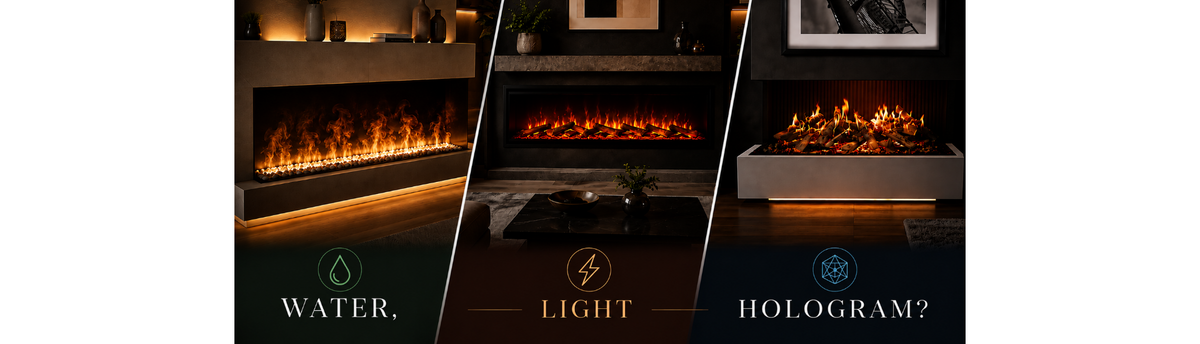

A modern fireplace is no longer defined by a single technology. Today, a fireplace can create the visual experience of fire through water vapour and light, LED illumination, digital or holographic effects, or an actual flame produced by bioethanol, gas or wood.
That distinction matters when a fireplace becomes part of a prominent interior feature. A fireplace below a TV, for example, has very different design and practical requirements from a freestanding fire used to create atmosphere on a terrace. The same is true of a bedroom, dining room, home theatre or hospitality lounge.
The question is therefore not simply which fireplace technology is newest. It is which technology creates the right fire experience for the room, the climate, the architecture and the way the space will actually be used.
In This Article
- Understanding the New Fireplace Technologies
- Water Vapour: Creating Fire Through Mist and Light
- LED and Electric Fireplaces: Fire Created Through Light
- Digital and Holographic Fire: When Fire Becomes an Optical Experience
- Real Flame: Bioethanol, Gas and Wood
- Water Vapour, LED, Digital or Real Flame?
- Which Technology Creates the Most Convincing Fire?
- Why Technology Matters on a TV Feature Wall
- Heat, Climate and the Indian Interior
- Installation, Maintenance and Everyday Use
- Navin Kanodia's Expert View
- How Does Vastu Fit Into Fireplace Technology?
- Fireplace in Mumbai: Choosing Fire for a Warm Climate
- Fireplace in Bangalore: Balancing Ambience and Seasonal Comfort
- Fireplace in Amritsar: Technology for Colder Interiors
- Fireplace in Anand: Matching Fire to the Interior
- Fireplace in Ankleshwar: Modern Fire for Contemporary Spaces
- Fireplace in Aurangabad: Technology, Architecture and Ambience
- Fireplace in Bareilly: Choosing Between Heat and Atmosphere
- Fireplace in Belgaum: Creating a Refined Fire Feature
- Fireplace in Bharuch: A Contemporary Approach to Fire Design
- Fireplace in Bhopal: Designing Fire Around the Room
- How to Choose the Right Fireplace Technology
- Frequently Asked Questions
Understanding the New Fireplace Technologies
The modern fireplace sits somewhere between architecture, technology and interior styling. Traditional fireplaces rely on combustion to produce both flame and heat, while newer systems can separate the visual experience of fire from combustion altogether.
A no-heat fireplace is a fireplace system designed primarily to create the visual and atmospheric experience of fire without using combustion as a source of room heat. This distinction is particularly relevant when selecting a fireplace for warm Indian climates, bedrooms, media rooms or feature walls where ambience is desired without additional heating.
This has opened up possibilities that were difficult to achieve with conventional fireplaces. A designer can create a long linear fire below a television without necessarily introducing a traditional chimney-based installation. A warm-climate home can introduce the visual character of fire without wanting additional room heat. A hotel or restaurant can use a controlled fire effect as part of its identity without treating the fireplace as a conventional heating appliance.
Understanding the difference between these technologies is therefore the first step towards making a sensible design decision.
For the broader selection framework, Spacio's complete guide to luxury fireplaces in India looks at the wider questions involved in choosing a fireplace for an Indian interior. This article focuses more specifically on what changes when the fire itself is produced through different technologies.
Water Vapour: Creating Fire Through Mist and Light
Water-vapour fireplaces create the appearance of fire without burning a fuel. Fine water vapour is illuminated to produce a flame-like visual effect, allowing the fireplace to create movement, glow and depth without functioning as a conventional combustion-based fire.
The biggest design advantage is the separation between the visual experience and heat. Where the intention is to create ambience rather than warm the room, a water-vapour fireplace can be particularly useful. This makes the technology relevant to warm Indian cities, apartments, bedrooms, hospitality interiors and feature walls where additional heat may not be desirable.
Water vapour also offers interesting possibilities for realism. The interaction between vapour, illumination and the surrounding media can create movement that feels more dimensional than a static illuminated image. The result still needs to be evaluated from the actual viewing positions in the room, particularly when the fireplace is being installed below a large television.
Spacio's indoor artificial water-vapour fireplaces provide examples of this approach, where the fire experience is created through water vapour and light rather than conventional combustion.
LED and Electric Fireplaces: Fire Created Through Light
LED and electric fireplaces use illumination and controlled visual effects to reproduce the appearance of flames. Depending on the system, the visual flame and heating function can be treated as separate experiences, allowing the fireplace to be used primarily for ambience when heat is unnecessary.
This makes electric technology particularly adaptable to contemporary interiors. A fireplace can be incorporated into cabinetry, a feature wall or a media composition without the visual language of the room having to revolve around a traditional chimney or hearth.
For a linear fireplace below a TV, the predictability of a controlled visual effect can also be useful. The designer can consider the brightness, scale and visual movement of the fire in relation to the television rather than treating the fireplace and screen as unrelated objects.
Spacio's indoor artificial LED fireplaces represent this category, where illumination and controlled flame effects become part of the overall interior composition.
Digital and Holographic Fire: When Fire Becomes an Optical Experience
Digital and holographic fireplaces take the idea of artificial fire further by treating the flame as a digital or optical experience. Instead of producing a physical flame, the system recreates the visual character of fire through projected or digitally generated effects.
This approach can be particularly interesting in interiors where the fireplace is part of a broader entertainment or media environment. A fireplace in a home theatre, for example, may need to work alongside screens, sound, lighting and other technology rather than behave like a conventional hearth.
The same consideration applies to a fireplace below a projector screen or a fireplace integrated into a large media wall. The visual character of the fire needs to complement the primary screen rather than compete with it.
Spacio's holographic fireplace collection explores this digitally driven interpretation of fire, demonstrating how the fireplace can become part of a contemporary technology-led interior.
Real Flame: Bioethanol, Gas and Wood
Real-flame fireplaces take a fundamentally different approach because the flame itself is produced through combustion. Bioethanol, gas and wood-burning fireplaces each create genuine fire, with natural variation in flame movement and, depending on the system, the potential to contribute meaningful heat to the room.
Indoor bioethanol fireplaces can provide a genuine flame without relying on the same fuel infrastructure as a conventional gas fireplace. Their visible flame can be particularly appealing when the fire itself is intended to be a central visual element.
Indoor gas fireplaces bring another form of real flame to architectural interiors. They can be incorporated into substantial built-in installations and can also be relevant where heat is an important part of the brief.
Wood-burning fireplaces offer perhaps the most traditional interpretation of fire, with logs, embers, smoke and the natural irregularity associated with burning wood. They also introduce the greatest number of practical considerations around installation, fuel, ventilation, cleaning and ongoing use.
The important point is that a real flame should not simply be compared with an artificial flame as “better” or “more realistic”. It creates a fundamentally different experience, and the practical requirements of that experience need to suit the room.
Water Vapour, LED, Digital or Real Flame?
There is no single fireplace technology that is right for every interior. The useful comparison is between what each technology contributes to the overall experience.
| Technology | How the fire is created | Real Flame | Heat | Design Flexibility | Best Considered For |
|---|---|---|---|---|---|
| Water vapour | Water vapour illuminated to create a flame-like effect | No | No | High | No-heat ambience, feature walls, warm climates and contemporary interiors |
| LED / electric | Light-based flame effects | No | Depends on the system | High | Living rooms, media walls, bedrooms and adaptable interiors |
| Digital / holographic | Digital or optical visual effects | No | Depends on the system | High | Media spaces, home theatres and technology-led interiors |
| Bioethanol | Burning bioethanol | Yes | Yes | Subject to installation requirements | Interiors where genuine flame is central to the experience |
| Gas | Gas combustion | Yes | Yes | More installation-dependent | Architectural fireplaces and spaces where heat is relevant |
| Wood | Burning wood | Yes | Yes | Most installation-dependent | Traditional real-fire environments and suitable architectural settings |
The table is a starting point rather than a substitute for specification. The exact heat output, installation requirements, controls, maintenance and safety provisions vary between individual fireplace systems, so the manufacturer's technical requirements always need to be considered before installation.
Which Technology Creates the Most Convincing Fire?
Realism is more complicated than simply asking whether the fire is real. An actual flame naturally varies in movement, height and intensity, but an artificial fireplace can also create a highly convincing visual experience when its movement, depth, colour, media and illumination are carefully designed.
This is why a fireplace that looks impressive in a showroom or product photograph may behave differently once it is installed in a room. Viewing distance, surrounding light, reflective surfaces and the scale of the installation all influence how the fire is perceived.
Spacio's article on what makes an artificial fireplace look real explores this visual question in greater depth, including flame movement, depth, colour, fire media, glow, reflection and viewing distance.
“The right fireplace technology should be selected by looking at the experience you want to create, not simply by asking which technology is newest. I look at the flame itself, the amount of heat required, how the fireplace will sit within the architecture, how it will interact with a television or other focal point, and how the system will be used throughout the year. In many Indian interiors, the most successful fireplace is the one that delivers the right atmosphere without compromising the way the room needs to function.”
Why Technology Matters on a TV Feature Wall
A fireplace around a television is one of the most demanding applications for any fire technology because two strong visual elements have to coexist. The screen is usually the dominant source of attention when it is in use, while the fireplace becomes more important when the television is switched off.
A fireplace below a TV therefore needs to be evaluated at the actual viewing distance. A flame that looks subtle and sophisticated close up may appear too weak when seen from the other side of a large living room. Conversely, a highly illuminated effect can become distracting when the television is being watched.
The same principle applies when a fireplace is integrated into a TV feature wall. The width of the fire, the height of the television, the material surrounding both elements and the level of illumination in the room all contribute to the final composition.
A fireplace beside a TV can provide more separation between the two focal elements, while a fireplace around a TV can create a stronger architectural composition. In a media room or home theatre, the fire may need to remain visually restrained so that it does not interfere with the primary screen experience.
Technology therefore becomes a design decision. A no-heat artificial system may be appropriate where the objective is visual ambience around electronics, while a real-flame installation introduces additional considerations around heat, materials, clearances and the technical design of the wall.
Heat, Climate and the Indian Interior
India's varied climate makes the distinction between flame and heat particularly important. A homeowner in a warm coastal city may want the atmosphere of a fire without turning the fireplace into a heating source. A residence in a colder part of the country may place greater value on genuine heat alongside the visual experience.
This is one reason artificial fireplace technologies have become relevant to contemporary Indian interiors. They allow the designer to consider the visual and emotional qualities traditionally associated with fire without automatically treating heating as the primary purpose of the installation.
In a bedroom, dining room or living room, the desired experience may be seasonal or purely atmospheric. In other projects, such as a larger villa, hospitality space or suitably designed winter-oriented interior, heat may be a more significant part of the brief.
Installation, Maintenance and Everyday Use
The technology also changes what happens before and after the fireplace is installed. Water-vapour systems require attention to their water and vapour-producing components. LED and digital systems generally centre more strongly on their electronic and visual components. Real-flame systems introduce fuel, combustion, ventilation and safety considerations that cannot be treated as afterthoughts.
Installation should therefore be considered alongside the architecture rather than after the interior design has already been completed. This is particularly important for a built-in fireplace, a large feature wall or a linear fireplace below a TV, where the fireplace, television, cabinetry, stone, electrical systems and other services may all need to work together.
Maintenance is equally important. A fireplace that looks beautiful but is inconvenient to use, difficult to clean or poorly suited to the way a room is occupied will not deliver the same long-term value as a system that fits naturally into everyday life.
“Fireplace technology should be understood in terms of the experience it creates. Water vapour, LED, digital effects and real-flame systems do not simply produce different types of fire; they create different relationships between flame, heat, architecture and everyday use. When I evaluate a fireplace for an interior, I look at how convincing the fire appears, whether heat is actually required, how the technology fits the architecture, and how the fireplace will behave in relation to the room's other focal points. The right technology is the one that supports the intended experience rather than forcing the interior to adapt to the technology.”
How Does Vastu Fit Into Fireplace Technology?
For homeowners who consider Vastu when planning a fireplace, the technology and the placement are two related but separate questions. Whether the fire is created by water vapour and light, electricity, digital effects or combustion, the installation still becomes part of the room's overall spatial composition.
Vastu considerations are therefore best addressed alongside the proposed location, room layout and architectural design rather than treating the technology itself as the only deciding factor. For a more detailed discussion, see Spacio's guide to Vastu corrections with a fireplace in India.
Fireplace in Mumbai: Choosing Fire for a Warm Climate
For a fireplace in Mumbai, the visual experience of fire can be more important than its heating function. The city's warm climate makes no-heat and controllable fireplace technologies particularly interesting for contemporary apartments, luxury residences and entertainment spaces.
A water-vapour or suitable electric fireplace can create the glow and movement associated with fire without making the room unnecessarily warm. This can be especially effective when the fireplace forms part of a living-room TV wall, where the aim is to create a sophisticated focal point that works both when the television is on and when it becomes the primary feature after dark.
For homeowners who are unsure whether water vapour, electric, digital or real flame will create the right visual effect, seeing different fireplace technologies in person can be more informative than comparing photographs alone. Spacio's Mumbai store provides an opportunity to explore fireplace options and discuss the requirements of the space with the team.
For homeowners considering different technologies, experiencing the difference between artificial and real flame in person can also help clarify whether the priority is ambience, heat or both.
Fireplace in Bangalore: Balancing Ambience and Seasonal Comfort
A fireplace in Bangalore can serve both an atmospheric and seasonal role. The city's varied temperatures mean that the desired relationship between fire and heat can change depending on the room and time of year.
Technology becomes particularly relevant in a living room or TV feature wall where the fireplace may be used primarily as an evening design element. An artificial system can provide visual fire without making heating the central purpose, while a real-flame option can be considered where genuine flame and warmth are part of the intended experience.
Fireplace in Amritsar: Technology for Colder Interiors
When considering a fireplace in Amritsar, the question of heat can carry more weight than it does in warmer Indian cities. Real-flame technologies may therefore be relevant where the fireplace is expected to contribute to the room's thermal comfort as well as its visual character.
At the same time, artificial technologies remain useful where the priority is controlled ambience. The choice should reflect whether the fireplace is primarily intended for warmth, atmosphere or a combination of both.
Fireplace in Anand: Matching Fire to the Interior
A fireplace in Anand can be approached as an interior-design feature as much as a source of warmth. The technology should be selected according to the architecture, room size, desired visual effect and the way the space will be occupied.
For a contemporary living room, an artificial or electric fireplace can become part of a clean feature wall, while a real-flame system may suit a project where the natural variation of fire is central to the design.
Fireplace in Ankleshwar: Modern Fire for Contemporary Spaces
For a fireplace in Ankleshwar, technology can help determine how easily fire integrates into a contemporary interior. A built-in artificial fireplace can work within a streamlined architectural wall, while a real-flame installation may require a more detailed approach to fuel, ventilation and safety.
Where the fireplace is positioned below a TV or within an entertainment wall, the visual intensity of the fire should also be considered in relation to the screen and the distance from which the composition will be viewed.
Fireplace in Aurangabad: Technology, Architecture and Ambience
A fireplace in Aurangabad can take many forms, from a compact artificial installation to a substantial architectural fire feature. The right technology depends on whether the room requires heat, visual ambience or a balance between the two.
For larger living rooms and feature walls, proportion becomes particularly important. The fireplace should be considered together with the television, cabinetry, wall finishes and lighting so that the technology supports the architecture rather than appearing as a separate object.
Fireplace in Bareilly: Choosing Between Heat and Atmosphere
When choosing a fireplace in Bareilly, the distinction between heat and atmosphere can help narrow the technology choice. A real-flame fireplace can provide both, while an artificial fireplace may be more appropriate when the visual experience is the primary objective.
The same distinction becomes useful when planning a TV wall. A controlled artificial fire can create a strong evening focal point while allowing the television to remain visually dominant when it is being used.
Fireplace in Belgaum: Creating a Refined Fire Feature
A fireplace in Belgaum can be designed as an architectural feature rather than simply a heating installation. Linear formats, built-in systems and carefully integrated artificial fire effects can work particularly well where the fireplace forms part of a contemporary living-room composition.
The choice of technology should still begin with the intended experience. If genuine flame is essential, real-flame systems need to be evaluated for their installation requirements. If ambience and flexibility are the priority, artificial technologies offer another route.
Fireplace in Bharuch: A Contemporary Approach to Fire Design
For a fireplace in Bharuch, the technology can be selected according to the role fire is expected to play within the interior. A no-heat artificial system may suit a decorative installation, while a real flame may be more appropriate when the fireplace is intended to provide both visual presence and warmth.
When the fireplace is placed below or beside a television, the scale and brightness of the fire should also be considered carefully. The best result is one in which both elements retain their intended role within the room.
Fireplace in Bhopal: Designing Fire Around the Room
A fireplace in Bhopal should be considered as part of the complete interior rather than as an isolated product. Technology, room scale, wall proportions, furniture orientation and the intended amount of heat all influence the final choice.
In a living room, a fireplace can become the architectural anchor of a TV feature wall. In a dining room, bedroom or entertaining space, it can instead provide a quieter layer of atmosphere. The technology should follow that intended role.
How to Choose the Right Fireplace Technology
The best way to choose between water vapour, LED, digital, bioethanol, gas and wood is to start with the experience rather than the product. Ask what you actually want the fireplace to do within the room.
- Do you want heat? If yes, real-flame or heating-capable systems may need greater consideration.
- Do you mainly want ambience? A no-heat artificial system may be more appropriate.
- Is the fireplace below a TV? Consider viewing distance, brightness, heat and the relationship between fire and screen.
- Is the fireplace part of a large feature wall? Consider width, proportion, surrounding materials and installation requirements.
- Is the room already warm? A technology that separates fire appearance from heat may make more sense.
- Do you want genuine flame? Real-flame systems create a different sensory experience but require appropriate technical planning.
- How much maintenance are you comfortable with? Different technologies have different requirements for cleaning, water, fuel, servicing or electronic components.
- How will the fireplace be used throughout the year? A system that works beautifully as an evening ambience feature may need different characteristics from one intended to heat the room during colder periods.
The most successful fireplace is rarely the one chosen solely because its technology sounds impressive. It is the one whose flame, heat, installation requirements, scale and controls make sense for the architecture and the people using the room.
Water vapour can create fire without combustion. LED and electric systems can provide controlled illuminated flame effects. Digital and holographic systems can turn fire into an optical experience. Bioethanol, gas and wood bring genuine flame and, where appropriate, heat. The right choice depends on the room, climate, architecture, viewing distance and the experience you want to create.
Frequently Asked Questions
What is the difference between a water-vapour and electric fireplace?
A water-vapour fireplace creates its flame-like effect using illuminated water vapour, while an electric fireplace generally uses light-based visual effects to reproduce the appearance of flames. Both can be used to create ambience without relying on a traditional wood-burning fire, but the visual character and technical operation differ between systems.
Which fireplace technology is best for a warm Indian home?
There is no single answer for every home, but no-heat technologies can be particularly relevant where the homeowner wants the visual character of fire without adding unnecessary warmth. Water-vapour and suitable artificial fireplace systems can therefore be considered for warm interiors, subject to the specific product and installation requirements.
Can an artificial fireplace be installed below a TV?
Yes, an artificial fireplace can form part of a TV feature wall, but the exact installation requirements depend on the fireplace and television. Heat output, clearances, ventilation requirements, wall construction and the manufacturer's installation instructions should all be considered before installation.
Is a fireplace below a TV better with real flame or artificial fire?
That depends on the intended experience. A real-flame fireplace provides genuine flame and can also provide heat, while an artificial fireplace can offer a more controlled visual experience and may be preferable where heat is not required. For a TV wall, both the fire's visual intensity and any heat produced by the system need to be considered.
Can a holographic fireplace be used in a home theatre?
A digital or holographic fireplace can be particularly interesting in a home theatre or media room because the fire experience itself is created digitally or optically rather than through combustion. The design should still consider screen position, viewing angles, brightness and the role the fire is intended to play when the main screen is in use.
Can I have a no-heat fireplace that still looks realistic?
Yes. Water-vapour, LED and digital fireplace technologies can create visual fire experiences without functioning as conventional heat-producing fireplaces. How realistic the result appears depends on factors such as movement, depth, colour, media, illumination and viewing distance.
Where can I see and experience different fireplace technologies in Mumbai?
If you want to compare different fireplace experiences in person, Spacio's Mumbai store provides an opportunity to explore fireplace options and discuss the differences between technologies with the team. Visit the Spacio Mumbai store at 3BK, Laxmi Industrial Estate, New Link Road, Andheri (West), Mumbai - 400 053.
Where can I explore fireplace technologies in Kolkata?
Spacio's Kolkata store allows customers to explore fireplace possibilities in person and discuss which technology may suit their interior. The store is located at 86B, Topsia Road South, Kolkata - 700 046. You can find more information on the Spacio Kolkata store page and Google Maps before planning your visit. This can be particularly useful if you are comparing artificial and real-flame fireplaces or considering a fireplace for a TV feature wall, because the visual scale and flame effect are easier to assess in person.
Explore the Right Fireplace for Your Interior
Choosing between water vapour, LED, digital, bioethanol, gas and wood is ultimately a design decision as much as a technology decision. Spacio's fireplace experts can help you consider the visual effect, heat requirement, installation, scale, TV placement, materials and everyday use before you make a choice.
Have Questions About a Fireplace?
Speak to our fireplace experts, chat with us, arrange a virtual call or visit one of our stores to experience different fireplace technologies and fire effects in person. We are happy to discuss your space, understand what you are trying to achieve and help you explore the possibilities.


