
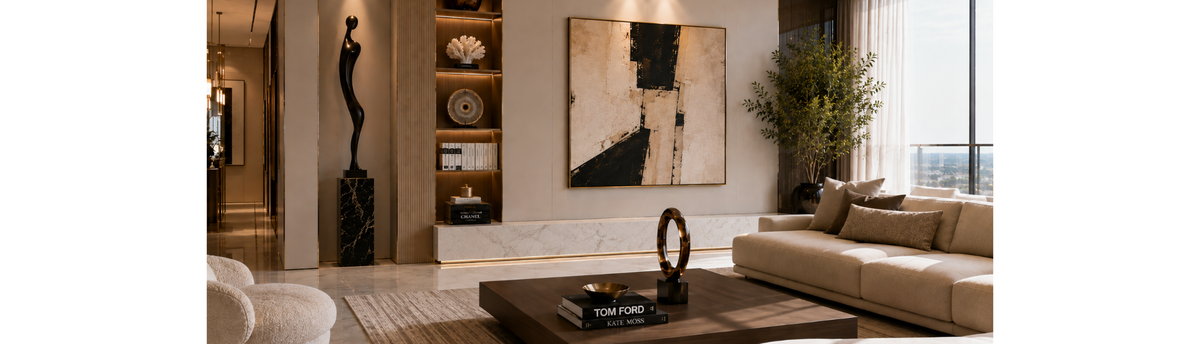

Choosing decorative objects for a home is not simply a matter of finding pieces that look beautiful. The right object has to work with the scale of the room, the furniture around it, the materials already present and the way the space is actually used.
This becomes even more important when choosing luxury home decor accessories. A beautifully made vase, sculpture, bowl or art object may have exceptional craftsmanship, but if it is too small for the surface, too dominant for the room or unrelated to the surrounding materials, it may not create the effect you expect.
For homeowners, interior designers and architects looking for premium home decor accessories, the decision therefore goes beyond appearance and price. Scale, proportion, material, colour, form, craftsmanship and placement all influence whether a decorative object feels natural within an interior or simply looks like something that has been placed there.
In this guide, I explain how to choose decorative objects for different interiors and surfaces, how to judge their visual weight, when to choose a statement piece and how to create relationships between objects without making the room feel overdecorated.
Table of Contents
- Start with the Room Before Choosing the Object
- Understand Scale Before You Buy
- Use Proportion to Judge the Relationship
- Think About Visual Weight, Not Just Physical Size
- Choose Materials That Belong to the Interior
- Use Colour to Create Relationships
- Consider Form, Shape and Silhouette
- Look Beyond Appearance at Craftsmanship
- Choose the Right Placement for Centrepieces
- When Should You Choose a Statement Decorative Object?
- Choose Objects According to the Room
- Choose Objects According to the Surface
- How to Combine Different Decorative Objects
- Common Mistakes When Choosing Decorative Objects
- The Spacio Decorative Object Test
- Frequently Asked Questions
- Choose for the Home, Not Just for the Object
Start with the Room Before Choosing the Object
The most useful starting point is the room itself. Before choosing a vase, sculpture, bowl, tray or other decorative accessory, look at the furniture, architecture, lighting, flooring, wall finishes and the areas that already attract attention.
A large artwork, dramatic fireplace, sculptural sofa or statement chandelier may already provide considerable visual weight. In that situation, the decorative objects may need to be quieter. A simpler room, on the other hand, may benefit from a stronger sculptural piece that introduces character and becomes a focal point.
This is why an object should never be judged entirely on its own. The same sculpture can feel too small in one room, perfectly proportioned in another and overwhelmingly large in a third. Its suitability depends on the visual environment around it.
Spacio's complete guide to luxury home decor accessories for modern Indian homes looks at the broader process of selecting decorative objects. This article takes that decision-making process further by focusing specifically on scale, proportion, material and placement.
Understand Scale Before You Buy
Scale refers to the size of an object in relation to the space around it. It is one of the first things to consider because even a beautifully designed accessory can look insignificant or overwhelming when its dimensions do not relate to the room.
A small sculpture placed on a large console may disappear visually. Several tiny objects may have the same problem on a substantial coffee table. Conversely, a large floor sculpture can overwhelm a compact room if there is not enough space around it to appreciate its form.
Look at the object in relation to the furniture, the wall behind it and the overall volume of the room. A generous living room with high ceilings can usually accommodate greater visual scale, while a compact apartment may benefit from fewer objects with stronger presence.
Scale is also important when choosing statement home decor accessories. A statement object does not necessarily have to be enormous, but it needs enough presence to register within its surroundings.
I never choose an object simply because it looks impressive in isolation. I first imagine it on the actual console, coffee table, shelf or floor where it will live. The surrounding furniture and architecture determine whether the object will feel important, insignificant or overpowering.
Use Proportion to Judge the Relationship
Scale and proportion are related, but they are not the same. Scale considers the size of an object in relation to its surroundings, while proportion considers the relationship between the different parts of a composition.
For example, a tall vase may be appropriately scaled for a large console but still look awkward if it is placed directly beside another object of almost identical height and visual weight. A lower bowl or a horizontal stack of books may create a better relationship because it introduces contrast.
Proportion is particularly important when several objects are being displayed together. Think about the height of the pieces, their width, the amount of space between them and how much of the surface they occupy.
A useful composition usually has variation. Tall and low objects, broad and narrow forms, solid and transparent materials or smooth and textured surfaces can work together to create visual rhythm.
This is one reason a collection of unrelated accessories can sometimes look more sophisticated than a perfectly matching set. The objects may differ, but their proportions create a relationship.
Think About Visual Weight, Not Just Physical Size
Two objects of exactly the same dimensions can have completely different visual weight. A dark stone sculpture may appear much heavier than a transparent glass object of the same size. A solid bronze form can command attention in a way that a delicate ceramic piece does not.
Colour, opacity, material, surface texture and shape all contribute to visual weight. Darker colours generally appear stronger, while transparent or lighter objects can feel more delicate even when they occupy considerable physical space.
This matters when creating groups of decorative objects. If every piece has a strong visual weight, the composition can become crowded very quickly. Pairing a visually dominant object with lighter pieces can create balance without requiring symmetry.
Visual weight also helps explain why a single sculptural object can sometimes be more effective than several smaller accessories. The larger object may create a clearer focal point while leaving more negative space around it.
Choose Materials That Belong to the Interior
Material is not simply a question of what an object is made from. It affects how the object interacts with the furniture, lighting and finishes around it.
Glass can introduce transparency and allow light to pass through a composition. Crystal can create reflections and visual movement. Ceramic and porcelain can provide a more tactile, opaque presence, while marble, stone and metal introduce greater visual weight.
Natural timber can bring warmth into an otherwise hard material palette, while polished metal can echo details already present in lighting, furniture or hardware. Leather and mixed materials can add texture and a more tactile quality.
The strongest choice is usually not the material that looks most luxurious in isolation. It is the material that creates a useful relationship with the interior.
Spacio's collections include designer vases, sculptures and art objects in different materials and forms, allowing material choice to become part of the wider interior composition.
Use Colour to Create Relationships
Colour can help an object connect to the room without requiring an exact match. A decorative accessory may repeat a tone found in the artwork, upholstery, rug or lighting, or it may introduce a carefully controlled contrast.
Consider a neutral living room with warm timber, cream upholstery and bronze lighting. A decorative object in a related bronze, amber or muted brown tone can strengthen the existing palette, while a contrasting colour can be used if the intention is to create a focal point.
What matters is repetition with restraint. If every accessory repeats the same colour, the room can begin to look overly coordinated. If a colour appears only once without any connection to the rest of the interior, it may feel accidental.
A carefully chosen object can therefore do more than add colour. It can create a bridge between different elements that already exist within the room.
Consider Form, Shape and Silhouette
The silhouette of a decorative object can be just as important as its material or colour. Curved forms can soften rooms dominated by straight architectural lines, while geometric objects can reinforce a more structured interior.
A tall, narrow vase introduces vertical movement. A broad decorative bowl creates a lower horizontal presence. An abstract sculpture may introduce an unexpected silhouette that gives the composition a focal point.
Look at the forms already present in the room and decide whether the next object should echo them or provide contrast. Repeating the same shape everywhere can become monotonous, while too much contrast can make the room feel disconnected.
The most successful compositions often combine related but different forms. A rounded object beside a more angular sculpture, for example, can create tension while still feeling visually coherent.
When selecting decorative objects, I look at the silhouette before I look at the details. A strong outline can give an object presence from across a room, while finer craftsmanship becomes something you discover as you move closer.
Look Beyond Appearance at Craftsmanship
When choosing a luxury decorative object, appearance is only the first layer. The quality of the material, the precision of the finish, the way the object has been made and the design thinking behind it all contribute to its value within an interior.
This is particularly important when choosing high-end home decor accessories. A well-made object tends to reveal itself gradually. Its proportions feel considered, its surfaces have depth and its details remain interesting when viewed closely.
Craftsmanship can also influence how an object ages. Natural variations in handmade glass, the character of a stone surface or the precision of a finely finished metal piece can give an accessory a sense of individuality rather than making it feel mass produced.
For this reason, when comparing decorative objects, look beyond the immediate visual impression. Consider the material, construction, finish, provenance and whether the design has enough character to remain relevant as the rest of the interior evolves.
This is one of the principles explored in greater detail in What Makes a Home Decor Object Luxury? Design, Materials, Craftsmanship & Collectability Explained.
Choose the Right Placement for Centrepieces
Even an exclusive centrepiece can lose its impact if it is placed in the wrong location. Placement determines how the object is seen, how much visual space it has around it and how it interacts with the furniture and architecture.
Before placing a decorative object, consider the viewing angle. A sculpture on a console may be seen from the entrance, the sofa and the dining area. A coffee table object may be viewed from several seats. A decorative piece on a shelf may need to work both from close range and from across the room.
Lighting is equally important. Transparent glass and crystal can benefit from natural light, while metallic surfaces may respond beautifully to carefully positioned decorative lighting. A textured ceramic or stone object may need softer light to reveal its surface.
Think about function too. Objects placed on frequently used surfaces should not obstruct everyday activities. A coffee table should remain usable, while accessories on a console should not interfere with circulation or create unnecessary visual congestion.
Placement of a statement centrepiece should therefore be considered as part of the selection process, not as something decided after the object has been purchased.
When Should You Choose a Statement Decorative Object?
A statement decorative object is useful when a room needs a clear visual anchor, but it should not be selected simply because it is larger or more dramatic than everything else.
A strong statement piece may have an unusual silhouette, exceptional craftsmanship, distinctive material or an expressive artistic quality. Its visual impact comes from character as much as from size.
Before choosing one, identify whether the room actually needs another focal point. A living room with a dramatic artwork, chandelier and fireplace may already have sufficient visual intensity. In such a space, a quieter accessory could be more effective.
A relatively restrained room, on the other hand, may benefit enormously from one sculptural object on a console, sideboard or centre table.
The principle is simple: the stronger the object, the more carefully the surrounding composition should be edited.
Choose Decorative Objects According to the Room
The right decorative object also depends on where it is going to be used. A piece that works beautifully in a living room may have a completely different role in a dining room, bedroom or entrance foyer.
Living Room
The living room usually offers several opportunities for decorative objects, including centre tables, consoles, side tables, shelves and display niches. Because it is often the main social space of the home, choose pieces that add personality without obstructing movement or conversation.
Sculptures, vases, decorative bowls and coffee table books can create different layers of visual interest. A larger living room can support stronger sculptural forms, while a compact room may benefit from fewer objects with greater visual purpose.
Dining Room
The dining table naturally becomes a focal point, so decorative objects placed here should be considered in relation to the table's size, shape and the chandelier or lighting above it.
A decorative bowl, vase or sculptural centrepiece can establish the composition, but it should not interfere with conversation across the table. The height of the object matters particularly when people are seated.
Entrance Foyer
The entrance creates the first impression of the home. A console, mirror and carefully selected decorative accessories can establish the visual language that continues into the rest of the interior.
A tall vase, sculpture or statement object can provide an immediate focal point, while smaller accessories can create detail without overcrowding the surface. Spacio's Entrance Foyer collection provides further inspiration for this area.
Bedroom
Bedrooms generally benefit from quieter decorative compositions. The objective is to introduce personality and refinement without creating excessive visual stimulation.
A sculptural object, small vase, decorative bowl or carefully selected art object can work well on a console, bedside surface or dresser. Materials and colours should support the more restful character of the room.
Choose Objects According to the Surface
The surface on which an object is placed is just as important as the room itself.
A large centre table can support several related objects, while a narrow console usually needs a more vertical composition. Open shelving requires an approach based on rhythm across several levels, while a side table may need only one carefully selected piece.
Centre Tables
Centre tables are usually viewed from several directions, so compositions should work from more than one angle. Books can establish a horizontal foundation, while a sculpture, bowl or smaller decorative object can introduce height and contrast.
The shape of the table should influence the arrangement. Rectangular tables can accommodate more than one grouping, while round tables often benefit from a central composition that respects the circular form.
Spacio's centre table collection includes designs intended to become part of the overall living-room composition rather than simply serving as functional surfaces.
Consoles and Sideboards
Consoles provide a strong opportunity for vertical styling because the wall behind them becomes part of the composition. Artwork, mirrors or wall finishes should therefore be considered before selecting the objects placed on the surface.
A tall vase or sculpture can establish the highest point, while books, bowls or smaller objects provide lower layers. Leave enough of the surface visible so that the arrangement feels deliberate rather than filled.
Open Shelves and Niches
Open shelving should be treated as one composition rather than as a series of independent shelves. Vary the number of objects, their heights and the amount of empty space from one level to another.
Repeating exactly the same arrangement on every shelf creates a rigid rhythm. Instead, allow some shelves to remain quieter while others carry stronger visual weight.
Spacio's Book Shelves & Niches collection offers a useful context for thinking about how decorative objects, books and art can work together within built-in displays.
How to Combine Different Decorative Objects
Once the individual objects have been selected, the next challenge is making them work together. The strongest compositions usually contain variation rather than repetition.
A decorative vase can provide height, while a sculpture or art object introduces a more irregular silhouette. A decorative bowl creates a lower, quieter form.
Coffee table books add another dimension. Their rectangular form provides a horizontal foundation and can create different levels on which smaller objects can be displayed.
Decorative trays can also help organise several smaller pieces. Instead of allowing individual accessories to appear scattered across a surface, a tray gives them a visual boundary and makes the group read as one composition. Spacio's decorative tray collection includes pieces designed for this kind of surface styling.
The variation should feel intentional. If every object is tall, the composition can become repetitive. If every piece is visually heavy, the surface may feel crowded. Combining different heights, forms, materials and visual weights creates greater depth with fewer objects.
When I combine decorative objects, I think about what each piece is contributing. If two objects are doing exactly the same visual job, one may not be necessary. The strongest compositions usually come from giving each object a distinct role.
Common Mistakes When Choosing Decorative Objects
Many styling problems begin before an object ever reaches the room. They happen at the selection stage, when the object is judged in isolation rather than as part of the intended interior.
Choosing an object because it looks good on its own
A beautiful object is not automatically the right object for your home. Always consider its scale, material, colour and visual weight in relation to the space where it will be used.
Ignoring the furniture beneath it
A decorative object should relate to the dimensions and character of the furniture supporting it. A tiny accessory can disappear on a substantial console, while an oversized piece can overwhelm a delicate table.
Buying too many similar objects
Several vases, sculptures or bowls with almost identical proportions can make a composition feel repetitive. Variation creates greater visual interest.
Choosing objects without considering the viewing angle
An accessory may look perfect from directly in front but feel awkward from the side or from a seated position. Consider how the object will actually be experienced within the room.
Filling every available space
Empty space gives decorative objects room to breathe. If there is still visible surface after styling, that does not necessarily mean another accessory is required.
The Spacio Decorative Object Test
Before buying a decorative object, it helps to move beyond the simple question of whether you like it. A more useful approach is to test whether the object has a clear place and purpose within your home.
Ask yourself these five questions:
- Is it correctly scaled? Will the object have enough visual presence for the surface or room where it will be placed?
- Does the proportion work? Will its height, width and shape relate naturally to the surrounding furniture and accessories?
- Does the material belong? Does it complement or thoughtfully contrast with the materials already present in the interior?
- Does it contribute something different? Does it introduce height, texture, colour, form or visual weight that the composition actually needs?
- Does it have enough space? Will the object be able to make an impression without being crowded by other accessories?
If the answer to all five is yes, the object is much more likely to become a meaningful part of the interior rather than simply another decorative purchase.
This approach is particularly useful when choosing premium home decor accessories or statement home decor accessories. The objective is not to collect the largest number of beautiful pieces, but to build a considered collection in which each object has a role.
Frequently Asked Questions
How do I choose decorative objects for my home?
Begin with the room, furniture and existing visual elements rather than choosing objects in isolation. Consider scale, proportion, material, colour, form, visual weight and placement, and choose pieces that add something the room actually needs.
What makes a decorative object look luxurious?
Luxury comes from a combination of design, material quality, craftsmanship, proportion and context. A beautifully made object becomes more effective when it is appropriately scaled and given enough space to be appreciated.
What are the best premium home decor accessories for a luxury home?
Vases, sculptures, art objects, decorative bowls, coffee table books, trays and other carefully selected accessories can all work well. The best choice depends on the room, its material palette, available surfaces and existing focal points.
How do I choose the right size decorative object?
Consider the size of the furniture or surface, the height of the surrounding elements and the overall scale of the room. The object should have enough visual presence to be noticed without overwhelming its surroundings.
What are statement home decor accessories?
Statement home decor accessories are decorative pieces with enough visual character to become a focal point within an interior. Their impact may come from their scale, silhouette, material, craftsmanship, colour or artistic quality rather than simply from their size.
What makes an exclusive centrepiece suitable for a luxury home?
An exclusive centrepiece should have a distinctive form, material, craftsmanship or artistic quality that gives it presence without overwhelming the space. Its scale, proportion and relationship with the surrounding interior are equally important.
Should decorative objects match the furniture?
They do not need to match exactly. It is usually more effective to create relationships through complementary materials, colours, forms and proportions. A degree of contrast can make the overall composition more interesting.
How many decorative objects should I place on a console or coffee table?
There is no fixed number. The appropriate quantity depends on the size and shape of the surface and the visual weight of the objects. A smaller number of well-proportioned pieces is generally more effective than filling the surface.
Why is scale important when styling luxury interiors?
Scale determines whether an object feels appropriately related to the room and furniture around it. An object that is too small can disappear, while one that is too large can overwhelm the composition.
How can I mix different decorative objects without making my home look cluttered?
Give each object a different visual role. Combine variations in height, shape, material and visual weight, and leave intentional negative space between important pieces.
Where can I find luxury home decor accessories in India?
Spacio curates luxury home decor accessories for Indian interiors, including vases, sculptures and art objects, decorative bowls, coffee table books and other decorative pieces from international design brands.
Luxury Home Decor Accessories Across India
Spacio serves clients across India with a curated selection of luxury home decor accessories, including premium and high-end decorative objects, statement pieces, sculptures, vases and other design-led accessories. Explore our city pages to discover luxury home decor accessories and the design support available in different parts of India.
- Luxury Home Decor Accessories in Mumbai
- Luxury Home Decor Accessories in Pune
- Luxury Home Decor Accessories in Bengaluru
- Luxury Home Decor Accessories in Hyderabad
- Luxury Home Decor Accessories in Surat
Choose for the Home, Not Just for the Object
The most successful decorative objects are not necessarily the most expensive, the largest or the most dramatic. They are the pieces that make sense within the home.
Scale determines whether an object belongs to the room. Proportion determines how it relates to the objects around it. Material connects it to the wider interior. Form gives it character, while placement determines how successfully all of these qualities are experienced.
This is why choosing luxury home decor accessories is ultimately an exercise in curation. A beautifully made vase, sculpture or decorative bowl can transform a quiet surface, but only when its size, material, form and position are considered as part of the whole.
For a broader understanding of how to select decorative objects for contemporary Indian homes, read Spacio's complete guide to luxury home decor accessories. You can also explore the Spacio collection of luxury home decor accessories for further inspiration.
Whether you are styling a living room, entrance, dining area or bedroom, the principle remains the same: choose fewer things with greater intention, give each object enough space to be appreciated and allow the collection to evolve with the home.
Explore Luxury Home Decor Accessories at Spacio
Discover curated vases, sculptures, art objects, decorative bowls, coffee table books and other accessories for refined interiors.
Explore Decor & Accessories


