
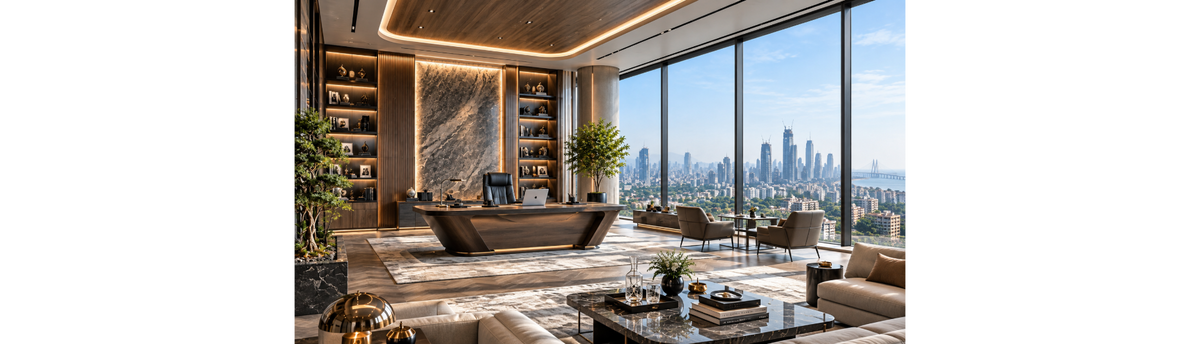

What makes one office look high-end while another, filled with expensive-looking objects, still feels ordinary? The answer is rarely the number of decorative pieces in the room. It is more often the quality of the materials, the level of craftsmanship, the scale and proportion of the objects, the way finishes relate to one another and, above all, the discipline of curation.
High-end office decor is not simply about choosing expensive accessories. It is about understanding why a particular object belongs in a particular space. A sculpture, desk accessory, clock, globe, piece of wall art or decorative light becomes more convincing when its material, scale, visual weight and finish have a clear relationship with the office around it.
This distinction matters in executive offices, corporate offices, reception areas, boardrooms, private studies and home offices. These spaces are not only functional. Their interiors can communicate the character of a business, the personality of the person using the room and the level of thought given to the environment.
Our complete guide to office decor accessories and luxury office styling in India explores the wider category. This article focuses specifically on the qualities that make office decor look and feel high-end: materials, craftsmanship, scale, proportion, visual weight, finish, negative space and curation.
Office decor looks high-end when the quality of the materials and craftsmanship is supported by the right scale, proportion, visual weight, finish and amount of negative space. The final difference comes from curation: selecting fewer, better-related pieces rather than filling every available surface.
Table of Contents
- What Does High-End Office Decor Mean?
- The 8 Elements That Make Office Decor Look High-End
- 1. Material Quality
- 2. Craftsmanship and Finishing
- 3. Scale and Proportion
- 4. Visual Weight and Presence
- 5. Colour, Texture and Finish
- 6. Negative Space
- 7. Curation Rather Than Accumulation
- 8. Relationship Between Objects and the Interior
- How to Combine Materials in a High-End Office
- How the Principles Change Across Different Office Spaces
- Does Expensive Office Decor Always Look High-End?
- A Practical Framework for Choosing High-End Office Decor
- Which Office Decor Accessories Can Support a High-End Look?
- Where to Experience Luxury Office Decor in India
- FAQs About High-End Office Decor
- Conclusion
What Does High-End Office Decor Actually Mean?
The words premium, high-end and luxury are often used to describe office interiors, but they do not simply refer to price. A high-end appearance comes from the relationship between the objects and the space.
Consider two executive desks. One may contain several costly decorative objects, while the other may contain only a clock, a sculpture and a carefully selected desk accessory. If the second desk has better scale, stronger material relationships and more considered spacing, it can appear substantially more refined.
This is because luxury office styling is fundamentally about curation, not accumulation.
A high-end office decor scheme usually demonstrates:
- Material quality appropriate to the interior.
- Craftsmanship visible in construction and finishing.
- Scale appropriate to the furniture and room.
- Proportion between objects and surrounding elements.
- Visual weight that creates hierarchy rather than competition.
- Colour and finish that relate to the wider material palette.
- Negative space that allows important objects to be seen.
- Curation that gives every significant object a reason for being there.
These principles are useful whether you are styling a large executive office in a corporate headquarters, a private office in a professional practice, a reception area or a luxury home office in India.
When an office looks expensive but not refined, the problem is often not the individual objects. It is the relationship between them. High-end office styling begins by looking at the room as one composition rather than choosing decorative pieces one at a time.
The 8 Elements That Make Office Decor Look High-End
There is no single material, colour or product category that automatically makes an office luxurious. Instead, the result comes from several design qualities working together.
The eight most important are material quality, craftsmanship, scale, visual weight, finish, negative space, curation and relationship with the interior.
1. Material Quality Makes a Difference
Material is one of the first qualities people notice when they encounter a decorative object. It affects the way an object reflects light, catches attention, feels to the touch and relates to the surrounding furniture and finishes.
Materials commonly associated with sophisticated office decor include metal, glass, crystal, stone, wood and leather. Each creates a different visual language.
| Material | Visual Character | Possible Office Applications |
|---|---|---|
| Metal | Structured, precise and visually strong | Sculptures, clocks, desk accessories and statement objects |
| Glass | Light, reflective and contemporary | Sculptures, decorative objects and display pieces |
| Crystal | Reflective, detailed and visually expressive | Statement objects, sculptures and selected desk accessories |
| Stone | Grounded, substantial and tactile | Sculptures, objects and larger statement pieces |
| Wood | Warm, natural and tactile | Desk accessories, decorative objects and studies |
| Leather | Warm, tactile and associated with executive environments | Desk accessories and selected functional objects |
The important point is not to use every premium material in one office. Too many unrelated materials can create visual noise. A stronger approach is to identify the materials already present in the desk, cabinetry, flooring, furniture and lighting, then introduce decorative objects that establish useful relationships with them.
For example, a metal sculpture can echo the metal detailing in a desk or light fitting. Glass can introduce reflection into an otherwise matte material palette. Stone can add visual weight to a lighter composition.
Material quality therefore becomes meaningful when it is considered in context.
Do not ask only, “Is this a good material?” Ask, “What does this material contribute to the room?” A material should bring an appropriate level of weight, warmth, reflection, texture or contrast to the existing interior.
2. Craftsmanship and Finishing Are Part of the Luxury
A good material does not automatically create a high-end object. The way that material has been worked and finished is equally important.
Look closely at the surface, edges, joins, detailing, polish, texture and transitions between materials. These details may not be obvious from across a room, but they become increasingly important when a decorative object is positioned on an executive desk, console, credenza or reception counter.
Craftsmanship is particularly important in office decor because many accessories are viewed at relatively close range. A sculpture placed behind an executive desk, for example, may be seen by the person using the room as well as by visitors sitting across from them.
The quality of finishing can therefore influence whether an object feels considered or mass-produced.
Craftsmanship can also become a bridge between different materials. When metal, glass, stone, wood or other surfaces are combined, the precision of those transitions contributes to the overall quality of the object.
This does not mean that every luxury office accessory must be ornate. In fact, a restrained object can reveal craftsmanship more clearly because there are fewer visual elements competing for attention.
3. Scale and Proportion Can Make or Break the Look
One of the most important principles in luxury office styling is scale. An object can be beautiful and well made but still look wrong if it is too small for the surface, too large for the room or poorly proportioned in relation to surrounding furniture.
Scale considers the size of an object in relation to the room or surface. Proportion considers the relationship between its dimensions and the elements around it. This distinction matters on an executive desk. A small decorative object may disappear on a very large desk. Several medium-sized objects may create more visual presence, but if they are placed too close together they can make the desk feel crowded.
The same principle applies to office wall art. A small artwork on a very large wall may lack sufficient presence, while an oversized piece placed too close to furniture can dominate the room.
Scale must therefore be considered at three levels:
- The object in relation to the surface.
- The surface in relation to the furniture.
- The furniture and objects in relation to the room.
This is why choosing office decor accessories should begin with an understanding of the space rather than with the object alone.
If an important decorative object looks insignificant in the room, do not immediately add more objects around it. First ask whether the original piece is large enough to perform the visual role you have given it.
4. Visual Weight Gives an Office a Clear Hierarchy
Visual weight describes how much attention an object appears to carry within a composition. Two objects can have similar physical dimensions but very different visual weights. A dark stone sculpture may feel heavier than a transparent glass sculpture of the same size. A highly reflective metal object may attract attention differently from a matte wooden object. A complex form may carry greater visual weight than a quiet geometric form.
Understanding visual weight helps prevent one of the most common office styling problems: everything competing for attention. A well-curated executive office may have one dominant sculpture, artwork or statement object supported by quieter desk accessories and furnishings. The supporting elements do not need to disappear. They simply should not compete with the focal piece.
This principle is especially useful when combining office sculptures, office wall art, clocks, globes and desk accessories.
5. Colour, Texture and Finish Influence Perceived Quality
Colour and finish determine how an object interacts with light and with the materials around it. A polished surface reflects its surroundings. A matte surface absorbs more visual attention into its texture. Brushed metal has a different character from highly polished metal. Clear glass behaves differently from tinted or textured glass.
These differences can be used to create contrast without introducing unnecessary colour.
For example, a neutral executive office may benefit from a reflective object that catches natural or decorative light. A room with many polished surfaces may instead benefit from a tactile or matte object that introduces visual balance.
Texture is equally important. A high-end interior does not have to be visually elaborate. Subtle differences between smooth, textured, reflective and tactile surfaces can create depth without making the space look busy.
Materiality is also relevant to workplace experience more broadly. Contemporary workplace design research increasingly considers colour, texture and finish as part of how people experience and connect with a workspace, rather than treating materials as purely decorative decisions.
6. Negative Space Is Part of the Design
One of the clearest differences between curated office decor and accumulated office decor is the treatment of empty space.
Negative space is the area around and between objects. It gives the eye room to separate individual elements and allows important pieces to have greater visual presence.
On an executive desk, negative space may mean leaving a substantial part of the work surface clear. On a reception wall, it may mean allowing one large artwork or sculpture to command attention rather than covering the wall with several unrelated pieces.
Negative space is particularly important for high-end objects because it allows their shape, finish and craftsmanship to be appreciated.
When too many objects are placed together, even good individual pieces can lose their impact.
Empty space is not unfinished space. In a carefully styled office, the space around an object is part of the composition. A statement piece often becomes stronger when it has room to breathe.
7. Curation Is More Important Than Accumulation
This is perhaps the most important principle in high-end office decor. Curation means choosing objects because they have a clear relationship with the space, the person using it, the business or the visual language of the interior. It also means knowing when not to add another object.
An executive office does not need every available category of office decor. It may not need a sculpture, globe, clock, multiple books, several desk accessories and decorative objects on every surface.
Instead, consider what the room already has and identify what is missing.
- Does the desk need a functional decorative object?
- Does the wall need scale?
- Does the room need a focal point?
- Does the material palette need warmth or contrast?
- Does a reception area need one stronger statement rather than several smaller pieces?
- Does the office need something personal to reflect the person or business using it?
This changes the question from “What can I add?” to “What does the space need?” That shift is at the heart of luxury office styling.
Collection Guide: Start With the Role, Not the Product
If the objective is to create a considered office rather than simply add decoration, begin by identifying the role an object needs to perform. Office desk accessories can support an executive desk, while business and motivational sculptures can establish a stronger focal point. Office wall art can provide scale on larger surfaces, while clocks, globes and other statement objects can introduce visual interest where the composition requires it.
8. The Object Must Have a Relationship With the Interior
The final quality that separates a high-end office from a collection of expensive objects is relationship. A decorative object should relate to something else in the room. This relationship may be based on material, colour, scale, shape, finish, function or visual position.
For example, a sculptural object may echo the geometry of the furniture. A metal finish may repeat a detail in the lighting. A globe may relate to the interests or international character of the business. A piece of wall art may provide contrast against a restrained material palette.
The relationship does not need to be literal matching. In fact, matching everything can make an office feel overly coordinated. High-end interiors often work through controlled contrast: warm against cool, smooth against textured, reflective against matte, substantial against light.
The objective is to create relationships that feel intentional without making every object look as though it came from the same set.
How to Combine Materials in a High-End Office
A sophisticated office often contains several materials rather than one dominant finish. The challenge is to make those materials feel related.
| Material Relationship | Effect | Possible Application |
|---|---|---|
| Metal + Wood | Balances precision with warmth | Executive desk and desk accessories |
| Glass + Metal | Creates a lighter, contemporary composition | Sculptures, decorative objects and lighting |
| Stone + Metal | Combines visual weight with precision | Statement sculptures and executive displays |
| Leather + Wood | Creates a warmer executive character | Private offices and studies |
| Glass + Stone | Balances transparency with substance | Display objects and sculptural compositions |
These are not fixed rules. The existing interior should always determine the appropriate balance. The goal is to avoid both extremes: a room where every surface looks identical and a room where every object introduces a completely different material language.
How the Principles Change Across Different Office Spaces
The definition of high-end office decor changes slightly according to the space because the visual role of an object is different in an executive office, reception area or boardroom.
Executive Offices
An executive office can support a stronger personal identity. A substantial sculpture, carefully selected desk accessories, a statement clock, globe or world map can contribute to the room when the scale and visual hierarchy are right.
The most important consideration is restraint. The room should communicate personality without becoming a display cabinet.
Reception Areas
Reception areas are often the first interior experience a visitor has of a business. Here, a strong focal point can be more effective than numerous smaller decorative objects.
This might be a substantial piece of wall art, a sculpture, statement decorative lighting or another object that establishes the visual character of the reception. For a detailed approach to this specific space, see How to Style Office Reception Areas with Art, Sculptures & Statement Decor.
Boardrooms
A boardroom generally benefits from visual restraint because the table, seating and surrounding surfaces already create substantial visual structure. One strong artwork, a considered wall feature or a carefully selected statement object may be more effective than multiple decorative pieces.
Private Studies and Home Offices
A home office can accommodate more personal references. Books, travel-related objects, globes, art and sculptures can reflect the interests of the person using the room while maintaining a professional visual language.
Corporate Offices
Corporate offices require consistency across multiple spaces. Reception areas, meeting rooms, executive offices and waiting areas may each have different styling requirements, but they can still share a common material or visual language.
This is where curation becomes particularly important. The objective is not to make every room identical, but to create a coherent relationship across the workplace.
Does Expensive Office Decor Always Look High-End?
No. Price and visual refinement are not the same thing. An expensive object can look wrong when it is too small, too large, badly positioned or unrelated to the surrounding interior. Conversely, an object does not need to dominate the room to contribute to a high-end result.
The difference comes from how the object participates in the composition. Consider three identical decorative objects placed in different settings:
| Placement | Likely Result |
|---|---|
| Placed among many unrelated objects | Competes for attention and may feel cluttered |
| Placed alone on an oversized surface without enough scale | May feel insignificant |
| Placed with appropriate scale, negative space and material relationships | Can become a considered focal point |
This is why the most useful question is not simply whether an accessory is expensive. It is whether it is right for the space.
A Practical Framework for Choosing High-End Office Decor
Before selecting a decorative object for an office, work through the following sequence.
1. Start With the Room
Look at the size, furniture, walls, lighting, flooring and existing finishes. Understand the visual language before introducing another object.
2. Identify the Role
Decide whether the object needs to be functional, decorative, symbolic, conversational or simply a visual counterpoint.
3. Establish the Scale
Measure the surface or wall and consider the object in relation to the surrounding furniture. Avoid choosing size in isolation.
4. Consider Material
Ask whether the material introduces warmth, contrast, texture, reflection or visual weight that the room needs.
5. Look at Craftsmanship
Examine the finish, surface, detailing and construction. The closer an object will be to the viewer, the more these qualities matter.
6. Check Visual Weight
Consider whether the object is likely to dominate the composition or disappear within it.
7. Protect Negative Space
Leave enough room around important objects. Do not fill every shelf, desk or wall simply because space is available.
8. Step Back and Edit
Once the objects are placed, look at the room as a whole. If one piece does not contribute anything meaningful, removing it may improve the composition.
Before adding a new office accessory, remove one existing object and see what happens. If the room immediately feels clearer, the problem may be accumulation rather than a lack of decoration.
Which Office Decor Accessories Can Support a High-End Look?
There is no requirement to use every category in a luxury office. Different accessories solve different visual and functional needs.
Office Decor Categories to Consider
Office desk accessories
These can introduce material quality and visual order to an executive desk. Scale is particularly important because the desk must remain functional.
Office sculptures
Sculptures can establish focal points and introduce form, movement or symbolism. Larger pieces may work well where the room has sufficient visual space.
Office wall art
Wall art can establish scale and character on larger wall surfaces. The size of the artwork should relate to the wall, furniture and viewing distance.
Office clocks
A clock can combine function with visual presence, particularly when its form and material complement the office environment.
Globes
Globes can work naturally in executive offices, libraries and studies, particularly where travel, international business or geography has relevance.
World maps
World maps can become statement wall pieces in global businesses, executive offices and spaces where travel or international activity is part of the visual story.
Office decorative lights
Decorative lighting can contribute both illumination and visual character, making the light fitting itself part of the office composition.
These categories form part of the wider Spacio approach to office accessories, where the objective is to consider individual pieces as part of a larger office styling language. For readers specifically selecting objects for the executive desk, our guide to how to choose luxury office desk accessories goes deeper into scale, function, material and style at desk level.
Where to Experience Luxury Office Decor in India
If you are selecting luxury office decor accessories for a home office, private study, library, executive office or professional workspace, seeing the products in person can be especially valuable. Scale, material, finish, proportion and visual impact are much easier to assess when sculptures, desk accessories, clocks, globes, decorative objects and lighting can be viewed as part of a complete interior composition.
Spacio's Mumbai and Kolkata showrooms bring together office accessories, sculptures, decor accessories, lighting, books, clocks and other collections for customers who want to see and experience these pieces before choosing them for a refined workspace. Explore the Spacio office decor collections to understand the different categories of accessories available for executive offices, corporate workspaces, reception areas, private studies and home offices. If you are unsure about scale, material or the right combination of pieces, you can also speak with the Spacio Interior Styling Team about your space and requirements.
FAQs About High-End Office Decor
What makes office decor look high-end?
High-end office decor comes from a combination of material quality, craftsmanship, scale, proportion, visual weight, finish, negative space and curation. The objects should also have a clear relationship with the room and the furniture around them.
Does expensive office decor always look luxurious?
No. Price alone does not determine how refined an office looks. An expensive object can feel out of place if it has the wrong scale, proportion or finish for the room. The relationship between the object and the interior is equally important.
Which materials are suitable for luxury office decor?
Metal, glass, crystal, stone, wood and leather can all work well in high-end office interiors. The appropriate material depends on the furniture, finishes, colour palette and visual character of the room.
How important is craftsmanship in office decor?
Craftsmanship is important because finishing, detailing, surface treatment and construction influence how an object is perceived, particularly when it is placed where people can view it closely.
How does scale affect luxury office decor?
Scale determines whether an object has enough visual presence for the surface or room where it is placed. An object that is too small can disappear, while one that is too large can overwhelm the composition.
Why is negative space important in office styling?
Negative space gives decorative objects room to be seen. It prevents different pieces from competing with one another and helps establish a clear visual hierarchy.
How many decorative objects should a luxury office have?
There is no fixed number. The right quantity depends on the size of the office, the furniture, the surfaces available and the visual weight of the objects. A considered office may need fewer pieces than expected.
Can office sculptures make a workspace look more high-end?
A well-selected sculpture can create a focal point in an executive office, reception area, boardroom or private study. Its effect depends on its scale, material, visual weight, placement and the amount of space around it.
Are globes and world maps suitable for executive offices?
Yes. Globes and world maps can work particularly well in executive offices, studies and professional spaces where travel, international business or global interests have a natural connection with the environment.
Can a home office also have a high-end look?
Yes. A home office can use the same principles of material quality, craftsmanship, scale, proportion and curation while allowing more personal elements such as books, art, travel objects and other pieces that reflect the person using the room.
Where can I see luxury office decor accessories in Mumbai?
You can visit the Spacio Mumbai store at 3BK, Laxmi Industrial Estate, New Link Road, Andheri (West), Mumbai 400 053, where you can explore relevant collections in person and discuss your requirements with the Spacio Interior Styling Team. You can also find the Spacio showroom in Laxmi Industrial Estate, Mumbai on Google Maps before planning your visit.
Where can I see luxury office decor accessories in Kolkata?
You can visit the Spacio Kolkata store at 86B, Topsia Road South, Kolkata 700 046, where you can experience relevant office decor collections and discuss your workspace requirements with the Spacio Interior Styling Team. You can also use Google Maps when planning your visit.
Conclusion: High-End Office Decor Is About Curation
The appearance of a high-end office is not created by simply choosing more expensive accessories. It comes from understanding how objects behave within a space. Material quality gives an object its physical character. Craftsmanship reveals the quality of its construction and finishing. Scale and proportion determine whether it belongs in the room. Visual weight establishes hierarchy. Colour, texture and finish create material relationships. Negative space gives important pieces room to be seen. And curation brings everything together.
This is why luxury office styling is ultimately about fewer, better-related pieces chosen with intention. Whether the setting is an executive office, corporate reception, boardroom, private study or home office, the objective is not to make the space look decorated. It is to create a workspace in which every significant element has a clear visual role.
When materials, craftsmanship, scale, proportion and curation work together, office decor becomes part of the identity of the space rather than something added after the interior is complete.


