
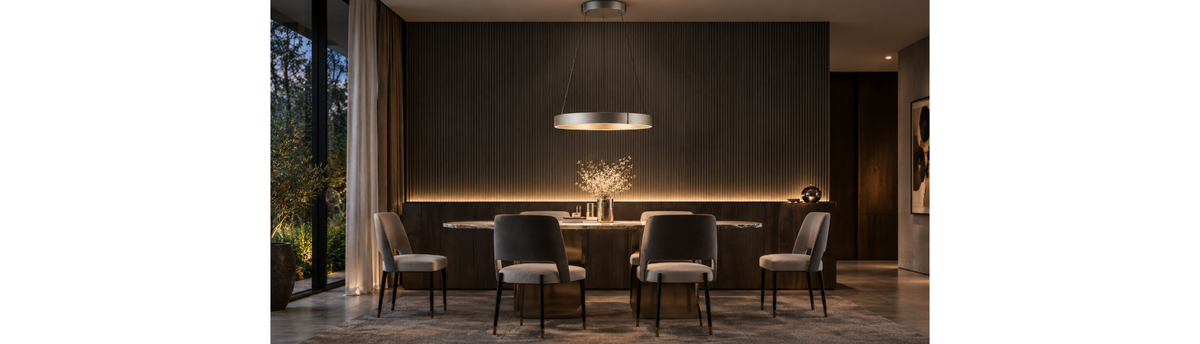

Choosing a chandelier for a round or oval dining table involves more than matching the shape of the light to the shape of the furniture. The diameter of the table, the length of an oval tabletop, the ceiling height, the size of the dining room and the amount of illumination required all influence which chandelier will work best.
A circular chandelier is often a natural choice above a round dining table because it reinforces the central geometry of the setting. It can also work above an oval dining table, where its circular form creates a visual contrast with the longer tabletop. The important consideration is proportion: the chandelier must relate to the table without appearing too small, too large or disconnected from the surrounding space.
Contemporary lighting has also introduced another consideration. Some chandeliers now offer motorised height adjustment, dimming and adjustable colour temperature. These features allow the lighting to respond to different activities and occasions. The Neuhaus Pure E-Clipse Mystic Grey 70 is one example, combining a circular 70 cm frame with motorised height adjustment and adjustable LED lighting.
A circular chandelier can complement both round and oval dining tables. For a round table, it reinforces the table's central geometry. For an oval table, it creates a contrasting focal point. Choose the diameter and suspension height according to the table dimensions, ceiling height, room proportions and lighting requirements. A motorised chandelier such as the Neuhaus Pure E-Clipse Mystic Grey 70 adds the flexibility of adjustable height, dimming and tunable white light.
This guide explains how to choose the right chandelier shape and size, how high it should hang, how much light a dining table needs, and what to consider before selecting a contemporary chandelier for your dining room.
If you are exploring the wider subject of dining illumination, begin with Spacio's Ultimate Guide to Choosing Dining Table Decorative Lights. That guide covers the broader range of decorative lighting options for dining areas, while this article focuses on selecting a chandelier for round and oval dining tables.
Table of Contents
- What Type of Chandelier Works Best Above a Round or Oval Dining Table?
- Which Chandelier Should You Choose for a Round Dining Table?
- Can You Use a Round Chandelier Above an Oval Dining Table?
- Round, Linear or Sculptural: Understanding Chandelier Shapes
- How to Choose the Right Chandelier Size
- How High Should a Dining Table Chandelier Hang?
- How Much Light Does a Dining Table Need?
- Are Adjustable-Height Chandeliers Suitable for Dining Tables?
- Choosing a Chandelier for Different Dining Room Layouts
- How Table Materials and Furniture Affect Chandelier Selection
- Common Mistakes When Choosing a Dining Chandelier
- What Should You Check Before Buying a Dining Chandelier?
- An Expert Perspective from Navin Kanodia
- Frequently Asked Questions
- Conclusion: Choosing the Right Chandelier for Your Dining Table
What Type of Chandelier Works Best Above a Round or Oval Dining Table?
A chandelier works best above a dining table when its shape, scale and light distribution relate to the furniture and the room. A circular chandelier is a strong option for a round table, while both circular and elongated chandeliers can work above an oval table. The final choice depends on the dimensions of the tabletop, the ceiling height and the visual effect you want to achieve.
There are several chandelier forms to consider:
- Circular chandeliers: These create a central focal point and often complement round tables particularly well. They can also provide an interesting contrast above oval tables.
- Linear chandeliers: These follow the length of an oval table and can distribute light across a longer dining surface.
- Multi-light chandeliers: Several light elements arranged within one fitting can provide wider visual coverage, depending on their design and light distribution.
- Sculptural chandeliers: These use distinctive forms to create a decorative focal point. Their size and visual weight need careful consideration in relation to the table.
- Adjustable or kinetic chandeliers: These introduce movement or motorised height adjustment, allowing the position of the fitting to change according to the product's design.
It is useful to distinguish between the shape of a chandelier and the way it distributes light. A circular fitting does not automatically provide even illumination across every part of an oval table. Similarly, a long chandelier does not always distribute light evenly simply because it follows the tabletop's shape. The light source, diffuser, optics and orientation all influence the result.
For a wider understanding of chandelier designs, materials and selection, explore Spacio's Chandeliers and Suspensions collection. You can also browse the broader Decorative Lighting collection, which includes chandeliers, pendant lights, ceiling lights and other decorative lighting formats.
Which Chandelier Should You Choose for a Round Dining Table?
A round dining table has a central point around which the seating is arranged. Unlike a rectangular table, it does not have a dominant length or direction. A chandelier placed centrally above it can reinforce this geometry and create a balanced relationship between the tabletop and the ceiling.
A circular chandelier is therefore a natural starting point. Its form relates directly to the table, helping the dining arrangement read as one connected composition. This is particularly effective in contemporary dining rooms where the furniture uses clean lines, restrained materials and clearly defined shapes.
Why a Circular Chandelier Works Above a Round Table
A circular chandelier creates a visual centre above the table. It can help define the dining zone in an open-plan interior and establish a clear relationship between the furniture and the lighting. However, the diameter of the chandelier should be considered carefully. A small circular fitting above a large round table may appear visually weak, while an oversized fitting can dominate the dining arrangement. The right size depends on the table diameter, ceiling height and the amount of open space around the furniture.
A circular chandelier is also useful when the dining table is positioned in the centre of a room rather than against a wall or within a narrow dining alcove. The symmetrical arrangement allows the fitting to be viewed from different directions without one side becoming visually dominant.
Can You Use a Sculptural Chandelier Above a Round Table?
Yes. A sculptural chandelier can work well above a round dining table, provided its form does not create an unbalanced composition. Organic, ring-shaped and multi-element designs can all be considered, but their dimensions and visual weight need to be assessed against the table. For example, a table with a substantial marble top and a bold pedestal base may support a chandelier with a stronger visual presence. A smaller glass or timber table may need a more restrained fitting.
The objective is not to match every curve or material. It is to establish a relationship between the furniture and the lighting that feels considered.
Can You Use a Round Chandelier Above an Oval Dining Table?
Yes. A round chandelier can be used above an oval dining table. The circular form creates a focal point at the centre of the longer tabletop, introducing a contrast between the horizontal shape of the furniture and the geometry of the light.
This arrangement can work particularly well when the oval table is not excessively long in relation to its width, or when the dining room has enough visual space around the table. The chandelier should have sufficient presence to relate to the overall size of the furniture.
When Does a Circular Chandelier Work Above an Oval Table?
A circular chandelier is worth considering when:
- The dining table has softly curved ends rather than sharp rectangular corners.
- The table is positioned centrally within the dining room.
- The design brief calls for a single focal point rather than an elongated lighting arrangement.
- The chandelier's diameter is proportionate to the width and length of the table.
- The surrounding interior already has strong horizontal lines and would benefit from a contrasting circular form.
When Is an Elongated Chandelier a Better Choice?
If the oval dining table is particularly long, a linear chandelier or a composition of multiple pendants may provide a more suitable relationship with the tabletop. These designs can distribute light across a greater length and visually follow the furniture's horizontal direction.
However, an elongated chandelier is not automatically the better choice. Its light distribution, position and dimensions still need to be assessed. A circular fitting can remain an effective option if the intention is to create a central focal point rather than illuminate the entire length through one continuous fixture.
For additional guidance on selecting decorative lights for dining tables, read The Ultimate Guide to Choosing Dining Table Decorative Lights.
Round, Linear or Sculptural: Understanding Chandelier Shapes
The shape of a chandelier influences how it relates to the dining table, but it also affects the visual balance of the room. Before selecting a design, consider whether the lighting should reinforce the shape of the table, contrast with it or introduce a separate sculptural element.
Round Chandeliers
Round chandeliers are particularly suitable for round dining tables because they repeat the geometry of the furniture. Above an oval table, they can create a central point of interest and soften the longer horizontal lines.
Ring-shaped designs, circular LED fittings and sculptural loop chandeliers fall into this broad category. Their visual impact depends on the frame thickness, diameter, material and lighting arrangement.
Linear Chandeliers
Linear chandeliers are designed around an elongated form. They can work well above oval and rectangular tables, especially when the lighting needs to extend across a longer surface.
Before choosing one, check whether the fitting's light distribution is suitable for the tabletop. A long decorative form does not necessarily mean that the entire surface will receive uniform illumination.
Cluster and Multi-Pendant Lighting
Several pendants arranged as a cluster can create a more varied lighting composition. This approach may be useful when the dining table is long or when the interior requires several points of light rather than one large central fitting. However, pendant spacing, suspension lengths and ceiling fixing positions need to be planned together. The arrangement should look balanced from the main viewing angles and should not obstruct sightlines across the table.
Explore Spacio's Pendant Lights collection for individual suspension designs, or browse Decorative Ceiling Lights for other formats that may suit different dining room layouts.
How to Choose the Right Chandelier Size
Chandelier size is one of the most important considerations when selecting dining table lighting. A fitting needs enough visual presence to relate to the furniture, but it should not overwhelm the table or restrict the sense of space around it.
There is no single chandelier diameter that works for every round or oval dining table. The correct size depends on several factors:
- The diameter or width of the dining table.
- The overall length of an oval table.
- The ceiling height.
- The size of the dining room.
- The visual weight of the chandelier.
- The distance between the dining table and nearby walls, cabinetry or other furniture.
Chandelier Size for a Round Dining Table
For a round table, begin by measuring the tabletop diameter. Then consider how much of the table the chandelier should visually occupy. A circular chandelier that is too small may look disconnected, while one that is too large may compete with the table and make the arrangement feel crowded.
It is also important to consider the table base. A round tabletop with a substantial pedestal may have a different visual weight from a round table supported by four slim legs. The chandelier should be assessed against the complete furniture design rather than the tabletop dimensions alone.
As an initial planning reference, a chandelier with a diameter of around half to two-thirds of the dining table's diameter can be a useful starting point. For example, a 150 cm round dining table could be assessed with chandeliers in the approximate 75 to 100 cm range. This is not a fixed rule. The final choice should also account for the chandelier's visual weight, ceiling height, room size and the space available around the table.
Chandelier Size for an Oval Dining Table
For an oval table, measure both its length and width. The width is particularly relevant when considering a circular chandelier, while the overall length helps determine whether a single fitting will have sufficient visual presence.
If the table is long, a single circular chandelier may appear concentrated at the centre. That may be intentional, but if the goal is to distribute light along the full tabletop, an elongated fitting or multiple pendants may be more appropriate.
When considering a circular chandelier above an oval table, use the table's width as an important reference for the fitting's diameter. The table's overall length must also be considered, particularly if the intention is to illuminate the full surface. A long oval table may work better with an elongated chandelier or multiple light sources, while a circular fitting can still be chosen to create a central focal point.
Consider the Chandelier's Visual Weight
Two chandeliers with the same diameter can appear very different in a room. A thick metal frame, a dense arrangement of glass elements or a dark finish may create more visual weight than a slim, open circular frame.
Similarly, a chandelier with a transparent or open structure may feel lighter even when its physical dimensions are substantial. This is why product dimensions should be considered alongside the design and material.
Do not select a chandelier using the table measurement alone. Mark the table dimensions on the floor plan, include the dining chairs in their pulled-out positions, and check the chandelier's diameter against the available ceiling area. This helps identify whether the fitting will feel balanced when the dining space is being used.
How High Should a Dining Table Chandelier Hang?
The suspension height of a dining chandelier affects both its appearance and its practical use. A fitting that hangs too high may feel disconnected from the table, while one that hangs too low can obstruct views, interfere with conversation or create discomfort.
Many lighting guides use a starting reference of approximately 75 to 90 cm between the tabletop and the bottom of the chandelier. This is a planning guideline, not a universal installation rule. The appropriate height depends on the fitting's dimensions, the ceiling height, the table size, the seated sightlines and the manufacturer's instructions.
Consider Seated Sightlines
People should be able to look across the dining table without the chandelier becoming an obstruction. The bottom edge of the fitting, its frame thickness and the position of its light sources all influence the experience from a seated position.
A large circular chandelier may need a different suspension height from a slim pendant, even when both are positioned above tables of similar dimensions. The shape and depth of the fitting matter as much as the distance from the tabletop.
Consider Ceiling Height
A dining room with a high ceiling offers more flexibility in suspension length, while a room with a lower ceiling requires closer attention to the chandelier's overall drop and physical presence.
In a room with a standard ceiling, the chandelier should not make the dining area feel compressed. In a double-height space, a longer suspension may be visually appropriate, but the fitting must still relate to the dining table rather than simply hang from the highest possible point.
How Much Light Does a Dining Table Need?
A dining chandelier should provide enough illumination for the table's intended use without creating glare or making the room feel overly bright. The right amount of light depends on the size of the table, the light distribution of the fitting, the colour of the surrounding surfaces and the presence of other light sources.
When evaluating a chandelier, consider four important lighting characteristics: lumen output, colour temperature, dimming and light distribution.
Lumens and Light Output
Lumens indicate the amount of light produced by a light source. A higher lumen figure does not automatically mean that a chandelier will illuminate a dining table better. The direction of the light, diffuser design, optics and distance from the surface all influence how much light reaches the tabletop.
For this reason, compare the actual lighting performance of the fitting rather than choosing solely by wattage. Wattage indicates electrical power consumption, while lumens describe light output.
Colour Temperature
Colour temperature is measured in Kelvin (K). It influences whether the light appears warm, neutral or cool.
- Warm white: Around 2700 K to 3000 K, often used to create a relaxed dining atmosphere.
- Neutral white: Around 3500 K to 4000 K, offering a more balanced appearance.
- Cooler white: Around 5000 K, producing a cooler, more daylight-like effect.
These are broad descriptions. The actual appearance of light also depends on the colour rendering, surrounding finishes and the other light sources in the room.
Dimming and Lighting Flexibility
Dimming allows the brightness to be adjusted according to the activity. A brighter setting may be useful for everyday dining or other tasks, while a lower setting can create a more relaxed atmosphere during an evening meal.
However, dimming compatibility should be checked carefully. The light source, driver and control system must support the dimming method being used. Integrated LED chandeliers may have their own dedicated controls or remote systems.
Direct and Indirect Lighting
Some contemporary chandeliers direct light downwards towards the table, while others provide a combination of direct and indirect illumination. Downward light helps illuminate the tabletop, while upward light can contribute to the overall brightness of the room by reflecting from the ceiling.
Neither approach is automatically better. The correct choice depends on the room, ceiling finish, table surface and the role of other lighting sources.
A chandelier should also be part of a wider lighting plan. Wall lights, recessed ceiling lights, floor lamps or concealed lighting may provide additional illumination. Spacio's Decorative Lighting collection offers different formats that can be considered alongside the principal dining chandelier.
Are Adjustable-Height Chandeliers Suitable for Dining Tables?
Yes. Adjustable-height chandeliers can be particularly useful above dining tables because they allow the suspension position to change according to the activity and the room's requirements. Instead of remaining fixed at one height, a motorised chandelier can be raised or lowered within its specified operating range.
This is different from a conventional chandelier with a fixed suspension. The movement introduces flexibility, but it also makes the installation requirements and movement range important buying considerations.
What Is a Kinetic Chandelier?
A kinetic chandelier is a lighting fixture that incorporates controlled movement. Depending on the model, this may involve motorised height adjustment, horizontal movement or changes in the position of individual lighting elements.
Not every kinetic chandelier offers the same movement. Some models focus on vertical adjustment, while others use more complex mechanisms. It is important to understand the specific technology rather than assume that all kinetic lights operate in the same way.
For a deeper explanation of the technology, read Spacio's guide to kinetic chandeliers for modern Indian homes. You can also explore the Kinetic Lights collection to understand the range of designs available.
Why Is Height Adjustment Useful Above a Dining Table?
A dining table may be used for everyday meals, working, family gatherings and entertaining. The preferred lighting arrangement can change with each activity. Motorised height adjustment allows the chandelier's position to be changed rather than relying on one permanent suspension height. A homeowner may prefer a higher position when the room is being used more generally and a lower position when the dining table is the focus.
The actual benefit depends on the fitting's movement range, the room's ceiling height and the position of the furniture. The movement should never compromise comfortable headroom or create an obstruction.
Does a Kinetic Chandelier Require Home Automation?
Not necessarily. Some kinetic chandeliers operate through a dedicated remote control or wall control and do not require a complete home automation system. Other models may offer additional integration options. Before buying, confirm which controls are included with the specific product. Do not assume that every kinetic chandelier supports app control, voice commands or integration with a smart home platform.
For another example of how kinetic lighting can be used in a different room, read Bedroom Lighting and Kinetic Lighting in Interior Styling. The article explores how adjustable lighting can contribute to the experience of a bedroom.
Choosing a Chandelier for Different Dining Room Layouts
The right chandelier is influenced not only by the table but also by the room in which it is placed. A circular chandelier may work differently in a compact apartment dining area, a large open-plan room or a formal dining room within a villa.
Dining Tables in Apartments
Apartment dining areas often share space with the living room or kitchen. In these layouts, the chandelier can help define the dining zone without requiring a physical partition.
A circular fitting above a round table can establish a clear centre, while an adjustable-height chandelier may offer flexibility where the room is used for several activities. The fitting's overall drop and diameter should be checked carefully, particularly where the ceiling height is limited.
Open-Plan Dining Rooms
In an open-plan home, the dining table may be visible from the kitchen, living room and entrance. The chandelier therefore needs to work from several viewing angles.
A circular chandelier can create a recognisable focal point without extending too far across the room. The surrounding lighting should be coordinated so that the dining area feels distinct but remains visually connected to the other spaces.
Large Dining Rooms and Villas
Larger dining rooms offer more freedom in terms of chandelier size and suspension length. However, the fitting still needs to relate to the table rather than the overall room volume alone.
A large oval table may require an elongated chandelier or multiple light sources if the intention is to illuminate the full length. A circular chandelier can still work when the design intention is to create a central focal point.
Dining Areas with High Ceilings
High ceilings can accommodate chandeliers with longer suspension systems, but the fitting should remain connected visually to the dining table. Hanging a chandelier too high may weaken the relationship between the light and the furniture.
Where a motorised chandelier is being considered, check its full suspension range and whether that range suits the ceiling height and the desired position above the table.
How Table Materials and Furniture Affect Chandelier Selection
The material and design of the dining table influence the visual weight of the room. A chandelier should be selected with the table, chairs and surrounding furniture in mind rather than treated as an independent decorative object.
Marble and Natural Stone Dining Tables
Marble and natural stone tables often have strong veining, substantial tops and distinctive colours. A clean circular chandelier can provide a contrast to these surfaces without introducing another elaborate pattern.
Grey metal, glass and restrained LED forms can be considered alongside stone surfaces, depending on the colour and finish of the table.
Wooden Dining Tables
Timber tables introduce warmth and natural texture. A contemporary metal chandelier can create a contrast with the grain and colour of the wood, while a warm lighting setting can help maintain a comfortable dining atmosphere.
Glass Dining Tables
Glass tables create visual lightness and allow the base to remain visible. A circular chandelier can establish a stronger focal point above the table, particularly when the surrounding furniture has a restrained design.
Reflections should be considered when selecting the position and brightness of the fitting. Highly reflective surfaces can make glare more noticeable if the light source is not appropriately controlled.
Dining Chairs and Sideboards
The chairs influence the visual weight around the table. Upholstered chairs may introduce soft forms and colour, while metal or timber chairs can create stronger lines. The chandelier should work with these forms rather than compete with them. A sideboard also contributes to the overall dining room composition. If it has a strong sculptural form, detailed surface or decorative objects, the chandelier may need a more restrained design. If the surrounding furniture is simple, the light can become a stronger focal point.
Explore Spacio's Dining Tables collection and Dining Chairs collection when planning the furniture foundation. The wider Furniture collection also offers options for coordinating the dining area with the rest of the home.
For ideas on how the dining table itself can be arranged for entertaining, see the Festive Interior Styling – Dining 2026 video with Navin Kanodia. It provides a useful companion to the practical lighting guidance in this article.
Common Mistakes When Choosing a Dining Chandelier
Choosing Only by Appearance
A chandelier may look attractive in a photograph but still be unsuitable for a particular dining room. Its diameter, suspension height, light distribution and installation requirements should be checked before a decision is made.
Assuming Round Chandeliers Are Only for Round Tables
A circular chandelier can work above an oval table as well. The important question is whether its size and visual position relate to the table and the room. The shape of the chandelier does not have to repeat the shape of the furniture exactly.
Ignoring the Length of an Oval Table
A circular chandelier positioned above the centre of a long oval table may not illuminate the full tabletop. If broader coverage is required, consider an elongated fitting or multiple light sources.
Choosing the Wrong Suspension Height
A chandelier that hangs too low can interfere with sightlines and conversation. A fitting that hangs too high may feel disconnected from the table. Always assess the position from seated and standing viewpoints.
Ignoring Other Lighting Sources
A dining chandelier should not necessarily provide all the illumination required by the room. Wall lights, ceiling lights and other sources may be needed to create balanced lighting across the wider space.
Assuming All Adjustable Chandeliers Offer the Same Features
Some models offer motorised height adjustment, while others may include additional movement or different lighting controls. Check the exact product specification rather than assuming that all kinetic chandeliers provide the same functions.
What Should You Check Before Buying a Dining Chandelier?
Before choosing a chandelier for a round or oval dining table, review the following points. This checklist can help homeowners, architects and interior designers assess whether a fitting is suitable for the proposed dining arrangement.
- Table dimensions: Record the diameter of a round table or the length and width of an oval table.
- Chandelier dimensions: Check the diameter, width, depth and overall physical size of the fitting.
- Ceiling height: Confirm that the suspension length will work with the room.
- Suspension adjustment: Check whether the chandelier is fixed or adjustable and confirm its minimum and maximum drop.
- Light output: Review lumens and understand how the fitting distributes light.
- Colour temperature: Check whether the light is fixed or adjustable.
- Dimming: Confirm the dimming method and compatible controls.
- Glare: Consider the position of the light source and the viewing angles from the dining chairs.
- Electrical requirements: Confirm the required electrical connection and driver or control arrangements.
- Mounting: Check the ceiling construction, mounting requirements and permitted installation conditions.
- Maintenance: Understand how the fitting and its integrated light source can be cleaned and serviced.
- Manufacturer instructions: Follow the product-specific installation, operating and safety guidance.
For motorised chandeliers, also check the movement range, control system, obstacle protection where specified and any clearance requirements. The ceiling structure and electrical provision should be assessed by the appropriate installation professional.
If the dining room is part of a new build or renovation, select the chandelier early enough for the electrical point, ceiling support and mounting arrangement to be planned correctly. This is especially important for motorised fittings, which may have specific weight, fixing and electrical requirements.
An Expert Perspective from Navin Kanodia
When I select a chandelier for a dining table, I begin with the proportions of the furniture and the room. The shape of the table is important, but it is not the only factor. I also consider the number of seats, the ceiling height, the distance from surrounding walls and how the dining area connects with the living room or kitchen. A circular chandelier can work beautifully above a round table because the two forms reinforce each other. Above an oval table, the same circular design can create a contrasting focal point. Neither approach is automatically right or wrong. The decision depends on the dimensions and the intended composition.
I also look beyond the appearance of the fitting. Light output, dimming, colour temperature and suspension height affect how the dining room is experienced. With adjustable-height chandeliers, there is an additional opportunity to change the position of the light, but the mechanism and installation requirements must be understood before specifying the product.
The final selection should bring together the table, chairs, chandelier and other lighting sources. When these elements are considered together, the dining room becomes more functional and visually balanced.
Frequently Asked Questions
What type of chandelier is best for a round dining table?
A circular chandelier is a natural option for a round dining table because it reinforces the table's geometry and creates a central focal point. However, sculptural and multi-light designs can also work. The final choice depends on the table diameter, ceiling height, room proportions and the chandelier's visual weight.
Can you use a round chandelier above an oval dining table?
Yes. A round chandelier can be positioned centrally above an oval dining table to create a focal point. It introduces a contrast between the circular fitting and the longer tabletop. The chandelier's diameter should be considered in relation to the width and length of the table.
Should a dining table chandelier match the shape of the table?
No. Matching the shapes can create a cohesive composition, but contrast can work equally well. A circular chandelier can complement a round table or create a focal point above an oval table. The important factors are proportion, position and light distribution.
How do I calculate the right chandelier size for a dining table?
Start by measuring the table's diameter or its length and width. Then consider the chandelier's dimensions, ceiling height, room size and visual weight. There is no single sizing formula that suits every dining room. A scaled floor plan or a physical layout can help assess the relationship before installation.
How high should a chandelier hang above a dining table?
A common planning reference is approximately 75 to 90 cm between the tabletop and the bottom of the chandelier. This is only a starting guideline. The correct height depends on the fitting's dimensions, ceiling height, seated sightlines and manufacturer instructions.
Are circular LED chandeliers suitable for oval dining tables?
Yes. A circular LED chandelier can work above an oval table when its dimensions are appropriate. If the table is particularly long and the objective is to illuminate the full surface evenly, an elongated fitting or multiple light sources may be more suitable.
What is the advantage of an adjustable-height dining chandelier?
An adjustable-height chandelier allows the suspension position to be changed within the product's specified range. This can provide flexibility for different activities and lighting preferences. Motorised models may also include dimming and adjustable colour temperature, depending on the design.
Does the Neuhaus Pure E-Clipse Mystic Grey 70 work above a round dining table?
The Neuhaus Pure E-Clipse Mystic Grey 70 has a circular 70 cm frame, making it a design worth considering above a round dining table. Its suitability depends on the table's diameter, ceiling height and the wider room proportions. It offers motorised height adjustment, integrated LED lighting, dimming and adjustable colour temperature.
Can the Neuhaus Pure E-Clipse Mystic Grey 70 be used above an oval dining table?
Yes, it can be considered above an oval dining table where a circular focal point is desired. The 70 cm diameter should be assessed against the table's length and width. If the table is particularly long and requires broader light coverage, compare it with elongated chandelier designs as well.
What is the difference between a traditional chandelier and a kinetic chandelier?
A traditional chandelier generally remains fixed at its installed height. A kinetic chandelier incorporates controlled movement, which may include motorised height adjustment or other movement depending on the model. Some kinetic designs also offer dimming and adjustable colour temperature.
Where can I explore contemporary dining table chandeliers in India?
You can explore Spacio's Chandeliers collection and the wider Decorative Lighting collection. For contemporary adjustable designs, browse the Neuhaus Pure collection and Kinetic Lights. You can also explore the E-Clipse Mystic Grey 70 product page for its dimensions and technical details.
Where can I explore dining table chandeliers at Spacio in Mumbai?
You can explore luxury dining table chandeliers and decorative lighting at Spacio's Mumbai store at Laxmi Industrial Estate, New Link Road, Andheri West. The collection includes contemporary chandeliers and European lighting designs for different dining room styles.
Where can I explore dining table chandeliers at Spacio in Kolkata?
You can explore dining table chandeliers and decorative lighting at Spacio's Kolkata store at 86B Topsia Road South, Kolkata. Spacio presents a curated range of international lighting designs, including chandeliers for contemporary dining spaces.
Conclusion: Choosing the Right Chandelier for Your Dining Table
A chandelier for a round or oval dining table should be selected by considering the shape and dimensions of the furniture, the ceiling height, the room layout and the lighting requirements. A circular chandelier can reinforce the geometry of a round table or introduce a contrasting focal point above an oval table. An elongated chandelier may be more suitable when the table is particularly long and broader light coverage is required.
Contemporary lighting also offers options beyond fixed suspension. Motorised height adjustment, dimming and adjustable colour temperature can make a chandelier more adaptable to the way a dining space is used. The Neuhaus Pure E-Clipse Mystic Grey 70 is one example of how circular design and adjustable lighting technology can come together in a contemporary dining chandelier.
Before making a decision, assess the complete dining arrangement rather than the light fitting alone. The table, chairs, ceiling, surrounding furniture and other light sources should all contribute to the final choice.


