
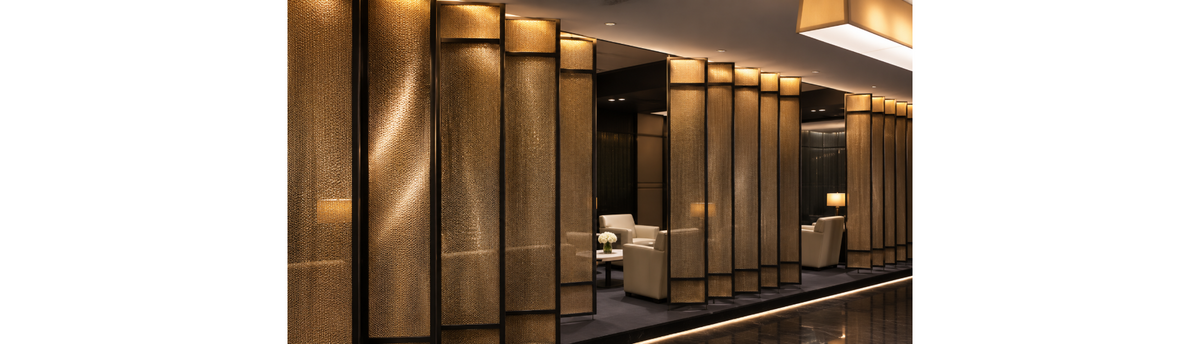

Metal fabric is a specialist decorative material that can be used to create distinctive wall coverings, glass-sandwich panels, decorative panels and wall-art installations. Its patterned metallic structure introduces texture and reflection, giving a wall a different visual character from conventional wallpaper or a solid metal sheet. Depending on the design and method of fabrication, metal fabric can be applied as a surface treatment, incorporated between glass layers or presented as a framed decorative feature.
Its appearance is closely connected to light. The metallic elements catch and reflect illumination, while the pattern creates visual depth and rhythm. A fine design may produce a subtle shimmer, whereas a more pronounced pattern can become a strong focal point. The result depends on the material, its scale, the surrounding finishes and the direction from which it is viewed.
This guide explains what metal fabric is, how it can be used on walls, what to consider when combining it with glass, and how lighting affects its appearance. It also covers scale, material selection and the practical points that should be resolved before installation.
- Metal fabric is a patterned metallic material that can be used as a decorative wall surface or as part of a larger installation.
- It can be incorporated between glass layers to create decorative glass panels.
- It can also be presented as wall art through framed or composed panel arrangements.
- Pattern, density, scale, finish and viewing distance influence its visual impact.
- Lighting affects how the metallic surface reflects light and reveals its texture.
- The material, substrate, fixing and fabrication method must be confirmed for the intended application.
In This Article
- What Is Metal Fabric for Interior Walls?
- LCD Textiles and Syntarqui
- Three Ways to Use Metal Fabric on Walls
- Metal Fabric in Glass-Sandwich Panels
- Using Metal Fabric as Wall Art
- How to Choose a Metal Fabric Design
- Where Metal Fabric Works Best
- How to Light Metal Fabric Walls
- Specification and Installation Considerations
- Common Mistakes to Avoid
- Explore Metal Fabric and Art Surface Coverings
- Frequently Asked Questions
What Is Metal Fabric for Interior Walls?
Metal fabric is a decorative material formed from fine metallic elements arranged in a woven, linked or patterned structure. Unlike a solid metal sheet, it has a textile-like visual quality. Depending on its construction, the surface may appear open and delicate, closely patterned, reflective or more graphic.
When used in interiors, metal fabric introduces a combination of pattern, texture and metallic reflection. Its appearance can change with the direction of light and the viewer's position. Some designs create a fine, detailed surface that is best appreciated at close range; others have a stronger pattern that remains visible across a larger room.
The term metal fabric does not describe one universal composition or installation system. Different designs may vary in their material, flexibility, finish, backing and intended use. A design suitable for one application should not automatically be assumed to be suitable for another. Product-specific information must guide the selection and installation.
For a broader view of how wall coverings, artwork, sculpture and lighting can be brought together, read the complete guide to luxury wall styling and statement walls.
How is metal fabric different from wallpaper and solid metal panels?
Wallpaper is generally selected as a decorative surface covering, with its appearance created through printing, pattern or texture. A solid metal panel provides a continuous, more rigid surface. Metal fabric has a different character: its patterned metallic structure introduces a textile-like quality, with visual depth and reflection that respond to light.
This difference matters when deciding how the material should be used. Metal fabric may form the visible wall finish, become an insert within a glass panel or be presented as a defined artwork. These applications involve different design and fabrication decisions.
| Material | Visual character | Typical design role |
|---|---|---|
| Wallpaper | Printed, patterned or textured surface | Continuous decorative wall finish |
| Solid metal panel | Continuous metallic surface with a defined form | Feature panel or fabricated installation |
| Metal fabric | Patterned metallic structure with a textile-like quality | Decorative wall covering, panel insert or wall-art composition |
| Metal fabric within glass | Metallic pattern viewed through a glass surface | Decorative glass panel or framed wall feature |
LCD Textiles and Syntarqui: Two Names to Explore
LCD Textiles and Syntarqui are two specialist names associated with the metal-fabric category at Spacio. They are relevant to this discussion because metal fabric can be considered beyond the conventional idea of a wall covering. Its pattern and metallic character can become part of a decorative surface, a glass-panel composition or an individual wall installation.
When comparing designs from either brand, begin with the actual material and pattern rather than assuming that every design has the same properties. Look at the density of the pattern, the metallic finish, the visual weight and the way the design changes when viewed from different distances. These details will influence whether it is better suited to a large wall, a defined panel or a smaller artwork.
The proposed application should also be considered at this stage. A design intended to be displayed as a wall covering may require a different backing or fixing approach from one being incorporated into glass. The brand name alone does not establish the technical suitability of a particular design for every installation.
For this reason, review the individual designs and confirm their product-specific information before making a final selection. The Spacio Metal Fabrics collection provides a starting point for comparing the available patterns and finishes, including Rain Gold.
Three Ways to Use Metal Fabric on Walls
Metal fabric can be used in three distinct ways in interior wall design: as a decorative wall covering, as a patterned insert within glass panels, or as wall art. Although the same material may be involved, the visual result and installation requirements are different.
1. As a decorative wall covering
When used as a wall covering, metal fabric becomes the visible decorative surface across a selected area. Its pattern creates continuity, while the metallic elements introduce texture and reflection. This application can give a feature wall a distinctive material quality without relying on a printed image or a conventional wallpaper pattern.
The scale of the wall and the repeat of the design need to be considered together. A fine, intricate pattern may be better suited to a wall that is viewed at a relatively close distance. A larger or more pronounced design may retain its presence across a spacious living room, entrance foyer or private lounge.
Before specifying a continuous application, establish how the material is intended to be fixed, what substrate is required and how the design will meet at corners, edges and adjoining finishes. The installation method must follow the instructions for the particular product.
2. As an insert within glass panels
Metal fabric can also be incorporated between glass layers to create a decorative glass-sandwich panel. In this application, the metallic pattern is viewed through the glass rather than remaining as an exposed surface. The combination brings together the texture and pattern of the fabric with the transparency and reflection of glass.
This approach changes the role of the material. Instead of covering the wall directly, the metal fabric becomes part of a defined panel. The panel can be used as a single feature or arranged with other panels to create a larger composition. Its dimensions, edges, spacing and position can all contribute to the final design.
The glass construction must be specified for the intended application. The term glass sandwich does not, by itself, confirm the type of glass, the fabrication process or the safety suitability of the completed panel. These details must be established by the glass fabricator and the project team.
3. As wall art or a decorative installation
Metal fabric can be presented as a defined artwork rather than used across the entire wall. A selected design may be framed or incorporated into a composed panel, allowing its pattern and metallic character to become the focal point. The surrounding wall then acts as a visual setting for the piece.
This application is useful when the intention is to introduce a distinctive material without creating a continuous metallic surface. A single panel can sit above a console or form part of an entrance feature. A series of panels can create rhythm across a wider wall, provided their sizes, spacing and relationship are planned as one composition.
The distinction between these three uses is important. A wall covering, a glass-sandwich panel and a framed artwork may share a material, but they are not interchangeable installation solutions. The intended role of the metal fabric should be decided before the design and fabrication are finalised.
Metal Fabric in Glass-Sandwich Panels
A glass-sandwich panel allows metal fabric to become part of a layered decorative surface. The fabric is positioned between glass layers, so the pattern can be seen through the glass. This creates a different visual effect from an exposed metal-fabric wall covering: the metallic pattern is viewed through a transparent surface, and the glass itself contributes reflections.
The panel format offers greater control over the composition. A single panel can become a focal point, while several panels can be arranged in a sequence or as a larger installation. The designer can consider the proportions of each panel, the gaps between them and the relationship with surrounding materials such as stone, wood or painted surfaces.
How the glass changes the appearance
Glass introduces transparency and reflection, while the metal fabric contributes pattern and metallic detail. Depending on the glass and the lighting conditions, the fabric may appear more layered or visually softened. The glass surface can also reflect objects and light sources elsewhere in the room, so the panel needs to be assessed from the main viewing positions.
The choice of glass should not be treated as a minor finishing decision. Clarity, thickness, edge treatment and the method of assembly affect both the appearance and the practical construction of the panel. The complete specification must be confirmed with the fabricator.
Where can glass-sandwich metal fabric panels be used?
- Living rooms: As a feature panel behind a seating arrangement or within a larger statement wall.
- Dining rooms: As a decorative backdrop that can be viewed from the dining table.
- Entrance foyers: As a framed material feature that establishes the character of the entrance.
- Private lounges and bars: As a decorative panel where controlled lighting can reveal the metallic pattern.
- Hospitality interiors: As part of a designed feature wall, subject to the project's technical and safety requirements.
For any of these settings, confirm the glass type, panel dimensions, edge finishing, support and fixing method for the actual installation. A decorative glass panel should not automatically be assumed to be suitable as a partition, balustrade or other safety-critical element.
Using Metal Fabric as Wall Art
When metal fabric is used as wall art, the focus shifts from covering a surface to creating a defined composition. The material becomes the subject of the wall rather than simply its finish. Its pattern, metallic quality and relationship with light can give an artwork a distinctive appearance that differs from conventional framed prints or paintings.
A single metal-fabric panel can work as a focal point above a console, in an entrance foyer or within a living room. Its proportions should relate to the wall and the furniture below it. A panel that is too small may appear isolated, while one that is too large can dominate the surrounding composition.
Single panels and multi-panel compositions
A single panel creates a clear visual anchor. It is often the more restrained option when the room already contains other strong features, such as large artwork, a statement light or sculptural furniture.
Several panels can be arranged to create a wider installation. They may follow a regular rhythm or form a more individual composition, but their relationship should be planned as a whole. Consistent spacing, considered proportions and a clear visual centre help the arrangement read as one artwork rather than a collection of separate pieces.
Combining metal fabric with other wall elements
Metal fabric can be considered alongside framed artwork, wall sculptures, textured surfaces and decorative lighting. The most important decision is which element should lead. If the metal-fabric panel is the focal point, the surrounding elements should support it through scale, colour or material rather than compete with its pattern and reflection.
For a broader selection of wall-art approaches, explore wall art prints and paintings and sculptures and art objects. These can help establish whether the wall needs a flat artwork, a dimensional feature or a combination of both.
How to Choose a Metal Fabric Design
The right metal fabric design depends on the scale of the wall, the intended application and the visual effect required. A metallic finish alone is not enough to make the choice. Pattern, density, colour, reflection and the relationship with nearby materials all influence the result.
Pattern and visual density
Look at the pattern as a complete surface. An open or fine design may create a lighter visual impression, while a denser pattern can carry more visual weight. Consider how much detail is already present in the room. If the furniture, flooring and other wall elements are highly patterned, a more restrained metal fabric may provide better balance.
Also consider the repeat of the design. On a large wall, the way the pattern continues across sections can affect the overall appearance. A small sample may not reveal how the repeat will look once installed, so review a larger sample wherever possible.
Colour and metallic finish
Metallic finishes can introduce warmth or a cooler reflective quality, depending on their tone and the materials around them. Gold-toned designs may work with warm woods, stone and softer neutral palettes, while cooler metallic finishes may sit comfortably alongside glass, darker surfaces and more restrained colour schemes.
Rain Gold is one of the designs to consider within the Spacio Metal Fabrics collection. When reviewing Rain Gold and the other available patterns, assess the actual finish under different lighting conditions. The appearance of a metallic surface can change considerably between daylight and evening illumination.
Scale and viewing distance
A pattern that looks intricate when viewed close up may become less noticeable from across a large room. Conversely, a bold design may feel visually dominant when used in a small panel. Consider where people will normally view the wall: from the entrance, from the main seating area, from a dining table or while moving through a foyer.
The scale of the metal fabric should also relate to the scale of the furniture and the wall itself. A continuous wall covering, a glass panel and a framed artwork will each require a different approach to proportion.
Relationship with surrounding materials
Metal fabric can be combined with glass, stone, wood and other decorative surfaces. Each material contributes something different. Glass introduces transparency and reflection; wood brings warmth; stone adds visual weight; and metal fabric contributes pattern and metallic detail.
The objective is to create a material relationship rather than assemble a collection of finishes. Select the dominant surface first, then decide which materials should provide contrast or support. The wider Art Surface Coverings collection offers a useful context for considering specialist decorative wall treatments alongside metal fabric.
Where Do Metal Fabric Wall Coverings Work Best?
Metal fabric can be considered in residential, hospitality and selected commercial interiors. Its suitability depends on the particular design, the proposed construction and the conditions of the space. The following applications illustrate where it may contribute to a wall composition.
Living rooms
In a living room, metal fabric can form a feature behind the seating arrangement or create a focal point on a wall visible from the entrance. A continuous surface may provide a distinctive backdrop, while a glass panel or framed composition can introduce the material in a more controlled way.
Consider the relationship with the sofa, coffee table, artwork and decorative lighting. If the room already contains a statement chandelier or a large artwork, a more restrained metal-fabric design may be appropriate.
Dining rooms
In a dining room, metal fabric can introduce pattern and reflection behind the table. The finish should be considered alongside the dining table, chairs, wall treatment and pendant lighting. A highly reflective design may create a strong evening effect, so it is important to assess how it looks from the seated position.
A defined panel may be more suitable than a continuous metallic surface when the dining room already has several decorative elements. The aim is to create atmosphere without distracting from the table and the people gathered around it.
Entrance foyers
An entrance foyer can provide a suitable setting for a framed metal-fabric panel or a carefully composed installation. The material can create an immediate point of interest, particularly when viewed alongside a console, mirror or sculptural object.
The scale should relate to the width and height of the foyer. A large, detailed installation may overwhelm a narrow entrance, while a proportionate panel can create a distinctive feature without crowding the space.
Bars, lounges and hospitality interiors
Metal fabric can also be considered for bars, private lounges, reception areas and selected hospitality interiors. Its metallic character can work with glass, darker finishes and controlled lighting to create a distinctive backdrop.
In these settings, the practical requirements need to be considered alongside appearance. Maintenance, access, fixing and the suitability of the specified construction should be confirmed for the intended use.
How to Light Metal Fabric Walls
Lighting changes how metal fabric is seen. It can reveal the pattern, emphasise the texture and create highlights across the metallic elements. The same design may appear subtle under even illumination and more dramatic when light falls across it from a particular direction.
The objective is to reveal the material rather than make the entire wall shine. The direction, intensity and position of the light should be considered in relation to the surface and the main viewing angles.
Grazing light to reveal texture
Grazing light falls across a surface at a shallow angle. It can emphasise the relief and pattern of a material by creating highlights and shadows. This approach may be worth considering when the metal fabric has a pronounced surface structure.
However, the effect depends on the specific design and its installation. A lighting position that reveals one pattern may create excessive highlights on another. Test the light against the actual material before finalising the arrangement.
Wall washing for a more even appearance
Wall washing creates a more even spread of light across a surface. It may be suitable when the intention is to reveal a larger area of metal fabric without drawing attention to individual details. The position and spacing of the light sources should be planned to avoid uneven brightness across the wall.
Focused lighting for panels and wall art
When metal fabric is used as a framed panel or wall artwork, focused lighting can help establish it as the main feature. The light should reveal the pattern and metallic finish without creating distracting reflections.
For glass-sandwich panels, consider both the glass surface and the metal fabric behind it. Reflections may come from the glass itself as well as from the metallic insert. The complete panel should therefore be assessed under the proposed lighting conditions.
Controlling glare and competing reflections
Reflective materials can create glare when a light source is positioned without considering the main viewing angles. This is particularly important in dining rooms and lounges where people may sit facing the wall.
Review the material from the positions where people will normally sit or stand. Adjust the direction and intensity of the light to reveal the surface while maintaining visual comfort. Also consider whether other reflective finishes in the room will create competing highlights.
Metal Fabric Wall Coverings: Specification and Installation Considerations
Metal fabric is a specialist decorative material, so its specification should begin with the exact design and the intended application. A material selected for a wall covering should not automatically be assumed to be suitable for a glass-sandwich panel or a framed artwork. The proposed construction and fixing method need to be confirmed before the design is finalised.
Confirm the material and product information
Establish the material composition, finish, dimensions and product-specific installation instructions. Confirm whether the design is intended for direct wall application, a panel system or another form of installation. Do not assume that different designs within the same category share identical technical properties.
Check the wall and substrate
The wall or backing surface, known as the substrate, can influence the finished result. It should be assessed for suitability, alignment and the fixing method required by the selected product. Any backing or support should be determined as part of the project specification rather than assumed in advance.
Plan joints, edges and transitions
On a large wall, the way the material meets at joints and edges can influence the overall appearance. Consider how the pattern continues across sections, where the material terminates and how it meets adjoining finishes. These details are particularly important when metal fabric is used across a continuous surface or several panels.
Confirm glass-panel requirements
For a glass-sandwich application, the fabricator should confirm the glass construction, panel dimensions, edge treatment, support and fixing method. The suitability of the complete assembly depends on its intended location and applicable project requirements. A decorative panel should not automatically be treated as suitable for a partition, balustrade or other safety-critical use.
Consider access and maintenance
Confirm the appropriate cleaning method for the specific metal fabric and finish. For glass panels, consider access to the visible surfaces and any areas that may be difficult to reach after installation. Larger installations should also be planned with future inspection and maintenance in mind.
Common Mistakes to Avoid
- Choosing only by appearance: A small sample may not reveal how the pattern will look across a large wall. Review the design at a representative scale.
- Ignoring viewing distance: Fine patterns and detailed textures may have a different visual impact from close up and from across the room.
- Overusing metallic surfaces: Too many reflective finishes can make a room visually busy. Balance metal fabric with quieter materials.
- Using unsuitable lighting: Poorly positioned lights can create glare or uneven reflections. Test the effect with the actual material.
- Confusing different applications: A wall covering, a glass-sandwich panel and a framed artwork require different design and fabrication decisions.
- Assuming all designs have the same technical properties: Material composition, fixing and suitability must be confirmed for the selected design.
- Leaving installation details until the end: Substrate preparation, joints, edges, access and maintenance should be considered before the material is ordered.
Explore Metal Fabric and Art Surface Coverings at Spacio
Metal fabric offers another way to approach statement walls. It can be used as a decorative surface, incorporated into a glass panel or presented as wall art. The right application depends on the design, the surrounding materials, the scale of the wall and the intended lighting effect. The Art Surface Coverings collection provides a wider context for comparing specialist decorative wall treatments.
For related guidance on specialist wall surfaces, see Luxury Wall Coverings: Wallpaper, Murals, Fresco and Metal Fabric Compared.
Frequently Asked Questions
What is metal fabric wall covering?
Metal fabric wall covering is a decorative wall treatment made from a patterned metallic material with a textile-like appearance. It introduces texture and reflection and can be used as a wall surface or as part of a larger decorative installation. Its appearance differs from conventional wallpaper and solid metal panels.
Can metal fabric be used inside glass panels?
Yes. Metal fabric can be incorporated between glass layers to create decorative glass-sandwich panels. The metallic pattern is viewed through the glass, creating a layered effect. The glass type, panel construction, fixing and suitability for the intended location must be confirmed by the fabricator.
Can metal fabric be used as wall art?
Yes. Depending on the design and construction, metal fabric can be presented as a framed panel or as part of a larger wall-art installation. It can create a focal point without covering the entire wall. The scale, spacing, frame and surrounding finishes should be considered together.
How should metal fabric walls be illuminated?
Lighting should reveal the pattern and metallic character without creating excessive glare. Grazing light may emphasise texture, wall washing can provide a more even appearance, and focused lighting can highlight a framed panel. The best approach depends on the design, finish and viewing positions.
Where can metal fabric wall coverings be used?
Metal fabric may be considered for living rooms, dining spaces, entrance foyers, private lounges, bars and selected hospitality interiors. Its suitability depends on the specific material, installation method, maintenance requirements and conditions of the location.
Which brands should I explore for metal fabric wall applications?
LCD Textiles and Syntarqui are two names to explore when considering metal fabric for decorative wall applications. Review the individual designs and their product information before deciding whether the material is suitable as a wall covering, a glass-panel insert or a wall-art feature.
Where can I see metal fabric designs and interior styling solutions in Mumbai?
You can visit Spacio's Mumbai store at 3BK, Laxmi Industrial Estate, New Link Road, Andheri West, Mumbai 400 053. Customers can explore luxury interior collections, including decorative wall surfaces and objects, and discuss wall styling and interior styling requirements with the team. Find the Spacio Mumbai store.
Where can I experience metal fabric designs and interior styling solutions in Kolkata?
Spacio's Kolkata store is located at 86B Topsia Road South, Kolkata 700 046. Customers can explore luxury interior collections and discuss wall styling and interior styling requirements for their homes and projects. Find the Spacio Kolkata store.


