
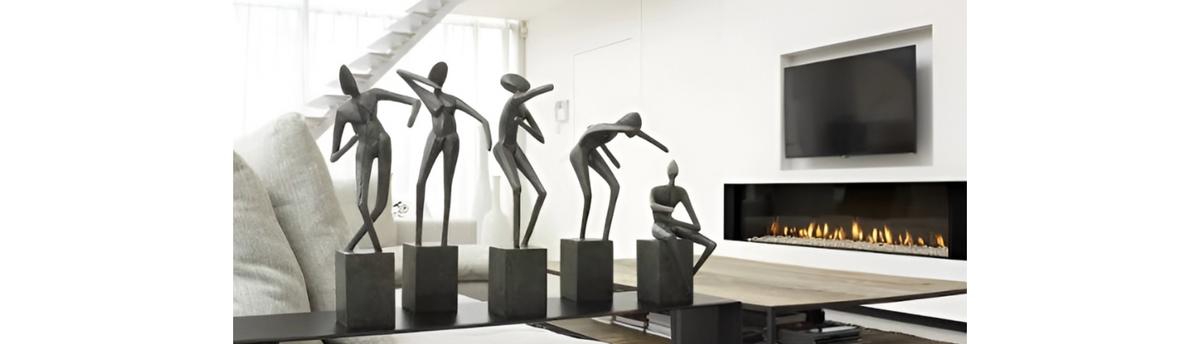

Choosing a sculpture or art object for a luxury home is not simply a matter of finding something beautiful. The right piece should have a clear relationship with the room, its furniture, materials, lighting and the way the space is experienced. Scale, proportion, craftsmanship, material, visual weight and placement all influence whether an object feels considered or simply added to the room.
For homeowners, interior designers and architects, the decision becomes even more interesting when the object is intended to be collected rather than replaced with the next trend. A well-chosen sculpture can remain relevant through different interiors and stages of life, while a distinctive art object can become part of the character of a home. This guide explains what to look for when choosing luxury sculptures and art objects, from crystal and Murano glass to metal, mixed media, porcelain, ceramic and wood.
If you are building a broader collection of decorative pieces, Spacio's guide to luxury home decor accessories for modern Indian homes provides the wider context for selecting objects according to design, material, scale and interior application.
Table of Contents
- What Makes a Sculpture or Art Object Right for a Luxury Home?
- Start with the Purpose of the Object
- Choose the Right Scale and Proportion
- Consider the Material and Craftsmanship
- Explore Different Types of Luxury Sculptures and Art Objects
- Why Provenance and Collectability Matter
- Match the Object to the Interior
- Choose the Right Place for the Sculpture
- Consider the Relationship with Furniture
- How Sculptures Work Around Major Focal Points
- Should You Display One Sculpture or Several?
- Common Mistakes When Choosing Sculptures
- How to Build a Sculpture Collection Over Time
- Frequently Asked Questions
- Choose the Object for the Room, Not the Room for the Object
What Makes a Sculpture or Art Object Right for a Luxury Home?
The right sculpture is one that contributes something meaningful to the interior. That contribution may come from form, material, colour, texture, symbolism, craftsmanship or simply the visual balance it creates within the room.
A luxury sculpture does not necessarily need to be large, expensive-looking or visually dramatic. A smaller crystal object can have greater impact than a large sculpture if it is better suited to the scale of the room. Similarly, a restrained piece of porcelain or glass may work more effectively in a calm interior than an object with a strong colour or complex form.
The starting point should therefore be the relationship between the object and the home. Ask what the room needs before asking which sculpture you like.
A good sculpture or art object for a luxury home should be selected according to its design, material, craftsmanship, scale, proportion, provenance, placement and relationship with the surrounding interior. The most successful pieces feel collected rather than simply displayed.
Start with the Purpose of the Object
Before choosing a sculpture, decide what role you want it to play. Is it intended to become the focal point of a living room? Is it meant to add interest to a console? Does a large entrance foyer need a vertical sculptural form? Or are you looking for a smaller art object that can sit among books, vases and other accessories?
This distinction matters because different objects have different visual responsibilities. A statement sculpture, particularly when it is one of the statement home decor accessories defining a room, needs enough surrounding space to be appreciated.
This is also why the Sculptures & Art Objects collection should be viewed as a broad category rather than a single style. It includes objects that can play very different roles within residential interiors.
Choose the Right Scale and Proportion
Scale is one of the most important considerations when choosing a sculpture. An object that looks impressive in isolation can feel lost on a large console, while the same piece may overwhelm a compact side table.
Consider the dimensions of the furniture first. A sculpture placed on a console should have enough visual presence to relate to the width of the console without occupying the entire surface. On a centre table, the height and footprint should allow people to see across the room and comfortably use the table.
Floor sculptures require a different approach. Their relationship is less about a tabletop and more about ceiling height, circulation, furniture scale and viewing distance. In a double-height entrance, for example, a vertically oriented sculpture may need considerably more presence than one selected for a compact apartment foyer.
Scale should also be considered relative to the surrounding architecture. A large sculpture against a quiet wall can create a strong focal point, while several small pieces may become visually insignificant if the wall, furniture and room around them are too dominant.
Consider the Material and Craftsmanship
Material changes how a sculpture is perceived. Glass can introduce transparency and light. Crystal can create reflection and visual brilliance. Metal can provide weight and definition, while wood introduces warmth and natural texture. Porcelain and ceramic can bring a more tactile, crafted quality to an interior.
Craftsmanship is equally important. Look beyond the general appearance of the object and consider how the material has been worked, finished and assembled. Details that are subtle from a distance can become important when the object is viewed closely on a console, shelf or centre table.
For this reason, choosing a sculpture is not simply a choice of colour or shape. It is a choice of materiality and how that material interacts with the rest of the room.
This is particularly relevant when working with premium and high-end home decor accessories. The object should not only look appropriate in a photograph. It should continue to feel considered when experienced at different distances and in different lighting conditions.
Explore Different Types of Luxury Sculptures and Art Objects
Luxury sculpture is not one visual category. Different materials and production traditions create very different experiences. Spacio's sculpture and art object collections allow homeowners and designers to explore the category through material, technique and design language.
- Crystal sculptures: Crystal Sculptures can introduce reflection, brilliance and a sense of visual lightness.
- Glass sculptures: Glass Sculptures can bring transparency, colour and fluidity into a composition.
- Metal sculptures: Metal Sculptures often create stronger visual weight and can work well against stone, timber and quieter finishes.
- Mixed media sculptures: Mixed Media Sculptures combine different materials to create contrast, texture and complexity.
- Murano glass sculptures: Murano Glass Sculptures bring the distinctive visual character of artistic Venetian glassmaking into contemporary interiors.
- Porcelain and ceramic sculptures: Porcelain & Ceramic Sculptures can add crafted texture and a more tactile presence.
- Wood sculptures: Wood Sculptures introduce natural grain, warmth and an organic quality.
- Objects of curiosity: Objects of Curiosity can be particularly interesting for collectors who want pieces with character, originality or an unusual visual story.
- Wall sculptures and murals: Wall Art, Sculptures & Murals allow the sculptural idea to become part of the wall composition rather than sitting independently on a surface.
These categories are useful starting points, but material alone should never determine the choice. A crystal sculpture may work beautifully in one interior and feel disconnected in another. The surrounding palette, lighting, furniture and architectural setting still matter.
Why Provenance and Collectability Matter
When a decorative object is being considered as part of a collection, provenance becomes more relevant. Provenance can help establish where an object came from, who designed it, how it was produced and, where applicable, whether it belongs to a particular edition or body of work.
Collectability does not automatically mean that an object is an investment. It means that the piece has qualities that can make it meaningful to own over time. Design authorship, craftsmanship, rarity, production method, material and the story behind the object can all contribute to that sense of collectability.
For Indian buyers purchasing international decorative objects, provenance can also help distinguish an original design or authorised production from visually similar reproductions whose appearance may be close but whose design authorship and manufacturing origin are different.
The strongest reason to collect, however, is still personal. A sculpture should first be something you want to live with. Its long-term relevance comes from the quality of the object and the relationship you develop with it, not simply from the possibility that it may become valuable later.
Match the Object to the Interior
A sculpture does not have to match the furniture around it. In fact, excessive matching can make a room feel predictable. What matters is whether there is a meaningful relationship between the object and the interior.
A contemporary sculpture can sit comfortably within a warm, material-rich interior if its form provides contrast. A traditional-looking object can bring depth to a modern room when its material or silhouette creates a useful counterpoint. Glass can sit against stone. Metal can contrast with timber. Ceramic can soften a room dominated by hard surfaces.
The goal is cohesion rather than coordination. Repeating one material, finish or colour somewhere else in the room can create continuity without making every object appear as though it was purchased as a set.
This principle also connects with Spacio's recent article on mixing vases, sculptures, books and decorative objects in one room, where the emphasis is on relationships between objects rather than isolated pieces.
Choose the Right Place for the Sculpture
Placement can completely change the impact of a sculpture. The same object can appear quiet on a crowded shelf but become a strong focal point when given a clear background and sufficient negative space.
Common locations include living room consoles, centre tables, side tables, dining sideboards, entrance foyers, bookshelves, niches, studies and bedrooms. Larger floor sculptures can also work in circulation areas where they can be viewed from more than one direction.
For surface styling, Spacio's console collection and centre table collection provide useful contexts for understanding how scale and proportion influence the placement of sculptural objects.
Plinths can also be useful when a sculpture deserves to be lifted visually from the surrounding furniture. A pedestal or plinth gives a three-dimensional object its own visual territory and can be particularly effective in foyers, niches and larger rooms.
Consider the Relationship with Furniture
Furniture provides the scale against which many decorative objects are judged. A sculpture on a console should relate to the width, height and visual weight of the console. A sculpture on a centre table should work with the seating arrangement and not obstruct the experience of the room.
Sideboards can accommodate slightly broader compositions because they provide more horizontal space. A sculpture can then be balanced with a vase, bowl, books or another quieter object rather than standing alone.
The same principle applies across a wider interior. Spacio's furniture collection provides the larger context in which decorative objects should be considered. Furniture establishes function and visual weight; sculptures and art objects then add personality and visual punctuation.
For more guidance on surface composition, see How to Style Consoles, Coffee Tables and Shelves with Luxury Home Decor Accessories.
How Sculptures Work Around Major Focal Points
Some rooms already have a dominant focal point. A large artwork, a double-height feature, a statement chandelier or a fireplace can command attention before decorative objects are introduced.
In such situations, sculptures should support the visual hierarchy rather than compete with it. A quieter object may work better beside a major focal point than another highly expressive sculpture.
This is particularly relevant around a fireplace. A fireplace can become a major architectural and visual element in a living room, so decorative objects positioned nearby should acknowledge its scale and presence rather than fight for attention.
The principle is simple: not every object needs to be the hero. Sometimes the best sculpture is the one that makes the main focal point feel more complete.
Should You Display One Sculpture or Several?
There is no fixed number of sculptures that makes an interior feel luxurious. The decision depends on the room, the objects and the visual hierarchy.
A single statement sculpture can be powerful when it has enough space around it. Several smaller objects can work when they have differences in height, shape, material or visual weight. The mistake is usually not having several objects; it is giving every object equal importance.
When grouping sculptures, look for relationships rather than matching pieces. Contrast can be useful: vertical against horizontal, transparent against solid, smooth against textured, dark against light. These differences create visual rhythm while keeping the arrangement connected.
Other accessories can then provide quieter layers. A sculpture might sit alongside a decorative vase, a decorative bowl or a small stack of coffee table books without turning the surface into a collection of competing statements.
Common Mistakes When Choosing Sculptures
- Choosing by appearance alone: A sculpture can look impressive online but still be wrong for the scale or character of the room.
- Ignoring proportion: The size of the object should relate to the furniture, wall, ceiling height and viewing distance.
- Using too many statement pieces: If every object demands attention, the room loses visual hierarchy.
- Matching everything too closely: A coordinated set can sometimes feel less personal than a carefully curated collection.
- Ignoring the viewing angle: Sculptural forms should be considered from the positions from which they will actually be seen.
- Forgetting negative space: A strong object needs breathing room around it.
- Buying without considering longevity: A sculpture intended to become part of a collection should be interesting beyond a short-lived trend.
- Confusing size with impact: A statement sculpture is defined by visual presence, not simply physical dimensions.
These principles are closely related to the wider approach used when selecting luxury home decor objects based on design, materials, craftsmanship and collectability. The object should earn its place through quality and relevance rather than simply through price or size.
How to Build a Sculpture Collection Over Time
A collection does not need to be created all at once. In fact, allowing it to develop gradually can result in a more personal interior.
Start by identifying what genuinely interests you. You may be drawn to Murano glass, crystal, abstract metal forms, handcrafted ceramics, figurative sculpture or unusual objects of curiosity. Over time, recurring preferences in material, form or subject can give the collection an underlying identity.
Do not worry about making every piece look as though it belongs to the same series. A collection can be more interesting when it contains contrast. A contemporary glass sculpture can sit alongside a warm wooden form. A restrained ceramic object can balance a more expressive metal piece.
The important thing is that each acquisition has a reason for being there. It may remind you of a place, represent an artistic idea you appreciate, introduce a material that was missing from the room or simply be an object you continue to enjoy looking at.
Over time, these decisions turn decorative objects into a personal collection rather than a group of purchases.
Before adding a sculpture, ask: Would I still want to live with this object if it were placed in a different room five years from now?
Frequently Asked Questions
What is the best material for a luxury sculpture?
There is no single best material. Crystal, glass, Murano glass, metal, mixed media, porcelain, ceramic and wood can all work beautifully. The better choice depends on the room, existing materials, lighting, scale and the character you want the sculpture to introduce.
How do I choose the right size sculpture for my home?
Start with the furniture or space where the sculpture will be placed. Consider the width and height of the surface, the viewing distance, ceiling height and the amount of negative space available. A sculpture should have enough presence to be noticed without making the composition feel crowded.
Are large sculptures suitable for apartments?
Yes. The important consideration is proportion rather than the overall size of the home. A carefully selected floor sculpture can work in an apartment foyer or living room if it respects circulation, ceiling height and the visual weight of the surrounding furniture.
Should sculptures match the furniture?
Not necessarily. Sculptures can introduce useful contrast. The aim is to create a relationship between the object and the interior through material, colour, form or scale rather than matching every element.
How do I style several sculptures together?
Give the grouping a clear hierarchy. Vary height, shape, material or visual weight, and avoid making every object equally dominant. Negative space is just as important as the objects themselves.
Are sculptures a good investment for a luxury home?
A sculpture can be a long-term acquisition, but it is better to think first about design, craftsmanship, provenance and personal relevance rather than financial return. Collectability can add interest, but a piece should have value to you even without an investment expectation.
Can sculptures be used with other home decor accessories?
Yes. Sculptures often work well with vases, bowls, trays, books, mirrors and other decorative objects. The key is to create a hierarchy so that the objects support one another rather than compete for attention. Spacio's Decor Accessories collection provides a wider selection of complementary categories.
Choose the Object for the Room, Not the Room for the Object
The best sculpture for a luxury home is rarely the object that simply looks impressive on its own. It is the one that becomes more interesting because of where it is placed and how it relates to everything around it.
Look at scale before style. Consider material before colour. Understand craftsmanship and provenance before assuming that price represents quality. Think about how the object will be viewed, what furniture it will sit beside and whether it deserves to stand alone or become part of a larger composition.
Most importantly, give yourself permission to collect slowly. A home becomes more personal when its objects are chosen with intention. Sculptures and art objects can then do more than decorate a room; they can introduce character, memory, materiality and a sense of curation that develops over time.
For those beginning or refining a collection, explore Spacio's complete Sculptures & Art Objects collection and explore the different materials and forms available for contemporary Indian homes.


