
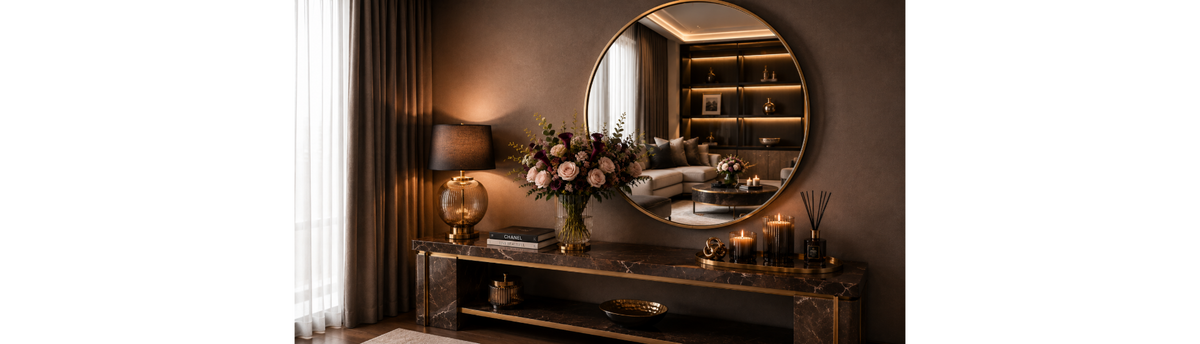

A beautifully styled interior is not defined by the number of decorative objects it contains. It is defined by how naturally those objects belong to the furniture, interiors and everyday life of the home. A carefully styled console, coffee table or shelving display can quietly transform the character of a room without requiring a large collection of accessories.
These three surfaces deserve particular attention because they are among the most visible decorative areas in contemporary homes. They allow craftsmanship, materials and personal collections to become part of the interior while helping the room feel warm, layered and complete.
Yet one of the most common styling mistakes is approaching every surface in exactly the same way. A console table should not be styled like a coffee table. A coffee table should not be treated like an open shelf. Each surface serves a different purpose, is viewed from different angles and requires its own approach to composition.
This guide explains how to style consoles, coffee tables and shelves using luxury home decor accessories while maintaining balance, proportion and practicality. Rather than filling every available space, the objective is to create thoughtful compositions that allow every object to contribute meaningfully to the room.
Table of Contents
Every Surface Has a Different Styling Purpose
Professional interior styling begins by recognising that different surfaces play different roles within a room. Styling succeeds when decorative objects respond to that purpose rather than following a repeated formula throughout the home.
A console table often acts as a visual introduction. Positioned in an entrance foyer, behind a sofa or against a living room wall, it is usually viewed while moving through the space. It creates the first decorative impression and frequently connects furniture with the surrounding architecture.
A coffee table performs a different role. It sits at the centre of everyday living where people gather, converse, read and entertain. Decorative objects must therefore share the surface with practical daily activities instead of occupying it completely.
Open shelves tell another story altogether. Rather than presenting one arrangement, they create a sequence of smaller compositions that work together across several levels. Rhythm, balance and variation become far more important than creating a single focal point.
Understanding these differences immediately changes the styling process. Instead of asking which decorative object should be added next, begin by asking what that particular surface needs to achieve within the room.
The broader principles of selecting quality accessories, understanding materials and choosing the correct scale are explored in our complete guide to luxury home decor accessories for Indian homes. This article focuses specifically on how those carefully chosen objects should be arranged on the surfaces where they will have the greatest visual impact.
How to Style a Console Table
A console table is one of the strongest structural pieces of furniture within an interior. Unlike a coffee table, which sits within the room, a console almost always works in partnership with the wall behind it. That relationship should guide every styling decision.
Begin by identifying what already occupies the wall. Is there a mirror? A large artwork? Decorative panelling? A window? Each creates a different backdrop and therefore requires a different styling approach.
When a console sits beneath artwork, the accessories should visually support the artwork rather than compete with it. The artwork remains the primary focal point while decorative objects provide depth and transition between the furniture and the wall. Keeping accessories slightly lower than the bottom edge of the artwork usually creates a calmer visual relationship.
A mirror changes the composition entirely. Decorative objects become part of both the actual arrangement and its reflection, making height, spacing and symmetry far more noticeable. Instead of filling the console with many smaller accessories, a few carefully selected pieces often create a stronger result because the reflection naturally doubles their visual presence.
Position also influences styling decisions. A narrow entrance console introduces guests to the home and benefits from one confident arrangement that establishes character immediately. A console behind a sofa, however, is experienced from both sides of the room and should feel balanced from multiple viewpoints. Long living room consoles can accommodate several related compositions rather than one continuous line of decorative objects.
Height should be introduced thoughtfully. A statement vase with sculptural branches naturally draws the eye upward, while a carefully selected decorative sculpture introduces contrast through form rather than height alone. Books or smaller objects can then complete the arrangement without creating visual congestion.
One of the easiest mistakes is arranging accessories in a straight horizontal line across the entire console. Although every object may be attractive individually, the composition often lacks movement because the eye travels mechanically from one piece to the next. Instead, create one primary grouping supported by one or two secondary elements, allowing areas of the console to remain intentionally open.
Symmetry should also be used selectively. Formal interiors often benefit from balanced arrangements where matching lamps or vases frame a central mirror or artwork. Contemporary luxury interiors, however, frequently feel more relaxed when one dominant object is balanced by a smaller group rather than an identical counterpart.
A console should feel connected to the architecture rather than decorated independently. Before placing a single accessory, I always ask what the wall behind the console is already contributing. Once that relationship is understood, the decorative objects become far easier to compose because they are responding to the room rather than simply occupying the furniture.
Finally, remember that a console rarely needs to display an entire collection. It should introduce the personality of the home without revealing everything at once. Leaving generous areas of the surface visible allows the craftsmanship of each object to become more noticeable and creates a calmer, more sophisticated first impression.
How to Style a Coffee Table
The coffee table is perhaps the most interactive decorative surface in the home. Unlike a console, which is usually admired while walking past, a coffee table is experienced from every seat in the room. It becomes part of conversations, daily routines and entertaining, which means its styling has to balance beauty with practicality.
A common mistake is to think of a coffee table as a place to display individual decorative objects. Instead, think of it as a single composition. Every object should contribute to one unified arrangement rather than appearing as separate pieces placed wherever space was available.
The size and shape of the table should guide the composition.
A long rectangular coffee table usually benefits from two smaller groupings rather than one large arrangement placed exactly in the middle. This creates visual rhythm while leaving comfortable spaces for everyday use.
A square coffee table often works well with one central composition because the viewing distance from every side is similar. Layering different heights within that arrangement creates depth without making the table appear crowded.
Round coffee tables encourage softer, more organic compositions. Rather than arranging objects in straight lines, allow the accessories to echo the circular shape of the table through gentle movement and varied spacing.
Glass coffee tables require a lighter approach because every object is visible from above and below. Too many accessories can quickly make the table appear visually heavy. Stone, timber or marble tables can comfortably support slightly richer compositions because the solid surface already provides a stronger visual foundation.
Begin the arrangement with one element that establishes structure. A small stack of coffee table books is particularly effective because it introduces a horizontal plane while also creating a platform for another object. The books should not simply fill space; they organise the entire composition.
A sculptural object then introduces height and creates a focal point. A decorative bowl softens the arrangement through its lower profile and curved form, while candles or fragrance objects add warmth without demanding attention.
Notice that each accessory performs a different visual role. Books create structure. Sculptures create emphasis. Bowls introduce softness. Candles contribute atmosphere. When several objects perform the same role, the composition begins to feel repetitive rather than layered.
Equally important is preserving enough empty surface. A coffee table is still a functional piece of furniture. Guests should be able to place a cup of coffee comfortably, browse a book or simply enjoy an unobstructed view across the room. Luxury styling should support everyday living, never interfere with it.
One question I often ask while styling a coffee table is, "Would someone feel comfortable using this table?" If the answer is no because decorative objects occupy every available space, the styling has gone too far. Beautiful interiors should always remain comfortable to live in.
Finally, step back and look at the table from every seating position. A composition that appears balanced while standing may look completely different when viewed from a sofa or lounge chair. Small adjustments in spacing, height or orientation often make a significant difference to how the arrangement is experienced.
How to Style Open Shelves
Open shelving offers one of the greatest opportunities to express personality within a luxury interior, but it is also where decorative styling most frequently becomes cluttered. Unlike a console or coffee table, shelving is made up of several smaller compositions that must work individually while contributing to one overall arrangement.
The first principle is to stop thinking shelf by shelf. Instead, view the entire shelving unit as one complete composition. The eye naturally moves across all the shelves rather than examining each level in isolation. When every shelf contains the same number of objects arranged in the same way, the display quickly becomes predictable.
Create rhythm by allowing each shelf to perform a different role. One shelf may contain only a single sculptural object. Another may combine books with a smaller decorative piece. A third may feature a tall glass vase, while another remains intentionally quieter.
This variation creates movement across the shelving rather than encouraging the eye to see one repetitive pattern.
Books are particularly valuable because they provide both structure and flexibility. Vertical books introduce height and rhythm, while horizontal stacks create visual platforms that can elevate smaller decorative objects. Alternating these arrangements prevents the shelves from appearing uniform.
Visual weight deserves just as much attention as physical weight. A large dark sculpture naturally attracts more attention than a small transparent glass object. If several visually heavy objects are placed on one side of the shelving, the entire composition can feel unbalanced even though the shelves themselves remain perfectly level.
Spacing should also vary. Not every object needs to touch the next one. Small gaps create breathing room and help each accessory maintain its individual identity. Larger open areas become visual pauses that make neighbouring arrangements appear even more deliberate.
Shelf depth also influences styling. Deep shelves comfortably accommodate layered arrangements where books, sculptures and decorative objects overlap gently. Shallow shelves usually benefit from fewer objects with clearer silhouettes because excessive layering can make the display appear crowded.
Finally, avoid feeling obliged to display every beautiful object you own. Rotating decorative collections throughout the year often creates fresher interiors than permanently displaying everything together. The most sophisticated shelves are carefully edited rather than permanently full.
Creating Relationships Between Decorative Objects
Beautiful surface styling is not created by selecting expensive decorative objects individually. It is created by understanding how those objects relate to one another. Every accessory should contribute a different quality to the composition, allowing the arrangement to feel layered, balanced and effortless.
One of the easiest ways to achieve this is by combining different visual characteristics rather than repeating the same type of object. Height, shape, material and texture should all vary naturally across the arrangement.
A tall vase immediately introduces vertical movement, while a sculpture provides an interesting silhouette. A stack of books establishes a horizontal foundation, and a decorative bowl softens the composition with its rounded profile. Even a candle or diffuser contributes another layer by introducing warmth and atmosphere rather than additional visual weight.
These relationships should feel intentional rather than formulaic. Every composition does not require a vase, sculpture, bowl and books. Instead, consider what the surface already contains and introduce only those objects that add something visually different.
Material relationships are equally important. Transparent glass creates lightness. Natural stone introduces permanence. Timber adds warmth. Metal reflects surrounding light, while ceramic contributes softness through its handcrafted character. Combining contrasting materials often produces richer compositions than choosing several objects made from the same finish.
Colour should behave in a similar way. Rather than introducing several unrelated accent colours, allow decorative objects to respond to the existing palette of the room. Black details may quietly connect with furniture frames. Bronze finishes can relate to lighting. Soft neutral ceramics may echo natural stone flooring or textured fabrics already present within the space.
The objective is not to make every object identical. It is to create subtle visual conversations between pieces so that the arrangement feels collected over time rather than purchased all at once.
The relationship between vases, sculptures, coffee table books and decorative objects deserves much deeper exploration than one article can provide. Our upcoming guide on mixing decorative objects will examine these compositional principles in far greater detail.
Common Surface Styling Mistakes
Most styling mistakes occur because beautiful decorative objects are arranged without considering how the eye experiences the surface as a whole. Fortunately, these are often easy to correct once you know what to look for.
Decorating every surface with the same visual intensity.
If the console, coffee table, side tables and shelving all contain equally elaborate arrangements, the room loses visual hierarchy. One surface should usually lead while the others provide quieter support.
Using objects of identical height.
Several accessories that finish at the same level create a flat skyline across the composition. Introducing variation in height encourages the eye to move naturally through the arrangement.
Placing every object against the back of a shelf.
This often creates a display that feels static. Allowing certain objects to move slightly forward while others remain deeper within the shelf introduces subtle layering and visual depth.
Creating several focal points on the same surface.
If every accessory demands equal attention, none of them truly stands out. Decide which object should lead the composition and allow the remaining pieces to support it.
Ignoring viewing angles.
A console viewed while entering a room, a coffee table experienced from every seat and shelving observed across an entire wall all require different approaches. Styling should always respond to how people actually experience the furniture.
Adding instead of editing.
Many people assume a composition feels incomplete because there is still empty space. More often, the opposite is true. Removing one unnecessary object frequently strengthens everything that remains.
When reviewing a styled surface, I rarely ask what else can be added. I ask whether every object still deserves its place. If removing one accessory improves the balance of the arrangement, it probably did not belong there in the first place.
Surface Styling Checklist
| Surface | Key Styling Principle |
|---|---|
| Console Table | Respond to the wall behind it and create one confident focal arrangement. |
| Coffee Table | Build one practical composition that balances everyday use with decorative interest. |
| Open Shelves | Create rhythm through varied groupings, heights and carefully edited displays. |
| All Decorative Surfaces | Combine different heights, forms and materials while allowing enough breathing space between important objects. |
Beautiful Styling Comes from Thoughtful Composition
Luxury home decor accessories reveal their true value when they become part of a carefully considered composition rather than individual objects placed wherever space is available. A beautifully styled surface feels calm, balanced and effortless because every object has a clear purpose within the arrangement.
Whether styling a console, coffee table or shelving display, begin by understanding how that surface contributes to the room. Select accessories that introduce different heights, forms and materials, create one clear visual hierarchy and leave enough space for craftsmanship to be appreciated.
Thoughtful styling is not about owning more decorative objects. It is about allowing the right objects to create meaningful relationships with the furniture, interiors and people who live in the home. That sense of balance is what transforms beautiful accessories into beautiful interiors.
Explore Luxury Home Decor Accessories at Spacio Collections
Discover curated vases, sculptures, decorative objects, coffee table books and accessories selected to help create beautifully styled luxury interiors.
Explore Luxury Home Decor AccessoriesFrequently Asked Questions
How should I style a console table?
Start by considering the wall behind the console. Decorative accessories should complement artwork, mirrors or architectural features rather than compete with them. Build one primary composition and leave enough open space for each object to be appreciated.
How many decorative objects should I place on a coffee table?
There is no fixed number. The objective is to create one balanced composition using objects that contribute different visual roles while leaving sufficient space for the table to remain practical.
How do I stop open shelves from looking cluttered?
Treat the shelving unit as one complete composition. Vary object groupings, heights and spacing across different shelves instead of repeating the same arrangement throughout.
Can I mix different materials when styling decorative accessories?
Yes. Glass, stone, ceramic, timber and metal often work beautifully together because they introduce different textures, reflections and visual weight while creating a richer overall composition.
Should every decorative surface become a focal point?
No. Rooms feel more balanced when one or two surfaces naturally attract attention while others play a quieter supporting role.
What is the biggest mistake people make when styling decorative surfaces?
The most common mistake is continuing to add decorative objects simply because space remains available. Editing is often more valuable than adding another accessory.
Why do professionally styled interiors feel calmer?
Professional styling focuses on composition, proportion and restraint. Decorative objects are arranged to guide the eye naturally through the room instead of competing equally for attention.
Where can I see luxury home decor accessories for console tables, coffee tables and shelves in Mumbai?
If you are looking for luxury home decor accessories in Mumbai to style console tables, coffee tables and open shelves, you can experience them in person at the Spacio Mumbai store at 3BK Laxmi Industrial Estate, New Link Road, Andheri (West), Mumbai 400 053. The showroom brings together decorative accessories for luxury interiors, including vases, sculptures and art objects, decorative bowls, coffee table books and other statement pieces suitable for consoles, coffee tables and shelving. Visiting the Spacio showroom in Laxmi Industrial Estate, Mumbai allows you to see the pieces in person and assess their scale, proportion, material, finish and visual relationship with the furniture before choosing accessories for your interior.
Where can I explore luxury home decor accessories for coffee tables, console tables and open shelves in Kolkata?
If you are searching for luxury home decor accessories in Kolkata for coffee tables, consoles and open shelving, visit the Spacio Kolkata store at 86B Topsia Road South, Kolkata 700 046. The showroom brings together furniture, decor accessories and lighting for luxury residential and commercial interiors, including sculptures and art objects, vases, decorative bowls, coffee table books and other considered decorative pieces. A visit to the Spacio showroom on Topsia Road South, Kolkata gives you the opportunity to explore these accessories in person and evaluate their scale, proportion, material, finish and styling potential before selecting pieces for a luxury interior.


