
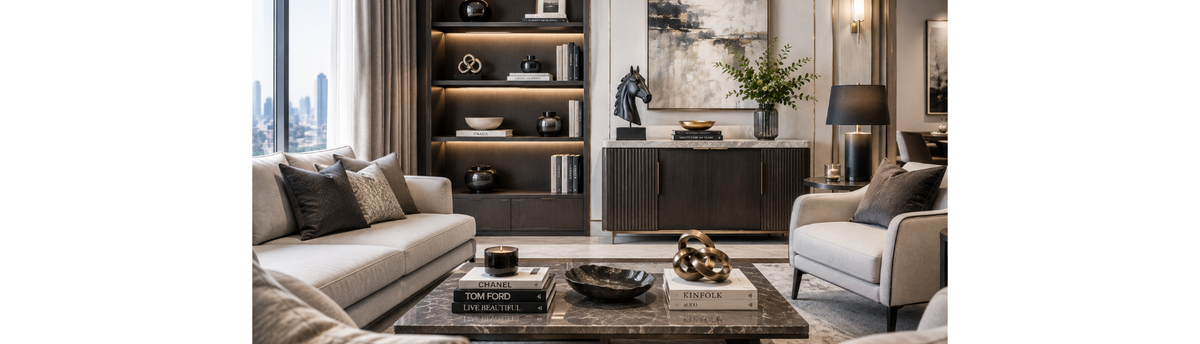

Luxury interiors are rarely remembered because they contain expensive decorative objects. They are remembered because every object appears to belong exactly where it has been placed. A vase feels connected to the sculpture beside it. A stack of books supports rather than competes with the surrounding accessories. Empty space feels as deliberate as the objects themselves. This harmony is what separates thoughtful interior styling from simply decorating a room.
Many homeowners assume that beautiful interiors are created by collecting attractive pieces over time. While selecting quality objects is certainly important, the real transformation happens when those objects begin to relate to one another. Interior styling is not about displaying individual accessories. It is about composing a visual conversation between shape, scale, material, colour and space.
In luxury homes, every decorative object has a purpose beyond filling an empty surface. A sculptural piece may introduce height. A vase may soften strong architectural lines. Coffee table books can establish structure, while smaller accessories provide rhythm and visual pauses. Individually these objects are beautiful, but together they create an interior that feels complete.
In our complete guide to luxury home decor accessories, we explored how to choose decorative objects for modern Indian homes. We also looked at editing and restraint in How to Style Luxury Home Decor Without Making Your Home Look Overdecorated and discussed styling individual surfaces in How to Style Consoles, Coffee Tables and Shelves with Luxury Home Decor. This article takes the next step by exploring how decorative objects work together to create one harmonious composition.
Table of Contents
- The Difference Between Decorating and Composing
- Why Decorative Objects Should Work Together
- Mixing Height, Shape and Scale
- Combining Different Materials Beautifully
- Creating Rhythm Instead of Symmetry
- Using Negative Space as a Decorative Element
- Common Object Mixing Mistakes
- A Simple Formula for Building Beautiful Arrangements
- Frequently Asked Questions
The Difference Between Decorating and Composing
People often use the words decorating and styling interchangeably, yet they describe two very different approaches to creating an interior.
Decorating usually begins with individual objects. A beautiful vase is purchased because it catches the eye. A sculpture is added later because there is empty space on a shelf. Books, candles and bowls gradually follow until every surface appears full. Although every object may be attractive on its own, the overall arrangement often lacks a clear relationship between the pieces.
Composition starts from the opposite direction. Rather than asking which object should be added next, an interior stylist first considers the entire arrangement. What should become the focal point? Where should the eye naturally travel? Which objects provide contrast, and which should quietly support the composition? Every accessory is selected because it contributes to the whole rather than because it simply occupies available space.
This distinction is subtle but important. Beautiful interiors rarely succeed because they contain exceptional individual objects. They succeed because each object strengthens the visual impact of the others.
Think of an orchestra. Every instrument may be played beautifully, but music only emerges when they work together. Decorative objects behave in much the same way. A room begins to feel luxurious when its accessories create harmony rather than competing for attention.
When styling a room, I rarely evaluate decorative objects individually. Instead, I step back and ask whether the entire composition feels balanced. Sometimes removing one beautiful accessory improves the arrangement more than introducing another expensive piece. Luxury styling is often an exercise in refinement rather than addition.
Why Decorative Objects Should Work Together
Every decorative object contributes something different to a room. Understanding these different roles is one of the most valuable skills in interior styling.
A vase usually introduces height and softness. A crystal sculpture creates a distinctive silhouette that immediately attracts attention. Coffee table books establish a horizontal foundation, while decorative bowls often provide visual relief through their lower, rounded forms. Candles and diffusers introduce warmth and atmosphere, making a composition feel more inviting without overwhelming it.
Problems begin when several objects perform exactly the same role. Imagine placing three tall vases beside one another. Although each may be beautifully crafted, together they compete for the same visual space. Likewise, grouping several sculptures of similar height often creates repetition instead of interest because the eye has little reason to move across the arrangement.
The strongest compositions combine complementary rather than competing roles. One object establishes the focal point. Another introduces contrast. A third softens the composition. Smaller accessories connect these elements together, allowing the arrangement to feel layered without becoming busy.
This is why luxury interiors often appear effortless. The objects have not been chosen because they belong to the same collection or share the same finish. They have been selected because each contributes a different visual quality that the others cannot provide.
Instead of asking whether two accessories match, consider whether they complement one another. A handcrafted ceramic vase beside a polished bronze sculpture creates contrast through texture. Transparent glass introduces lightness beside natural stone. Books provide structure beneath organic forms. These relationships create interiors that feel collected over time rather than assembled in a single shopping trip. Understanding what gives an individual object its sense of luxury is equally important when combining pieces. Explore What Makes a Home Decor Object Luxury? Design, Materials, Craftsmanship & Collectability Explained for a deeper look at the qualities behind exceptional decorative objects.
Every decorative object should have a purpose within the composition. If two objects perform exactly the same visual role, consider whether both are truly necessary. Strong styling is often about creating complementary relationships rather than repeating similar forms.
Mixing Height, Shape and Scale
One of the easiest ways to recognise professionally styled interiors is the variation in height, shape and scale within every decorative composition. Rather than placing objects of similar proportions together, interior stylists deliberately create contrast so that the eye continues to discover something new as it moves across the arrangement.
Height is usually the first element to establish. A tall statement vase or sculptural branch arrangement naturally becomes the vertical anchor of the composition. Once this has been introduced, lower objects can gradually step down in height, allowing the arrangement to feel balanced instead of abrupt.
Shape deserves equal attention. If every object is cylindrical, rectangular or spherical, the arrangement quickly becomes predictable. Combining organic forms with geometric pieces creates greater visual interest because each silhouette reinforces the uniqueness of the others.
Scale should always respond to the furniture rather than the individual object. A generous console can comfortably support larger decorative pieces, while a smaller side table often benefits from fewer, more refined accessories. Similarly, oversized porcelain and ceramic sculptures may overwhelm compact shelves even though they appear perfectly proportioned on a larger surface.
It is often tempting to purchase several decorative objects from the same collection because they naturally coordinate. While this can work successfully, compositions become more interesting when one or two carefully selected statement pieces are supported by quieter accessories of different sizes and forms.
Instead of creating several objects that demand equal attention, establish one clear hierarchy. One piece should naturally become the focal point while the surrounding accessories provide context, rhythm and balance.
Height should guide the eye rather than dominate it. I usually build a composition the way the eye naturally travels—from the tallest element, through supporting objects and finally towards the quieter details. When every object competes to become the tallest or most dramatic piece, the arrangement loses its sense of hierarchy.
Combining Different Materials Beautifully
Material selection has an extraordinary influence on how decorative objects interact with one another. Two accessories may have similar proportions, yet the relationship between them changes completely when one is transparent crystal and the other is carved stone. Materials introduce texture, reflection, warmth and contrast in ways that colour alone cannot achieve.
Glass creates lightness. It reflects surrounding light, allowing compositions to feel open and elegant without appearing visually heavy. Stone introduces permanence and grounding. Timber contributes warmth through its natural grain, while polished metal brings subtle highlights that respond beautifully to decorative lighting.
The objective is not to include as many materials as possible. Rather, it is to allow each material to contribute something unique. A transparent vase placed beside a solid Murano sculpture immediately creates contrast because the eye experiences weight and lightness simultaneously. Likewise, a polished bronze object resting on a stack of linen-covered books feels richer because the surfaces respond differently to light.
Luxury interiors often rely on this quiet dialogue between materials. Highly reflective finishes become more noticeable when paired with matte surfaces. Smooth ceramics feel softer beside textured timber. Crystal appears even more brilliant when surrounded by natural materials that absorb rather than reflect light.
Colour should also support these material relationships. Instead of introducing several unrelated accent colours, allow decorative objects to respond to finishes already present within the room. Bronze may relate to lighting fixtures. Black accents can connect with furniture frames. Soft neutral ceramics often echo stone flooring or textured upholstery, creating visual continuity throughout the space.
The result is an arrangement that feels collected rather than coordinated. Nothing appears to match perfectly, yet everything belongs together.
Creating Rhythm Instead of Symmetry
Many people assume balance means placing identical objects on either side of a surface. While symmetry certainly has its place, especially within more formal interiors, rhythm often creates compositions that feel more natural and visually engaging.
Rhythm is created through repetition with variation. Similar materials, colours or shapes appear throughout a composition, but never in exactly the same way. This encourages the eye to travel comfortably from one object to the next instead of stopping abruptly at a perfectly mirrored arrangement.
Imagine a console styled with one tall vase, a lower sculpture and a stack of books. Across the opposite side, instead of repeating the same arrangement, a smaller decorative object and candle may provide visual balance without creating perfect symmetry. Although the two sides differ, the composition still feels stable because the visual weight has been distributed thoughtfully.
The same principle applies to shelving. Rather than repeating identical groupings on every shelf, alternate between larger and smaller compositions. Allow one shelf to feature books prominently, another to focus on sculpture and another to remain intentionally restrained. The variation creates rhythm while preventing the display from appearing repetitive.
Rhythm also benefits from subtle repetition. A bronze finish that appears on a sculpture may quietly reappear on a candle holder. A curved silhouette introduced by a vase might be echoed by a decorative bowl elsewhere in the room. These recurring details create visual connections without making the styling feel predictable.
Symmetry creates order. Rhythm creates life. The most memorable luxury interiors usually contain both, using symmetry where architecture demands it and rhythm where decorative objects can introduce movement and personality.
Using Negative Space as a Decorative Element
One of the greatest misconceptions in interior styling is that empty space is unfinished space. In reality, negative space is one of the most powerful decorative elements available to a stylist. It allows carefully chosen objects to breathe, creates visual clarity and gives every arrangement a greater sense of refinement.
Luxury interiors rarely rely on displaying everything at once. Instead, they celebrate restraint. A beautifully crafted sculpture commands far more attention when surrounded by space than when crowded by several equally important accessories. Likewise, a striking vase feels more elegant when its silhouette can be appreciated without visual competition.
Negative space also guides the eye through a composition. As the eye moves naturally from one object to another, moments of visual pause prevent the arrangement from feeling overwhelming. These pauses are just as carefully considered as the decorative objects themselves.
This principle becomes particularly important when styling shelves, consoles and coffee tables. Leaving one section intentionally open immediately increases the impact of neighbouring objects. Rather than appearing incomplete, the arrangement feels confident because it avoids the need to justify every available surface with decoration.
Negative space should not be mistaken for minimalism. Luxury interiors can contain rich materials, layered accessories and meaningful collections while still feeling calm because every object has been given sufficient room to exist independently.
If you would like to explore this principle in greater detail, our guide to styling luxury home decor without making your home look overdecorated explains how restraint often creates more sophisticated interiors than simply adding additional accessories.
Common Object Mixing Mistakes
Beautiful decorative objects can still create disappointing interiors when they are combined without a clear understanding of composition. Fortunately, most styling mistakes are easy to recognise once you begin looking at the arrangement as a whole rather than evaluating each object individually.
Choosing objects that all perform the same role.
Several tall vases, sculptures of identical height or accessories made from the same material often compete instead of complementing one another. Every composition benefits when different objects contribute different visual qualities.
Ignoring visual hierarchy.
Every arrangement needs one clear focal point. When every decorative object demands equal attention, the eye struggles to understand where to begin, making even expensive accessories feel visually confusing.
Matching everything too perfectly.
Luxury interiors rarely feel successful because every object belongs to the same collection. Slight variations in craftsmanship, materials and finishes create a richer, more collected appearance that evolves naturally over time.
Forgetting the surrounding architecture.
Decorative compositions should always respond to the furniture, lighting and architectural elements around them. Accessories that ignore their surroundings often appear disconnected from the room, regardless of how beautiful they are individually.
Styling for the photograph instead of everyday living.
Many arrangements look impressive in a carefully framed photograph but become impractical for daily use. Beautiful styling should comfortably support how the room is actually lived in rather than existing purely for visual impact.
Adding instead of refining.
Perhaps the most common mistake is assuming every composition improves by adding another object. More often, refinement comes from removing one accessory that interrupts the balance of the arrangement.
Whenever I finish styling a surface, I spend a few minutes looking for the object that contributes the least to the overall composition. Removing that single piece often strengthens every other object around it. Editing is not the final step because something is wrong. It is the final step because thoughtful compositions always benefit from clarity.
A Simple Formula for Building Beautiful Arrangements
While every room deserves its own response, there is a simple thought process that helps create balanced decorative compositions across almost any surface.
| Step | Styling Principle |
|---|---|
| 1 | Choose one object that becomes the clear focal point. |
| 2 | Add supporting objects that introduce different heights, shapes and materials. |
| 3 | Create visual rhythm through variation rather than repetition. |
| 4 | Leave enough negative space for every object to be appreciated individually. |
| 5 | Step back, edit the composition and remove anything that weakens the overall arrangement. |
The Beauty of Luxury Interiors Lies in Relationships
Luxury home decor is not simply about acquiring exceptional decorative objects. It is about understanding how those objects relate to one another and to the space they inhabit. When every vase, sculpture, coffee table book and decorative accessory contributes a different visual quality, the room begins to feel composed rather than decorated.
Great interior styling is built on thoughtful relationships. Height complements scale. Materials create contrast. Rhythm guides the eye. Negative space provides moments of calm. Together, these principles transform individual objects into one harmonious composition that feels timeless rather than trend driven.
As you build your own collections, resist the temptation to judge each decorative object in isolation. Instead, consider how it will strengthen the conversation already taking place within your home. The most memorable interiors are not those with the greatest number of accessories, but those where every object has earned its place.
Explore Luxury Home Decor Accessories at Spacio Collections
Discover curated vases, sculptures, decorative objects and coffee table books selected to help you create beautifully balanced luxury interiors.
Explore Luxury Home Decor AccessoriesFrequently Asked Questions
How do I mix different decorative objects without creating clutter?
Begin with one focal object and introduce supporting pieces that vary in height, shape, material and scale. Leave enough negative space so each object can be appreciated individually rather than competing for attention.
Should decorative objects always match?
No. Luxury interiors generally feel richer when decorative objects complement one another instead of matching perfectly. Contrasting materials, textures and forms often create more interesting compositions.
Why do coffee table books work so well with sculptures and vases?
Coffee table books provide a horizontal foundation that helps organise the arrangement. They elevate smaller objects, introduce structure and create visual contrast with taller accessories such as vases or sculptural pieces.
What is the role of negative space in interior styling?
Negative space allows decorative objects to breathe and prevents compositions from feeling crowded. It helps guide the eye naturally through an arrangement while increasing the visual impact of the objects themselves.
Can I combine glass, stone, ceramic and metal together?
Yes. Mixing different materials often creates richer compositions because each surface responds differently to light, texture and surrounding objects. The objective is to create contrast while maintaining overall harmony.
What is the biggest mistake when mixing decorative objects?
The most common mistake is choosing accessories that all perform the same visual role. Strong compositions rely on complementary relationships rather than repetition.
How do professional interior stylists decide when a composition is complete?
A composition is complete when every object contributes meaningfully to the arrangement and removing or adding another piece would not improve its overall balance. The final step is often careful editing rather than additional decoration.
Where can I see and buy luxury home decor accessories in Mumbai for styling vases, sculptures and decorative objects?
If you want to see and buy luxury home decor accessories in Mumbai for creating layered arrangements with vases, sculptures, coffee table books and decorative objects, you can experience the collection in person at the Spacio Mumbai store at 3BK Laxmi Industrial Estate, New Link Road, Andheri (West), Mumbai 400 053. The showroom brings together decorative accessories for luxury interiors, including vases, sculptures and art objects, decorative bowls, coffee table books and other statement pieces. Visiting the Spacio showroom in Laxmi Industrial Estate, Mumbai allows you to see and compare the scale, proportion, material and finish of different pieces in person and consider how they work together before choosing accessories for your home.
Where can I experience and buy luxury home decor accessories in Kolkata for creating curated decorative arrangements?
If you are looking to experience and buy luxury home decor accessories in Kolkata for combining vases, sculptures, coffee table books and decorative objects, visit the Spacio Kolkata store at 86B Topsia Road South, Kolkata 700 046. The showroom brings together furniture, decor accessories and lighting for luxury residential and commercial interiors, with decorative pieces that can be combined to create considered compositions across coffee tables, consoles, shelves and other surfaces. A visit to the Spacio showroom on Topsia Road South, Kolkata gives you the opportunity to see these pieces in person and assess their scale, proportion, material, finish and visual relationship before selecting accessories for your interior.


