
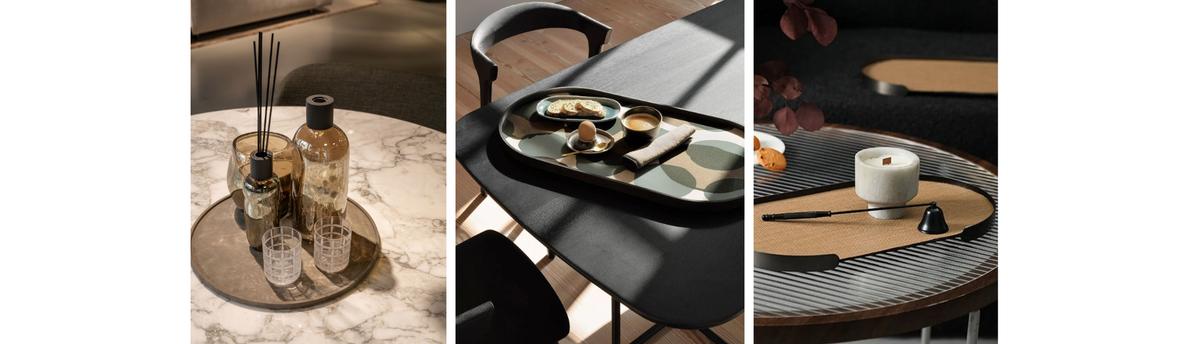

Decorative trays are often treated as small finishing pieces, but in a well-designed interior they can do much more than simply hold objects. A thoughtfully chosen tray can organise a coffee table, create a visual centre on a console, bring materials together on a sideboard or give smaller decorative objects a stronger sense of composition.
Choosing the right tray for a luxury home, however, requires more than selecting an attractive shape. The material, craftsmanship, scale, proportion, finish and intended use all influence whether a tray feels like an integrated part of the interior or simply another accessory placed on a surface.
This becomes particularly important when choosing premium and high-end home decor accessories. The quality of an object is experienced not only through its appearance, but also through its relationship with the furniture, materials and other objects around it.
In this guide, we look at how to choose decorative trays for luxury home interiors, including materials, craftsmanship, scale, proportion, functionality, placement and styling. We will also consider when a tray should remain understated and when it can act as an exclusive centrepiece within a carefully composed interior.
For a broader understanding of how different objects work together, explore Spacio's guide to mixing vases, sculptures, books and decorative objects in one room.
Table of Contents
- What Is a Decorative Tray?
- What Makes a Decorative Tray Luxury?
- Which Materials Work Best for Luxury Decorative Trays?
- Why Craftsmanship Matters in a Decorative Tray
- How to Choose the Right Size and Scale
- How Should a Tray Relate to the Furniture?
- Should a Luxury Decorative Tray Be Functional?
- Where Can You Use Decorative Trays?
- How to Style a Decorative Tray
- When Should a Tray Become a Statement Piece?
- Can Decorative Trays Complement a Fireplace?
- Common Mistakes to Avoid
- What Should You Consider Before Choosing a Tray?
- Frequently Asked Questions
- Conclusion
What Is a Decorative Tray?
A decorative tray is an accessory designed not only to hold or organise objects, but also to contribute to the visual composition of an interior. Its shape, material, finish and proportion can make it an important part of the styling rather than simply a practical surface.
It can bring several smaller objects into one deliberate composition. Candles, books, fragrance, a small sculpture, a vase or other personal objects can feel more cohesive when they are visually gathered within a defined area rather than scattered independently across a surface.
This makes the tray particularly useful in luxury interior styling. It creates a boundary within the larger surface while allowing the objects placed on it to remain part of the wider composition.
A tray can therefore have several roles. It can organise everyday objects, provide a practical surface for entertaining, create a centrepiece or introduce another material into a room. The most successful examples do not look as though they have been added simply to fill an empty space. They have a clear relationship with the furniture and objects surrounding them.
A decorative tray is not simply a container. In a considered interior, it is a compositional tool that can organise objects, introduce material contrast and give a surface a defined visual centre.
What Makes a Decorative Tray Luxury?
Not every decorative tray belongs in the luxury category. The distinction is rarely created by size alone, nor does it depend simply on an elaborate appearance.
A luxury decorative tray is more likely to demonstrate thoughtful design, good material selection, skilled craftsmanship, balanced proportions and a finish that remains convincing when viewed closely. This is the same principle that applies across premium and high-end home decor accessories more broadly.
Form is important. A tray may be minimal, sculptural, geometric, organic or highly decorative, but the design should feel intentional rather than arbitrary. The shape should have a reason for being there and should work with the furniture and objects around it.
Material is equally important. Glass, crystal, metal, wood, stone, ceramic and combinations of materials each bring a different visual and tactile quality. The best choice depends on the role the tray is expected to play within the room.
Finish also matters. A tray that looks attractive from a distance but has poorly resolved edges or inconsistent finishing may not create the same sense of quality when viewed closely.
Ultimately, luxury comes from the combination of these qualities rather than from any single feature. A restrained tray made exceptionally well can feel more sophisticated than an elaborate tray with little attention to proportion or detail. In a luxury interior, restraint can be as important as visual richness. A tray does not need to be elaborate to feel exceptional; distinctive material, precise detailing and well-resolved proportions can give a quieter design greater presence.
Which Materials Work Best for Luxury Decorative Trays?
The material of a decorative tray should be considered in relation to the wider interior rather than chosen simply because it looks attractive on its own. A tray can introduce warmth, reflect light, add texture or create contrast with the furniture and accessories around it.
Spacio's decorative trays collection reflects this range of possibilities, with trays designed around different materials, forms and uses.
Metal Decorative Trays
Metal trays can introduce structure and a subtle sense of formality to an interior. Depending on the finish, they can appear contemporary, classic, understated or more decorative. A restrained metallic finish can work particularly well when the room already contains details in brass, bronze, stainless steel or other metals. The tray does not have to match those finishes exactly. A related tone can be enough to create visual continuity.
A sculptural metal tray can also function as more than a surface for holding objects. Its shape, edge treatment and finish can make it an independent decorative element on a coffee table, console or sideboard.
Glass and Crystal Trays
Glass introduces lightness and reflection. It can be useful when a room already contains substantial furniture or strong architectural elements and the styling needs to remain visually lighter. Crystal can add another layer of visual interest because the material itself becomes part of the composition. Light interacts with the surface, making the tray noticeable without necessarily requiring a strong colour or elaborate form.
Because glass and crystal can already have visual presence, they often work best when the objects placed on them are carefully edited. Leaving part of the surface visible allows the material and craftsmanship to remain part of the visual experience.
Stone and Marble Trays
Stone brings natural variation, weight and texture to a decorative composition. Marble, in particular, can make a tray feel substantial while introducing the veining and tonal variation associated with natural stone.
Because stone already has a strong visual character, it does not always need to be surrounded by numerous decorative objects. A carefully selected vase, candle or sculptural object may be enough to complete the composition.
Wooden Decorative Trays
Wood introduces warmth and can work particularly well in interiors where the furniture already has natural timber elements. A beautifully finished wooden tray can soften rooms dominated by stone, glass and metal.
The grain, tone and finish of the wood matter. A strongly patterned timber may become a focal point, while a quieter finish can provide a neutral foundation for other decorative objects.
Ceramic and Other Crafted Materials
Ceramic trays can bring texture, colour and a more artisanal character to a room. Their appeal often comes from the combination of form and surface rather than from functionality alone.
Other crafted materials can similarly introduce individuality. The important consideration is to ensure that the character of the tray complements the room rather than introducing an unrelated decorative language.
Why Craftsmanship Matters in a Decorative Tray
Craftsmanship is one of the characteristics that separates an ordinary accessory from a luxury home decor accessory. With a tray, this can be experienced through the precision of its form, the quality of its finish and the way the material has been worked.
Look closely at the edges. Are they clean and intentional? Does the surface finish appear consistent? If different materials have been combined, do they meet with precision? Does the object feel considered from every angle rather than designed only for one viewpoint?
These details matter because decorative trays are usually placed within areas that are viewed at close range. A coffee table or console is part of everyday life, so the objects placed there are repeatedly seen and sometimes handled.
Craftsmanship should not, however, be confused with ornamentation. A tray does not have to be elaborate to feel luxurious. In many interiors, restrained detailing and excellent finishing create a more enduring result than excessive decoration.
Navin Kanodia's perspective:
“Luxury in an interior is often felt through the quality of the details rather than the number of objects. A well-made accessory can quietly elevate an entire composition because it belongs there, rather than simply occupying space.”
How to Choose the Right Size and Scale
Scale is one of the easiest things to overlook when buying a decorative tray online. A tray can look perfectly proportioned in a product photograph but feel either insignificant or overwhelming when placed on your furniture.
Before choosing one, consider the dimensions of the surface where it will be placed. A coffee table, console, sideboard and dining table each offer a different amount of usable space and have different styling requirements. The tray should leave enough surrounding space for the furniture to remain visually legible. It should also leave room for people to use the surface if it is part of an everyday living area.
For example, a tray on a coffee table should not occupy so much of the surface that books, drinks or other everyday objects have nowhere to go. On a large console, however, a more substantial tray can help anchor the composition and prevent the decorative arrangement from appearing lost.
Think About the Objects That Will Go Inside It
The dimensions of the tray should also be considered in relation to the objects you intend to place on it. A small fragrance bottle and candle may need only a compact tray. A composition involving a vase, coffee table book, candle and decorative object will require considerably more space.
This is why choosing the tray first and deciding what to put on it later can sometimes lead to awkward arrangements. When possible, think about the complete composition before making the purchase.
How Should a Tray Relate to the Furniture?
Scale describes the size of the tray. Proportion considers how that size relates to the furniture, the surrounding objects and the overall composition. A long rectangular tray can echo the horizontal lines of a console or coffee table. A round tray can soften furniture with strong linear forms. A sculptural tray can introduce an organic shape into an otherwise geometric room.
This relationship is particularly useful when styling consoles, where the tray can help establish a visual centre without competing with the furniture itself. On a coffee table, the shape of the tray can also help organise the surface. Rather than placing several unrelated objects across the table, the tray creates a defined area in which they can interact.
This is one reason decorative trays work so well alongside other decor accessories. They provide a framework within which smaller objects can be composed.
Should a Luxury Decorative Tray Be Functional?
A luxury decorative tray does not have to be purely decorative. In fact, some of the most useful trays are those that combine aesthetic value with everyday function. A tray can hold books, candles, fragrance, glasses or smaller decorative objects while keeping them organised. It can also make a collection of objects easier to move when the surface needs to be cleared.
Function, however, should not dictate the design completely. A tray chosen only because it is practical may not contribute much to the interior. Conversely, an extremely delicate or sculptural tray may be beautiful but unsuitable for an area where it will be handled frequently. The better approach is to decide how the tray will actually be used and then choose a design that supports that use without compromising its decorative role.
Decorative Tray or Serving Tray?
The distinction is useful when choosing a piece for a luxury interior. A serving tray is primarily designed around carrying and serving. A decorative tray may be designed primarily around presentation and composition.
Some pieces can perform both roles successfully. But if the main purpose is to create an elegant arrangement on a coffee table, console or sideboard, the visual qualities of the tray become just as important as its carrying capacity.
1. Where will I place it?
Will it sit on a coffee table, console, sideboard, dining table, bar or another surface?
2. What objects will it hold?
Think about the complete composition rather than the tray alone.
3. How much of the furniture surface should it occupy?
Leave enough room for both visual breathing space and practical use.
4. Does its material complement the room?
Consider the furniture, lighting, finishes and other accessories already present.
5. Will it be decorative, functional, or both?
Choose the design according to how you expect to live with it.
Where Can You Use Decorative Trays?
One of the reasons decorative trays are such useful luxury home decor accessories is their versatility. Unlike an object designed for one specific location, a well-chosen tray can move between different surfaces and rooms as the needs of a home change.
The key is to understand what each surface needs. A tray should help organise and strengthen the composition rather than simply occupy an empty area. They can also be useful within display niches, where a tray can create a defined base for smaller decorative objects without making the niche feel crowded.
Decorative Trays on Coffee Tables
A coffee table is one of the most natural places for a decorative tray. It can bring together several smaller objects and create a visual centre while leaving enough of the table available for everyday use. A tray can hold a combination of coffee table books, candles, a small vase, fragrance or a sculptural object. The important point is not to fill every available centimetre. A little breathing space around and within the tray allows each object to remain visible.
On a larger coffee table, the tray can also become one element within a broader composition. For example, a stack of books may sit beside the tray while a small sculptural object provides height at another point on the table.
Decorative Trays on Consoles
On a console, a decorative tray can provide a defined area for smaller accessories while helping the overall arrangement relate to the length of the furniture. A long console may benefit from a rectangular tray positioned slightly off-centre, balanced by a taller vase, sculpture or lamp elsewhere on the surface. A smaller console may need a simpler composition so that the tray does not overwhelm the furniture.
For a more focused guide to styling this type of surface, see How to Style a Console Table: Vases, Sculptures, Books & Decorative Objects.
Decorative Trays on Sideboards
A sideboard provides more horizontal space and can accommodate a slightly larger arrangement. A decorative tray can gather objects such as candles, fragrance, books or smaller art objects into one coherent group. This can be particularly effective in dining areas, where the tray can also support entertaining without making the sideboard look purely functional.
Decorative Trays in a Bar or Den
In a bar or den, a decorative tray can bring structure to a collection of smaller objects while adding another layer of material and texture to the setting. It can be used to group barware, fragrance, books or selected decorative objects, depending on the character of the room.
The tray should support the atmosphere of the space rather than make the arrangement feel overly formal. A more sculptural or distinctive tray can also become a statement accessory when the surrounding styling is deliberately restrained.
Decorative Trays on Dining Tables
On a dining table, the tray can act as a foundation for a centrepiece. Rather than placing a vase, candleholders and other objects directly on the table, a tray can visually unite them. For everyday dining, a relatively restrained composition often works best. For entertaining, the same tray can become a more substantial centrepiece, depending on the occasion.
The tray should, however, leave sufficient space for place settings and serving. A beautiful centrepiece loses its value if it interferes with the practical use of the table.
Decorative Trays in a Home Office
In a home office, a decorative tray can bring visual order to smaller objects without making the workspace feel overly styled. It can gather a small clock, stationery, books or a carefully chosen decorative object into one considered arrangement on a console, credenza or open shelf.
The same principle of restraint applies here. A home office should remain functional, so the tray should support the character of the room rather than compete with the workspace. A well-made tray in metal, wood, stone or another refined material can add warmth and texture while keeping the composition visually organised.
Decorative Trays in the Bedroom
A smaller decorative tray can help organise a bedside table, dressing table or bedroom console without making the surface appear cluttered.
It can hold fragrance, a candle, jewellery, a small decorative object or other personal items. Because bedrooms tend to benefit from a calmer visual language, a quieter tray with a refined finish may work better than a highly elaborate design.
How to Style a Decorative Tray
The tray creates the framework, but the objects placed on it determine the character of the composition. The objective is not to create a collection of unrelated beautiful things. It is to create relationships between form, height, material and scale.
Start with One Dominant Object
Begin with the object that has the strongest visual presence. This might be a sculptural vase, a distinctive bowl, a candle arrangement or an art object.
Once this anchor is established, add smaller objects around it rather than giving every piece equal visual importance. A clear hierarchy makes the composition easier to understand.
Vary the Heights
A composition in which every object is the same height can look flat. Introduce variation by combining a taller object with lower pieces such as books, bowls or candles.
Height creates movement and helps the eye travel through the arrangement. The differences do not need to be dramatic. Even modest variation can create a more natural composition.
Combine Different Forms
Think about the relationship between shapes. A rectangular tray can provide a strong foundation for a rounded vase. A circular tray can soften angular books or geometric objects.
Similarly, an organic sculpture can introduce contrast against a highly structured tray. The aim is not to make every shape different, but to create enough variation to prevent the arrangement from feeling repetitive.
Mix Materials Carefully
Glass can sit comfortably alongside metal. Wood can soften stone. Ceramic can introduce a tactile surface beside polished finishes.
The aim is not to introduce as many materials as possible. Two or three complementary materials are often enough to create depth without making the arrangement feel busy.
Leave Negative Space
One of the most common mistakes in tray styling is filling the entire surface. Negative space allows the individual objects and the tray itself to remain visible.
It also gives the arrangement a calmer, more considered appearance. This follows a broader principle of luxury interior styling: curation is often about knowing what not to add.
Repeat a Material or Colour
A subtle repetition can connect the tray to the rest of the room. A metallic detail on the tray might echo a finish elsewhere in the room. A dark ceramic object might relate to the frame of a mirror or the tone of a side table.
This does not mean that everything needs to match. Repetition should create a visual relationship rather than a showroom-like uniformity.
A useful styling rule:
Think of the tray as the stage and the objects as the composition. The tray should support the arrangement, not compete with everything placed on it.
When Should a Tray Become a Statement Piece?
Not every tray needs to disappear into the composition. Some designs are strong enough to become a statement home decor accessory in their own right.A statement tray works best when it is given enough visual space to be appreciated. If the tray has a strong material, sculptural form or distinctive finish, surrounding it with too many competing objects can weaken its impact.
A sculptural form, unusual material, distinctive finish or strong colour can give a tray considerable visual presence. In such cases, adding too many objects can actually reduce its impact. If the tray itself has a strong personality, consider displaying it with only one or two carefully chosen objects, or even leaving it largely empty. This is particularly effective with decorative pieces that have artistic or sculptural qualities.
The objective is to allow the design to be seen rather than covering it with accessories. A statement piece becomes stronger when the surrounding composition knows when to step back. Spacio's luxury decorative trays collection includes pieces intended not only for practical use but also as artful foundations for curated displays.
Can Decorative Trays Complement a Fireplace?
They can, provided the relationship is considered carefully. A fireplace is naturally a strong focal point, so accessories placed around it should support rather than compete with its visual presence.
A decorative tray can work particularly well on a console, sideboard or other surface positioned near a fireplace. It can gather smaller objects into a controlled composition while allowing the fireplace itself to remain the principal architectural and visual feature. For example, a restrained tray arrangement with a candle, small sculpture or decorative bowl can provide a secondary layer of detail around a fireplace without attempting to become another focal point.
The same principle applies when styling around a contemporary fireplace: the accessory should complement the material, scale and visual language of the fireplace rather than compete with it.
For homes where the fireplace itself is intended to be a major design feature, explore Spacio's fireplace collection separately and consider the tray as part of the surrounding styling rather than as the centre of attention. This is a useful example of how a decorative accessory can support a larger focal point without trying to become the focal point itself.
Common Mistakes to Avoid
Even a beautiful tray can look wrong if it is selected without considering the room and the surface on which it will be used.
A Tray That Is Too Large
A large tray is not automatically more luxurious. If it occupies most of the available surface, there may be no room for the composition to breathe. Always consider the furniture around the tray and leave sufficient negative space between the tray and the edges of the surface.
A Tray That Is Too Small
At the other extreme, a tiny tray on a large console or coffee table can look accidental rather than intentional. If the furniture is substantial, the tray needs enough visual weight to establish a meaningful relationship with it.
Too Many Objects
A decorative tray should organise a composition, not become an excuse to display every favourite accessory at once. If the tray is crowded, remove one or two pieces and reassess the arrangement. Often the remaining objects will become more noticeable once the visual noise has been reduced.
Ignoring the Room's Existing Materials
A beautiful tray can still feel out of place if its material and finish have no relationship with the surrounding interior. Look at the furniture, lighting, flooring and other decorative objects already present. The tray does not need to match them, but it should feel as though it belongs in the same visual language.
Choosing Fashion Over Longevity
Trends can be useful sources of inspiration, but a luxury home decor accessory should ideally remain relevant after the trend has passed. Classic proportions, good materials and thoughtful craftsmanship generally have greater longevity than a piece chosen only because it is currently fashionable.
What Should You Consider Before Choosing a Tray?
Buying a decorative tray online requires a slightly different approach from choosing one in person. Photographs can communicate the overall design, but scale, finish and material need to be considered carefully before making a decision.
For Indian homes, also consider the scale of the room and furniture carefully. A tray that looks substantial in a large villa or expansive living room may feel oversized on a compact urban coffee table. The right choice should respond to the actual proportions of the space rather than the perceived size of the object online.
Start with the surface. Measure the available area and think about how much of it you want the tray to occupy. Then consider the objects that will sit inside or beside it. Next, look at material and finish. Does the tray introduce something useful to the room, such as warmth, reflection, texture or contrast? Or does it simply repeat something that is already present?
Consider how the tray will be used. A piece intended primarily for display can be chosen differently from one that will regularly hold drinks, books or entertaining accessories. Finally, consider longevity. Ask whether the tray will still work if the furniture changes, the room is restyled or the object is moved elsewhere in the home.
For a broader guide to evaluating luxury home decor online in India, including quality, materials and scale, read How to Buy Luxury Home Decor Online in India: A Guide to Quality, Materials & Scale.
Material — Does it add the right texture, warmth, reflection or contrast?
Craftsmanship — Is the finish convincing when viewed closely?
Scale — Is the size appropriate for the surface?
Proportion — Does its shape relate naturally to the furniture?
Function — Will it be decorative, practical or both?
Composition — Will the tray help organise the objects around it?
Longevity — Will it remain useful and relevant as the home evolves?
These questions help move the buying decision away from simply asking whether a tray looks attractive and towards understanding whether it genuinely belongs in the interior.
Frequently Asked Questions
What is the difference between a decorative tray and a serving tray?
A serving tray is primarily designed around carrying and serving, while a decorative tray places greater emphasis on presentation, material, form and composition. Some trays can perform both roles, but the intended use should guide the choice.
What materials are best for luxury decorative trays?
Metal, glass, crystal, wood, stone, marble and ceramic can all work well in luxury interiors. The best material depends on the character of the room, the furniture around it and whether the tray is intended to be quiet, functional or visually prominent.
Can a decorative tray be used as a centrepiece?
Yes. A tray can provide a defined foundation for a centrepiece on a dining table, coffee table, console or sideboard. The key is to create a clear hierarchy and leave enough space for the arrangement to breathe.
How do I choose the right size decorative tray?
Start with the dimensions of the furniture surface and the objects you expect to place on the tray. The tray should have enough visual weight to relate to the furniture without occupying so much space that the surface becomes crowded or impractical.
How many objects should I place on a decorative tray?
There is no fixed number. A better approach is to establish one dominant object and support it with a small number of complementary pieces. Negative space should remain visible so that the tray and the objects can each be appreciated.
Can decorative trays be used around fireplaces?
Yes. A tray can work well on a nearby console or sideboard, particularly when it gathers smaller accessories into a controlled composition. The fireplace should generally remain the principal focal point, with the tray supporting rather than competing with it.
Can a decorative tray itself be a statement home decor accessory?
Yes. A distinctive form, material, finish or colour can give a tray enough visual presence to become a statement piece. In that situation, using fewer objects around it can make the design more effective.
Are decorative trays useful when buying luxury home decor online?
They can be particularly useful because they are versatile and can work across several surfaces. When buying online, however, pay close attention to dimensions, material, finish and the furniture on which the tray will be placed.
What size decorative tray should I choose?
The right size depends on the furniture surface, the objects the tray will hold and the amount of space you want to leave around the composition. A tray should have enough presence to organise the arrangement without making the surface feel crowded.
Where can I see and buy luxury decorative trays in Mumbai?
If you want to see and buy luxury decorative trays in Mumbai, visit the Spacio Mumbai store at 3BK Laxmi Industrial Estate, New Link Road, Andheri (West), Mumbai 400 053. The showroom brings together decorative trays and other luxury home decor accessories suited to coffee tables, consoles, bar areas and entertaining spaces. Seeing the trays at the Spacio showroom in Laxmi Industrial Estate, Mumbai allows you to compare their size, material, finish, shape and styling potential in person and choose a piece that works with the proportions of your interior.
Where can I experience and buy decorative trays for luxury interiors in Kolkata?
If you are looking to experience and buy decorative trays in Kolkata for a luxury home or entertaining space, visit the Spacio Kolkata store at 86B Topsia Road South, Kolkata 700 046. The showroom offers decorative accessories for luxury residential and commercial interiors, including trays that can be considered for coffee tables, consoles, bar settings and other styled surfaces. At the Spacio showroom on Topsia Road South, Kolkata, you can see the trays in person, assess their scale, craftsmanship, material and finish, and select a decorative tray that complements the rest of your interior.
Conclusion
A decorative tray can be one of the quieter elements in a luxury interior, or it can become a distinctive statement object. What determines its success is not simply how attractive the tray looks on its own, but how well it belongs to the room.
Material, craftsmanship, scale and proportion all matter. So does function. A tray may organise everyday objects, support entertaining, create a centrepiece or provide a visual framework for smaller decorative pieces.
The most sophisticated approach is to choose the tray according to what the interior needs. A substantial console may require a stronger visual anchor. A busy coffee table may need a quieter design. A restrained room may benefit from a sculptural tray that introduces material interest.
This is what separates a decorative tray from simply another accessory. When selected with intention, it becomes part of the composition of the home. For a broader guide to selecting luxury home decor accessories for modern Indian interiors, explore Spacio's complete guide.
Explore Spacio's luxury decorative trays collection alongside the wider luxury home decor accessories collection to discover pieces that can be selected according to material, scale, function and the character of your interior.


