
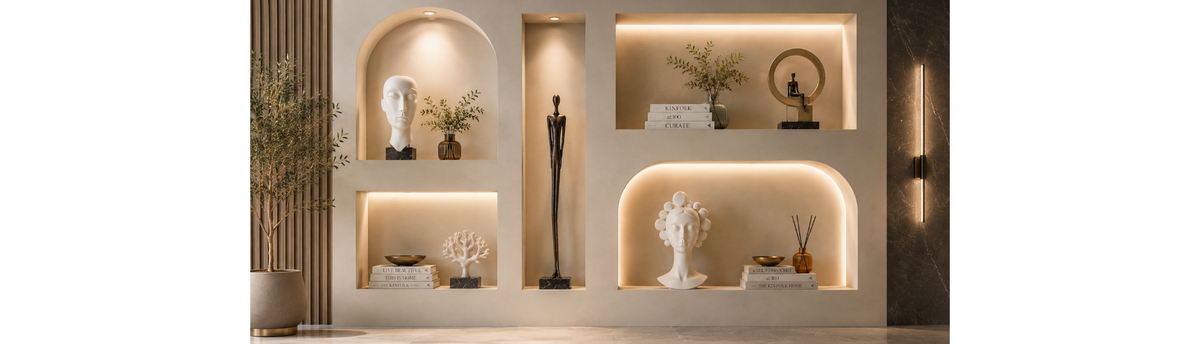

Architectural niches can become some of the most distinctive styling areas in an interior. They create a natural recess for displaying sculptures, vases, art objects and other decorative accessories, but their enclosed proportions also make them less forgiving than an open console or shelf. The most successful niche styling begins with the architecture rather than the object. The height, width and depth of the recess determine what can be displayed comfortably, while the surrounding wall, lighting and furniture influence how much visual weight the niche should carry.
A beautifully made sculpture can look lost inside a deep niche if it is too small. A large statement object can overwhelm a shallow recess. Similarly, filling a niche simply because there is space available can remove the negative space that gives the display its character. This is why styling a niche requires a slightly different approach from styling an ordinary surface. The objective is not to fill the recess. It is to create a considered relationship between the object, the niche and the surrounding interior. The key is to treat the niche as a deliberate display environment, balancing the scale of the object with the depth of the recess, the surrounding negative space and the visual language of the room.
In this guide, we explore how to style niches with luxury home decor accessories, focusing on scale, proportion, negative space, material, visual weight and placement. We will also look at how sculptures, vases and art objects can work within feature walls, and how a niche should respond when it sits beside or around a fireplace. A niche can be one element within a larger feature wall, but it should still be styled as its own visual environment rather than treated simply as another section of the wall.
For the broader principles behind selecting decorative objects, see Spacio's complete guide to luxury home decor accessories. It provides the wider framework for understanding scale, materials, craftsmanship and placement before choosing an individual object.
Table of Contents
- Why Niches Need a Different Styling Approach
- Start with Scale and Proportion
- Why Negative Space Matters in a Niche
- How to Style Sculptures in Niches
- How to Style Vases in Niches
- Using Art Objects and Statement Pieces
- Choosing Materials for Niche Styling
- How Lighting Changes a Niche Display
- Styling Niches Within Feature Walls
- How Niches Work Around Fireplaces
- Styling Niches Across Different Interiors
- Common Niche Styling Mistakes
- A Stylist's Perspective
- Frequently Asked Questions
- Final Thoughts
Why Niches Need a Different Styling Approach
A niche is not simply a small shelf built into a wall. Its three-dimensional form changes how an object is seen. The side walls frame the piece, the back surface creates a visual backdrop and the depth of the recess affects the amount of shadow around the object. Unlike a freestanding shelf, a niche has a fixed architectural frame, so the object is viewed in relation to the wall, the recess and the surrounding composition. This is why niche styling depends more heavily on proportion, depth and negative space than simply filling an available surface.
This framing can be an advantage. A well-chosen sculpture placed inside a niche can appear more intentional because the architecture naturally separates it from the rest of the room. The niche becomes a quiet stage for the object rather than another surface competing with everything around it. This makes niches particularly effective for displaying luxury home decor accessories that deserve visual attention without taking over the room. Sculptures, vases, art objects and other statement pieces can each become a focal element when the architecture gives them enough space to breathe.
But the same architectural framing makes proportion particularly important. An object that is too small may disappear against the back wall. An object that is too large may feel trapped rather than displayed.
The first question should therefore be: what does this niche need to do within the room?
It may provide a focal point on a feature wall. It may add a small moment of interest along a corridor. It may balance a fireplace or television wall. It may provide a place for a collectible object in a study, bedroom or private library. The answer determines the scale, number and character of the objects that belong there.
Do not start by asking which object will fit inside the niche. Start by asking what visual role the niche needs to play in the room.
Start with Scale and Proportion
Scale is usually the first consideration when styling a niche. The object needs to relate not only to the dimensions of the recess but also to the wall, furniture and other architectural elements surrounding it. A tall, narrow niche may suit a vertically oriented sculpture or elongated vase. A wider recess can accommodate a broader sculptural form or a carefully composed group of objects. A shallow niche generally benefits from pieces that do not project too far into the room.
The relationship between the object and the empty space around it matters just as much as the object's physical dimensions. A sculpture that occupies most of the width and height of a niche may become visually heavy, while one that occupies too little of the recess may lose its presence.
This is why visual weight is often more useful than simply measuring an object. A dark metal sculpture may feel heavier than a similarly sized clear glass piece. A solid ceramic form can have more visual presence than a delicate open sculpture of the same height.
When selecting premium home decor accessories for a niche, consider both physical scale and visual density.
A niche gives an object an architectural frame. The object should therefore be strong enough to hold that frame, but not so dominant that the architecture disappears behind it.
— Navin Kanodia, Interior Stylist & Curator, Spacio
One Strong Object Can Be Enough
One of the most effective ways to style a niche is to use a single object with enough presence to carry the composition. This can be particularly effective with sculptural pieces. A single form allows the eye to understand its silhouette, material and relationship with the recess without having to negotiate several competing objects.
Spacio's Sculptures & Art Objects collection includes sculptural pieces in materials such as metal, glass, crystal, wood, ceramic and porcelain, giving you different ways to introduce visual weight and material contrast into a niche.
When a Grouping Works Better
A grouping can work when the niche is sufficiently wide or when the objects have a clear relationship with one another. The key is to create hierarchy rather than giving every object equal importance.
For example, a larger sculpture can act as the anchor while a smaller object provides supporting detail. A vase can introduce height beside a lower decorative object, while a small bowl can create a horizontal element.
However, groupings should be treated as one composition rather than several individual products placed together.
Why Negative Space Matters in a Niche
Negative space is especially important inside a niche because the recess already creates a defined visual boundary. Filling every part of it can make the display feel cramped very quickly. Space above an object allows the eye to register its silhouette. Space beside it separates the object from the vertical edges of the niche. Space below it can create a visual base and prevent the object from appearing as though it has simply been pushed into the recess.
This is also why a niche does not necessarily need decoration on every available surface. Some niches are strongest when they contain one object and a generous amount of quiet space. The same principle applies when several niches appear together. They do not all need to contain objects of equal size or even be decorated in exactly the same way. Leaving one recess quieter can create rhythm across the entire wall.
If the first thing you notice is that the niche is full, remove something. If the first thing you notice is the object, the composition is probably working.
How to Style Sculptures in Niches
Sculptures are particularly effective in niches because their three-dimensional forms can use the recess to create depth and shadow. Unlike a flat artwork, a sculpture can be appreciated from its silhouette as well as from the material, texture and details of its surface.
The strongest choice is usually a sculpture with a clear silhouette. When the surrounding wall is relatively quiet, an expressive form can become a natural focal point without requiring additional decoration around it. If you are choosing a sculpture specifically for its material, craftsmanship, scale or collectability, our guide to luxury sculptures for the home explores how Murano glass, glass, crystal, porcelain and ceramic sculptures can be selected for different interiors.
Consider the viewing angle as well. A sculpture that looks balanced from directly in front may appear different when seen from the side of the room. In a living room, entrance, corridor, office or hospitality interior, the object should have enough presence to remain visually interesting from the angles from which people normally encounter it.
Material also changes the way a sculpture occupies a niche. Reflective metal can catch light and create sharper highlights. Glass can introduce transparency and allow the background to remain part of the composition. Crystal can add luminosity, while ceramic, porcelain or wood can bring a quieter tactile quality.
For a more specific selection, explore Spacio's Sculptures & Art Objects, including collections of crystal sculptures, glass sculptures, metal sculptures, mixed media sculptures, Murano glass sculptures, porcelain and ceramic sculptures and wood sculptures.
Let the Sculpture Have Room Around It
A common mistake is to treat the space around a sculpture as unused space. In reality, that space helps define the sculpture. Leaving breathing room around the form allows its outline to remain clear and gives the eye somewhere to rest.
This is particularly important with expressive or intricate pieces. A highly detailed sculpture surrounded by several smaller objects can lose its impact because the eye has too many forms to process at once.
Use the Backdrop to Your Advantage
The colour and material of the niche's back panel can either emphasise or soften the sculpture. A light object may become more visible against a darker background, while a dark sculpture can gain definition against a lighter surface.
Texture matters too. A highly textured wall behind an equally detailed sculpture can create visual competition. A quieter backdrop often allows a complex object to become the hero.
How to Style Vases in Niches
Vases can introduce a different kind of visual language into a niche. Their height, curves and openings create vertical and organic forms that can soften the architectural geometry of a recess.
A tall vase can work particularly well in a narrow or vertically proportioned niche, while a broader vessel may suit a wider recess. The important consideration is not simply whether the vase fits, but whether its shape creates an intentional relationship with the surrounding negative space.
Vases also provide an opportunity to introduce material variation. Glass, ceramic, porcelain, metal and other finishes can shift the mood of a niche without changing its overall composition. For example, a transparent glass vase can keep a niche feeling visually light, while a sculptural ceramic form can give it more weight. A reflective metal vase can respond to decorative lighting and introduce highlights as people move through the room.
Spacio's Vases collection can be considered when the niche requires height, shape or a contrasting material rather than another sculpture.
Do Not Automatically Add Flowers
A vase does not need flowers to work as a decorative object. In a carefully styled niche, the vessel itself may provide enough shape, colour and material interest.
Adding stems or foliage can make sense when the niche needs softness or height, but it should be a deliberate styling decision rather than an automatic finishing step.
Using Art Objects and Statement Pieces
Not every niche needs a conventional sculpture or vase. An art object, collectible or object of curiosity can create a more personal focal point, particularly in interiors where the decorative scheme already contains familiar forms.
This is where unusual proportions, craftsmanship or cultural references can become part of the visual story of a room. The object does not necessarily need to be large. What matters is whether it has enough character to hold attention within the architectural frame.
Spacio's Objects of Curiosity collection is particularly relevant when the intention is to introduce something unexpected rather than another conventional decorative form. In some interiors, a small object with an unusual silhouette can be more effective than a larger but predictable piece. This is especially useful in a series of niches where repetition can otherwise make the wall feel too uniform.
When a Niche Needs a Statement Piece
A statement piece works best when the niche has enough architectural presence to support it. A large sculpture or distinctive art object can anchor a feature wall, entrance or double-height space, but it should still relate to the scale of the surrounding room.
Think of the niche and the object as one composition. The statement piece should not look as though it was simply inserted into an empty recess; it should feel as though the architecture was made to frame it.
Choosing Materials for Niche Styling
Material can be used to create contrast, continuity or a subtle change of texture within a niche. The best choice depends on the materials already present in the surrounding interior.
If the room contains a great deal of timber, a glass or metal object can introduce contrast. If the architecture already includes stone and polished surfaces, ceramic, porcelain or wood can bring a softer tactile note. Crystal and glass can be particularly effective where light is part of the composition. Their transparency and reflective qualities allow the niche to feel less visually dense, while still giving the display a sense of refinement.
Metal can create stronger visual definition, particularly when the sculpture has an open or geometric form. Wood can bring warmth and natural variation, while porcelain and ceramic can introduce a more crafted, tactile quality.
Explore Sculptures by Material
Spacio's sculpture collections make it possible to approach niche styling through material as well as form. Explore Crystal Sculptures, Glass Sculptures, Metal Sculptures, Mixed Media Sculptures, Murano Glass Sculptures, Porcelain & Ceramic Sculptures and Wood Sculptures.
How Lighting Changes a Niche Display
Lighting can completely change how a niche and its contents are perceived. A sculpture that looks relatively quiet in daylight can become much more expressive when a focused light picks up its contours or reflective surfaces.
Where possible, lighting should reveal the object rather than simply illuminate the entire recess. A focused beam can create depth by allowing parts of the sculpture to catch light while other areas remain in shadow. Warm lighting can make wood, ceramic and metallic surfaces feel richer, while glass and crystal can respond strongly to points of light. The exact effect will depend on the finish, colour and form of the object.
Decorative lighting elsewhere in the room should also be considered. A niche should participate in the overall lighting composition rather than becoming an isolated bright spot.
Before finalising an object for a niche, look at it in the actual lighting conditions of the space. Reflection, shadow and transparency can change its visual weight considerably.
Styling Niches Within Feature Walls
A niche often works as part of a larger feature wall rather than as an isolated decorative detail. The wall may include panelling, stone, textured finishes, mirrors, artwork, a television or other architectural elements, and the niche needs to relate to all of them.
The most successful compositions establish a clear hierarchy. If the feature wall already has a strong material or architectural treatment, the niche can remain relatively restrained. If the surrounding wall is quiet, the niche can carry more visual interest through a sculpture, statement vase or distinctive art object.
This is where statement home decor accessories can be particularly effective. A carefully selected object can create a focal point without requiring the entire wall to become visually busy.
Repeat Materials Without Repeating Everything
A niche can feel connected to its surroundings when one material or finish is echoed elsewhere in the room. A metal sculpture might relate to the finish of a console or lighting fixture. A glass object may connect with a glass coffee table or decorative lighting. Wood can repeat the warmth of flooring, furniture or wall panelling.
The repetition should be subtle. Matching every decorative object to the furniture can make the interior feel overly coordinated. The aim is to create relationships between materials rather than identical combinations.
Use Niches to Break Large Walls
On a long or expansive feature wall, a series of niches can introduce rhythm. They can break the visual length of the wall while creating several opportunities for carefully curated objects.
However, identical niches do not require identical styling. One may contain a sculpture, another a vase and another a smaller art object. What creates cohesion is the relationship between their scale, materials and visual weight.
How Niches Work Around Fireplaces
When niches are positioned beside or around a fireplace, the fireplace naturally becomes one of the strongest focal points in the room. The niche styling should support that focal point rather than compete with it.
This is particularly important with contemporary fireplaces, where the flame, fireplace surround or installation itself may already provide movement, light and visual interest. Decorative objects placed nearby should therefore be selected with restraint. A sculpture can echo the verticality of the fireplace installation. A vase can soften the geometry of the surrounding architecture. A quieter decorative object can provide balance without creating another competing focal point.
If two niches flank a fireplace, symmetry can be useful, but exact duplication is not always necessary. Two objects can have similar visual weight while differing in shape or material. This creates balance without making the composition feel mechanically matched.
When a niche sits beside a fireplace, I first consider the fireplace as the hero. The decorative objects should strengthen the composition around it, not ask the eye to choose between competing focal points.
— Navin Kanodia, Interior Stylist & Curator, Spacio
For interiors where a fireplace forms part of the styling environment, Spacio's fireplace collection includes contemporary fireplace solutions that can become architectural focal points around which surrounding niches and decorative objects are composed.
Styling Niches Across Different Interiors
Niches are not limited to living rooms. They can be used across residential, workplace, hospitality and commercial interiors, and the styling should respond to the purpose and character of each environment.
Living Rooms and Formal Sitting Areas
In a living room, a niche can provide a visual pause between larger furniture pieces or become part of a feature wall. A sculpture, vase or art object can give the wall a focal point without adding another piece of furniture.
Where the room already contains several decorative surfaces, restraint usually produces a more sophisticated result. One well-scaled object can be more effective than a collection of smaller accessories.
Bedrooms and Private Spaces
In bedrooms and quieter private spaces, niches can be used to introduce a smaller moment of decoration. Softer materials and simpler forms can work particularly well where the overall interior is intended to feel calm.
A ceramic or porcelain object, a subtle glass piece or a small sculpture can provide interest without creating the visual intensity that might be appropriate in a formal entertaining space.
Home Offices and Studies
In a study or home office, a niche can provide a place for an art object, sculpture or clock that contributes to the character of the workspace. The display should remain considered and avoid making the working environment feel cluttered.
A functional object can also become decorative. Spacio's Timepieces & Clocks collection offers another way to combine function with visual interest when a niche requires something more than purely decorative accessories.
Executive Offices and Corporate Interiors
In executive offices, reception areas and corporate interiors, niches can help communicate the character of a space. Sculptures and art objects can introduce personality while maintaining a professional visual language.
Scale becomes particularly important here because decorative pieces may be viewed from greater distances. A small object that works beautifully in a residential niche can disappear when viewed across a large reception area.
Hotels, Restaurants and Hospitality Spaces
Hospitality interiors often provide more opportunities for expressive niche styling. A niche in a hotel lobby, restaurant, lounge or corridor can become a small visual moment that guests encounter as they move through the space.
Here, repetition can be used intentionally. A sequence of niches may carry a common material or sculptural language while allowing individual objects to vary. This creates continuity without making every display identical.
Premium Commercial Interiors
Retail environments, showrooms, galleries, clinics and other commercial spaces can also use niches to frame selected objects. In these settings, the display needs to work with the architecture, circulation and viewing distance of the space.
Objects should therefore be chosen not simply because they look attractive individually, but because they communicate appropriately within the environment. A distinctive sculpture can establish a focal point, while smaller objects can support the overall composition.
The same styling principle can work across a home, office or commercial interior, but the scale of the object should always respond to the distance and context from which it will be viewed.
Common Niche Styling Mistakes
Niches can look effortless when they are well styled, but several common mistakes can make them feel either empty or overcrowded.
Choosing an Object That Is Too Small
A small decorative object inside a large niche can lose its presence. Instead of becoming a focal point, it can appear disconnected from the architecture around it. If the niche is large, consider a sculpture or statement piece with enough visual weight to hold the space.
Filling the Entire Niche
Adding several objects simply because there is room often removes the negative space that makes a niche attractive in the first place. Edit the composition after placing the objects. If two pieces perform the same visual role, one may not be necessary.
Ignoring the Surrounding Architecture
A niche should not be styled in isolation. The objects need to relate to the wall finish, furniture, lighting, artwork and architectural elements around them. This becomes particularly important when a niche is part of a feature wall or sits beside a fireplace.
Using Too Many Materials at Once
Material contrast can make a niche interesting, but too many contrasting finishes can create visual noise. Two or three related material directions are often enough to create depth without overwhelming the composition.
Ignoring the Viewing Angle
A niche is rarely viewed from exactly one position. Consider how the object looks when entering the room, sitting across from the wall or walking past it. This is especially important in corridors, entrances, offices, hospitality spaces and other areas where people encounter the niche while moving through the interior.
Styling Every Niche Identically
When several niches are arranged together, exact repetition can make the wall feel predictable. Similar visual weight is often more sophisticated than identical objects. Varying the forms while maintaining a common material or colour relationship can create rhythm and cohesion.
A Stylist's Perspective
A niche is one of those places where editing becomes as important as selection. I look at the architecture first, then decide whether the space needs height, weight, contrast or simply a single object with enough character to hold the recess.
— Navin Kanodia, Interior Stylist & Curator, Spacio
The most successful niche displays rarely come from adding more. They come from understanding the relationship between the recess, the object and everything surrounding it.
That is also why high-end home decor accessories can work beyond the traditional home. The same principles of scale, proportion, material, visual weight and negative space apply to offices, hospitality interiors, retail environments and other commercial spaces.
Frequently Asked Questions
What are the best accessories for styling a niche?
Sculptures, vases, art objects, clocks and statement decorative pieces can all work well. The right choice depends on the niche's scale, depth, lighting and relationship with the surrounding interior.
How many objects should I put in a niche?
There is no fixed number. A single well-scaled sculpture can be more effective than several smaller objects. Wider niches can accommodate a carefully edited grouping, provided the objects have a clear hierarchy.
Should a niche be completely filled?
No. Negative space is an important part of the composition. Leaving room around an object helps define its silhouette and prevents the niche from appearing overcrowded.
Can sculptures be used in niches beside a fireplace?
Yes. Sculptures can work particularly well beside a fireplace, provided they support rather than compete with the fireplace as the primary focal point. Similar visual weight on either side can create balance without requiring identical objects.
Are niches only suitable for homes?
No. Niches can be styled in homes, private offices, corporate interiors, hotels, restaurants, showrooms, retail spaces and other commercial environments. The main difference is the scale and visual language appropriate to each setting.
What makes a niche look luxurious?
A luxurious niche is usually defined by proportion, restraint, quality of materials and a clear focal point rather than by the number of objects displayed. A carefully selected sculpture or art object with sufficient negative space can create more impact than a crowded arrangement.
Where can I see sculptures and luxury decor accessories for architectural niches in Mumbai?
If you are styling an architectural niche, feature wall or recessed display in Mumbai and want to see luxury sculptures, art objects, vases and decorative accessories in person, visit the Spacio Mumbai store at 3BK Laxmi Industrial Estate, New Link Road, Andheri (West), Mumbai 400 053. The showroom brings together sculptures, art objects, vases and other luxury home decor accessories that can be considered for niches and statement architectural displays. Visiting the Spacio showroom in Laxmi Industrial Estate, Mumbai allows you to see the pieces at full scale and experience their material, finish, visual weight and proportions before selecting an object for a niche or feature wall.
Where can I experience sculptures and luxury home decor accessories for niches in Kolkata?
For an interior in Kolkata where a niche, feature wall or recessed display needs a considered sculptural focal point, you can experience luxury sculptures, art objects, vases and decorative accessories at the Spacio Kolkata store at 86B Topsia Road South, Kolkata 700 046. The showroom brings together furniture, decor accessories and lighting for luxury residential and commercial interiors, making it possible to consider decorative pieces in relation to the wider interior rather than selecting them in isolation. Visit the Spacio showroom on Topsia Road South, Kolkata to see and experience sculptures, vases and statement objects in person and assess their scale, material, finish and visual presence before choosing pieces for an architectural niche.
Final Thoughts
Styling a niche successfully is less about filling an architectural recess and more about creating a relationship between architecture and object. Scale determines whether the piece feels appropriately grounded. Negative space gives it room to breathe. Material introduces texture and contrast, while lighting can reveal details that might otherwise remain unnoticed.
Sculptures, vases, clocks, art objects and statement pieces can each play a different role, but the strongest compositions usually have a clear visual hierarchy. The object should belong to the niche while still contributing to the wider interior. Whether the setting is a luxury home, private study, executive office, hotel, restaurant or commercial interior, the principle remains the same: choose fewer, better pieces and give them enough space to be seen.
Explore Luxury Decor Accessories for Niches
Discover curated sculptures, vases, art objects, clocks and statement decorative accessories selected for refined niches, shelves and architectural displays.
Explore Sculptures & Art Objects


