
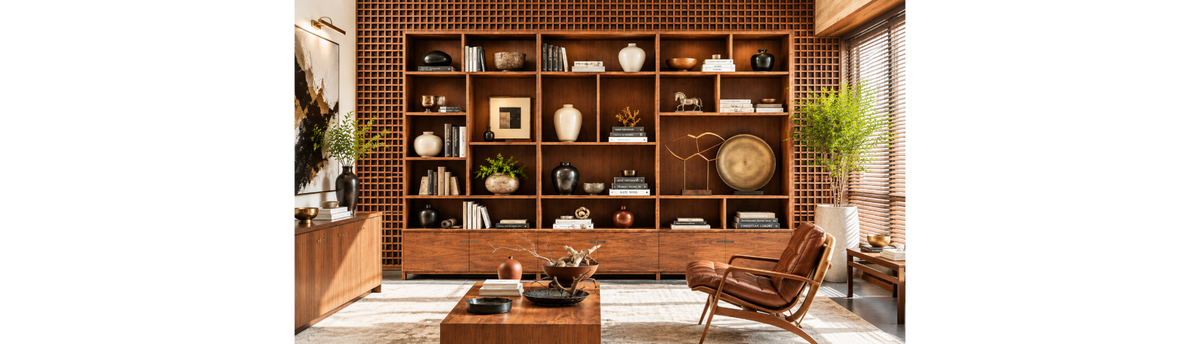

A bookshelf is rarely just a place to store books. In a well-designed interior, it can become one of the most expressive surfaces in the room, bringing together literature, art, sculpture and carefully chosen decorative objects.
The challenge is knowing how to combine these elements without making the shelves look crowded or arranging them so neatly that they lose their character. A successful bookshelf composition has rhythm, variation and negative space. Books provide structure, while luxury home decor accessories introduce shape, material, colour and personality. The right combination can turn an ordinary bookshelf into a collection of statement home decor accessories that feels curated rather than decorated.
This approach works across many settings. A bookshelf in a luxury home may hold art books, sculptures and collected objects. A study or home library may combine books with clocks, ceramics and personal pieces. In an office, shelving can introduce design and personality without compromising the professional character of the space. In a commercial interior, carefully selected objects can help establish a stronger visual identity.
The important principle is that the accessories should work with the books rather than compete with them. The shelf becomes a composition in which every object has a reason for being there. In contemporary Indian interiors, this approach works particularly well with materials such as marble, timber, metal, glass and stone. Whether the shelving forms part of a living room, home library, study or executive office, decorative objects can soften the functional character of bookshelves while adding a more personal layer to the room.
Table of Contents
- Why Bookshelves Need More Than Books
- Start with the Books
- Use Sculptures to Create Focal Points
- Add Vases for Height and Shape
- Use Clocks as Functional Art
- Introduce Art Objects and Decorative Accessories
- Create Rhythm Through Height, Shape and Spacing
- Work With Shelf Depth
- Why Negative Space Matters
- What Makes a Bookshelf Feel Luxurious?
- A Simple Process for Styling a Bookshelf
- Choosing Decorative Accessories by Material
- Bookshelf Styling Across Homes, Offices & Hospitality Spaces
- Styling Bookshelves Around a Fireplace
- Common Bookshelf Styling Mistakes
- Frequently Asked Questions
- Final Thoughts
Why Bookshelves Need More Than Books
Books naturally create repetition. Their spines introduce a series of vertical lines, colours and rectangular forms. While this provides useful structure, a shelf made entirely of books can sometimes appear visually uniform.
Decorative objects break that repetition.
A sculpture introduces an organic or sculptural silhouette. A vase creates height and a different visual rhythm. A decorative bowl adds a softer horizontal form. A clock introduces a circular element while also serving a practical function. An art object can bring an unexpected point of interest to an otherwise predictable arrangement.
This is why the best bookshelf decor accessories are not necessarily the largest or most expensive pieces. They are objects that introduce something the books do not already provide.
Spacio's Book Shelves & Niches collection is specifically curated around this idea, bringing together artefacts, books, sculptures, figurines, decorative bowls, vases and art objects that can be used to create more considered bookshelf compositions.
I never approach a bookshelf by asking how many objects can fit on it. I ask what the books are already contributing, what the shelf is missing and which objects can create contrast without disturbing the overall rhythm.
Start with the Books
Before adding decorative objects, look at the books themselves. Their height, colour, subject matter and orientation already determine much of the visual character of the shelf.
Not every book needs to stand vertically. A few horizontal stacks can introduce a different direction and create useful platforms for smaller decorative objects.
Books can also be grouped according to size rather than colour. A group of similarly sized books can create a stable visual block, while a smaller stack beside a taller object creates variation.
For luxury interiors, coffee table books and art books can be particularly useful because their covers and proportions can contribute to the design of the shelf even when they are not being read. Spacio's coffee table books collection provides another layer of objects that can combine cultural interest with decorative value.
The key is not to arrange every book in exactly the same way. A bookshelf becomes more interesting when vertical rows, horizontal stacks and carefully placed objects create variation across the shelves.
Use Sculptures to Create Focal Points
Sculptures are among the most effective statement home decor accessories for bookshelves because their forms immediately break the repetition created by books. A sculpture can be placed between books, on top of a horizontal stack or within an area of negative space. Its position should depend on its scale and silhouette.
A small sculpture can provide a moment of detail within a larger arrangement. A more substantial piece may need an entire section of shelving around it so that its form can be appreciated. This is particularly important with sculptural objects that have strong silhouettes. If they are surrounded by too many books and accessories, their shape becomes difficult to read.
Spacio's sculptures and art objects collection includes pieces that can be considered for shelves, consoles, libraries and other surfaces where an artistic focal point is required.
Pairing Sculptures with Books
The relationship between a sculpture and the books beside it can be more important than the sculpture itself.
A dark sculpture against pale book spines creates contrast. A glass sculpture can introduce transparency among solid rectangular forms. A ceramic object can soften a shelf dominated by paper and timber. A metallic sculpture can introduce reflection and connect with hardware, lighting or other finishes elsewhere in the room.
This is where premium home decor accessories can make a bookshelf feel collected rather than merely decorated. The objective is to create relationships between materials, shapes and colours.
Add Vases for Height and Shape
Vases are useful on bookshelves because they introduce a vertical form into an arrangement that is otherwise dominated by rectangular books. A tall vase can occupy an open section of a shelf and establish a stronger vertical rhythm. A smaller sculptural vase can sit beside books or on top of a stack.
Vases do not always need flowers. In a carefully styled bookshelf, the form, material and colour of the vase can be enough to make it a decorative object in its own right. Glass can provide visual lightness. Ceramic can add texture and substance. Metal can introduce reflection. Organic forms can soften shelves filled with books and straight architectural lines.
Explore Spacio's vases collection when selecting pieces that can contribute height, material contrast and sculptural interest to bookshelf styling.
When a bookshelf feels too repetitive, look for what is missing rather than automatically adding more. If the shelves already have plenty of vertical lines, a rounded object may be more useful than another tall accessory.
Use Clocks as Functional Art
A clock can perform an unusual role on a bookshelf because it combines function with visual character. The circular face of a clock can break the repeated rectangular geometry of books. A sculptural clock can also become a focal point without feeling purely decorative.
Consider the clock's scale carefully. A small timepiece may work well within a group of books and objects, while a larger sculptural clock may require a more open section of shelving. Spacio's timepieces and clocks collection offers design-led clocks that can contribute both function and artistic detail to shelves, studies, libraries and other interiors.
Introduce Art Objects and Decorative Accessories
Not every shelf needs a sculpture. Smaller decorative objects can provide the detail that connects the larger elements of a composition. Objects of curiosity, figurines, decorative boxes, bookends, bowls and other small artefacts can be used to create moments of interest between larger groups of books. They are particularly useful when a shelf feels visually incomplete but does not need another dominant piece.
Spacio's Objects of Curiosity collection is suited to this kind of styling. These pieces can add personality and individuality to shelves without necessarily becoming the primary focal point. Bookends can also become part of the composition rather than being treated purely as functional objects. A sculptural bookend can anchor a group of books while adding another material or shape to the shelf.
Similarly, a decorative box can introduce a solid block of colour or texture, while a small bowl can soften a composition dominated by rectangular forms. The objective is not to use every category of accessory. Select the objects that solve a visual need within the shelf.For a refined interior, the goal is not to fill the shelves with expensive objects but to select a few premium home decor accessories whose material, scale and character contribute something meaningful to the overall composition.
Create Rhythm Through Height, Shape and Spacing
A successful bookshelf composition has rhythm. This does not mean that every shelf needs to follow a repeated pattern. It means that the eye should move naturally from one section to another. One of the simplest ways to create rhythm is to vary height. A tall vase can sit several shelves away from a lower sculpture. A horizontal stack of books can create a visual pause between two vertical groups.
Shape is equally important. Books are predominantly rectangular. Introducing circles, curves and organic silhouettes prevents the entire bookshelf from becoming visually rigid. This is why a combination of books, sculptures, vases and clocks can be so effective. Each category contributes a different geometry.
Spacing creates another layer of rhythm. If every section is filled to the same density, the shelves can feel repetitive. If one section is allowed more breathing room, it creates a visual pause.
When I look at a bookshelf, I do not read each shelf independently. I step back and look at the entire elevation. A tall object on one shelf should usually have a visual relationship with something elsewhere rather than competing with every other tall object.
Work With Shelf Depth
Shelf depth changes the way decorative accessories should be selected and positioned. Deep shelves offer more freedom. Books can be placed towards the back while objects sit slightly forward, creating layers. Shallower shelves require greater restraint because large accessories can quickly make the composition feel crowded.
Depth can also be created without filling the shelf. A stack of books placed behind a smaller object can create a simple foreground-and-background relationship. This is particularly useful with sculptural accessories. Giving an object a little space around it allows its silhouette to be read clearly rather than disappearing into the surrounding books.
For built-in shelving, consider the depth and height of the individual compartments before buying decorative accessories. An object that looks perfectly proportioned in isolation may feel oversized once placed inside a shallow niche.
Why Negative Space Matters on a Bookshelf
Negative space is one of the most important tools in luxury bookshelf styling. An empty section is not unfinished. It gives the eye somewhere to rest and allows the objects around it to become more visible.
This is especially important when using statement home decor accessories. A distinctive sculpture or art object needs enough surrounding space for its shape to remain clear.
The same principle applies to books. A small group of carefully selected books can often have more visual impact than a shelf packed from end to end. Instead of asking whether a shelf looks empty, ask whether the empty space is helping the composition.
Create Material Contrast
Bookshelves naturally contain a large amount of paper, printed surfaces and often timber or painted cabinetry. Decorative accessories provide an opportunity to introduce different materials. Glass can create transparency and reflection. Metal can add precision and a subtle highlight. Ceramic and porcelain can introduce texture. Wood can bring warmth and connect the shelving to the wider interior.
Spacio's glass sculptures, metal sculptures, mixed-media sculptures and wood sculptures demonstrate how different materials can change the character of a decorative composition.
For a more refined setting, material repetition can also create continuity. A metal object on the bookshelf might relate to the finish of the lighting. A glass object might echo a glass table nearby. A wooden sculpture might connect with timber furniture elsewhere in the room. The bookshelf therefore becomes part of the wider interior rather than an isolated display.
Bookshelf Styling Across Homes, Offices & Hospitality Spaces
Bookshelves are not limited to residential living rooms. They can become important styling elements in home offices, private libraries, executive offices, hotels, restaurants and other premium interiors. The approach changes with the character and purpose of the space, but the principle remains the same: books and decorative objects should work together to create a considered visual composition.
Home Offices and Studies
In a home office or study, bookshelves naturally combine functional books with decorative objects. Sculptures, vases, clocks, art objects and other carefully selected accessories can soften the practical character of the workspace and make the room feel more personal. A few distinctive pieces are usually more effective than filling every available shelf, particularly when the office already contains a desk, artwork or other strong visual elements.
Private Libraries
A private library gives bookshelves a more substantial role within the interior. Here, the books themselves become part of the visual composition, while sculptures, glass objects, vases and other decorative pieces can be introduced to break up long runs of books and create moments of visual interest. Larger shelves can accommodate objects with greater scale, provided they are balanced by areas of open space.
Executive and Corporate Offices
Bookshelves in executive offices and corporate spaces can introduce warmth and character without making the environment feel residential. A limited selection of sculptures, clocks, art objects and premium decorative accessories can give shelving a more refined appearance while maintaining the professional character of the room. The emphasis should be on quality, restraint and objects that have a clear relationship with the overall design.
Hotels and Hospitality Interiors
In hotels and other hospitality interiors, bookshelves can become part of the experience of a space rather than simply a place for books. In a lobby, lounge or reading area, curated books can be combined with sculptures, vases, glass objects and other statement pieces to create a memorable backdrop. Because these spaces are experienced by many people, the accessories need to have enough visual presence to be noticed while still supporting the wider interior design.
Restaurants and Dining Spaces
Restaurants can also use bookshelves as decorative features, particularly in dining rooms, private dining areas and lounge spaces. Books, art objects, sculptures and carefully chosen accessories can reinforce the character of the restaurant and create a more layered setting for diners. The styling should complement the dining environment rather than compete with the tables, lighting or architectural features that already establish the visual focus.
Premium Commercial Interiors
Showrooms, studios, galleries and other premium commercial interiors can use bookshelves to communicate a particular design language. Here, the selection of objects becomes especially important because the shelving may be one of the elements visitors encounter first. A combination of books, sculptures, vases, clocks and collectible art objects can create a sense of curation while allowing the accessories to reflect the identity of the space.
Across all these environments, the same principle applies: a bookshelf should feel curated rather than filled. The most successful compositions balance books with decorative objects, vary scale and material, and leave enough negative space for each piece to be appreciated.
Styling Bookshelves Around a Fireplace
When bookshelves sit around or beside a fireplace, the styling needs to respond to the fireplace as the dominant focal point. The shelves should support the visual hierarchy of the room rather than compete with the fire, its surround or the feature wall.
If the fireplace has a strong flame effect, dramatic surround or substantial architectural presence, the shelves can benefit from more restrained compositions. Repeating a material or finish across the shelving can connect the fireplace with the rest of the wall.
Symmetry can also be useful when shelving sits on both sides of a fireplace. However, symmetry does not require identical objects. Similar visual weight can be achieved through different combinations of books and accessories. For example, a taller vase on one side can balance a sculpture and horizontal book stack on the other. The objective is visual balance rather than duplication.
When selecting a fireplace for an interior with built-in shelving, the relationship between the fireplace, shelving, furniture and decorative accessories should be considered from the beginning. Spacio's fireplace collection includes contemporary fireplace solutions that can become part of a larger interior composition.
Where a fireplace is the dominant feature, resist the temptation to make every shelf equally dramatic. The strongest interiors usually have a clear hierarchy.
Common Bookshelf Styling Mistakes
Even a collection of beautiful objects can look unsettled when the overall composition has not been considered. Bookshelf styling is less about finding more things to display and more about deciding what deserves space.
1. Filling Every Shelf
A completely full bookshelf can make even high-quality accessories lose their impact. When books, sculptures, vases and smaller objects are packed together, the eye has difficulty identifying a focal point.
Leave some sections deliberately lighter. Empty space gives the surrounding objects greater presence.
2. Making Every Shelf Look the Same
Repeating the same arrangement on every shelf creates a predictable rhythm. Instead, vary the composition. One shelf may contain a vertical group of books and a sculpture, while another uses a horizontal stack with a vase.
The shelves should feel connected, but they do not need to be identical.
3. Using Objects That Are Too Small
A small decorative object may look beautiful when viewed closely but disappear when placed on a large bookshelf. Consider the viewing distance and the scale of the shelving before selecting accessories.
Large built-in shelves generally need some objects with sufficient visual weight to hold their own within the overall elevation.
4. Using Too Many Statement Pieces
A bookshelf filled with large sculptures, elaborate vases and other statement accessories can become visually competitive. If everything demands attention, nothing becomes the focal point.
Select a few pieces to lead the composition and allow smaller objects and books to provide support.
5. Ignoring the Rest of the Room
A bookshelf should not be styled independently of its surroundings. Look at the furniture, lighting, artwork, fireplace and other materials in the room before deciding on the accessories.
An object can be beautiful on the shelf but still feel disconnected from the interior if its material, colour or scale has no relationship with anything around it.
6. Treating Books Only as Background
Books are not simply fillers between decorative objects. Their colours, covers, sizes and orientation are part of the composition.
Use them deliberately. A horizontal stack can create a base for a small sculpture. A group of similarly sized books can create a visual block. A more colourful cover can become a small accent within an otherwise restrained arrangement.
7. Ignoring Function
A bookshelf may still need to be used. Books that are frequently read should remain accessible, and decorative objects should not make it unnecessarily difficult to remove them.
In offices and studies especially, the best bookshelf styling combines visual interest with practical use.
The best bookshelf is not the one with the most objects. It is the one where books, art and decorative accessories appear to have found their natural places. If an object is only there because there was an empty space, it probably does not belong there.
A Simple Process for Styling a Bookshelf
If you are starting with an empty bookshelf, it helps to work from large decisions to small ones rather than placing objects randomly.
Step 1: Look at the Entire Bookshelf
Before placing anything, consider the complete elevation. Look at the height and width of the shelves, the number of compartments and any architectural features around them.
If the shelving surrounds a fireplace, artwork or another strong architectural feature, identify that focal point first.
Step 2: Place the Books
Establish the basic structure using the books. Combine vertical groups with a few horizontal stacks and avoid creating one continuous wall of identical book spines.
Step 3: Add the Larger Objects
Introduce sculptures, larger vases, clocks or other substantial art objects next. These become the visual anchors of individual sections.
Step 4: Introduce Smaller Accessories
Once the major pieces are in position, use smaller decorative objects to fill selected gaps. Think about what each object adds: shape, texture, colour, material contrast or visual balance.
Step 5: Step Back and Edit
This is often the most important step. Walk away from the bookshelf and look at it from the normal viewing distance. Objects that looked necessary up close may become unnecessary when viewed as part of the complete composition.
Remove anything that makes the shelf feel crowded, repetitive or visually disconnected.
Choosing Decorative Accessories by Material
Material can be a useful starting point when you want to create a more coherent bookshelf composition.
Crystal and glass can bring light and transparency to shelves dominated by books. Metal can introduce a sharper, more contemporary accent. Porcelain and ceramic can add softness and surface texture. Wood can create warmth and connect the bookshelf to other natural materials in the room.
For example, Spacio's crystal sculptures can introduce luminosity, while the Murano glass sculptures collection can add colour, transparency and handcrafted character.
For a more tactile composition, consider porcelain and ceramic sculptures. These can work particularly well when the bookshelf already contains a large number of paper and timber surfaces.
Material selection should ultimately support the atmosphere of the room. A bookshelf in a warm, natural interior may benefit from wood and ceramic, while a contemporary setting may respond well to glass, crystal and metal.
What Makes a Bookshelf Feel Luxurious?
Luxury does not come from filling a bookshelf with expensive objects. It comes from selection, proportion, quality and restraint.
A small number of well-designed pieces can create a stronger impression than a large collection of unrelated accessories. Materials should feel intentional. Scale should respond to the architecture. Objects should have enough space to be appreciated.
This is where premium home decor accessories and high-end home decor accessories can make a meaningful difference. The objective is not to display the price or provenance of an object, but to create a composition in which its design and material qualities can be appreciated.
For a deeper understanding of how to choose these objects, explore Spacio's guide to luxury home decor accessories for modern Indian homes. It provides the broader foundation for selecting objects based on design, material, craftsmanship, scale and placement.
Frequently Asked Questions
What are the best accessories for a bookshelf?
The best bookshelf accessories depend on the size and character of the shelving, but useful choices include sculptures, vases, clocks, art objects, decorative bowls, bookends, trays and carefully selected books. The most successful combinations balance different shapes, heights and materials.
How do you decorate a bookshelf with books and decor?
Start with the books, using a mixture of vertical groups and horizontal stacks. Then introduce larger decorative objects such as sculptures, vases or clocks. Finish with smaller accessories and leave areas of negative space so the composition does not become crowded.
What sculptures work well on bookshelves?
Sculptures with a clear silhouette and appropriate scale work particularly well. Glass, crystal, metal, wood, porcelain, ceramic and mixed-media sculptures can all create contrast with books and shelving.
How do you style shelves around a fireplace?
Treat the fireplace as the dominant focal point and use the shelving to support it. Balance the visual weight on either side without necessarily using identical objects. Keep the shelves more restrained if the fireplace or its surround is already visually strong.
How many decorative objects should be on a bookshelf?
There is no fixed number. The correct quantity depends on shelf size, object scale and the amount of visual weight already created by the books. A useful rule is to stop adding objects once the composition feels complete rather than trying to fill every available space.
Can bookshelf styling work in an office?
Yes. The same principles work in executive offices, studies, libraries and commercial spaces. Combine books with a restrained selection of sculptures, clocks, vases and art objects to introduce personality while keeping the space professional.
Final Thoughts: Let the Bookshelf Become Part of the Interior
A bookshelf offers far more than storage. It is an opportunity to bring literature, art, sculpture and decorative objects into a single composition.
The most successful bookshelf styling begins with the architecture and the books, then introduces objects that provide contrast in height, shape, material and visual weight. Sculptures can establish focal points. Vases can introduce height and organic form. Clocks can add a functional element. Smaller art objects can provide detail.
But the most important part is editing. Leave space around the objects that matter. Allow some shelves to remain quieter. Look at the entire wall rather than treating each shelf as an isolated display.
Whether you are styling a luxury home library, a living-room bookshelf, an executive office or a commercial interior, the principle remains the same: choose fewer, better objects and give each one enough space to be seen.
That is what turns a bookshelf from storage into a considered part of the interior.


