
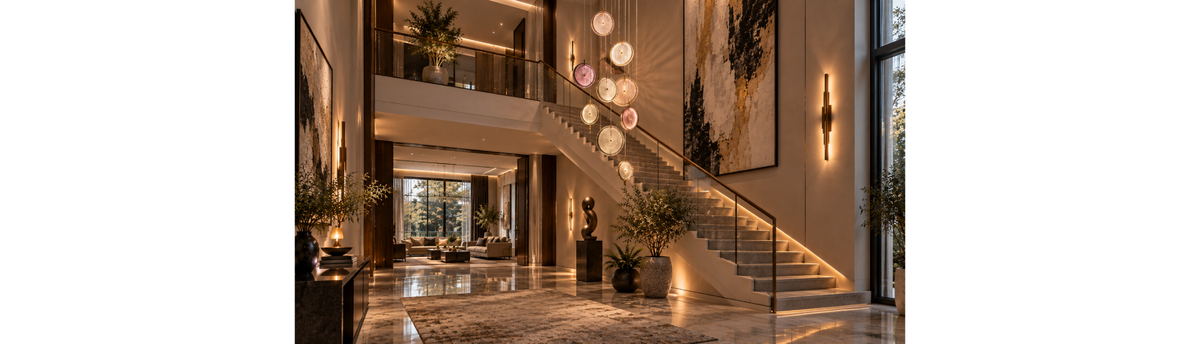

A staircase is one of the most visible parts of a home, yet it is often one of the least styled. Living rooms receive sofas, coffee tables, rugs and artwork. Dining rooms receive chandeliers and carefully arranged tables. Even entrance foyers are usually given some thought. The staircase, meanwhile, is often treated as something purely functional: steps, a railing, a wall and perhaps a light above it.
That is a missed opportunity. A staircase connects different levels of a home, but visually it can do much more than that. It can carry the design language from one floor to another, create a moment of discovery as someone moves through the house and provide vertical space for artwork, decorative lighting, sculptures, plants and carefully selected accessories.
The challenge is that a staircase is not experienced like a normal wall or room. You see it while walking. You see parts of it from the living room, entrance foyer or upper floor. A landing may be viewed from below, while a wall beside the stairs may be seen at an angle rather than straight on. This means that staircase styling requires more thought about movement, sightlines, scale and proportion than simply deciding what looks good on an empty wall.
In a luxury Indian home, the staircase can therefore become a carefully composed transition between spaces. Wall art can establish a visual rhythm along the ascent. Decorative lighting can make the stairwell feel warm rather than merely illuminated. A sculpture on the landing can create a moment of pause. A well-proportioned planter can soften the harder lines of the staircase, while plants can bring life into an otherwise vertical and material-heavy area.
A staircase should not be decorated simply because there is an empty wall. I look at how the staircase is seen from the rest of the house first. If the landing is visible from the living room, it becomes part of that room's composition. If the staircase is enclosed, the lighting and artwork need to make the journey itself interesting. The best staircase styling makes you want to look again as you move through the home.
This guide explains how to style a staircase in a luxury Indian home, from choosing staircase wall art and decorative lighting to selecting a chandelier, placing sculptures on a landing and using planters to introduce greenery. It also looks at how staircase shape, scale, sightlines, materials and circulation affect these decisions, so that the staircase feels connected to the living room, entrance foyer and upper floor rather than styled in isolation.
Table of Contents
- Why the Staircase Deserves to Be Styled
- Read the Staircase Before Choosing Anything
- Start With Sightlines, Not Products
- The Five Styling Zones of a Staircase
- How Staircase Shape Changes the Styling Approach
- How to Style a Staircase Wall
- Using Wall Art Along a Staircase
- When One Large Artwork Is Better
- Creating a Gallery Wall Along a Staircase
- How to Position Artwork on a Staircase Wall
- Why Stairwell Lighting Changes Everything
- Using Wall Lights Along a Staircase
- Choosing a Chandelier for a Stairwell
- When Sculptural Lighting Works Better
- How Lighting and Artwork Should Work Together
- How to Style the Staircase Landing
- Should You Put a Console on a Staircase Landing?
- How to Style Sculptures on a Staircase Landing
- Using Planters and Plants on Staircase Landings
- Styling Open Staircases
- Match Decor to the Staircase Materials
- How the Railing Influences Staircase Styling
- Choosing the Wall Background
- Should You Use a Mirror on a Staircase?
- Making the Staircase Belong to the Rest of the Home
- Styling Staircases in Indian Homes
- Styling Staircases in Large Villas
- Styling Staircases in Duplex and Double-Height Homes
- Styling Staircases in Apartments
- How to Style a Double-Height Stairwell
- Design the Staircase for Day and Night
- Check the Staircase From Five Viewpoints
- The Five-Layer Staircase Styling Framework
- Common Staircase Styling Mistakes
- Why Restraint Makes a Staircase Look More Refined
- Style the Journey
- A Practical Staircase Styling Sequence
- Frequently Asked Questions About Staircase Styling
- Conclusion
- About Navin Kanodia
Why the Staircase Deserves to Be Styled
Most staircase styling begins with the wrong question: “What should I put on this wall?” The better question is, “What should this staircase contribute to the home?”
That small change in thinking makes a significant difference. A staircase is a connecting space, so its styling needs to relate to what happens before and after it. If the staircase rises from a formal living room, the materials, artwork and lighting should feel comfortable beside that room. If it leads towards a more private bedroom level, the atmosphere can become quieter and more personal as you move upwards. The staircase also has its own rhythm. Steps repeat. Railings repeat. Balusters, wall panels or vertical details may repeat. Because the structure already contains repetition, decorative elements should not necessarily repeat at the same intensity. This is why filling every section of a staircase wall with artwork can make the area feel busier than intended.
A beautifully styled staircase often has fewer objects than people expect. One substantial artwork may be enough for a landing wall. A sculptural chandelier may do more than a collection of small ceiling fixtures. One tall planter can have greater impact than several small pots scattered along the steps. The objective is not to make the staircase look decorated. It is to make it feel as though the staircase belongs naturally to the home.
Read the Staircase Before Choosing Anything
Before choosing artwork or decorative objects, spend a few minutes looking at the staircase from different positions. This sounds obvious, but it is one of the steps most often skipped when people begin decorating. Stand at the bottom and look upwards. Then stand on the landing and look back towards the lower level. Look at the staircase from the living room, entrance foyer and upper floor if those views are available. You may discover that the wall that appears most important when standing on the stairs is barely visible from the living room, while a small landing becomes one of the strongest visual points in the entire house.
This is particularly important in open-plan Indian homes. A staircase may sit beside a double-height living room, with the upper landing visible across the room. In that situation, the landing is not simply part of the staircase. It becomes part of the living room composition as well.
Look at the staircase before styling it and identify:
- the main viewing points from the rest of the house
- the wall with the greatest visual presence
- where natural light enters
- where the eye naturally pauses while walking
- where there is enough floor space for a sculpture or planter
- where a chandelier or pendant could be seen from more than one level
- which areas should deliberately remain quiet
These observations tell you where to spend your styling effort and, just as importantly, where not to add anything.
Start With Sightlines, Not Products
This is perhaps the most useful rule when styling a staircase.
Do not decide that a staircase needs a sculpture, chandelier or gallery wall simply because the category seems appropriate. First establish what needs to be seen and from where. Imagine a staircase beside a formal living room. The sofa may face towards the staircase, meaning the landing is constantly within the peripheral view of anyone sitting there. In that situation, a sculpture placed on the landing can become far more important than a series of small artworks along the stair wall.
Now consider a closed staircase with high walls and very little connection to the surrounding rooms. Here the experience is different. Lighting, artwork and material finishes need to make the journey itself engaging because there are fewer external sightlines to provide visual interest. This is why staircase styling cannot be copied directly from a photograph. A photograph gives you one viewpoint. A staircase is experienced from several.
When I look at a staircase, I do not first ask what object will look good there. I ask where the eye goes naturally. Once that is clear, the right decorative element becomes much easier to identify.
The Five Styling Zones of a Staircase
For practical styling, it helps to divide a staircase into five connected zones. They should not necessarily all receive decoration. They simply help you understand where different visual jobs can be performed.
1. The Stair Wall
The stair wall is usually the largest available decorative surface. It can carry artwork, a gallery arrangement, sculptural wall pieces, mirrors or a quiet textured finish.
2. The Lighting Zone
This includes the wall, ceiling and open vertical space where decorative lighting can operate. It may contain wall lights, pendants or a chandelier.
3. The Landing
The landing creates a natural pause. It may be suitable for a sculpture, planter, plant or narrow console if circulation allows it.
4. The Staircase Edge
The railing, balustrade and staircase materials create their own visual rhythm. They should be considered part of the composition rather than something to hide beneath decoration.
5. The View Beyond
What is visible beyond the staircase matters too. A chandelier, artwork or planter may be seen against a living room, dining area, window or upper-floor corridor. That background becomes part of the styling.
Thinking in these zones prevents one common mistake: decorating the staircase wall while ignoring everything that can be seen around it.
How Staircase Shape Changes the Styling Approach
Not every staircase gives you the same styling opportunity. The shape determines where the eye moves, where it pauses and how much wall or floor area is available.
Straight Staircases
A straight staircase creates a long visual line. This can support a sequence of artworks or carefully spaced wall lights, but the length should not be treated as an instruction to fill every available section.
Two or three well-proportioned artworks can establish rhythm without creating visual noise. A single larger artwork may be better if the staircase wall is wide and the surrounding interior already contains several focal points.
L-Shaped Staircases
The turn in an L-shaped staircase gives the eye a natural pause. This can be an excellent location for a stronger artwork, wall light or small sculptural moment, particularly when the turn is visible from the entrance or living room.
U-Shaped Staircases
A U-shaped staircase often creates a more substantial landing. This gives you an opportunity to make the landing itself the focal point rather than decorating every wall equally. A sculpture or planter can work particularly well because it can be appreciated from several directions.
Spiral Staircases
A spiral staircase already contains considerable visual movement. The curve, railing and repeated steps create a sculptural quality of their own. Heavy decoration can therefore work against the staircase rather than with it. In this situation, one strong light or a carefully placed artwork in the surrounding space may be enough. The staircase itself should remain visible.
How to Style a Staircase Wall
A staircase wall should not automatically become a gallery wall. Sometimes one artwork is better. Sometimes a vertical series works beautifully. In other cases, the wall is already strong because of its material or finish and needs almost nothing. The first consideration is the shape of the wall itself. A long sloping wall can work with a carefully arranged sequence of artwork that acknowledges the movement of the stairs. A tall rectangular wall beside a landing may be better suited to one large artwork.
Do not let the angle of the staircase force every artwork into an exact diagonal. That can become predictable very quickly. It is often more sophisticated to allow the arrangement to acknowledge the staircase without literally tracing every step. Material matters too. If the staircase has dark timber, artwork with warm timber, bronze, muted colours or textured surfaces may create continuity. Against pale stone, stronger colour or darker frames can provide definition. Against a patterned wall finish, the artwork may need to be quieter.
The wider Spacio guide on styling walls with art, sculptures and decor accessories provides useful principles for scale, focal points, materiality and negative space.
For a broader approach to composing statement walls, choosing artwork and balancing decorative elements, read Spacio's guide to wall styling and luxury statement walls. These principles are especially useful for staircase walls, where artwork must work with the height of the wall, the angle of the stairs and the views from different floors.
Using Wall Art Along a Staircase
Wall art can be one of the most effective ways to give a staircase personality, particularly when the stairwell has a long uninterrupted wall. But staircase artwork has one major difference from artwork in a living room: the viewer is moving.
The artwork therefore needs to remain meaningful from more than one position. Very intricate pieces that need to be viewed from a fixed distance may lose some of their impact when passed quickly. Strong silhouettes, confident colour fields, sculptural pieces and artworks with clear visual structure can work particularly well. There is also an opportunity to create a visual sequence. Related works can share a colour family, artist, material or subject without being identical. This creates cohesion without making the staircase look repetitive.
Use Artwork to Create Rhythm, Not Repetition
A sequence should have breathing room. If every frame is identical in size, spacing and position, the wall can begin to feel mechanical. Small variations can make the arrangement more natural, provided there is still a clear relationship between the pieces. Think about the pace of the staircase. The artwork should not create a visual stop at every step. It should allow the eye to move, pause and continue.
When One Large Artwork Is Better
One substantial artwork can be far more powerful than six smaller pieces when the staircase has a large landing wall or generous vertical surface. This is particularly effective in contemporary homes where the staircase already has strong materials, a sculptural railing or a statement chandelier. Adding another busy layer of small artwork can create unnecessary competition.
A large artwork also gives the eye somewhere to rest. This matters because the steps, railing and vertical lines are already creating movement. The artwork can provide a controlled visual pause. When using one large piece, consider what sits around it. The wall should provide enough negative space for the artwork to breathe. The frame, colours and texture should relate to the staircase materials without disappearing into them.
Creating a Gallery Wall Along a Staircase
A gallery wall can work beautifully on a staircase, but it needs discipline. The mistake is to treat the staircase as an excuse to display every artwork that does not have a home elsewhere. Start by deciding what connects the pieces. It could be black or brass frames, a restrained colour palette, photography, abstract work or a collection of smaller pieces from the same visual family.
Then consider the overall weight. Tiny frames spread across a very tall wall will look lost. If the wall is generous, fewer but larger pieces may be more successful. Lay the arrangement on the floor before fixing it to the wall. Photograph it from a distance. Then remove one piece and look again. Often the stronger arrangement is the one with slightly more space around the individual works.
How to Position Artwork on a Staircase Wall
There is no universal measurement that works for every staircase because wall angle, ceiling height, artwork size and viewing positions all change the answer. Instead, use the movement of the staircase as your reference. Artwork should feel connected to the person walking through the space without appearing to chase the steps too literally.
Before fixing anything permanently, make paper templates of the artwork and place them on the wall. View them from the bottom of the staircase, the middle and the landing. Also check the relationship between artwork and handrail. The art should not feel squeezed into a narrow strip immediately above the railing. Where possible, allow enough visual breathing room for both the railing and artwork to retain their clarity.
Why Stairwell Lighting Changes Everything
Lighting is particularly important in a staircase because the space changes dramatically between daytime and evening. During the day, natural light may enter through a window, skylight or double-height opening. At night, the staircase depends on illumination to provide both visibility and atmosphere. If the only lighting is a bright ceiling fixture, the staircase may feel functional but flat. Decorative lighting gives the stairwell another layer.
Wall lights can wash a textured surface with light. Accent lighting can pick out artwork or sculpture. A chandelier can occupy the vertical space between floors. Concealed illumination can highlight a railing or wall without becoming a visible feature itself. The strongest staircase lighting schemes usually combine more than one approach, while still keeping one clear visual hierarchy.
Spacio's guide to ambient lighting in luxury Indian interiors explores the wider principle of using light to influence atmosphere, material perception and visual focus.
Using Wall Lights Along a Staircase
Wall lights serve a different purpose from a chandelier. A chandelier can establish a strong focal point, while wall lights provide rhythm, scale and a softer layer of illumination along the staircase. Symmetry is useful when the staircase has a formal character, but it is not compulsory. Two matching wall lights can create order on a long wall. On a more relaxed contemporary staircase, fewer fittings with greater spacing can feel more considered.
The light should also be considered in relation to artwork. A fitting directly beside or above a painting can either enhance it or flatten the composition depending on its beam and position. Before selecting the fitting, decide whether the artwork is the hero or whether the light itself is meant to attract attention. Trying to make both equally dominant often creates competition.
Choosing a Chandelier for a Stairwell
A staircase is one of the few locations in a home where a chandelier can be appreciated from several levels at once. That makes the choice more demanding than choosing a chandelier for a dining table. A chandelier that looks beautiful from the ground floor may look completely different from the upper landing. Its proportions, drop, width and visual density all need to work from multiple viewpoints.
For a double-height stairwell, a sculptural chandelier can provide the vertical punctuation the space needs. In a more compact staircase, an elongated or vertically proportioned fixture may create presence without overwhelming the stairwell. The chandelier should also relate to the staircase itself. A highly decorative railing paired with an extremely ornate chandelier can become excessive. Conversely, a very restrained staircase may benefit from a more expressive light fixture.
For homeowners and interior professionals comparing luxury staircase chandeliers in India, Spacio's dedicated staircase and stairwell chandelier collection focuses on lighting for tall vertical spaces, including villas, duplexes and stairwells. The broader Chandeliers collection extends the choice across European and Italian design styles. Compare each fixture from the ground floor and upper landing, paying attention to its drop, silhouette, visual density and relationship with the staircase materials.
When Sculptural Lighting Works Better
Some staircases do not need a conventional chandelier at all. A sculptural suspension or artistic lighting installation can create a more individual result, especially where the staircase has clean lines and relatively little decorative detail. This approach works particularly well when the light is visible from the entrance or living room. The fixture becomes part of the room's visual composition rather than simply an overhead source.
Spacio's sculptural lighting collection can be considered when the lighting itself needs to become a strong visual element. The important point is restraint elsewhere. If the light has a strong sculptural character, the surrounding wall does not necessarily need a large gallery of artwork competing with it.
How Lighting and Artwork Should Work Together
Artwork and lighting are often selected independently, which is one reason staircases can end up feeling visually disjointed. The artwork establishes colour, scale and subject matter. The light determines how that artwork is actually experienced in the evening.
A painting with strong texture may need a different treatment from a smooth print. A metallic artwork can reflect a direct beam and become unnecessarily bright. Sculptural wall art may cast shadows that are part of its appeal. Consider the daytime and evening versions of the composition. Natural light may reveal texture and colour during the day, while decorative illumination becomes the dominant visual layer at night.
How to Style the Staircase Landing
If the staircase wall is the journey, the landing is the pause. This is why landings deserve much more attention than they usually receive. A landing can provide the one place where a sculpture, planter, artwork or small console can be seen from several directions without being interrupted by the movement of the steps.
The best landing styling begins with what the landing can be seen from. If it is visible from the living room, choose something that belongs to the living room palette. If it faces a bedroom corridor, the styling can become quieter. If it is positioned beneath a large chandelier, avoid placing another oversized object directly below it unless the two elements have been intentionally designed as a pair. A landing does not necessarily need furniture. In many homes, one strong sculpture or a tall planter is enough.
Should You Put a Console on a Staircase Landing?
A staircase landing can sometimes accommodate a narrow console, but the decision should begin with circulation rather than decoration. The landing needs enough clear space for people to turn, pass and use the staircase comfortably. A beautiful console that narrows the walking route is not a successful styling decision.
Where there is sufficient width, a slim console can provide a useful horizontal counterpoint to the vertical movement of the stairs. It can also create a base for one sculptural object, a small lamp or a restrained arrangement of accessories. If the landing is already visually strong because of a window, artwork or chandelier, a console may be unnecessary. An empty section of floor can sometimes provide exactly the negative space the staircase needs.
For more detailed guidance on arranging objects on a console, see Spacio's guide to styling console tables with decorative accessories.
How to Style Sculptures on a Staircase Landing
Sculptures are particularly effective on staircase landings because they can be appreciated from changing viewpoints. A flat artwork is generally read from one main plane. A sculpture changes as you walk around it. Its silhouette can appear different from the living room, lower stairs and upper landing. That makes a three-dimensional piece particularly suitable for a transitional space.
Scale is critical. A sculpture that is too small can disappear against a large landing wall or open stairwell. A sculpture that is too large can interfere with circulation and make the landing feel cramped. Material changes the experience too. Glass can catch and reflect chandelier light. Metal can introduce contrast against stone or timber. Ceramic can bring a softer, more tactile quality. Crystal can become expressive when it catches both daylight and decorative illumination.
Spacio's Sculptures & Art Objects collection provides different visual directions. The important point for staircase styling is not the category itself, but choosing a piece whose scale and silhouette can hold its own within the landing.
Give the Sculpture Room to Breathe
One of the easiest ways to weaken a sculptural arrangement is to surround the main object with too many smaller objects. A sculpture needs negative space around it so that its silhouette can be read clearly. If the landing already contains a planter, artwork and console, adding another group of accessories may not improve it. Remove one or two objects and look again.
In luxury interiors, editing is often more valuable than adding another beautiful piece.
Using Planters and Plants on Staircase Landings
Plants bring something to a staircase that artwork and lighting cannot: softness and movement. A staircase is often made up of hard surfaces such as stone, timber, glass, metal and plaster. A well-chosen plant introduces a different texture and breaks the repetition of those materials without making the space feel overly decorated.
The planter matters just as much as the plant. A beautiful plant in an undersized or visually weak pot can make the entire arrangement feel accidental. A substantial sculptural planter, on the other hand, can act almost like a piece of furniture or sculpture. On a large landing, a tall planter with a strong vertical or slightly spreading silhouette can help connect the lower and upper levels. In a smaller landing, a compact plant with controlled growth may be more appropriate because circulation needs to remain clear.
Spacio's Planters & Pots collection can be considered when the planter itself needs to contribute to the composition. The guide to styling decorative planters and pots in Indian homes provides further guidance on proportion, placement and greenery.
Choose Plant Height According to the Landing
A plant should not block the sightline through the staircase. This is especially important where the landing overlooks the living room or entrance. A plant that is attractive from close range can become an obstruction when seen from the floor below. For a wide landing, a larger plant can establish a useful vertical transition between floors. In a narrow landing, a more compact arrangement may be better.
Plant foliage also matters. Large leaves create a strong silhouette, while finer foliage creates movement without carrying as much visual weight. Choose according to the amount of visual activity already present in the staircase.
Styling Open Staircases
Open staircases require a different level of restraint because there is less solid wall to hold artwork and decorative objects. The staircase itself becomes a visible object in the room, particularly when the treads, railing and supporting structure are exposed.
Here, the temptation is often to compensate by adding decoration elsewhere. Resist that instinct. If the staircase has a strong timber finish, glass railing or sculptural metalwork, allow those materials to participate in the styling. A carefully selected chandelier and one strong landing element may be enough.
Furniture placed near an open staircase also becomes part of the composition. A large sofa, console or sculpture positioned immediately beside the stairs can either strengthen the visual relationship or make the circulation area feel congested.
Match Decor to the Staircase Materials
The material of the staircase should influence the objects placed around it. This does not mean everything has to match. In fact, exact matching can make the area feel overly coordinated. What matters is finding a relationship between materials.
A timber staircase can accommodate metal lighting, stone sculptures and ceramic planters because each material introduces a different quality. A marble staircase may benefit from warmer timber or bronze details to prevent the composition from becoming too hard.
A dark staircase can provide a strong background for lighter artwork, while a pale staircase may need stronger visual weight from the lighting or objects.
Think in terms of material rhythm. If brass appears on the chandelier, it can reappear subtly in a frame or sculpture. If black metal is used in the railing, a black detail elsewhere can connect the composition.
How the Railing Influences Staircase Styling
The railing is easy to overlook because it is considered part of the staircase itself, but visually it can have a major effect on the finished composition. A delicate glass railing behaves very differently from a heavy timber or metal railing. A glass railing leaves more of the background visible, so artwork and lighting can become stronger visual elements. A dark metal railing introduces a strong graphic line and may already provide considerable visual rhythm.
A timber railing brings warmth and may create a useful relationship with timber furniture elsewhere in the home. Do not try to hide the railing with decoration. Let it remain part of the composition. Decorative elements should sit around its visual structure rather than compete with it.
Choosing the Wall Background
The background behind the staircase can determine how successfully artwork, lighting and sculpture are perceived. A quiet neutral wall allows objects to become the focus, while a stronger colour or textured finish already contributes visual weight. If the wall has a strong finish, be more selective with artwork. If the wall is plain and tall, artwork or a sculptural light can give it depth.
The same principle applies to wallpaper. A patterned wall can be beautiful in a stairwell, but it changes how much decorative material the space can comfortably carry. When the background already has movement, lighting and objects need to be edited accordingly.
Should You Use a Mirror on a Staircase?
A mirror can work on a staircase, particularly where it helps reflect natural light or visually connect two areas of the home. However, the position needs more thought than simply finding an empty wall. A mirror opposite a busy staircase may reflect too much movement and make the area feel unsettled. A carefully positioned mirror can instead reflect a window, artwork or decorative light and add another layer of depth.
If the staircase already has substantial artwork, a large chandelier and a sculptural landing piece, another reflective surface may not be necessary.
Making the Staircase Belong to the Rest of the Home
A staircase should not look as though it was decorated after the rest of the house was completed. It sits between spaces, so it naturally becomes one of the places where different rooms meet. If the living room uses warm timber, bronze lighting and neutral upholstery, the staircase might pick up the same warmth through a timber frame, bronze sculpture or warm-toned lighting.
If the home is built around pale stone, black metal and glass, those materials can appear again in the stairwell without being repeated literally. The same principle applies to colour. A staircase does not need to introduce an entirely new palette. It can borrow one colour from artwork downstairs, repeat a muted tone from a rug or echo a metal finish used in the living room.
This creates a visual thread through the home.
Spacio's guide to luxury home decor accessories provides broader guidance on bringing decorative objects, sculptures, vases and artwork together without overfilling an interior.
Styling Staircases in Indian Homes
Indian homes often present a particular staircase styling challenge because staircases can sit between very different zones: the formal entrance, family living area, dining space and upper-floor bedrooms. In villas and duplexes, they may also be visible from a double-height entrance or large living room. This makes sightlines especially important. Before selecting artwork or lighting, stand at the entrance and look towards the staircase. Then view it from the living room, first landing and upper floor. The objects that matter most are the ones visible from these important viewpoints.
Material selection also needs to respond to the existing flooring, railing and joinery. Marble, natural stone, timber, metal and glass can all be combined successfully, but the transition between them should feel intentional.
Styling Staircases in Large Villas
Large villas often offer the greatest opportunity for dramatic staircase styling. A double-height entrance, generous landing and long stairwell wall can accommodate a substantial chandelier, large-scale artwork or sculptural installation. But having the space does not mean every opportunity should be used.
Decide which element should dominate. If the chandelier is visually striking, keep the wall treatment quieter. If the staircase wall carries a large artwork, the lighting can become more atmospheric. If a sculpture commands the landing, surrounding accessories can be reduced.
This hierarchy is what prevents a large staircase from becoming a collection of unrelated statements.
Styling Staircases in Duplex and Double-Height Homes
In a duplex, the staircase often becomes one of the strongest connecting elements between floors. It can be seen from the lower living area while also forming part of the upper-level circulation space. A chandelier suspended through the stairwell can visually connect the two levels. Artwork can provide a slower rhythm along the wall, while a sculpture or planter at the landing gives the eye a point of pause.
Where the stairwell opens into a living room, remember that the staircase is also part of the living-room composition. The colour, material and visual weight of the staircase should sit comfortably alongside the sofa, coffee table, lighting and other major pieces visible from that viewpoint.
Styling Staircases in Apartments
In an apartment or smaller duplex, the staircase may not have enough wall or landing space for several decorative categories. This is where editing becomes especially important. One well-proportioned artwork, a pair of considered wall lights or one plant on a landing can be enough. A narrow staircase does not need to imitate the treatment of a large villa simply because the same categories of products are available.
In a smaller space, use vertical height intelligently. A carefully selected pendant or chandelier can create presence without occupying valuable floor area. Artwork can provide personality without introducing furniture into the circulation zone.
How to Style a Double-Height Stairwell
Double-height stairwells are particularly easy to underestimate. Something that looks substantial at eye level can become surprisingly small when viewed against a tall wall or large open void. This does not mean everything has to become oversized. Instead, introduce scale at different levels. The chandelier can occupy the vertical space. Artwork can establish the wall rhythm. A landing sculpture can create a lower focal point. Plants can soften the transition between floors.
Think of these elements as a sequence rather than competing objects. The eye should be able to travel from the lower staircase to the landing and then upwards without becoming trapped by one dense area of decoration.
Design the Staircase for Day and Night
A staircase changes character considerably after sunset. During the day, daylight may enter through windows or skylights and make the artwork and materials more prominent. At night, decorative lighting becomes much more important. Look at the staircase after the main ceiling lights are switched off. Which elements disappear? Which become too bright? Does the chandelier create a pleasant glow or simply illuminate the entire stairwell? Does the wall artwork still have enough light to be appreciated?
This simple evening test often reveals more than choosing products from a catalogue. A staircase should feel intentional in the evening because that is when decorative lighting can transform it from a circulation route into part of the home's atmosphere.
Check the Staircase From Five Viewpoints
Before finalising the arrangement, look at the staircase from the places where it will actually be experienced.
| Viewpoint | What to Check |
|---|---|
| Entrance | Does the staircase create a clear first impression without feeling crowded? |
| Living room | Does the staircase complement the furniture and lighting visible around it? |
| Bottom of the stairs | Does the artwork and lighting create a convincing upward visual rhythm? |
| Landing | Is there enough space for movement and does the focal object have breathing room? |
| Upper floor | Does the composition still look balanced when viewed from above? |
This exercise is particularly valuable because the composition is experienced while moving. An arrangement that looks perfect from the living room may feel awkward from the landing. Small changes in height, spacing or visual weight can make a surprising difference.
The Five-Layer Staircase Styling Framework
For a practical way to bring everything together, think of the staircase as five overlapping layers.
Layer 1: The staircase itself. The steps, railing, flooring and materials provide the base visual rhythm.
Layer 2: The wall. Artwork, wall lights, mirrors or textured finishes establish the main surface composition.
Layer 3: Decorative lighting. A chandelier or pendant introduces vertical presence and changes the atmosphere after sunset.
Layer 4: The landing. A sculpture, console or planter can create a moment of visual pause where the staircase changes direction.
Layer 5: Organic and decorative detail. Plants and smaller accessories add softness and personality, but should be introduced only after the larger composition is working.
This order matters. If accessories are selected before the larger layers are resolved, the staircase can end up with many attractive objects but no clear hierarchy.
Think of the Staircase as a Sequence
A successful staircase rarely depends on one decorative object. It works because the eye moves from one element to another: the artwork catches attention, the light creates atmosphere, the railing carries the line, the landing provides a pause, and a sculpture or plant gives that pause a sense of character. The individual pieces matter, but the sequence matters more.
Common Staircase Styling Mistakes
1. Filling Every Wall
A staircase provides a lot of wall area, but that does not mean every section needs artwork. Too many pieces remove the pauses that allow the eye to appreciate the staircase itself.
2. Using Artwork That Is Too Small
Small artwork can become insignificant against a long stair wall. If the wall has substantial height or length, consider fewer pieces with greater visual presence rather than many small frames.
3. Choosing a Chandelier Only Because It Is Large
A stairwell chandelier needs height and presence, but size alone does not make it suitable. Its form, drop, visual weight and relationship with the staircase all matter.
4. Blocking the Landing
A console, sculpture or planter should never compromise movement. Measure the available space and consider the route people actually take through the staircase before placing anything.
5. Matching Every Object
When the chandelier, artwork, sculpture, planter and railing all use the same finish, the staircase can feel staged rather than collected. Contrast is useful. The objective is cohesion, not uniformity.
6. Styling Only for Daylight
A staircase can look beautiful in daylight and lose all its character after sunset if the lighting has not been considered properly. Always evaluate the composition in the evening.
7. Treating the Landing Like a Display Shelf
A landing is not another console table. It is part of the circulation route. A sculpture or planter needs enough room around it to remain visually strong without becoming an obstacle.
8. Ignoring the View From Below
People often style a landing while standing on it. The more important question may be how that landing looks from the living room or lower staircase. Always check the view from below before finalising the composition.
9. Adding Plants Without Considering the Light
A plant should not be selected only for its appearance. Consider the amount of daylight, maintenance requirements, watering and drainage, as well as the physical space available for the planter.
Why Restraint Makes a Staircase Look More Refined
There is a particular temptation with staircases because they often have empty walls and unused landings. Empty space can feel like an invitation to decorate. Yet some of the strongest staircases leave substantial areas untouched.
Negative space gives the eye somewhere to rest. It also makes the objects that have been selected feel more important. A single sculpture on a quiet landing can have considerably more impact than the same sculpture surrounded by vases, books, trays and smaller objects.
This is one of the clearest differences between furnishing a staircase and styling one. Furnishing is about providing what the space needs. Styling is about deciding what deserves attention.
Style the Journey, Not Just the Landing
A staircase is experienced while moving through it. The styling should therefore reveal itself gradually rather than being visible as one crowded arrangement from a single viewpoint.
This is perhaps the most useful way to think about a staircase. You do not experience it while standing still in the centre of the room. You approach it, begin climbing, turn at the landing and continue upwards. Artwork changes angle. A chandelier appears differently from each level. A sculpture becomes more visible as you approach it. A plant may frame the view rather than simply decorate the landing.
Good staircase styling takes advantage of this movement. It gives the eye something to discover without creating visual clutter at every step.
A Practical Staircase Styling Sequence
If you are styling a staircase from scratch, do not begin by shopping for accessories. Work through the space in this order.
| Step | Styling Decision |
|---|---|
| 1 | Study the staircase from every important viewpoint. |
| 2 | Identify the strongest focal point. |
| 3 | Decide whether decorative lighting or artwork should carry the greatest visual weight. |
| 4 | Plan the wall art around the wall length, staircase movement and sightlines. |
| 5 | Choose the chandelier or wall-light strategy. |
| 6 | Use the landing for one strong sculptural or organic element where appropriate. |
| 7 | Introduce planters and plants only where they improve the composition and do not obstruct circulation. |
| 8 | Repeat one or two materials from the surrounding rooms to create cohesion. |
| 9 | View the complete staircase in daylight and after sunset. |
| 10 | Remove anything that competes with the main focal point. |
This sequence keeps the room in control. Products become the result of the styling decision rather than the starting point.
Frequently Asked Questions About Staircase Styling
How do I style a staircase in a luxury home?
Start by studying the staircase from the entrance, living room, bottom step and landing. Establish one main focal point through decorative lighting or artwork, then introduce a sculpture, planter or additional artwork only where the space supports it. The aim is to create rhythm and hierarchy rather than fill every available wall.
What should I put on a staircase wall?
Artwork is one of the most versatile choices, but a staircase wall can also support sculptural wall pieces, selected mirrors or decorative wall lights. The correct choice depends on wall length, staircase shape, viewing angle and the other elements already present.
What type of chandelier is best for a staircase?
A chandelier with enough vertical presence to relate to the height of the stairwell generally works well, but there is no single correct shape. Long pendants, branching chandeliers and sculptural suspension lights can all work depending on the staircase and surrounding composition. Scale, drop, visual weight and viewing angles should be considered together.
How do you decorate a staircase landing?
First protect the circulation area. If there is sufficient space, a landing can accommodate one strong sculpture, planter, artwork or slim console with a restrained arrangement. The landing usually benefits from one clear focal point rather than several small decorative groups.
Can I put plants on a staircase landing?
Yes. Plants can soften hard staircase materials and introduce organic form. Choose the planter and plant according to the landing's width, available light and sightlines, and make sure the arrangement does not obstruct movement.
Where can I find luxury decor accessories for a staircase?
Spacio curates luxury decor accessories for Indian homes, including sculptures, art objects and planters that can be used to style staircase walls and landings. The Luxury Home Decor Accessories guide explains how to select objects according to scale, proportion, material and visual balance. For a staircase landing, the best choice is usually an object with a clear visual role and enough space around it, rather than a collection of smaller pieces.
Is a gallery wall a good idea for a staircase?
A gallery wall can work particularly well on a long straight staircase, provided the artwork has a clear relationship in scale, colour or subject. Avoid filling every available section of wall. A gallery arrangement should have visual rhythm and enough negative space to remain readable while people move through the staircase.
How can I style a small staircase without making it look crowded?
Use fewer elements and give priority to wall-based decoration rather than floor-standing objects. One strong artwork, a carefully chosen wall light or a compact plant can be enough. Avoid adding furniture to a narrow landing unless there is genuinely enough space for comfortable movement.
How do you style a double-height staircase?
Use different visual layers to address the height rather than trying to make one object fill the entire space. A substantial chandelier can occupy the vertical volume, while artwork and a landing sculpture create lower points of interest. Check the composition from both floors so that no single element dominates unnecessarily.
Should staircase lighting match the rest of the house?
It does not have to match exactly, but it should feel related. Repeating a material, finish or design language from nearby rooms can create continuity. The staircase can also carry a slightly more sculptural lighting element if the rest of the composition is restrained.
How should I choose artwork for a staircase?
Choose artwork according to the staircase's scale, viewing distance, wall proportions and movement through the space. Pieces with strong visual structure often work well because they remain readable from different positions. For a gallery wall, establish the overall arrangement before fixing anything permanently.
Where can I find luxury staircase chandeliers in India?
Spacio offers a dedicated luxury staircase and stairwell chandelier collection for Indian homes, including villas, duplexes and double-height interiors. The wider Chandeliers collection provides further options from European and Italian design brands. When choosing a staircase chandelier, consider the stairwell height, viewing angles, chandelier drop, visual weight and the relationship with the railing, artwork and surrounding interior.
How many decorative accessories should I put on a staircase landing?
Usually fewer than you think. A landing already contains the visual weight of the staircase, railing and surrounding walls. One substantial sculpture or planter can often create more impact than a group of smaller accessories.
Where can I find luxury staircase lighting and decor accessories in Mumbai?
Homeowners and interior professionals looking for decorative lighting, sculptures, planters and other styling objects in Mumbai can visit Spacio's Mumbai store at 3BK, Laxmi Industrial Estate, New Link Road, Andheri West. The showroom brings together European decorative lighting, decor accessories, sculptures and planters, making it useful when the aim is to develop a complete staircase composition rather than select isolated objects. Get directions to Spacio Mumbai on Google Maps.
Where can I find staircase decor accessories and lighting in Kolkata?
Spacio's Kolkata flagship store at Spacio Towers, 86B Topsia Road (South), Kolkata, brings together furniture, European decorative lighting, sculptures, planters and home decor accessories. For a staircase project, seeing lighting, materials and decorative objects together can make it easier to judge scale, proportion and how the staircase relates to the wider home. Get directions to Spacio Kolkata on Google Maps.
Style the Staircase as Part of the Home
A staircase deserves more attention than it usually receives. It connects floors, but visually it also connects rooms, materials and different parts of the home. Because people experience it while moving, its styling needs to work through changing viewpoints rather than from one carefully photographed position.
The strongest results usually come from a clear hierarchy. Start with the staircase itself and its proportions. Establish the main lighting element or artwork. Use the wall to create rhythm. Give the landing one meaningful focal point. Introduce sculptures and plants where they improve the composition, and then stop before the area becomes crowded. Wall art, decorative lighting, sculptures, planters and plants can all make a staircase more memorable, but none of them should be selected simply because there is an empty space available. Each should have a reason for being there.
That is ultimately what makes staircase styling feel considered: not the number of beautiful objects, but the confidence to know where each one belongs and where nothing more is needed.


