
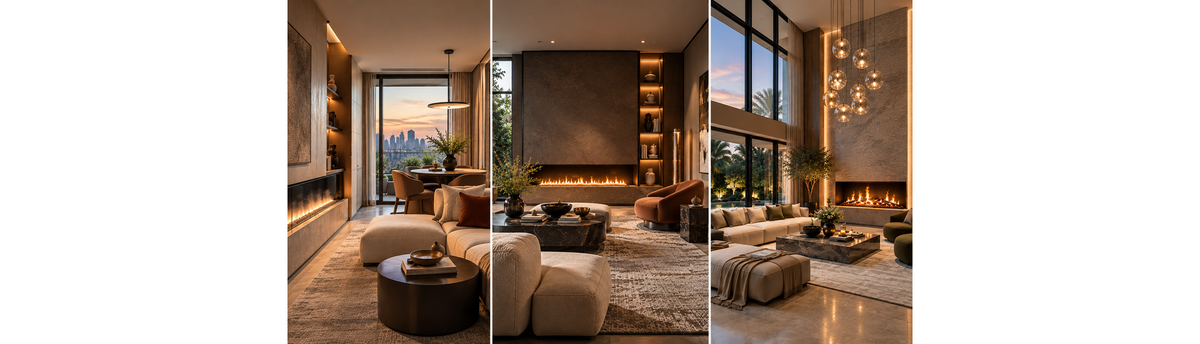

Can a fireplace work in a compact apartment? What makes one suitable for a large living room, a penthouse or a grand villa? The answer depends on more than the size of the room. The fireplace format, wall width, viewing distance, furniture layout, desired flame effect and need for heat must all be considered together.
Spacio approaches fireplaces as part of the complete interior. Its fireplace range brings together different technologies and formats for contemporary Indian homes, from electric and water vapour fireplaces to holographic, bioethanol and gas options, with wood-burning models also forming part of the wider category. The right choice depends on the room, the experience the homeowner wants and the practical conditions of installation.
Navin Kanodia, Co-Founder and Creative Director at Spacio and a Fireplace Expert and Interior Stylist, brings the room-planning perspective to this decision. His approach connects the fireplace with the wall that holds it, the furniture around it, the distance from which it is viewed and the way the room will be used. This matters whether the brief is for a compact city apartment or a generous villa living room.
In This Article
- What Fireplace Scale Really Means
- Choosing a Fireplace for a Compact Apartment
- Planning a Fireplace for a Large Living Room
- Fireplaces for Penthouses and Grand Villas
- Which Fireplace Technology Suits the Space?
- Matching the Fireplace with Furniture and the Wall
- Heat, Ventilation and Installation: What Changes?
- Navin Kanodia's Approach to Fireplace Selection
- Fireplace Planning Across Indian Cities
- Mistakes to Avoid When Choosing a Fireplace
- Frequently Asked Questions
- Finding the Right Fireplace for Your Space
What Fireplace Scale Really Means
Fireplace scale is the relationship between the fire feature and everything around it. A fireplace may fit physically on a wall and still look wrong because it is too short for the width of the room, too dominant beside the seating or positioned where it cannot be appreciated from the main viewing area. Good selection considers the full composition, not just the available opening.
Four factors have a direct influence on that composition. The first is the room's footprint: how much space is available for seating, circulation and the fireplace installation. The second is the wall's width and height, which affect how much visual presence the fire needs. The third is viewing distance, because the same flame effect can look very different from a sofa a few metres away and from the far end of a large room. The fourth is the intended function: a fireplace selected for real heat has different requirements from one chosen mainly to create atmosphere.
These factors explain why there is no universal rule that an apartment needs a small fireplace or a villa needs a large one. A compact apartment may have a wide media wall that can support a long, linear fire feature. A grand villa may have a carefully proportioned fireplace that sits within a more restrained composition. The right scale is determined by the room and its purpose, not by the property label.
Fireplace scale is one part of a wider selection decision. For the broader framework covering fireplace technologies, real flame versus artificial flame, heating requirements, installation and interior applications, read Spacio's complete guide to luxury fireplaces in India.
What to Measure Before Choosing a Fireplace
Before shortlisting a fireplace, collect a few measurements and details about the room. These will help narrow the options and make discussions with a fireplace specialist more productive.
- Room dimensions: Record the room's length, width and ceiling height. Together, these help establish the room volume, which matters when assessing heating needs.
- Available wall space: Measure the wall's width and height, including the space already occupied by a television, windows, doors, cabinetry or other fixed features.
- Viewing distance: Measure the distance from the main seating position to the proposed fireplace. The flame should be considered from the places where people will actually sit.
- Furniture layout: Note the sofa width, seating positions, walking routes and any nearby furniture that could affect the composition.
- Installation conditions: Identify the proposed location, available electrical or fuel connections, and any building restrictions. Requirements depend on the fireplace technology and model.
If the fireplace is intended to heat the room, do not choose its output from floor area alone. Ceiling height, connected open-plan spaces, windows, insulation and local conditions can all affect the requirement. Ask the supplier or a qualified professional to assess the specific room and model before making the final choice.
Choosing a Fireplace for a Compact Apartment
In an apartment, the fireplace must earn its place. It should create a clear focal point without making the room harder to use. The available wall, sofa position, television, storage and walking routes all affect the decision. Before considering the fireplace itself, establish how people will sit, move through the room and use the space every day.
A wall-mounted or built-in fireplace may be suitable where the design and installation conditions allow it. Integrating the fire into a media wall can help organise the television, storage and focal point into one composition. However, the fireplace should not be treated as a decorative strip added beneath the television at the end of the project. Its dimensions and position need to be planned with the cabinetry, screen, seating and wall finishes from the beginning.
For apartments where heating is not the main purpose, electric LED, water vapour or holographic fire effects may be worth exploring. They offer different ways to create the visual presence of fire without using the same mechanism as a conventional fuel-burning fireplace. Their flame appearance, operating requirements and any heating function vary by technology and model, so the selection should reflect the actual brief rather than assumptions about the category.
Furniture is equally important. A deep sofa, an oversized coffee table and a bulky media unit can crowd a compact room even when the fireplace is well chosen. A more balanced layout leaves space around the focal point and keeps the seating group comfortable. The aim is not to make every object small; it is to give each object a clear role.
Indoor LED fireplace collection and water vapour fireplace collection are relevant starting points when the design brief favours a visual fire feature. The suitability of any model still depends on the wall, room layout and manufacturer's installation requirements.
Planning a Fireplace for a Large Living Room
A large living room creates different challenges. There may be more wall space, greater viewing distances and a larger seating arrangement, but an expansive room can make a fireplace appear visually disconnected if its scale and placement are not carefully considered.
Begin with the principal seating group. If the sofa and chairs face the fireplace, the fire should relate to their combined width and the distance between the seating and the wall. If the living room is open-plan, the fireplace may help define the lounge area within a larger space. In either case, its position should make sense from the places where people actually sit, not only from the entrance or a photograph taken straight on.
A linear fireplace can work well on a broad wall, particularly where it is part of a media wall or a composition with cabinetry and selected materials. Its length should relate to the wall rather than simply fill as much space as possible. A long fire feature can give a broad wall a clear horizontal line, but surrounding surfaces, television placement and furniture need to support that line.
Large rooms also need attention to visual weight. If the fireplace is the principal focal point, the furniture can reinforce its position through a considered seating arrangement. Lighting, artwork and decorative objects can add depth, but too many competing elements may weaken the overall effect. A generous room does not need every wall or surface to make a statement.
For a room where the fireplace is intended to provide real heat, the selection also needs to reflect the room's use and the requirements of the chosen model. Room volume and the open connections to adjoining areas may affect heating needs, so a visual decision should not substitute for model-specific technical advice.
Fireplaces for Penthouses and Grand Villas
Penthouses and villas can include long feature walls, double-height living rooms, large glazed openings and several connected seating areas. Here, the fireplace may need to hold attention across a much larger visual field. The question is not simply how large the fire should be, but how it will relate to the height of the room, the length of the wall and the furniture below it.
In a double-height room, a fireplace positioned low on a very tall wall may appear disconnected from the rest of the space unless the surrounding composition brings the elements together. A strong horizontal fire feature, carefully placed artwork, shelving or lighting can help create a visual relationship across the wall. The solution depends on the room's proportions and should be planned as a whole.
A villa may also have more than one room in which a fireplace could be considered. A formal living room may call for a strong visual focal point, while a family lounge may place greater emphasis on comfort and everyday use. A bedroom or private suite may need a more intimate scale. Each application should be judged on its own purpose rather than repeating the same fireplace treatment throughout the property.
Where the fireplace is intended as a real-flame feature, the design must account for the system's installation and operating requirements from the earliest planning stage. A large room does not automatically make every technology suitable, and the presence of more wall space does not remove the need for correct clearances, ventilation where required and professional installation.
Spacio's fireplace collection brings together options for different interior settings and design requirements. It is a useful starting point for exploring the breadth of the category before narrowing the choice to the technology and format that suit a particular room.
How the Room Changes the Fireplace Decision
| Room or property type | What deserves the most attention | Key selection question |
|---|---|---|
| Compact apartment | Usable floor space, wall width, television position and circulation | Can the fireplace create a focal point without crowding the room? |
| Large living room | Viewing distance, seating-group width and the visual weight of the feature wall | Will the fireplace remain visually connected to the main seating area? |
| Penthouse or grand villa | Ceiling height, long or double-height walls, connected spaces and installation access | How will the fireplace relate to the full height and width of the interior? |
These are starting points, not fixed rules. A compact apartment can have a wide feature wall, while a villa can include intimate rooms that need a restrained solution. The final choice should reflect the dimensions, intended use and technical conditions of the individual space.
Which Fireplace Technology Suits the Space?
Room scale helps determine the fireplace's dimensions and visual presence. Technology determines how the fire is created, whether heat is provided and what installation conditions must be met. These are separate decisions, and both need to be made before the design is finalised.
Electric and LED fireplaces
Electric and LED fireplaces create a visual fire effect without a conventional open fuel flame. Depending on the model, they may be designed mainly for ambience or may also provide heating. They can be considered for apartments, living rooms, bedrooms and media walls, provided the selected model fits the intended use and installation conditions.
For homeowners who want a visual fire feature in a room where heating is not needed, the important questions include the appearance of the flame, the dimensions of the unit, the way it will be integrated into the wall and the requirements for electrical connection and operation.
Water vapour fireplaces
Water vapour fireplaces create a flame-like visual effect using mist and lighting. They are generally considered when the visual experience of fire is the priority rather than room heating. Their potential role in an apartment, media wall or contemporary living room depends on the particular model and how the feature is to be viewed within the room.
They should not be selected on appearance alone. The water supply, electrical requirements, dimensions and installation details need to be checked for the specific unit. Spacio's water vapour range offers a route to explore this type of fire effect for interiors where ambience is the principal aim.
Holographic fireplaces
Holographic fireplaces focus on the visual presentation of fire. They may suit a design brief in which the flame effect is intended to form part of a contemporary focal wall or a distinctive interior setting. The viewing position matters because the effect needs to be considered from the main seating areas and the normal approach to the room.
The chosen system's actual capabilities and installation requirements should be confirmed rather than inferred from the word "holographic". Explore holographic fireplace collection when this type of visual fire is being considered.
Bioethanol fireplaces
Bioethanol fireplaces use fuel to create a real flame. Their visual character differs from an electric or water vapour effect, and that distinction can influence the role they play in a room. Depending on the model, a fireplace may be integrated into a planned wall or used as a separate feature.
Because this is a real-flame technology, fuel handling, clearances, operation and installation requirements must be reviewed for the exact model. The fact that a fireplace may not require a conventional chimney does not mean it can be installed anywhere without further assessment. Spacio's indoor bioethanol fireplace collection covers this branch of the category.
Gas and wood-burning fireplaces
Gas and wood-burning fireplaces are different real-flame systems, each with its own requirements for installation, ventilation or flue arrangements, clearances, fuel and operation. They may be considered where the project brief and property conditions support them, but they should never be treated as interchangeable with electric or visual flame technologies.
The room's design and the technical suitability of the system must be assessed together. Before committing to a wall design or furniture arrangement, confirm the requirements of the specific fireplace with the manufacturer and a qualified installer. Spacio's indoor gas fireplace collection is one resource for exploring the category.
Matching the Fireplace with Furniture and the Wall
The fireplace cannot be judged in isolation because its scale is read through the objects around it. A long sofa may make a narrow fire feature appear undersized, while a broad fireplace wall can overpower a small seating group. Furniture, wall finishes and lighting should be planned as connected parts of the same interior.
Start with the sofa and chairs. Their position establishes the main viewing area and the distance from which the fireplace will be seen. A coffee table, rug and side tables then help define the seating group. These elements should leave enough room for movement and should not interrupt the visual connection between the seating and the fire.
The wall surround also affects perceived scale. A fireplace set into a continuous wall finish may read differently from one framed by contrasting materials or cabinetry. Stone, timber, metal and other finishes can give the feature more definition, but their proportions and visual strength should be considered carefully. A strong finish is useful when it supports the fireplace; it is distracting when it competes with it.
Lighting should support the room at different times of day. Decorative lighting can add a separate layer of atmosphere, particularly when the fire effect is subtle. However, bright reflections, glare or too many competing light sources can reduce the impact of the fireplace. The aim is a balanced evening composition, not a wall where every element demands attention.
Decorative objects can complete the composition. A sculpture may introduce a contrasting form, a vase may add height to a console and books or a tray may bring a more personal layer to the seating area. Their size should relate to the furniture and the available surfaces. Leave enough open space for the fireplace to remain the principal focal point when that is the intended design.
Furniture layout and wall proportions also influence the choice between built-in, wall-mounted and freestanding fireplaces. Spacio's guide to choosing the right fireplace format for your interior explains how each option changes the relationship between the fire, wall, cabinetry and available floor space.
Heat, Ventilation and Installation: What Changes?
The larger the project, the more important it is to separate the visual design decision from the technical approval. A fireplace chosen mainly for atmosphere has different needs from a system expected to heat a room. A real-flame model also introduces requirements that do not apply in the same way to a visual electric feature.
For any fireplace, confirm the unit's dimensions, installation method, required clearances, electrical or fuel connections and any ventilation or flue requirements that apply to that model. In apartments, check the property's rules and whether the intended installation is permitted. In villas and penthouses, account for the building design, access for installation and the conditions needed for safe operation.
Do not assume that every electric fireplace provides heat, that every real-flame fireplace has the same ventilation requirements, or that a model described as ventless can be installed without further assessment.
Real-flame fireplaces consume oxygen as fuel burns. The room and installation must provide the combustion air required by the specific system. Room volume alone cannot establish whether a fireplace is suitable: the assessment must also consider the combustion-air supply, ventilation, required clearances and any flue arrangements that apply to the model. Requirements differ between bioethanol, gas and wood-burning systems, and between individual models.
Before selecting a real-flame fireplace, have a qualified professional assess the particular fireplace, room and installation against the manufacturer's instructions. The same principle applies to any heating requirement: the room and the model must be assessed together rather than relying on room size alone.
These checks should happen before the furniture layout, media wall or finish schedule is locked. Planning them early helps avoid redesigning cabinetry or moving the seating after the fireplace has already been selected.
Navin Kanodia's Approach to Fireplace Selection
Navin Kanodia's work at Spacio brings together fireplace selection and interior styling. The purpose is not simply to identify a fireplace that fits a wall, but to understand how the fire will function within the complete room. That includes its visual relationship with the furniture, its place in the wall composition, the intended flame experience and the practical requirements of the chosen system.
This room-first approach is useful because the same fireplace format can produce different results in different settings. A linear unit may become a strong focal point in a large living room, while its proportions may need more careful consideration in a compact apartment. A real-flame fireplace may be appropriate for one project but unsuitable for another because of the building conditions or the homeowner's intended use. The answer comes from assessing the full brief, not applying one formula to every room.
Spacio's role is to bring the available fireplace options into that decision. Its collection spans several technologies, allowing homeowners, architects and interior designers to explore alternatives according to the room, the desired effect and the practical conditions. This breadth matters when a project begins with a design problem rather than a fixed product choice.
For a homeowner, the value of expert guidance lies in understanding the trade-offs before committing: visual flame versus real flame, ambience versus heating, a built-in feature versus a freestanding form, and a focal wall versus a more integrated treatment. These decisions shape not only the fireplace but also the furniture plan and the overall experience of the room.
For a more detailed examination of fireplace dimensions and visual proportion, read How Much Fire Do You Need? Scale, Proportion and the Width of a Statement Wall. The guide explores how fireplace width relates to wall width, room volume, furniture, television walls, double-height spaces and viewing distance.
Fireplace Planning Across Indian Cities
Across India, homeowners consider fireplaces for different reasons. Some want a strong focal point in a city apartment, others are planning a large living room or villa, and some are interested in visual flame effects that suit warmer conditions. The city alone does not determine the right fireplace; the property, room layout, desired function and installation conditions matter more.
Fireplace planning in Bangalore
A fireplace in Bangalore should be planned around the room it will serve, whether that is a compact apartment, an open-plan living room or a spacious villa. A broad media wall may suit a linear fireplace, while a smaller room may call for a more integrated format that preserves floor space and comfortable movement. The fireplace, seating arrangement and wall treatment should be considered together, with the choice of technology guided by whether the priority is heating or visual ambience.
Fireplace planning in Hyderabad
A fireplace in Hyderabad should relate to the scale and use of the room. A large living room may need a fireplace with enough visual presence to balance the seating group and surrounding wall, while an apartment may call for a more discreet integration. Wall width, viewing distance, furniture proportions and the installation requirements of the chosen technology should guide the decision—not size alone.
Fireplace planning in Pune
A fireplace in Pune should respond to the living room's layout and intended use. If the fireplace is to anchor the seating area, it should be clearly visible from the main seats without obstructing circulation. Where it shares a wall with a television or cabinetry, the entire composition should be planned as one. The right format is the one that fits the room's dimensions and function, rather than simply occupying the largest possible area of wall.
Fireplace planning in Coimbatore
For a fireplace in Coimbatore, homeowners seeking atmosphere rather than substantial heat can consider water vapour, LED and holographic formats alongside real-flame systems. These technologies create different flame effects and have different installation requirements, so the specific model and intended experience matter. Whatever the format, its proportions should relate to the seating group, wall width and viewing distance, allowing the fireplace to feel integrated rather than added as an afterthought.
Fireplace planning in Indore
A fireplace in Indore can take a more prominent role in a generous living room or villa, but its visual weight still needs to balance the furniture and surrounding finishes. A substantial fire feature works best when its relationship with the seating group is clear. If the room already has bold stone, textured surfaces or statement objects, a more restrained fireplace composition may create a stronger overall result than introducing another competing focal point.
Fireplace planning in Ahmedabad
When considering a fireplace in Ahmedabad, first establish whether the priority is heat or the visual experience of a flame. This distinction helps narrow the technologies worth exploring and the practical installation checks required for the chosen model. Once the purpose is clear, wall proportions, furniture placement and viewing distance can guide the design, ensuring that the fireplace contributes to the room without overwhelming its other elements.
In all six cities, Spacio's fireplace collection provides a starting point for exploring different options, while Navin Kanodia's room-first approach helps frame the questions that should be answered before a final selection is made.
Mistakes to Avoid When Choosing a Fireplace
Choosing by room size alone. A large room does not automatically require the largest fireplace, and a compact apartment does not always require the smallest. Wall proportions, furniture and viewing distance must be considered together.
Selecting the fireplace before planning the wall. The fireplace, television, cabinetry, finishes and lighting need to work as one composition. Adding the fireplace after the wall design is complete can lead to awkward proportions or unnecessary changes.
Confusing visual ambience with heating. Different fireplace technologies serve different purposes. Confirm the actual flame effect and heating function of the specific model rather than relying on the broad category name.
Ignoring installation requirements. The appearance of a fireplace does not establish whether it is suitable for a particular property. Clearances, ventilation or flue needs, fuel and electrical requirements, and building restrictions must be checked for the chosen model.
Overloading the focal wall. Too many finishes, accessories or lighting elements can weaken the fireplace's role. Choose supporting elements that create balance and allow the fire to remain visible and well placed within the room.
Frequently Asked Questions
Can a fireplace work in a compact apartment in India?
Yes. The suitable option depends on the available wall, furniture layout, intended flame effect and installation conditions. Electric LED, water vapour and holographic formats may be worth exploring when visual ambience is the main purpose. The selected model's actual features and requirements should be checked before installation.
Does a grand villa need a larger fireplace than an apartment?
Not always. A villa may have a larger wall and a greater viewing distance, which can call for a fireplace with more visual presence. However, the correct scale still depends on the room's proportions and use. A well-integrated fireplace can be more effective than an oversized one.
Where can I explore fireplace options for my home in Mumbai?
If you want to discuss fireplace scale in person, visit Spacio's Mumbai store at 3BK, Laxmi Industrial Estate, New Link Road, Andheri (West), Mumbai – 400 053. You can discuss how a fireplace could relate to your television wall, furniture and room proportions. Use the Spacio showroom location in Laxmi Industrial Estate, Mumbai when planning your visit.
Where can I discuss fireplace scale and room planning in Kolkata?
Visit Spacio's Kolkata store at 86B, Topsia Road South, Kolkata – 700 046 to discuss fireplace options and how they may relate to a larger wall or living-room composition. You can also use the Spacio showroom location on Topsia Road South, Kolkata when planning your visit.
What is the difference between a real-flame and a visual-effect fireplace?
Real-flame fireplaces use a fuel such as bioethanol, gas or wood, and their installation and operating requirements depend on the specific system. Electric LED, water vapour and holographic fireplaces create visual fire effects using different technologies. Their appearance, heating capabilities and installation needs vary, so the model documentation should guide the decision.
How do I work out the right fireplace size for my room?
Start by measuring the available wall, the room's length and width, the ceiling height and the distance from the main seating area. Consider how the fireplace will relate to the sofa, television and other features on the wall. If heating is required, room volume and heat loss must also be assessed for the chosen model. There is no single fireplace size that suits every room.
Where can homeowners explore different fireplace types in India?
Spacio brings together a range of fireplace technologies, including electric LED, water vapour, holographic, bioethanol and gas options, alongside other fireplace formats. Homeowners, architects and interior designers can begin with the Spacio fireplace collection and narrow the choice according to the room, intended use and installation conditions.
Which fireplace is best for a home that does not need heating?
For homes where the main aim is to enjoy the visual effect of a flame, water vapour, LED and holographic fireplaces are options worth exploring. Water vapour systems create a flame-like effect using mist, while LED and holographic systems use different visual technologies. These formats are generally chosen for ambience rather than room heating; confirm the features of the specific model.
Can a fireplace be installed below a television?
Yes, some fireplaces can be incorporated below a television in a media wall, provided the chosen model's installation instructions, clearances and heat-output requirements are followed. The television, fireplace and surrounding cabinetry should be planned together so that viewing height, wall proportions and ventilation requirements are addressed before installation.
Which fireplace is better for a villa: electric, bioethanol or gas?
The best choice depends on whether the villa needs actual heat, a real flame or a visual fire effect. Electric fireplaces offer a range of visual effects, while bioethanol and gas fireplaces use real flames and have specific fuel, ventilation and installation requirements. Room size alone does not determine the answer; the intended use, site conditions and suitability of the particular model should guide the decision.
Does Vastu influence fireplace size and placement?
For homeowners who follow Vastu, traditional placement preferences may influence the wall selected for a fireplace, which can affect the available width, television position and furniture arrangement. These preferences should be considered alongside the technical requirements of the chosen fireplace. For a broader discussion of fireplace placement and Vastu, read Spacio's guide to Vastu corrections with real and artificial fireplaces. Spacio's article is for general information; consult a qualified Vastu adviser for individual guidance.
Finding the Right Fireplace for Your Space
The right fireplace is not defined by the size of the property. It is defined by how well the fire feature suits the room, the furniture, the wall, the viewing distance and the experience the homeowner wants. Compact apartments, large living rooms, penthouses and grand villas all call for the same disciplined process: understand the room first, decide what the fireplace must do, compare suitable technologies and confirm the practical requirements before finalising the design.
Spacio brings together a broad range of fireplace options for different interiors and requirements in India. Navin Kanodia's expertise as a Fireplace Expert and Interior Stylist adds the room-planning perspective: helping homeowners and design professionals think beyond the unit itself to the relationship between fire, furniture and the complete interior.
For anyone planning a fireplace, the most useful starting point is not simply to ask which model looks best. It is to ask which type of fire, in which format, will work best in this particular room. That is the decision Spacio's fireplace collection and Navin Kanodia's design-led guidance are intended to help inform.


