
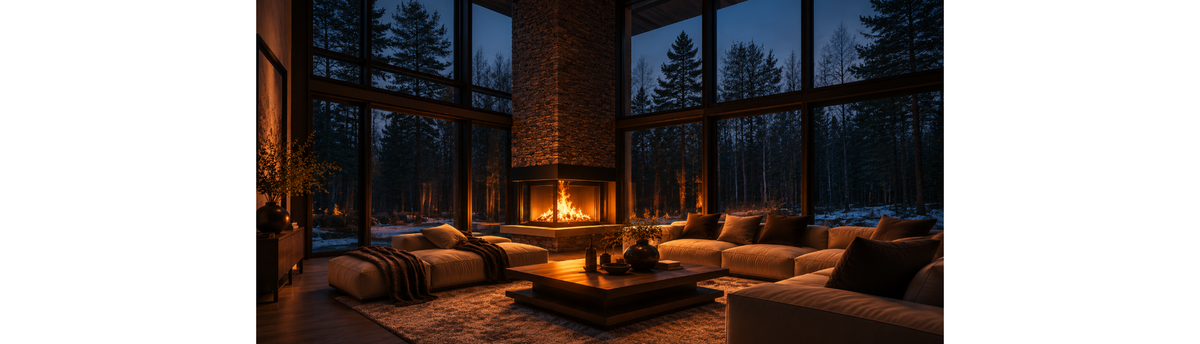

The living room changes when daylight disappears. Materials that looked quiet during the afternoon begin to respond to pools of warm light. Timber becomes deeper, stone develops more contrast, glass catches reflections and upholstery takes on a softer appearance. The room is no longer being experienced only through its shape and colour. It is being experienced through light.
This is where a fireplace can become much more than a feature on a wall. After dark, the glow of fire can become one layer of the room's atmosphere, working alongside decorative lighting, furniture, materials, artwork and carefully chosen objects. The aim is not to make the fireplace dominate everything around it. The aim is to allow the fire to become part of a complete evening composition.
For a living room designed around evening use, the important question is therefore not simply where the fireplace should go. It is how the rest of the room responds once the fire becomes visible.
Table of Contents
- Why the Living Room Changes After Dark
- Fireplace Light Is One Layer of the Lighting Scheme
- How Fireplace Glow Changes Upholstery and Textiles
- Stone, Marble and Wood Under Fireplace Glow
- Glass, Metal and Reflective Surfaces
- Styling Sculptures and Art Around the Fire
- Books, Vases, Bowls and Decorative Objects
- Rugs, Sofas and the Evening Seating Experience
- Fireplace Glow and Decorative Lighting
- Fire, Television and the Evening Media Wall
- How Fireplace Technology Changes the Evening Experience
- Creating Evening Atmosphere in Indian Living Rooms
- Fireplace in Hill Station Homes
- Fireplace Styling and Vastu Considerations
- Common Evening Styling Mistakes Around a Fireplace
- A Simple Evening Styling Framework
- Frequently Asked Questions
- The Living Room After Dark
Why the Living Room Changes After Dark
During the day, a living room is largely defined by natural light, wall colour, furniture shape and the materials used throughout the space. At night, illumination becomes a design tool. The same room can feel more intimate, more dramatic or more relaxed depending on where the light comes from and what it touches.
A fireplace is particularly interesting because its light is not completely static. Flame movement creates changing highlights and shadows. That movement can bring depth to a stone surround, catch the edge of a glass object or create a soft reflection on a nearby surface. This is why the fireplace should be considered together with the elements around it. A fire feature placed beside a dark sculptural object will produce a different evening composition from the same fire surrounded by pale stone, glass and light upholstery.
The room does not need to become dark simply because the fireplace is glowing. Instead, the lighting should become more selective. Some areas can remain softly illuminated while others are allowed to recede. This creates visual hierarchy and gives the fire a natural place within the composition.
Fireplace light Is One Layer of the Lighting Scheme
One of the most common mistakes in evening living-room styling is expecting the fireplace to provide all the atmosphere. A fire can create a beautiful focal glow, but it does not automatically replace the other sources of light in a well-planned room.
Think of the room as a series of overlapping layers. The fireplace provides one layer. Concealed lighting can softly illuminate the wall or ceiling. A floor lamp can create a pool of light beside a chair. A table lamp can bring a lower level of illumination to a console or side table. Wall lights can add a controlled glow without flooding the entire room.
The result should not be a collection of unrelated light sources. Each source should have a role. The fire may provide movement and visual warmth, while decorative lighting provides structure and allows the rest of the room to remain visible.
Spacio's guide to ambient lighting in contemporary luxury Indian interiors explores this broader relationship between illumination, materials and atmosphere.
Do not make every part of the living room equally bright. Let some surfaces catch light while others remain quieter. Contrast gives the fireplace more visual depth.
How Fireplace Glow Changes Upholstery and Textiles
Upholstery becomes particularly important after dark because the fire is experienced from the seating area. Sofas, lounge chairs and cushions are not simply functional pieces. They become part of the visual field in which the fireplace is experienced.
Velvet can respond strongly to changing light because its surface direction affects how the fabric appears. Linen and other woven fabrics create a quieter texture. Leather can reflect small amounts of light and introduce a more defined surface. Bouclé and other tactile fabrics can soften the overall composition.
The choice does not need to match the fireplace. In fact, matching everything too closely can make the room feel flat. A better approach is to create relationships between textures. A smooth stone surround can be balanced by tactile upholstery. A timber wall can be softened by a textured rug. Glass can introduce a clean reflective note beside softer fabrics.
Colour matters too. Deep neutrals can become richer in fireplace glow, while warm creams and natural tones can reflect some of the glow into the seating area. Strong colours should be considered carefully because moving fireplace light can change how saturated they appear.
Stone, Marble and Wood Under Fireplace Glow
Natural materials can become particularly expressive in evening light. Stone may reveal veining and variation that is less noticeable during the day. Marble can catch small highlights across its surface, while timber can appear deeper and warmer when illuminated by the fire.
The important principle is not to use several materials simply because each one is attractive. The materials should have a relationship.
For example, a timber fireplace wall can be supported by stone or marble on the floor or coffee table. A stone surround can be softened by timber furniture and woven textiles. Metal details can introduce small points of reflection without turning the room into a collection of shiny surfaces.
Materiality becomes even more important when the fireplace is part of a large TV or feature wall. The surround, cabinetry, flooring and furniture all contribute to how the fire is perceived after dark.
Let the material carry some of the atmosphere
A good evening interior does not need decorative objects on every surface. A beautifully veined stone, a timber wall or a textured rug can provide enough visual interest when the fireplace glow moves across it.
This is one of the reasons restraint matters. When the materials are strong, the accessories can often become quieter.
Glass, Metal and Reflective Surfaces
Glass and metal can make fireplace light more dynamic because they respond to movement and reflection. A glass object near the fireplace may pick up a small highlight, while a brushed or polished metal detail can catch the light without becoming the main focal point.
Reflection, however, needs to be controlled. Too many reflective surfaces can create competing highlights and make the room feel visually restless.
The same consideration applies to a television. A fire below a TV can be visually compelling, but the surrounding lighting should be planned so that reflections do not interfere with the viewing experience. The fire, screen and decorative lighting need to coexist rather than compete for attention.
Styling Sculptures and Art Around the Fire
A fireplace already has visual movement. This changes the way sculpture & art objects should be introduced around it.
A large sculpture can become a strong companion to a fireplace when it has enough visual weight to belong to the composition without competing directly with the flame. Smaller sculptural objects can work on shelves, consoles or side tables where they are experienced as supporting details.
Placement matters as much as the object itself. A sculpture positioned too close to the strongest part of the fire can become visually confused with it. Moving the object slightly away can give both elements enough negative space to remain legible.
The same principle applies to wall art. Artwork does not need to sit immediately above the fire to be relevant to the composition. It can occupy an adjacent wall, balance a larger media wall or provide visual weight on the opposite side of the room.
For readers interested in developing this relationship further, Spacio's guide on styling luxury interiors with sculptures and art objects explores how sculptural pieces contribute to balance, proportion and visual rhythm.
Books, Vases, Bowls and Decorative Objects
The objects around a fireplace should not feel like a collection assembled simply to fill empty shelves. Each object should contribute something to the composition.
A tall vase can introduce height beside a lower fire feature. A bowl or platter can provide a grounded horizontal form on a coffee table. A tray can group smaller objects so that they read as one composition rather than several unrelated pieces. Candle holders can introduce another small point of evening illumination.
Coffee Table Books can provide both texture and context. On a coffee table, a carefully chosen stack can create a low visual layer beneath a sculptural object. On open shelving beside a fireplace, books can soften the geometry of cabinetry while adding variation in height and texture.
Navin Kanodia's guide on how to style coffee table books in luxury interiors offers a useful extension of this idea.
When several decorative objects are used around a fire feature, restraint becomes important. The flame already provides movement. The objects should provide form, texture and balance rather than another layer of visual noise.
Rugs, Sofas and the Evening Seating Experience
The fireplace may be installed on a wall, but its evening experience happens across the room. The sofa, lounge chairs, coffee table and rug determine where people sit and therefore from where the fire is actually seen.
A rug can visually gather the seating arrangement and make the fireplace feel connected to the furniture. A coffee table then becomes a middle layer between the seating and the fire, carrying books, a tray, a bowl or another carefully selected object.
Furniture orientation should support conversation as well as the view towards the fire. Not every chair needs to face the fireplace directly. In a larger living room, angled seating can create a more natural arrangement while still allowing the fire to remain part of the evening experience.
This becomes particularly important in open-plan Indian homes where the living room may connect directly with a dining area, bar or another entertaining zone. The fireplace can help establish the emotional centre of the living area without forcing every piece of furniture into a rigid arrangement.
A fireplace changes the way a room is experienced because people naturally become aware of light and movement around it. I look at the seating, coffee table, rug, materials and decorative objects as one composition. The fire should have enough presence to create atmosphere, while the surrounding elements give people reasons to stay in the room.
Fireplace Glow and Decorative Lighting
Fireplace glow and decorative lighting can work beautifully together, but only when their roles are understood.
The fire provides a moving source of light close to the floor or within the wall. A table lamp provides a quieter pool of illumination. A floor lamp can create a vertical layer. A wall light can add a controlled glow to a surface. Concealed lighting can bring out the texture of stone, timber or panelling without becoming a visible focal point.
The objective is not to make all these sources equally noticeable. In a well-layered evening room, some light sources are seen and others are experienced indirectly.
This is also where colour temperature matters. If the fire has a warm visual character and the surrounding lighting is extremely cool and bright, the two can feel disconnected. Warmer supporting illumination often allows the fire to sit more naturally within the room, although the final lighting choice should respond to the materials, finishes and overall design intention.
As the next stage of Spacio's wider content ecosystem explores decorative lighting in greater depth, this relationship becomes particularly useful: the fireplace is not competing with lighting. It is one of the sources around which the evening lighting composition is built.
Fire, Television and the Evening Media Wall
A fireplace below a TV is one of the most common ways fire enters the contemporary living room, but the evening experience needs special consideration.
During the day, the television may be the strongest visual object on the wall. At night, the fire introduces movement directly below it. This creates a relationship between two very different forms of visual attention: the stable screen and the moving flame.
The surrounding wall should therefore remain controlled. Excessive decorative lighting, reflective finishes or a large number of objects can make the wall feel busy when the television and fire are both active.
A fireplace below a TV can work particularly well when the screen, fireplace, cabinetry and surrounding material are treated as one composition. The evening lighting should then support the entire wall rather than creating bright competing areas around it.
Keep the fire visible without making the TV wall visually loud
One useful approach is to keep decorative objects away from the strongest visual axis of the television and fire. Shelving can be used at the sides, while the central wall remains relatively quiet.
This gives the fireplace room to become expressive after dark without turning the entire TV wall into a collection of competing focal points.
How Fireplace Technology Changes the Evening Experience
The evening atmosphere also depends on the type of fire being introduced. The visual character of a water-vapour fireplace is different from an LED or electric flame effect, while a digital or holographic system creates another visual experience. Real-flame systems such as bioethanol, gas and wood-burning fireplaces bring genuine combustion and therefore require a different level of technical planning.
For an evening-led interior, the most important question is what role the fire needs to play. If the objective is primarily visual atmosphere, a no-heat flame-effect system may allow the design to focus more heavily on light, material and styling. If genuine heat or real flame is part of the brief, the installation requirements become an essential part of the design conversation.
For a broader foundation, read Spacio's complete guide to luxury fireplaces in India, which explains fireplace formats and technologies in greater depth.
The important point for this article is that technology should support the intended evening experience. The room should not be styled around assumptions about a fireplace that the selected system cannot support.
Styling should never be separated from technical planning. Fuel, combustion, heat, ventilation, surrounding materials and manufacturer requirements need to be considered for the specific fireplace before the final installation is designed.
Creating Evening Atmosphere in Indian Living Rooms
Indian living rooms can vary dramatically in scale and use. A compact city apartment may have one room serving as living room, media room and entertaining space. A large villa may have several seating areas, a double-height volume and a separate formal lounge. The evening role of the fireplace therefore needs to respond to the actual room rather than to a fixed idea of what a fireplace room should look like.
In warm cities, the fireplace may be selected primarily for visual atmosphere rather than heating. This can make the evening styling even more important because the fire is contributing to the experience of the room rather than being used primarily as a source of warmth.
In cooler destinations, the relationship may be different. The fire can contribute both visual warmth and physical comfort, depending on the technology. In either situation, the room should remain the starting point.
Contemporary Indian interiors also often use marble, timber, large-format flooring, glass, metal details, statement lighting and substantial upholstered furniture. Fireplace light can connect these different materials by providing a common evening layer across the room.
The strongest compositions are usually not the ones with the most objects. They are the ones in which the fireplace, furniture, lighting and materials appear to belong to the same visual language.
Fireplace in Hill Station Homes
Hill destinations create a particularly natural context for evening fire, but even here the fireplace should be treated as part of the complete living-room composition. The role of the fire can change according to the property, room size, climate, technology and whether the interior is a private residence, holiday home or hospitality setting.
Fireplace in Ooty
A fireplace in Ooty can become a strong evening feature in a living room where timber, natural textures and upholstered seating already create a sense of warmth. Rather than surrounding the fire with too many decorative objects, use a few well-chosen materials and accessories that become more expressive as the light falls.
In a larger residence or hospitality setting, a linear fireplace can provide a broad horizontal glow across a wall. In a more intimate room, a smaller installation can work with a reading chair, rug, coffee table and low decorative lighting to create a quieter composition.
Fireplace in Kodaikanal
For a fireplace in Kodaikanal, the evening experience can be closely connected to natural materials and slower-paced living. Timber, stone, woven textiles and soft upholstery can create a strong background for the fire without requiring excessive decoration.
A fireplace in a holiday home can also become part of the social arrangement. Seating should allow people to enjoy the fire while still facing one another, rather than creating a room where every chair is arranged only towards the wall.
Fireplace in Coonoor
A fireplace in Coonoor can work particularly well with a restrained material palette. Timber, stone, linen, leather and muted upholstery can create a calm background against which the moving fire becomes the most active element in the room.
For evening styling, the surrounding lighting should remain controlled. A floor lamp beside a reading chair or concealed illumination on a shelf can be enough to extend the fireplace light into the rest of the room without flattening the atmosphere with bright overhead lighting.
Fireplace in Nainital
A fireplace in Nainital should be considered in relation to the scale of the living room and the way the property is used. A substantial residence may support a stronger fireplace composition with generous seating and layered materials, while a smaller home may benefit from a more concentrated fire feature.
The evening setting can be strengthened through a rug, textured upholstery, timber or stone and a carefully selected group of objects. The objective is not to recreate a traditional hearth in every project. Contemporary fire features can provide the same emotional centre while fitting a more current interior language.
Fireplace in Mount Abu
For a fireplace in Mount Abu, the evening role of fire can extend beyond private living rooms into holiday homes, villas and hospitality-inspired spaces. A fireplace can define a seating zone and give an entertaining area a clear visual centre after sunset.
In larger spaces, the surrounding furniture and lighting should be substantial enough to relate to the fire. In smaller rooms, restraint is more important. The fireplace should create atmosphere without filling the room with unnecessary visual elements.
Across Ooty, Kodaikanal, Coonoor, Nainital and Mount Abu, the same principle remains useful: the evening experience should be designed around the fire, not simply decorated around it.
Fireplace Styling and Vastu Considerations
For homeowners who include Vastu in the planning of an interior, fireplace placement may also be considered in relation to traditional ideas around the fire element. These are traditional beliefs rather than scientifically established principles, so they should be considered alongside room planning, technology and practical installation requirements.
Vastu can affect the evening composition indirectly as well. If the preferred fireplace location changes, the television, sofa, artwork, lighting and circulation may all need to move with it. This is why the fireplace should be considered early rather than treated as a decorative object added after the room has already been planned.
Spacio's guide to Vastu considerations for fireplaces in India explores this subject in greater detail for homeowners who want to include traditional Vastu thinking in the planning process.
Common Evening Styling Mistakes Around a Fireplace
Making the whole room equally bright
When every light is switched on at full brightness, the fireplace loses some of its visual impact. Evening atmosphere comes from contrast, so allow some areas of the room to remain quieter.
Using too many competing light sources
A fire, bright ceiling lights, several decorative lamps and strong shelf lighting can create visual competition. Each light source should have a clear role.
Ignoring reflections
Glass, polished stone, metal and television screens can all respond to fireplace light. Reflection can be beautiful when controlled, but distracting when every surface catches a different highlight.
Over-styling the fireplace wall
The fire already provides movement. Too many sculptures, vases, books, candles and decorative objects can compete with that movement. A smaller number of carefully selected objects often creates a stronger composition.
Forgetting the seating position
The fireplace is experienced from the sofa and chairs, not from the wall alone. Check how the fire looks from the main seating positions and how the rest of the room appears around it.
Using the wrong relationship between warm fireplace glow and surrounding lighting
If surrounding lighting is much brighter or visually colder than the fire, the two layers can feel disconnected. The supporting lighting should be considered as part of the same evening composition.
A Simple Evening Styling Framework
Before finalising the evening look of a living room, work through the room in this order:
- Start with the fire. Decide what role the fireplace should play in the evening experience: focal point, background glow, seating anchor, media-wall element or room divider.
- Look at the seating. Make sure sofas and chairs allow people to experience the fire comfortably while still supporting conversation.
- Study the materials. Consider how stone, timber, upholstery, glass and metal will respond to moving fireplace light.
- Layer the lighting. Add decorative, concealed or functional lighting where it supports the room without overpowering the fire.
- Add the larger objects. Introduce sculpture, artwork, shelving or a major decorative element before adding smaller accessories.
- Build the lower layers. Use the rug, coffee table, books, tray, bowl or other low objects to connect the seating area with the fire.
- Control reflection. Check glass, polished surfaces and the television from the main seating positions.
- Remove something. If the room feels visually busy, take away one or two objects before adding another light or accessory.
- Experience the room after dark. The final judgement should be made in the lighting conditions in which the fireplace is actually intended to be enjoyed.
When I style a room around a fireplace, I think about what happens after the main ceiling lights are reduced. The fire should reveal the materials, furniture and objects around it rather than fighting them. A well-composed evening room has layers: the fire provides movement, decorative lighting provides structure, materials provide texture and the objects provide character. The room feels complete because all of these elements are working together.
Frequently Asked Questions
How can I make a living room feel warmer around a fireplace after dark?
Begin with the lighting rather than adding more objects. Reduce harsh overhead illumination, use softer supporting light and allow the fire to become one of the stronger sources of evening atmosphere. Upholstery, rugs, timber and textured materials can then reinforce the sense of warmth.
Should the fireplace provide all the lighting in the living room?
No. A fireplace works best as one layer within a wider lighting scheme. Floor lamps, table lamps, wall lights and concealed lighting can illuminate areas that the fire cannot reach while preserving the atmosphere of the room.
What materials work well with fireplace light?
Stone, marble, timber, glass, metal and textured upholstery can all respond well to fireplace glow. The important point is not to collect materials simply because they look attractive individually. They should have a relationship in texture, tone and visual weight.
How should I style sculptures around a fireplace?
Think about the sculpture as a companion to the fire rather than a competitor. A strong sculptural object can balance the fireplace when it has appropriate scale and enough surrounding space. Smaller objects can work on shelves, consoles and side tables.
Can I use books and decorative accessories near a fireplace?
Yes, where the installation and surrounding conditions allow them to be used appropriately. Books, trays, bowls, vases and other decorative objects can provide texture and visual balance. They should be positioned as part of the overall composition rather than used simply to fill empty space.
How do I style a fireplace below a TV for evening use?
Treat the television, fireplace, cabinetry, wall finish and surrounding lighting as one composition. Control reflections and avoid excessive lighting around the screen. The fire should provide visual movement without making the media wall feel overly busy.
Does a water-vapour fireplace work well for an evening living room?
A water-vapour fireplace can be considered when the visual experience of fire is important and conventional combustion heat is not the primary objective. The exact installation and use should always be assessed for the specific model.
Can real-flame fireplaces be styled in the same way as no-heat fireplaces?
The styling principles can overlap, but the technical conditions are different. Real-flame fireplaces involve combustion and may introduce heat, ventilation and other installation considerations. The specific fireplace and manufacturer requirements should be understood before surrounding materials and decorative elements are finalised.
How does decorative lighting work with fireplace glow?
Decorative lighting should extend the atmosphere created by the fire rather than compete with it. A floor lamp, table lamp, wall light or concealed source can create additional layers of illumination while allowing the fireplace to remain visually important.
Where should I place decorative objects around a fireplace?
Start with the major composition and then introduce smaller objects. Sculpture, artwork, vases and books can be positioned on nearby shelves, consoles, side tables or coffee tables depending on the room. Negative space is just as important as the objects themselves.
How can I create a cosy evening living room without making it look cluttered?
Use fewer, better-related elements. Let the fireplace provide movement, then support it with tactile upholstery, a well-sized rug, a few decorative objects and controlled lighting. If every surface contains an object, the fire loses some of its visual importance.
Where can I experience fireplace and evening styling ideas in Mumbai?
If you want to see fireplace possibilities in person and discuss how a fire feature could work with furniture, materials and an evening living-room composition, visit Spacio's Mumbai store at 3BK, Laxmi Industrial Estate, New Link Road, Andheri (West), Mumbai – 400 053. You can also use the Spacio Mumbai Google Maps location when planning your visit.
Where can I explore fireplace options for an evening living room in Kolkata?
For an in-person discussion about fireplace styling, room atmosphere and the relationship between fire, furniture and lighting, visit Spacio's Kolkata store at 86B, Topsia Road South, Kolkata – 700 046. You can also use the Spacio Kolkata Google Maps location when planning your visit.
Does Vastu affect where a fireplace should be placed?
For homeowners who follow Vastu, traditional beliefs about the fire element may influence the preferred location of a fireplace. That decision should be considered alongside the room layout, technology, installation requirements and the way the living room is intended to function.
The Living Room After Dark
A fireplace becomes most interesting after the room's main daylight has disappeared. The flame begins to reveal the character of the materials around it. Timber becomes deeper. Stone catches movement. Glass reflects small points of light. Upholstery becomes softer. Sculptures develop stronger shadows. Books and decorative objects become quieter layers within the room. This is why styling around a fireplace is not simply about decorating the wall where the fire is installed. It is about understanding how the entire living room behaves after dark.
The fire should have a clear role. Furniture should allow people to experience it naturally. Materials should respond to its glow. Decorative lighting should extend rather than overpower the atmosphere. Sculpture, books, vases, trays and other objects should add character without creating competition. And when the fireplace sits below a TV or within a feature wall, the screen, fire, cabinetry, materials and evening lighting should be considered as one composition.
There is no single formula for creating this atmosphere. The strongest result comes from understanding the room first and then deciding how much fire, light, texture and decoration the space genuinely needs.
Discover Spacio's complete fireplace collection to explore different fireplace formats and technologies for contemporary interiors. If you are planning a living room around the evening glow of fire, the right starting point is to understand the room, the intended atmosphere and the fireplace's role within the complete composition.
Explore the Fireplace Collection


