
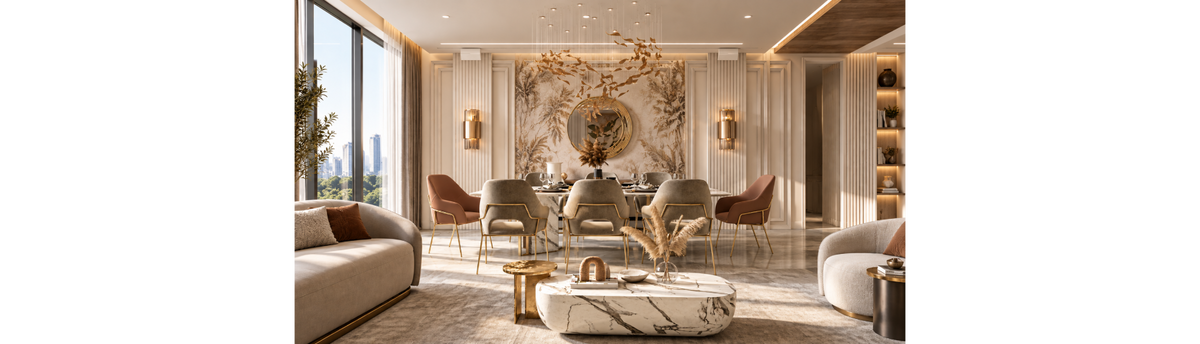

A dining room wall does more than complete the room. It helps shape the atmosphere around the table, influences what the eye notices while people are seated, and can give the entire dining area a stronger sense of identity. This is why dining room wall styling needs to be considered as part of the dining experience rather than as a final exercise in filling an empty surface.
Art, mirrors, decorative lighting, fresco surfaces and statement installations can each create a very different mood. A large artwork can establish a focal point; a mirror can introduce reflection and visual depth; a textured or fresco wall can become the background of the entire composition; while carefully positioned lighting can reveal colour, texture and material after daylight fades.
The most successful dining room walls usually do not depend on one decorative object alone. They are composed around a clear visual hierarchy, with the dining table, chairs, wall treatment, lighting and surrounding materials working together. In this sense, a statement dining wall is not simply about what is placed on the wall. It is about how the wall participates in the room.
This approach is part of the wider principles explored in Wall Styling: A Complete Guide to Creating Luxury Statement Walls in Indian Interiors, where different wall surfaces, objects, lighting layers and applications are considered as parts of one composition.
A dining wall should be styled in relation to the table, not in isolation. The table is usually the visual and social centre of the room, so I first consider its size, shape, material and position. Then I look at what the wall needs to support that composition. Sometimes it needs artwork. Sometimes reflection is more valuable. In other rooms, the wall itself should become the statement through a fresco, mural or textured surface. The objective is to create a relationship between the wall and the dining experience rather than simply decorate the wall.
Table of Contents
- Why the Dining Room Wall Matters
- Read the Dining Room Before Styling the Wall
- Start with the Dining Table
- Create One Clear Focal Point
- Using Art on a Dining Room Wall
- Using Mirrors to Bring Reflection into the Dining Room
- Lighting as Part of the Wall Composition
- When a Fresco or Decorative Wall Surface Should Lead
- Statement Wall Installations
- How to Layer Art, Mirrors, Light and Wall Surfaces
- Let Dining Room Materials Guide the Wall
- Scale and Proportion Around the Dining Table
- Dining Wall Ideas for Different Interior Styles
- Dining Walls in Modern Indian Homes
- Common Dining Room Wall Styling Mistakes
- A Practical Dining Wall Styling Framework
- How Spacio Approaches Dining Room Wall Styling
- FAQs
- Conclusion
Why the Dining Room Wall Matters
The dining room is one of the few spaces in a home where people naturally gather around a fixed point. The table establishes the centre, chairs define its rhythm, and the wall behind or beside the dining area becomes part of the visual frame around that experience.
That makes the dining wall different from a wall in a passage or a secondary corner. It is often viewed repeatedly from the same seated positions, across the table and from adjoining rooms. The composition therefore needs to work from several sightlines rather than from one standing viewpoint.
A well-styled dining wall can also help establish the emotional character of the room. Art can make the space feel collected and personal. A mirror can bring light and reflection into a darker dining area. A fresco or mural can create a richer backdrop. Decorative lighting can introduce warmth and visual rhythm after sunset.
The important point is that these elements should not compete with one another. A dining room becomes visually stronger when one element leads and the others support it.
A dining room wall should support the table, the atmosphere and the way the room is experienced. Choose the dominant wall treatment first, then use supporting elements to create balance, depth and visual rhythm.
Read the Dining Room Before Styling the Wall
Before choosing artwork, a mirror or a wall covering, look at what already exists in the dining room. The wall may appear empty, but the room may already contain considerable visual weight through a large dining table, upholstered chairs, a chandelier, a sideboard, timber panelling, marble flooring or strong architectural features.
This is where dining room wall styling begins to differ from simply choosing wall decor. The question is not, “What can I put on this wall?” It is, “What does this wall need to do for the room?”
If the dining table is visually dominant, the wall may benefit from restraint. If the table and chairs are understated, the wall may have more freedom to become the focal point. If a large chandelier already occupies the upper visual field, artwork may need to sit lower and remain controlled. If the room has abundant natural light, a reflective surface can behave very differently from the same mirror in a darker room.
Look at the dining room from the positions where it will actually be experienced. Consider the view from the entrance, the living room, the dining chairs and the circulation route around the table. This helps reveal whether the wall needs a frontal statement, a softer background or a composition that unfolds as people move through the space.
Start with the Dining Table
The dining table is usually the strongest horizontal element in the room, so it provides an important reference for the wall above or behind it. Its length, width, material and shape can all influence the appropriate wall composition.
A long rectangular dining table often works well with a horizontal artwork, a broad mural or a wall treatment that follows the table's width. A round table creates a different visual condition. It can work beautifully with a centred artwork, a circular or sculptural composition, or a vertical wall treatment that gives the room height.
The relationship does not have to be symmetrical, but it should feel intentional. A very small artwork above a large dining table can lose its presence, while an oversized wall treatment can overwhelm a smaller table and make the room feel compressed.
For this reason, the width of the dining wall should not be considered independently from the furniture beneath it. The composition should acknowledge the table as an anchor and establish an appropriate visual relationship between the horizontal furniture and the vertical wall.
Use the dining table as the first scale reference. The wall treatment does not have to match the table, but it should feel proportionate to its width, visual weight and position within the room.
Create One Clear Focal Point
One of the most common problems with dining room walls is not a lack of decoration but a lack of hierarchy. Artwork, mirrors, lighting, wall coverings and accessories may all be attractive individually, yet together they can create visual competition.
A stronger approach is to establish one dominant element. This might be a large artwork, an illuminated wall surface, a fresco, a statement mirror or a sculptural installation. The other elements should then reinforce that focal point rather than compete with it.
For example, if a large artwork is the focal point, decorative lighting can reveal it without becoming another major object. If a richly textured fresco is the main feature, the dining furniture can remain quieter so the surface has room to breathe. If a large mirror is the dominant element, artwork placed directly beside it may need to be restrained to prevent competing reflections and focal points.
This idea of one dominant anchor is especially important in dining rooms because the table itself already carries visual and social importance. The wall should strengthen the composition rather than create a second unrelated centre.
Using Art on a Dining Room Wall
Art is one of the most versatile ways to give a dining wall identity. It can introduce colour, subject, texture and personality without changing the entire surface of the room. The choice, however, should respond to the dining environment rather than being made solely because the artwork looks attractive on its own.
A large artwork can create a strong visual anchor behind a dining table, particularly when the surrounding walls are relatively quiet. A group of smaller artworks can create rhythm, but the grouping should be treated as one composition rather than as several unrelated pictures.
Framing also affects the relationship between artwork and dining furniture. A substantial frame can introduce another material and visual boundary, while a quieter frame allows the artwork itself to dominate. The right decision depends on what is already happening in the room.
Choosing the right artwork for this setting also involves decisions about size, composition, material and placement. For a deeper guide to these choices across residential and commercial interiors, see Spacio's guide to choosing wall art for luxury homes, offices and commercial spaces.
Spacio's Wall Art Prints & Paintings collection can be considered when the dining wall calls for a two-dimensional focal element. The important styling decision remains the composition: how the artwork relates to the table, chairs, lighting and surrounding negative space.
For a more art-led dining room, Artist of the World Masterpieces can introduce a stronger sense of individuality and cultural depth. Such works should be given enough visual space to be experienced rather than crowded by multiple decorative elements.
Art is particularly effective when the room needs a clear focal point, a sense of personality or a visual connection between the dining furniture and the surrounding interior. Let the artwork lead when it has enough scale and presence to carry the wall.
Using Mirrors to Bring Reflection into the Dining Room
A decorative mirror changes the behaviour of a dining wall because it does not simply occupy the surface. It reflects the room around it. This can introduce visual depth, extend sightlines and bring light from windows or decorative lighting into the composition.
That reflective quality can be especially useful in dining rooms where the table, chandelier or surrounding furniture already provides a strong sense of structure. Instead of adding another subject or artwork, a mirror can allow the existing interior to become part of the wall composition through reflection.
But reflection needs to be considered carefully. A mirror facing a visually busy wall may multiply the clutter rather than create calm. Likewise, reflecting a television, doorway or strong circulation route can make the dining area feel visually unsettled. The most successful placement considers what the mirror will actually reflect at eye level when people are seated. A beautiful view, artwork, lighting feature or carefully composed part of the room can become part of the visual experience.
This makes the mirror an active styling element rather than a decorative object placed simply because the wall has space.
Lighting as Part of the Wall Composition
Lighting should be considered alongside the dining wall from the beginning, not added after the artwork or wall treatment has been selected. The quality and direction of light can change how colour, texture, reflection and depth are perceived.
In a dining room, the central decorative light above the table already establishes one important layer. The wall can then provide another layer that supports the atmosphere without competing with the dining light.
Decorative wall lighting can highlight artwork, create a pool of illumination on a textured surface or establish vertical rhythm on a larger wall. More directional light can bring out texture, while softer illumination can allow a richly coloured surface to become part of the evening atmosphere.
Spacio's Decorative Lighting collection provides a broader reference point for considering lighting as part of an interior composition rather than simply as illumination.
I look at dining-room lighting in layers. The light above the table establishes the centre of the room, while light around the wall can shape what happens beyond the table. The objective is not to make every element equally bright. It is to create hierarchy so that the room changes naturally from day to evening.
When a Fresco or Decorative Wall Surface Should Lead
Not every dining room needs artwork placed onto the wall. Sometimes the surface itself should become the artwork.
A fresco, mural or other specialist wall covering can establish atmosphere across a larger area than a framed artwork. Instead of creating one focal object, it can give the entire dining wall a visual language through colour, pattern, texture and continuity.
This approach can be particularly effective when the dining table and chairs are relatively restrained. The wall then becomes the expressive layer, while the furniture provides the structure in front of it.
Spacio's Italian Fresco Modern, Italian Fresco 3D and Italian Fresco Classical collections represent different visual directions within fresco wall treatments. The choice should follow the interior language of the dining room rather than being made independently from it.
A richly detailed fresco generally benefits from editing elsewhere. The more expressive the wall surface becomes, the more carefully the table styling, chairs, lighting and surrounding accessories should be controlled.
When a fresco, mural or specialist wall covering is visually strong, it can become the dominant element of the dining room. The furniture and lighting should then support its scale, colour and materiality rather than compete with it.
Statement Wall Installations
A statement installation sits between wall art and the wall itself. It may combine dimensional objects, sculpture, a specialised wall surface, lighting or several materials into one composition. In a dining room, this approach can create a stronger sense of depth because the wall is experienced not simply as a picture but as a three-dimensional part of the interior.
The key is to establish hierarchy before adding layers. A dining wall does not become more considered simply because more elements are placed on it. A successful installation usually has one dominant idea, supported by secondary elements that create rhythm, contrast or depth.
For example, an illuminated wall surface can act as the background while framed artwork provides the foreground focal point. A sculptural object can sit within a larger wall composition, while controlled lighting gives it visual separation. A textured surface can provide depth behind a quieter artwork without requiring several competing objects.
Spacio's Wall Art, Sculptures & Murals collection brings together several of these wall-oriented possibilities. The styling decision should still begin with the dining room itself: its scale, furniture, sightlines and existing material palette.
When Layering Works on a Dining Wall
Layering works when each element performs a different visual role. One surface may provide texture, another element may provide focal interest, while lighting establishes atmosphere. When every element tries to become the focal point, the composition loses clarity.
The relationship between an illuminated surface and framed artwork is a useful example. The illuminated surface can provide the atmospheric background while the framed artwork establishes the more controlled foreground. The two elements therefore contribute differently to the composition.
This principle can also apply to sculpture and artwork. A dimensional sculpture introduces projection and shadow, while a flat artwork provides a different visual plane. The contrast can create depth without requiring a large number of objects.
Layering is successful when every element has a job. Ask of each addition: does it create focal interest, texture, reflection, depth, light or rhythm? If it does none of these, it may not need to be there.
How to Layer Art, Mirrors, Light and Wall Surfaces
Controlled layering begins with deciding which element should be seen first. This is the visual hierarchy of the wall. Once that is established, supporting elements can be introduced without making the composition feel crowded.
A useful sequence is to think from the surface outward. First consider the wall itself. Is it plain, textured, patterned, reflective or already visually strong? Then consider the dominant element. Is it artwork, a mirror, a sculpture or the wall treatment itself? Only after those decisions should lighting and secondary objects be considered.
Consider an example where a dining wall has a richly textured surface. Adding a large artwork may create too much visual density if the surface is already highly expressive. A carefully positioned light might be enough to reveal the texture. Conversely, a quiet wall may benefit from both a strong artwork and a controlled lighting layer.
The same principle applies to mirrors. Reflection can amplify everything around it, so the space visible within the mirror becomes part of the composition. A mirror should therefore be positioned with the same care as artwork. This is why layering should not be understood as adding more. It is the deliberate coordination of visual planes, materials and light.
1. Surface — establish the background.
2. Dominant element — choose what the eye should notice first.
3. Supporting layer — introduce art, sculpture, reflection or texture where it strengthens the composition.
4. Lighting — reveal rather than compete.
5. Editing — remove anything that weakens the hierarchy.
Let Dining Room Materials Guide the Wall
A dining wall becomes more cohesive when its materials have a relationship with the furniture and finishes already present in the room. This does not mean matching everything. It means creating a material dialogue.
A timber dining table can sit comfortably against a wall treatment that introduces stone-like texture, metal, glass or a richly coloured surface. Marble can be balanced with warmer materials so the dining room does not feel visually cold. Glass and crystal can introduce transparency and reflection, while metal can bring visual weight and controlled highlights.
The same principle applies to artwork frames and sculptural objects. A metal frame may connect with a lighting fixture or chair detail. Timber can repeat the warmth of the dining table. Glass can echo a chandelier without copying it. These relationships are subtle, but they help the room feel curated rather than assembled.
Spacio's Sculptures & Art Objects collection can be relevant when a dining composition needs a dimensional element rather than another flat artwork. The material of the sculpture should be considered in relation to the wall and dining furniture around it.
Scale and Proportion Around the Dining Table
Scale is one of the most important decisions in dining room wall styling. A wall treatment can be beautiful in isolation and still feel wrong because it is too small for the table, too large for the room or positioned without regard to the surrounding furniture.
Start by looking at the width of the dining table and the available wall. A broad table usually needs a wall composition with enough horizontal presence to feel connected to it. This does not mean the artwork must exactly match the table width, but the relationship should feel intentional.
Height matters as well. Artwork or other wall elements positioned above the table should feel connected to the dining setting without becoming so low that they interfere visually with the furniture or so high that the wall and table appear disconnected.
For larger dining rooms, the wall can carry more visual weight. Double-height or unusually tall dining spaces may need vertical elements that acknowledge the height rather than concentrating everything around table level. A tall artwork, vertically oriented installation or wall treatment with strong vertical rhythm can help connect the upper and lower parts of the room.
Scale should be judged from the room, not from the artwork alone. I look at the relationship between the wall, table, chairs and the height of the room before deciding whether a piece feels large enough. The same artwork can feel perfectly proportioned in one dining room and completely lost in another.
Dining Wall Ideas for Different Interior Styles
The wall treatment should belong to the visual language of the dining room. A modern dining space, a classic room and a Japandi interior may all use artwork, mirrors or textured surfaces, but the way those elements are composed will be different.
Modern Dining Rooms
Modern dining rooms often benefit from a controlled composition with one strong focal element. A large artwork, restrained sculptural installation or carefully detailed wall surface can provide visual interest without requiring many objects.
Material contrast can be particularly effective here. Smooth surfaces can be balanced with texture, while metal, glass or reflective details can introduce small changes in light across the wall.
Classic Dining Rooms
Classic dining rooms can accommodate richer layering, particularly where the furniture and room architecture already have a sense of formality. Art, mirrors, fresco-inspired surfaces and decorative lighting can work together when their visual weight is carefully controlled.
The danger is overstatement. If the dining table, chandelier, wall treatment and accessories are all highly expressive, the room can lose the sense of restraint that makes a classic interior feel composed.
Japandi Dining Rooms
Japandi interiors generally benefit from restraint, natural materials and carefully considered negative space. A single artwork, quiet textured surface or sculptural object can often create more impact than a collection of decorative pieces.
Warm timber, neutral surfaces and tactile materials can provide the foundation, while artwork or sculpture introduces a carefully edited focal point. Lighting should support the calm atmosphere rather than dominate it.
Dining Walls in Modern Indian Homes
Dining rooms in Indian homes can take many forms, from compact dining areas within open-plan apartments to dedicated dining rooms in villas, duplexes and larger residences. The wall styling needs to respond to that spatial context.
In an apartment, the dining wall may also be visible from the living room. This makes sightline planning particularly important. A wall that looks balanced from the dining chairs may appear disconnected when viewed from the sofa or entrance. In larger homes, the dining wall may have more room to become an independent statement. A broad artwork, fresco, sculptural composition or layered installation can then establish a stronger identity, provided its scale relates to the room.
Indian dining rooms also often bring together several strong materials—marble, timber, metal, glass and textiles. Rather than trying to repeat every material on the wall, select one or two relationships that strengthen the existing composition. This is where editing becomes more important than adding more decoration.
For dining spaces that are part of a wider open-plan home, the wall can also act as a visual bridge between rooms. A colour, material or artwork relationship can connect the dining area with the living room without making the two spaces identical.
Common Dining Room Wall Styling Mistakes
Making the wall compete with the dining table. The table is already a major visual anchor. A wall treatment that is equally dominant without a clear relationship can make the room feel divided.
Choosing artwork that is too small. Small pieces can disappear above a substantial dining table or across a broad wall. If a smaller artwork is important, consider whether it needs to be grouped into a larger composition.
Using a mirror without considering its reflection. A mirror does not simply fill the wall. It duplicates what it sees. Always consider the view that will appear within it.
Adding too many focal elements. Art, mirror, fresco, sculpture and decorative lighting can all work in the same room, but they do not all need to lead. Choose a dominant element and let the others support it.
Ignoring evening lighting. A dining wall can look completely different after sunset. If the wall is intended to remain important in the evening, its lighting should be considered as part of the original composition.
Matching everything too literally. A dining room does not need every material and colour to be repeated on the wall. Relationships are more effective when they are considered rather than mechanical.
Filling every available area. Negative space gives the eye somewhere to rest. Leaving part of the wall quiet can make the focal element feel more important.
A Practical Dining Wall Styling Framework
When several wall treatments could work, it helps to make the decision in a deliberate order rather than choosing individual objects one at a time. The following framework keeps the dining table, wall and atmosphere connected.
1. Read the room
Start with the dining room as a whole. Look at the table, chairs, chandelier or pendant, flooring, windows, doors and adjoining spaces. Identify where the eye naturally travels and where the wall is visible from the main sightlines.
2. Define the purpose of the wall
Decide what you want the wall to contribute. Does the dining room need a focal point, greater visual depth, more texture, a stronger sense of atmosphere or simply a quieter background for the furniture?
This question often narrows the choices immediately. If the room lacks a focal point, art or a statement installation may be appropriate. If the room feels visually flat, texture or reflection may contribute more. If the wall already has strong materiality, additional decoration may not be necessary.
3. Use the dining table as the scale reference
Consider the width, shape and visual weight of the table before selecting the wall treatment. The composition above or behind it should feel connected to the furniture rather than floating independently.
4. Choose the dominant element
Select one element to lead the composition: artwork, mirror, fresco, mural, sculpture, illuminated surface or another statement treatment. This is the point at which hierarchy is established.
5. Introduce supporting layers
Once the dominant element is clear, consider whether the wall needs another layer. A mirror may introduce reflection, sculpture may add dimension, artwork may introduce personality and lighting may reveal texture. Add only what strengthens the primary composition.
6. Check material relationships
Look at the materials already present in the room. Timber, marble, metal, glass, textiles and stone can all influence the choice of wall treatment. The objective is not to repeat every material but to create a considered dialogue between them.
7. Design for both day and evening
Consider how natural daylight affects the wall and how the composition will appear once the room is lit after sunset. Reflective surfaces, artwork, textured walls and sculptural objects can all change character under different lighting conditions.
8. Step back and edit
The final step is often subtraction. Remove an object if it competes with the focal point. Reduce visual repetition if the wall feels busy. Increase negative space if the composition feels compressed. A well-styled dining wall should feel intentional without making every element announce itself.
Before finalising the wall, ask:
Does it relate to the dining table?
Is there one clear focal point?
Do the materials belong together?
Does the composition work from the main sightlines?
Does the wall work in both daylight and evening light?
Is there enough negative space?
If the answer to all six is yes, the wall is likely supporting the room rather than competing with it.
How Spacio Approaches Dining Room Wall Styling
At Spacio, wall styling is considered as part of the larger interior composition rather than as a separate exercise in choosing wall decor. Art, mirrors, sculpture, lighting and specialist wall surfaces can all play different roles within the same room.
The starting point is the space itself: its proportions, furniture, material palette, sightlines and atmosphere. From there, the wall treatment can be selected according to what the dining room actually needs. This may mean a single artwork rather than a gallery wall, a mirror rather than another decorative object, or a textured surface rather than anything placed onto the wall. In another dining room, a combination of surface, art and lighting may create the stronger composition.
The principle is consistent: design the wall in relation to the room.
For readers exploring the wider possibilities of dining and interior styling, Spacio's Dining Room collection provides a broader context for the furniture, lighting and decorative elements that contribute to the space.
The most interesting dining walls are not necessarily the ones with the most decoration. They are the ones where every element has a relationship with the room. I look for a clear focal point, then consider what can support it through material, reflection, texture or light. Good styling often comes from knowing what to leave out.
FAQs About Dining Room Wall Styling Ideas
What should I put on a dining room wall?
Start with the room rather than the object. Depending on the space, a dining wall can work with artwork, a mirror, sculpture, fresco, mural, textured wall treatment or decorative lighting. Choose the option that supports the dining table, proportions and overall atmosphere.
Should dining room wall art be centred above the table?
Usually, the composition should relate visually to the table, but exact centring is not always necessary. The wider wall, surrounding furniture, lighting and sightlines should also be considered. What matters most is that the relationship feels intentional.
Is a mirror a good idea for a dining room wall?
Yes, when the reflection is useful. A mirror can bring visual depth and reflect natural or decorative light, but it should not reflect distracting elements such as clutter, an unwanted doorway or another overly busy wall.
Can I use art and a mirror on the same dining wall?
You can, but they should not automatically be treated as equal focal points. Decide which element leads and use the other as a supporting layer. Reflection, scale and negative space become particularly important when both are present.
What type of wall treatment works behind a dining table?
Artwork, murals, fresco surfaces, textured wall coverings, illuminated wall treatments and sculptural installations can all work. The right choice depends on the table, room scale, existing materials and the atmosphere you want to create.
How do I make a dining room wall look luxurious without overdecorating it?
Focus on proportion, material quality, visual hierarchy and restraint rather than the number of objects. One well-scaled artwork or a carefully chosen wall surface can have more impact than several unrelated decorative pieces.
How should I light artwork on a dining room wall?
Lighting should reveal the artwork without becoming a competing focal point. Consider the direction, intensity and position of the light, as well as how it interacts with the dining light and other reflective surfaces in the room.
Can a fresco be used as a dining room statement wall?
Yes. A fresco can make the wall itself the dominant visual element rather than placing a separate artwork onto it. The dining furniture and lighting should then be edited so the surface has enough visual space.
How do I style a dining wall in a small apartment?
Begin with sightlines and visual weight. A carefully scaled artwork or mirror can establish a focal point without consuming floor space. In a compact dining area, keeping the wall composition controlled can also help the room feel more open.
Where can I explore dining room wall styling ideas at Spacio?
You can explore the Dining Room collection alongside Spacio's wall art, sculpture, lighting and specialist wall-treatment collections to understand how different elements can work together within a dining interior.
Where can I see and buy dining room wall art pieces in Mumbai?
If you are looking to see dining room wall statement pieces in Mumbai before choosing them for your home, visit the Spacio Mumbai store at 3BK, Laxmi Industrial Estate, New Link Road, Andheri (West), Mumbai 400 053. You can explore wall art, sculptures, decorative lighting and other interior styling pieces in person, making it easier to consider scale, proportion, material and visual impact in relation to your dining room. You can also see the Spacio showroom location in Laxmi Industrial Estate, Mumbai on Google Maps before planning your visit.
Where can I explore and buy dining room wall statement pieces in Kolkata?
If you want to see and experience dining room wall statement pieces in Kolkata before selecting pieces for your home, visit the Spacio Kolkata store at 86B, Topsia Road South, Kolkata 700 046. The showroom brings together wall art, sculptures, decorative lighting and other interior styling pieces, allowing you to consider their scale, proportion, material and finish in person. You can also see the Spacio showroom location on Topsia Road South, Kolkata on Google Maps before visiting.
Conclusion
A dining room wall should do more than fill an empty surface. It should help define the atmosphere of the room, frame the dining table and create a visual experience that works from the positions where people actually sit, gather and move.
Art can provide personality and a focal point. Mirrors can introduce reflection and depth. Fresco and other specialist wall surfaces can make the wall itself expressive. Lighting can reveal texture and change the atmosphere after dark. Sculptural installations can introduce dimensionality and visual rhythm.
The strongest compositions do not necessarily use all of these elements. They establish hierarchy first, then introduce only the layers that genuinely strengthen the room. Scale, proportion, material dialogue, sightlines, lighting and negative space matter more than the number of decorative pieces.
Ultimately, the best dining room wall ideas are those that make the entire room feel more connected. The wall, table, lighting, furniture and materials should read as parts of one considered composition rather than as separate decisions.
Discover how art, sculpture, lighting and other interior elements can be brought together to create a considered dining environment. Explore the Dining Room collection and related wall-styling collections at Spacio.


