
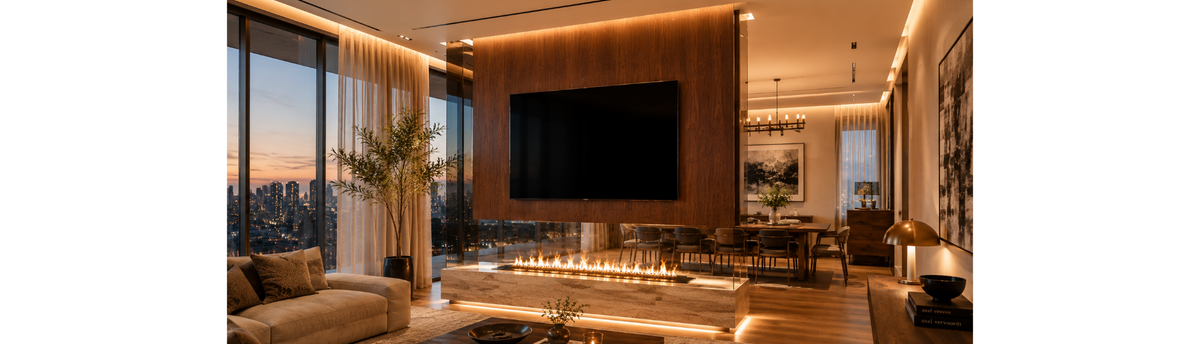

Open-plan living rooms have changed the way we think about partitions. Instead of dividing a home with solid walls, contemporary interiors increasingly use design elements that define different zones while preserving light, openness and visual connection. A water vapour fireplace can perform this role beautifully.
Integrated into a low partition, floating television wall or central interior feature, a long linear fireplace creates a natural boundary between living, dining and entertainment areas without making the interior feel enclosed. The movement of illuminated water mist introduces another layer: the partition becomes a focal point that can be enjoyed from more than one part of the room.
This approach is particularly relevant to luxury apartments, penthouses and open-plan homes where every element needs to contribute to both spatial planning and atmosphere. Instead of treating a fireplace as something that belongs against a wall, interior stylists can use it to shape how the entire room is experienced.
Table of Contents
- Rethinking the Fireplace as a Room Partition
- Defining Open-Plan Spaces Without Closing Them
- Creating a Focal Point from More Than One Direction
- Combining a Fireplace Partition with a TV Wall
- Why Proportion Matters with Linear Fireplaces
- Styling Water Vapour Fireplaces with Stone and Timber
- Using Firelight to Change the Evening Atmosphere
- Why Water Vapour Technology Expands Styling Possibilities
- Interior Styling Principles for Fireplace Partitions
- Frequently Asked Questions
Rethinking the Fireplace as a Room Partition
Traditional fireplaces were usually positioned against a wall. The layout of the room determined where the fireplace belonged, and the furniture was then arranged around it.
Contemporary water vapour fireplaces allow a different way of thinking.
Because these fireplaces create their flame effect using illuminated water mist rather than combustion, they can be considered primarily as an atmospheric and visual feature. This makes them particularly interesting for interior styling, where the fireplace can become part of the spatial composition rather than simply an object placed within it.
A long linear fireplace positioned between two zones can establish a visual boundary without creating the heaviness of a full-height wall. The eye recognises that one area has ended and another has begun, yet the room continues to feel connected.
This distinction is important. Good open-plan styling does not necessarily remove every boundary. It creates boundaries that are subtle enough to preserve openness while giving each part of the home its own identity.
A fireplace partition can therefore become three things at once: a spatial divider, a design feature and a source of atmosphere.
Defining Open-Plan Spaces Without Closing Them
Large open-plan interiors can sometimes feel visually undefined. The living room flows into the dining area, which may continue towards a bar, family lounge or entrance. Without some form of visual structure, furniture can appear to float within one large space.
A fireplace partition introduces that structure.
Consider a living room where the seating arrangement faces a suspended television wall. Instead of taking that wall all the way to the floor, a low stone platform can extend beneath it, incorporating a linear water vapour fireplace. The television wall provides visual weight above, while the fireplace creates a horizontal line below.
The composition defines the living area without completely separating it from the rest of the home.
This is particularly effective in contemporary Indian apartments where homeowners often want the spaciousness of an open plan while still creating a clear distinction between living and dining areas.
Rather than thinking of a partition as something that blocks a view, the better question is: how can the partition organise the room while preserving the view?
A water vapour fireplace answers that question unusually well because the flame effect itself remains visually light. There is movement and warmth in the composition without the visual mass of another solid surface.
Creating a Focal Point from More Than One Direction
One of the most interesting advantages of positioning a fireplace within a partition is that the feature no longer belongs to only one wall.
It becomes part of the centre of the interior.
When sightlines are planned carefully, the fireplace can be visible while entering the living room, while sitting on the sofa and even from the adjoining dining area. The same feature therefore contributes to several different experiences of the home.
This changes the way a focal point works.
A conventional feature wall asks the eye to look towards one surface. A centrally positioned fireplace creates a more fluid visual relationship. As people move through the room, the perspective changes, but the fireplace continues to anchor the composition.
The effect becomes particularly compelling in the evening. Reflections from the moving flame effect can interact with stone flooring, glass, polished surfaces and nearby furniture, adding subtle visual rhythm without introducing additional decorative objects.
This is where restraint becomes important. When the fireplace itself has enough movement and presence, the surrounding interior does not need to compete with it. Furniture, artwork and accessories can remain quieter, allowing the architectural composition to carry the room.
Combining a Fireplace Partition with a TV Wall
The television is often one of the most difficult elements to integrate into a refined living room. Its dark rectangular form naturally attracts attention, even when it is switched off.
A fireplace can help rebalance that visual weight.
Instead of designing a conventional television unit filled with cabinetry, shelving and decorative objects, the TV can become part of a simpler interior composition. A suspended timber or stone-clad panel provides the vertical element, while a linear fireplace beneath it creates a strong horizontal counterpoint.
The result is not simply a TV wall with a fireplace added underneath. The two elements need to be considered together in terms of proportion, materiality and negative space.
For Indian homes where fireplaces are often chosen for ambience rather than heating, indoor water vapour fireplaces are particularly well suited to this kind of composition. They create the visual presence of fire without adding unwanted heat to the living room, making them relevant to apartments and homes in warmer climates as well.
The fireplace can also extend beyond the width of the television. This creates a stronger horizontal axis and prevents the entire composition from feeling centred around the screen alone.
In a well-balanced room, the television should feel integrated into the overall interior. It should not visually dominate it.
Why Proportion Matters with Linear Fireplaces
A fireplace partition works best when it feels like part of the room rather than an object inserted into it. Proportion is what creates that sense of belonging.
In a large living room, a fireplace that is too short can lose its visual authority. The surrounding wall, television or furniture may overpower it. A longer linear fireplace creates a stronger horizontal line and can visually connect different parts of the composition.
But bigger is not automatically better.
The length of the fireplace should respond to the width of the partition, the scale of the television wall, the furniture arrangement and the distance from which the feature will normally be viewed. A generous room can support a long flame line, while a more compact living room usually benefits from greater restraint.
The height of the surrounding structure matters just as much. If a fireplace sits within a low partition, keeping the structure visually light helps preserve openness. If it forms part of a taller feature wall, enough negative space should remain around the flame so that the composition does not feel crowded.
This is why interior stylists think about visual weight rather than dimensions alone.
A dark stone surface carries more visual weight than pale travertine. A thick timber panel feels heavier than a slim floating structure. A large television adds another strong rectangular form. Each element changes how large or small the fireplace appears within the complete composition.
Stylist's Perspective
When working with a linear fireplace, I prefer to first establish the dominant horizontal line of the room. The fireplace should strengthen that line rather than compete with the television, furniture or surrounding finishes. When the proportions are right, you notice the complete composition before you notice its individual parts.
Styling Water Vapour Fireplaces with Stone and Timber
Once the proportion has been established, materiality determines the character of the fireplace partition.
Natural stone and timber work particularly well because they introduce two very different qualities. Stone brings permanence, texture and visual weight. Timber introduces warmth and softness. The movement of the fireplace between them adds another layer to the composition.
A pale limestone, travertine or softly veined marble can create a calm, understated base for the fireplace. The material allows the illuminated mist to remain the most animated part of the feature.
Darker stones create a different mood. Charcoal, deep grey and richly veined surfaces increase contrast, making the flame effect appear more pronounced in the evening. These finishes can work beautifully in sophisticated living rooms, but they should be balanced with lighter upholstery, warm timber or softer textiles so that the overall space does not become visually heavy.
Timber can be introduced above, beside or behind the fireplace. A vertical timber panel behind a television, for example, can soften the harder character of stone below. The change in material also helps establish hierarchy: the stone anchors the composition while the timber gives the upper section warmth.
Glass introduces yet another possibility. Where the objective is to maintain sightlines between two areas, transparent or partially open sections can make the partition feel almost weightless.
The important principle is not to use several luxurious materials simply because they are available. A refined composition usually comes from a limited material palette used consistently.
Stone, timber, glass and fire can be enough.
Using Firelight to Change the Evening Atmosphere
A fireplace partition should be considered in daylight, but its real atmospheric value often becomes most apparent after sunset.
During the day, the structure helps organise the room. In the evening, the illuminated flame effect begins to influence how the room feels.
This is where decorative lighting and the fireplace should work together rather than compete with one another.
A room does not need every light switched on at full brightness. Instead, different sources can create layers. A chandelier or suspension may provide the principal decorative statement, while wall lights, table lamps and concealed lighting add softer pools of illumination. The fireplace then contributes movement and a warm visual glow closer to eye level.
The contrast between these layers creates depth.
If the surrounding room is excessively bright, much of the atmosphere created by the fireplace is lost. Softer ambient lighting allows the flame effect to become more noticeable without making the room dark.
This is particularly effective in living rooms designed for evening entertaining. Guests may be seated in different areas, yet the fireplace remains a shared visual element within the room. It provides movement without noise and presence without requiring another decorative object.
For a calmer interior, the surrounding palette can remain restrained: warm neutrals, natural timber, textured fabrics and stone. The fireplace then provides the changing element within an otherwise composed setting.
Why Water Vapour Technology Expands Styling Possibilities
The design possibilities of a water vapour fireplace come from the way the flame effect is created.
Unlike a conventional fireplace based on combustion, a water vapour fireplace uses illuminated mist to create the appearance of flames. There is no real burning flame, smoke or combustion within the room. Spacio's collection of indoor artificial water vapour fireplaces is intended primarily for visual ambience rather than space heating.
International fireplace brands such as Planika have developed advanced water vapour fireplace systems that allow this flame effect to be integrated into contemporary interior compositions. Explore Planika fireplaces at Spacio in India.
For an interior stylist, this changes the conversation.
The fireplace no longer needs to be considered only in relation to a chimney or a traditional masonry fireplace surround. It can become part of contemporary cabinetry, a television composition, a room divider or a purpose-designed feature within an open-plan interior.
This is especially relevant in Indian cities where the emotional and visual appeal of a fireplace may be desirable even when additional room heating is not.
In Mumbai, Bengaluru, Hyderabad, Chennai and many other warmer regions, a no-heat fireplace can contribute atmosphere throughout the year without turning the living room into a seasonal space.
Interior Styling Principles for Fireplace Partitions
A water vapour fireplace partition can become one of the strongest visual features in a living room, but its success depends on how well it belongs to the rest of the interior.
The fireplace should not be designed in isolation. Its length, surrounding materials, furniture placement, lighting and sightlines all need to contribute to the same composition.
Plan Furniture Around the Partition
A partition changes how people move through a room, so furniture placement should be considered at the same time as the fireplace.
In a living room, the sofa and occasional chairs can face towards the fireplace composition without every seat being arranged directly in front of it. This creates a more relaxed setting and allows the fireplace to remain visible from different angles.
Where the partition separates living and dining spaces, sufficient circulation should remain around its ends. A dramatic feature loses much of its elegance if people have to squeeze around furniture to move between rooms.
Rugs can help reinforce the zoning created by the fireplace. A large rug beneath the living-room seating visually establishes one area, while the fireplace provides the architectural boundary beyond it.
Keep Accessories Secondary
A fireplace partition already combines form, material and movement. It rarely needs extensive decoration.
A single sculptural vase, a carefully placed art object or a small arrangement of coffee table books may be enough on an adjoining surface. If the fireplace is surrounded by richly veined stone, even fewer accessories may be necessary.
The objective is not emptiness. It is hierarchy.
The eye should understand what matters first, what supports it and what remains quietly in the background.
For more ideas on creating this balance, our guide to luxury Interior Styling explores how focal points, decorative objects, lighting and materials can work together within a refined interior.
From Room Divider to Living Experience
The most interesting fireplace partitions do more than separate one part of a home from another.
They change the experience of moving through the interior.
During the day, a carefully proportioned stone or timber structure gives an open-plan room definition. As daylight fades, the illuminated mist introduces movement and atmosphere. From the sofa it becomes a focal point; from the dining area it may appear as a distant line of fire; while moving through the room it reveals itself from changing perspectives.
This is why water vapour fireplaces have such interesting potential within contemporary luxury interiors. Their value is not limited to reproducing the appearance of a conventional fireplace. They allow designers and homeowners to reconsider where the visual experience of fire can belong within a home.
For luxury Indian interiors, this is particularly relevant. A fireplace can contribute atmosphere without being tied to the need for space heating, while open-plan apartments and villas can gain a visual boundary without sacrificing the sense of space that makes them desirable.
Used thoughtfully, a water vapour fireplace becomes more than an appliance or decorative feature.
It becomes part of the interior itself.
Explore Water Vapour Fireplaces for Contemporary Interiors
Discover Spacio's curated collection of indoor water vapour fireplaces for luxury apartments, villas and modern living spaces.
Explore Water Vapour FireplacesFrequently Asked Questions
Can a water vapour fireplace be used as a room divider?
Yes. A water vapour fireplace can be integrated into a purpose-designed partition to create a visual division between living, dining or entertainment areas. Because the flame effect is created using illuminated water mist rather than combustion, it offers greater design flexibility than a traditional wood-burning fireplace. The surrounding structure and installation should still follow the fireplace manufacturer's technical requirements.
Where does a fireplace partition work best in a living room?
Fireplace partitions work particularly well in open-plan living rooms where different functional areas need visual definition without being completely separated. They can divide living and dining spaces, sit beneath a floating TV wall or mark the transition between formal and informal seating areas.
Can a water vapour fireplace be installed below a television?
Water vapour fireplaces are often incorporated into contemporary TV-wall compositions because they are designed primarily for visual ambience rather than conventional space heating. The fireplace and television should nevertheless be planned according to the installation clearances and technical specifications provided for the particular model.
Are water vapour fireplaces suitable for homes with children and pets?
Water vapour fireplaces create their flame effect with illuminated mist rather than a real burning flame, making them an attractive option for family homes. Safety requirements can vary between models and installations, so the manufacturer's instructions should always be followed.
What materials work well around a water vapour fireplace?
Natural stone, marble, travertine, timber, glass and refined composite surfaces can all work beautifully around a water vapour fireplace. The best material depends on the wider interior palette. Rather than combining too many finishes, a limited material selection usually creates a calmer and more luxurious result.
Does a water vapour fireplace require a chimney?
Water vapour fireplaces do not create smoke through combustion and are designed without the conventional chimney or flue required by wood-burning fireplaces. Installation requirements vary by model, so electrical, water and ventilation requirements should be confirmed before the surrounding partition is designed.
How long should a linear fireplace be for a luxury living room?
There is no single ideal length. The fireplace should be proportioned to the width of the partition, television wall, furniture arrangement and overall scale of the room. Larger spaces can accommodate longer flame lines, while compact living rooms generally benefit from a more restrained proportion.
For readers who want to understand the technology, installation considerations and practical differences in greater depth, read our Expert Advice guide to Water Vapour Fireplaces in India: Safe Luxury for Modern Homes.


