
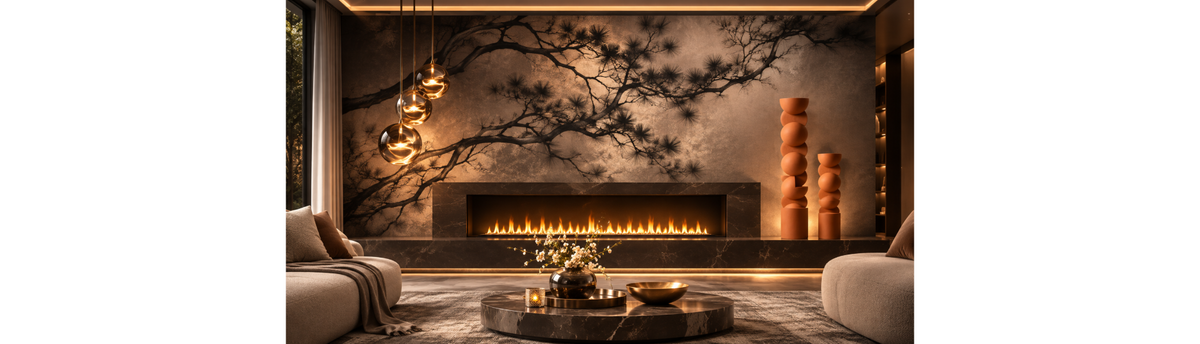

A fireplace feature wall brings together the fire feature, wallpaper, artwork, decorative objects and lighting as one interior composition. The fireplace creates a focal point, wallpaper gives the wall its visual character, art and sculptures add individual expression, and lighting reveals the materials after dark. When these elements are planned together, the wall feels connected to the room rather than like a collection of separate design choices.
The challenge is to give each element a clear role. A large wallpaper pattern may need a quieter fireplace surround. A dramatic sculpture may work better beside the fire than directly above it. Decorative lighting can reveal the texture of a wall covering, but excessive illumination may compete with the pattern or create unwanted reflections.
In this guide, Navin Kanodia, Interior Stylist, Co-Founder and Creative Director at Spacio, explains how to bring these elements together through proportion, pattern scale, material contrast, visual hierarchy and practical installation considerations.
Table of Contents
- Understanding the Feature Wall as One Composition
- The Fireplace as the Visual Anchor
- Choosing Wallpaper Around a Fireplace
- Pattern Scale, Colour and Visual Balance
- When Wallpaper Works Better Than Stone or Panelling
- Bringing Art Objects and Sculptures into the Composition
- Using Decorative Lighting to Complete the Wall
- Proportion, Spacing and Visual Hierarchy
- Designing a Fireplace, TV and Wallpaper Wall
- Common Feature Wall Styling Mistakes
- Fireplace Feature Walls and Vastu
- Fireplace Feature Walls Across Indian Cities
- Navin Kanodia's Approach to Feature Wall Styling
- Frequently Asked Questions
- Creating a Feature Wall That Feels Complete
Understanding the Feature Wall as One Composition
A feature wall is not simply a wall with an expensive finish or a collection of decorative items. It is a planned arrangement in which the main surface, focal object, surrounding materials and lighting work together. The wall should have a clear visual order, so the eye understands where to look first and how the other elements support it.
When a fireplace is part of the composition, it often becomes the main visual anchor. Wallpaper can establish the background, while artwork, sculptures and decorative objects introduce secondary points of interest. Lighting connects these elements and changes how the wall is experienced during the day and evening.
Think of the wall in layers:
- The focal element: the fireplace, which gives the wall a clear centre of attention.
- The background: wallpaper, stone, timber, panelling or another surface treatment that sets the visual character.
- The supporting elements: artwork, sculptures, vases and selected decorative objects.
- The lighting: decorative and concealed sources that reveal the surfaces and create depth.
- The surrounding room: furniture, rugs, flooring and the wider colour palette that connect the wall to the interior.
These layers should not all demand equal attention. A strong feature wall usually has one dominant element, a few supporting details and enough quiet space for the composition to remain legible.
The Fireplace as the Visual Anchor
The fireplace often determines the position and balance of the rest of the feature wall. Its width, height, format and location influence the wallpaper layout, the placement of artwork and the amount of space available for decorative objects.
A long linear fireplace creates a strong horizontal line. This can help ground a broad wall and work particularly well with a large wallpaper mural or a continuous surface treatment. A smaller fireplace may need a more compact composition, with the wall finish and surrounding objects providing additional visual presence.
The type of fireplace also matters. A built-in fire feature can be planned as part of the wall from the beginning, while a wall-mounted or freestanding format creates different relationships with the surface behind it. The chosen technology, installation method and manufacturer's clearances must be understood before deciding on wallpaper, cabinetry or nearby finishes.
For a broader understanding of the available formats and technologies, read Spacio's complete guide to choosing a fireplace in India. You can also explore the fireplace collection when considering the fire feature that will anchor the wall.
Navin Kanodia's approach is to begin with the fireplace's position and scale, rather than selecting wallpaper or accessories first. Once the fire feature is established, the surrounding wall can be designed to support it without competing for attention.
Choosing Wallpaper Around a Fireplace
Wallpaper can give a fireplace wall a character that stone or plain painted surfaces may not achieve on their own. It can introduce a landscape, botanical pattern, abstract artwork, texture or a subtle change in colour. In a room where the fireplace is already visually strong, wallpaper can provide the background that connects the fire feature to the wider interior.
However, wallpaper should be selected for its relationship with the fireplace, not simply because a pattern looks attractive in a sample book. Consider the scale of the wall, the width of the fire opening, the colour of the surround and the amount of visual movement created by the flame.
Wallpaper as a backdrop
A restrained wallpaper can frame a fireplace without becoming the main attraction. Soft textures, muted patterns and tonal designs can add depth while allowing the fire to remain prominent. This approach is useful when the fireplace surround already has a strong material or colour presence.
Wallpaper as the artwork
A large-scale mural or expressive pattern can act as the main visual surface of the wall. Botanical imagery, tree branches, landscape scenes and abstract compositions can create the feeling of a large artwork extending across the room. In this arrangement, additional framed art may not be necessary. A few carefully selected objects can complete the wall without interrupting the main image.
The attached interior image demonstrates this approach. The branching tree pattern gives the wall a strong visual identity, while the long fireplace opening creates a contrasting horizontal element below it. The terracotta sculptural objects introduce a warm, solid form against the more detailed background.
Wallpaper as a contrast
Wallpaper can also create contrast against a fireplace surround. A dark stone surround against a lighter wall covering, for example, can make the fire opening more distinct. A patterned surface can bring movement to a wall with a simple linear fireplace, while a quieter wall covering can soften a bold stone or metal surround.
The important point is to choose contrast with intention. If the wallpaper, fireplace surround and decorative objects all have strong colours or patterns, the wall may lose its visual order.
Pattern Scale, Colour and Visual Balance
Pattern scale is one of the most important decisions when using wallpaper on a fireplace wall. A pattern that looks delicate on a small sample can become dominant when repeated across a large surface. Similarly, a large mural may look overwhelming in a small room but well balanced on a broad wall with enough viewing distance.
Before choosing a pattern, consider the following:
- Wall width: large patterns and murals need enough surface area to be appreciated. On a narrow wall, a dense pattern may feel crowded.
- Viewing distance: the pattern should be comfortable to view from the main seating positions. Very fine detail may disappear from a distance, while oversized forms may dominate when viewed close up.
- Fireplace width: the pattern should relate to the horizontal scale of the fire opening. A strong linear fireplace can work with a flowing or expansive pattern, provided the two do not compete.
- Colour relationship: identify one or two colours in the wallpaper that can be repeated subtly in the fireplace surround, furniture or decorative objects.
- Visual movement: a busy pattern combined with a moving flame can create considerable activity. The remaining elements may need to be quieter.
Colour also affects the way the fireplace is perceived. Darker backgrounds can make the flame appear more distinct, while lighter surfaces can create a softer overall effect. Warm colours may relate naturally to the glow of a fire, whereas cooler colours can provide contrast. Neither approach is automatically better; the decision should respond to the room's materials, daylight and intended atmosphere.
It is useful to view a larger wallpaper sample beside the proposed fireplace finish and under the lighting conditions of the actual room. A small sample viewed in a showroom may not reveal how the pattern will behave across an entire wall.
When Wallpaper Works Better Than Stone or Panelling
Wallpaper, stone and panelling offer different visual qualities. The choice should be based on the design intention, the fireplace installation and the practical conditions of the wall.
Wallpaper for pattern and visual expression
Wallpaper is useful when the wall needs a pattern, mural or surface detail that would be difficult to achieve through stone or timber. It can introduce a strong visual theme without requiring every part of the wall to be covered with a heavy material. It also allows a designer to use the wall as an expressive surface rather than relying only on the fireplace surround.
Exploring Art Surface Coverings at Spacio
The choice of wallpaper should follow the character of the room and the role the fireplace plays within it. Some interiors call for the expressive quality of a large mural, while others benefit from a textured finish or a more restrained pattern. The aim is to choose a surface that complements the fireplace, rather than competes with its form and flame.
At Spacio, the Art Surface Coverings collection brings together different approaches to decorative wall treatments. These include Wallpaper Art Murals for more expressive wall compositions, Italian Fresco Modern and Italian Fresco Classical for distinct decorative styles, and Italian Fresco 3D for surfaces with added visual depth.
For more specialised treatments, the range also includes LED Crystal Wallpaper, Metal Fabrics and Waterproof Wall Paper. Each offers a different surface character, so the selection should be guided by the design intent, the location and the technical suitability of the material around the fireplace.
Stone for material depth
Stone and marble can give the fireplace surround a strong material presence. Their natural variation, veining and surface finish can become part of the composition. They are often effective when the intention is to make the fire opening feel grounded and substantial.
When stone is already visually active, wallpaper may be better used on an adjoining section of the wall rather than behind every element. This allows the stone and the pattern to retain their individual character.
Panelling for structure
Panelling introduces order through repeated lines, framed sections or changes in depth. It can help organise a broad wall and create defined areas for a fireplace, television, artwork or display niches. Wallpaper can be used within selected panels when a more decorative treatment is required.
In some interiors, a combination works best: stone around the fireplace opening, wallpaper on the upper wall and restrained panelling on an adjoining section. The transitions must be planned carefully so that the wall does not look like a collection of unrelated finishes.
As a practical guide, choose wallpaper when the wall needs pattern, colour or a mural-like surface without making the entire composition depend on stone. Choose stone when the fireplace surround needs material depth and a strong physical presence. Choose panelling when the wall needs defined sections for the fireplace, television, shelves or display niches. These materials can also be combined, provided their transitions and the fireplace installation requirements are planned together.
Important installation considerations
Not every wallpaper or wall covering is suitable for every fireplace installation. Heat exposure, the fireplace manufacturer's specified clearances, the type of fire technology and the construction of the wall must all be considered. Do not assume that a material is suitable simply because it is labelled decorative or suitable for interiors.
Before installation, confirm the permitted surrounding materials and distances with the fireplace manufacturer and qualified installation professionals. Wallpaper, adhesives, backing materials, wiring and any nearby cabinetry must not interfere with ventilation, service access or safe operation.
Bringing Art Objects and Sculptures into the Composition
Art objects give a feature wall personality and help connect it to the rest of the room. They can introduce height, texture, colour and sculptural form. However, their role should be decided in relation to the fireplace and wallpaper rather than treating the wall as an empty display area that needs to be filled.
Use sculpture to create a secondary focal point
A sculptural object can provide a strong form beside a fireplace, particularly when the wall has a long horizontal fire opening. A tall sculpture can introduce vertical movement, while a smaller object can create a more intimate point of interest on a suitable console or ledge.
In the attached image, the terracotta objects on the right introduce height and repetition. Their warm colour relates to the fire and the overall lighting, while their solid shapes contrast with the intricate tree pattern behind them. They are positioned as supporting objects rather than placed directly in front of the fireplace.
Explore Spacio's sculptures and art objects when considering pieces that can complement a fireplace wall.
For a broader look at how decorative objects can be arranged around a fireplace, read our guide to styling sculptures, vases and decorative objects around a fire feature. It explores how different forms, heights and materials can support the fireplace without crowding the surrounding space.
Balance tall and low forms
A feature wall can feel unbalanced when every decorative object is tall or when all the objects sit at the same level. A combination of vertical and low forms usually creates a more considered arrangement. A tall sculpture can be balanced by a low bowl, while a vase can introduce height on a console without blocking the main pattern.
Consider the objects as a group. Their heights, shapes and visual weight should relate to one another, but they do not need to match. Different forms can create interest when they share a colour, material or design quality.
Know when not to add artwork
If wallpaper already functions as a large-scale artwork, adding several framed pictures may make the wall feel crowded. In such cases, a sculpture or one carefully chosen object may be enough. If the wallpaper is subtle or textured, a painting or wall art piece may have a stronger role.
Spacio's wall art prints and paintings can be considered where the wall needs a separate artwork rather than a full-surface mural.
Using Decorative Lighting to Complete the Wall
Lighting changes how a feature wall is seen. During the day, wallpaper, stone and decorative objects are mainly read through natural light. After dark, decorative and concealed lighting can reveal texture, create shadows and give the fireplace wall a different character.
Firelight and decorative lighting need to be planned as complementary sources rather than competing features. The fireplace creates a natural focal point, while wall lights, pendant lights and concealed lighting help illuminate the surrounding surfaces. Read our guide to layering firelight and decorative lighting for a closer look at brightness, colour temperature, glare and evening ambience.
The lighting plan should support the wall's composition. It should not simply add brightness to every available surface.
Wall lights for controlled emphasis
Wall lights can highlight a section of wallpaper, illuminate an artwork or add a vertical element beside a fireplace. Their beam direction matters. A light that washes the wall gently can reveal texture, while a sharply directed beam may create strong highlights or shadows.
When using patterned wallpaper, check how the light falls across the design. Strong side lighting can exaggerate texture or create shadows that change the appearance of the pattern. The position of the fixture should be considered with the wallpaper layout rather than decided afterwards.
Concealed lighting for depth
Concealed lighting can be integrated into suitable ceiling details, niches, shelves or cabinetry. It can create a soft outline around a wall section or reveal the depth of a display area. In the reference image, the warm ceiling lighting and the light beneath the long fireplace platform help define the horizontal composition.
Use concealed lighting selectively. If every edge, shelf and recess is illuminated, the wall may become visually busy. A few well-placed sources often create more depth than continuous lighting around every detail.
Pendant lights and the wider room
Pendant lights may not be attached to the feature wall itself, but they can influence how the wall is experienced from the seating and dining areas. Their shape, height and light output should relate to the fireplace composition and the room's furniture layout.
In the attached image, the glass pendant cluster introduces a separate point of light to the left of the fireplace. It creates a visual connection with the warm glow of the fire without being placed directly over the fire opening.
For more options, explore Spacio's decorative lighting collection. The right fixture should be selected for its form, light direction, scale and relationship with the other elements in the room.
Proportion, Spacing and Visual Hierarchy
A successful feature wall is not determined by the number of elements it contains. It depends on their proportion and the space between them. The fireplace, wallpaper pattern, artwork, sculptures and lights should feel connected without being crowded together.
Begin by looking at the entire wall from the main seating position. Identify the dominant element and check whether the supporting pieces are too large, too small or too close to one another.
Some useful principles include:
- Relate the fireplace to the wall width. A long fire opening needs enough surrounding surface to feel intentional. A small opening may need a more compact treatment.
- Keep the wallpaper composition in mind. Avoid placing the fireplace, shelves or artwork over the most important part of a mural unless the overlap is intentional.
- Give sculptures breathing space. Objects should be visible as individual forms rather than merging into one crowded display.
- Vary the heights. A combination of low and tall objects can create rhythm, but avoid unnecessary repetition.
- Consider the furniture below and in front. The coffee table, sofa and rug should connect visually with the wall without blocking the fireplace or its view.
- Preserve negative space. An unoccupied section of the wall can be just as important as a decorated one.
It is also useful to view the wall from different positions. A composition that looks balanced from the entrance may appear crowded from the sofa. The fireplace should remain visible from the main seating area, and decorative objects should not obstruct circulation or access to the installation.
Designing a Fireplace, TV and Wallpaper Wall
A fireplace and television are often planned together in contemporary living rooms. This creates a more demanding feature wall because the screen, fire opening, wallpaper, cabinetry and lighting all compete for space and attention.
A common arrangement places a television above a linear fireplace. In this layout, the screen and fire create two strong horizontal elements. The wallpaper or wall finish needs to connect them without becoming too busy. A large mural may work, but its main pattern should not interfere with the screen or make the wall feel visually fragmented.
Other layouts may place the fireplace beside the television or use separate sections of a larger wall. The decision should reflect viewing distance, wall width, furniture arrangement and the intended visual hierarchy.
Lighting requires particular care around a television. Bright wall lights, exposed bulbs and reflective surfaces may create glare on the screen. Concealed lighting may be useful, but its brightness and position should be checked from the sofa.
Heat and installation requirements are equally important. A television above or beside a fireplace must comply with the requirements of the specific fireplace model. Do not assume that a decorative wall treatment or a particular distance is suitable for every system. Confirm clearances, ventilation and temperature limits with the manufacturer and qualified professionals.
For more detailed guidance on this arrangement, read Spacio's guide to choosing a fireplace below a TV in modern Indian homes.
Common Feature Wall Styling Mistakes
Using too many strong elements. A bold wallpaper mural, dramatic stone, large artwork and several sculptures can all compete for attention. Decide which element should lead and reduce the visual strength of the others.
Choosing wallpaper without considering the fireplace. The pattern may look attractive on its own but become difficult to read once the fireplace opening, screen or cabinetry is added. Review the complete wall before finalising the surface.
Placing artwork over an already expressive mural. A large wallpaper design may already provide the visual impact of artwork. Adding multiple pictures can interrupt the composition.
Ignoring scale. Small decorative objects can disappear against a large wall, while oversized sculptures can crowd a compact setting. Relate the size of every object to the fireplace, wall and furniture.
Using lighting without considering the pattern. A bright or poorly positioned light can create glare and unwanted shadows on wallpaper, polished stone and glass. Review the wall after dark before fixing the final positions.
Forgetting the rest of the room. A feature wall should not look disconnected from the sofa, coffee table, rug, flooring and other furnishings. Repeat selected colours, shapes or materials elsewhere in the room to create a relationship.
Overlooking fireplace installation requirements. Wallpaper, adhesives, wiring, shelves and cabinetry must be suitable for the specific fireplace installation. Follow the manufacturer's instructions and seek professional advice before work begins.
Fireplace Feature Walls and Vastu
For homeowners who follow Vastu principles, the position of a fireplace may influence the planning of the feature wall and the surrounding room. These preferences can be considered alongside the practical requirements of the fireplace, the layout of the room and the placement of furniture.
It is useful to consider the fireplace position early in the design process rather than trying to make Vastu adjustments after the wallpaper, cabinetry and lighting have been installed. The final arrangement must also respect the fireplace manufacturer's installation instructions, electrical requirements, ventilation and service access.
For a more detailed discussion, read Spacio's guide to Vastu considerations for fireplace placement in India.
Fireplace Feature Walls Across Indian Cities
The approach to a fireplace feature wall can change with the type of home, room size, climate and lifestyle. A large living room may allow a wide mural and linear fireplace, while a compact apartment may need a more restrained surface treatment. In warmer cities, the fireplace may be chosen mainly for its visual contribution, making the relationship between the flame, wallpaper and lighting especially important.
Fireplace in Pune: Balancing Pattern and Proportion
A fireplace in Pune may be part of a contemporary apartment, a larger family home or a villa. The feature wall should respond to the available width and the distance from which it will be viewed. A broad wall can accommodate a large wallpaper mural with a linear fire opening, while a smaller living room may benefit from a more restrained pattern and fewer decorative objects.
Where the fireplace is integrated below a television, keep the wallpaper composition calm around the screen and allow the fire to remain visible. Explore Spacio's fireplace options in Pune when considering the right format for the room.
Fireplace in Coimbatore: Creating Visual Warmth
For a fireplace in Coimbatore, the visual role of the fire may be more important than additional room heating for much of the year. This makes the surrounding wall an important part of the experience. Wallpaper can introduce colour, pattern or a nature-inspired image, while a suitable fire feature provides movement and a focal point.
In a warm-climate interior, decorative lighting can help maintain the atmosphere after dark without relying on the fireplace as the room's only source of illumination. Explore fireplace options in Coimbatore when planning a feature wall around the intended use of the room.
Fireplace in Kochi: Working with Coastal Interiors
A fireplace in Kochi may be considered for its visual character rather than a regular need for room heating. In such settings, a wall-mounted or built-in fire feature can become part of a living-room composition with wallpaper, textured finishes and carefully selected art objects.
Where the room receives generous daylight or opens towards a balcony, consider how the wall covering and decorative objects will look in both daylight and evening conditions. Explore Spacio's fireplace options in Kochi when planning the fire feature and its surrounding wall treatment.
Fireplace in Calicut (Kozhikode): A Considered Feature Wall
In Calicut, also known as Kozhikode, a fireplace feature wall can be planned around the character of the home and the way the living room is used. A wallpaper mural can bring visual interest to a broad wall, while a linear fireplace can provide a clear focal point below it. The remaining objects should be selected with restraint so that the pattern, fire and lighting remain easy to appreciate.
In a warm and humid coastal setting, consider the intended role of the fireplace and the suitability of the selected wall covering, adhesives and surrounding finishes. The installation should be planned around the specific fireplace model and the conditions of the room. Explore Spacio's fireplace options in Kozhikode when planning a feature wall for your home.
Fireplace in Indore: Making a Strong Wall Feel Balanced
A fireplace in Indore can form the centre of a living room with a substantial feature wall or become part of a more compact arrangement. The scale of the wallpaper should relate to the wall width and the fireplace opening. A large mural can work in a spacious setting, while a smaller wall may benefit from a tonal pattern or a limited section of decorative wall covering.
Art objects and sculptures can add character, but their placement should not interrupt the main pattern or compete with the fire. Explore fireplace options in Indore when considering a suitable format for the room.
Fireplace in Raipur: Connecting the Wall with the Room
For a fireplace in Raipur, the feature wall should be considered in relation to the scale of the living room and its furniture. A wide fireplace can anchor a larger wall, while wallpaper and decorative objects can bring texture and personality to the surrounding surface. A carefully placed floor lamp or wall light can help connect the feature wall with the seating area.
Rather than filling the entire wall with decorative details, select a few elements that relate to the wallpaper and fireplace. Explore fireplace options in Raipur as part of the planning process.
Fireplace in Ahmedabad: Using Wallpaper as a Design Surface
A fireplace in Ahmedabad can be planned as part of a contemporary living room, a larger residence or a villa. Wallpaper offers an opportunity to introduce a strong design surface behind or around the fire feature. Botanical patterns, abstract murals and textured finishes can each create a different mood, depending on the room's materials and colour palette.
Where the wall already includes a substantial stone surround, use wallpaper selectively so that the two surfaces do not compete. Explore Spacio's fireplace options in Ahmedabad when planning the scale and position of the fire feature.
Navin Kanodia's Approach to Feature Wall Styling
Expert Advice from Navin Kanodia
When I plan a fireplace feature wall, I begin with the fireplace and the proportions of the room. The wallpaper, artwork, sculptures and lighting must support that focal point rather than compete with it. I also look at the wall from the main seating position, because a composition that looks balanced from the entrance may feel crowded when viewed from the sofa. My approach is to select the dominant element first, then introduce supporting materials and objects with care. This gives every part of the wall a clear role and allows the complete composition to connect with the rest of the room.
Navin Kanodia
Interior Stylist, Co-Founder and Creative Director, Spacio
Frequently Asked Questions
Can wallpaper be used behind a fireplace?
Wallpaper may be used as part of a fireplace feature wall when the chosen material, adhesive and installation are suitable for the specific fireplace and its surrounding conditions. Follow the manufacturer's clearance and installation requirements, and confirm the suitability of the wall covering with qualified professionals before installation.
What type of wallpaper works best with a linear fireplace?
The right wallpaper depends on the width of the wall, the fireplace surround and the intended atmosphere. A large mural can work with a long linear fireplace when the pattern and fire opening are balanced. A quieter texture or tonal pattern may be more suitable when the fireplace surround already has a strong material presence.
Should artwork be placed above a fireplace with wallpaper?
Not always. If the wallpaper is a large-scale mural or already functions as the main artwork, an additional picture may make the wall feel crowded. If the wallpaper is subtle, a carefully selected artwork can introduce a separate focal point. The decision should be based on the visual hierarchy of the complete wall.
How do I light a fireplace feature wall?
Use lighting to reveal selected surfaces and connect the wall with the rest of the room. Wall lights can highlight artwork or texture, while concealed lighting can add depth to suitable niches and cabinetry. Check for glare and reflections on the wallpaper, polished stone, glass and television screen from the main seating positions.
Where can I explore fireplaces and feature wall styling in Mumbai?
You can explore Spacio's fireplace collection, along with its art surface coverings and sculptures and art objects. To experience the collections in person, visit the Spacio Mumbai store at Laxmi Industrial Estate, Andheri West. You can find the store on Google Maps.
Where can Kolkata homeowners explore fireplaces and decorative wall objects?
Kolkata homeowners can explore Spacio's fireplace collection, wallpaper art murals and sculptures and art objects. These collections can also be experienced at the Spacio Kolkata store on Topsia Road South, Kolkata. Find the store on Google Maps.
Creating a Feature Wall That Feels Complete
A well-planned feature wall brings together the fireplace, wallpaper, artwork, decorative objects and lighting in a way that feels connected to the wider room. The fireplace establishes the focal point, wallpaper gives the wall its visual character, art objects add personality and lighting reveals the composition after dark.
The result depends on proportion and restraint. Choose the dominant element first, consider how the pattern relates to the fire opening, select objects that add rather than repeat visual interest, and plan lighting around the materials and viewing positions. Most importantly, make sure the wall works with the furniture and the way the room is used.
Explore Spacio's fireplace collection, art surface coverings, wall art and sculptures and art objects when planning a fireplace feature wall. Consider the fireplace first, then select the wall treatment, artwork and lighting around the proportions and character of your room. Spacio's interior styling team can help you explore these elements together.


