
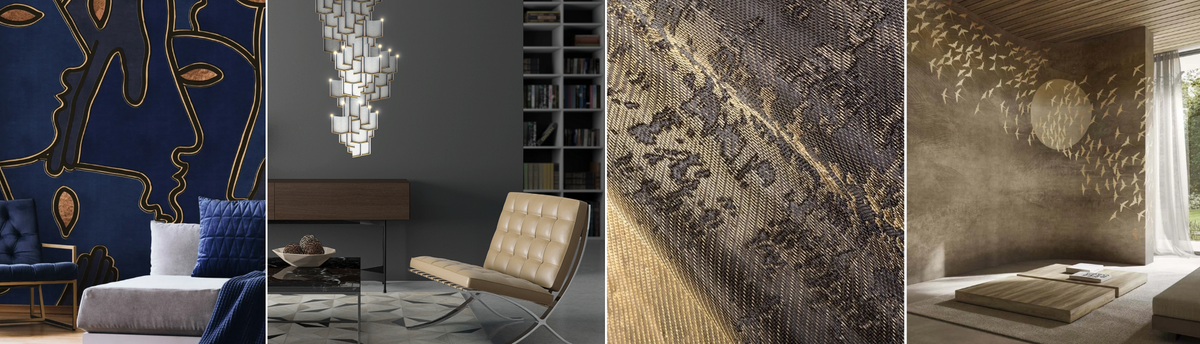

Luxury wall coverings can completely change how a room is perceived, but wallpaper, murals, fresco, metal fabric and illuminated wall coverings do not create the same visual result. Each belongs to a different design language and changes the wall through colour, pattern, texture, reflection, depth or light.
The right choice depends on what the wall needs to do. A wallpaper may introduce pattern and colour across a broad surface. A mural can create a more continuous visual composition. Italian fresco can make the surface itself part of the design language. Metal fabric introduces texture and reflective depth, while an LED or crystal wall covering can make light part of the wall rather than treating it only as illumination.
For a luxury interior, the decision should therefore go beyond asking which wall covering looks attractive. Consider the scale of the wall, the furniture in front of it, the amount of natural and artificial light, the desired visual weight, the surrounding materials and whether the wall should remain a background or become the dominant feature. This guide compares these specialist wall-covering families so homeowners, architects, interior designers and project decision-makers can understand what each one contributes and where it may be most appropriate.
For the broader principles behind statement walls, see Spacio's Wall Styling: A Complete Guide to Creating Luxury Statement Walls in Indian Interiors.
A wall covering should not be selected simply because the surface looks impressive on its own. I look at what happens when that surface meets the room around it — the furniture, the light, the floor, the ceiling height and the sightlines. The strongest wall treatments are those that give the room a clear visual direction without overwhelming everything around them.
In This Guide
- What Are Luxury Wall Coverings?
- The Five Wall-Covering Families Compared
- Wallpaper vs Murals vs Fresco vs Metal Fabric vs LED Wall Coverings
- What Does Wallpaper Contribute to a Wall?
- When Should You Choose a Wall Mural?
- What Makes Italian Fresco Different?
- What Is Metal Fabric and How Does It Change a Wall?
- What Are LED & Crystal Wall Coverings?
- How Each Wall Covering Changes the Visual Language of a Room
- How to Choose Between Wallpaper, Murals, Fresco, Metal Fabric & LED Wall Coverings
- Where Art Surface Coverings Fit
- Modern, 3D & Classical Fresco: How Should They Be Considered?
- When Metal Fabric Is the Better Wall-Covering Direction
- When LED Crystal Wallpaper Becomes the Wall's Main Feature
- Questions to Ask Before Finalising a Wall Covering
- Luxury Wall Coverings in Indian Interiors
- FAQs about Luxury Wall Coverings
- Conclusion
What Are Luxury Wall Coverings?
A wall covering is a surface treatment applied to a wall to change its appearance, texture or visual character. In a luxury interior, the category can extend well beyond conventional wallpaper to include artistic surfaces, murals, fresco treatments, metal-based coverings and illuminated surfaces.
The important distinction is that a specialist wall covering can become part of the composition of the room itself. It may establish the background for artwork, become the focal point behind a dining table, create depth on a living-room wall or provide a continuous surface across a large area.
These should not be treated as interchangeable products. They create different relationships between the wall and the rest of the room.
Wallpaper primarily changes the surface through pattern, colour and visual texture. A mural introduces a more continuous image or artistic composition. Fresco gives the wall a distinct surface language. Metal fabric introduces texture, reflection and visual depth. LED or crystal wall coverings make illumination part of the visual surface.
The Five Wall-Covering Families Compared
Before comparing individual materials, it helps to understand the five broad families as different design tools rather than as competing finishes. Spacio also has specialist Art Surface Coverings, which sit alongside these families as artistic surface treatments rather than needing to be treated as a separate universal material category.
1. Wallpaper
Wallpaper is often the most familiar wall-covering category. Its strength is the ability to establish colour, pattern, rhythm and visual texture across a wall without requiring the wall to be treated as an individual artwork. In a luxury interior, wallpaper can be quiet and tonal or highly expressive. The important consideration is scale. A pattern that feels refined on a large wall may become visually heavy when compressed into a smaller area, while a very restrained design can disappear when used across a large surface.
For specialist applications, Spacio also has a Waterproof Wall Paper collection. Technical suitability should always be established for the intended environment rather than assumed from the word "waterproof". This is best treated as a specialist wallpaper application rather than as a separate wall-covering family. Suitability should be confirmed for the specific environment, wall condition and selected system.
2. Wallpaper Art Murals
A mural uses the wall as a larger visual composition. Instead of treating pattern as a repeating background, the design can create a stronger image, scene or artistic narrative across the surface. This makes murals particularly useful when a wall needs a clear focal identity. They can work behind a dining table, across a living-room wall, within an entrance or across another large visual plane where a conventional repeating pattern may feel too fragmented.
The main design question is continuity. The mural needs to relate to the dimensions of the wall, the furniture placed in front of it and the main viewing positions in the room.
3. Italian Fresco
Italian fresco represents a different approach because the wall surface itself becomes an important part of the visual language. Within Spacio's collection, Italian fresco is represented through Modern, 3D and Classical approaches. These three collections should be understood as related but visually distinct families. A modern fresco can support a contemporary composition, a 3D treatment can introduce greater visual dimension, while a classical approach can bring a more traditional visual language to the wall.
The decision should therefore be based on the language of the interior rather than on the label "fresco" alone.
4. Metal Fabric
Metal fabric is a specialist wall-covering material that can function as a wall covering or as part of a larger wall installation. Its character comes from texture, reflective qualities and the way light interacts with the surface. This makes metal fabric particularly interesting when the wall needs material depth without relying on a printed image. It can create a more tactile visual field and can become especially expressive when considered together with decorative lighting.
Spacio's Metal Fabrics collection belongs to this specialist category.
5. LED & Crystal Wall Coverings
LED and crystal wall coverings introduce illumination into the surface itself. Instead of using a light only to illuminate a finished wall, the wall treatment can become part of the lighting experience. Spacio's LED Crystal Wallpaper collection is particularly relevant to this category. Its visual role should be considered in relation to the room's other sources of light, especially decorative pendants, chandeliers, wall lights and concealed illumination.
The key design principle is restraint. An illuminated wall already carries visual energy, so surrounding elements may need to be edited rather than added simply because the wall can accommodate them.
Wallpaper vs Murals vs Fresco vs Metal Fabric vs LED Wall Coverings
The following comparison is a design framework rather than a technical specification sheet. Exact installation requirements, substrate conditions, electrical requirements and suitability should be confirmed for the selected system before a project is specified.
| Wall covering | Primary visual contribution | Works particularly well when | Design consideration |
|---|---|---|---|
| Wallpaper | Pattern, colour and surface rhythm | A broad wall needs a coherent background or visual identity | Pattern scale and repetition should relate to room proportions |
| Art mural | Image, narrative and continuous visual composition | The wall needs a strong artistic focal point | Composition must be planned around wall dimensions and sightlines |
| Italian fresco | Surface character, visual language and material presence | The wall itself needs to become an expressive design element | Select the visual language to suit the interior rather than treating all fresco as the same |
| Metal fabric | Texture, reflection and visual depth | The room needs material contrast without relying on an image | Lighting and surrounding materials strongly affect its appearance |
| LED / crystal wall covering | Illumination, sparkle, depth and visual movement | The wall is intended to become part of the lighting composition | Coordinate with other light sources and maintain visual hierarchy |
Do not ask which wall covering is universally better. Ask what the wall needs to contribute. If the room needs pattern, wallpaper may solve the problem. If it needs an image, consider a mural. If the surface itself should become expressive, fresco may be relevant. If material depth and reflection are needed, metal fabric can change the wall's character. If illumination should become part of the wall, LED or crystal coverings introduce another layer of possibility.
What Does Wallpaper Contribute to a Wall?
Wallpaper is most useful when the wall needs a consistent visual language rather than a single isolated focal object. It can connect a large surface to the colour palette of the room and create rhythm across an otherwise plain wall. For example, a dining room with sculptural furniture and a strong chandelier may benefit from a quieter wallpaper that provides texture or pattern without competing with the central composition. Conversely, a restrained dining room can support a more expressive surface if the furniture and lighting are edited accordingly.
In living rooms, wallpaper can also provide the background for artwork or sculpture. The important relationship is between the surface and the object placed in front of it. A busy pattern behind a detailed artwork can reduce clarity, while a carefully selected surface can frame the artwork and give it greater visual presence.
This is why wallpaper should not be considered separately from wall art, sculpture and lighting. The surface establishes the field; the objects placed against it establish hierarchy.
When Should You Choose a Wall Mural?
A mural becomes relevant when the wall needs to carry a more specific visual story or image. Unlike a repeating wallpaper pattern, a mural can be designed around the complete wall composition. This is particularly useful on large walls where a small decorative object may lack sufficient visual weight. It can also work where the wall is visible from a long sightline, such as behind a dining table or at the end of a living room.
When a mural is being considered specifically for a dining wall, the decision also needs to respond to the dining table, seating, lighting and the atmosphere of the room. Spacio's guide to dining room wall ideas using art, mirrors, lighting, wall murals and fresco explores this room-specific application in greater depth.
However, a mural should not be selected simply because the wall is large. The image, scale and visual density need to relate to the room. A highly detailed mural can become overwhelming when combined with equally expressive furniture, sculpture and lighting.
Spacio's Wallpaper Art Murals collection is therefore best understood as part of a broader wall-composition decision rather than as an isolated decorative purchase.
What Makes Italian Fresco Different?
Italian fresco can shift the role of the wall from background to surface expression. Rather than asking what artwork should be placed on the wall, the designer can begin by considering what visual language the wall itself should carry. Spacio's three Italian fresco categories — Modern, 3D and Classical — provide different directions within this broader family. This distinction matters because a fresco treatment should relate to the style, scale and material vocabulary of the interior around it.
In a contemporary interior, a modern fresco may support a controlled material palette. A 3D treatment can introduce stronger dimensional interest. A classical direction can create a different relationship with traditional furniture, richer materials or interiors influenced by historical visual language. The important point is that fresco is not simply another version of wallpaper. It occupies a different position in the composition because the surface itself becomes a major part of the visual identity.
What Is Metal Fabric and How Does It Change a Wall?
Metal fabric introduces a material layer that behaves differently from a printed wall covering. Its texture and reflective qualities can give the wall greater visual weight, while light can reveal changes across the surface. This relationship between material and light is central to metal fabric. In daylight, the surface may read differently from how it does under evening illumination. The result can therefore change with the room rather than remaining visually static.
Metal fabric can also be considered alongside sculpture, artwork and lighting. For example, a wall could use metal fabric as the primary surface, with a sculptural object providing dimensional contrast. Alternatively, decorative lighting can be used to activate the texture of the surface rather than simply illuminate it. This is one reason metal fabric belongs within the broader wall-styling category rather than being treated only as a material finish.
What Are LED & Crystal Wall Coverings?
LED and crystal wall coverings bring together surface treatment and illumination. The wall is no longer only something that receives light; it becomes part of the visual lighting composition. This can be particularly relevant in spaces where atmosphere matters after dark, such as dining rooms, lounges, bars, hospitality interiors and statement living spaces. The illuminated surface can provide a visual background while other decorative elements create the foreground hierarchy.
One of the strongest combinations identified within Spacio's wall-styling strategy is LED crystal wallpaper with framed wall art: the illuminated surface acts as the background while the framed artwork provides a controlled foreground focal point. The relationship works because the two elements have different roles. The wall surface establishes atmosphere and depth; the artwork establishes a more defined point of visual attention.
However, the same principle means the rest of the room needs careful editing. If the illuminated wall, chandelier, artwork, sculpture and decorative lighting all compete equally, the room can lose hierarchy.
How Each Wall Covering Changes the Visual Language of a Room
The easiest way to compare these materials is to consider what each one does to the wall as a visual plane.
Wallpaper creates continuity
Wallpaper can make separate areas of a wall read as one continuous surface. Pattern and colour establish rhythm, while the repetition of the design can provide cohesion across a broad area.
Murals create a focal composition
A mural can make the wall read as one large image rather than as a repeating surface. This makes composition and sightline particularly important.
Fresco creates surface identity
Fresco can make the material and visual character of the wall itself central to the room. The wall is no longer simply the background for furniture and objects.
Metal fabric creates material depth
Metal fabric introduces texture and reflection, creating a different visual relationship with light. It can make the wall feel more dimensional without depending on a printed image.
LED and crystal coverings create illuminated atmosphere
Illuminated wall coverings introduce light directly into the surface experience. They can become particularly expressive after dark, but they also demand stronger control of the surrounding visual hierarchy.
Before choosing a wall covering, ask: What should this wall contribute to the room?
If the answer is pattern and continuity, investigate wallpaper. If it is an image or artistic narrative, consider a mural. If the surface itself should carry the design, explore fresco. If texture and reflection are central, metal fabric may be relevant. If illumination should become part of the wall, consider LED or crystal wall coverings.
How to Choose Between Wallpaper, Murals, Fresco, Metal Fabric & LED Wall Coverings
A wall covering determines the visual character of the surface, but wall styling considers what happens around it — artwork, sculpture, decorative lighting, furniture, proportion, sightlines and negative space. The strongest result comes when the surface and the elements around it work as one composition.
Once the differences between these wall-covering families are clear, the next step is to specify the surface according to the actual design problem. A wall may need pattern, an artistic focal point, surface depth, reflection, texture or illumination. The material should be selected in response to that need rather than simply because it looks impressive in isolation.
| If the wall needs... | Consider... | Why |
|---|---|---|
| A broad pattern, colour treatment or artistic surface | Wallpaper or Art Surface Coverings | Creates a continuous visual field while giving the wall greater character |
| A strong artistic image or continuous composition | Wallpaper Art Murals | Allows the wall to function as a large-scale visual composition |
| A distinctive surface language | Italian Fresco Modern, Italian Fresco 3D or Italian Fresco Classical | Makes the wall surface itself an important part of the composition |
| Texture, reflection and material depth | Metal Fabrics | Introduces a material layer that changes with light |
| An illuminated wall experience | LED Crystal Wallpaper | Makes illumination part of the wall treatment |
| A wall treatment for an environment requiring a suitable water-resistant surface | Waterproof Wall Paper | Provides a specialist wall-covering option where the particular system is suitable for the application |
This is not a list of universal rules. The final choice still depends on the actual wall, the selected material or system, the room and the project requirements.
Where Art Surface Coverings Fit
Art Surface Coverings occupy an interesting position between conventional wallpaper and more specialised statement surfaces. Their role is to give the wall an artistic identity while maintaining the continuity of a surface treatment.
They can be useful when the wall needs more character than a plain finish but the design does not necessarily need to become one large standalone mural. This makes them relevant to rooms where pattern, artwork and surface treatment need to coexist.
The important question is how much visual attention the surface should command. If furniture, sculpture or framed artwork already provides the focal point, the covering may need to remain controlled. If the wall is relatively open, a more expressive surface can carry greater visual weight.
Modern, 3D & Classical Fresco: How Should They Be Considered?
Spacio's Italian Fresco collections are divided into Modern, 3D and Classical approaches. These should be understood as different visual languages within the same specialist material family rather than as interchangeable finishes.
Italian Fresco Modern
A modern fresco direction can support interiors where the wall needs a contemporary visual language. It can sit within a restrained material palette while still giving the surface greater character than a conventional plain wall.
Italian Fresco 3D
A 3D fresco direction can be considered when dimensional visual interest is important. It can contribute greater perceived depth and become particularly relevant when the wall is intended to be experienced as a surface rather than simply a background.
Italian Fresco Classical
A classical fresco direction can support interiors where the visual language calls for a more traditional or historically influenced character. It should be considered alongside furniture, materials and decorative elements so that the wall does not appear disconnected from the rest of the room.
The important distinction is therefore not simply modern versus classical. The designer should consider the relationship between the fresco language, room proportions, furniture, lighting and the overall visual hierarchy.
When Metal Fabric Is the Better Wall-Covering Direction
Metal fabric becomes particularly interesting when the wall needs material presence rather than a printed image. Its texture and reflective qualities create a different type of visual depth.
Metal fabric can also work as part of a layered wall installation. When combined with decorative lighting, its texture and reflective qualities can become more visible, creating a relationship between material, light and depth. For example, a metal-fabric wall can provide the surface layer while decorative lighting establishes highlights and a sculpture or artwork provides a controlled foreground element.
The more reflective the material becomes, the more important it is to consider glare, sightlines and competing reflective surfaces in the room.
When LED Crystal Wallpaper Becomes the Wall's Main Feature
LED Crystal Wallpaper has a different relationship with the room because the wall treatment incorporates illumination into the visual experience. This makes it particularly relevant when atmosphere after dark is an important part of the design.
One useful composition is an illuminated surface behind framed artwork. Here, the wall provides the atmospheric background while the artwork provides a more defined foreground focal point. This is different from placing a light behind an artwork simply to illuminate it.
The same principle can be used with other elements, but restraint is important. If the wall is already luminous, the designer should assess whether the chandelier, pendant, decorative wall lights and other illuminated objects need to be equally prominent.
LED crystal wallpaper + framed wall art is one useful way to create this relationship. The illuminated wall provides the atmospheric background while the artwork establishes a more defined foreground focal point.
Questions to Ask Before Finalising a Wall Covering
Before a specialist wall covering is selected, a project should answer several practical design questions.
What is the wall's primary purpose?
Is it intended to create atmosphere, provide a background, establish a focal point, add texture, introduce reflection or become the main visual feature?
How large is the visible wall?
Measure the actual area that will remain visible after furniture, doors, windows, artwork and other elements are considered.
What will be placed in front of it?
Consider sofas, dining tables, consoles, beds, sculptures, artwork, shelving and lighting before deciding how visually strong the surface should be.
How will it look in daylight and after dark?
This is especially important for metal, crystal, reflective and illuminated surfaces. The material should be considered under the lighting conditions in which the room will actually be used.
Does the wall need one dominant treatment or several layers?
A wall can combine a surface treatment with art, sculpture or lighting, but layering should establish hierarchy rather than visual noise.
What installation requirements need to be confirmed?
The exact wall-covering system should be checked for its project-specific installation requirements, wall condition and any relevant technical considerations. Do not assume that one specialist surface can be installed in the same way as another.
I would make the wall decision in this order: first understand the room, then define the wall's role, then choose the material. When this order is reversed, the material can start dictating the room. When the room comes first, the material becomes a design tool.
Luxury Wall Coverings in Indian Interiors
Indian homes and professional interiors can present very different wall conditions, from compact urban apartments and large villas to duplexes, penthouses, hospitality spaces and corporate interiors. This makes scale and application particularly important when selecting specialist wall surfaces.
A wall covering should be considered alongside the proportions of the room, the amount of natural light, the indoor environment, furniture density and how the space is used.
In a large Indian living room, for example, a statement mural or expressive fresco can provide the visual weight required by a broad wall. In a more compact apartment, the same level of visual density may need to be controlled through scale, colour and surrounding negative space. Likewise, an illuminated wall surface may be highly effective in an entertaining area but require greater restraint in a room designed primarily for quiet concentration.
The important point is that there is no single "luxury wall covering" that suits every Indian interior. The appropriate solution depends on the room, the wall, the material and the intended experience.
FAQs about Luxury Wall Coverings
Which is better for a statement wall: wallpaper or a mural?
Neither is universally better. Wallpaper is useful when the wall needs a continuous pattern, colour or surface treatment. A mural is more appropriate when the wall needs a defined artistic image or larger visual composition.
Is Italian fresco suitable for contemporary interiors?
Yes, depending on the particular fresco treatment and the interior around it. Spacio's Italian Fresco Modern collection provides a contemporary direction, while the 3D and Classical collections offer different visual languages.
What is the difference between metal fabric and wallpaper?
Wallpaper primarily changes the wall through pattern, colour and surface imagery. Metal fabric introduces a material layer with texture and reflective qualities, creating a different relationship with light and visual depth.
Can LED crystal wallpaper be combined with artwork?
Yes. LED crystal wallpaper can act as an illuminated background while framed artwork provides the foreground focal point. The two elements should be coordinated through scale, spacing and visual hierarchy.
Can a luxury wall covering be used on a large or double-height wall?
Yes, but the scale of the treatment needs to relate to the size of the wall. Large surfaces can accommodate stronger compositions, while vertical proportions and sightlines should be considered carefully.
Where can I see luxury wall-covering options in Mumbai?
You can visit the Spacio Mumbai store at 3BK, Laxmi Industrial Estate, New Link Road, Andheri (West), Mumbai 400 053, where you can explore Spacio's luxury wall-covering and statement-wall collections and discuss your project requirements with the Spacio Interior Styling Team. You can also find the Spacio showroom in Laxmi Industrial Estate, Mumbai on Google Maps before planning your visit.
Where can I explore luxury wall-covering options in Kolkata?
You can visit the Spacio Kolkata store at 86B, Topsia Road South, Kolkata 700 046, where you can explore relevant luxury interior collections and discuss wall-covering and statement-wall requirements with the Spacio Interior Styling Team. You can also use Google Maps when planning your visit.
What should I choose if I want texture rather than a printed design?
Metal fabric or an appropriate fresco treatment may be worth considering because both can give the surface a stronger material presence. The final choice depends on the desired visual language and project conditions.
Can I combine different wall-covering materials?
Yes, but combining materials should serve a clear hierarchy. Useful combinations can include metal fabric with lighting, fresco with sculpture, and illuminated wall surfaces with framed artwork, provided each element has a distinct role in the composition.
How do I know which luxury wall covering is right for my room?
Begin with the wall's role, then consider scale, furniture, materials, lighting, sightlines and installation requirements. The material should solve a design need rather than being selected only because it looks attractive in isolation.
Conclusion
Luxury wall coverings are not one category with one visual result. Wallpaper, murals, Italian fresco, metal fabric, art surface coverings and LED or crystal wall treatments give designers different ways to shape the character of a wall. Wallpaper can establish pattern and continuity. Murals can turn a wall into an artistic composition. Fresco can make the surface itself expressive. Metal fabric can introduce texture, reflection and material depth. LED crystal wallpaper can make illumination part of the wall.
The most useful comparison is therefore not simply material against material. It is design problem against design solution. When the wall's purpose is clear, the decision becomes more precise. Scale, proportion, hierarchy, material dialogue, lighting, sightlines and installation conditions then determine how that surface should work within the room.
That is the difference between selecting a wall covering and designing a wall.


