
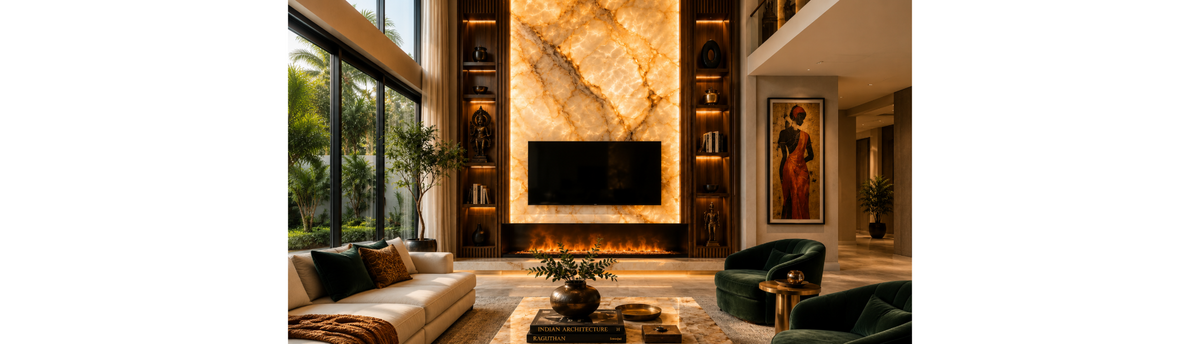

Fireplaces have moved well beyond the traditional image of a masonry hearth, a chimney and burning logs. In contemporary Indian interiors, a fireplace can be a source of genuine heat, a real-flame architectural feature, a controlled ambience element or an entirely artificial fire experience designed to recreate the visual depth and movement of flames without combustion.
In a luxury interior, a fireplace is defined less by price or size than by the quality of its technology, flame experience, materials, proportions, architectural integration and overall design. A luxury fireplace should feel considered within the room rather than added to it as an afterthought.
This guide is intended for homeowners exploring a fireplace for a new home or renovation, as well as architects and interior designers specifying fireplaces for residential, hospitality and other contemporary interior projects in India.
Table of Contents
- What Is a Fireplace Today?
- Why “Fireplace” Is No Longer a Single Category
- The First Decision: What Do You Want the Fireplace to Do?
- Real Flame vs Artificial Flame Fireplaces
- Heating vs Non-Heating Fireplaces
- Understanding Fireplace Technologies: What Actually Creates the Fire?
- Modern Fireplace Taxonomy: Understanding the Main Categories
- Fireplace Formats: Built-In, Freestanding, Linear and Multi-Sided
- Indoor vs Outdoor Fireplaces
- Fireplaces as Architecture: How the Surrounding Interior Changes the Experience
- Where Are Fireplaces Actually Used in Indian Homes?
- Why Fireplace Selection in India Requires a Different Approach
- Climate Should Influence the Fireplace Brief, Not Dictate It
- Fireplaces and Vastu: What Indian Homeowners Should Consider
- What Should You Consider Before Installing a Fireplace?
- Maintenance Should Be Considered Before Purchase
- What Architects and Interior Designers Should Establish Before Specifying a Fireplace
- Where Spacio Fits into the Fireplace Decision
- Where to Buy Luxury Fireplaces in India
- Where Can You Explore Fireplaces in Mumbai and Kolkata?
- Why Fireplace Selection Requires More Than a Product Catalogue
- The Final Selection: Match the Fireplace to the Home, Not the Other Way Around
- The Indian Fireplace Has Evolved Beyond the Traditional Hearth
In a luxury interior, a fireplace is defined less by price or size than by the quality of its technology, flame experience, materials, proportions, architectural integration and overall design. A luxury fireplace should feel considered within the room rather than added to it as an afterthought.
The right fireplace for an Indian home is not determined by appearance alone. It depends on whether you want genuine flame, useful heat, year-round ambience, or a combination of these, and then on the technology, room, architecture, climate and installation requirements that can support that experience.
That makes the modern fireplace a much broader design and technology category. Wood-burning, gas and bioethanol fireplaces create real fire, while electric, LED, water vapour and holographic systems approach the experience of fire through different forms of visual technology. A fireplace can be built into a marble feature wall, placed below a television, used as a room divider, integrated into a double-height living room, positioned within a bedroom or home office, or designed as an outdoor focal point for a terrace, garden or entertaining area.
For a broader styling approach to the entire room, read Spacio's guide to styling a double-height interior with furniture, lighting, fireplace and decor. It explores how fire, furniture, decorative lighting, artwork and decor can be composed together to create balance across a tall interior.
In contemporary Indian homes, one of the most common expressions of this idea is the fireplace around a TV. A fireplace may sit directly below a television, form part of a full-height TV feature wall, extend beside the TV within a wider media unit, or become the lower element of a double-height entertainment wall. The same design principle can be adapted to living rooms, family lounges, bedrooms, bars, dens and home theatres.
For rooms organised around a projector rather than a television, the fireplace can occupy the architectural zone below the projection screen or sit elsewhere on the media wall, depending on sightlines and the room's layout. The fireplace is therefore increasingly being designed as part of the complete media environment rather than as an isolated decorative object.
For an Indian homeowner, architect or interior designer, the important question is therefore not simply which fireplace looks attractive. The right choice begins with understanding what the fireplace needs to do, what technology can achieve that purpose, what the architecture allows, and how the system will behave within the climate and lifestyle of the home.
Spacio's fireplace collection brings together different approaches to this category, including indoor artificial fireplaces, water vapour systems, LED electric fireplaces, holographic fireplaces, bioethanol fireplaces, gas fireplaces and wood-burning fireplaces. The purpose of this guide is to make those distinctions clear before moving into the more specific technology, installation, styling and buying questions explored throughout the September fireplace series.
What Is a Fireplace Today?
A fireplace is fundamentally a designed system for introducing fire, a representation of fire, heat, light or some combination of these into an interior or exterior environment. The traditional fireplace used combustion to create heat and light. Contemporary fireplaces have expanded the definition by separating these functions.
A wood-burning fireplace combines flame, heat, smoke, fuel and the sensory experience of burning timber. A gas fireplace combines a real flame with controlled fuel delivery and heat. A bioethanol fireplace also produces a genuine flame, but uses liquid bioethanol rather than wood or piped gas. These are all real-flame fireplaces, but they differ substantially in installation, fuel, operation and architectural requirements.
Artificial fireplaces take a different route. An electric fireplace can use LEDs and digital imagery to create a flame effect. A water vapour fireplace uses fine mist and illumination to create the appearance of moving flames. More advanced digital or holographic systems use projection and layered visual effects to create a deeper and more realistic representation of a fire.
The distinction matters because the visual word "flame" does not tell you what is actually happening inside the fireplace. Two fireplaces can look similar in a photograph while having completely different requirements for fuel, heat, ventilation, installation and operation.
For this reason, a professional fireplace selection process should begin with the technology behind the experience, not with the appearance of the product alone.
The term fire feature is sometimes used more broadly to describe the visual or architectural role of fire within a space. A fire feature may therefore refer to a fireplace itself, a built-in fire installation, a room divider incorporating fire, or another architectural element in which flame becomes part of the interior composition. In this guide, fireplace refers to the complete system, while fire feature describes the way that system functions within the architecture.
Fire — creating a genuine combustion flame.
Heat — contributing to thermal comfort.
Ambience — creating the visual and atmospheric character associated with fire.
Architecture — becoming part of the spatial composition and focal hierarchy of the room.
Why "Fireplace" Is No Longer a Single Category
The word fireplace now describes a family of technologies rather than one product type. This is particularly important in India, where the climate, construction type and intended use can vary enormously from one project to another.
A homeowner in a cold-climate retreat may genuinely need a heating fireplace. A homeowner in Mumbai may want the visual presence of fire without introducing additional heat into an air-conditioned living room. An architect designing a double-height residence may be looking for a large linear fire feature that becomes part of the architecture. An interior designer working on a bedroom may want a controlled, quiet visual effect rather than a conventional combustion system.
All of these requirements can legitimately be described as a search for a fireplace, but the appropriate solution can be completely different.
This is why terms such as luxury fireplace, modern fireplace, electric fireplace, artificial fireplace, water vapour fireplace, holographic fireplace, bioethanol fireplace, gas fireplace and wood-burning fireplace should be understood as connected entities within a larger category.
For someone researching fireplaces in India, understanding these relationships is more useful than trying to identify one universally "best" fireplace.
The First Decision: Fire, Heat, Ambience or All Three?
The most useful way to begin choosing a fireplace is to identify the experience the room actually requires.
Many poor fireplace decisions begin with the assumption that a fireplace must provide heat. In a large part of contemporary Indian residential design, that assumption is no longer necessarily correct. A fireplace may be specified because the designer wants movement on a feature wall, a warm visual glow in the evening, a focal point within a large room or the architectural character associated with a hearth.
That is particularly relevant when the fireplace is being designed into a TV wall. In many Indian living rooms, the television already occupies the principal focal wall, so the fireplace is selected to complement the screen rather than compete with it. A fireplace below the TV can provide a visual base to the composition, while a fireplace beside the TV can extend the feature wall into a larger architectural arrangement.
The same thinking applies to a bedroom TV wall, a bar and den with a television, or a home theatre where the screen or projector is already the dominant visual element. The fireplace technology should support the experience the room is being designed to create.
Once that objective is separated from heating, an entirely different range of technologies becomes available.
If genuine fire is the priority
A genuine flame points the selection toward wood-burning, gas or bioethanol fireplaces. Each creates actual combustion, but each does so differently.
Wood provides the most traditional fire experience and can be particularly compelling in a cold-climate residence or retreat where heat is genuinely required. Gas offers controlled real flame and can be suitable for larger residential and outdoor applications where the necessary infrastructure can be planned. Bioethanol provides a genuine flame without relying on wood as the fuel and can offer greater architectural flexibility depending on the system.
Real fire, however, means that the installation must be evaluated as a combustion system. Fuel, operating conditions, clearances, ventilation or flue requirements where applicable, maintenance and the manufacturer's technical requirements must be established for the specific fireplace.
If heating is the priority
The question becomes more specific: how much heat is actually required?
A fireplace intended to supplement heating in a cold residence should not be evaluated by the same criteria as a decorative fireplace installed in a warm, air-conditioned apartment. Heating output, room volume, insulation, climate and the intended operating pattern all become relevant.
Some gas and wood-burning systems provide genuine heat as an inherent part of combustion. Some electric fireplaces also offer heating functions. Other electric, LED and water vapour systems are primarily ambience products and should not be treated as primary heating appliances.
This distinction should be established before the fireplace is selected, because choosing a non-heating system for a room that genuinely needs heat can be just as inappropriate as specifying a heat-producing fireplace in a space where the homeowner only wants visual ambience.
If ambience is the priority
When the purpose is to create the visual and atmospheric presence of fire rather than provide substantial heat, artificial fireplace technologies become especially important.
Water vapour, LED electric and holographic or digital fireplaces can create different versions of a fire experience without requiring conventional wood combustion. The visual quality varies between technologies and models, so the decision should not stop at the label “artificial.” Flame movement, depth, colour, ember effects, logs or media, reflections, viewing distance and the relationship with surrounding lighting can all influence how convincing a fireplace appears.
For Indian homes where the visual warmth and atmosphere of a fireplace are more important than additional heat, artificial fireplaces can offer a particularly practical approach. Water vapour, LED electric and other non-combustion systems can introduce the movement and visual character of fire into living rooms, bedrooms, apartments and other contemporary interiors without making heating the primary purpose of the installation. For a more detailed look at how this approach works in Indian homes, see Spacio's guide to artificial fireplaces for Indian homes.
Navin Kanodia, Fireplace Expert & Interior Stylist, explains that the realism of an artificial fireplace depends on more than simply producing a flame. Movement, depth, colour, fire media, glow, reflections and viewing distance all influence how convincing the fire appears. For a deeper examination of these visual cues, explore What Makes an Artificial Fireplace Look Real? Flame Realism Explained. Artificial fire is therefore not synonymous with low-quality fire simulation.
If fire, heat and ambience all matter
Some projects require a more complete fireplace experience. A large villa in a colder region, for example, may want a genuine flame, meaningful heat and a strong architectural focal point.
In such cases, the selection process becomes more technical. The fireplace must satisfy the thermal requirement while also working with the architecture and the visual language of the interior.
The key is to avoid allowing one requirement to dominate the others. A fireplace that heats exceptionally well may not have the right visual proportions for the room. A visually spectacular fireplace may not provide the required heat. A technically appropriate system may still fail if its installation requirements were not incorporated into the architectural design early enough.
Navin Kanodia has developed Spacio's fireplace expertise through a body of Expert Advice covering artificial fireplaces, electric fireplace applications, water vapour technology, fireplaces below televisions, Vastu considerations and wood-burning fireplaces. The consistent principle across these subjects is that a fireplace should be selected as part of the architecture and lifestyle of the space, rather than treated as an isolated decorative purchase.
For a deeper look at how a fireplace changes the atmosphere of a living room after dark, read The Living Room After Dark: Designing Around the Glow of Fire. The guide explores how firelight works with upholstery, stone, wood, glass, sculpture, books, rugs and decorative lighting to create a layered evening interior.
A Simple Starting Point for Fireplace Selection
| If your priority is… | Technologies worth exploring |
|---|---|
| Genuine flame and heat | Wood-burning, gas, bioethanol |
| Genuine flame with contemporary flexibility | Gas or bioethanol |
| Visual fire without conventional combustion | Electric, water vapour, digital/holographic |
| Ambience without additional heat | Water vapour, selected electric or digital systems |
| A major architectural feature | Linear, built-in, multi-sided or room-divider formats |
| Portable or flexible ambience | Selected freestanding or portable systems |
| Strong winter heating | Wood-burning or appropriate gas systems |
This is only a starting point. The final choice depends on the specific model, room, climate, installation conditions, available infrastructure and manufacturer requirements.
Real Flame vs Artificial Flame Fireplaces
The real-flame versus artificial-flame distinction is one of the most important branches in the modern fireplace category.
It should not be framed as a simple choice between "authentic" and "fake." Both categories can solve legitimate design problems, but they solve different problems.
Real flame fireplaces
Real flame fireplaces use combustion. The principal categories are wood-burning, gas and bioethanol.
The attraction is obvious: the flame is physically present rather than digitally represented. The movement of a real flame is naturally irregular, and the relationship between fire, surrounding materials and reflected light creates an experience that artificial systems attempt to reproduce in different ways.
Real flame also introduces responsibilities. The fireplace must be treated according to its technology, fuel and installation requirements. A gas fireplace is not installed in the same way as a wood-burning fireplace. A bioethanol fireplace is not automatically equivalent to either of them simply because all three produce real fire.
Artificial flame fireplaces
Artificial fireplaces create the visual experience of fire without conventional combustion. Within this category, there are meaningful technological differences.
LED electric fireplaces primarily use lighting and visual effects. Water vapour fireplaces combine mist and illumination to produce a three-dimensional flame-like effect. Holographic or advanced digital fireplaces use projection and layered visual systems to create a more immersive representation of burning logs and flame.
The category is particularly relevant to India because a homeowner does not necessarily need additional heat simply because they want the visual presence of a fire.
For example, DRU's Virtuo range includes electric fireplaces with front, two-sided and three-sided configurations, while the manufacturer positions the system around realistic flame imagery, ambience and controllable warmth depending on the model.
That illustrates an important point: electric fireplace is a technology category, not a single visual outcome.
Heating vs Non-Heating Fireplaces
For Indian interiors, this distinction deserves its own category because climate can fundamentally change what "the right fireplace" means.
In a cold residence, heating may be a functional requirement. In a warm city, the fireplace may be used almost entirely for visual atmosphere. In a large luxury residence, the requirement may vary by room: a family lounge may benefit from warmth while a bedroom fireplace may be intended primarily as an ambience feature.
This is why the fireplace specification should identify heat requirement separately from flame requirement.
Fireplaces where heat is part of the experience
Wood-burning fireplaces naturally generate heat through combustion. Gas fireplaces also provide heat while creating a controlled real flame. Certain electric fireplaces incorporate heating functions, although the heating performance and intended use vary by model.
For any heating application, the technical specification of the individual fireplace should take precedence over generic assumptions about the technology.
Fireplaces where ambience is the primary purpose
Non-heating systems can be particularly valuable in climates where adding heat would work against the comfort of the room.
This is one reason water vapour fireplaces have become relevant to contemporary Indian interiors. They allow designers to introduce a fire-like visual element without using conventional combustion. LED and certain digital fireplace systems can similarly separate the appearance of fire from the need to heat the room.
For a warm city apartment, this can turn the fireplace from a seasonal heating feature into a year-round architectural element.
Do I need a real flame?
Do I need heat?
Do I need the fireplace primarily for ambience?
How much architectural freedom does the project require?
The Modern Fireplace Taxonomy
A useful fireplace taxonomy needs to classify the category from more than one direction. Fuel alone is not enough. Installation alone is not enough. A fireplace can simultaneously be an electric fireplace, an indoor fireplace, a built-in fireplace, a linear fireplace and a non-combustion fireplace.
Understanding the category through multiple dimensions makes the selection process considerably clearer.
1. By flame: real or artificial
Real flame: wood-burning, gas and bioethanol.
Artificial flame: LED electric, water vapour and holographic or digital systems.
"Artificial" does not necessarily mean visually simple or less sophisticated. Modern artificial fire systems can use layered light, projection, water vapour, digital imagery and carefully controlled visual effects to create a highly developed representation of flame.
2. By fuel or energy source
Wood: traditional combustion using logs or other approved solid fuel, with substantial architectural implications for the flue and installation.
Gas: controlled combustion using the applicable gas supply, with specific infrastructure and installation requirements.
Bioethanol: liquid bioethanol used to create a genuine flame. Modern automated systems can use advanced combustion technology to control the burning process.
Electricity: electrical power used for lighting, visual effects and, on selected models, heating.
Water vapour: water and lighting technology used to create a flame-like visual effect without conventional combustion.
3. By heat output
Heating fireplaces are selected where thermal performance is part of the brief.
Non-heating fireplaces prioritise visual atmosphere and can be particularly relevant to warm climates and air-conditioned interiors.
Separately controllable systems can allow the visual fireplace experience and heat function to be managed independently, depending on the technology and model.
4. By location
Indoor fireplaces are designed for interior environments such as living rooms, dining rooms, bedrooms, home offices, bars, dens and hospitality spaces.
By architectural location: a fireplace may be positioned below a television, beside a television, within a TV feature wall, inside a media room or home theatre, below a projector screen, within a bedroom media wall, in a living-room feature wall, within a bar or den, or as part of a room-divider installation.
This location-based classification matters because the same fireplace technology can behave very differently depending on where it is placed. A fireplace below a TV has different sightline and proportion considerations from a fireplace beside a TV, while a fireplace below a projector screen may need to be considered in relation to the screen, projection equipment and seating distance.
Outdoor fireplaces are designed for terraces, balconies, gardens, pool decks, patios, rooftops and outdoor entertaining areas, subject to the requirements of the specific product and installation environment.
5. By installation format
Built-in fireplaces are incorporated into walls, feature walls, media units, cabinetry or other architectural structures.
Freestanding fireplaces remain independent objects within the room and can become architectural or sculptural focal points in their own right.
Wall-mounted fireplaces attach to a wall and can be useful where a built-in architectural installation is not required or possible.
Insert fireplaces are designed to occupy a prepared opening or architectural enclosure, depending on the system.
For a closer look at how built-in, wall-mounted and freestanding fireplaces change the planning of an interior, read Built-In, Wall-Mounted or Freestanding? Choosing the Right Format for Your Interior. The guide compares these formats in relation to feature walls, cabinetry, furniture layout, TV and media walls, room proportions and flexibility.
Other formats can serve more flexible applications. Freestanding and suspended fireplaces can function as sculptural architectural elements, while portable and tabletop fireplaces provide a more flexible way to introduce fire into balconies, terraces, entertaining areas and smaller interiors. Outdoor fire tables and related fire features extend the category further into gardens, poolside areas, terraces and open-air entertaining spaces. The appropriate format depends on the intended use, technology, scale, safety requirements and the architecture of the space.
6. By viewing configuration
Front-view fireplaces direct the visual experience primarily toward one side.
Two-sided fireplaces allow the flame to be experienced from adjoining spaces or from both sides of a partition.
Three-sided fireplaces provide a wider field of view and can be particularly effective where the fireplace is intended to remain visible from multiple positions within a room.
Open or freestanding formats can create an even more object-like relationship between fire and architecture.
7. By architectural shape
Linear fireplaces use a long horizontal proportion and are especially relevant to contemporary feature walls, media walls and large architectural compositions.
Vertical fireplaces create a stronger upward visual emphasis and can work where the architecture benefits from a taller focal element.
Corner fireplaces are designed to open the fire toward an adjoining wall or viewing direction.
Room-divider fireplaces allow the fire to become part of a partition between two spaces rather than sitting against a conventional wall.
This classification becomes particularly useful when an architect or interior designer moves from the question "Which fireplace should I buy?" to the more precise question: "Which combination of technology, heat, installation, viewing configuration and architectural form is appropriate for this project?"
The technology behind the fire deserves closer examination because two fireplaces can create very different experiences even when they appear similar visually. Water-vapour systems use illuminated vapour to create a flame-like effect, LED and electric fireplaces use controlled illumination and visual effects, digital or holographic systems approach fire as an optical experience, while bioethanol, gas and wood-burning fireplaces produce a genuine flame through combustion. These differences affect not only the appearance of the fire, but also heat, installation, maintenance, architecture and everyday use. For a deeper comparison of how these technologies work and where each can be appropriate, read Water, Light or Hologram? The New Technologies Changing Interior Fireplace Design.
Fireplace Technologies at a Glance
| Technology | Flame | Heat | Primary strength | Typical design role |
|---|---|---|---|---|
| Wood-burning | Real | Yes | Traditional fire and genuine heat | Cold-climate residences, retreats and traditional architectural settings |
| Gas | Real | Yes | Controlled real flame and heat | Large residences, villas, contemporary interiors and selected outdoor spaces |
| Bioethanol | Real | Yes | Real flame with architectural flexibility | Contemporary living rooms, dining spaces, room dividers and outdoor entertaining |
| LED electric | Artificial | Model-dependent | Flexible visual ambience | TV walls, living rooms, bedrooms and offices |
| Water vapour | Artificial | No conventional combustion heat | Three-dimensional flame effect without conventional combustion | Warm-climate homes, apartments, feature walls and contemporary interiors |
| Holographic / digital | Artificial | Model-dependent | Advanced visual realism and architectural immersion | Luxury feature walls, large living spaces and hospitality environments |
This table is a starting framework rather than a substitute for technical specification. Individual fireplace models within the same technology can differ significantly in dimensions, output, controls, installation requirements and intended application.
These categories can overlap: for example, an electric fireplace may use LED lighting or digital visual effects, while “holographic” describes the visual technology rather than a separate fuel source.
For example, Planika's current portfolio spans bioethanol, gas and electric technologies for indoor and outdoor applications, while its BEV technology is specifically designed around controlled combustion of ethanol vapours.
GlammFire similarly operates across electric fireplaces and real-flame burner and insert systems, including multi-sided configurations and different architectural formats.
DRU's Virtuo range demonstrates another side of the category: electric fireplaces can be developed around highly realistic flame imagery, multiple viewing configurations and controlled ambience without requiring a conventional combustion fire.
These examples show why the modern fireplace market should be understood as a technology ecosystem rather than a collection of visually similar products.
Indoor vs Outdoor Fireplaces
Where the fireplace will operate is another fundamental selection variable.
An indoor fireplace becomes part of the architecture of a controlled interior environment. Its relationship with furniture, walls, ceilings, lighting, flooring, artwork and circulation must be considered as part of the room design.
Within indoor architecture, the most common contemporary application is often the fireplace and TV wall. The fireplace can be installed below the television, positioned beside it as part of a wider feature wall, or integrated into a complete media unit. In a media room or home theatre, the same principle can be adapted around a large television or projector screen.
The room itself changes the design brief. A living room may require the fireplace to balance a large seating arrangement, while a bedroom fireplace below a TV may need a quieter and more restrained composition. In a bar or den, the fireplace can become part of an entertainment wall, while a double-height media wall may require a substantially larger architectural treatment.
Once the fireplace has been selected and positioned, its role within the wider interior becomes equally important. The relationship between the fire, furniture, lighting, materials and decorative objects can determine whether it feels integrated into the architecture or simply added to the room. For a deeper look at this approach, read how to make the fireplace the most important object in a room.
An outdoor fireplace has a different brief. It may become the centre of a terrace seating arrangement, an element beside a pool, a focal point in a garden or a feature within an outdoor bar and entertaining space. Exposure, wind, weather, fuel, placement and the manufacturer's suitability requirements become important.
Spacio’s collection therefore covers several distinct fireplace technologies, including indoor artificial water vapour fireplaces, indoor LED fireplaces, holographic fireplaces, indoor bioethanol fireplaces, indoor gas fireplaces and indoor wood-burning fireplaces.
For outdoor settings, the collection includes outdoor bioethanol fireplaces and outdoor gas fireplaces, where weather exposure, ventilation, fuel requirements and installation conditions become additional considerations.
That distinction is useful for both search discovery and actual specification because an outdoor fireplace should not simply be treated as an indoor fireplace moved outside.
Built-In, Freestanding and Architectural Fireplace Formats
Technology tells you how the fireplace works. Installation format tells you how the fireplace occupies the architecture.
A built-in fireplace can disappear into a carefully detailed feature wall so that the flame appears to emerge from the architecture. A freestanding fireplace can work almost like a piece of furniture or sculpture. A room-divider fireplace can become the physical and visual connection between two spaces. A long linear fireplace can establish a strong horizontal line within a large wall.
This is why the installation format should be considered alongside the technology rather than after it.
Built-in fireplaces
Built-in fireplaces are particularly effective when the designer wants the fire to become part of the architecture. The recess, surrounding material, wall depth, cabinetry, ventilation requirements where applicable and service access should be resolved before construction.
They are commonly used within feature walls, television walls, marble or stone compositions and large architectural backgrounds.
A built-in fireplace is particularly effective when the objective is to create a TV feature wall with a fireplace. The fireplace can sit directly below the television, creating a clear vertical hierarchy, or it can be positioned beside the TV within a larger composition of stone, marble, timber, cabinetry and open shelving.
In a full-height living-room media wall, the fireplace can also become the horizontal element that visually anchors the television. In bedrooms, bars and dens, a smaller built-in fireplace can be integrated into the TV unit without making the fire feature feel disproportionately dominant.
Freestanding fireplaces
Freestanding fireplaces offer greater visual independence. The fireplace can become the object around which furniture is arranged rather than simply another component of a wall.
This can be particularly effective in large rooms, lounges, dens, hospitality settings and outdoor entertaining areas where the fire needs to be experienced from several directions.
Linear fireplaces
Linear fireplaces are defined by their long horizontal proportion and are especially compatible with contemporary architecture. They can reinforce the width of a feature wall, sit below a television or artwork, or establish a visual line within a long living room.
The important consideration is not simply how long the fireplace can be, but whether its proportions are appropriate for the wall and the furniture around it.
Fireplaces as room dividers
A fireplace can also become an architectural partition. Two-sided and selected three-sided systems can allow the fire to remain visible from adjoining spaces while defining a transition between them.
This is particularly relevant to open-plan luxury interiors where the designer wants separation without creating a completely opaque wall.
Why Fireplace Selection Must Begin with Architecture
A fireplace is one of the interior elements that can become expensive and difficult to correct when selected too late.
The reason is simple: the fireplace can affect the wall, electrical planning, gas infrastructure, flue or ventilation requirements where applicable, cabinetry, stone detailing, television placement, furniture layout and even the dimensions of the room's focal wall.
That planning becomes even more important when the fireplace is part of a television wall. A TV unit with a fireplace below it is not simply a cabinet with two products installed into it. The designer needs to establish the relationship between the screen, fireplace, cabinetry, wall finishes, viewing height and seating position from the beginning.
The same applies to a fireplace beside a television, a fireplace below a projector screen in a media room, or a fireplace integrated into a home theatre. If the fireplace is introduced after the media architecture has already been finalised, the result can be compromised proportions, inadequate installation space or an awkward relationship between the fire and screen.
Architects and interior designers should therefore consider the fireplace during the design-development stage rather than treating it as a finishing product.
For example, a fireplace below a television requires the relationship between the two objects to be considered together. The width of the fireplace, height of the screen, viewing distance, wall proportions and manufacturer's installation requirements all influence the final composition.
Read Navin Kanodia's expert advice on choosing a fireplace below a TV in modern Indian homes
Why Fireplace Selection in India Requires a Different Approach
There is no single "Indian fireplace." India contains warm coastal cities, hot inland regions, seasonal winter climates and cold mountain environments. Residential architecture ranges from high-rise apartments to independent villas, farmhouses, holiday homes and large multi-level residences.
Consequently, the right fireplace for a home in Mumbai can be fundamentally different from the right fireplace for a residence in Delhi, Bengaluru, Hyderabad or Kolkata.
In a warm, humid city, the homeowner may value a convincing flame effect without additional heat. In a colder residence, genuine heating may become central to the decision. In a large double-height living room, scale and viewing distance may matter more than the fireplace's footprint. In an apartment, the availability of architectural infrastructure may eliminate some technologies while making others particularly attractive.
This is also why "best fireplace for India" is an incomplete question.
The more useful question is: Which fireplace technology is appropriate for this Indian climate, this architecture, this room, this installation environment and this intended experience?
For a more detailed decision-making framework, read our guide on how to choose the right fireplace for an Indian home, including considerations such as ambience, heating, technology, room, installation and maintenance.
What This Complete Fireplace Guide Covers
This guide is deliberately broader than any single fireplace technology because category authority requires the relationships between the technologies to be understood.
This guide examines the individual fireplace systems and the decisions that surround them: water vapour fireplaces, LED electric fireplaces, holographic and digital fireplaces, bioethanol fireplaces, gas fireplaces and wood-burning fireplaces; real flame versus artificial flame; heating versus non-heating systems; built-in, freestanding, linear and multi-sided formats; indoor versus outdoor applications; room-by-room selection; double-height spaces; TV walls; bedrooms; home offices; bars and dens; terraces and hospitality environments.
The guide will also examine fireplace design in the Indian context, including climate-specific selection, Vastu considerations, installation planning, safety and maintenance, the relationship between fireplaces and feature walls, furniture and lighting, and the questions architects and interior designers should resolve before specifying a system.
Brand and technology context will also form part of the wider guide. Spacio's fireplace offering includes international fireplace brands and technologies, including Planika, GlammFire and DRU, allowing the category to be understood through the engineering and design differences between systems rather than through brand names alone.
Finally, the guide will connect the category back to actual selection and buying decisions: what to evaluate, what questions to ask before ordering, how to compare fireplace technologies, when a real flame makes sense, when an artificial fireplace is more appropriate, how climate changes the decision, and how a fireplace should be integrated into a luxury Indian interior.
A fireplace should be selected from the inside out: first define the experience, then the technology, then the installation format, then the architecture and finally the visual expression.
Understanding Fireplace Technologies: What Actually Creates the Fire?
Once the basic fireplace categories are understood, the next step is to look beneath the appearance of the flame and understand the technology creating it. This is where many fireplace comparisons become misleading. A wood-burning fireplace, a bioethanol fireplace, a water vapour fireplace and a holographic fireplace may all be described as a fireplace, but they create their visual and sensory experience through fundamentally different mechanisms.
The technology determines whether there is actual combustion, whether the fireplace produces heat, what fuel or energy source it requires, what installation infrastructure is necessary, how it can be integrated into architecture and how it should be operated and maintained. It also determines whether the fireplace can realistically be used throughout the year in a warm Indian city or whether its strongest application is in a colder residence.
For this reason, choosing a fireplace should never begin with the assumption that one technology is universally superior to another. The correct question is which technology best matches the intended experience, the architecture, the climate and the practical requirements of the project.
Wood-burning — genuine fire, genuine heat and the traditional hearth experience.
Gas — genuine fire with controlled fuel delivery and heat.
Bioethanol — genuine flame using liquid bioethanol fuel.
LED electric — artificial flame effects created through lighting and digital visual technology.
Water vapour — flame-like visual effects created through fine mist and illumination without conventional combustion.
Holographic / digital — advanced projected or digitally generated fire effects designed to create a highly immersive visual experience.
Real-Flame Fireplaces: Wood, Gas and Bioethanol
Real-flame fireplaces have one defining characteristic: the flame is produced by combustion rather than being digitally represented. This creates a fundamentally different experience because the fire itself is physically present.
Within the luxury fireplace category, the three principal real-flame technologies are wood-burning, gas and bioethanol. They should not, however, be treated as interchangeable. Each has different fuel requirements, installation considerations, operating characteristics and applications.
Wood-Burning Fireplaces
A wood-burning fireplace is the most traditional form of residential fireplace. Logs are burned inside a firebox and the resulting combustion produces both visible flame and heat. For many people, this remains the benchmark for the traditional fireplace experience because the fire is completely physical: the logs burn, the flame changes naturally, embers develop and the room receives genuine radiant and convective heat.
The appeal of wood burning is therefore not simply visual. It is sensory and architectural. The sound and movement of burning wood, the changing character of the fire and the physical warmth create an experience that artificial systems intentionally recreate but do not reproduce through the same mechanism.
That authenticity comes with considerably greater infrastructure requirements. A wood-burning fireplace needs an appropriate combustion arrangement and a properly designed route for combustion gases. Chimney or flue planning, clearances, construction, ventilation and maintenance must be resolved for the specific installation rather than assumed from the appearance of a traditional hearth.
This makes wood burning particularly relevant to new-build villas, mountain homes, holiday residences and cold-climate retreats where the architecture can be planned around the fireplace and where genuine heating is useful.
It is considerably less straightforward in a high-rise apartment in a warm city. Even when the homeowner likes the traditional appearance of a wood-burning fireplace, the building may simply not provide the infrastructure required for safe and appropriate combustion.
Spacio has separately examined the selection of wood-burning fireplaces for Indian homes, including the importance of climate, architecture and practical installation considerations. That specialist article can be used when the project specifically requires a traditional wood-burning system.
Gas Fireplaces
Gas fireplaces also produce a genuine flame, but fuel delivery can be controlled far more precisely than with a conventional wood fire. This makes gas particularly relevant to homeowners who want real fire combined with controllability and, depending on the system, meaningful heating.
The visual character of a gas fireplace can also be integrated into contemporary architecture. Long linear installations, corner formats and multi-sided fireplaces can allow the flame to become part of a feature wall, room divider or large architectural composition rather than resembling a traditional hearth.
Gas does not mean installation is simple. The project still needs to account for the applicable fuel supply, ventilation or flue requirements, clearances, controls and technical specifications of the particular fireplace. These requirements must be established with the manufacturer or qualified installation professional before the surrounding architecture is finalised. Gas fireplaces can be particularly relevant to large villas, independent homes, hospitality environments and selected outdoor applications where genuine flame and heat are part of the brief.
Spacio's fireplace collection includes dedicated indoor and outdoor gas fireplace categories, allowing gas systems to be considered separately according to the intended environment.
Bioethanol Fireplaces
Bioethanol fireplaces produce a genuine flame using liquid bioethanol fuel. Their significance in contemporary fireplace design comes from the combination of an actual flame with architectural formats that can be considerably more flexible than the traditional wood-burning hearth.
Depending on the specific system, bioethanol fireplaces can take the form of built-in burners, linear fire features, freestanding fireplaces, room-divider installations and outdoor fire elements.
This makes bioethanol particularly interesting when the designer wants the authenticity of real fire but does not want the visual language of a conventional chimney-and-hearth arrangement.
Spacio offers separate indoor bioethanol fireplaces and outdoor bioethanol fireplaces, reflecting the fact that indoor and outdoor applications need to be considered independently.
A real bioethanol flame should nevertheless never be treated as equivalent to an artificial flame. Combustion is taking place, and the fireplace must therefore be installed and operated according to the requirements of the individual system, including fuel handling, clearances and safety instructions.
It means that combustion is part of the fireplace experience. Whether that is an advantage depends on whether the project actually requires genuine fire, heat and the associated installation requirements.
Artificial Fireplaces: When the Visual Experience Matters More Than Combustion
Artificial fireplaces have changed the relevance of fireplaces in countries and climates where traditional combustion is not always practical. They allow designers to introduce the visual character of fire without necessarily introducing wood, gas or bioethanol into the room.
But "artificial fireplace" is an umbrella term. There is a substantial difference between a basic LED flame effect, a three-dimensional water vapour flame and a sophisticated digital or holographic fire representation.
The quality of an artificial fireplace should therefore be assessed through the actual visual technology rather than through the word artificial alone.
LED Electric Fireplaces
LED electric fireplaces use electrical power to create a visual representation of fire. Depending on the system, this can involve LED illumination, digital flame effects, simulated logs, ember beds and other visual elements.
The major advantage is flexibility. Because the flame is not produced through conventional combustion, electric fireplaces can be considered for environments where a real flame or chimney would be impractical.
Electric fireplaces are particularly relevant to apartments, bedrooms, home offices, media walls and contemporary living rooms where the visual presence of fire is desired without necessarily requiring a combustion system.
Some electric fireplaces also include heating functions, while others are designed primarily or entirely for visual ambience. This distinction should always be checked against the individual model rather than inferred from the word electric.
Spacio's indoor LED fireplace collection represents this ambience-focused branch of the wider fireplace category.
Water Vapour Fireplaces
Water vapour fireplaces represent one of the most important developments for contemporary interiors because they address a very specific problem: how to create a convincing flame effect without conventional combustion and without turning the fireplace into a heat source.
The technology uses fine water mist combined with illumination to create the appearance of a moving flame. The vapour catches and diffuses the light, creating visual depth that can make the flame appear to occupy physical space above the media or log bed.
This is fundamentally different from simply displaying a flame image on a screen.
The distinction becomes particularly important in warm Indian cities. A homeowner may want the atmosphere associated with a fireplace but have no practical reason to heat an already warm, air-conditioned living room. A water vapour fireplace can address that requirement by separating the visual fire experience from conventional combustion.
Water vapour technology is therefore particularly relevant to luxury apartments, contemporary villas, television walls, bedrooms, lounges, hospitality interiors and large architectural feature walls.
Spacio maintains a dedicated water vapour fireplace collection, and the category is also covered in greater depth in Spacio's dedicated article on why water vapour fireplaces are becoming important to luxury interiors in India.
The existing Spacio fireplace content also examines water vapour fireplaces as partitions in luxury living rooms, which is an important application because the technology can allow the fireplace to become part of an architectural division between spaces rather than simply occupying a wall.
Holographic and Digital Fireplaces
Holographic and advanced digital fireplaces take artificial fire another step further by using projection or digitally generated imagery to create the visual impression of burning logs and flames.
The objective is not merely to make the flame visible. It is to reproduce some of the visual complexity of a real fire: the apparent depth of the flames, movement around the logs, glowing embers and the changing interaction between firelight and the surrounding space. This makes the category particularly relevant to luxury interiors where the fireplace is expected to withstand close visual inspection rather than simply provide a generic orange glow in the background.
Advanced digital systems can also offer considerable architectural flexibility. Depending on the system, front-view, corner and multi-sided configurations can allow the fire to remain visible from several parts of a room. DRU's Virtuo range is an important example of this direction in fireplace technology. Its electric systems use projection-based visual technology and detailed media elements to create a more immersive fire experience, illustrating how the electric fireplace category is moving beyond simple flame graphics.
Spacio's holographic fireplace collection brings this category into the Indian luxury-interior market.
An LED fireplace, a water vapour fireplace and a holographic fireplace all avoid conventional combustion, but they create their visual fire experiences through different technologies. For an informed comparison, the technology behind the flame matters as much as the appearance of the finished installation.
Real Flame vs Artificial Flame: The Practical Comparison
The choice between real and artificial fire becomes much easier when the decision is separated into individual requirements.
| Consideration | Real Flame | Artificial Flame |
|---|---|---|
| Physical flame | Yes | No conventional combustion flame |
| Heat | Normally produced through combustion | Often no heat, although some electric systems may include heating |
| Fuel | Wood, gas or bioethanol depending on technology | Electricity and, for water vapour systems, water |
| Installation | Can require combustion-related infrastructure and clearances | Generally offers greater flexibility, subject to individual model requirements |
| Warm-climate suitability | Depends strongly on whether heat is wanted | Often highly relevant where ambience is the priority |
| Fire authenticity | Actual combustion flame | Visual recreation of fire |
| Typical architectural role | Hearth, fire feature, linear flame, room divider or outdoor focal point | Feature wall, media wall, bedroom, office, partition or architectural fire feature |
The table should not be interpreted as a ranking. It is a way of identifying the correct technology for the brief.
A homeowner who says, "I want a real fire," has already narrowed the category substantially. The next decision is whether wood, gas or bioethanol is appropriate.
A homeowner who says, "I want the look of fire but do not want heat," has moved into a completely different decision tree, where water vapour, LED and holographic systems become particularly relevant.
Heat Is a Separate Decision from Flame
One of the most useful principles in contemporary fireplace selection is to treat flame and heat as two separate requirements.
Traditional fireplaces naturally combine the two. A wood fire produces flame and heat. A gas fireplace produces flame and heat. A bioethanol fire produces flame and heat.
Artificial fireplaces can separate them. A water vapour fireplace can provide a flame-like visual effect without conventional combustion heat. An LED fireplace may provide visual ambience with or without a heating function depending on the model. A digital or holographic fireplace can focus almost entirely on visual realism.
This separation is particularly important in India because the country's climate means that a visually desirable fireplace is not necessarily a thermally desirable one.
In Mumbai, for example, the homeowner may use air-conditioning for much of the year and have little reason to introduce additional heat. In Delhi, winter heating can become more relevant. In Bengaluru, the requirement may be somewhere between the two. In a mountain residence, heat may be one of the principal reasons for installing the fireplace.
The fireplace should therefore be selected according to the actual thermal requirement of the room rather than according to the traditional assumption that a fireplace must heat the home.
When Does a Water Vapour Fireplace Make More Sense Than a Real Flame?
A water vapour fireplace becomes particularly compelling when the homeowner wants the visual presence of fire but does not need the physical consequences of combustion.
This can include a luxury apartment where chimney construction is impractical, a warm-climate living room where additional heat is unwanted, a bedroom where a controlled visual effect is preferred, or a feature wall where the fireplace is primarily an architectural focal point.
It can also be useful when the designer wants the fireplace to operate as a year-round design element rather than a seasonal heating appliance.
This makes artificial fireplaces particularly useful for fireplaces below TVs in air-conditioned living rooms, bedrooms and media rooms. Where the television, projector or entertainment system is already in use throughout the year, a non-heating fireplace can contribute visual warmth without turning the media wall into an unwanted source of additional heat.
For a contemporary TV unit, the fireplace may be centred directly below the screen. In a wider media wall, it can sit below the TV while cabinetry, shelving or artwork extends around it. In a bedroom, the fireplace can create a quieter focal point beneath the television, while in a bar or den it can become part of a more relaxed entertainment wall.
However, it would be incorrect to say that water vapour is automatically the right choice simply because it is a modern technology. A homeowner who values the physical experience of a genuine flame may reasonably prefer bioethanol, gas or wood. Technology should follow the desired experience, not the other way around.
When Does a Real Flame Make More Sense?
Real flame becomes more appropriate when the physical presence of fire is central to the experience.
This may be because the homeowner wants genuine heat, wants the natural movement of combustion, values the sensory character of a real fire, or has an architectural setting where a real flame becomes an important part of the room's identity.
A mountain retreat with a wood-burning fireplace is solving a different problem from a Mumbai apartment with a water vapour fireplace. A terrace designed around an outdoor bioethanol fire is solving a different problem again.
The correct comparison is therefore not "real versus artificial." It is which experience does the project require, and which technology can deliver it appropriately?
How to Select the Technology Before Selecting the Fireplace Design
For an architect or interior designer, the most efficient sequence is to determine the technology before becoming attached to a particular visual form.
Start with the intended experience. Decide whether the project requires genuine flame, visual fire, heat, ambience or a combination.
Then assess the climate. Determine whether heating is desirable, useful only seasonally or largely unnecessary.
Then assess the architecture. Establish whether the fireplace can be built into the wall, placed as a freestanding element, integrated into a partition or positioned outdoors.
Then assess infrastructure. Consider electrical supply, fuel, water where applicable, ventilation, flue or chimney requirements, clearances and access for servicing.
Then determine scale and viewing configuration. A fireplace in a compact bedroom has very different proportional requirements from one in a double-height living room.
Only then select the specific model and finish.
This sequence prevents one of the most common mistakes in fireplace design: choosing a visually attractive fireplace first and discovering later that the technology does not suit the room or cannot be integrated into the intended architecture.
For Navin Kanodia, the fireplace is not an isolated appliance placed into an otherwise finished interior. It is an architectural decision that should respond to how the room is used, what the climate demands and what role the fire is expected to play. This is why Spacio's fireplace advice covers different technologies and applications rather than presenting one fireplace type as the answer for every Indian home.
From Technology to Architecture: The Next Decision
Once the fireplace technology is established, the next question is how that technology should occupy the space.
A linear fireplace may be ideal for a long contemporary feature wall but inappropriate for a compact room. A three-sided fireplace may be valuable where the fire needs to be visible from several seating positions. A freestanding fireplace may be more effective when the fire should act as an independent sculptural element. A two-sided system can transform a partition between two rooms into a shared focal point.
The architecture therefore becomes the next layer of the selection process.
In the next stage of this guide, we move from how the fire is created to how the fireplace is physically integrated into the architecture — including built-in, freestanding, linear, front-view, two-sided and three-sided formats; feature walls; television walls; room dividers; double-height spaces; proportions; surrounding materials and the planning decisions architects and interior designers need to make before installation.
A Fireplace Is an Architectural Element, Not Just an Appliance
Once the fireplace technology has been selected, the next decision is how that fireplace should occupy the space. This is where the distinction between a fireplace product and a fireplace installation becomes important. The same underlying technology can produce completely different results depending on whether it is built into a wall, mounted on a surface, positioned as a freestanding object or used as a transparent room divider.
In a luxury interior, the fireplace often becomes one of the largest visual elements in the room. Its width can establish the horizontal proportion of a feature wall, its height can influence the perceived scale of the room, and its position can determine where furniture faces and where the eye naturally settles. A fireplace can also affect the television position, cabinetry, artwork, lighting, circulation and the selection of surrounding materials.
This is why the question should not simply be, "Which fireplace fits this wall?" A better architectural question is, "How should the fireplace and the architecture work together?"
Built-In Fireplaces: When Fire Becomes Part of the Wall
A built-in fireplace is incorporated into an architectural opening, recess, feature wall, media wall, cabinetry composition or other prepared structure. The installation can make the fireplace appear almost inseparable from the architecture, with the surrounding material framing the flame rather than the fireplace appearing as a separate object placed against a wall.
This format is particularly effective in contemporary luxury interiors because it allows the designer to control the complete composition. The fireplace opening, wall finish, stone or marble, cabinetry, television, niches, lighting and decorative elements can all be considered as one visual system.
Built-in installations are also where early planning becomes critical. The required cavity, depth, electrical connections, fuel supply, flue or ventilation requirements where applicable, access for servicing and manufacturer's clearances must be established before the surrounding wall is constructed.
For artificial fireplaces, the architectural freedom can be particularly useful. Spacio's indoor water vapour fireplaces and indoor LED electric fireplaces are relevant to this type of contemporary integration, subject to the installation requirements of the selected model.
Built-In Fireplaces and Feature Walls
A built-in fireplace can become the central element of a feature wall, but the wall should not be designed as a collection of unrelated features around it. The fireplace needs to establish the hierarchy.
For example, if the fireplace is long and horizontal, the surrounding architecture can reinforce that direction through elongated cabinetry, horizontal stone joints or controlled lighting. If the fireplace is tall and narrow, the wall may benefit from vertical elements that support its proportion rather than competing with it.
The same principle applies when other wall elements are introduced around the fireplace. Wall art, sculpture, mirrors, decorative lighting and surface treatments should support the fireplace's hierarchy rather than create competing focal points. For a broader guide to designing these elements as one considered composition, see Spacio's complete guide to luxury wall styling and statement walls in Indian interiors.
The principle is simple: the architecture surrounding a fireplace should strengthen its visual identity rather than make the fireplace compete with five other focal points.
Wall-Mounted Fireplaces: A Different Relationship with the Wall
Wall-mounted fireplaces sit on the surface of the wall rather than being recessed into a fully integrated architectural cavity. This can reduce the visual commitment of the installation while still allowing the fireplace to become an important focal element.
The format can work particularly well where the homeowner wants a contemporary fireplace without creating a substantial built-in feature wall. It can also be relevant to existing interiors where a full architectural renovation is not being undertaken.
However, wall-mounted does not mean installation requirements can be ignored. The wall structure, mounting method, surrounding clearances, electrical connections and the specifications of the individual fireplace must all be checked before installation.
Visually, a wall-mounted fireplace can also be treated almost like a large piece of functional design. The wall around it needs sufficient breathing space for the fireplace to remain legible as a focal point.
Freestanding Fireplaces: When the Fire Becomes an Object
A freestanding fireplace creates a fundamentally different spatial relationship because it does not depend on a conventional feature wall to establish its identity.
The fireplace can sit within a living room, lounge, den, library or other space as an independent architectural object. Depending on the technology and model, it can become the centre around which furniture is arranged rather than simply being positioned opposite a sofa.
This format is particularly powerful in large rooms where the designer wants to create a focal point without building another substantial wall. It can also work in spaces where circulation and sightlines allow the fireplace to be viewed from multiple directions.
Freestanding should not, however, be interpreted as "place it anywhere." A real-flame fireplace still has fuel, heat, combustion and clearance requirements appropriate to its technology. Even an artificial fireplace needs appropriate electrical access, stable placement and compliance with the manufacturer's installation instructions.
Linear Fireplaces: Designing with a Long Horizontal Flame
The linear fireplace has become one of the defining formats of contemporary fireplace architecture. Its long horizontal proportion allows the fire to occupy a substantial part of a wall without requiring the vertical mass associated with a traditional hearth.
Linear fireplaces are particularly effective beneath televisions, within long feature walls, below artwork or as part of a large-scale architectural composition. They can also work exceptionally well in open-plan rooms because their horizontal form reinforces the width of the space.
The mistake is to assume that longer automatically means more luxurious.
A fireplace should be proportionate to the wall, furniture and viewing distance. A very long fire feature on a narrow wall can make the architecture appear compressed. Conversely, a small fireplace on an enormous wall can lose its authority and look visually insignificant.
This relationship between fireplace width and architectural scale becomes particularly important in large Indian residences, where double-height spaces and expansive feature walls can make an incorrectly sized fireplace appear much smaller than expected.
Two-Sided Fireplaces: Connecting Two Spaces
A two-sided fireplace allows the fire to be experienced from two adjoining sides. Instead of functioning solely as a feature against a wall, the fireplace can become part of a partition between two spaces.
This can be valuable in open-plan interiors where the designer wants some degree of spatial separation without creating a completely opaque partition. A fireplace between a living room and dining area, for example, can establish a visual relationship between the two spaces while giving each side a distinct identity.
The architectural advantage is that the fire becomes shared rather than isolated. It can act as a visual connector between rooms while simultaneously defining their boundaries.
Two-sided configurations are especially useful where the fireplace has been considered early enough in the floor-plan development. Retrofitting such an installation into an existing partition can be substantially more complicated because the wall, services and surrounding finishes may already have been established.
Three-Sided Fireplaces: Increasing the Field of View
A three-sided fireplace exposes the flame across a wider viewing angle, typically allowing the fire to be seen from the front and both adjoining sides. This creates a more open visual experience than a conventional front-facing fireplace.
The format is particularly effective where seating surrounds the fireplace or where the installation occupies the end of a room rather than a conventional flat wall. It can also be useful in contemporary feature walls where the designer wants the flame to remain visible as people move through the space.
Because more of the fire is visible, the detailing around the installation becomes even more important. The edges, surrounding materials, media and sightlines are exposed to a larger number of viewing positions.
A three-sided fireplace should therefore be selected not simply because it looks impressive in a product photograph, but because the room genuinely benefits from the additional viewing angles.
Fireplaces as Room Dividers
A fireplace can perform a particularly sophisticated architectural role when it becomes part of a room divider. Rather than treating the fireplace as something attached to the architecture, the designer uses the fireplace itself to organise the architecture.
This approach works especially well in open-plan luxury homes. The fire can separate a living area from a dining space, a lounge from a bar, or one part of a large suite from another while retaining visual continuity.
Artificial technologies can be particularly interesting for this application because they can offer the visual presence of fire without introducing the same combustion requirements as wood, gas or bioethanol. Water vapour fireplaces, for example, can be considered where the design requires a visually open fire feature without conventional combustion, subject to the individual model's specifications.
Spacio's broader collection includes luxury fireplaces across multiple technologies and formats, allowing the architectural solution to be considered alongside the technology rather than independently from it.
Front-View Fireplaces: When the Wall Is the Focal Plane
A front-view fireplace directs the visual experience primarily toward one side. This remains one of the most straightforward formats and can be highly effective when the room has a clear focal wall.
The strength of the front-facing installation is control. The designer knows where the primary viewing position is and can compose the fireplace, television, artwork, furniture and lighting around that axis.
For living rooms and media walls, this can be particularly effective because the fireplace can establish a strong centreline for the room. For bedrooms and private spaces, a front-facing fireplace can similarly create a controlled focal point without requiring the additional visual exposure of a multi-sided system.
Suspended and Sculptural Fireplaces
Some fireplace formats move away from the idea of the fireplace as a wall installation altogether. Suspended and sculptural fireplaces can create the impression that the fire is floating within the room, giving the fireplace an object-like quality.
This format can be especially powerful in contemporary interiors where the designer wants the fireplace to read as architecture, furniture and sculpture simultaneously. The surrounding floor can remain visually open, which can be useful in rooms where maintaining a sense of spaciousness is important.
Real-flame suspended systems require particularly careful attention to their technical installation requirements because the fireplace is physically separated from a conventional wall enclosure. Structural support, clearances, flue requirements where applicable and the manufacturer's specifications must be resolved professionally.
Choosing a Fireplace for an Existing Home
Installing a fireplace into an existing home is very different from designing a new home around one.
In a new-build or major renovation, the architect can coordinate the fireplace with the floor plan, wall construction, services, ceiling, flooring, furniture and finishes from the beginning. In an existing home, the fireplace must work within constraints that may already be fixed.
The first question should therefore be feasibility rather than aesthetics.
Can the chosen technology be accommodated? Is the required electrical infrastructure available? Is a gas connection possible? Is there a suitable flue route where combustion requires one? Can the wall support the installation? Is there sufficient depth for a built-in fireplace? Can the surrounding materials meet the required clearances? Is service access available once the wall is finished?
These questions should be resolved before selecting the final finish or designing the feature wall around a particular fireplace.
Planning a Fireplace During New Construction
New construction provides the greatest freedom because the fireplace can be incorporated into the architecture before the building is finished.
For a wood-burning fireplace, early planning can include the firebox, flue, chimney, combustion air, structural support and surrounding construction. For a gas fireplace, fuel infrastructure and the applicable venting requirements can be coordinated with the architecture. For artificial systems, electrical services, recess depth, water supply where required and access for servicing can be incorporated into the design.
This is also the stage at which the designer can determine the fireplace's position relative to furniture, television, artwork and circulation.
A fireplace that is planned early can become an integral part of the architecture. A fireplace selected at the very end often becomes a compromise.
Stone, marble, timber, wallpaper, cabinetry and decorative details should follow the technical requirements and proportions of the selected fireplace. Do not finalise the surrounding architecture first and assume every fireplace will fit into it.
Clearances: The Invisible Part of Fireplace Design
One of the least visible but most important aspects of fireplace planning is clearance. The space immediately surrounding a fireplace may need to satisfy specific requirements depending on the technology, model, fuel, heat output and installation format.
This is particularly important when the fireplace is surrounded by combustible materials, integrated into cabinetry or positioned below a television or artwork.
There is no universal clearance number that can safely be applied to every fireplace. The manufacturer's installation instructions for the specific model should always be treated as the controlling technical reference, together with applicable local requirements and professional installation guidance.
This is one reason Spacio's role in fireplace selection extends beyond the visual category. The appropriate fireplace has to be compatible with the intended architecture, not merely attractive in isolation.
Fireplaces Below Televisions: A Special Architectural Case
The television wall has become one of the most common locations for a contemporary fireplace, particularly in Indian living rooms. The combination can create a strong focal wall, but it requires considerably more thought than simply placing a fireplace below a television.
The width of the fireplace, width of the television, viewing height, seating distance, wall proportions and the technical requirements of both systems need to be considered together.
A long linear fireplace can visually anchor a wide media wall, while a compact fireplace may be better suited to a smaller television composition. Artificial technologies can be especially relevant where the designer wants the visual presence of fire without introducing unnecessary heat into the media installation.
Spacio has a dedicated Expert Advice guide on choosing a fireplace below a TV in modern Indian homes, which addresses this specific architectural decision in greater detail.
Fireplaces in Double-Height Spaces
Double-height rooms create a different proportional challenge because the fireplace is being viewed against a much larger vertical field.
A fireplace that appears substantial in a conventional room can become visually lost when placed against a wall that rises two storeys or more. Conversely, an oversized installation can dominate the room so completely that the furniture and other architectural elements lose their intended hierarchy.
The solution is not necessarily a larger fireplace. It may be a stronger architectural composition around the fireplace, a longer horizontal format, a vertical installation, integrated artwork, shelving, lighting or a combination of these elements.
Double-height fireplace design therefore belongs to the broader discipline of architectural proportion rather than simple product sizing.
This becomes particularly important when a fireplace is positioned below a TV in a double-height living room. The television may occupy only a small portion of the available vertical wall, while the fireplace needs to help connect the lower seating zone with the much larger architectural volume above.
A fireplace below a TV in a double-height space can therefore be supported by a wider stone or marble surround, integrated cabinetry, vertical panelling, artwork, shelving or lighting. The objective is not simply to make the fireplace larger, but to create a visual relationship between the TV, fireplace, furniture and the full height of the room.
Sightlines Matter as Much as the Fireplace Itself
A fireplace can look perfect from one photograph and disappointing from the actual seating positions in the room. This happens when sightlines have not been considered. The flame should be visible from the primary seating areas, but the installation should also work when people are standing, dining, walking through the space or using adjacent rooms.
This is especially important for a fireplace below a television. The TV has its own viewing requirements, while the fireplace has its own visual relationship with the seating. Raising or lowering either element can affect the overall composition, so the two should be considered together rather than independently.
The same principle applies when a fireplace sits beside a TV, below a projector screen or within a home theatre. The best position is not necessarily the geometric centre of the wall; it is the position that works from the principal viewing locations while maintaining a convincing relationship between the fire, screen and surrounding architecture.
Multi-sided fireplaces are particularly valuable when the room has multiple viewing zones. A front-facing fireplace may be more appropriate when the room has one dominant seating axis.
Viewing distance also affects perceived flame realism. A flame effect that looks convincing from a few metres may appear different when viewed at close range, which is why the technology, media, flame depth and visual detail should be evaluated at realistic distances rather than only in photographs.
The Architectural Fireplace Checklist
Before finalising a fireplace for a residential or hospitality project, the architect or interior designer should be able to answer a clear set of questions.
What is the intended role? Is the fireplace primarily for genuine fire, heat, ambience or architectural impact?
Which technology is being used? Wood, gas, bioethanol, LED electric, water vapour or holographic/digital?
What installation format is appropriate? Built-in, wall-mounted, freestanding, linear, two-sided, three-sided, room divider or another format?
Where are the primary sightlines? Can the fire be experienced from the important seating and circulation positions?
What infrastructure is required? Electrical supply, fuel, water where applicable, ventilation, flue or chimney requirements and service access?
What are the manufacturer's clearances? Can the intended surrounding materials and cabinetry comply with them?
How large should the fireplace be? Is its width and height proportionate to the wall, room, furniture and viewing distance?
What else shares the wall? Television, artwork, shelving, niches, lighting, cabinetry or decorative accessories?
How will the fireplace be maintained? Can the relevant components be accessed without dismantling the architecture?
What happens if the room changes? Can the fireplace continue to work if furniture is rearranged or the room is used differently?
These questions turn fireplace selection into a professional specification exercise rather than a decorative purchase.
Why the Best Fireplace Design Often Starts Before the Fireplace Is Visible
The strongest fireplace installations are often successful because the technical and architectural decisions disappear into the finished room.
The viewer sees the flame, the material surrounding it, the furniture and the atmosphere. They do not see the planning of the cavity, the service route, the structural preparation or the access required for maintenance. Yet those invisible decisions determine whether the finished installation looks effortless.
This is particularly true of luxury interiors, where visual simplicity usually depends on considerable planning behind the scenes. A fireplace should therefore be treated with the same seriousness as a staircase, kitchen, bathroom or lighting plan. It is an architectural system whose visual expression is only one part of the decision.
From Fireplace Format to Fireplace Scale
Once technology and installation format have been established, the next question is scale.
How wide should the fireplace be relative to the wall? How should it relate to a television? How does the room's ceiling height affect perceived flame scale? When does a long linear fireplace become too dominant? When does a compact fireplace disappear? How far should the seating be from the fire? And how does the answer change between an apartment, a villa and a double-height residence?
These are not questions that can be answered by choosing the largest or most visually dramatic fireplace. They require an understanding of proportion, viewing distance, wall width, furniture scale and focal hierarchy.
That proportional layer becomes the next stage of the Spacio fireplace framework: how much fire does a room actually need, and how should the dimensions of the fireplace relate to the architecture around it?
For a deeper look at fireplace scale and proportion, read How Much Fire Do You Need? Scale, Proportion and the Width of a Statement Wall. The guide explains how fireplace width relates to wall width, room volume, furniture, TV walls, double-height spaces and viewing distance, with practical guidance on judging the right visual scale for the room.
How to Choose the Right Fireplace for an Indian Home
Choosing a fireplace for a luxury home is not a matter of selecting the most impressive flame effect or the largest model that fits on a feature wall. The right fireplace is the one that matches the way the room is used, the climate in which the home is located, the architecture available for installation, the amount of heat required and the experience the homeowner actually wants from the fire.
This is particularly important in India because the country does not have one uniform fireplace requirement. A Mumbai apartment, a Delhi villa, a Bengaluru penthouse, a Hyderabad farmhouse and a Kolkata residence can have completely different reasons for incorporating a fireplace. In one home, the fireplace may be primarily decorative. In another, it may be expected to provide genuine winter warmth. In a third, it may be a major architectural feature in a double-height living room.
The most reliable way to make the decision is therefore to work through a sequence rather than beginning with a product.
1. Define the experience — real fire, artificial fire, heat, ambience or a combination.
2. Understand the climate — determine whether additional heat is useful, seasonal or undesirable.
3. Assess the architecture — wall, room, ceiling height, floor plan and available installation space.
4. Establish infrastructure — electricity, fuel, water, ventilation, flue or chimney requirements and servicing access.
5. Determine the format — built-in, freestanding, linear, front-facing, two-sided, three-sided or room-divider.
6. Determine scale — relate the fireplace to the wall, room, furniture and viewing distance.
7. Select the specific system — only after the preceding decisions are clear.
Step One: Decide What You Want the Fireplace to Do
The first question should be surprisingly simple: what do you want from the fireplace?
If the answer is "I want genuine fire," the selection moves toward wood-burning, gas or bioethanol systems. If the answer is "I want the appearance and atmosphere of fire without combustion," water vapour, LED electric and holographic or digital technologies become relevant.
If the answer is "I want heating," thermal performance becomes a central part of the decision. If the answer is "I want a focal point for my living room," visual scale, flame realism, installation format and architectural integration become more important.
There is also a fifth possibility: the homeowner wants all of these things. That is where the selection becomes more involved because the technology must satisfy both functional and aesthetic requirements.
Separating these requirements at the beginning prevents the common mistake of treating every fireplace as though it has the same purpose.
When the Experience of Real Fire Matters
Real flame has qualities that artificial systems deliberately attempt to reproduce but do not create through the same physical process. The flame changes naturally, light is produced by actual combustion and, depending on the technology, heat becomes part of the experience.
For a homeowner who specifically wants the sensory character of a genuine fire, a wood-burning, gas or bioethanol fireplace should be considered rather than choosing an artificial system simply because it is easier to install.
The three real-flame technologies then require a second decision. Wood burning is closely associated with traditional fire and substantial heat. Gas provides controlled real flame and heat. Bioethanol offers genuine fire in contemporary architectural formats and can be particularly relevant when design flexibility is important.
The decision should always be made around the individual fireplace's technical requirements rather than broad assumptions about the fuel category.
When the Visual Experience Matters Most
Artificial fireplaces become especially relevant when the homeowner's priority is the visual and atmospheric character of fire rather than combustion itself.
This can be an important distinction in Indian cities. A homeowner may love the idea of a fireplace but have little interest in introducing additional heat into an air-conditioned room. An artificial fireplace can then become a year-round architectural element rather than a seasonal heating appliance.
Among artificial technologies, the choice still matters. LED electric systems, water vapour fireplaces and holographic or digital fireplaces create different visual experiences. Flame depth, movement, media, reflections and viewing distance can all affect how convincing the finished installation appears.
Step Two: Let the Indian Climate Influence the Decision
Climate should be one of the earliest considerations when selecting a fireplace in India, not an afterthought.
A fireplace designed primarily for heating makes obvious sense in a residence where winter temperatures make additional warmth desirable. The same fireplace can become less practical in a warm climate where the homeowner wants the atmosphere of fire but does not want the room to become warmer.
This is one of the reasons the growth of artificial fireplace technologies is important to contemporary Indian interiors. They allow the visual language of fire to be considered independently from conventional heating.
Luxury Fireplaces Across India's Major Cities
The demand for luxury fireplaces is not restricted to one type of Indian property or one geographic market. The requirements vary by city, climate, architecture and lifestyle, which is why the fireplace category needs to be understood at a national level while still being applied locally.
Fireplaces in Mumbai
Mumbai's warm, humid climate means that a fireplace is often more relevant as an ambience and architectural feature than as a primary source of heating. In an air-conditioned luxury apartment or villa, introducing substantial additional heat may not be desirable for much of the year.
This makes non-combustion technologies such as water vapour, LED electric and suitable digital fireplace systems particularly relevant to certain Mumbai interiors. The decision still depends on the room, architecture and selected model, but the climate changes the starting point.
In Mumbai apartments in particular, a fireplace below the TV can be more about visual atmosphere than heating. A water vapour or electric fireplace integrated into a television wall can provide the movement and glow of fire while remaining compatible with the way an air-conditioned living room is used throughout the year.
For genuine flame, the homeowner may instead be interested in bioethanol or gas where the project can accommodate the necessary technical requirements and where the physical experience of fire is more important than avoiding heat.
Fireplaces in Delhi
For homeowners researching a fireplace in Delhi, the city presents a different proposition because winter conditions can make heating more relevant. A fireplace may therefore be selected for both ambience and thermal comfort, depending on the residence and the heating strategy already in place.
In Delhi, a fireplace below a television can serve both a visual and functional role during winter, provided the selected technology and installation are appropriate. The media wall therefore needs to be designed around both the thermal behaviour of the fireplace and the viewing requirements of the television.
Gas, wood-burning and selected heating-enabled electric systems can become relevant where genuine or supplementary heat is required. Artificial non-heating systems remain valuable when the fireplace is primarily intended as a design feature or when heating is already adequately addressed through another system.
Fireplaces in Bengaluru
Bengaluru's comparatively moderate climate can make a fireplace in Bengaluru a more flexible design decision. In many contemporary residences, the homeowner may value the atmosphere and visual character of fire more than the need for substantial heating, allowing the fireplace to become an architectural feature that can be enjoyed beyond the colder months.
Bengaluru homes also allow considerable flexibility in media-wall design. A fireplace below a TV can become the centre of a contemporary living-room feature wall, while a fireplace in a bedroom, den or private lounge can be specified more for ambience than for room heating.
This makes both real-flame and artificial technologies relevant, depending on the architecture and lifestyle. The choice may ultimately be determined by whether the homeowner values genuine combustion, ease of operation, heat, architectural flexibility or simply the visual character of a fire feature.
Fireplaces in Hyderabad
For homeowners researching a fireplace in Hyderabad, the fireplace may be part of a large villa, farmhouse, entertainment room or outdoor living environment where scale and architecture become important considerations.
In larger Hyderabad residences, the fireplace may become part of a substantial entertainment wall, a double-height TV feature wall, a bar and den, or an indoor-outdoor entertaining composition. Here, scale and sightlines can be just as important as heat output.
The city's warm conditions mean that heating should not automatically be assumed to be the primary purpose. A visually substantial artificial fireplace can be useful where the goal is to create a focal point without adding conventional combustion heat, while gas or bioethanol can be considered where genuine flame is central to the design.
Fireplaces in Kolkata
For homeowners researching a fireplace in Kolkata, the city's seasonal variation means the fireplace brief can range from ambience-led contemporary installations to genuine-fire applications depending on the residence and intended use.
For Kolkata residences, the choice can similarly range from an ambience-led electric or water vapour fireplace below a TV to a genuine-flame installation where heating and the physical experience of fire are important to the brief.
As elsewhere in India, the correct choice depends on the combination of climate, architecture and desired experience rather than the city name alone.
Apartment, Penthouse or Villa: Does the Property Type Change the Choice?
It can significantly change the selection.
A luxury apartment may have strict constraints around chimney routes, structural changes, fuel infrastructure and building services. A penthouse may offer greater architectural freedom but still require careful coordination with the building. An independent villa may provide considerably more flexibility for combustion systems, large feature walls, outdoor fireplaces and purpose-built flues.
This does not mean apartments are limited to artificial fireplaces or villas should automatically have real flame. It means that the building type changes the feasibility of different technologies.
Fireplaces for Apartments
For an apartment, the first question is often what can realistically be installed within the building's constraints.
Artificial fireplaces can be particularly attractive because many systems avoid conventional combustion infrastructure. Water vapour, LED electric and digital systems can therefore be considered where the homeowner wants the appearance of a fire feature without designing a chimney.
Real-flame fireplaces are not automatically excluded, but their feasibility must be established from the specific building, fuel arrangement and manufacturer's installation requirements. A fireplace should never be selected first and then assumed to be compatible with an apartment.
Fireplaces for Villas and Independent Homes
Independent villas provide greater freedom to integrate the fireplace into the architecture from the beginning.
This can make larger built-in fireplaces, room dividers, double-sided installations, substantial linear fire features and outdoor fireplaces possible where the architecture and technical planning support them.
Villas can also accommodate more specialised fireplace experiences because the architect can coordinate the system with the structure, services and landscape design rather than adapting an existing apartment layout.
Choose According to the Room, Not Just the Property
The same residence can require different fireplace technologies in different rooms.
A living room may need a large architectural focal point. A bedroom may benefit from a quieter, more intimate visual experience. A home office may need ambience without becoming thermally uncomfortable. A bar or den may benefit from a dramatic real flame or a multi-sided installation. An outdoor terrace has entirely different exposure and installation considerations.
This is why "the fireplace for my home" can still be too broad a question.
The more useful question is "What fireplace is right for this particular room?"
Living Rooms
The living room is one of the most common locations for a luxury fireplace because it is often the room in which the largest number of people experience the fire.
Here, the fireplace frequently becomes the primary focal point. The selection should therefore consider viewing distance, seating arrangement, wall width, television placement, ceiling height and the visual relationship between the flame and surrounding decor.
Fireplaces also need to be considered alongside the decorative elements that complete the surrounding interior. Sculptures, vases, decorative objects, books, trays, bowls and other luxury home decor accessories can support a fireplace as a focal point, but they should reinforce its architectural presence rather than compete with it.
For a broader guide to selecting and styling these elements, see Spacio's complete guide to luxury home decor accessories for modern Indian homes, which explores scale, proportion, materials, colour, visual hierarchy and the role of decorative objects within a finished interior.
Large contemporary living rooms may support long linear fireplaces, while smaller apartments may benefit from a more restrained installation. The fireplace should establish the focal hierarchy rather than compete with artwork, shelving, lighting or an excessively busy feature wall.
Bedrooms and Private Suites
A bedroom requires a different approach to fire. The objective is usually atmosphere rather than theatrical scale.
A smaller fireplace can create a strong visual effect when the rest of the room is restrained. The relationship between firelight, upholstery, timber, stone, bedside lighting and the surrounding wall can be more important than the size of the flame itself. Artificial technologies can be particularly relevant where the homeowner wants a controlled visual experience without introducing unnecessary heat into a sleeping environment.
For a deeper look at how fire can be composed with the rest of a private interior, see Spacio's guide to luxury bedroom styling with a fireplace, decorative lighting and decor accessories. It explores how the fireplace, decorative lighting, materials, scale and carefully selected decor accessories can work together in bedrooms, master suites and private spaces.
Home Offices, Studies and Libraries
A fireplace can give a home office or private study a strong architectural identity, particularly in large executive spaces and libraries.
The decision should nevertheless remain subordinate to the purpose of the room. A fireplace that creates excessive heat, visual distraction or operational complexity may not be appropriate for a workspace.
A controlled artificial fire feature can provide atmosphere while allowing the room to remain primarily a working environment.
Bars and Dens
Bars and dens offer more freedom to treat fire as an entertainment feature. The fireplace can sit behind a bar, form part of a lounge wall, divide a room or become a focal point around which seating is organised.
Real flame can be particularly compelling in these environments, but artificial systems can also create a sophisticated evening atmosphere without the requirements associated with combustion.
Dining Rooms
In a dining room, the fireplace becomes part of the experience of entertaining. Its visual relationship with the dining table, sideboard, centrepiece, decorative lighting and artwork needs to be considered as a single composition.
A fireplace does not have to sit directly behind the dining table to work. It can be positioned on an adjacent wall, integrated into a partition or used to anchor the visual axis of the room.
For a more detailed look at how fire works with the dining table, decorative lighting and tabletop styling, read Spacio's guide to luxury dining room styling with fire, lighting and decor accessories.
When Should the Fireplace Be the Main Focal Point?
A fireplace is naturally capable of attracting attention because fire introduces movement and light into the room. But the designer should decide deliberately whether the fireplace is the principal focal point or one element within a larger composition.
In a living room, it may be the dominant feature. In a room with significant artwork, architectural views or a dramatic staircase, it may need to play a supporting role. In a double-height room, the fireplace may become the visual anchor while artwork and lighting extend the composition vertically.
This distinction matters because the size, format and surrounding architecture should follow the intended hierarchy.
How Realistic Does the Fire Need to Be?
Not every project requires the same level of flame realism.
A fireplace viewed from across a large living room has different visual demands from one positioned directly opposite a sofa at close range. A flame that looks convincing from a distance may reveal its limitations when viewed closely.
This makes viewing distance an important part of technology selection. For close viewing, the designer should pay attention to flame movement, depth, media, ember effects, reflections and the way the fire interacts with the surrounding material. For a larger architectural installation, the overall scale and rhythm of the flame may become equally important.
The question should therefore be not simply "Is this fireplace realistic?" but "Is the level of realism appropriate for how this fireplace will actually be experienced?"
Lifestyle and Frequency of Use
A fireplace can be visually important even when it is not used every day. Conversely, a fireplace intended for frequent use should be evaluated for operating convenience, maintenance and the practical demands of its technology.
A homeowner who wants to switch on the fireplace for a short evening gathering may value very different characteristics from someone who expects to operate a wood-burning fire throughout a winter season.
Families with children or pets may also have different practical considerations from households where the fireplace is located in a private adult entertaining space. These considerations do not automatically determine the technology, but they should be part of the specification conversation.
Maintenance Should Be Considered Before Purchase
Maintenance is often ignored when a fireplace is being selected because the visual appearance dominates the initial decision.
Yet different technologies create different maintenance requirements. Wood-burning systems involve ash, soot and chimney or flue maintenance. Gas and bioethanol systems require attention appropriate to their combustion technology and fuel. Artificial systems have different requirements involving electrical components, media, water reservoirs where applicable, cleaning and servicing.
The exact maintenance regime varies by model and manufacturer, so it should be established from the product's technical documentation before purchase. A luxury fireplace should not only look right when newly installed. It should remain practical to operate and maintain over the years.
What Architects and Interior Designers Should Establish Before Specifying a Fireplace
For a design professional, the selection process should go beyond aesthetics. The brief should establish the intended experience, technology, location, dimensions, viewing configuration, heat requirement, installation method, surrounding materials and available infrastructure.
The manufacturer or authorised supplier should then provide the applicable technical information for the selected system, including installation requirements, clearances, services, fuel requirements, ventilation or flue arrangements where applicable, operating requirements and maintenance access. This information should be available before the final architecture is frozen.
Experience: real flame, artificial flame, heat, ambience or combination.
Technology: wood, gas, bioethanol, LED electric, water vapour or digital/holographic.
Location: indoor, outdoor or semi-outdoor environment as applicable.
Format: front-view, linear, built-in, freestanding, two-sided, three-sided or room divider.
Architecture: wall construction, cavity, depth, surrounding materials and structural requirements.
Services: electrical, gas, water, ventilation and flue/chimney requirements where applicable.
Scale: wall width, room volume, ceiling height, furniture and viewing distance.
Operation: controls, frequency of use and access for maintenance.
Safety: manufacturer requirements, clearances and applicable installation standards.
Where Spacio Fits into the Fireplace Decision
Spacio's fireplace offering is structured around the fact that there is no single fireplace technology suitable for every Indian interior. The collection includes fireplaces across multiple technologies and applications, allowing the selection to begin with the requirement rather than forcing every project into one format.
For homeowners and design professionals looking specifically for artificial fire without conventional combustion, Spacio's water vapour fireplaces, LED electric fireplaces and holographic fireplaces form distinct branches of the category.
Where genuine flame is required, the selection extends to indoor bioethanol fireplaces, indoor gas fireplaces and indoor wood-burning fireplaces. Outdoor applications are separately represented through outdoor bioethanol fireplaces and outdoor gas fireplaces.
This structure is important because it reflects how a professional fireplace decision is actually made: requirement first, technology second, architecture third and product fourth. This approach is particularly useful for architects and interior designers because the fireplace decision can influence the wall, services, cabinetry, finishes, furniture layout and overall visual hierarchy of the room.
Common Fireplace Selection Mistakes
Several mistakes occur repeatedly when fireplaces are treated primarily as decorative products.
Choosing the Look Before the Technology
A beautiful fireplace that cannot provide the required heat, cannot be installed in the building or creates an unsuitable operating environment is not the right fireplace.
Assuming Every Fireplace Should Heat the Room
Warm Indian climates often make this assumption unnecessary. A homeowner may want the visual atmosphere of fire without additional heat, making non-combustion technologies more appropriate.
Choosing the Largest Possible Fireplace
Large does not automatically mean luxurious. A fireplace needs to be proportionate to its wall, room, furniture and viewing distance. Scale should be calculated rather than guessed.
Planning the Fireplace Too Late
Combustion systems and architectural installations can affect walls, services, ceilings, cabinetry and finishes. Even artificial systems can require specific cavities, electrical connections or access for servicing.
Assuming One Technology Works Everywhere
A fireplace that is ideal for a mountain residence may be completely inappropriate for a warm-city apartment. Technology must follow the climate, architecture and intended experience.
The Simple Decision Framework for Choosing a Fireplace
For homeowners who want a practical starting point, the decision can be reduced to a sequence of questions.
Do you want a genuine flame? If yes, consider wood, gas or bioethanol. If no, consider electric, LED, water vapour or digital/holographic systems.
Do you need heat? If yes, focus on technologies and models that are designed to provide the required heating performance. If no, a non-heating ambience-led system may provide greater flexibility.
Where will it be installed? Indoor and outdoor fireplaces have different requirements. The property type and existing architecture also affect feasibility.
How should it be seen? Decide whether the room requires a front-facing, linear, two-sided, three-sided, freestanding or room-divider configuration.
How large should it be? Measure the wall and consider the room's volume, ceiling height, furniture, viewing distance and focal hierarchy before choosing dimensions.
What infrastructure is available? Establish electrical, fuel, water, ventilation, flue or chimney and servicing requirements before the architecture is finalised.
How will it actually be used? Daily heating, occasional entertaining, evening ambience and purely decorative use can lead to very different choices. Frequency matters as well. A fireplace used every evening may justify different priorities for operating convenience, maintenance and controls from one used occasionally for entertaining or seasonal warmth.
Once these questions have been answered, the number of genuinely suitable fireplaces becomes much smaller — and the selection becomes considerably more rational.
The Next Question: How Much Fireplace Does the Room Need?
Technology and application determine what kind of fireplace belongs in a room. The next challenge is determining how much fireplace the room can carry.
A fireplace that is technically suitable can still be visually wrong if it is too narrow for the wall, too large for the furniture, too small for a double-height room or positioned at an awkward viewing distance. The relationship between the flame, the wall and everything around it is what determines whether the installation feels integrated or merely inserted.
This becomes especially important with statement fireplaces, where a long linear flame can extend across a substantial feature wall, where a fireplace sits below a television, or where a large architectural installation is being considered for a double-height living room.
This makes a linear fireplace below a TV particularly effective on wide contemporary media walls. The long horizontal flame can visually balance a large television while reinforcing the width of the architecture. A linear fireplace can also extend beyond the width of the screen, allowing the TV and fireplace to function as two related elements rather than requiring identical dimensions.
Scale, proportion and viewing distance therefore form the next layer of fireplace expertise — because the question is no longer simply which technology should you choose? It is how should the fireplace be sized and proportioned so that it belongs to the architecture?
Fireplace Selection in India: Why Climate Changes the Decision
A fireplace designed for India cannot be selected using the same assumptions that apply to a cold European or North American climate. The country's geography creates dramatically different requirements, from warm and humid coastal cities to regions with pronounced winter conditions and mountain environments where heating can become a genuine necessity.
For a luxury home, climate affects more than whether a fireplace is used in winter. It can influence whether heat is desirable at all, how frequently the fireplace will operate, which technologies make practical sense, whether an artificial fire experience is preferable to combustion and how the fireplace should be integrated into an air-conditioned interior.
This is why the phrase best fireplace in India has limited meaning without a location, room, architectural context and intended use attached to it.
The better question is: which fireplace technology is appropriate for this climate, this home and this particular room?
Fireplaces for Warm and Tropical Indian Climates
In warm cities, the visual and emotional appeal of fire can remain strong even when the physical heat of a traditional fireplace is unnecessary. A homeowner may want the glow, movement and focal-point quality associated with a fire without making the room warmer.
This changes the technology decision considerably.
For this reason, the fireplace below the TV has become an especially useful application in warm Indian interiors. The television already establishes the principal focal point of the room, while a no-heat fireplace can introduce movement, glow and architectural depth without making the entertainment area uncomfortable.
This is particularly relevant in air-conditioned living rooms, bedrooms, media rooms, bars and dens where the fireplace may be used for evening ambience rather than winter heating. The result is a fireplace that can remain visually relevant throughout the year instead of being treated as a seasonal appliance.
Water vapour, LED electric and digital fireplace systems can become particularly relevant because they separate the visual experience of fire from conventional combustion. They allow a fireplace to function as an architectural and atmospheric element rather than only as a seasonal heating appliance.
Real-flame technologies remain possible where the physical experience of genuine fire is important and the installation is appropriate, but the additional heat produced by combustion needs to be considered as part of the overall room brief.
Mumbai: When Fire Is About Ambience Rather Than Heating
For many luxury residences in Mumbai, the fireplace is likely to be considered within an air-conditioned environment where additional heating is not the primary requirement. This makes the distinction between fire as heat and fire as ambience particularly useful.
A water vapour fireplace can create a three-dimensional flame-like effect without conventional combustion, while LED and digital systems can offer other forms of artificial fire. These technologies can therefore be considered for contemporary living rooms, media walls, bedrooms, lounges and other spaces where the fireplace is intended to contribute to the visual identity of the room.
For homeowners specifically researching a fireplace in Mumbai, the technology should therefore be evaluated alongside the building type, available services and desired experience rather than simply searching for a conventional heating fireplace.
Kolkata: Balancing Seasonal Comfort and Ambience
Kolkata presents a more varied fireplace proposition. A fireplace may be introduced primarily for ambience in a contemporary apartment or become part of a more traditional or substantial residential interior where genuine fire has a stronger role.
The same selection principle applies: determine whether the fireplace is expected to produce heat or primarily create atmosphere, and then choose the technology accordingly.
This can make both real-flame and artificial fireplace technologies relevant, depending on the residence, room and architectural constraints.
Delhi: Where Winter Heating Can Matter More
Delhi creates a stronger case for considering thermal performance because winter conditions can make additional heat useful in some residences.
A homeowner may therefore place greater emphasis on wood-burning, gas or heating-enabled electric systems where the architecture and technical requirements support them. At the same time, a fireplace installed primarily as a visual feature does not automatically need to produce heat simply because the city experiences winter.
The decision remains room-specific. A large villa may have a genuine heating requirement in one living area while another room may use an artificial fireplace purely for atmosphere.
Bengaluru: A Flexible Ambience-and-Comfort Brief
Bengaluru's relatively moderate climate can support a particularly broad range of fireplace concepts. In many contemporary homes, the homeowner may value the ambience of fire while requiring only limited or occasional additional warmth.
This can make artificial fireplaces attractive for year-round visual use, while gas, bioethanol or other real-flame technologies can be considered when genuine fire is central to the experience and the installation permits it.
Hyderabad: Large Homes, Villas and Entertaining Spaces
Hyderabad's luxury residential market includes substantial villas and entertaining environments where a fireplace can become a major architectural feature rather than a compact heating appliance.
In such spaces, the choice may be driven as much by scale, viewing configuration and the relationship between the fire and the surrounding architecture as by heat output. Large linear installations, room-divider concepts and outdoor fire features can all be considered where the specific technology and site requirements permit.
Climate Should Influence the Fireplace Brief, Not Dictate It
Climate is an important variable, but it should never be used as a simplistic rule such as "warm city equals artificial fireplace" or "cold city equals wood-burning fireplace."
A homeowner in Mumbai may genuinely want a real bioethanol flame. A Delhi homeowner may want a completely non-heating digital fireplace. A Bengaluru residence may use different fireplace technologies in different rooms.
Climate establishes the starting conditions. Lifestyle, architecture, room function and personal preference complete the decision. Climate is an important variable, but it should never be used as a simplistic rule such as "warm city equals artificial fireplace" or "cold city equals wood-burning fireplace."
A homeowner in Mumbai may genuinely want a real bioethanol flame. A Delhi homeowner may want a completely non-heating digital fireplace. A Bengaluru residence may use different fireplace technologies in different rooms. Climate establishes the starting conditions. Lifestyle, architecture, room function and personal preference complete the decision.
For a more detailed look at how climate changes the fireplace brief across India, read A Fire Feature for Every Indian Climate: From Tropical Homes to Winter Interiors. The guide examines how warm and cold climates can influence the need for heat, the choice of fireplace technology, room use and the way a fireplace is specified for different Indian homes.
| Indian context | Questions to ask | Fireplace direction to consider |
|---|---|---|
| Warm coastal city | Is additional heat actually desirable? | Non-heating artificial fire may be particularly relevant |
| Warm inland city | Is the fireplace primarily architectural or functional? | Artificial, bioethanol or gas depending on the brief |
| Seasonal winter city | How important is supplementary heat? | Heating-capable systems or real flame may become more relevant |
| Cold-climate residence | Is genuine heating a primary requirement? | Wood, gas or other heating-capable systems subject to installation requirements |
| Mountain or retreat residence | Is the fireplace part of the home's primary heating strategy? | Real-flame systems may become particularly relevant |
Fireplaces and Vastu: What Indian Homeowners Should Consider
For many Indian homeowners, fireplace selection includes another consideration that does not appear in a conventional Western fireplace guide: Vastu.
In Vastu Shastra, fire is associated with the Agni element, and the south-east is traditionally regarded as a favourable zone for fire-related elements. For a homeowner who incorporates Vastu principles into the planning of a residence, the fireplace may therefore be considered not only as an architectural feature but also as a representation of fire within the home.
However, Vastu should be treated as a traditional design and spatial belief system rather than presented as a scientifically established method of determining fireplace performance or safety.
The technical requirements of the fireplace remain separate. A Vastu-preferred location does not override manufacturer installation requirements, building regulations, structural constraints, ventilation or clearances.
Vastu considerations can also influence the location of a fireplace within a TV wall or media room for homeowners who follow those principles. For example, the intended position of the fireplace may need to be reconciled with the location of the television, seating and room-divider architecture. The practical approach is to establish the preferred spatial orientation first and then determine how the fireplace, TV or projector can be integrated without compromising the technical requirements of the selected system.
How Vastu and Fireplace Planning Can Be Considered Together
The most sensible approach is to consider Vastu during the architectural planning stage rather than after the fireplace has already been selected and installed.
If Vastu forms part of the homeowner's brief, the designer can consider the intended fire zone alongside the practical requirements of the chosen fireplace. The resulting location should then be tested against the actual architecture, circulation, furniture layout, services and technical specifications.
This approach avoids treating Vastu and technical planning as competing systems. They answer different questions: Vastu addresses traditional spatial principles, while the fireplace specification addresses how the actual system must be installed and operated.
Spacio has previously addressed this subject in Navin Kanodia's dedicated guide, Vastu Fire: Simple Corrections with Designer Fireplaces. That article can serve as the deeper resource for homeowners who want to consider fireplace placement through a Vastu lens.
Does Vastu Apply Differently to Artificial Fireplaces?
This is a question that often arises when homeowners compare artificial fireplaces with real-flame systems. From a traditional Vastu perspective, the symbolic association with the fire element can still be part of the conversation even when the fireplace uses an artificial flame effect. But the exact interpretation depends on the Vastu practitioner and the principles being followed.
From a technical perspective, however, the distinction is straightforward: an artificial fireplace that does not use combustion does not create the same combustion-related requirements as a wood, gas or bioethanol fireplace.
These two perspectives should not be confused. Vastu is a question of traditional spatial interpretation; fireplace technology is a question of how the system actually operates.
Climate and Room Function Must Be Considered Together
Climate alone does not determine the right fireplace because different rooms within the same home can have different requirements.
A living room may be large enough to accommodate a substantial fire feature. A bedroom may need a more intimate installation. A home office may benefit from ambience without heat. A bar or den may be designed around evening entertaining. An outdoor terrace has completely different environmental conditions from an enclosed room.
This is why the most useful fireplace specification combines three variables:
Climate + room function + desired fire experience.
Once those three are established, technology becomes much easier to narrow down.
Fireplaces in Air-Conditioned Interiors
Luxury Indian interiors frequently combine advanced climate control with highly designed architectural features. This creates a specific question for fireplace selection: what happens when the room is already mechanically cooled?
In such environments, a heat-producing fireplace may be visually desirable but thermally unnecessary. This is one of the situations in which non-heating artificial technologies can become particularly valuable.
The fireplace can operate as an ambience layer while the room's primary thermal comfort continues to be managed independently through the building's HVAC system.
This is especially relevant to large living rooms, media rooms, bedrooms and hospitality environments where the fire is intended to remain part of the visual identity of the space throughout the year.
Should a Fireplace Be a Seasonal Feature?
A traditional heating fireplace naturally encourages seasonal use. An ambience-focused artificial fireplace can operate differently.
When heat is separated from the visual fire experience, the fireplace can become a year-round design feature. It can be used during cooler evenings, switched on for entertaining, incorporated into evening lighting scenes or simply used when the homeowner wants to change the atmosphere of the room.
This can fundamentally change how the fireplace is designed. Instead of treating it as a winter appliance that happens to occupy a wall, the designer can treat it as a permanent architectural feature that happens to create the visual experience of fire.
What Makes a Fireplace Appropriate for an Indian Home?
An appropriate fireplace for an Indian home is not defined by whether it looks European, contemporary, traditional or technologically advanced. It is defined by whether its technology, installation, scale and operation make sense within the actual project.
For one homeowner, that may mean a wood-burning fireplace in a mountain retreat. For another, it may mean a gas fireplace integrated into a large villa. For another, it may be a bioethanol fire feature on a terrace. In a Mumbai apartment, it may instead be a water vapour or LED fireplace designed primarily for ambience.
The important point is that all of these are legitimate fireplace decisions. The category is broad enough to accommodate very different Indian lifestyles and architectural conditions.
Do not begin by asking which fireplace is most luxurious. Begin by asking which fireplace technology gives this particular home the right combination of fire, heat, ambience, architecture and practicality.
When Professional Fireplace Guidance Becomes Important
Some fireplace decisions can be made relatively simply, particularly when an artificial system is being selected for an existing interior. Other installations require coordination between the homeowner, architect, interior designer, fireplace specialist and relevant technical professionals.
This becomes particularly important for combustion systems, major built-in installations, large linear fireplaces, room-divider configurations, outdoor installations and projects where the fireplace is being incorporated into a new architectural structure.
The role of a specialist is not simply to recommend a model. It is to help establish whether the chosen technology is appropriate for the project, what information the architect needs, how the fireplace should relate to the room and which technical questions must be resolved before construction.
For Spacio, this specialist approach is consistent with the wider fireplace authority being developed across the category: from technology and flame realism to climate, architecture, styling and selection.
The Next Decision: From Climate and Technology to Scale
By this stage, the fireplace decision should be considerably narrower. We know whether the project requires real or artificial fire, whether heat is desirable, which technologies are relevant, whether the property and architecture can accommodate them and how climate changes the brief.
The remaining question is one of proportion.
A technically appropriate fireplace can still fail visually if it is too small for the wall, too large for the room or poorly related to the furniture and viewing distance. This becomes particularly important when designing statement fireplaces, long linear installations, media walls and double-height spaces.
The next layer of fireplace planning therefore moves from what kind of fire to how much fire — establishing the relationship between fireplace width, wall width, room volume, ceiling height, furniture, television placement and viewing distance.
Understanding Fireplace Brands: Why the Manufacturer Matters
Once the technology, room, climate and architectural format have been established, the next important consideration is the manufacturer behind the fireplace. A fireplace is not simply a visual object. Depending on the technology, it can involve combustion, heat, fuel, electrical systems, water vapour generation, projection technology, controls and specialised installation requirements.
That makes the provenance of the fireplace important. Two products may look broadly similar in a photograph while differing substantially in engineering, flame technology, materials, controls, installation requirements, after-sales support and long-term reliability.
For a luxury residential project, the brand therefore forms part of the specification. The objective should not be to select a famous name for its own sake, but to establish whether the manufacturer has the technology, product depth and technical support appropriate to the intended installation.
Spacio's fireplace collection brings together specialist international fireplace brands and technologies so that the selection can be made according to the requirements of the project rather than restricted to a single fireplace format.
Planika: Technology-Led Contemporary Fireplaces
Planika is particularly relevant to contemporary fireplace projects where design flexibility and advanced fireplace technology need to work together. Its portfolio spans real-flame and electric fireplace solutions, allowing the brand to participate in different branches of the modern fireplace category.
For designers, the importance of a manufacturer such as Planika is not simply the appearance of the finished fire. The wider product ecosystem can include automated fuel systems, controls and fireplace formats intended for integration into contemporary architecture.
This makes the manufacturer relevant when a project requires a fireplace to become part of a larger architectural installation rather than functioning as an independent traditional hearth.
In a double-height living room, a long linear fireplace below a television can provide a strong horizontal counterpoint to the vertical scale of the space. In a home theatre or media room, it can similarly establish a low visual anchor beneath a large screen or projector environment.
Spacio's fireplace collection provides access to the broader range of technologies and formats available for luxury Indian interiors.
GlammFire: Fireplace Design as a Luxury Architectural Element
GlammFire represents another important direction within the contemporary luxury fireplace category, particularly where the fireplace is expected to contribute strongly to the visual identity of the interior.
The brand's design-led approach demonstrates an important principle in luxury fireplace selection: the fireplace can be both a functional fire system and a significant piece of design. Its proportions, finishes and architectural presence can influence the character of the entire room.
This becomes particularly relevant for large residences, hospitality interiors, contemporary living rooms, lounges and entertaining spaces where the fireplace is intended to be seen as an object of design rather than hidden inside a conventional hearth.
DRU: A Long-Established Specialist in Gas and Fire Technology
DRU is particularly significant within the gas-fireplace category and has a long history of developing fireplace systems for residential interiors. Its product range illustrates how gas fireplaces have evolved far beyond the traditional image of a small hearth.
Contemporary gas fireplaces can be linear, corner-based or multi-sided, allowing the flame to become part of a larger architectural composition. This makes specialist manufacturers important when an architect is specifying a fireplace where the fire needs to work simultaneously with the room's proportions, sightlines and interior architecture.
DRU is also relevant to the broader evolution of artificial fire technology. Its Virtuo range demonstrates how electric fireplaces can move beyond basic flame graphics towards more sophisticated digitally generated fire experiences.
The significance for the Indian buyer is that the fireplace market should not be divided simply into "traditional" and "modern". Specialist manufacturers are developing increasingly differentiated technologies for different experiences and architectural requirements.
How Should You Evaluate Fireplace Manufacturers and Brands?
Brand recognition alone is not enough to evaluate a fireplace manufacturer. What matters is the combination of technology, product depth, intended application, technical documentation, installation support, warranty and after-sales service.
| Factor | What to evaluate |
|---|---|
| Technology | What creates the flame and how does the system operate? |
| Flame experience | How realistic, visible and controllable is the fire? |
| Heat | Does the system produce heat, and is that heat desirable for the project? |
| Format | What built-in, linear, freestanding, corner or multi-sided configurations are available? |
| Architecture | What cavity, depth, wall or structural preparation is required? |
| Controls | How is the fireplace operated and what level of control is available? |
| Installation | What technical requirements must be coordinated before construction? |
| Maintenance | What servicing and maintenance does the system require? |
| Support | What installation, commissioning and after-sales support is available locally? |
This is particularly important for Indian projects because a fireplace may be imported, integrated into locally executed architecture and expected to operate for many years. The quality of the local specification and installation support can therefore be as important as the product itself.
What Makes a Fireplace a Luxury Fireplace?
The word luxury is frequently used for fireplaces, but price alone does not establish luxury. A genuinely premium fireplace is the result of several factors working together: technology, engineering, materials, flame quality, design, integration, controls, installation and service.
A luxury fireplace should look convincing from the viewing positions from which it will actually be experienced. Its proportions should work with the architecture. The materials should be appropriate to the heat and installation environment. Controls should be considered as part of the user experience. Technical components should not be compromised merely to achieve a particular appearance.
Most importantly, the finished installation should feel intentional. The fireplace should not appear to have been added after the interior was completed. It should look as though the architecture was designed to accommodate it.
Materials Around a Fireplace: Stone, Marble, Metal, Timber and More
The material surrounding a fireplace is not simply a decorative finish. It must respond to the technology, installation requirements and heat characteristics of the chosen system.
Stone and marble are frequently used around luxury fireplaces because their substantial visual presence can reinforce the fireplace as an architectural focal point. The choice between a dramatic veined marble, a quieter stone or another mineral surface can significantly change the character of the installation.
Metal can introduce a more contemporary industrial or sculptural quality, while timber can create warmth and contrast when used in accordance with the fireplace manufacturer's requirements. Plaster, textured surfaces, microcement and other contemporary finishes can also be used in fireplace architecture, but their suitability should be evaluated against the technical specifications of the selected fireplace rather than assumed from their visual appearance.
The material palette should therefore be selected after the fireplace technology and installation requirements have been established.
The Fireplace Surround Should Support the Flame
The surround is one of the most important visual decisions because it determines how the eye reads the fire.
A highly patterned material immediately around a relatively delicate flame can compete with it. Conversely, a completely plain surround may allow a dramatic fireplace to become the sole visual focus. There is no universally correct material treatment. The appropriate surround depends on the desired hierarchy.
For a statement fireplace, restraint around the fire can often increase its impact. For a more discreet fireplace, a richer material treatment can help integrate it into the wider room.
Fireplace and Lighting: Two Sources of Light in One Room
Fire introduces its own light into an interior, which means the lighting design should account for it. A fireplace can create warm visual illumination on nearby stone, timber, metal and furniture. If artificial lighting is too bright or poorly positioned, this effect can be weakened. If the lighting is controlled carefully, the fireplace can become part of the room's evening lighting composition.
This is particularly important for artificial fireplaces because the quality of the surrounding lighting can influence how convincing the fire appears. The objective is not to make the entire room orange. It is to allow the fireplace to contribute a controlled layer of light within a broader lighting scheme.
Fireplaces and Decorative Accessories
A fireplace can also become the anchor around which decorative accessories are composed. Sculptures, vases, books, candle holders, trays and other luxury home decor accessories can extend the visual language of the fireplace into the surrounding architecture.
However, the fireplace should remain visually legible. A common mistake is to overload the mantel, hearth or surrounding niches with objects until the fire loses its position as the focal element.
The better approach is to establish hierarchy first and then introduce accessories that support it.
This is particularly important in a luxury interior because restraint allows individual objects to retain their identity while the fireplace remains the architectural anchor.
Fireplaces and Art
Artwork can create a powerful relationship with a fireplace, but the two elements should not automatically compete for the same position.
A fireplace can sit below artwork, beside it or within a larger composition where the art and fire become separate focal layers. The appropriate relationship depends on the wall, the fireplace format and the scale of the artwork.
In a double-height space, artwork can also extend vertically above or beside a fireplace, allowing the fire to anchor the lower portion of the composition while the artwork establishes a higher visual layer.
For practical guidance on choosing and arranging sculptures, vases, trays, candle holders and other decorative objects around a fire feature, read our guide to what belongs around a fire feature. It explores how to create a considered composition while keeping the fireplace as the focal point.
Designing the Entire Fireplace Wall
When a fireplace occupies a major feature wall, the designer should stop thinking of it as a single product and begin thinking in terms of the complete wall composition.
The wall may contain a fireplace, television, artwork, shelving, niches, cabinetry, lighting and decorative objects. Every one of these elements competes for attention, so the composition requires an intentional hierarchy.
The fireplace may be the primary focal point, with the television and cabinetry supporting it. Alternatively, the television may be the dominant element while the fireplace provides a secondary architectural layer.
The answer should be determined by how the room is actually used rather than by a generic formula.
Why Fireplace Expertise Matters Before Installation
A fireplace specialist adds value before the product reaches the site.
The most important decisions often occur during the specification stage: identifying the correct technology, establishing whether the room can accommodate it, understanding the infrastructure, checking dimensions, coordinating the architecture and identifying what information the contractor needs.
This is particularly important for architects and interior designers because fireplace dimensions can affect wall construction, cabinetry, services and finished levels. A late change in fireplace model can therefore create a chain reaction throughout the interior.
The earlier the fireplace specialist becomes involved, the more opportunity there is to integrate the system correctly rather than modify the architecture around a late product decision.
What Architects and Interior Designers in India Should Ask a Fireplace Supplier
Before specifying a fireplace, design professionals should ask the supplier for more than a product photograph and price.
What technology does the fireplace use?
What are the exact installation dimensions?
What cavity and surrounding clearances are required?
What services are required?
Does the system require a flue, ventilation, fuel supply, water or dedicated electrical provision?
What is the heat output, if any?
What materials can safely surround the fireplace?
How is the fireplace controlled?
What maintenance access is required?
Who installs and commissions the system?
What after-sales support is available in India?
What happens if a component requires replacement?
These questions move the discussion from retail purchase to professional specification.
Installation Quality Can Make or Break a Fireplace
Even a technically advanced and beautifully designed fireplace can disappoint if it is poorly installed.
The finished result depends on alignment, framing, surrounding finishes, dimensions, electrical or fuel connections, ventilation where applicable, access for maintenance and the relationship between the fireplace and the architecture.
This is why a luxury fireplace should be treated as a coordinated installation rather than a product delivery.
For built-in fireplaces, the cavity should be prepared according to the approved technical drawings. For real-flame systems, fuel and combustion-related requirements must be addressed professionally. For water vapour systems, the water system and access requirements need to be understood before the wall is closed. For electric and digital fireplaces, electrical and service access must be properly planned.
The visual finish is only the final expression of all these decisions.
Commissioning the Fireplace
Commissioning should not be treated as simply switching the fireplace on for the first time.
The system should be checked according to the manufacturer's procedures, including the relevant operating controls, installation conditions and safety requirements. The homeowner or responsible operator should understand how the fireplace is intended to be used and maintained.
For technologically advanced systems, this is particularly important because the fireplace may involve remote controls, automated functions, water systems, sensors or other components that need to be understood before regular use.
Buying a Luxury Fireplace in India: What Should You Compare?
Price is an obvious consideration, but it should not be the only comparison point.
A lower-priced fireplace may initially appear attractive until installation, infrastructure, servicing and long-term operating requirements are considered. Conversely, a premium system may justify a higher investment if its technology, construction, controls, flame realism, architectural flexibility and support are substantially better suited to the project.
The meaningful cost of a fireplace is therefore not simply the price of the appliance. It is the cost and complexity of the complete installed solution, including the fireplace, required infrastructure, surrounding architecture, installation, commissioning and ongoing support.
The meaningful comparison is therefore the complete installed solution, not simply the product price.
| Buying consideration | Why it matters |
|---|---|
| Fireplace technology | Determines flame type, heat, fuel and installation requirements |
| Dimensions | Determines whether the fireplace works with the intended architecture |
| Installation | Can materially affect the total project cost and timeline |
| Fuel or energy | Affects operating requirements and ongoing use |
| Controls | Influences convenience and user experience |
| Maintenance | Determines long-term practicality |
| Warranty and support | Important for an imported or technologically complex system |
| Brand and provenance | Helps establish product quality and technical credibility |
| After-sales service | Important for long-term ownership |
Where to Buy Luxury Fireplaces in India
For a significant architectural purchase such as a fireplace, the ability to understand the technology, compare alternatives and discuss the intended installation can be as important as online product discovery. Spacio's fireplace offering is intended for homeowners, architects and interior designers looking for premium fireplace solutions in India, with multiple technologies and formats represented within the collection.
For projects where the fireplace is a major architectural element, a discussion with a specialist can help establish which technology and format should be considered before the final wall design is approved.
Vastu and Fireplace Placement in Indian Homes
Vastu remains an important consideration for many Indian homeowners when planning the placement of a fireplace. Traditional Vastu principles associate the fire element with Agni and commonly identify the south-east as the preferred zone for fire-related elements.
However, Vastu considerations should be integrated with the actual architectural and technical requirements of the fireplace. A preferred Vastu location cannot override the manufacturer's installation requirements, building constraints, structural conditions, ventilation, clearances or safety requirements.
For homeowners who want to explore this subject in greater depth, Spacio's dedicated guide Vastu Fire: Simple Corrections with Designer Fireplaces examines the relationship between Vastu principles and contemporary designer fireplaces in India.
Why Fireplace Selection Requires More Than a Product Catalogue
A fireplace catalogue can show dimensions, finishes and photographs. It cannot, by itself, determine whether a particular technology is right for a specific room.
That decision requires an understanding of how fire behaves, how technologies differ, what architecture is possible, what climate demands, what the room is used for and how the fireplace will be experienced from the primary viewing positions. This is why fireplace expertise sits at the intersection of architecture, interior design, technology and lifestyle.
For Spacio, establishing authority in luxury fireplaces in India means addressing that complete decision rather than simply presenting fireplaces for sale.
The Final Selection: Match the Fireplace to the Home, Not the Other Way Around
The best fireplace is not necessarily the most technologically advanced, the largest, the most expensive or the most visually dramatic.
It is the fireplace whose technology, flame experience, heat output, dimensions, format, architecture, installation requirements and operating characteristics are appropriate to the project.
For one Indian home, that may be a traditional wood-burning fireplace. For another, a gas fireplace may provide the right combination of genuine flame and controllable heat. A contemporary apartment may be better served by a water vapour fireplace, while a highly designed media wall may call for an advanced electric or holographic system.
The important distinction is that luxury fireplace selection is no longer a binary choice between traditional fire and an imitation flame. It is a broad category containing multiple technologies, formats and experiences, each solving a different design problem.
Understanding those differences is what allows the homeowner, architect or interior designer to make an informed decision.
Where Are Fireplaces Actually Used in Indian Homes?
The location of a fireplace is almost as important as the fireplace technology itself. In India, the overwhelming majority of contemporary residential fireplace installations are not designed as traditional standalone hearths. They are integrated into the architecture of the living room, most commonly as part of a television or media wall.
The relationship between a fireplace and its surrounding lighting also shapes the way a living room feels after dark. Firelight creates movement and a natural focal point, while table lamps, floor lamps, wall lights and concealed lighting provide additional illumination and bring out the character of nearby materials. The key is to balance brightness, colour temperature and reflections so that the different light sources work together rather than compete. Read our guide to layering firelight and decorative lighting for practical guidance on creating a comfortable evening setting.
From Spacio's experience of the Indian luxury-interior market, the practical application can be thought of broadly as follows: approximately 90% of installations are associated with a television or media wall, around 8% are designed around a traditional or contemporary fireplace-mantel composition, around 1% function as room dividers, and the remaining 1% fall into other architectural applications.
These percentages should be understood as a useful market observation rather than a formal industry statistic. Their importance lies in what they reveal about how Indian homeowners and designers are actually incorporating fireplaces into contemporary residential architecture.
Fireplaces in Apartments
Apartments require a different approach because the available wall depth, services, ventilation, structural conditions and room proportions can be more constrained than in a detached villa. For this reason, electric, water vapour and selected digital fireplace systems can be particularly relevant where the homeowner wants the visual presence of fire without the infrastructure associated with combustion. The suitability of any installation still depends on the specific model and the building's technical conditions.
Television / media wall — approximately 90%
The fireplace becomes part of the main entertainment wall, usually below or alongside the television.
Fireplace mantel — approximately 8%
The fireplace becomes a more traditional architectural focal point, often with a mantel, surround or hearth composition.
Room divider — approximately 1%
The fireplace separates two spaces while maintaining visual connection between them.
Other applications — approximately 1%
Specialist installations including sculptural, suspended, niche-based or highly customised architectural applications.
This hierarchy is strategically important for anyone researching fireplaces in India. It explains why the contemporary fireplace category cannot be understood only through the traditional image of a mantel and hearth. In the Indian luxury-home market, the fireplace is very often part of a much larger media-wall and living-room architecture.
Fireplace Below a TV: The Dominant Indian Application
If there is one fireplace application that deserves particular attention in the Indian market, it is the fireplace below the TV.
The reason is architectural rather than merely decorative. The television is already one of the most important visual and functional elements in the contemporary living room. When a fireplace is introduced below it, the two become part of a single vertical composition.
The fireplace can provide the lower architectural anchor while the television establishes the upper visual element. The wall between them, the cabinetry, stone, marble, wood, lighting and decorative accessories then determine whether the composition feels integrated or simply crowded.
This is why a fireplace below a television should never be treated as a simple matter of mounting one product beneath another.
The Fireplace and TV Must Be Designed as One Composition
The width of the television, width of the fireplace, wall width, viewing distance and furniture arrangement all influence the final result.
A long television above a very short fireplace can make the lower portion of the wall feel disconnected. An oversized fireplace beneath a relatively small screen can reverse the hierarchy and make the television appear visually insignificant. The surrounding architecture also matters. A television wall may contain cabinetry, open shelves, niches, stone panels, artwork or decorative objects. Every additional element changes the visual weight of the composition.
The most successful installations therefore establish a clear hierarchy before adding detail: television, fireplace, architecture and accessories should read as one coordinated wall.
Which Fireplace Technologies Work Below a TV?
The technology selected below a television needs particular consideration because heat, installation requirements, viewing distance and wall construction all become relevant.
Artificial fireplaces can be particularly useful in this application because the homeowner may want the visual effect of fire without introducing conventional combustion into the media-wall environment. Water vapour, LED electric and digital fireplace technologies can therefore become important options, depending on the specific model and installation requirements.
Real-flame fireplaces can also be used below televisions where the architecture, technology and installation conditions are appropriate. However, the heat output, clearances and manufacturer's requirements must be established before the television and surrounding architecture are finalised.
Spacio has already created a dedicated authority article on how to choose a fireplace below a TV in modern Indian homes. That article should be treated as the deeper supporting resource for this specific application rather than repeating the entire TV-fireplace specification here.
Why the Fireplace Below the TV Has Become So Important
The popularity of the combination comes from the way it solves two competing requirements of the modern living room.
The television needs a defined visual position, while the living room also benefits from an architectural focal point that adds warmth, movement and atmosphere. A fireplace introduces the latter without requiring a separate area of the room.
This makes the television wall one of the most commercially important contexts for contemporary fireplaces in India.
It also explains why artificial fireplaces have such significant potential in the Indian market. Where the objective is architectural ambience rather than heating, the fireplace can become a year-round design feature beneath the television.
Fireplace Mantels: The Traditional Fireplace Reinterpreted
The second major residential application is the fireplace mantel. This is closer to the traditional architectural language associated with fireplaces, but contemporary Indian interiors can reinterpret the mantel in many different ways.
A mantel may be formal and classical, minimal and contemporary, sculptural, stone-clad or integrated into a larger architectural surround. It can become a platform for artwork and decorative objects, or it can remain deliberately restrained so that the flame is the principal feature.
The mantel format is particularly appropriate where the homeowner wants the fireplace to read unmistakably as a hearth rather than as another component of a media wall.
Modern Mantels Do Not Have to Look Traditional
A contemporary fireplace mantel does not need columns, elaborate mouldings or a classical surround.
A thick slab of natural stone, a sculptural architectural frame or a simple projecting ledge can create a modern interpretation of the mantel while retaining the visual idea of a hearth.
The key is proportion. The mantel should relate to the width and height of the fireplace and to the surrounding wall. If the mantel is visually heavier than the fireplace itself, it can become the dominant object. If it is too small, the fireplace may lose the architectural definition that makes the mantel format distinctive.
What Can Be Placed on a Fireplace Mantel?
A mantel can provide an opportunity to introduce artwork, sculpture, decorative objects, vases, books, clocks and other luxury home decor accessories.
But the mantel should not become a shelf for every attractive object in the room.
The strongest mantel compositions establish one clear focal hierarchy. A large artwork can anchor the composition, while smaller decorative objects provide balance. Alternatively, a sculptural object can become the principal element with the rest of the mantel kept restrained.
This is where the principles established during Spacio's Luxury Home Decor Accessories cycle become relevant: scale, proportion, negative space, material relationships and curation remain important even when the fireplace itself is the focal point.
Fireplaces as Room Dividers
Room-divider fireplaces represent a much smaller proportion of the Indian residential market, but they are among the most architecturally interesting applications.
Instead of placing the fireplace against a wall, the designer uses it to define the boundary between two spaces. The fire can remain visible from both sides, allowing the partition to separate without completely closing the rooms off from one another.
This can work particularly well between living and dining areas, living rooms and lounges, bedrooms and dressing areas, or other open-plan spaces where some separation is required without sacrificing visual continuity.
A room-divider fireplace can also incorporate a television into one side of the architectural composition. For example, a fireplace may sit below a TV on the living-room side of a partial divider, while the fire remains visible from an adjoining lounge or dining area. This creates a TV wall fireplace within a room divider rather than treating the television wall and partition as two unrelated elements.
Where the fireplace is visible from multiple spaces, sightlines become particularly important. The television may be intended for one seating zone while the fire is designed to be appreciated from both sides, making the fireplace the more spatially connected element.
Double-Sided Fireplaces for Open-Plan Homes
A double-sided fireplace can provide a particularly strong solution when two spaces need to share a focal element.
The fire becomes a visual bridge between the rooms. Instead of creating one focal point for one side and a blank partition for the other, the architecture gives both spaces access to the same fire feature.
The success of this arrangement depends heavily on sightlines and circulation. The fireplace should be visible from the intended seating positions on both sides without obstructing movement through the home.
Technical requirements also become more important because the fireplace is exposed to more than one room and may be integrated into a substantial architectural partition.
Other Fireplace Applications: Beyond the Main Categories
The remaining fireplace applications are smaller in number but demonstrate how flexible the category can become when designers move beyond the standard living-room wall.
A fireplace can become a sculptural freestanding object, a suspended installation, part of a niche, a feature within a large library or study, an element of a home theatre, or an outdoor focal point for a terrace or entertaining area.
These applications are usually driven by the architecture of the project rather than by a standard fireplace layout.
Fireplaces in Home Offices, Studies and Libraries
A fireplace can give a large study, library or executive home office a strong architectural identity.
In these rooms, the fireplace does not necessarily need to dominate the space. A more restrained installation can create atmosphere while allowing books, artwork, furniture and architectural details to remain part of the composition.
Artificial fireplaces can be particularly useful where the homeowner wants the visual character of fire without introducing unnecessary heat into a workspace.
Fireplaces in Home Theatres and Entertainment Rooms
Home theatres and entertainment rooms present another specialist application. Here, light control and visual atmosphere become important because the room is deliberately designed around a controlled viewing environment.
An artificial fireplace can provide a secondary visual element when the main screen is not being used, while the installation can be designed to integrate with acoustic treatments, cabinetry and lighting.
Fireplaces on Terraces and Outdoor Living Areas
Outdoor fireplaces serve a different purpose from indoor installations. They can become focal points for terraces, rooftops, garden rooms, patios and outdoor entertaining areas.
Here, the selection must account for exposure, wind, fuel, placement, surrounding materials and the specific requirements of an outdoor fireplace system.
Spacio's outdoor bioethanol fireplaces and outdoor gas fireplaces represent dedicated branches of the category for outdoor applications.
Where Should You Put a Fireplace in a Luxury Home?
The answer should begin with the room's existing focal hierarchy.
If the living room is already organised around a television, the fireplace will often become part of the media wall. It may sit directly below the TV, run as a longer linear fireplace beneath the screen, or sit beside the TV as part of a wider composition of cabinetry, stone, marble, timber, artwork and shelving. The correct arrangement depends on the wall width, screen size, furniture layout and intended visual hierarchy.
In a bedroom, the same principle can produce a more intimate fireplace below a bedroom TV. In a bar or den, the fireplace may become part of an entertainment wall or sit below a television viewed from lounge seating. In a home theatre, the equivalent composition may be designed around a large screen or projector rather than a conventional television.
If the homeowner wants a traditional hearth experience, the mantel may become the organising element. If the priority is spatial separation, a room-divider fireplace may be the more appropriate architectural solution.
The right location is therefore the one that supports the room's intended use and visual hierarchy.
Do Not Put a Fireplace Where It Has No Architectural Role
The presence of a fireplace does not automatically improve a room. If it is positioned on a wall with no clear relationship to furniture, circulation or architecture, it can appear arbitrary.
The fireplace should answer a spatial need.
It may anchor the television wall, define a seating arrangement, separate two rooms, reinforce a feature wall, create a focal point in a large volume or establish an outdoor entertaining zone.
A fireplace below a TV is successful when the two elements belong to the same visual hierarchy. The fireplace should not simply fill the empty space beneath the television; its width, position, surrounding material and relationship with the furniture should make the entire wall feel intentional. Equally, a fireplace beside a TV can work when the additional width creates a deliberate asymmetry or allows the media wall to connect with adjacent cabinetry and architecture.
In rooms without a television, the fireplace can instead become the primary focal point. In rooms with a TV, projector or other entertainment system, the designer must decide whether the fireplace should support that focal point or establish a separate one.
When the fireplace has a clear architectural role, the rest of the room becomes easier to organise around it.
A Practical Application Decision Tree
For many contemporary Indian interiors, the first application question is simply: Is the fireplace going to be part of the media wall? If the answer is yes, the next decision is whether it belongs below the TV, beside the TV, within a larger TV unit, below a projector screen, or within a room-divider composition where the television occupies only one side.
If the fireplace is being considered for a contemporary Indian living room, start with the following questions.
Is the main television already the room's dominant focal point? If yes, investigate a fireplace integrated into the TV or media wall.
Does the room require a more traditional hearth composition? If yes, consider a fireplace with a mantel or architectural surround.
Does the fireplace need to separate two spaces? If yes, investigate a two-sided or other room-divider configuration.
Does the room have multiple important viewing positions? If yes, consider whether a three-sided or freestanding fireplace would provide a better visual experience.
Is the fireplace intended for an outdoor entertaining area? If yes, select an outdoor-specific fireplace system rather than adapting an indoor product.
Is the fireplace primarily for atmosphere rather than heat? If yes, artificial technologies deserve serious consideration.
Is genuine flame and heat central to the experience? If yes, investigate the appropriate real-flame technology and its installation requirements.
Is the room centred around a TV or projector? If yes, design the fireplace and media equipment as one architectural composition rather than selecting the fireplace independently.
Is the TV located in a bedroom, bar, den or home theatre rather than a conventional living room? If yes, consider the room's viewing distance, furniture arrangement, desired ambience and heat requirement before choosing the fireplace format.
Spacio's Fireplace Collection Across Applications
Spacio's fireplace category reflects this range of applications rather than treating the fireplace as one uniform product type. The broader Spacio fireplace collection brings together different technologies for different architectural and lifestyle requirements.
For indoor artificial fire, the range includes water vapour fireplaces, LED electric fireplaces and holographic fireplaces. For genuine flame, the collection includes indoor bioethanol fireplaces, indoor gas fireplaces and indoor wood-burning fireplaces.
Outdoor projects can be considered separately through outdoor bioethanol fireplaces and outdoor gas fireplaces.
This breadth matters because the correct fireplace cannot be selected without understanding the application first. The technology, format and installation should follow the role the fireplace is expected to perform within the architecture.
Across these applications, the TV fireplace remains one of the most relevant formats for contemporary Indian residential design. Electric, water vapour and selected digital fireplaces can be integrated below televisions in living rooms, bedrooms, bars and dens, while larger linear systems can become part of wide media walls and double-height entertainment spaces. Where the room uses a projector, the fireplace can similarly form part of the lower architectural composition around the screen.
The same fireplace vocabulary also extends beyond the standard TV wall: a fireplace can sit beside a television, occupy one side of a room divider, become a focal point in a home theatre, or form part of an open-plan media and entertaining environment.
Where Can You Explore Fireplaces in Mumbai and Kolkata?
For a major fireplace installation, seeing and discussing the category in person can be useful, particularly when comparing flame technologies, proportions, finishes and installation formats.
Can I See Luxury Fireplaces in Person in Mumbai?
Yes. Homeowners, architects and interior designers researching luxury fireplaces in Mumbai can visit Spacio's Mumbai fireplace store and discuss fireplace technologies, formats and applications for contemporary Indian homes. The store is at Laxmi Industrial Estate, Andheri (West), Mumbai, making it a useful destination for anyone exploring fireplace solutions in Mumbai and wanting to understand the difference between real-flame and artificial fireplace systems before specifying one. View the Spacio Mumbai showroom on Google Maps or visit the Mumbai store page.
Where Can Kolkata Homeowners Explore Fireplace Options?
Homeowners and design professionals looking for luxury fireplaces in Kolkata can explore the category through Spacio's Kolkata fireplace store at Topsia Road South, Kolkata. It provides a local point of discovery for comparing fireplace concepts for living rooms, media walls, contemporary interiors and other residential applications. View the Spacio Kolkata showroom on Google Maps or visit the Kolkata store page.
The Indian Fireplace Has Evolved Beyond the Traditional Hearth
The modern Indian fireplace is no longer defined by one architectural format.
For the majority of contemporary residential projects, the fireplace is integrated into the television or media wall. A significant secondary group continues to use the mantel and hearth as a deliberate architectural statement. A smaller number use the fireplace as a room divider, while specialist projects explore freestanding, suspended, outdoor and highly customised applications.
This evolution is important because it changes how fireplaces should be researched and specified in India. The question is no longer simply "Which fireplace should I buy?"
The more useful questions are: Where should the fireplace go? What should it do? What should it look like? Which technology supports that role? How should it relate to the architecture? And how will it be experienced from the rest of the room?
Once those questions have been answered, the fireplace becomes much more than a decorative feature. It becomes an intentional architectural element.
The Complete Fireplace Decision
For many homeowners, the practical starting point will be much more specific: what fireplace works below my TV? But even that question needs to be expanded. The right solution may be a fireplace below the TV in a living room, a fireplace beside the TV on a feature wall, a fireplace below a TV in a bedroom, a fireplace within a bar or den, or a fireplace integrated into a room divider or double-height media wall.
Where the entertainment system uses a projector, the question becomes how the fireplace should relate to the projection screen, seating and surrounding architecture. In a home theatre, the fireplace may be primarily atmospheric; in a colder living room, heating may be equally important. The application determines the brief, and the brief determines the technology.
Choosing a luxury fireplace for an Indian home ultimately requires several decisions to come together: technology, flame type, heat requirement, climate, room function, installation format, architectural integration, scale, viewing distance, materials, controls, maintenance and the way the fireplace will be used.
Perhaps nowhere is this evolution more visible than in the modern TV wall with fireplace. What was once an unusual combination has become a significant architectural application in contemporary Indian homes, where the television and fireplace are often designed together as the focal point of the living room, bedroom, media room, bar or den. The same principle can extend to projector screens, home theatres, room dividers and double-height entertainment walls.
That is why the fireplace category has become considerably broader than the conventional wood-burning hearth. Today's luxury fireplace can be a genuine wood fire, a gas flame, a bioethanol fire, an LED electric installation, a water vapour fire or an advanced digital fireplace. It can sit below a television, form the centre of a mantel, divide two rooms, anchor a double-height wall or become a focal point outdoors.
For the Indian market, this breadth is an advantage. It allows the fireplace to be adapted to different climates, property types, rooms, lifestyles and architectural ambitions rather than forcing every home into the same traditional model.
Spacio's role within this category is therefore broader than offering individual fireplace products. The objective is to help homeowners, architects and interior designers understand fireplace technology, architecture, application, selection and design as one connected decision.
That is the foundation for choosing a fireplace that does not simply occupy space, but belongs to the space.


