
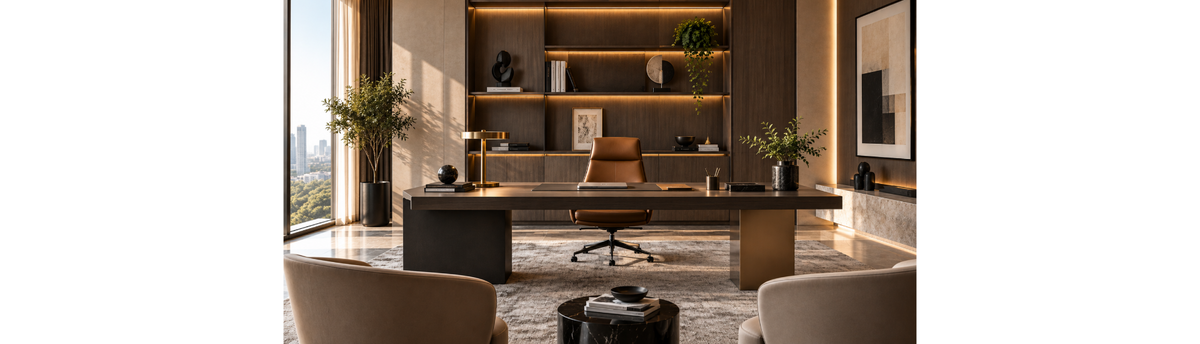

An executive office should feel considered without feeling decorated. The most successful spaces balance the authority of the room with the personality of the person using it, allowing the architecture, desk, seating, lighting and carefully selected office decor accessories to work together rather than compete for attention. In a luxury office, styling is therefore less about adding expensive objects and more about creating a coherent relationship between the architecture, furniture and decorative elements.
Styling an executive office is therefore less about adding more objects and more about creating a clear visual hierarchy. A substantial desk, a well-positioned artwork or sculpture, considered lighting and a small number of meaningful accessories can give a private office a sophisticated character while leaving enough negative space for the room to feel calm and functional.
For a broader understanding of the categories and principles behind luxury office decor accessories, explore Spacio's complete guide to styling a luxury office in India. This article focuses specifically on applying those principles to executive offices, director's cabins and private professional spaces.
Table of Contents
- Start With the Office Architecture
- Create a Clear Visual Hierarchy
- Make the Desk the Working Centre
- Use Wall Art and Sculptures With Intention
- Choose Lighting That Supports the Room
- Use Materials to Create Cohesion
- Add Personality Without Overdecorating
- Use Negative Space as Part of the Design
- Consider the Office From Different Viewpoints
- Where to Experience Luxury Office Decor in India
- Frequently Asked Questions
- Conclusion
Start With the Office Architecture
Before choosing decorative objects, look at the executive office as a complete architectural space. The position of the door, windows, built-in storage, feature walls, flooring, ceiling height and natural light all influence where visual emphasis should sit.
This is particularly important in a director's office or private executive cabin, where the furniture is often substantial and the room may contain several strong architectural elements. Accessories should respond to those elements rather than attempting to hide or compete with them.
A large blank wall may provide the right setting for artwork or a world map. A quieter shelf may allow a sculpture or decorative object to become a focal point. A well-proportioned side table can provide an opportunity for a smaller accessory without adding visual noise to the main desk.
Create a Clear Visual Hierarchy
Every executive office benefits from a visual hierarchy. There should be a clear sense of what the eye notices first, what supports that focal point and what remains deliberately quiet.
The desk may naturally become the principal element, while a statement artwork, sculpture or architectural feature provides a secondary point of interest. Smaller office accessories then act as supporting details rather than competing focal points.
In luxury executive office styling, this hierarchy is what separates a carefully curated room from one that simply contains expensive or decorative objects. The desk, artwork, sculpture, lighting and smaller office accessories should have different visual roles, with each element supporting the overall composition rather than demanding attention independently.
This hierarchy is especially useful when working with business and motivational sculptures. A sculpture can carry significant visual weight, so its position should be considered in relation to the desk, artwork, seating and available wall or floor space.
Make the Desk the Working Centre
The executive desk is both a functional workstation and an important part of the room's composition. It should therefore feel organised without becoming empty or excessively decorated.
Begin with the practical requirements of the desk and then introduce decorative elements around them. A small number of well-chosen objects can create a sense of completion without interfering with writing, meetings, screens or everyday work.
Office desk accessories can provide this balance particularly well when their scale and material relate to the desk itself. The objective is not to fill the desktop but to create a controlled arrangement in which functional and decorative elements belong together.
For larger executive desks, a single substantial object may have greater impact than several small accessories. On a more compact desk, quieter pieces with a smaller visual footprint can maintain the same sense of refinement without making the working surface feel crowded.
Use Wall Art and Sculptures With Intention
Artwork and sculpture can give an executive office personality, but their success depends on placement and scale as much as on the objects themselves. A large wall should not automatically be filled simply because there is available space.
Consider the relationship between artwork and the furniture below it. A statement piece positioned behind or near an executive desk can establish a strong backdrop, while a sculpture on a credenza, sideboard or shelf can introduce three-dimensional visual interest at a different level.
For offices where artwork forms an important part of the composition, office wall art collection can be considered alongside sculptures and other accessories. The important principle is to select the artwork according to the proportions and visual language of the room rather than treating the wall as an independent display area.
Choose Lighting That Supports the Room
Lighting affects how every other element in an executive office is perceived. It influences the atmosphere of the room, the appearance of materials and the visual emphasis given to artwork, furniture and decorative objects.
Where the architecture allows it, decorative lighting can become part of the styling composition rather than being treated only as a functional requirement. A sculptural light fitting can create a focal point, while more restrained lighting can allow artwork, materials or furniture to take precedence.
Office decorative lights can be considered as part of this wider composition. The choice should relate to the scale of the room, the furniture, the ceiling and the visual character already established by the architecture.
Use Materials to Create Cohesion
A sophisticated executive office does not need every object to be made from the same material. What matters is how the materials relate to one another.
Timber can provide warmth against metal, glass can introduce reflection, stone can add visual solidity and leather can bring softness to a furniture composition. Decorative accessories can then repeat or contrast these material qualities at a smaller scale.
For example, a darker timber desk may provide a strong foundation for a metal sculpture, while a glass or polished object can introduce a controlled reflective element. The relationship becomes more convincing when the materials appear elsewhere in the room rather than existing as isolated finishes.
This approach creates material cohesion without requiring visual uniformity. It also allows an executive office to feel collected and individual rather than assembled from a single matching set.
Add Personality Without Overdecorating
An executive office should usually reveal something about the person who uses it, but personality does not require a large collection of personal objects. A few carefully selected pieces can communicate interests, experiences, values or professional identity more effectively than a crowded display.
A globe, for example, can work naturally in an office where travel, international business or a sense of geography is relevant. Spacio's globes can introduce this sense of scale and exploration as a relatively contained decorative element, while a world map can create a larger visual statement on a feature wall. Both work particularly well when their visual language relates to the character of the executive office rather than being added simply to suggest status or travel.
Personalisation can also come through books, artwork, objects collected over time or a distinctive material. The strongest compositions allow these elements to feel as though they belong naturally to the person and the room.
Use Negative Space as Part of the Design
Negative space is not unused space. In executive office styling, it provides visual pauses between furniture, artwork and accessories and allows important objects to be appreciated without competition.
This becomes particularly important around a large desk, credenza or feature wall. If every available surface carries an object, the eye has nowhere to rest and even well-made pieces can lose their individual presence.
The same principle applies to functional decorative pieces such as an office clock. A clock can contribute to the visual composition of a wall, shelf or desk while retaining a practical role, but its presence should still be considered in relation to the surrounding artwork, furniture and available negative space.
Consider the Office From Different Viewpoints
An executive office is experienced from several positions, not from one carefully chosen photograph. Consider how the room looks when entering, sitting behind the desk, sitting opposite the executive and moving around the space during meetings.
An accessory that looks balanced from one viewpoint may feel dominant from another. A sculpture positioned beside the desk may work beautifully from the entrance but obstruct the visual relationship between the seating area and the desk.
Thinking about these viewpoints helps maintain both function and visual balance. It is particularly useful in private offices where conversations, meetings and individual work all take place within the same room.
Where to Experience Luxury Office Decor in India
For luxury office decor accessories, seeing scale, material, finish and visual impact in person can be particularly useful. This is especially relevant when selecting statement sculptures, desk accessories, decorative lighting, clocks or other pieces for an executive office, where proportion and visual weight need to work together.
Where can I see luxury office decor in Mumbai?
If you are looking to buy luxury office decor accessories in Mumbai and want to see the pieces in person before choosing them for an executive cabin, director's office, home office or professional workspace, visit the Spacio Mumbai store at 3BK, Laxmi Industrial Estate, New Link Road, Andheri (West), Mumbai 400 053. You can see office accessories, sculptures, decorative pieces, lighting and related collections and speak with the Spacio Interior Styling Team about your requirements.
Where can I experience luxury office decor in Kolkata?
If you want to see and experience luxury office decor in Kolkata before choosing pieces for an executive office, private study or professional workspace, visit the Spacio Kolkata store at 86B, Topsia Road South, Kolkata 700 046. The showroom brings together office accessories, sculptures, lighting, clocks and other decorative pieces, allowing you to consider their scale, proportion, material and finish in person while discussing your requirements with the Spacio Interior Styling Team.
Frequently Asked Questions
How do you style an executive office without making it look cluttered?
Start with the architecture and major furniture, establish one or two clear focal points and then add a limited number of accessories with appropriate scale. Negative space should remain part of the composition so that important objects are not competing for attention.
What should be the focal point in an executive office?
The focal point depends on the architecture and furniture. It may be the executive desk, a feature wall, artwork, a sculpture or another strong architectural element. The important point is to establish a clear hierarchy rather than allowing several objects to compete equally.
How can I make a professional office feel more personal?
Introduce a small number of objects that relate to the person using the office, such as artwork, books, a globe, a world map, a sculpture or meaningful decorative pieces. Personalisation works best when it feels integrated with the room rather than displayed as a collection of unrelated objects.
Are sculptures suitable for executive office decor?
Yes. Sculptures can work particularly well in executive offices because they introduce form, visual weight and personality. Their scale and placement should be considered in relation to the desk, seating, walls and other major elements in the room.
Should an executive office have decorative lighting?
Decorative lighting can be useful when it contributes to the overall composition of the room. A sculptural light can become a focal point, while a quieter fitting may support artwork, furniture or architectural features without competing with them.
Can a fireplace work in an executive office?
Yes. A fireplace can form part of an executive office or private professional interior when the room and architectural design support it. In that situation, surrounding furniture, artwork and office decor accessories should be styled in relation to the fireplace rather than treating it as a separate element.
Where can I see luxury office decor accessories in Mumbai?
You can visit the Spacio Mumbai store at 3BK, Laxmi Industrial Estate, New Link Road, Andheri (West), Mumbai 400 053, where you can explore relevant collections in person and discuss your requirements with the Spacio Interior Styling Team.
Where can I see luxury office decor accessories in Kolkata?
You can visit the Spacio Kolkata store at 86B, Topsia Road South, Kolkata 700 046, where you can experience relevant office decor collections and discuss your workspace requirements with the Spacio Interior Styling Team.
Conclusion
A sophisticated executive office is not created by filling the room with expensive objects. It comes from understanding the relationship between architecture, furniture, lighting, materials and decorative accessories, then allowing each element to perform a clear role.
The strongest office styling usually begins with the largest elements: the architecture, desk, seating and primary visual features. Accessories then add personality, texture and visual interest through considered placement, appropriate scale and enough negative space to let the composition breathe.
For a broader look at how office accessories, sculptures, wall art, clocks, decorative lighting, globes and world maps can be selected for professional interiors, explore Spacio's complete guide to luxury office decor accessories in India.
For an executive office, luxury office decor accessories are most effective when they are selected as part of the room's overall design rather than as isolated decorative purchases. Office desk accessories, sculptures, wall art, clocks, decorative lighting, globes and world maps can each contribute differently to the composition, depending on the architecture, function and personality of the workspace.
To continue exploring pieces that can support an executive office composition, discover Spacio's office accessories collection and related office decor categories.


