
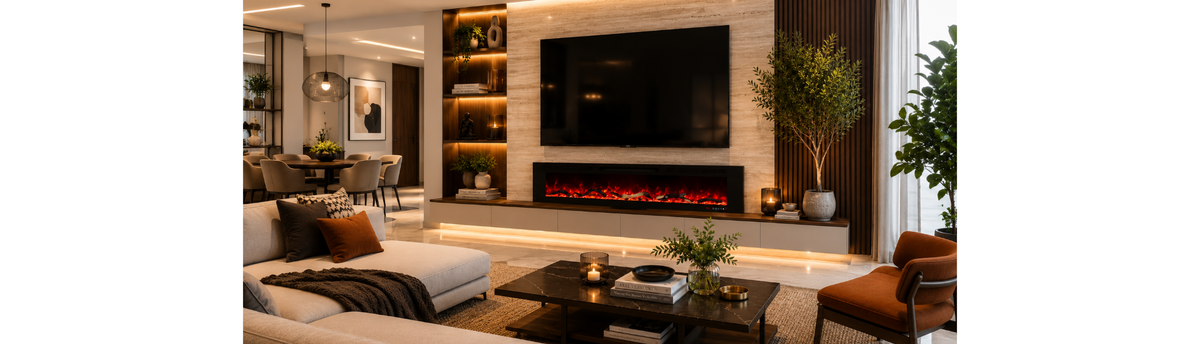

Choosing a luxury fireplace for an Indian home is no longer simply a question of selecting a mantel, a hearth or a source of heat. The modern fireplace can be a genuine architectural feature, an ambience-led design element, a sculptural focal point or an integrated part of a television and media wall. The right choice depends on what the fireplace is expected to do, how the room is used, what the architecture permits and which fire technology best suits the space.
Today, homeowners, architects and interior designers can choose between real-flame and artificial-fire technologies, heating and non-heating systems, built-in and freestanding formats, linear and multi-sided designs, and installations intended for interiors or outdoor environments. For Indian homes, the decision becomes even more nuanced because climate, air-conditioning, room size, available infrastructure and the desired experience of fire can vary dramatically from one project to another.
Spacio's Luxury Home Decor Accessories: A Complete Guide for Modern Indian Homes established how carefully selected objects can become part of the architecture and visual language of a room. A fireplace takes that principle further. It can become one of the strongest elements in the room, which is why its technology, proportions, position and relationship with furniture, lighting and decorative accessories need to be considered together.
This guide explains how to choose a luxury fireplace in India, from understanding real flame and artificial fire to comparing wood-burning, gas, bioethanol, electric, water vapour and holographic technologies. It also looks at fireplace placement around televisions, climate, architecture, Vastu, installation, maintenance and the questions that homeowners and design professionals should answer before making a major fireplace decision.
Table of Contents
- What Is a Fireplace Today?
- Why “Fireplace” Is No Longer a Single Category
- The First Decision: What Do You Want the Fireplace to Do?
- Real Flame vs Artificial Flame Fireplaces
- Heating vs Non-Heating Fireplaces
- Understanding Fireplace Technologies
- Modern Fireplace Taxonomy
- Built-In, Freestanding, Linear and Multi-Sided Fireplaces
- Indoor vs Outdoor Fireplaces
- Fireplaces Around TVs and Media Walls
- Fireplaces as Architecture
- Where Are Fireplaces Used in Indian Homes?
- Why Fireplace Selection in India Requires a Different Approach
- How Climate Should Influence the Fireplace Decision
- Fireplaces and Vastu in Indian Homes
- What to Consider Before Installing a Fireplace
- Maintenance and Long-Term Ownership
- What Architects and Interior Designers Should Establish
- Where Spacio Fits into the Fireplace Decision
- Where to Buy Luxury Fireplaces in India
- Luxury Fireplaces Across Indian Cities
- Why Fireplace Selection Requires More Than a Product Catalogue
- The Final Selection: Match the Fireplace to the Home
- Frequently Asked Questions
- Final Thoughts
What Is a Fireplace Today?
A fireplace is fundamentally a designed system for introducing fire, a representation of fire, heat or a combination of these experiences into an interior or exterior environment. Historically, the fireplace was closely associated with combustion and heating. In contemporary interiors, however, its role has expanded considerably, and a fireplace may be selected primarily for atmosphere, architectural presence or visual interest rather than for thermal performance.
This distinction is particularly important in India. A fireplace in a cold-weather villa may be expected to provide meaningful heat, while a fireplace in a Mumbai apartment may be intended primarily as an architectural feature that can be enjoyed throughout the year without adding unwanted heat. A large farmhouse in a cooler region may require a genuine flame, whereas a compact urban apartment may benefit from an artificial fireplace integrated into a television wall.
The modern category therefore includes systems that burn wood, gas or bioethanol as well as technologies that create an artificial fire experience through electricity, LED effects, water vapour, digital projection or optical effects. Spacio's fireplace collection brings these different approaches together, allowing the selection to begin with the requirements of the project rather than assuming that one fireplace technology is suitable for every home.
Fire Is Now an Architectural Experience
The biggest change in modern fireplace design is that fire no longer has to sit inside a traditional chimney breast with a mantel above it. It can become a long linear feature beneath a television, appear within a room divider, occupy one side of a media wall or become part of a larger architectural composition. It can also be freestanding, suspended or incorporated into a bespoke interior in ways that would have been difficult to achieve with a conventional hearth.
For this reason, the fireplace should be considered at the same stage as other major architectural decisions. Wall proportions, television placement, cabinetry, stone or timber finishes, electrical infrastructure, ventilation, lighting and furniture sightlines may all be affected by the choice.
Why “Fireplace” Is No Longer a Single Category
Searching for a “fireplace” today can lead to products designed for completely different purposes. A wood-burning fireplace, an indoor gas fireplace, a bioethanol fire, an electric fireplace, a water vapour fireplace and a holographic fireplace may all create a fire-like focal point, but they differ fundamentally in how the fire is produced, whether combustion occurs, whether heat is generated, what infrastructure is required and how the system is installed.
Even within artificial fire, there are meaningful differences. An electric fireplace using LED effects does not create the same visual experience as a water vapour fireplace, and a holographic or digital system uses another method again. The useful question is therefore not simply “Which fireplace looks best?” but “Which technology creates the right fire experience for this room and this project?”
This is also why the term fake fireplace needs context. People often use “fake fireplace” to describe any fireplace without a conventional burning flame, but the phrase covers a broad range of technologies. A high-quality artificial fireplace can be deliberately designed around flame movement, depth, reflected light, media and architectural integration; it should not automatically be understood as a decorative imitation with no design sophistication.
For homeowners researching artificial options, Spacio's existing guide, How to Choose an Artificial Fireplace for Your Home, provides a useful companion to this broader category guide. The distinction is important because “artificial” describes how the fire experience is created, not whether the resulting interior has to look artificial.
Do not choose a fireplace by technology name alone. First establish whether you need genuine flame, heat, visual fire or simply ambience; then evaluate which technology can deliver that experience within the architecture and conditions of the room.
The First Decision: What Do You Want the Fireplace to Do?
The most reliable way to begin choosing a fireplace is to define its job. This sounds obvious, but it prevents one of the most common mistakes in fireplace selection: choosing a visually attractive model before understanding the role it needs to perform. A fireplace intended to heat a winter retreat has a very different brief from one intended to create an elegant focal point in an air-conditioned Mumbai living room.
Begin by identifying whether the primary requirement is heat, genuine flame, ambience, architectural impact or a combination of these. If heating is essential, the thermal output and fuel technology need to be considered alongside the room size and climate. If ambience is the priority, technologies that create visual fire without conventional combustion may provide greater flexibility. If the fireplace is intended to become a major architectural feature, its format and dimensions may be just as important as the technology itself.
The room's lifestyle also matters. A family living room, formal drawing room, bedroom, home theatre, bar and den, library, executive study and hospitality lounge each create different expectations. The fireplace may need to remain visible from multiple seating positions, work beneath a television, coexist with a projector screen, or become part of a room divider.
If Genuine Fire Is the Priority
When the experience of an actual flame is central to the brief, real-flame technologies deserve consideration. Wood-burning fireplaces provide the traditional relationship between flame, fuel and hearth, while gas and bioethanol can offer different forms of genuine fire suited to contemporary applications. Each technology has its own installation, fuel, ventilation, clearance and maintenance considerations, so “real flame” should never be treated as a complete specification by itself.
Spacio's indoor bioethanol fireplace collection, indoor gas fireplace collection and indoor wood-burning fireplace collection provide distinct starting points for exploring genuine-flame applications.
If Ambience Is the Priority
When the purpose is to create the visual and emotional presence of fire rather than substantial room heating, artificial fireplace technologies become especially relevant. This is often the more appropriate direction for warm Indian cities, air-conditioned interiors and rooms where adding continuous heat would work against the comfort of the space.
Water vapour, LED electric and holographic or digital fireplaces can create different versions of an artificial fire experience without requiring conventional wood combustion. The important distinction is that these technologies should be evaluated for their actual visual qualities, installation requirements and intended use rather than grouped together simply because they do not rely on a traditional burning fire.
Spacio's indoor artificial water vapour fireplace collection is particularly relevant where the visual character of fire is required without conventional combustion, while the indoor artificial LED fireplace collection provides another technology-led approach. For a more digital interpretation, the holographic fireplace collection explores a different method of creating the appearance of fire.
If Fire, Heat and Ambience All Matter
Some projects require a more complete fireplace experience. A large villa in a colder region, for example, may want a genuine flame, meaningful heat and a strong architectural focal point. In such cases, the fireplace has to satisfy the thermal requirement while also working with the architecture and visual language of the interior.
The key is to avoid allowing one requirement to dominate the others. A fireplace that provides substantial heat may not have the visual proportions required for the wall. A visually spectacular fireplace may not provide the required thermal performance. A technically appropriate system may still be unsuitable if its installation requirements were not incorporated into the architectural design early enough.
| If your priority is... | Technologies worth exploring |
|---|---|
| Genuine flame and heat | Wood-burning, gas or appropriate bioethanol systems |
| Genuine flame with contemporary flexibility | Gas or bioethanol, subject to project requirements |
| Visual fire without conventional combustion | Electric, water vapour or digital/holographic systems |
| Ambience without additional heat | Water vapour, selected electric or digital systems |
| A major architectural focal point | Linear, built-in, multi-sided or room-divider formats |
| Flexible ambience | Selected freestanding or portable formats |
This is a starting framework rather than a substitute for product-specific technical evaluation. The final choice depends on the particular model, room, climate, installation conditions, available infrastructure and manufacturer requirements.
Navin Kanodia approaches fireplace selection from the intersection of interior styling, architecture and product expertise. His work at Spacio has covered artificial fireplaces, electric fireplace applications, water vapour technology, fireplaces integrated below televisions, Vastu considerations and wood-burning fireplaces. His consistent principle is that a fireplace should be selected as part of the architecture and lifestyle of the space, rather than treated as an isolated decorative purchase.
Real Flame vs Artificial Flame Fireplaces
The distinction between real and artificial flame is one of the most important branches in the modern fireplace category. It should not, however, be reduced to a simplistic choice between “authentic” and “fake”. Both approaches can be appropriate for luxury interiors; the correct choice depends on what the project requires the fireplace to achieve.
Real Flame Fireplaces
Real-flame fireplaces use combustion, with wood, gas and bioethanol representing important categories. The attraction is the physical presence of flame and the naturally changing relationship between fire, surrounding materials and reflected light. For homeowners who specifically want the sensory character of genuine fire, this can remain an important part of the design brief.
Real flame also introduces greater technical responsibility. The fireplace must be considered according to its fuel, installation method, ventilation requirements, clearances, fuel storage or supply and the manufacturer's specifications. A gas fireplace is not installed in the same way as a wood-burning fireplace, and a bioethanol system has its own operating considerations.
This is why genuine flame should be considered alongside architecture from the beginning. If a project requires a chimney, flue, gas connection, ventilation or specific clearances, these requirements can influence the wall construction and interior layout well before the fireplace itself is installed.
Artificial Flame Fireplaces
Artificial fireplaces create the visual experience of fire without relying on conventional wood combustion. Depending on the technology, they may use LED effects, water vapour, projection or other optical and digital methods. Their principal advantage in many Indian interiors is the ability to separate the visual presence of fire from the thermal requirements of a traditional fireplace.
This can be particularly useful in apartments, bedrooms, living rooms, media rooms and contemporary homes where the homeowner wants a fireplace as a design feature but does not necessarily want continuous heat. It can also create greater flexibility when the fireplace is being integrated into a television wall or another highly designed architectural composition.
However, artificial does not mean that every system looks or behaves in the same way. Flame movement, apparent depth, colour, media, reflections, light interaction and viewing distance all affect the quality of the visual experience. A sophisticated artificial fireplace therefore deserves to be evaluated as a piece of design technology, not simply categorised as a “fake fireplace”.
For homeowners comparing these approaches, Spacio's Water Vapour vs LED Electric Fireplaces: Choosing the Right Technology for Indian Homes provides a more focused comparison of two important artificial-fire technologies.
Heating vs Non-Heating Fireplaces
One of the most important decisions for an Indian project is whether the fireplace is actually required to heat the room. The answer can radically change the technology that makes sense. In a cold climate, heat may be a functional requirement. In a warm or predominantly air-conditioned environment, heat can become an unwanted by-product rather than a benefit.
This is why a non-heating fireplace can be an entirely rational luxury-interior choice. A homeowner may want the visual rhythm of fire beneath a television, the atmosphere of a glowing feature in a bedroom or the architectural character of a fireplace in a lounge without changing the room's thermal comfort.
Water vapour systems are particularly relevant to this conversation because they are designed around visual fire rather than conventional combustion. Selected electric and digital systems can also provide visual ambience, with individual models differing in whether optional heating is available. The technical specification of the particular fireplace should always be checked rather than assuming that every electric or artificial system behaves identically.
Why This Matters in Indian Homes
India contains dramatically different climates, from cold northern winters to warm and humid coastal environments. Even within one city, the requirements of a naturally ventilated villa can be very different from those of a centrally air-conditioned apartment. The fireplace therefore needs to be selected according to the room's actual environmental conditions rather than according to an assumption that every fireplace should function as a heater.
This is one reason the idea of a fireplace has expanded so successfully into contemporary Indian interior design. Fire can now be experienced as atmosphere and architecture even where traditional heating is unnecessary. A non-heating fireplace can remain visually relevant through the year rather than becoming a seasonal feature used only when temperatures fall.
The right question is therefore not simply “Does this fireplace produce heat?” but “Do I need this fireplace to produce heat?” That distinction can prevent an unnecessarily complex installation while opening up a much broader range of design possibilities.
How to Choose the Right Fireplace for an Indian Home
Choosing a luxury fireplace begins with a more important decision than appearance: understanding what role the fireplace needs to play in the room. In an Indian home, that role can range from providing genuine heat in a cooler environment to creating the visual movement and atmosphere of fire without adding heat at all. The right choice therefore depends on climate, room size, architecture, ventilation, installation possibilities, maintenance expectations and the way the fireplace will be experienced.
For a contemporary apartment, an electric or water vapour system may make more sense than a traditional wood-burning fireplace. In a large villa or a project where genuine flame and heat are central to the brief, bioethanol, gas or wood-burning systems may be considered instead. A fireplace may also be selected primarily as an architectural feature, particularly when it forms part of a TV wall, media wall, room divider or other major focal point.
This is why the question should not simply be which fireplace looks best? A better starting point is: what do you want the fireplace to do, where will it be installed, and how should it interact with the architecture? Once those decisions are clear, the appropriate technology and format become much easier to identify.
Heat or Ambience: What Do You Actually Need?
The first distinction is between a fireplace selected primarily for heating and one selected primarily for visual ambience. This distinction is particularly important in India because climate varies considerably between regions. A fireplace in a colder hill environment may have a very different brief from one installed in a Mumbai apartment, where the homeowner may want the character of fire without introducing additional heat into the room.
Real-flame systems can provide genuine fire and, depending on the technology and specification, useful heat. Artificial fireplaces can instead prioritise the visual experience. Water vapour systems, LED electric fireplaces and selected digital or holographic systems can create a fire-like effect without requiring the room to be treated as though it were accommodating a conventional wood-burning hearth.
This makes fake fireplace an important search term in the modern fireplace category, although the phrase can encompass very different technologies. A fake fireplace may refer to an artificial flame effect, an electric fireplace, a water vapour fireplace or another system designed to reproduce the appearance of fire without a traditional fuel-burning fire. The important distinction is not whether the fireplace is described as artificial, but how convincingly it achieves the intended visual effect and whether its installation requirements suit the room.
Spacio's fireplace collection brings together different approaches to the category, allowing the choice to follow the architectural and lifestyle requirements of the project rather than forcing every interior into one fireplace format.
Consider the Architecture Before the Fireplace
A fireplace should be considered at the architectural planning stage whenever possible. Its dimensions, depth, ventilation requirements, fuel or power source, surround and position can influence the wall construction, furniture arrangement and even the proportions of the room. Retrofitting a fireplace after every other design decision has already been made can unnecessarily restrict the possibilities.
This becomes particularly important with a fireplace integrated into a TV feature wall. The television, fireplace, wall finish, storage, lighting and surrounding furniture need to be understood as one composition. A linear fireplace below a TV can create a strong horizontal element beneath the screen, while a fireplace beside TV positioning can create an asymmetrical composition when the architecture allows it.
The same principle applies to a fireplace in a media room or fireplace in a home theatre. The screen or projector remains the primary viewing element, so the fireplace needs to complement rather than compete with it. Where a projector is used, a fireplace below a projector screen can form part of the lower architectural composition, provided the proportions and sightlines are properly considered.
For a broader understanding of how a fireplace can become part of a room's architectural composition, the complete guide to luxury fireplaces in India can be used as the central reference point for the category.
Built-In, Freestanding or Architectural?
The physical format of a fireplace can be as important as its technology. Built-in fireplaces are often chosen when the fire is intended to become part of a wall, TV unit, media wall or other architectural feature. Freestanding fireplaces offer greater flexibility and can sometimes be treated almost like furniture or a sculptural object within the room.
Linear fireplaces are especially effective when a strong horizontal line is desirable. They can sit beneath a television, within a long feature wall or across a substantial architectural composition. A taller or more compact fireplace may instead work better where the room requires vertical emphasis or where wall width is limited.
The choice should therefore follow the room rather than a trend. A large fireplace does not automatically make a room more luxurious, and a compact fireplace does not necessarily feel insignificant. What matters is whether the proportions of the installation make sense in relation to the wall, furniture, ceiling height and viewing distance.
Do not choose the fireplace before deciding its architectural role. First establish whether it is meant to provide heat, create ambience, anchor a TV or media wall, divide a space or become a standalone focal point. The technology and format should follow that decision.
Real Flame or Artificial Fireplace?
The choice between real and artificial fire is ultimately a choice between different experiences, practical requirements and architectural possibilities. A genuine flame has qualities that cannot be reduced to an image: real combustion, natural movement, changing light and the sensory presence of fire. Artificial systems approach the experience differently, often prioritising flexibility, visual realism, ease of integration or the ability to enjoy fire without conventional combustion.
For homeowners considering a real flame, the specification needs to account for the fuel source, ventilation, installation, safety requirements, maintenance and the particular manufacturer's instructions. Wood-burning fireplaces require an entirely different architectural and operational approach from electric or water vapour systems. Gas and bioethanol introduce their own considerations as well.
Artificial systems can be particularly useful when the visual role of the fireplace matters more than traditional heating. A water vapour fireplace can create a moving flame effect through illuminated vapour, while an LED electric fireplace uses light to create its visual effect. Digital and holographic systems approach the experience through image, projection or other visual technologies.
There is therefore no single answer to whether a real fireplace or a fake fireplace is better. The better question is which technology gives the room the experience it needs while remaining appropriate to its architecture and intended use.
The Fireplace and TV Relationship
One of the most important applications to consider in contemporary Indian homes is the relationship between a fireplace and television. The television is already a major visual object, and simply placing a fireplace underneath it does not automatically produce a successful composition.
A well-designed fireplace below TV arrangement considers the width of both elements, the wall surrounding them, the furniture facing the composition and the viewing height. A linear fireplace can provide a horizontal counterpoint to the rectangular screen, particularly when the fire feature extends beyond the width of the television.
There are also situations where a fireplace around TV can be more architecturally interesting than a simple fireplace-under-TV arrangement. Stone, timber, plaster, metal or another wall treatment can frame the two elements as a single feature rather than making the fireplace appear to have been added below an existing television unit.
A fireplace beside TV can work when the wall is sufficiently wide to accommodate an asymmetrical composition. This allows the television to remain on one side while the fireplace provides a secondary vertical or horizontal anchor. The success of the arrangement depends heavily on the furniture orientation and the visual weight of the surrounding architecture.
The same thinking applies to a fireplace + TV in a living room, where the objective should be to make the media wall part of the interior rather than allowing the technology to dominate the room.
For apartments and warm-climate homes where the fireplace is often desired for ambience rather than heating, indoor water vapour fireplaces can be considered as one of the artificial-fire approaches. The appropriate choice, however, should always follow the specific installation requirements and manufacturer's specifications.
What About Vastu When Placing a Fireplace?
For Indian homeowners, Vastu can form part of the fireplace-planning conversation, particularly when the fireplace is being incorporated into a new home or major renovation. The important point is to treat Vastu as one consideration within the wider design and architectural decision-making process rather than trying to force a fireplace into a location that does not work for the room.
Questions around direction, placement and the relationship between fire and other elements of the home should be considered before the final location is fixed. This is especially relevant when the fireplace is being integrated into a TV wall, feature wall or room divider because moving the fireplace later may involve substantial architectural changes.
Spacio's guide to Vastu corrections with a fireplace in India explores the subject specifically from the perspective of fireplace placement. It is a useful companion resource when Vastu is part of the brief.
From an interior-styling perspective, the best approach is to resolve the practical and spatial requirements first, then ensure that the final placement also aligns with the Vastu principles being followed for the project.
Understanding the Different Types of Luxury Fireplaces
The term luxury fireplace covers a wide range of technologies and formats, and understanding the differences is essential before making a selection. A fireplace may be wood-burning, gas, bioethanol, electric, water vapour or another form of artificial fire. Each creates a different combination of flame, heat, installation requirements, maintenance and visual character. The right choice depends less on which technology is considered most luxurious and more on which one is appropriate for the architecture, climate and intended experience of the space.
For Indian interiors, this distinction is particularly important because a fireplace is increasingly being specified as an architectural and decorative element rather than solely as a source of heat. In a contemporary apartment, for example, the homeowner may want the visual warmth of a fire within a living-room feature wall without requiring a chimney or introducing significant additional heat. In a large villa, mountain residence or expansive entertainment room, genuine flame and heat may be central to the brief. In an executive study, library or den, the fireplace may instead be selected primarily to establish atmosphere and visual authority.
Wood-Burning Fireplaces
Wood-burning fireplaces represent the traditional idea of a fireplace, with a genuine wood fire providing both flame and heat. Their appeal lies in the sensory experience as much as the appearance: the movement of a natural flame, the sound of burning wood and the changing light contribute to an atmosphere that is difficult for artificial systems to reproduce exactly.
However, a traditional fireplace requires substantially more architectural planning than many contemporary alternatives. The chimney, flue, ventilation, combustion requirements, hearth, clearances and ongoing maintenance all need to be addressed as part of the design. Smoke, ash, soot and the need to store and handle fuel also make wood-burning fireplaces less suitable for some urban homes and apartments.
For this reason, a wood-burning fireplace should be considered only when the building and project brief can genuinely accommodate it. It is not simply a decorative object that can be installed on any wall. Its architectural and technical requirements need to be resolved before the surrounding interior is finalised.
Gas Fireplaces
Gas fireplaces offer another form of genuine flame while providing a different operational experience from wood-burning systems. They can be incorporated into contemporary architectural compositions and can be particularly effective when the designer wants a controlled linear flame within a substantial feature wall.
The installation, fuel supply, ventilation and safety requirements depend on the specific system and must be addressed according to the manufacturer's specifications and applicable local requirements. The visual advantage is that the fireplace can often be designed with a cleaner architectural expression than a traditional wood-burning hearth.
For a luxury interior, the surrounding architecture remains just as important as the technology. A gas fireplace set within stone, marble, timber, plaster or another carefully selected finish can become an integral part of the wall rather than appearing like an appliance added to it.
Bioethanol Fireplaces
Bioethanol fireplaces use a liquid fuel to create a genuine flame without the conventional chimney arrangement associated with a wood-burning fireplace. Their flexibility has made them an interesting option for contemporary interiors where the visual and atmospheric experience of a real flame is desired but the architecture may not suit a traditional chimney.
Because bioethanol is still a fuel-burning system, it should never be treated as equivalent to an electric or purely visual fireplace. Installation, fuel handling, ventilation, positioning, clearances and operating procedures remain important. The specific product and manufacturer's instructions should determine how and where the system is used.
From an interior perspective, bioethanol can be particularly effective in spaces where the flame itself is intended to become a sculptural feature. A long horizontal flame can reinforce the proportions of a contemporary wall, while a more compact installation can provide a concentrated focal point in a study, den or lounge.
Electric Fireplaces
Electric fireplaces are often selected when the visual character of fire is more important than traditional combustion. They can be incorporated into contemporary interiors with relatively greater flexibility than wood-burning systems, although the exact installation requirements still depend on the product.
One of their strongest applications is the modern media wall. An electric fireplace can be positioned beneath a television, within a built-in wall or as part of a larger entertainment composition. Because the fireplace does not have to compete with the operational requirements of a conventional chimney, designers can focus more closely on the relationship between the fire, screen, storage and architectural finishes.
The quality of the visual effect matters, however. Not every electric fireplace creates the same level of realism or refinement. Flame movement, lighting, media, proportions, glass treatment and the overall construction of the unit all influence whether the finished installation feels like a considered architectural feature or simply an appliance.
Water Vapour Fireplaces
Water vapour fireplaces have become particularly relevant to contemporary luxury interiors because they approach the visual experience of a flame without relying on conventional combustion. The effect is created through illuminated water vapour, producing a moving flame-like appearance that can be incorporated into a range of architectural settings.
This makes a water vapour fireplace an interesting option for homes where genuine fire and heat are not necessary but the homeowner still wants the presence of a fireplace. It can work particularly well in warm climates, apartments, entertainment spaces and modern living rooms where a traditional wood-burning or gas fireplace would be unnecessarily complex.
Spacio's indoor artificial water vapour fireplace collection is relevant to this particular category, where the visual presence of fire becomes part of the interior without requiring the same type of combustion-based installation as a conventional fireplace.
It is worth making an important distinction here. A water vapour fireplace is an artificial fireplace, but artificial does not necessarily mean visually inferior or temporary. In a luxury interior, the value lies in how convincingly the technology integrates with the architecture and how successfully it creates the intended atmosphere. This is why the term fake fireplace, although widely used in search behaviour, should not automatically be interpreted as meaning a low-quality decorative imitation.
Fake Fireplaces and Artificial Fireplaces
People searching for a fake fireplace may be looking for very different solutions. Some may want a decorative fireplace with no flame at all. Others may want an electric fireplace with a realistic flame effect, while another homeowner may specifically be looking for a water vapour system. The phrase therefore describes a broad search category rather than one particular technology.
For luxury interiors, the distinction should be made according to the quality of the experience. An artificial fireplace can be highly sophisticated when its flame effect, materials, glass, controls and architectural integration have been carefully considered. It can also offer an important practical advantage in environments where a genuine combustion system would not be appropriate.
The decision should therefore be based on the desired outcome rather than the label. If the objective is a visually convincing focal point for a feature wall, an artificial fireplace may be exactly the right solution. If the objective is genuine heat and the sensory experience of real fire, a combustion-based fireplace may be more appropriate.
How to Choose the Right Fireplace Size
Fireplace size should always be judged in relation to the architecture. A fireplace that appears substantial in a product image may feel surprisingly small once installed within a large wall, while an oversized fireplace can overwhelm a compact room. The dimensions of the wall, ceiling height, furniture, television or artwork and the distance from which the fireplace will be viewed all contribute to the perceived scale.
A useful starting point is to consider the wall as a whole rather than measuring only the available opening. If the fireplace forms the centre of a feature wall, its width should have a meaningful relationship with the elements around it. A narrow linear fireplace may work beautifully within a broad architectural composition when it is intentionally framed by stone, timber or another material. The same fireplace can feel lost if it is simply placed on an oversized blank wall without sufficient supporting structure.
The furniture arrangement should also be considered. A fireplace viewed from a deep sectional sofa needs enough visual presence to remain legible from the principal seating position. A fireplace in a smaller study may need much less physical scale because the viewer encounters it at closer range. In hospitality or commercial interiors, where people may experience the feature from several metres away, the visual scale can need to be considerably stronger.
Proportion matters just as much as absolute dimensions. A long horizontal fireplace can reinforce a wide wall, while a more compact or vertically expressed fireplace can work where the architecture calls for greater height. The objective is not to make the fireplace as large as possible, but to make it feel as though it belongs naturally to the room.
Choosing a Fireplace for the Space
For a contemporary living room: Consider whether the fireplace should become the principal focal point or work alongside a television, artwork or other architectural feature.
For a luxury den or study: A fireplace can create atmosphere and visual warmth while working with bookshelves, sculptures, artwork and other collected objects.
For a home theatre: Keep the viewing experience primary. A fireplace, wall art or serving trolley can provide a sophisticated secondary layer without competing with the screen.
For an executive office: The fireplace should reinforce the architecture and character of the room rather than making the workspace feel overly residential.
For hospitality and commercial interiors: Consider viewing distance, traffic, maintenance, durability and the way the feature will be experienced from multiple directions.
Choosing Materials and Finishes Around a Fireplace
The fireplace itself is only one part of the final composition. The material surrounding it can determine whether the installation feels architectural, decorative, traditional or contemporary. Stone, marble, timber, metal, plaster, concrete, ceramic and other finishes can each produce a very different relationship with the flame or artificial fire effect.
Natural stone and marble can create a substantial architectural presence, particularly when the fireplace forms the centre of a large feature wall. Their natural variation can provide enough visual interest that the surrounding accessories should remain relatively restrained. Timber can introduce warmth and soften a contemporary composition dominated by hard surfaces, while metal can reinforce a more industrial or sculptural language.
Minimal plaster or painted finishes can create a quieter background, allowing the fire itself to become the hero. This can be particularly effective with a linear fireplace, where the simplicity of the surrounding surface emphasises the horizontal flame line.
Glass also deserves consideration, particularly when the fireplace is positioned within a contemporary interior. Transparent or reflective surfaces can connect the fireplace visually with the surrounding architecture while allowing light from the flame to become part of the material experience.
The same principle applies to decorative objects around the fireplace. A sculptural object, vase, bowl or art piece should not simply be chosen because it is attractive. Its material, scale and silhouette should relate to the fireplace surround and the larger composition. Spacio's Sculptures & Art Objects collection offers a broader selection of sculptural forms that can be considered when a fireplace is being treated as part of a curated interior rather than as an isolated appliance.
For transparent and reflective materiality, Spacio's Murano Glass Sculptures can introduce another layer of colour, light and craftsmanship. The objective is not to decorate the fireplace with multiple objects, but to select pieces that reinforce the material story of the space.
Styling a Fireplace in the Living Room
The living room is one of the most common settings for a luxury fireplace because it allows the fire to become part of the social and visual centre of the home. However, the fireplace does not necessarily need to sit in the middle of the room or dominate every other element. Its position should be determined by the architecture, seating arrangement, primary sightlines and the other focal points already present.
In a contemporary living room, the fireplace can form part of a larger feature wall with a television, artwork, storage or architectural panelling. In a more traditional setting, it may be framed by a mantel, artwork and carefully selected decorative objects. In either case, the most sophisticated result usually comes from treating the entire wall as one composition.
A console, sideboard or low cabinet can sometimes provide the horizontal element needed to connect the fireplace wall with the furniture in the room. Decorative accessories placed on these surfaces can then create a transition between the vertical architecture and the lower furniture plane. A vase can introduce height, a sculptural object can create a secondary focal point and a bowl or tray can provide a lower visual layer.
However, the fireplace should not become an excuse to overdecorate the room. If the fireplace surround already has strong stone veining, dramatic proportions or a substantial architectural frame, additional objects may need to be limited. Luxury comes from the quality of the composition, not from the number of accessories placed around it.
Fireplaces in Dens, Studies and Libraries
A fireplace can have an especially strong presence in a den, study or private library because these environments naturally lend themselves to a more layered and collected aesthetic. Bookshelves, leather or upholstered seating, wood finishes, artwork, sculptures and personal objects can create a setting in which the fireplace feels integrated into the character of the room.
In a library, the fireplace can provide a visual pause within a larger wall of books. It can sit between shelving, beneath artwork or within a central architectural bay. The surrounding objects should be selected with restraint because books already contribute considerable visual rhythm. One exceptional sculpture or vase can often create more impact than several smaller decorative objects.
In a den, the fireplace can be more expressive. A substantial sculptural fireplace wall can become a backdrop for entertaining, conversation or relaxed seating. Materials such as dark timber, stone and metal can create a more intimate atmosphere, while glass and reflective elements can introduce lightness.
The same principle can extend to executive studies and private workspaces. Here the fireplace should contribute to the character of the room without compromising the practical requirements of a working environment. Artwork, books, clocks, sculptures and other decorative objects can be layered around it, provided that the composition remains controlled.
Fireplaces in Home Theatres and Entertainment Spaces
A home theatre generally has a different design priority from a living room or den: the viewing experience comes first. There may therefore be relatively little scope for extensive decorative styling, but that does not mean the room cannot have a strong luxury identity.
A fireplace can become a particularly effective architectural statement when it is positioned away from the primary screen or integrated carefully into the lower part of a media wall. The objective should be to create atmosphere without introducing visual distraction. A linear fireplace beneath a screen can provide a controlled horizontal element, while a fireplace positioned on an adjacent wall can create a secondary focal point for the room.
Wall art can also contribute without overwhelming the space. A single large artwork or carefully selected sculptural composition can create visual interest in areas outside the main screen wall. A serving trolley can add another layer of functionality and character, particularly in an entertainment space intended for hosting.
This is one of the situations where a fireplace does not have to perform a traditional heating role. An artificial or water vapour fireplace can provide the visual presence of fire while allowing the room to remain focused on entertainment. As with any fireplace installation, the specific system's technical requirements should be considered before the architectural design is finalised.
Luxury Fireplaces in Offices, Hotels and Commercial Interiors
Fireplaces can also contribute to the identity of commercial and hospitality interiors. In an executive office, a fireplace can establish authority and warmth without making the room feel overly decorated. In a hotel lobby, lounge or private dining environment, it can become a memorable architectural focal point. In a restaurant, club or premium retail setting, the fireplace can contribute to atmosphere even when it is not intended to provide significant heat.
The requirements are different from those of a private residence. Commercial environments may experience considerably greater traffic and therefore require more attention to durability, access, maintenance, safety and the protection of surrounding materials. The fireplace also needs to work at multiple viewing distances and from different angles.
Material selection can help define the character of the environment. Metal can create a sharper contemporary expression, while wood can introduce warmth. Stone can provide architectural permanence, and glass can create a lighter, more contemporary visual effect. Decorative objects should then be selected to support that language rather than compete with it.
For projects where sculptural materiality forms an important part of the surrounding environment, Spacio's Metal Sculptures, Wood Sculptures and Porcelain & Ceramic Sculptures provide different material directions that can be considered alongside the fireplace architecture.
The important point is not to turn these collections into a checklist. A commercial fireplace does not need a metal sculpture, wood sculpture and ceramic object simply because all three are available. The material should be selected according to the architecture, atmosphere, scale and purpose of the specific project.
Choosing a Luxury Fireplace in India
India's regional differences make location an important consideration when selecting a fireplace. Climate, building typology, apartment versus villa living, availability of installation infrastructure and the intended role of the fireplace can all influence the decision. A homeowner in a cooler environment may prioritise genuine heat, while someone in a warmer metropolitan city may be looking primarily for ambience and architectural character.
For homeowners and designers looking for a fireplace in Cochin, the emphasis may be on integrating a fireplace into a sophisticated interior without allowing it to feel disconnected from the region's warmer climate and contemporary residential architecture.
Those looking for a fireplace in Mumbai may similarly consider artificial or low-maintenance systems for apartments and contemporary residences, where the architectural and visual role of the fireplace can be more important than conventional heating.
For a fireplace in Kolkata, the choice can range from a statement feature in a large residence to a more compact architectural installation in an apartment or private study. The fireplace should be selected in relation to the scale and character of the surrounding interior.
Similarly, a fireplace in Pune can become part of a living room, den, library or entertainment environment, with the final technology determined by the intended use, architecture and climate of the property.
For a fireplace in Surat, contemporary artificial systems can be considered where the homeowner wants the visual character of fire without making conventional heating the primary objective. The same architectural principles of scale, proportion and integration remain essential.
A fireplace in Ahmedabad can likewise be designed as part of a feature wall, living room, den or larger entertainment space. The most appropriate system should be determined by the specific project rather than by location alone.
Across all cities in India, the underlying principle remains the same: a luxury fireplace should be selected as part of the interior architecture. It should respond to the climate, room, installation conditions, visual hierarchy and lifestyle of the space rather than being treated as an isolated decorative purchase.
Choosing the Right Fireplace Format for the Architecture
Once the technology is understood, the next decision is the physical format of the fireplace. This is where a fireplace stops being simply an appliance or fire source and becomes part of the architecture. The same technology can create very different results depending on whether it is installed as a long linear feature, built into a TV wall, placed within a traditional mantel, used as a room divider or specified as a freestanding statement.
For a luxury interior, format should therefore follow the architecture rather than the other way around. The available wall width, ceiling height, furniture arrangement, viewing distance, circulation, structural conditions and intended focal point all influence which format will look and function correctly. A long, low fire can emphasise the horizontal character of a contemporary living room, while a taller installation may work more naturally within a double-height space or a vertically proportioned architectural composition.
Linear Fireplaces
A linear fireplace is particularly effective when the objective is to create a strong horizontal architectural line. Its elongated proportions can sit naturally beneath a television, within a feature wall or along a substantial wall in a living room, lounge or entertaining area. The format also works well when the designer wants the fire to occupy a significant visual width without introducing a bulky mantel or traditional hearth.
The proportions should nevertheless be determined by the complete wall composition. A fireplace that is excessively narrow can look disconnected from a large TV or feature wall, while one that is disproportionately wide can dominate the architecture. The relationship between the fire, television, cabinetry, artwork, lighting and surrounding materials should be resolved together during the design stage.
Built-In Fireplaces
Built-in fireplaces are designed to become part of the architectural envelope. They can be integrated into stone, marble, plaster, wood, cabinetry or other wall treatments, allowing the fire feature to appear deliberately embedded rather than added afterwards. This approach is particularly powerful in contemporary luxury interiors where clean architectural lines are important.
Built-in does not mean that every element needs to disappear. The surround, reveal, media bed, finish and lighting can all contribute to the final expression. What matters is that the fireplace has been considered alongside the wall construction and not squeezed into an already completed design.
Three-Sided, Two-Sided and See-Through Fireplaces
Where a fireplace can be viewed from more than one direction, multi-sided formats can create a particularly strong architectural effect. A three-sided fireplace can provide greater visual openness than a conventional front-facing installation, while a two-sided or see-through fireplace can help connect adjoining zones without closing them off completely.
This makes such formats useful for large living spaces, open-plan interiors and carefully planned room divisions. The fireplace can become a visual bridge between two areas rather than a decorative object belonging exclusively to one wall. The decision should, however, be made with the complete circulation and safety requirements of the space in mind.
Freestanding Fireplaces
A freestanding fireplace has a different architectural character because it does not necessarily depend on a conventional feature wall. It can become an object within the room, allowing the surrounding architecture to remain visible. Depending on the technology and model, this can be particularly effective in large living rooms, lounges, hospitality environments and spaces where the fireplace needs to be appreciated from several viewpoints.
The freestanding format also requires greater attention to placement because the fireplace becomes part of the circulation pattern. Furniture should frame it without blocking access or compromising its intended visual impact. In a large room, the distance between the fireplace and seating can also determine whether the flame feels intimate or remote.
Fireplace Below the TV: Designing the Media Wall as One Composition
One of the most important applications in contemporary Indian interiors is the fireplace below TV. The combination is visually powerful because both elements naturally attract attention, but it also requires more planning than simply mounting a television above a fireplace.
The fireplace and screen should be treated as one architectural composition. Their relative widths, vertical spacing, viewing height, surrounding cabinetry, wall finish and lighting all influence how balanced the final media wall appears. A linear fireplace below a TV can create a strong horizontal base for the screen, while a broader feature wall can incorporate shelving, niches, decorative lighting or artwork around the central composition.
This is also an application where installation requirements become especially important. If the fireplace is introduced after the media architecture has already been finalised, the result can be compromised proportions, inadequate installation space or an awkward relationship between the fire and screen. Architects and interior designers should therefore consider the fireplace during the design-development stage rather than treating it as a finishing product.
For a detailed treatment of this specific application, read Navin Kanodia's expert advice on choosing a fireplace below a TV in modern Indian homes. The article goes deeper into the relationship between the fireplace, television and surrounding architecture.
Fireplaces in Media Rooms and Home Theatres
The same principle extends to a fireplace in a media room or fireplace in a home theatre, although the visual and technical priorities are slightly different. A home theatre already contains a large visual focus in the form of a screen or projector, so the fireplace should support the cinematic environment rather than compete with it.
Where a projector screen is used, a fireplace below a projector screen can create a particularly sophisticated lower architectural anchor. The fire feature can provide warmth visually while the screen remains the dominant viewing surface. In smaller media rooms, an artificial fireplace may be preferable where additional heat is unnecessary and where the objective is to create atmosphere before or after the screen is in use.
Choosing a Fireplace by Room and Lifestyle
The best fireplace is ultimately determined by how the room is used. A formal living room, family room, bedroom, home office, bar and den or hospitality lounge can all accommodate a fireplace, but they do not necessarily require the same technology, scale or visual treatment. This is why room-by-room selection is more useful than choosing a fireplace solely by appearance.
Living Rooms and Double-Height Spaces
The living room is often the natural home for a fireplace because it provides both the viewing distance and the social setting required for the feature to become meaningful. In a large living room, the fireplace can anchor a seating arrangement, reinforce a feature wall or create a relationship between the furniture and the architecture. A double-height living room requires additional attention to scale because a compact fireplace may visually disappear within the height of the space.
In such interiors, the fireplace does not necessarily need to become the tallest element. Instead, its horizontal scale, surrounding wall treatment and lighting can give it sufficient visual authority. Sculptures, vases, decorative objects and other luxury home decor accessories can then be used selectively around the architecture without competing with the fire as the principal focal point.
Fireplaces in Bedrooms
A bedroom fireplace is generally more intimate than one in a formal living room. The objective may be to create atmosphere rather than provide substantial heating, particularly in India's warmer cities. This makes artificial fireplace technologies relevant where the homeowner wants the visual presence of fire without introducing unnecessary heat into the sleeping environment.
Placement should also be considered in relation to the bed, television, wardrobes and other built-in elements. A fireplace below TV in a bedroom can create a strong integrated feature wall, but the composition needs to be designed around comfortable viewing heights and the manufacturer's installation requirements rather than following a decorative formula.
Bars, Dens and Entertaining Spaces
In a bar or den, the fireplace can create an especially atmospheric focal point because the room is already designed around gathering, conversation and entertaining. A fireplace can sit behind a bar, form part of a feature wall or anchor a lounge arrangement, depending on the architecture.
Here, decorative accessories can play a supporting role. Sculptures, trays, vases, bowls, books and statement objects can build the surrounding visual layer, while the fireplace remains the source of movement and light. The objective is not to decorate the fireplace heavily but to create a considered relationship between the fire, furniture, materials and objects around it.
Studies, Libraries and Home Offices
A fireplace can also be appropriate in a substantial study, library or executive-style home office, particularly where the room has enough architectural scale for a focal element. The decision is more about atmosphere and architecture than necessity. In a smaller workspace, an elaborate fireplace may occupy valuable visual and physical space, while a discreet artificial system can provide a quieter architectural accent.
Fireplace Placement and Vastu Considerations
For many Indian homeowners and designers, fireplace placement also raises questions around Vastu. These considerations should be addressed during planning rather than after the fireplace has already been specified. The orientation, location and relationship with other major elements of the room can all become part of the discussion.
Vastu guidance should not, however, be treated as a substitute for technical planning. A fireplace still has to satisfy the requirements of its technology, installation environment, ventilation where applicable, clearances, electrical infrastructure and manufacturer instructions. The best result is one in which architectural, technical and Vastu considerations are resolved together.
For a more detailed discussion, see Spacio's guide to Vastu corrections with a fireplace in India. It provides a dedicated resource for readers who want to understand the Vastu dimension before finalising fireplace placement.
The strongest installations are planned as complete architectural compositions. Consider the wall, television or artwork, furniture, lighting, materials, circulation and Vastu requirements together before finalising the fireplace position.
Materials, Finishes and Styling Around a Luxury Fireplace
The material surrounding a fireplace has almost as much influence on its appearance as the fireplace itself. In a luxury interior, the surround should feel like an intentional continuation of the architecture rather than a decorative frame added around a product. Stone, marble, metal, glass, timber, textured plaster and other architectural finishes can each produce a very different effect, even when the underlying fireplace technology is identical.
Material selection should therefore follow the character of the room. A restrained marble surround can create a timeless composition, while dark stone can give a contemporary fireplace greater visual depth. Timber can soften an otherwise architectural installation, whereas metal and glass can reinforce a more modern, sculptural aesthetic. The objective is not to use the most expensive material available, but to create a coherent relationship between the fireplace, architecture and furnishings.
Marble and Natural Stone Fireplaces
Marble remains one of the most effective materials for a luxury fireplace because it combines architectural presence with natural variation. Veining can be used deliberately to create movement across a large wall, while quieter marble varieties can provide a more restrained backdrop for a contemporary fireplace. Natural stone can similarly introduce texture and depth without requiring additional decorative elements.
For large installations, slab direction and joint placement deserve particular attention. A beautifully selected stone can lose some of its impact if the pattern is interrupted without a clear design intention. Where a fireplace forms part of a feature wall, the material should ideally be selected and detailed as part of the complete wall composition.
Metal and Glass
Metal and glass can make a fireplace feel lighter and more contemporary. Dark metal frames can define the fire opening with precision, while glass can increase visual openness and allow the flame to become the principal feature. These materials work particularly well in modern apartments, minimalist interiors, contemporary villas and hospitality spaces where clean detailing is important.
Because metal and glass are visually crisp, surrounding materials should not necessarily become equally elaborate. A restrained palette can allow the flame, geometry and architectural detailing to provide the interest. This is especially useful when the fireplace is positioned alongside other statement elements such as artwork, sculptures or a large television.
Timber and Softer Architectural Finishes
Timber can introduce warmth into a fireplace composition, particularly when the room already contains wood flooring, cabinetry or furniture. It can also help a large installation feel less severe. However, the material must be specified and installed according to the fireplace manufacturer's requirements, including any necessary separation from heat-producing components.
Textured plaster and other non-combustible architectural finishes can provide an alternative when the intention is to create a quiet, almost monolithic fireplace wall. This approach suits contemporary luxury particularly well because it allows proportion and materiality to do more of the visual work instead of relying on excessive ornamentation.
Getting Fireplace Scale and Proportion Right
One of the most common reasons a fireplace fails to look luxurious is not the product itself but incorrect scale. A premium fireplace can appear underwhelming when placed on a wall that is too large for it, while an oversized installation can overpower the furniture and make the room feel visually heavy.
Begin with the wall rather than the fireplace. Consider the overall width and height of the architecture, the size of the furniture arrangement and the position of doors, windows and circulation routes. If the fireplace is part of a media wall, evaluate its width alongside the television. If it is part of a lounge feature, consider the visual relationship between the fireplace and the seating group.
Proportion is particularly important in Indian homes because contemporary residences can vary dramatically in scale. A compact urban apartment, a large Mumbai residence, a spacious Pune villa and a double-height home in Ahmedabad may all require entirely different fireplace compositions. There is no single ideal fireplace size that works across every room.
Creating a Focal Point Without Overdecorating
A fireplace already has movement, light and architectural presence, so it does not need to be surrounded by a large number of decorative objects. This is where the principles used elsewhere in luxury interior styling become relevant. The fireplace can act as the focal point while a smaller number of carefully selected objects establish scale, texture and visual balance around it.
For example, a sculptural object may work on one side of a substantial fireplace wall, while a restrained arrangement of books or a vase can provide a quieter counterpoint on the other. In a niche or shelving composition surrounding the fireplace, objects should be spaced deliberately rather than filling every available surface.
Spacio's guide to styling luxury home decor without overdecorating is useful when the fireplace is being integrated into a broader decorative scheme. The same principle applies here: luxury is often communicated through editing, proportion and material quality rather than quantity.
Decor Accessories That Complement a Fireplace
Accessories should support the architectural character of the fireplace rather than compete with the flame. Sculptures, vases, decorative bowls, trays, books, clocks and carefully chosen objects can all work, but their relevance depends on the surrounding architecture and the available surface area.
A substantial mantel may accommodate a single sculptural centrepiece or a restrained arrangement of objects. A contemporary wall-mounted fireplace may require almost no accessories at all. Open shelving beside a fireplace creates a different opportunity, allowing smaller objects to build a layered composition while keeping the fire itself visually clear.
For interiors where the fireplace forms part of a broader decorative scheme, Spacio's luxury decor accessories collection provides a relevant starting point for considering sculptural and decorative elements alongside the architecture.
Using Sculptures Around a Fireplace
Sculptures can be particularly effective around a fireplace because they introduce a second form of visual movement without relying on additional colour. A sculptural object placed on a console, shelf or adjacent plinth can echo the organic movement of a flame while providing a more permanent visual anchor.
The material of the sculpture should also be considered in relation to the fireplace surround. Murano glass can introduce translucency, crystal can add reflected light, metal can reinforce an architectural aesthetic, while porcelain or ceramic can soften the composition. The aim is to establish contrast without creating visual competition.
Books, Vases and Decorative Objects
Books and vases are useful when the fireplace is integrated into cabinetry, a console or shelving. Books can establish horizontal lines and introduce scale, while a vase or smaller decorative object can provide verticality. The arrangement should remain edited, particularly when the fireplace itself is visually active.
For shelving or built-in niches around a fireplace, vary the height and orientation of objects rather than creating identical arrangements on every shelf. Negative space is important because it allows both the architecture and the objects to remain legible. The fireplace should continue to read as the central architectural feature rather than becoming lost among accessories.
A fireplace should not be decorated as though it were an ordinary shelf. The flame already provides movement and attention, so the surrounding styling should create balance rather than competition. I prefer fewer, stronger objects with enough negative space around them to let the architecture remain visible.
Installation, Safety and Practical Considerations
A luxury fireplace should be selected as carefully for its installation requirements as for its appearance. Before committing to a model, establish whether the system requires a chimney, flue, ventilation, fuel supply, electrical connection, specialist construction or particular clearances. These requirements can significantly influence where the fireplace can be positioned and how the surrounding architecture needs to be built.
This distinction is particularly important when comparing traditional fireplaces with electric, water-vapour, bioethanol and gas systems. A non-combustion or decorative system may offer considerably greater flexibility in certain interiors, but the exact installation requirements still depend on the technology and manufacturer's specifications.
Electrical fireplaces, for example, still require appropriate electrical infrastructure and clearances. Water-vapour fireplaces may avoid the heat associated with conventional flames but still have specific installation and maintenance requirements. Bioethanol and gas fireplaces involve actual combustion and therefore require appropriate attention to ventilation, fuel, clearances and safety. A traditional wood-burning fireplace introduces additional considerations around chimney design, smoke extraction, heat management and building requirements.
Maintenance and Long-Term Ownership
The maintenance burden should be considered before purchase, particularly when a fireplace is being installed as part of a permanent architectural feature. A fireplace that looks beautiful on installation day should remain practical to operate and maintain several years later.
Ask what needs to be cleaned, how often consumable components need attention, whether specialist servicing is required and how easily the system can be accessed if maintenance becomes necessary. For combustion-based fireplaces, fuel handling, ventilation and servicing become especially important. For electric and water-vapour systems, maintenance requirements may differ, but they should still be understood before installation.
Choosing a Fireplace for India's Climate
India's climate makes the question of why a fireplace is being installed especially important. In colder regions and during winter months, heating can be a genuine requirement. In warmer or humid cities, however, the primary purpose may be ambience, architectural character and visual comfort rather than heat.
This is one reason the category of artificial and non-traditional fireplaces has become relevant to contemporary Indian interiors. Someone searching for a fake fireplace may not actually be looking for an imitation in the conventional sense. They may be searching for an electric fireplace, water-vapour fireplace, decorative fireplace or another solution that creates the visual experience of a fire without requiring the same heating function as a traditional fireplace.
The terminology matters because “fake fireplace” is a useful search phrase but not a precise description of technology. Before purchasing, identify whether the desired result is real flame, visual flame, heating, ambience or some combination of these. That distinction makes it much easier to compare suitable options.
Exploring Fireplace Options in India
Spacio's fireplace collection brings together fireplace options intended for contemporary Indian interiors, including artificial, electric, water-vapour, bioethanol and gas formats. The right choice depends on the room, architecture, desired visual effect, heating requirement and installation conditions.
Finding the Right Fireplace in Major Indian Cities
The ideal fireplace can also vary considerably by city. Climate, apartment sizes, architectural styles, availability of specialist installation and the way homes are used all influence the practical decision. A fireplace for a coastal apartment may be selected primarily for ambience, while a larger residence in a cooler region may place greater emphasis on heat output. For this reason, searching for a fireplace in India should ultimately lead to a location-specific and architecture-specific decision rather than a single universal recommendation.
Fireplace in Cochin
For a fireplace in Cochin (Kochi), the emphasis will often be on atmosphere and architectural character rather than the need for substantial heating throughout the year. The city's warm, humid coastal climate makes it important to establish the intended function of the fireplace before selecting the technology. An artificial, electric or water-vapour fireplace can be particularly relevant when the visual presence of fire is desired without making heat the principal purpose of the installation.
In larger contemporary homes, a fireplace can anchor a living room, lounge or entertainment area, while a carefully integrated installation can become part of a stone, marble or textured feature wall. Where the architecture opens towards outdoor spaces, the fireplace can also provide a visual focal point that helps define the interior seating area without requiring excessive decorative treatment.
Fireplace in Mumbai
A fireplace in Mumbai is usually approached as a design feature as much as a source of warmth. Space can be a significant consideration in Mumbai apartments, making wall-mounted, built-in and compact linear formats particularly useful where the fireplace needs to integrate with existing architecture without consuming valuable floor area.
In a larger Mumbai residence, the fireplace can become the central feature of a living room, media wall, private lounge, bar or den. A non-combustion fireplace may be appropriate where ambience is more important than heating, while the architectural surround can be used to introduce marble, stone, metal or another refined finish. Readers looking to experience Spacio's collections in person can also visit the Spacio Mumbai store at Laxmi Industrial Estate, Andheri (West).
Fireplace in Kolkata
When selecting a fireplace in Kolkata, consider both the room's scale and the desired role of the fireplace. Kolkata homes can range from traditional architectural settings to highly contemporary residences, making the surround and overall format particularly important. A classic mantel treatment can complement a more traditional interior, while a clean linear or built-in fireplace can sit naturally within a contemporary feature wall.
For a modern Kolkata home, an artificial or electric fireplace can provide the visual character of a fire without requiring the room to be designed around a traditional chimney and combustion system. Where the fireplace is intended to be a major architectural feature, the relationship between the fire opening, television, cabinetry and surrounding materials should be resolved as one composition. Spacio's Kolkata store at Topsia Road South provides an opportunity to explore the brand's luxury home decor collections in person.
Fireplace in Pune
A fireplace in Pune can have a particularly strong role in larger homes, villas and contemporary residences where winter ambience and architectural warmth are both relevant. The relatively cooler winter period compared with many other Indian cities can make heating a more meaningful consideration, although the decision should still be based on the actual room and the homeowner's requirements.
Pune's mix of modern apartments, expansive residences and independent homes also allows for considerable variation in fireplace format. A linear fireplace can anchor a contemporary living room, while a more substantial built-in installation can become part of a stone feature wall in a villa. Where the fireplace is primarily decorative, an artificial or electric system can provide flexibility without making heat output the central criterion.
Fireplace in Surat
For a fireplace in Surat, the first question should again be whether the homeowner wants heating, ambience or both. In a contemporary residence where the fireplace is primarily intended to establish a luxury focal point, a non-combustion option can allow the visual character of a fireplace to be incorporated without making heating the principal function.
Large living rooms and entertainment areas can accommodate a substantial linear fireplace, while more compact residences may benefit from a wall-integrated format. The surrounding architecture should remain restrained enough to allow the fireplace to establish the focal point, with decorative accessories introduced selectively rather than filling the entire feature wall.
Fireplace in Ahmedabad
A fireplace in Ahmedabad can work particularly well within spacious contemporary residences where strong architectural elements are used to define formal living areas, lounges and entertainment spaces. Here, scale becomes especially important. A small fireplace can lose visual authority against a large feature wall, while a correctly proportioned linear or built-in fireplace can provide a convincing architectural anchor.
For larger homes, the fireplace can also be incorporated into a double-height living room, bar or den, library or private lounge. Where heating is not the primary requirement, artificial, electric or water-vapour formats can be considered according to the intended visual effect and installation conditions. The technology should always be selected after establishing the actual purpose of the fireplace rather than simply choosing the most visually impressive model.
Which Fireplace Technology Is Best for Indian Homes?
There is no single fireplace technology that is universally best. The right choice depends on whether the priority is genuine heating, a real flame, visual ambience, installation flexibility, maintenance, architectural integration or a combination of these factors. The following comparison provides a starting point, but final specifications should always be checked against the manufacturer's technical requirements and the conditions of the proposed installation.
| Fireplace type | Primary strength | Best suited to | Key consideration |
|---|---|---|---|
| Wood-burning | Authentic fire and traditional atmosphere | Suitable architectural settings where substantial installation is possible | Chimney, smoke extraction, ventilation, fuel and building requirements |
| Gas | Real flame with controlled operation | Residences and hospitality spaces designed for combustion-based systems | Gas supply, ventilation, flue and professional installation |
| Bioethanol | Real flame without a conventional wood-burning setup | Selected contemporary interiors | Fuel handling, ventilation, clearances and safety requirements |
| Electric | Visual fireplace effect with convenient operation | Apartments, media walls, bedrooms and interiors where ambience is the priority | Electrical infrastructure, installation clearances and intended heat function |
| Water-vapour | Flame-like visual effect without conventional combustion | Contemporary luxury interiors where visual ambience is more important than traditional heating | Water, electrical requirements, maintenance and manufacturer's installation specifications |
| Artificial or decorative fireplace | Architectural and visual presence | Spaces seeking a fireplace aesthetic without conventional combustion | Clarify whether the product provides heat, flame simulation or purely decorative appeal |
The table also explains why the term fake fireplace should be treated carefully when researching products online. “Fake fireplace” is commonly used by consumers to describe a fireplace that does not operate like a traditional wood-burning fire, but it can refer to very different products. An electric fireplace, water-vapour fireplace and purely decorative artificial fireplace should not be treated as interchangeable simply because they may all appear in searches for a fake fireplace.
What Does “Fake Fireplace” Actually Mean?
The phrase fake fireplace is increasingly useful from a search perspective because many homeowners use it when looking for an alternative to a conventional fireplace. However, it can create confusion when used as a product specification. A person searching for a fake fireplace may want an electric flame effect, a water-vapour installation, a decorative architectural feature or simply the appearance of a traditional fireplace without the associated combustion requirements.
For a luxury interior, it is better to move from the broad search term to the exact requirement. Ask whether you need a real flame. Ask whether you need heat. Ask whether the fireplace is intended for a TV wall, living room, bedroom, bar, den or commercial environment. Ask whether the architecture can accommodate a flue or ventilation system. Once these questions are answered, the appropriate technology becomes considerably easier to identify.
This distinction is particularly valuable in Indian cities where climate and architecture can make heating unnecessary for much of the year. A homeowner may want the atmosphere and visual rhythm of a fireplace without introducing a heat source into a warm room. In such situations, the most suitable solution may be a non-traditional fireplace designed primarily around ambience and architectural integration.
A Practical Checklist Before Buying a Luxury Fireplace
Before purchasing or specifying a fireplace, work through the following questions with the architect, interior designer, installer or specialist supplier:
- Is the fireplace required primarily for heating, ambience or both?
- Do you want a genuine flame or a flame-like visual effect?
- Is the installation intended for a living room, bedroom, study, library, bar, den, media room or hospitality space?
- Will the fireplace sit below a television or form part of another feature wall?
- Is the preferred format built-in, wall-mounted, freestanding, two-sided, three-sided or linear?
- Does the selected technology require a chimney, flue, ventilation, gas connection, water supply or dedicated electrical infrastructure?
- What clearances and installation conditions does the manufacturer specify?
- How will the fireplace relate to furniture, circulation and viewing positions?
- What material will surround the fireplace, and is it appropriate for the selected technology?
- How much maintenance will the system require over its lifetime?
- Will the fireplace be used regularly or primarily as an occasional design feature?
- Does the installation need to accommodate Vastu preferences?
- Does the chosen scale work with the complete wall rather than only the fireplace opening?
Answering these questions before selecting a model can prevent one of the most common mistakes in fireplace design: choosing a visually attractive product first and discovering later that it does not suit the room, technology requirements or intended use.
Luxury Fireplace Design Ideas for Indian Interiors
Once the fireplace technology, format and installation requirements have been established, the design can be developed around the character of the room. A luxury fireplace does not have to follow one visual language. It can be minimal and architectural, richly material-led, traditional in proportion, sculptural and contemporary, or deliberately understated. What matters is that the fireplace feels connected to the interior rather than appearing as an isolated feature.
For Indian interiors, this creates considerable scope for interpretation. A fireplace can sit within a marble media wall in a contemporary apartment, form the centre of a richly detailed living room, create atmosphere within a private bar and den, or provide a quiet architectural element in a study or library. The most successful designs generally establish the fireplace as a focal point while allowing the rest of the room to retain visual calm.
Minimal and Contemporary Fireplaces
A minimal fireplace works particularly well when the architecture itself is intended to provide the visual interest. A long linear opening, restrained surround and limited material palette can create a sophisticated result without requiring additional ornamentation. This approach is especially effective in contemporary apartments and modern villas where clean lines, generous negative space and carefully proportioned furniture define the interior.
The surrounding wall can remain relatively quiet, allowing the flame or flame effect to become the point of movement. A single sculpture, a carefully placed vase or a small arrangement of books may be sufficient to complete the composition. The restraint is important: adding too many decorative elements can dilute the architectural clarity that makes a minimal fireplace effective.
Statement Fireplaces
A statement fireplace takes a more prominent architectural role. This can be achieved through scale, material, unusual geometry, a substantial stone surround, a dramatic opening or a carefully designed multi-sided installation. Such fireplaces are best suited to rooms with enough volume to accommodate a strong focal point without making the rest of the interior feel crowded.
In a large living room or double-height space, the fireplace can become the element around which the seating arrangement and architectural detailing are organised. The key is to ensure that the statement comes from the fireplace and its architecture rather than from excessive decoration around it.
Fireplace Feature Walls
A fireplace feature wall can combine several functions within one architectural composition. Depending on the room, it may incorporate the fireplace, television, storage, display niches, artwork, lighting and decorative objects. The challenge is to make these elements feel related rather than treating the wall as a collection of separate features.
Where niches or shelving are incorporated, the principles of luxury styling become particularly important. Varying object height, leaving intentional negative space and balancing horizontal and vertical forms can prevent the installation from becoming visually busy. Spacio's guide to styling niches with sculptures and luxury home decor accessories provides a useful complementary approach when display niches are part of the fireplace architecture.
Fireplaces with Art and Sculptures
A fireplace does not always need to be paired with a television. In formal living rooms, lounges, studies and hospitality interiors, artwork or sculpture can provide the visual focus above or beside the fireplace. This can create a more timeless composition and avoids making the fireplace permanently dependent on a media wall.
When artwork is introduced, scale becomes critical. A small artwork above a substantial fireplace may appear lost, while an oversized work can compete with the architecture. Sculptural objects can be equally effective when positioned beside the fireplace or within adjacent niches, particularly when their material and silhouette provide contrast with the fireplace surround.
Spacio's article on styling walls with art, sculptures and luxury home decor accessories can be considered alongside the fireplace plan when the installation forms part of a larger decorative wall.
Lighting a Fireplace Setting
Lighting can determine whether a fireplace feels integrated and atmospheric or flat and disconnected from its surroundings. The fire itself provides a source of visual movement, but ambient, architectural and accent lighting can help define the wider composition after daylight fades.
Recessed lighting can highlight a stone or textured surround without competing directly with the flame. Concealed lighting within shelving or niches can give depth to the surrounding architecture, while carefully positioned accent lighting can draw attention to artwork or sculpture nearby. The objective is not to illuminate everything equally but to establish a hierarchy of light.
Colour temperature should also be considered in relation to the fireplace. Warm illumination can reinforce the intimate quality associated with fire, while excessively bright or cool lighting can weaken the atmosphere. Dimmers and layered lighting controls can be particularly valuable in rooms that transition from daytime entertaining to evening use.
Positioning Furniture Around a Fireplace
Furniture placement should acknowledge the fireplace without allowing it to dictate every aspect of the room. In a traditional arrangement, seating may face the fireplace directly. In a contemporary open-plan interior, the fireplace may sit at an angle to the principal seating group, creating a visual focal point that can be appreciated without requiring every chair to face it.
Large sofas, lounge chairs and coffee tables should maintain comfortable circulation while preserving sightlines towards the fireplace. In a substantial room, a conversational seating arrangement can allow the fire to remain visible from multiple positions. The distance should also reflect the technology: a fireplace selected primarily for visual ambience can be treated differently from one intended to provide meaningful heat.
Where the fireplace forms part of a bar or den, seating can be arranged to create a more intimate relationship with the fire. Spacio's guide to styling a luxury bar and den with home decor accessories is relevant when the fireplace is being integrated into an entertaining space rather than a conventional living room.
Fireplaces Beyond Residential Interiors
Luxury fireplaces are not limited to private homes. The same design principles can be applied to hospitality, corporate and other commercial interiors where atmosphere and architectural identity are important. Hotels, restaurants, lounges, private clubs, executive spaces and high-end retail environments may use a fireplace as a focal point or as a device for defining a particular zone.
In hospitality, a fireplace can help establish the character of a lounge or reception area, particularly when guests experience the space from several directions. A two-sided or three-sided format can be useful when the architecture needs to remain visually open. In a restaurant or bar, the fireplace can reinforce the atmosphere without necessarily becoming the central object in the room.
Corporate environments can also use fireplace-inspired features selectively in executive lounges, boardroom waiting areas or premium hospitality zones. Here, the design should generally be more restrained, with material quality and architectural detailing carrying the luxury expression.
Where to Buy a Luxury Fireplace in India
Buying a luxury fireplace is different from purchasing a conventional decorative accessory because the product has to work at the intersection of design, architecture and technology. The supplier should therefore be able to help clarify the differences between fireplace types, explain installation requirements and identify products appropriate to the intended setting.
Spacio Collections approaches the category as part of the wider luxury home decor landscape, with fireplace options for contemporary Indian interiors alongside sculptures, decorative accessories, lighting and other architectural styling elements. The Spacio fireplace collection is a useful starting point for exploring different approaches to the category.
For homeowners, architects and interior designers, the most useful purchasing conversation should begin with the project rather than with a particular model. Share the room dimensions, wall drawings or photographs, intended position, desired visual effect and whether heating is required. This makes it easier to determine which technologies and formats are realistically suitable.
What Architects and Interior Designers Should Specify
Architects and interior designers should ideally introduce the fireplace during the design-development phase. This allows the wall construction, electrical services, ventilation, flue requirements, cabinetry, stone detailing and furniture layout to be coordinated before installation begins.
The specification should document the fireplace technology, dimensions, installation requirements, clearances, finish, control system and relationship with adjacent materials. Where the fireplace is part of a television wall or bespoke joinery, the fireplace manufacturer's technical drawings should be incorporated into the architectural detailing rather than relying on assumptions about dimensions.
This approach is particularly important for built-in fireplaces because the final result depends as much on the surrounding construction as on the fireplace unit. A carefully specified fireplace can disappear elegantly into the architecture; an afterthought can make even an expensive installation look improvised.
Is a Luxury Fireplace Worth the Investment?
A luxury fireplace can be worthwhile when it solves a genuine design or lifestyle requirement. It can provide a focal point, establish atmosphere, anchor a large architectural wall and add a sense of permanence to a room. In the right interior, it can also become one of the defining elements that gives the space its character.
However, the value does not come simply from choosing the most expensive fireplace. It comes from selecting the right technology, scale and format and integrating it properly into the architecture. A modestly proportioned fireplace that is beautifully detailed can feel considerably more luxurious than a technically sophisticated model that has been inserted without regard for the room.
The same principle applies to a fake fireplace. If the requirement is primarily visual, an artificial, electric or water-vapour solution can be an intelligent design decision rather than a compromise. The quality of the final result depends on how convincingly the fireplace integrates with the room and whether it fulfils the intended purpose.
Do not begin with the question, “Which fireplace looks best?” Begin with, “What do I want the fireplace to do in this room?” Once the purpose is clear, the choice between real flame, electric, water-vapour, bioethanol, gas or a purely decorative solution becomes much more straightforward. The final fireplace should feel like part of the architecture, not an object placed in front of it.
The Final Decision: Choosing a Fireplace That Belongs in the Space
The right luxury fireplace is ultimately the one that responds to the room's architecture, climate, lifestyle and technical realities while contributing something meaningful to its visual identity. For some homes, that may mean a genuine flame and substantial heating capability. For others, particularly in warmer Indian cities, an electric, water-vapour or artificial fireplace may provide the desired atmosphere without making heat the primary consideration.
Consider the complete setting: the proportions of the wall, the furniture arrangement, the television or artwork if present, the materials, lighting, decorative objects and circulation. A fireplace should strengthen these relationships rather than compete with them. The distinction between a successful installation and an ordinary one is often found in these details.
For anyone searching for a fireplace in Cochin, fireplace in Mumbai, fireplace in Kolkata, fireplace in Pune, fireplace in Surat or fireplace in Ahmedabad, the same principle applies: begin with the requirements of the space, then select the technology and design that best answer them. Climate, architecture and intended use should guide the decision more strongly than trends alone.
Frequently Asked Questions About Luxury Fireplaces in India
Choosing a fireplace involves more than selecting a style that looks attractive. Homeowners, architects and interior designers often have practical questions about fireplace technology, heating, installation, artificial or fake fireplaces, placement and suitability for different Indian cities. The answers below address the most common questions while keeping the distinction between visual ambience, genuine heating and combustion-based fireplace systems clear.
Which type of fireplace is best for Indian homes?
There is no single fireplace type that is best for every Indian home. The right choice depends on whether the primary requirement is heating, a genuine flame, ambience, ease of installation or architectural impact. Wood-burning, gas and bioethanol fireplaces can provide genuine flames, while electric and water-vapour systems can be considered when the visual experience of a fireplace is more important than conventional combustion-based heating. Climate, room size, installation requirements and the intended use of the space should all be considered before making the final selection.
What is a fake fireplace?
A fake fireplace is a broad consumer term often used for a fireplace that recreates the appearance or atmosphere of a traditional fire without functioning as a conventional wood-burning fireplace. Depending on the product, it may refer to an artificial decorative fireplace, electric fireplace or water-vapour fireplace. Because the term does not identify a specific technology, buyers should establish whether they want actual heat, a genuine flame, a flame-like visual effect or simply the architectural appearance of a fireplace.
Is a fake fireplace the same as an electric fireplace?
Not necessarily. “Fake fireplace” is a broad search term rather than a precise technical category, whereas an electric fireplace describes a particular type of system. An electric fireplace may create a visual flame effect and, depending on the model, may also provide heat. A purely decorative artificial fireplace may provide neither heat nor an actual flame. It is therefore important to look beyond the search terminology and understand exactly what the selected product is designed to do.
What is a water-vapour fireplace?
A water-vapour fireplace creates a flame-like visual effect using water vapour and lighting rather than a conventional combustible flame. This makes the technology relevant to interiors where the appearance and atmosphere of fire are desired without using a traditional wood-burning system. The exact operation, installation requirements and maintenance depend on the model, so manufacturer specifications should always be reviewed before installation.
Do luxury fireplaces actually heat a room?
Some fireplaces are designed to provide meaningful heat, while others are primarily intended to create visual ambience. Traditional wood-burning, gas and certain electric fireplaces can provide heating, whereas decorative or water-vapour systems may be selected principally for their visual effect. This distinction is particularly important in India because a fireplace may be installed in a city where heating is required only occasionally. Before purchasing, establish whether the fireplace is expected to function as a heat source or primarily as an architectural and atmospheric feature.
Can you install a fireplace below a TV?
Yes, a fireplace can be incorporated below a television, and the combination is increasingly common in contemporary interiors. However, the fireplace and TV should be designed as one composition, with careful consideration given to installation clearances, heat management, viewing height, wall construction, electrical requirements and the manufacturer's specifications. The visual proportions of the fireplace should also relate to the width of the television and the surrounding media wall.
Can I put a fireplace in a bedroom?
Yes, provided the selected fireplace technology and installation conditions are suitable for the room. In bedrooms, many homeowners prioritise atmosphere over substantial heating, particularly in warmer Indian cities. An artificial, electric or other suitable non-traditional fireplace can therefore be considered when the objective is to introduce a refined focal point without making heat the primary function. The installation should always follow the specific safety and clearance requirements of the chosen system.
Where should a fireplace be placed in a living room?
A fireplace can be positioned on a principal feature wall, below a television, within a media wall or as a freestanding focal point, depending on the architecture. The best position is one that gives the fireplace visual importance while maintaining comfortable furniture circulation and sightlines. The location should also be determined alongside electrical, ventilation, flue and other technical requirements rather than being decided purely for visual reasons.
What materials work best around a luxury fireplace?
Marble, natural stone, metal, glass, timber and carefully specified architectural finishes can all work around a luxury fireplace. The best material depends on the fireplace technology, the surrounding architecture and the desired aesthetic. Marble and stone can create a substantial architectural statement, while metal and glass can feel more contemporary. Timber and textured finishes can introduce warmth, provided they are appropriate for the particular installation and comply with the manufacturer's requirements.
Which direction is best for a fireplace according to Vastu?
Vastu considerations can influence fireplace placement in Indian homes, but they should be considered alongside the technical requirements of the fireplace. The final location should take into account the selected technology, ventilation, clearances, electrical or fuel requirements and the overall architecture of the room. Where Vastu is important to the homeowner, it is best addressed during the design stage rather than attempting to correct the position after installation.
What should I consider when choosing a fireplace in Cochin?
When choosing a fireplace in Cochin (Kochi), climate and intended use are particularly important. In a warm coastal environment, the fireplace may be intended primarily to create ambience rather than provide substantial heating. Electric, water-vapour or other suitable artificial fireplace options can therefore be considered alongside conventional systems, depending on the desired effect. The fireplace should also be integrated carefully into the architecture so that it feels like part of the living space rather than an additional appliance.
What type of fireplace works well in a Mumbai apartment?
For a fireplace in Mumbai, space efficiency and ambience are often important considerations, particularly in apartments. Wall-integrated, built-in and linear formats can work well when floor space is limited, while electric or other non-traditional systems can be appropriate when heating is not the main objective. Larger Mumbai residences provide greater scope for substantial feature walls, bars, dens and living-room installations. The fireplace should be specified with the actual apartment architecture and installation conditions in mind.
How can I choose a fireplace in Kolkata for a modern home?
When selecting a fireplace in Kolkata, consider the architectural style of the home as well as the desired function. A clean linear or built-in fireplace can complement a contemporary feature wall, while a more traditional surround may suit an interior with classical detailing. If the fireplace is primarily decorative, an artificial or electric system can provide visual atmosphere without making conventional combustion the centre of the installation. Proportion is particularly important when integrating the fireplace with a TV, cabinetry or artwork.
Is a fireplace practical for a home in Pune?
Yes. A fireplace in Pune can be practical in larger residences, villas and contemporary homes, particularly where winter comfort and atmosphere are both relevant. The extent to which heating should influence the choice depends on the room and how frequently the fireplace will be used. A genuine heating fireplace may be appropriate where warmth is important, while an electric, water-vapour or artificial option can be considered where the fireplace is primarily intended as a design feature.
What kind of fireplace suits a luxury home in Surat?
A fireplace in Surat should be selected according to the size and architecture of the room and whether heating is genuinely required. In a spacious contemporary residence, a linear fireplace can create a strong architectural focal point, while a built-in or wall-integrated model can work well within a more compact interior. Where the fireplace is intended primarily for visual ambience, a suitable artificial, electric or water-vapour system may be more appropriate than a combustion-based installation.
What should I look for in a fireplace in Ahmedabad?
When choosing a fireplace in Ahmedabad, scale and architectural integration deserve particular attention, especially in large contemporary homes. A linear or substantial built-in fireplace can anchor a spacious living room, double-height area, private lounge or entertainment space. The choice between genuine flame and non-traditional technologies should then be based on heating requirements, desired ambience and installation conditions. The surrounding material and furniture arrangement should be planned at the same time to ensure that the fireplace feels proportionate to the room.
Where can I buy a luxury fireplace in India?
Luxury fireplaces in India should ideally be sourced from a specialist supplier that can address both the aesthetic and technical sides of the purchase. Spacio Collections offers a dedicated fireplace collection covering different approaches to fireplace design for contemporary Indian interiors. Before purchasing, discuss the intended room, dimensions, desired fireplace effect, heating requirement and installation conditions so that the appropriate technology and format can be identified.
Are fireplaces difficult to maintain?
Maintenance varies significantly according to the technology. Traditional wood-burning and other combustion-based fireplaces require attention to fuel, ventilation, cleaning and servicing, while electric and water-vapour systems have different maintenance requirements. A decorative artificial fireplace may have comparatively simple upkeep. The important point is to understand the manufacturer's maintenance schedule and access requirements before the fireplace is built into permanent architecture.
What makes a fireplace look luxurious?
Luxury comes less from the price or visual complexity of the fireplace than from proportion, material quality, detailing and integration. A well-scaled fireplace surrounded by carefully selected stone, marble or another appropriate material can feel more sophisticated than an elaborate installation that overwhelms the room. The relationship between the fireplace, furniture, lighting, artwork, television and decorative accessories also contributes significantly to the final result.
Are fireplaces still fashionable in modern Indian interiors?
Yes. The role of the fireplace has evolved beyond traditional heating. Contemporary fireplaces can function as architectural focal points, media-wall features, room dividers and atmospheric elements in living rooms, bedrooms, bars, dens, studies and hospitality spaces. Electric, water-vapour and artificial fireplace technologies have also expanded the possibilities for Indian interiors where the visual character of fire is desirable even when conventional heating is not.
Should an architect or interior designer be involved in fireplace installation?
For a built-in or architecturally integrated fireplace, involving the architect or interior designer early in the process is strongly advisable. The fireplace can affect wall construction, joinery, stone detailing, electrical services, ventilation, flue requirements, furniture placement and the overall dimensions of the feature wall. Coordinating these elements before construction reduces the risk of compromising either the design or the technical installation.
Can I See Artificial Fireplaces in Person in Mumbai?
Yes. Homeowners, architects and interior designers researching artificial fireplaces in Mumbai can visit Spacio's Mumbai fireplace store and explore fireplace technologies, formats and applications for contemporary Indian homes. The store is at Laxmi Industrial Estate, Andheri (West), Mumbai, making it a useful destination for anyone considering an artificial fireplace for a living room, media wall, bedroom or other interior where the visual presence of a fireplace is desired without specifying a conventional real-flame installation. Visitors can also discuss the differences between artificial and real-flame fireplace systems before making a decision. View the Spacio Mumbai showroom on Google Maps or visit the Mumbai store page.
Where Can Kolkata Homeowners Explore Artificial Fireplace Options?
Homeowners and design professionals looking for artificial fireplaces in Kolkata can explore the category through Spacio's Kolkata fireplace store at Topsia Road South, Kolkata. The store provides a local point of discovery for comparing artificial fireplace concepts for living rooms, media walls, contemporary interiors and other residential applications, particularly when the design calls for the architectural character of a fireplace without necessarily using a conventional real-flame system. Visitors can discuss fireplace formats and applications and understand which approach is appropriate for their interior before specifying a solution. View the Spacio Kolkata showroom on Google Maps or visit the Kolkata store page.
A Luxury Fireplace Should Be Chosen for the Whole Room
A fireplace can transform the character of an interior, but the best result comes from treating it as part of the complete design rather than as an isolated purchase. Start by establishing the purpose: genuine heating, a real flame, visual ambience or architectural presence. Then consider the appropriate technology, format, scale, materials, installation requirements and relationship with the rest of the room.
For Indian homes, this approach is particularly important because climate and architecture vary considerably between cities. A fireplace in Cochin may be selected primarily for ambience, while a fireplace in Pune may have a stronger heating role. A Mumbai apartment may require a space-conscious wall-integrated solution, while a large Ahmedabad residence may provide the scale for a substantial architectural installation. Kolkata and Surat likewise call for decisions based on the individual room rather than a generic formula.
Even the increasingly common search for a fake fireplace should lead to a more precise conversation about what the homeowner actually wants. Once “fake” is translated into the specific requirement—electric, water-vapour, artificial, decorative or another non-traditional system—the decision becomes much clearer.
Conclusion: Choosing the Right Luxury Fireplace for Your Indian Interior
A luxury fireplace can become one of the defining elements of an interior when it is chosen with the same care as the architecture, furniture and other significant design features. The decision should begin with the purpose of the fireplace rather than its appearance alone. Consider whether the room genuinely needs heating, whether a real flame is important, whether the primary objective is ambience, and how the fireplace needs to interact with the architecture around it.
From traditional wood-burning and gas fireplaces to bioethanol, electric, water-vapour and artificial options, today's fireplace category offers considerably more choice than the conventional hearth. This is particularly relevant in India, where the climate varies significantly between cities and where many homeowners want the atmosphere of a fireplace without necessarily requiring year-round heating. A fake fireplace, for example, may be the starting search term, but the final decision should be based on whether an electric, water-vapour, artificial or decorative solution actually meets the intended requirement.
Architecture should then determine the format. A linear fireplace can reinforce the horizontal character of a contemporary feature wall, a built-in fireplace can become part of the architecture, and a two-sided or three-sided fireplace can connect adjoining spaces while maintaining visual openness. In larger residences, a fireplace can anchor a living room, double-height space, bar or den, study or library. In apartments, a carefully proportioned wall-integrated fireplace can provide the same sense of architectural focus without unnecessarily consuming floor space.
The surrounding material and styling matter just as much. Marble, stone, metal, glass, timber and textured architectural finishes can establish very different moods, while sculptures, vases, books and other luxury home decor accessories should be introduced selectively. The objective is not to decorate every surface around the fireplace but to create a composition in which the fireplace, architecture and objects have enough space to be appreciated individually.
Most importantly, technical requirements should never be treated as an afterthought. Installation conditions, clearances, ventilation, flues, electrical requirements, fuel requirements, maintenance and manufacturer specifications need to be considered before the surrounding architecture is finalised. This is especially important for built-in fireplaces and fireplace-and-TV compositions, where the product becomes physically integrated with the wall.
Whether you are looking for a fireplace in Cochin, a fireplace in Mumbai, a fireplace in Kolkata, a fireplace in Pune, a fireplace in Surat or a fireplace in Ahmedabad, the principle remains the same: choose for the room, the climate, the architecture and the way you intend to use the space. A fireplace should not simply fill an empty wall. At its best, it gives the room a focal point, creates atmosphere and becomes a natural part of the interior's identity.
For a broader understanding of how individual decorative elements work together in an Indian luxury interior, explore Spacio's Luxury Home Decor Accessories Guide for Indian Homes. For fireplace-specific options, the Spacio fireplace collection provides a starting point for exploring the category.
Explore fireplace options from Spacio Collections and discover designs suited to contemporary Indian homes and sophisticated interior projects.
Explore the Fireplace CollectionHis approach to interior styling centres on proportion, materiality, functionality and considered selection, with an emphasis on creating interiors that feel refined without becoming visually excessive.


