
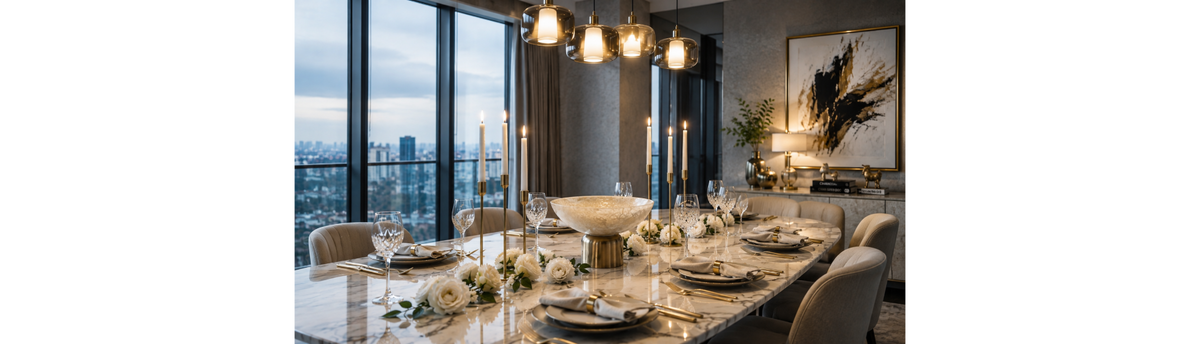

Dining spaces often have a different visual rhythm from living rooms. The dining table is designed around gathering, conversation and movement, while the sideboard provides a quieter surface for objects that can remain on display throughout the day. When styled together, these two surfaces can create a strong sense of cohesion without looking overly decorated.
The key is not to place as many luxury home decor accessories as possible. It is to decide what each surface needs to contribute to the room. A sculptural centrepiece can establish a focal point on the dining table, while a vase, bowl, decorative tray or art object on the sideboard can create height, texture or visual balance.
For contemporary Indian homes, this approach works particularly well across marble dining rooms, timber interiors, open-plan spaces, formal dining areas and hospitality-inspired residences. The right combination of premium home decor accessories, lighting and carefully chosen materials can make the dining area feel considered without making it feel staged.
This article explores how to style a dining table and sideboard using centrepieces, sculptures, vases, bowls, trays, candles, books and other decorative objects, while considering scale, proportion, visual weight, negative space and the relationship between the two surfaces.
Table of Contents
- Why Dining Table and Sideboard Styling Matters
- How to Style a Luxury Dining Table
- Choosing the Right Dining Table Centrepiece
- Using Sculptures and Vases on a Dining Table
- Styling Bowls and Decorative Trays
- Adding Candles and Atmospheric Detail
- How to Style a Dining Room Sideboard
- Creating a Relationship Between Table and Sideboard
- How Dining Lighting Changes the Composition
- When a Fireplace Becomes Part of the Dining Composition
- Common Dining Styling Mistakes
- A Stylist's Perspective
- Frequently Asked Questions
- Final Thoughts
Why Dining Table and Sideboard Styling Matters
A dining room can contain beautiful furniture and still feel visually incomplete. This usually happens when the horizontal surfaces have not been considered as part of the overall composition. The dining table, sideboard, lighting and surrounding artwork all occupy the same visual field, so each element influences how the others are perceived.
The dining table is usually the most prominent horizontal surface in the room. Because people sit around it, its styling needs to remain relatively low, balanced and easy to live with. The sideboard has more freedom. It can accommodate taller objects, layered compositions and pieces that introduce a stronger vertical element.
This difference is important. Trying to make both surfaces look identical can create unnecessary symmetry. Instead, they should feel related through colour, material, shape or design language.
I rarely think of a dining table and sideboard as two separate styling exercises. I see them as two surfaces within one composition. The table carries the central moment, while the sideboard supports and extends that visual language.
A useful starting point is to decide which surface should carry greater visual weight. In many dining rooms, the table becomes the primary focal point, with the sideboard providing a quieter layer behind or beside it. In other spaces, particularly where the sideboard sits beneath artwork or a mirror, the sideboard may become the stronger visual anchor.
This is where thoughtful curation becomes more important than quantity. Spacio's luxury home decor accessories guide explores this broader principle: decorative objects work best when their scale, materiality and purpose are considered in relation to the interior rather than selected as isolated pieces.
How to Style a Luxury Dining Table
A dining table should feel ready to use even when it is not being used. This is one of the most important differences between styling a dining table and styling a console or shelf.
The centre should have enough visual interest to anchor the room, but it should not become a permanent obstacle between people sitting opposite one another. For this reason, horizontal arrangements, low bowls, compact sculptures, grouped candles and carefully proportioned vases often work better than a single very tall object.
The size and shape of the table should guide the composition. A long rectangular dining table can support a linear arrangement or two related groupings. A round table often benefits from one central composition that follows its circular geometry rather than introducing a strong directional line.
Material also matters. A marble table already has visual movement through its veining, so the accessories can be quieter. A plain timber table may benefit from more contrast through glass, metal, ceramic or stone. The objective is not to match every material, but to create enough contrast for the composition to have depth.
The more visually active the dining table itself is, the more restrained the centrepiece can be. Let the table material participate in the composition rather than covering it with accessories.
Choosing the Right Dining Table Centrepiece
A centrepiece does not have to be a traditional floral arrangement. In contemporary luxury interiors, an exclusive centrepiece may be a sculptural object, a decorative bowl, a low arrangement of candles, a collection of smaller objects or a vase selected for its form rather than simply its ability to hold flowers.
The strongest centrepieces usually have a clear visual role. They establish a focal point, introduce a material, create contrast or connect the dining table with another element in the room. A dining table can be the ideal setting for an exclusive centrepiece when the object has enough presence to anchor the composition without obstructing conversation.
For example, a sculptural metallic object can echo brass details in the lighting or furniture. A glass vase can pick up reflections from a chandelier. A ceramic bowl can soften a room dominated by marble and metal. These relationships make the composition feel intentional.
For a rectangular dining table, consider whether one central arrangement or a series of smaller connected objects better suits the proportions. A long table can often accommodate a low sequence rather than one object placed awkwardly in the middle.
For a round table, a single sculptural centrepiece can be particularly effective because it can be appreciated from every seat. Its silhouette therefore becomes more important than its front-facing appearance.
Using Sculptures and Vases on a Dining Table
Sculptures and vases perform different visual functions. A sculpture is generally appreciated for its form, silhouette and artistic character. A vase can perform the same role while also introducing flowers, branches or foliage when required.
This makes both useful for creating a dining table composition, but they should not automatically be combined. If the sculpture already has a strong silhouette, adding a large vase beside it may create unnecessary competition.
Instead, consider visual weight. A heavier sculptural object may need a quieter companion. A delicate glass vase can sit comfortably beside a more substantial object because its transparency reduces its apparent visual mass.
Spacio's vase collection includes sculptural forms that can work even without flowers, making them useful as decorative objects rather than purely functional vessels.
Likewise, sculptures can introduce a strong artistic element to a dining room without requiring the entire room to become gallery-like. The surrounding space should still have enough negative space for the object to be appreciated.
Styling Bowls and Decorative Trays
Bowls and decorative trays are particularly useful on dining tables because they add structure without demanding too much height. They can also bring several smaller objects together so that the composition reads as one deliberate arrangement rather than a collection of unrelated pieces.
A decorative bowl can become the centre of a dining table on its own, particularly when its material or shape has enough presence. Stone, ceramic, glass and metal bowls can each create a different effect. A sculptural bowl can add softness to a room dominated by straight lines, while a metallic bowl can introduce a subtle reflective element.
A tray works differently. It creates a visual boundary around a group of objects. Candles, a small vase, a decorative object and a bowl can therefore be arranged together while still reading as one composition. For a deeper look at selecting this versatile accessory, see our guide to how to choose decorative trays for luxury home interiors.
This is especially useful on larger dining tables. Rather than spreading five or six objects across the entire surface, grouping them on a tray creates visual order and leaves generous areas of the tabletop visible.
For a selection of decorative pieces suitable for this type of styling, explore Spacio's luxury home decor accessories, where objects can be considered according to their material, scale and role within an interior.
I often use a tray when a dining table needs several smaller objects but the composition is beginning to look scattered. The tray gives the eye a boundary and makes the arrangement feel intentional without making it rigid.
Adding Candles and Atmospheric Detail
Dining rooms naturally benefit from atmospheric lighting, particularly in the evening. Candles can reinforce that atmosphere while also becoming part of the decorative composition.
The important consideration is scale. Several tall candle holders may create too much vertical competition with a chandelier or pendant light. Lower candle holders can often work more effectively because they introduce warmth without obstructing the visual relationship between diners.
Glass candle holders can introduce transparency and reflections. Metallic candle holders can connect with brass, bronze or other finishes already present in the room. Sculptural candle holders can also function as decorative objects even when they are not lit.
Rather than placing candles randomly around the table, group them within the overall centrepiece. A few pieces with different heights can create rhythm while keeping the composition visually contained.
Spacio's candles and diffusers collection can be considered when introducing this layer of warmth and sensory detail into a dining composition.
How to Style a Dining Room Sideboard
The sideboard offers considerably more freedom than the dining table. Because it is not used for dining, it can accommodate taller sculptures, larger vases, layered books and more substantial decorative objects.
However, more freedom does not mean that every part of the surface needs to be filled. A luxury sideboard often looks stronger when one area carries the main visual weight while the remaining space is allowed to breathe.
Begin by considering what is above the sideboard. A large artwork, mirror or decorative wall installation already creates significant visual weight. The objects placed below should support that element rather than compete with it.
A large artwork may work well with a relatively simple arrangement below it: perhaps a sculptural vase, a low bowl and a small stack of books. A quieter wall, on the other hand, may allow the sideboard itself to carry a stronger collection of objects.
Use Height to Create a Visual Hierarchy
One of the easiest ways to make a sideboard arrangement feel considered is to vary height. A tall vase or sculpture can establish the highest point, while books, bowls and smaller objects create lower layers around it.
Keeping everything at the same height often makes a composition feel flat. Making everything tall creates the opposite problem: the arrangement becomes visually heavy.
The aim is to create a gradual change in height so that the eye can move naturally across the surface.
Use Books as Structural Elements
Books are useful on a sideboard because they provide a stable horizontal layer beneath smaller objects. They can raise a decorative object slightly, create a transition between different heights or add colour and texture to an otherwise restrained arrangement.
They should, however, support the composition rather than become the composition. A small stack beneath a sculpture or vase is often enough.
Spacio's coffee table books can also be used on sideboards where their covers, proportions and subject matter complement the wider interior.
Combine Objects Without Making the Sideboard Look Busy
A strong sideboard composition usually combines objects that perform different visual roles. A sculpture may provide form, a vase may provide height, a bowl may provide a lower horizontal element and books may create a base.
This creates contrast without requiring a large number of pieces.
It is also useful to vary shapes. If the sideboard is rectangular and the artwork above it is linear, a rounded vase or bowl can soften the geometry. If the room already contains many curved forms, a more architectural object can provide contrast.
Creating a Relationship Between the Dining Table and Sideboard
The dining table and sideboard should not necessarily use the same objects. What they need is a visual relationship.
This can be created through repeated materials, related colours, similar shapes or a shared design language. For example, a sculptural object on the table might relate to a larger sculpture on the sideboard. A glass vase on one surface might echo glass details elsewhere in the room. Brass candle holders might connect with brass accents in the lighting.
This repetition creates cohesion without producing a matching set.
Repeat a material, colour or shape rather than repeating the exact same object. Luxury interiors usually feel more sophisticated when the relationship is subtle.
Do Not Give Both Surfaces Equal Visual Weight
One of the most common styling mistakes is trying to make the dining table and sideboard equally elaborate. When both surfaces contain strong sculptures, tall vases, books, trays and candles, the eye has nowhere to rest.
Instead, decide which surface should lead.
If the dining table has a substantial sculptural centrepiece, keep the sideboard more restrained. If the sideboard sits beneath an important artwork and is already visually dominant, the dining table may need a quieter centrepiece.
This difference in visual intensity is what allows several decorative objects to coexist without making the dining room feel overdecorated.
How Dining Lighting Changes the Composition
Lighting is part of dining-table styling, not something that should be considered separately. A chandelier or pendant positioned above the table becomes another vertical element within the composition, and the centrepiece needs to work with it.
A sculptural chandelier can already provide considerable visual drama. In that situation, a quieter centrepiece may create a more balanced result. Conversely, a simple pendant can allow the decorative objects on the table to become more prominent.
Reflections also matter. Glass, crystal and polished metal objects can respond to decorative lighting by catching highlights and creating subtle movement across the table.
This is one reason decorative lighting should be considered alongside accessories rather than after them. The relationship between illumination, reflective materials and decorative objects can change the way the entire dining composition is perceived after dark.
When a Fireplace Becomes Part of the Dining Composition
In larger dining rooms, an adjoining fireplace can become another important visual anchor. When this happens, the dining table, sideboard and fireplace should be considered together rather than styled as independent elements.
A fireplace already brings light, movement and visual focus to the room. The decorative objects around it should therefore support its presence rather than compete with it. A restrained sideboard composition can work particularly well when the fireplace or feature wall is already dramatic.
Modern fireplaces in India are increasingly used for ambience and design as much as for warmth. Electric and water-vapour fireplaces can create the visual effect of flame without adding unwanted heat, making them particularly relevant to Indian dining spaces where the climate may not require conventional heating.
Spacio's fireplace collection includes electric, water-vapour, bioethanol and gas fireplaces designed for modern Indian interiors. When a fireplace forms part of a dining composition, its scale, position and finish should be considered alongside the furniture, lighting and decorative accessories.
The principle remains the same: allow the strongest element in the room to lead. If the fireplace is the focal point, the sideboard and dining table can provide supporting layers through quieter objects and restrained compositions.
Common Dining Table and Sideboard Styling Mistakes
Even beautiful objects can make a dining room feel unsettled when they are used without considering the overall composition. The most common mistakes are usually related to proportion, visual competition and lack of editing rather than the quality of the accessories themselves. A well-considered combination of sculptures, vases, bowls, trays and books can turn a sideboard into a display of high-end home decor accessories without making the surface feel crowded.
1. Using a Centrepiece That Is Too Tall
A dining table is a social surface. A very tall arrangement can interrupt sightlines between people sitting opposite one another and make the table feel more like a display pedestal than a functional part of the room.
Consider the viewing height from a seated position before deciding how tall the centrepiece should be.
2. Filling the Entire Table
Large dining tables can create the temptation to fill the available space. This usually reduces the sense of luxury. The exposed surface of the table is part of the composition and provides the negative space that allows the centrepiece to stand out.
3. Making the Sideboard and Table Identical
Repeating the same vase, sculpture or arrangement on both surfaces can make the room feel overly coordinated. Instead, repeat a material, colour or shape and allow each surface to have its own character.
4. Ignoring What Is Above the Sideboard
A sideboard is rarely viewed in isolation. Artwork, mirrors, wall lighting or architectural details above it contribute to the composition. If the wall already has strong visual weight, the objects below should be edited accordingly.
5. Using Too Many Statement Accessories
Statement home decor accessories are most effective when they have room to breathe. A dining room containing a dramatic sculpture, large floral arrangement, elaborate chandelier, bold artwork and several reflective objects can quickly become visually noisy.
Choose the pieces that deserve attention and allow the remaining elements to support them.
6. Forgetting Practical Use
A dining table is still a dining table. Decorative objects should be easy to move when the table is being used for meals or entertaining. A composition that looks beautiful but makes everyday use difficult is not successful styling.
The best dining-room styling should disappear into the experience of the room. You should notice the beauty of the composition, but you should never feel that the accessories are getting in the way of conversation, movement or everyday living.
A Stylist's Perspective: Think in Compositions, Not Objects
When styling a dining room, I find it more useful to think in terms of relationships than individual objects. A vase is not simply a vase. It has a height, material, silhouette and visual weight. A sculpture has its own presence. A dining table has a geometry. A sideboard introduces another horizontal line. Lighting creates another layer above them.
The styling becomes successful when these elements begin to relate to one another.
This is also why premium and high-end home decor accessories should be selected with the room in mind. An exceptional object may be beautiful on its own, but its real value in an interior comes from what it contributes to the complete composition.
For a broader understanding of how luxury home decor accessories are selected for modern Indian homes, return to Spacio's complete guide to luxury home decor accessories. The principles of scale, material, craftsmanship and curation discussed there provide the foundation for styling dining surfaces successfully.
For further inspiration, Spacio's Interior Styling Ideas for Luxury Indian Homes brings together styling concepts developed by Interior Stylist Navin Kanodia, including the relationship between curated objects, lighting, art and the wider interior.
Frequently Asked Questions
What should I put in the centre of a luxury dining table?
A sculptural vase, decorative bowl, low floral arrangement, artistic object or carefully grouped collection of candles can work well. The choice should depend on the table's shape, size, material and the visual weight already present in the room.
How do you style a dining table without making it look cluttered?
Start with one focal point and build around it selectively. Use negative space deliberately, group smaller objects together and avoid giving every item equal visual importance. A restrained composition usually feels more luxurious than a crowded one.
How should a dining room sideboard be decorated?
Begin with the wall above the sideboard and then establish one strong visual anchor. Add supporting objects such as a vase, bowl, sculpture, books or candles at different heights. Keep enough empty surface visible so the composition can breathe.
Should the dining table and sideboard have matching decor?
They should coordinate rather than match. Repeating a material, finish, colour or shape creates continuity while allowing each surface to have its own visual identity.
Can sculptures be used as dining table centrepieces?
Yes. A sculpture can make an excellent centrepiece when its proportions work with the table and it does not obstruct conversation. Sculptures with strong silhouettes are particularly effective when they have sufficient negative space around them.
What are premium home decor accessories for a dining room?
Premium home decor accessories can include sculptural vases, decorative bowls, trays, candles, art objects, books, centrepieces and other carefully crafted pieces. Their impact comes from the combination of design quality, material, craftsmanship, scale and placement.
Where can I buy luxury dining table centrepieces and decor accessories in Mumbai?
If you want to buy luxury dining table centrepieces and home decor accessories in Mumbai, you can see and experience a curated selection at the Spacio Mumbai store at 3BK Laxmi Industrial Estate, New Link Road, Andheri (West), Mumbai 400 053. The showroom brings together sculptural centrepieces, vases, decorative bowls, trays, sculptures, art objects, candles and other statement accessories that can be used to style dining tables and sideboards. Visiting the Spacio showroom in Laxmi Industrial Estate, Mumbai lets you see the pieces in person and assess their scale, material, finish and visual relationship with your dining furniture before buying.
Where can I see and buy dining room decor accessories in Kolkata?
If you are looking to see and buy luxury dining room decor accessories in Kolkata, visit the Spacio Kolkata store at 86B Topsia Road South, Kolkata 700 046. The showroom brings together furniture, decor accessories and lighting for luxury residential and commercial interiors, including sculptures, art objects, vases, decorative bowls, trays, candles and statement pieces suitable for dining tables and sideboards. A visit to the Spacio showroom on Topsia Road South, Kolkata gives you the opportunity to experience these pieces in person, compare their scale and finishes with your requirements, and select accessories for a refined dining interior.
Final Thoughts: Let the Dining Room Feel Curated, Not Decorated
A beautifully styled dining room does not need a large number of accessories. It needs a clear visual hierarchy and a thoughtful relationship between its major elements.
Let the dining table carry a considered centrepiece. Give the sideboard enough height and visual interest to support the room without competing with the table. Use sculptures, vases, bowls, trays, books and candles for specific reasons rather than simply because there is space for them.
Most importantly, consider the dining table, sideboard, lighting, artwork and fireplace as parts of one composition. When materials, proportions and visual weights relate naturally, the room begins to feel complete.
That is the essence of luxury styling: not adding more, but knowing what deserves to be seen.


