
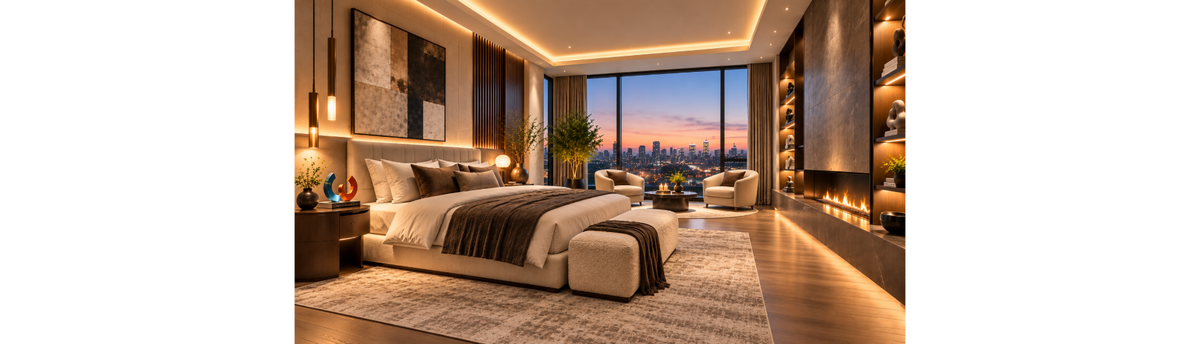

Bedrooms are among the few spaces in a home where luxury is experienced quietly. There is less need for display, fewer reasons to fill every surface and a greater emphasis on how the room feels when the day is ending. In this setting, a fireplace, a carefully considered decorative light and a small number of well-chosen decor accessories can create something far more powerful than a room filled with expensive objects.
The difference lies in composition. Fire provides movement and a natural focal point. Decorative lighting controls the surrounding glow, shadows and sense of depth. Decor accessories introduce texture, material, colour and personality at a much smaller scale. When these three layers are considered together, a bedroom can feel intimate, warm and deeply considered without becoming visually busy. This approach is particularly relevant to contemporary Indian bedrooms, master suites and private suites in luxury residences, where generous materials, large feature walls, statement beds and hospitality-inspired styling are increasingly common. The same principles also translate naturally into boutique hotel suites, private lounges, dressing areas and other spaces where atmosphere matters as much as function.
The objective is not to make a bedroom look like a hotel or to place a fireplace simply because the room has space for one. The objective is to understand what the room needs, establish a focal point, build layers around it and then edit the composition until every element has enough space to be appreciated.
Throughout this guide, the approach is built around three layers: fire establishes the focal point, decorative lighting establishes the atmosphere, and decor accessories establish the personal layer. The bedroom then provides the restraint that allows all three to work together. This is particularly useful when styling a master bedroom, private suite or boutique-hotel bedroom where scale, low lighting, material warmth and visual calm matter as much as the individual products.
Table of Contents
- Why Bedroom Luxury Depends on Atmosphere
- The Role of Fire in a Private Bedroom
- Where a Fireplace Belongs in a Bedroom
- Choosing the Right Fireplace Experience
- Where Vastu Fits Into Bedroom Fireplace Planning
- Scale: When the Fireplace Becomes Too Much
- Designing the Fireplace Around the Bed
- Building the Fireplace Feature Wall
- Why Decorative Lighting Must Work With the Fire
- Bedside and Peripheral Lighting
- Using Decor Accessories Around the Fireplace
- Materials That Make Fire, Light and Decor Feel Connected
- Three Layers, One Bedroom
- Applying the Approach to a Master Suite
- Creating a Boutique-Hotel Private Suite
- Fireplaces, Television Walls and Private Spaces
- Why Restraint Makes the Room Feel More Luxurious
- When a Bedroom Does Not Need a Fireplace
- Applying the Three-Layer Approach Across Indian Cities
- Common Bedroom Styling Mistakes
- Navin Kanodia's Principle for Private Spaces
- Frequently Asked Questions
- Final Thoughts
Why Bedroom Luxury Depends on Atmosphere
A bedroom does not need the visual drama of a living room. In fact, trying to give it the same level of display can weaken the very quality that makes a private bedroom feel special. The most successful bedrooms usually have a slower visual rhythm. Furniture is given room to breathe, lighting is softer, materials are tactile and decorative objects are selected with greater discipline.
This is why bedroom styling should begin with atmosphere rather than objects. Ask what the room should feel like at 10 pm when the main ceiling lights are switched off. Should it feel warm and cocooning? Calm and minimal? Like a private hotel suite? Contemporary and sculptural? Or quietly traditional with richer materials?
Once that atmosphere is defined, the relationship between fireplace, decorative lighting and decor becomes much clearer. A fireplace may provide the movement and focal point. Decorative lighting can reinforce the warmth of the flame or provide a contrasting layer of light elsewhere in the room. Accessories then connect the fireplace area with the bed, bedside tables, seating, dressing area and surrounding surfaces.
The room therefore becomes a composition rather than a collection of products. This is the central principle behind successful luxury bedroom styling: every element should support the experience of the room.
In a private room, I prefer to create fewer but stronger visual moments. The eye should be able to rest. A fireplace, a sculptural light or a carefully selected object can become powerful precisely because the surrounding space has not been overfilled.
The Role of Fire in a Private Bedroom
Fire has a different emotional role in a bedroom than it does in a living room. In a living area, a fireplace can become a social focal point around which people gather. In a bedroom, its role is more intimate. It can mark the transition from the active parts of the home to a quieter private environment.
The movement of a flame also introduces something that furniture and fixed surfaces cannot provide: subtle change. The room looks different when the flame is active, especially when surrounding surfaces are restrained enough to reflect its light. Stone can catch highlights. Glass can transmit or reflect small points of light. Metal can introduce controlled glimmer. Timber and textiles can absorb some of the brightness and make the overall effect feel softer.
That interaction is important. A fireplace should not be treated as a glowing rectangle placed on a wall. It should be considered as a source of movement within the entire composition.
For bedrooms, this makes fireplace technology and placement particularly important. A design selected for strong heat output may not provide the same styling advantage as one chosen primarily for visual atmosphere. Likewise, a very large fire feature may dominate a bedroom when a more proportionate installation would create greater intimacy.
The wider guide to luxury fireplaces in India provides the broader context for understanding fireplace types, technologies and applications. Within a bedroom, however, the question is more specific: what kind of fire supports the atmosphere without taking over the room?
Where a Fireplace Belongs in a Bedroom
When considering bedroom fireplace ideas, placement should begin with the room's main sightlines and the relationship between the fireplace, bed and principal seating area. The fireplace does not necessarily need to be directly opposite the bed. What matters is that its position feels intentional and that the room's main visual axis, circulation and furniture arrangement are considered before installation.
A fireplace beneath a television creates one type of composition. A fireplace positioned beside a television creates another. A low horizontal fireplace beneath artwork or a quiet wall surface creates something completely different. In a private bedroom, the choice should be driven by the experience you want to create rather than by a formula. Where the fireplace is positioned opposite the bed, the wall becomes a major visual plane. This is where proportion becomes critical. A long, low fire feature can visually anchor the wall without competing with the height of the bed. A taller fireplace installation may work when the room has sufficient ceiling height and the surrounding composition is kept quiet.
Another option is to place the fireplace within a broader feature wall that incorporates shelving, stone, timber or a controlled artwork arrangement. This can be particularly effective in larger master suites because the fire becomes part of a complete composition rather than appearing as an isolated appliance.
The principle is simple: the fireplace should have a defined visual territory. Give it enough surrounding space to read as the focal point, but connect that territory to the rest of the room through material, lighting and carefully selected objects.
Choosing the Right Fireplace Experience
There is no single fireplace format that suits every bedroom. The choice should follow the room, the intended atmosphere and the practical requirements of the project.
For a bedroom where ambience is the priority, water-vapour and non-heating electric fireplace formats can be considered where the installation and product specifications suit the project. They allow the visual experience of fire to become part of the room without making the fireplace primarily about heating. Electric fireplaces with heat can be relevant where additional warmth is genuinely useful. Bioethanol and gas fireplaces create a different experience because they involve a real flame and therefore require more careful consideration of installation, fuel, ventilation and project conditions.
The choice should therefore not begin with the question, “Which fireplace looks most luxurious?” A more useful question is, “What should this fireplace do for the room?”
| Bedroom requirement | Styling consideration |
|---|---|
| Primarily visual atmosphere | Consider a fireplace format designed around flame appearance and ambience. |
| Occasional additional warmth | Consider an electric model with a suitable heat function where appropriate. |
| Strong real-flame experience | Consider bioethanol or gas options only after the installation requirements have been properly assessed. |
| Compact bedroom | Prioritise proportion and a visually quiet installation rather than maximum size. |
| Large master suite | A broader fireplace composition can work when the wall and surrounding furniture have enough visual volume. |
The important distinction is that technology is part of the decision, but it should serve the interior rather than dictate it.
For many Indian bedrooms, particularly air-conditioned urban bedrooms, the desired experience may be visual rather than thermal. In that situation, the value of the fireplace lies in flame movement, glow and atmosphere rather than in producing additional room heat. This distinction can influence the technology, scale and placement that make sense for the project.
For a broader framework on matching fireplace technology to room, climate, intended fire experience and installation requirements, see Spacio's guide on how to choose the right fireplace for an Indian home.
Where Vastu Fits Into Bedroom Fireplace Planning
For many Indian bedroom projects, Vastu forms part of the fireplace conversation from the beginning. Traditional Vastu principles associate fire with the Agni element and commonly identify the south-east as the Agni zone. However, Vastu should be considered alongside the room layout, fireplace technology, installation requirements, electrical or fuel requirements and manufacturer instructions rather than treated as a substitute for them.
In a master bedroom or private suite, this becomes a planning question rather than a styling detail. The fireplace needs to work with the bed, television if present, feature wall, circulation and the intended visual focal point. When Vastu is part of the project brief, it is better considered before the fireplace position and surrounding composition are finalised.
For a deeper discussion of fireplace placement and Vastu in Indian homes, see Spacio's guide to Vastu corrections with fireplaces in India.
Scale: When the Fireplace Becomes Too Much
Scale is one of the clearest differences between a fireplace that feels integrated and one that feels imposed. A large bedroom does not automatically require a large fireplace. Similarly, a compact room does not always need a small fireplace if the composition has been designed around a strong horizontal element.
Look at the fireplace in relation to the bed, bedside tables, wall width and ceiling height. A fireplace that occupies almost the entire width of the wall may become the only thing the eye notices. That can be effective in a dramatic lounge, but it can feel excessive in a bedroom where calm is the objective. At the other extreme, a tiny fireplace centred on a very large wall can lose its authority. The surrounding empty space may make the feature feel accidental rather than deliberate.
The right proportion usually comes from the relationship between the fireplace and the other major horizontal and vertical elements in the room. The bed, headboard, bedside furniture, wall treatment and fireplace should feel as though they belong to the same visual language.
Think of the fireplace as one member of the room's composition. Before deciding its size, look at the width of the bed, the height of the headboard, the available wall area and the distance from which the fire will be viewed. Scale should be judged in the room, not from a product photograph.
Designing the Fireplace Around the Bed
A bedroom fireplace should be judged from the bed as much as from the doorway. The bed is where the room is experienced for long periods, particularly in the evening, so the fireplace needs to work from this primary viewing position rather than only looking impressive when someone walks into the room.
Consider what the eye sees from the pillow. Is the fireplace centred within the visual field? Does the television, if there is one, compete with it? Does the feature wall feel too dominant when viewed at close range? Does the fire sit comfortably within the width of the bed and headboard? These questions can reveal proportion problems that may not be obvious from a floor plan or product photograph.
Viewing distance also changes how materials behave. A large stone surface may look impressive from across the room but feel visually heavy when seen from the bed. A highly reflective finish can catch too much light at night, while a softer material may allow the fire to remain the main point of movement.
This is why the fireplace, bed, headboard, bedside lighting and television should be considered as one visual composition. The goal is not simply to create a beautiful fireplace wall. It is to create a wall that feels comfortable to live with every night.
Building the Fireplace Feature Wall
A fireplace becomes far more convincing when the surface around it has been considered as carefully as the fire itself. This does not mean the wall needs elaborate treatment. In many luxury bedrooms, the strongest solution is a restrained material plane that gives the fire enough contrast and visual authority.
Natural stone can provide depth and permanence. Timber can soften the installation and introduce warmth. Textured surfaces can create subtle shadow. A plain painted surface can work equally well when the fireplace itself has sufficient presence. The important point is continuity. If the bedroom already contains a strong material story, the fireplace wall should participate in it rather than introduce a completely unrelated finish.
This is where wall styling becomes more than a backdrop. The wall becomes the connecting layer between the fireplace, the bed and the decorative objects placed around the room. For a deeper discussion of proportion, focal points and complete wall compositions, the guide to styling luxury statement walls provides a useful wider framework.
In a bedroom, however, restraint is usually more valuable than visual complexity. The fireplace itself already introduces movement and light. The wall does not need to compete with it.
Why Decorative Lighting Must Work With the Fire
Firelight and decorative lighting occupy the same visual territory, which means they have to be planned together. If the lighting is too bright, the flame loses its atmospheric impact. If the room depends entirely on the fireplace, other areas may become visually flat or functionally uncomfortable.
The solution is layering.
Instead of asking which light should illuminate the bedroom, think about several different jobs. General illumination allows the room to function. Bedside lighting supports reading and personal routines. Decorative lighting creates visual interest. Accent lighting can draw attention towards artwork, materials or a particular design feature. The fireplace then becomes another low-level source of movement and glow.
This approach prevents the common mistake of treating decorative lighting as a statement object that has to carry the entire room. A beautiful pendant or wall light is more effective when it has a clear role within the composition. For bedrooms with fireplaces, the most successful decorative lights are often those that complement rather than compete. Softly diffused wall lights, sculptural pendants, refined table lamps or carefully positioned floor lamps can create pools of light that sit around the fireplace's glow.
When the lighting is switched to a lower level in the evening, the room begins to reveal its layers. The fire becomes visible. Materials become warmer. Glass catches small reflections. Metal details appear selectively. Decorative objects stop reading as isolated accessories and become part of the atmosphere.
That is the point at which lighting stops being merely functional and becomes an interior-styling tool.
Bedside and Peripheral Lighting
The area immediately around the bed deserves particular attention because it is where the room is experienced most closely. Decorative lighting here should create intimacy without producing harsh pools of brightness or competing with the fireplace.
Wall lights can keep bedside tables visually clean while introducing a controlled vertical element. Table lamps create a softer, more intimate glow and can also become part of the decorative composition. Pendant lights suspended beside the bed can provide stronger sculptural presence, particularly when the room has sufficient ceiling height. The choice between these options should be based on the furniture and wall composition. A large upholstered headboard may benefit from lighting that sits quietly beside it. A more minimal bed may provide an opportunity for a stronger sculptural light.
It is also worth considering what happens when the decorative lighting is switched off. A good light should still belong to the room as an object. This is one reason European and Italian decorative lighting can be particularly useful in high-end interiors: the fixture can contribute to the visual composition during the day and then perform its atmospheric role after dark.
For projects in Hyderabad, for example, the local collection of European and Italian decorative lighting provides a useful starting point when the bedroom needs lighting that is considered as part of the interior rather than treated as a purely functional installation.
Using Decor Accessories Around the Fireplace
Decor accessories are often where bedroom styling either becomes personal or becomes cluttered. The fireplace establishes the focal point, but accessories determine how the surrounding space feels when the eye moves away from the flame.
The most important principle is not quantity. It is role.
A sculptural object may introduce height. A vase can soften a hard surface and bring organic form into the composition. A decorative bowl can provide a lower, quieter shape. A small artistic object can introduce colour or material contrast. Books can create horizontal layers on a console or side table. A decorative tray can give smaller objects a visual boundary.
These pieces should not all appear around the fireplace simply because the surface is available. Instead, consider what the area needs. If the fireplace is already visually strong, the objects beside it may need to be quieter. If the fire is low and restrained, a sculptural object on one side of the composition can provide additional visual weight.
This is where negative space becomes essential. A valuable object needs room around it. If a sculpture, vase and candle holder are pressed together against a fireplace wall, each object loses some of its identity. Separating them can actually make the overall arrangement feel richer. The same principle applies to the rest of the bedroom. The bedside table does not need five objects because it has five inches of empty surface. A dresser does not need to become a display shelf. A console in a private suite may need one strong object rather than a collection of small decorative pieces.
The wider guide to luxury home decor accessories for Indian homes explores this principle in greater depth: luxury comes not from filling a room with objects, but from choosing pieces that have the right scale, material, visual weight and relationship to the surrounding interior.
When a bedroom already has a strong fireplace and beautiful lighting, the decor accessories should not try to become another focal point. I look for objects that connect materials, introduce a little personality and give the eye somewhere to pause without competing with the main feature.
Materials That Make Fire, Light and Decor Feel Connected
Materiality is one of the most effective ways to make three different categories feel like one interior. The fireplace may contain glass and metal. The decorative light may introduce brass or another metallic finish. The accessories may bring in glass, crystal, ceramic, stone or timber. These elements do not need to match exactly. They need to have relationships.
Stone and Marble
Stone gives a fireplace wall visual weight and can provide a strong foundation for softer bedroom materials. Marble, in particular, can reflect small amounts of firelight and decorative illumination across its surface. If the stone is strongly veined, however, the surrounding accessories should usually be quieter so that the wall retains its authority.
Timber and Natural Finishes
Timber introduces warmth and can soften the harder presence of stone, glass and metal. In bedrooms influenced by Japandi or Scandinavian styling, timber can be particularly effective because it gives the fire a natural visual partner without requiring additional decoration.
Glass and Crystal
Transparent and reflective materials behave differently from solid objects. They can catch firelight, reflect decorative lighting and create movement without adding heavy visual mass. A carefully placed glass sculpture may therefore contribute more to a bedroom composition than a larger opaque object.
Metal
Metal can repeat a finish already present in the fireplace or lighting while giving smaller objects a stronger visual connection to the main feature. Brass, bronze, brushed metal and darker finishes each create different effects. The objective is not to match every metal in the room, but to establish enough repetition for the composition to feel coherent.
In a private bedroom, material warmth is not only about colour. It also comes from how surfaces respond to touch, light and sound. Upholstered beds, rugs, curtains and soft bedding can absorb the harder visual qualities of stone, glass and metal, while timber can bridge the fireplace wall and the furniture. The result is a room where the fire feels integrated into the bedroom rather than treated as a separate feature.
Textiles
Fire, stone, glass and metal can all feel visually hard. Bedrooms need softer counterpoints. Upholstery, linen, wool, velvet and layered bedding absorb light and sound, helping the room feel more intimate. This is why the fireplace should never be considered separately from the bed, curtains, rugs and seating.
Three Layers, One Bedroom
The most useful way to think about this style of bedroom is not as three product categories, but as three layers performing different jobs.
| Layer | Primary role | What it contributes |
|---|---|---|
| Fireplace | Focal point and movement | Flame, glow, visual warmth and a sense of intimacy |
| Decorative Lighting | Atmosphere and visual rhythm | Pools of light, shadow, material emphasis and functional illumination |
| Decor Accessories | Scale, texture and personality | Form, colour, material relationships and the personal layer of the room |
When these layers are planned together, they prevent one another from becoming excessive. The fireplace does not have to carry the entire room. The decorative light does not have to be the statement. The accessories do not have to fill every surface.
Instead, each element does a specific job.
This is the difference between decorating a bedroom and styling one. Decorating can involve adding beautiful things. Styling involves understanding what each element contributes to the experience of the whole room.
Applying the Approach to a Master Suite
A master suite provides more opportunities because the bedroom is usually part of a larger private environment. The same design language can move from the sleeping area into a sitting space, dressing area or private lounge.
This is where repetition becomes important. A fireplace may introduce a particular stone or metal finish. That material can appear again in a decorative light or sculpture without being repeated literally. A warm brass detail on the lighting might reappear as a small accent in a vase or decorative object. Timber used around the fireplace can be echoed through a side table or furniture detail.
These quiet repetitions create continuity across the suite.
The sitting area should not look as though it belongs to another room. If the bedroom is calm and restrained but the adjacent lounge suddenly becomes highly decorative, the suite loses its sense of cohesion. Instead, allow the visual language to continue while changing the intensity. The bedroom can remain softer, while the sitting area may accommodate a larger sculpture, stronger decorative light or more expressive artwork.
Creating a Boutique-Hotel Private Suite
Boutique hotels offer an important lesson for residential bedroom styling: atmosphere is often created through controlled contrast. A hotel suite may combine a restrained bed, a dramatic wall, low-level lighting, tactile fabrics and a small number of highly visible decorative objects. The room feels memorable because each element has a clear role.
A private residential suite can use the same principle without copying hospitality design literally.
The same approach works when designing a boutique hotel suite with a fireplace. The fire can establish a memorable evening focal point, while decorative bedside lighting, a restrained feature wall and a few tactile objects create the layered atmosphere guests experience most strongly after dark. The key is to make the suite feel composed rather than staged.
For example, the fireplace can become the evening focal point while a sculptural pendant or pair of wall lights establishes the room's secondary rhythm. A console or sideboard can carry one strong vase or sculpture rather than a large collection of objects. Artwork can be selected for its relationship to the material palette rather than simply because the wall is empty.
The result should feel more personal than a hotel. The room can contain books, collected objects, travel pieces or meaningful gifts alongside contemporary European design. This mixture prevents the suite from becoming overly staged.
The principle is hospitality-inspired, not hospitality-replicated.
Fireplaces, Television Walls and Private Spaces
Bedrooms increasingly combine several functions: sleeping, watching films, reading, working briefly and relaxing. This makes the television wall one of the most complicated surfaces to style.
A fireplace below a television can create a strong horizontal composition, but it needs careful proportion. The fireplace, television, wall width and furniture should be considered together rather than installed as separate decisions.
In a bedroom, the television should not automatically become the dominant visual element. When the room is being used in the evening, a low fireplace glow can become the more atmospheric feature while the television is switched off.
A fireplace below a TV in a bedroom can therefore work particularly well when the fireplace provides the lower visual anchor and the television remains visually quiet when it is not in use. The surrounding wall, lighting and decorative objects should support this hierarchy rather than create additional competing focal points.
Where the fireplace is placed below the television, the surrounding wall should usually remain controlled. Excessive shelves, accessories and competing lighting can make the wall feel busy precisely when the room should feel calm.
For a more detailed discussion of fireplace placement below televisions, see the guide on choosing a fireplace below a TV in modern Indian homes.
Why Restraint Makes the Room Feel More Luxurious
Bedrooms reveal the value of restraint more clearly than almost any other room. In a living room, there may be enough distance for several focal points to coexist. In a bedroom, many of the objects are viewed from much closer range. A decorative object that looks subtle across a showroom can become visually dominant when placed beside the bed.
This is why negative space should be treated as an active part of the styling composition.
Leave space around the fireplace. Leave space between the fireplace and the next major visual element. Leave enough surface around a sculpture to understand its silhouette. Allow the bedside table to remain useful. Let the stone, timber or wall finish remain visible rather than covering it with accessories.
A room can contain fewer objects and still feel richer because each object has greater visual importance.
This principle also protects the bedroom from becoming overly trend-driven. A restrained room can accommodate a new decorative object or lighting piece later without requiring the entire interior to change.
When a Bedroom Does Not Need a Fireplace
Not every bedroom benefits from a fireplace. A private room may already have a strong headboard, an expressive artwork, a large window, a dramatic view or another focal element that deserves to remain dominant. Adding fire simply because there is an available wall can make the room feel more designed rather than better designed.
The same applies when the bedroom is compact. If the fireplace requires too much wall space, reduces useful storage, interferes with circulation or creates a second focal point beside the bed, the room may benefit more from refined lighting and carefully selected decor accessories alone.
A fireplace is most successful when it solves a genuine design need. It may establish a focal point, create evening atmosphere, connect a feature wall to the rest of the room or give a large private suite a stronger sense of intimacy. If it does none of these things, restraint may be the better choice.
This is an important part of luxury interior styling: the objective is not to place more elements in a room. It is to understand which elements deserve to be there.
Applying the Three-Layer Approach Across Indian Cities
The principles of bedroom styling remain consistent across India, but the way they are applied can respond to the scale of the home, local preferences, project type and the wider design language of the residence. This is where city-specific discovery becomes useful: not because the styling principle changes completely, but because homeowners, architects and interior designers may be looking for different combinations of fireplace, decorative lighting and decor accessories within their local project context.
Mumbai: Fire, Light and Calm in Air-Conditioned Bedrooms
Mumbai bedrooms often sit within air-conditioned apartments, penthouses and larger private residences where the fireplace is more likely to be about atmosphere than additional heating. This makes the relationship between a low-heat or ambience-focused fireplace, decorative lighting and soft bedroom materials particularly important. The fire can provide movement and evening warmth visually, while layered lighting keeps the room comfortable and functional when the flame is not the only source of illumination.
In a Mumbai master bedroom, the material palette can do much of the work. Stone, timber, glass, metal, upholstered surfaces and layered textiles can create depth without requiring a large number of decorative objects. A sculptural light beside the bed, one carefully scaled object near the fireplace and controlled lighting around the feature wall can create a more intimate composition than a heavily decorated arrangement.
For projects in Mumbai, Spacio's fireplace collection in Mumbai, European and Italian decorative lighting and luxury home decor accessories can be considered as three parts of the same bedroom styling brief. The Mumbai showroom is at 3BK, Laxmi Industrial Estate, New Link Road, Andheri West, Mumbai 400053.
Kolkata: Layered Materials and Quiet Evening Atmosphere
Kolkata offers a different interior context, with homes ranging from traditional residences and larger bungalows to contemporary apartments and private suites. A bedroom fireplace can therefore be used as either a quiet atmospheric feature or a stronger visual anchor, depending on the room's scale. The surrounding lighting and decor should respond to the fireplace rather than compete with it.
In a larger master bedroom or private suite, the three-layer approach can be particularly effective: the fireplace establishes the focal point, decorative lighting creates softer pools of light around the bed and seating areas, and carefully selected decor accessories connect the materials across the room. Sculptural objects, glass, ceramics, vases and smaller decorative pieces can introduce personality while leaving enough negative space around the fire.
For Kolkata projects, Spacio's fireplace collection in Kolkata, European and Italian decorative lighting and luxury home decor accessories bring these three categories together. The Spacio Kolkata showroom is at 86B, Topsia Road (South), Kolkata 700046.
Bengaluru: Calm, Contemporary Bedroom Compositions
Bengaluru's contemporary residences often lend themselves to warm, material-led bedroom schemes where timber, stone, soft textiles and controlled lighting can work together. A fireplace can establish the evening focal point, while decorative lighting introduces softer pools of illumination around the bed and seating area. Sculptural decor accessories can then bring the smaller-scale detail needed to complete the composition without making the room feel crowded.
For a project being developed in Bengaluru, these three layers can be explored through fireplace options, European and Italian decorative lighting and luxury home decor accessories, depending on what the room requires.
Pune: Warmth Within Larger Residential Interiors
Pune's mix of apartments, villas and larger private residences allows bedroom styling to move between compact compositions and more generous master suites. In a larger room, the fireplace can be given a wider visual territory, with decorative lighting creating a secondary focal point and larger sculptural objects providing scale.
In more compact bedrooms, the same principle works at a smaller scale: a proportionate fireplace, a carefully selected bedside light and one strong decorative object can create greater impact than a crowded arrangement. The fireplace, decorative lighting and luxury home decor accessories in Pune can therefore be considered as parts of the same styling brief rather than unrelated purchases.
Hyderabad: Firelight Against Richer Material Palettes
Hyderabad homes can range from contemporary city apartments to substantial villas and residences where marble, timber, metal and richer finishes create a stronger material presence. In these interiors, a fireplace can provide the movement that breaks up large surfaces, while decorative lighting can soften the transition between the fire feature and the rest of the bedroom.
The accessory layer then becomes particularly important. Rather than adding more decoration to an already expressive room, choose objects that provide contrast or continuity through material, form and scale. A restrained glass sculpture may bring lightness to a stone setting, while a sculptural vase can provide height beside a low console.
This three-layer approach is reflected naturally in the dedicated fireplace options in Hyderabad, the range of European and Italian decorative lighting in Hyderabad and the selection of luxury home decor accessories in Hyderabad. The value of these pages is not simply that they represent three categories; together they reflect three different layers of a complete interior.
Surat: Scale, Material and Personal Expression
In larger contemporary residences, bedroom styling can accommodate more substantial decorative pieces, but that does not mean every surface needs to be filled. A fireplace can establish the main focal point, while a sculptural pendant or pair of decorative lights can define another part of the room. The accessory layer can then introduce a personal element through art objects, glass, vases, books or collected pieces.
For Surat projects, the relationship can be explored through the city's fireplace collection, European and Italian decorative lighting and luxury home decor accessories. The important design decision remains the same: select each element according to the role it plays within the room.
Ahmedabad: Contemporary Styling With Strong Material Relationships
Bedrooms in Ahmedabad can benefit from the same principle of connecting fire, light and objects through materials. A fireplace may become the visual centre of a feature wall, while decorative lighting creates depth around the bed and seating areas. Accessories can then provide the smaller details that connect the material palette across the room.
A bedroom does not need to become visually elaborate to feel substantial. One strong sculpture, a considered vase or an artistic glass object can sometimes achieve more than several small accessories. This approach allows the fireplace and decorative lighting to retain their importance.
For Ahmedabad projects, the same styling journey can begin with the city's fireplace options, continue through European and Italian decorative lighting and then be completed with luxury home decor accessories.
Across all seven cities, the underlying design logic remains more important than the geography: fire establishes the focal point, lighting establishes the atmosphere and decor accessories establish the personal layer.
Common Bedroom Styling Mistakes
Making the Fireplace the Only Source of Atmosphere
A fireplace can be visually powerful, but a bedroom still needs other layers of light. Without them, the room can feel flat when the fire is off and poorly balanced when it is on. Decorative lighting should therefore be planned as part of the same composition.
Using Too Many Decorative Objects
The presence of a fireplace can tempt homeowners to decorate every nearby surface. This usually weakens the composition. If the fire is already the focal point, accessories should support it rather than compete with it.
Choosing Accessories Without Considering Scale
A small sculpture can disappear beside a substantial fireplace wall. An oversized vase can dominate a bedside table. The correct scale depends on the surface, wall, furniture and viewing distance.
Matching Everything Too Closely
Repeating the same finish everywhere can make a bedroom feel overly coordinated. It is usually more interesting to establish relationships through similar tones, materials or visual weight while allowing some contrast.
Ignoring What the Room Looks Like During the Day
Fire and decorative lighting become particularly important at night, but the room must also work in daylight. Glass, polished metal, stone and reflective surfaces can behave very differently under natural light. The composition should therefore be judged at different times of day.
Filling Empty Space Because It Feels Empty
Empty space is not automatically a styling problem. In a luxury bedroom, it can be the element that gives the fireplace, light or decorative object its visual authority.
Navin Kanodia's Principle for Private Spaces
Before selecting a fireplace, light or decorative object, imagine the room at different moments: morning daylight, late afternoon, evening relaxation and bedtime. Ask what should be seen, what should recede and where the eye should rest. This simple shift from product selection to experience usually leads to better proportions and a calmer interior.
That way of thinking also explains why the three categories work so well together. Fire has movement. Lighting has rhythm. Decorative accessories have form and texture. Furniture provides scale and function. Materials establish continuity. Textiles soften the room. Together, these elements create atmosphere.
The fireplace is therefore not the entire story. Nor is the chandelier, wall light, sculpture or vase. The luxury comes from the relationship between them.
At Spacio Collections, this approach brings fireplaces, decorative lighting and decor accessories into the same wider language of interior styling: each category has a different role, but all three can contribute to a complete and considered interior.
Frequently Asked Questions
Can a fireplace work in a bedroom?
Yes. A fireplace can work particularly well in a master bedroom or private suite when it is treated as part of the room's overall composition. The most important considerations are proportion, placement, fireplace technology, installation requirements and the relationship between the fire feature and the rest of the room.
How do you style a bedroom with a fireplace?
Start with the fireplace as the main visual anchor, then layer decorative lighting and a small number of decor accessories around it. Consider the fireplace in relation to the bed, feature wall, bedside lighting, seating, materials and viewing distance. Keep the surrounding composition restrained so the fire, light and decorative objects each have enough space to be appreciated.
What are good fireplace ideas for a master bedroom?
Good master bedroom fireplace ideas usually begin with proportion and atmosphere rather than size. A fireplace can sit below a bedroom TV, within a feature wall, beside a seating area or on a quieter focal wall. Water-vapour and selected electric formats can be useful when ambience is more important than additional heat, while the surrounding lighting, materials and decor should remain restrained.
What type of fireplace is suitable for a bedroom?
The appropriate type depends on the project's requirements and whether the primary objective is visual ambience, warmth or a real-flame experience. Water-vapour and non-heating electric formats can be considered where ambience is the priority, while electric heating, bioethanol and gas options involve different practical considerations. The fireplace should be selected according to the room rather than simply its appearance.
How should decorative lighting work with a bedroom fireplace?
Decorative lighting should complement the fireplace rather than compete with it. Use different layers for general illumination, bedside function, decorative presence and accent lighting. Lower-level lighting in the evening allows the fireplace to remain visually important while preventing the room from becoming too dark or dependent on the flame alone.
What decor accessories work well around a bedroom fireplace?
Sculptures, vases, artistic glass, decorative bowls, books and other carefully selected objects can work well, depending on the wall, furniture and material palette. The strongest arrangements usually use fewer objects with enough negative space around them rather than filling every surface.
Should a bedroom fireplace be placed below the TV?
It can be, but the fireplace, television, wall width, bed and viewing height should be considered together. In a private bedroom, the objective should be to create a balanced feature wall rather than allowing the television and fireplace to become two unrelated focal points.
How do I create a luxury bedroom without overdecorating it?
Begin with proportion, materials and atmosphere rather than accessories. Establish the major focal point first, layer decorative lighting around it, then introduce a small number of objects that add scale, texture or personality. Leave deliberate negative space so that important materials and objects remain visible.
Where can I explore bedroom fireplaces and related interior categories in Mumbai?
For clients in Mumbai, the Mumbai fireplace store provides a dedicated point of discovery for fireplace solutions. The wider Spacio Mumbai store at Laxmi Industrial Estate, Andheri West also provides access to the broader world of European luxury interior and decor collections.
Where can I explore bedroom fireplaces and luxury decor in Kolkata?
Clients in Kolkata can explore fireplace solutions through the Kolkata fireplace store. The wider Spacio Kolkata store at Topsia Road South provides access to furniture, decor and other interior collections that can be considered alongside bedroom styling projects.
Can the same fire, lighting and decor approach be used outside the bedroom?
Yes. The principle extends naturally to living rooms, private lounges, dining rooms, entrance spaces, studies and hospitality interiors. What changes is the intensity and function of each layer. A living room may support a stronger fireplace and more expressive accessories, while a bedroom generally benefits from softer lighting and greater restraint.
How important is scale when styling a bedroom with a fireplace?
Scale is critical because the fireplace, bed, bedside furniture, wall and decorative objects are read together. A fireplace that is too large can dominate a private room, while one that is too small may lose visual authority. Accessories should also be judged against the furniture and room volume rather than in isolation.
Final Thoughts
A more intimate kind of luxury begins when a bedroom stops being treated as a collection of expensive things and starts being considered as an experience. Fire can provide the movement and focal point. Decorative lighting can shape the room after daylight fades, creating pools of warmth, shadow and depth. Decor accessories can introduce the smaller details that make the space personal: a sculptural form, a piece of artistic glass, a vase, a book, a collected object or simply a material that connects one part of the room to another.
None of these elements needs to dominate. In fact, the strongest private interiors often work because they know when to stop. The fireplace needs enough space to breathe. The light needs enough darkness around it to be felt. The decorative object needs enough negative space to be understood. The materials need enough restraint to work together. And the bedroom itself needs enough calm to remain a place of rest.
That is what makes fire, decorative lighting and decor accessories such a powerful combination. They do not simply add more to a bedroom. When selected and composed properly, they create layers of atmosphere, materiality, visual rhythm and personality that make the room feel complete.
Continue exploring the relationship between fire, light and interior styling.
Discover the wider fireplace, decorative lighting and decor accessories collections, or explore the related styling guides for more ideas on creating balanced luxury interiors.
Explore Fireplace Collection Explore Decorative Lighting Explore Decor Accessories


