
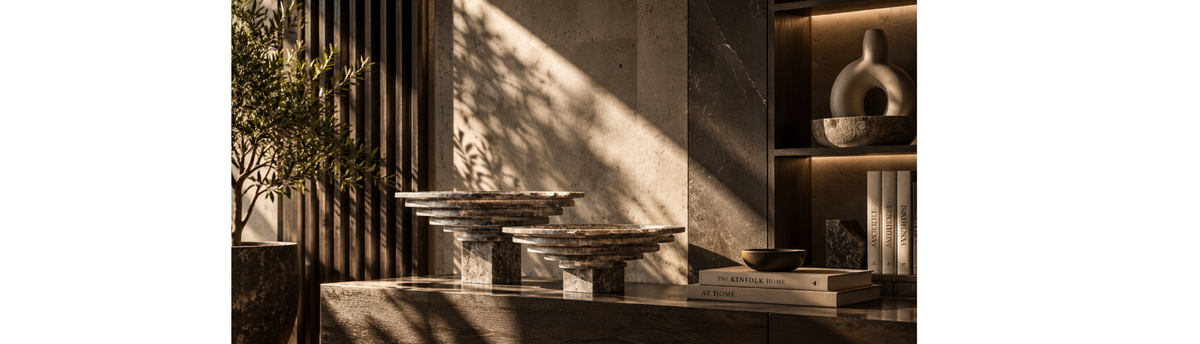

Minimal interiors are often misunderstood as spaces where very little is placed. In reality, successful minimal styling depends on choosing fewer objects with greater character. A sculptural vessel, a ceramic form or a piece of travertine can bring depth to a room without making it feel crowded.
This is where natural materials become important. Travertine carries organic markings, tonal variation and a sense of weight, while ceramic introduces a softer, tactile quality through its matte surfaces and shaped forms. When these materials are placed within a restrained interior, their texture becomes part of the visual experience. For a broader understanding of how luxury decor and accessories can be selected and styled in Indian homes, explore Spacio's complete guide to luxury home decor accessories for Indian homes.
The approach is closely connected to the quiet beauty found in Wabi-Sabi, the warmth of Nordic and Scandinavian interiors, and the balanced simplicity of Japandi design. The common thread is not the absence of decoration. It is the idea that every object should have a reason to be there.
Table of Contents
- The Beauty of Natural Materials in Minimal Interiors
- Why Travertine Brings Visual Depth
- Ceramic as a Sculptural Material
- How Light Reveals Materiality
- Wabi-Sabi and the Beauty of Imperfection
- Nordic and Scandinavian Influence
- Japandi: Where Warmth Meets Restraint
- 101 Copenhagen and Sculptural Minimalism
- How to Style Sculptural Objects Without Clutter
- Where Travertine and Ceramic Objects Work Best
- Combining Natural Materials in a Minimal Interior
- Common Mistakes When Styling Minimal Decor
- Frequently Asked Questions
- Conclusion
The Beauty of Natural Materials in Minimal Interiors
Minimal interiors rely heavily on proportion, negative space and materiality because there are fewer objects competing for attention. This makes the character of each individual piece more visible. A decorative object does not need an elaborate pattern or strong colour to make an impression. Its form, surface and relationship with light can be enough.
Travertine and ceramic are particularly effective in this setting because both materials bring visual interest without depending on decoration. Travertine can show natural tonal shifts, pores and organic markings, while ceramic can range from smooth and restrained to softly irregular and sculptural. These details become part of the composition.
The result is a quieter form of decor in which objects feel collected rather than accumulated. Instead of filling a console, shelf or coffee table, the stylist selects a small number of forms and gives each one enough surrounding space to be appreciated.
Minimal styling is not about removing personality from a room. It is about giving the right objects enough space to show their personality. When material, scale and light are considered together, even a restrained arrangement can feel rich and layered.
Why Travertine Brings Visual Depth
Travertine has a naturally tactile quality that makes it particularly interesting in contemporary interiors. Its surface can contain subtle variations in tone, grain, pores and markings, meaning that two pieces made from the same natural stone can still have individual character.
In a minimal room, these variations are valuable. A neutral travertine object does not simply sit against a neutral background. Its surface creates small changes in tone and texture that become visible as the light moves across it. This makes travertine useful for sculptural decor. Stepped forms, rounded bowls, pedestal-like shapes and other strong silhouettes can introduce visual weight without introducing a loud colour. The material itself becomes the detail.
Travertine also works naturally with other quiet materials. Dark timber can make its lighter tones more pronounced. Stone surfaces can create continuity. Linen and other soft textiles can balance its hardness, while brushed or dark metals can introduce a subtle contrast. The key is not to match every surface. Minimal interiors often become more interesting when materials are related through tone and texture rather than through exact repetition.
Ceramic as a Sculptural Material
Ceramic has a different visual language from stone. It can appear softer, lighter and more fluid, even when the form itself is substantial. Its ability to take on rounded, abstract or organic shapes makes it especially useful when an interior needs a sculptural element without introducing visual heaviness.
Matte ceramic is particularly suited to minimal and Japandi-inspired interiors because it absorbs rather than strongly reflects light. This creates a softer relationship with the surrounding space. A ceramic vessel may look almost monochromatic in one moment and reveal subtle tonal differences when daylight or artificial light moves across its surface. This is why ceramic should not be treated simply as a container. In contemporary styling, a ceramic object can function more like a small piece of sculpture. Its silhouette, opening, curve, volume and surface can be appreciated even when it has no flowers or other decorative additions.
The same principle applies to sculptural ceramic objects with deliberately irregular or organic forms. Their appeal comes from the interaction between shape and space. The empty area around the object becomes just as important as the object itself.
How Light Reveals Materiality
One of the most compelling aspects of natural materials is the way they change under different lighting conditions. The objects may remain physically unchanged, but their appearance can shift considerably between morning daylight, soft afternoon light and evening illumination. Travertine is particularly responsive to directional light. Its natural markings and stepped surfaces can create highlights and shadows that emphasise the form. A layered travertine object can therefore appear almost architectural in silhouette during one part of the day and softer and more tonal later in the evening.
Ceramic behaves differently. A matte ceramic surface tends to diffuse light, producing gentle transitions rather than sharp reflections. Curved forms can therefore reveal themselves gradually as light moves across them.
This relationship between light and material is one of the reasons minimal interiors do not need a large number of decorative objects. A single sculptural piece can create changing visual interest throughout the day simply because its surface responds to light. At night, decorative lighting becomes equally important. A warm source positioned near a textured object can reveal relief, edges and tonal variation while creating a more intimate atmosphere. The objective is not to illuminate every object equally. Selective light allows certain materials to become part of the room's visual rhythm.
When styling a room with natural materials, I look at how the surface will appear at different times of the day. Texture is not static. Light can reveal details that are almost invisible in a bright room and make a simple object feel much more sculptural in the evening.
Wabi-Sabi and the Beauty of Imperfection
The appeal of Wabi-Sabi lies in an appreciation of simplicity, natural materials, irregularity and the passage of time. In interiors, this can translate into spaces where surfaces are allowed to show character rather than being made completely uniform. Travertine naturally supports this approach. Its markings and tonal changes prevent it from feeling mechanically perfect. Ceramic can do the same through softly irregular shapes, tactile surfaces and forms that feel influenced by nature rather than strict geometry.
Wabi-Sabi does not mean that a room should look unfinished. It is better understood as an appreciation of authenticity and restraint. The interior can remain highly considered while allowing natural variation to become part of its character. This makes Wabi-Sabi particularly relevant to contemporary Indian interiors, where natural stone, timber, plaster-like surfaces and handcrafted-looking objects can create a sense of calm without making a space feel cold.
Nordic and Scandinavian Influence
Nordic and Scandinavian interiors are often associated with simplicity, natural materials, functional forms and a strong connection between comfort and visual restraint. Decorative objects in these spaces are rarely used simply to fill a surface. They contribute to the overall rhythm of the room. This makes sculptural objects particularly effective. A simple stone form on a dark console or a ceramic object on an open shelf can provide the contrast needed to keep a restrained room from feeling flat.
Scandinavian styling also demonstrates the importance of tonal layering. A room does not need strong colour contrast to have depth. Different shades of beige, grey, stone, brown, charcoal and off-white can work together when their textures and proportions vary. For a deeper look at how sculptural forms and Nordic minimalism can work together, explore Spacio's guide to refined interiors where sculptural elegance meets Nordic minimal decor.
Travertine and ceramic fit naturally into this palette. Their material character provides the variation that colour might otherwise provide, allowing the room to remain calm while still feeling visually considered.
Japandi: Where Warmth Meets Restraint
Japandi interiors bring together the restraint associated with Japanese design and the warmth associated with Scandinavian interiors. The result is often calm, tactile and uncluttered, but never empty.
Materiality plays a central role. Natural timber, stone, ceramic, linen and muted finishes create layers without relying on strong patterns. Sculptural objects can then introduce personality while maintaining the overall sense of quiet.
In a Japandi-inspired living room, for example, a substantial travertine object can sit against dark timber, while a matte ceramic form introduces a softer silhouette nearby. The composition becomes interesting through the contrast between weight, shape and surface rather than through colour alone. This is also where negative space becomes important. A small number of carefully positioned objects often feels more intentional than a collection of similar pieces spread across every available surface.
101 Copenhagen and Sculptural Minimalism
The design language of 101 Copenhagen fits naturally into this conversation. The Danish design brand is associated with an interest in textures, shapes and colours, with a visual language that connects Scandinavian design with Wabi-Sabi and Japandi influences.
What makes this approach relevant to minimal decor is the way an object can be appreciated as a form in its own right. A vase, bowl or sculptural object does not have to perform a purely functional role. Its proportions, surface and silhouette can contribute to the room before anything is placed inside it. This is particularly effective in interiors where the palette is restrained. A sculptural object in stone, ceramic or another tactile finish can create a focal point without breaking the calm of the space.
For Spacio, this makes 101 Copenhagen a natural reference point when discussing contemporary minimal decor: the object is important, but the surrounding space remains equally important.
How to Style Sculptural Objects Without Clutter
The easiest way to make minimal decor feel unsuccessful is to treat every empty surface as an invitation to add another object. Sculptural styling works best when the composition has enough negative space for the individual forms to remain visible.
Start With One Strong Form
Begin with the object that has the greatest visual weight. This could be a large travertine bowl, a stepped stone form or a sculptural ceramic vessel. Place it first and observe how much visual space it needs before adding anything else.
Create Variation in Height
When several objects are used together, vary their height rather than placing everything at the same level. A low bowl, a taller ceramic vessel and a smaller sculptural object can create a more natural visual rhythm than three objects of similar proportions.
Balance Visual Weight
Travertine has a sense of solidity. Ceramic can feel lighter depending on its form and finish. Combining the two can create balance, particularly when the heavier object is placed against a visually quieter background.
Leave Enough Negative Space
Negative space is not wasted space. It allows the eye to move around an object and makes the overall composition feel calmer. This is especially important with sculptural pieces because their form needs room to be understood.
Use Light to Define the Composition
Natural daylight can reveal surface variation, while a carefully positioned decorative light can create shadows and highlights after dark. Rather than lighting every object equally, allow light to fall naturally on the pieces that form the visual focus.
Where Travertine and Ceramic Objects Work Best
The beauty of these materials is that they can move easily between different rooms. Their neutral tones make them adaptable, while their sculptural qualities allow them to contribute more than colour alone.
Living Rooms
In a living room, a substantial travertine or ceramic object can anchor a coffee table, console or open shelf. The key is to consider the object in relation to sofas, rugs, artwork and lighting rather than styling it as an isolated centrepiece.
A larger sculptural object can also work particularly well in a quiet corner where its silhouette can be appreciated against a plain wall or textured surface.
Dining Rooms
Dining rooms benefit from objects that create a focal point without interfering with the function of the table. A low sculptural bowl or stone object can become a restrained centrepiece, while a ceramic form can add height to a nearby sideboard.
The combination of natural materials, soft lighting and a considered table setting can create an atmosphere that feels refined without becoming formal.
Bedrooms
Bedrooms require restraint because too many decorative elements can make the space feel visually active. Small ceramic forms, a low stone object or a sculptural piece on a bedside table can introduce personality without overwhelming the room.
Soft textiles, timber and warm lighting can balance the harder surface qualities of stone and ceramic.
Entryways and Console Tables
A console is one of the easiest places to introduce sculptural decor because it provides a defined horizontal surface against which an object can be composed. A substantial travertine form can establish the visual anchor, while a smaller ceramic object can provide contrast.
The same principle applies to other decorative accessories: each object should have enough space around it to remain legible as part of the composition.
For broader guidance on combining objects such as vases, sculptures, books and other decorative pieces, explore Spacio's guide to mixing vases, sculptures, books and decorative objects in luxury interiors.
Combining Natural Materials in a Minimal Interior
The most successful minimal interiors rarely depend on a single material. Instead, they create subtle relationships between surfaces that differ in texture, density and reflectivity.
| Material | Visual Character | Works Well With |
|---|---|---|
| Travertine | Natural markings, tonal variation and visual weight | Dark timber, linen, stone, ceramic and dark metal |
| Ceramic | Soft matte texture and sculptural forms | Timber, stone, glass and neutral textiles |
| Timber | Warmth and natural grain | Travertine, ceramic, linen and metal |
| Linen | Soft texture and understated warmth | Stone, ceramic, timber and muted palettes |
| Dark metal | Contrast and visual definition | Light stone, ceramic and timber |
The objective is not to make every material look similar. Contrast is useful when it is controlled. A rough stone surface against smooth ceramic, or warm timber against pale travertine, gives the eye enough variation to stay interested while the overall palette remains quiet.
Build the Material Story Before Adding More Objects
When styling a minimal interior, begin by identifying the dominant materials already present in the room. Then choose decorative objects that complement those materials through texture, tone or form. Spacio's decor and accessories collection can be explored as a broader source of vases, sculptures, bowls and other objects that support layered interior styling.
Common Mistakes When Styling Minimal Decor
Using Too Many Objects
Minimal styling loses its impact when every surface is filled. A small collection of strong forms is usually more effective than a large group of objects competing for attention.
Ignoring Scale
A beautifully designed object can still look wrong when it is too small for its surroundings. Consider the size of the console, shelf, coffee table or wall before selecting the object. Sculptural pieces need enough visual presence to relate to the furniture around them.
Making Everything Match
Travertine does not need to be paired only with other stone. Ceramic does not need to sit beside ceramic. The strongest compositions often come from carefully controlled differences in texture and material.
Ignoring Light
Natural materials are experienced through light. A surface that looks flat in bright overhead lighting may become much more expressive when directional daylight or softer evening illumination creates shadows across it.
Styling Simply to Fill Space
Every decorative object should contribute something: scale, texture, contrast, rhythm, shape or atmosphere. If an object has been added only because a surface feels empty, it may not belong there.
Frequently Asked Questions
What is minimal decor in interior styling?
Minimal decor uses a carefully selected number of objects to create visual interest without overcrowding a room. The focus is on proportion, material, texture, form and negative space rather than the quantity of accessories.
Why is travertine suitable for minimal interiors?
Travertine brings natural tonal variation, organic markings and tactile texture without requiring strong colour or decorative patterns. Its surface can add depth while keeping the overall palette restrained.
Why are ceramic objects popular in Japandi and Scandinavian interiors?
Ceramic objects can introduce soft, sculptural forms and matte textures that work naturally with timber, stone, neutral textiles and restrained colour palettes. Their form can provide visual interest without making the room feel busy.
How does lighting change the appearance of stone and ceramic decor?
Light reveals the texture, edges and tonal variations of natural materials. Directional light can emphasise the relief and markings of travertine, while softer light creates gentle transitions across matte ceramic surfaces.
How does Wabi-Sabi influence minimal interior styling?
Wabi-Sabi encourages an appreciation of simplicity, natural materials, irregularity and authentic surface character. In interiors, this can translate into restrained compositions where natural variations in stone, ceramic and other materials become part of the design.
What is the relationship between Japandi and minimal decor?
Japandi combines elements of Japanese restraint with Scandinavian warmth. Natural materials, muted colours, functional forms and carefully selected decorative objects help create interiors that feel calm, tactile and uncluttered.
Where can I see and buy minimal decor and sculptural objects for japandi style interiors in Mumbai?
Homeowners and interior designers looking for minimal decor, sculptural art objects, Wabi-Sabi decor and Japandi-inspired accessories in Mumbai can explore Spacio's Mumbai store at 3BK, Laxmi Industrial Estate, New Link Road, Andheri (West), Mumbai 400 053. The store brings together a curated selection of luxury decor and accessories, including sculptural forms, vases, art objects and pieces suited to contemporary interiors where material, proportion and restraint are important. Visit the Spacio Mumbai store page to explore the store and location. Seeing larger decorative objects in person can also help when judging their scale, texture and finish within an actual showroom setting.
Where can I buy Wabi-Sabi and Japandi-inspired decor in Kolkata?
Where can I buy Wabi-Sabi and Japandi-inspired decor in Kolkata?
Those looking for Wabi-Sabi decor, Japandi accessories, Scandinavian-inspired decor and sculptural art objects in Kolkata can explore Spacio's Kolkata store at 86B, Topsia Road (South), Kolkata 700046. The store provides a local destination for discovering luxury interior objects, decorative accessories and sculptural pieces that can be used to create calm, material-led interiors. Visit the Spacio Kolkata store page to explore the store and location.
Can I buy minimal decor and sculptural art objects online in India?
Yes. Spacio's collection of minimal decor, sculptural art objects and decorative accessories is also available to explore online. Homeowners across India can browse the wider collection of vases, sculptures, art objects, bowls, decorative pieces and other interior accessories through Spacio's online store. This is particularly useful when searching for specific material, form or design influences such as ceramic decor, sculptural objects, Scandinavian decor, Wabi-Sabi-inspired pieces and Japandi accessories. Product details and images can help with initial selection, while the Mumbai and Kolkata stores provide an opportunity to experience selected pieces in person. Shop Spacio collections online.
Conclusion: Let Materials Become the Decoration
Minimal interiors do not need to be empty to feel calm. They need enough restraint for the right materials, forms and objects to be seen clearly. Travertine brings the visual character of natural stone, while ceramic introduces softer surfaces and sculptural silhouettes.
Wabi-Sabi, Nordic and Scandinavian design, and Japandi all offer useful ways of thinking about this approach. Their shared lesson is that material, proportion and restraint can create richness without excessive decoration.
Light then completes the composition. As daylight moves across stone or a warm evening glow falls onto matte ceramic, the same object can reveal different textures, shadows and tonal variations. This changing relationship between light and material is what gives a minimal interior much of its quiet depth.
The goal is therefore not to fill a room with beautiful objects. It is to select forms that have enough character to stand on their own, give them space to breathe and allow their materiality to become part of the interior.
Discover 101 Copenhagen and other curated decor and art objects at Spacio Collections, selected for contemporary interiors where material, form and restraint matter.
Explore 101 Copenhagen


