
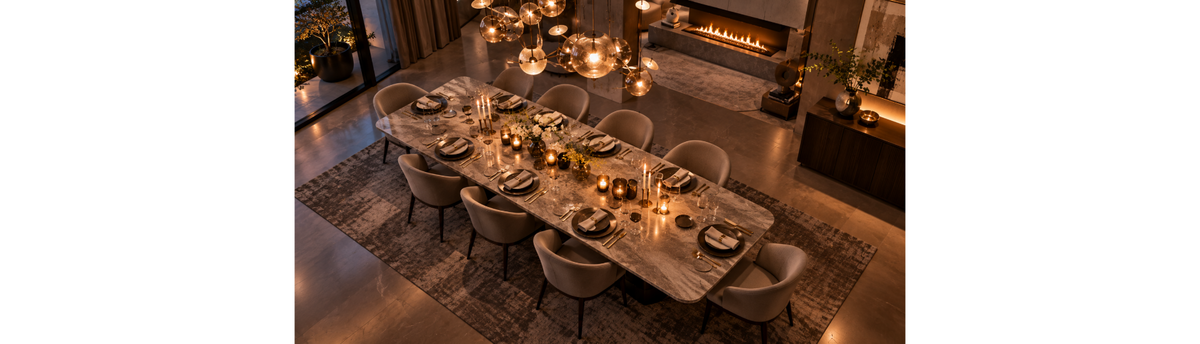

Dining rooms are among the most interesting spaces to style because they are designed around an activity rather than simply around furniture. A living room can be arranged for conversation and a bedroom for rest, but a dining room has to bring people together around one central point. The table becomes the physical centre of the room, while lighting, fire, materials and decor determine how that gathering feels.
This becomes even more important after sunset. Daylight reveals the interiors of the room, the dining table, chairs, walls and materials. Evening light changes the experience completely. A chandelier draws the eye towards the table. Candlelight makes the setting feel closer and more intimate. A fireplace can introduce movement somewhere beyond the table. Glassware catches small reflections. Metallic surfaces begin to glow. Sculptures and vases become part of the play between light and shadow. That is why luxury dining room styling should not begin with the question of which chandelier, fireplace or decorative object to buy. It should begin with a more important question: How should the dining room feel when people are actually sitting around the table?
Once that experience is defined, the relationship between decorative lighting, fireplaces and decor accessories becomes much clearer. The chandelier is no longer just a light above the table. The fireplace is no longer just a feature on a wall. A vase, sculpture or candle stand is no longer simply something placed in an empty space. Each element becomes part of the dining experience. This is particularly relevant to contemporary Indian homes, where dining rooms can range from compact apartment spaces to large formal dining rooms, private dining areas, open-plan interiors and hospitality-inspired residences. The same principles can also be applied to dining areas in luxury hotels, private clubs and other spaces where food, conversation and atmosphere come together.
The strongest dining rooms are not the ones with the greatest number of beautiful objects. They are the ones where the table, chandelier, fire, materials and decorative details appear to have been considered together.
A dining room should be designed around the experience of sitting at the table. I first look at where the eye should go, how the lighting changes in the evening and how people will interact across the table. The chandelier, fireplace and decorative objects should then support that experience rather than compete with one another.
Throughout this guide, the dining table is treated as the social centre around which three connected styling layers are built: decorative lighting establishes the visual hierarchy, fire introduces movement and atmosphere, and decor accessories provide materiality and personality. The table gives these layers their context, while the chandelier, fireplace and decorative objects are selected in relation to the table, the room and the way people actually use the dining space.
Table of Contents
- Why Dining Room Luxury Depends on Atmosphere
- The Dining Table Is More Than a Table
- The Role of Decorative Lighting in a Dining Room
- Choosing a Chandelier Around the Dining Table
- Layering Dining Room Lighting
- The Role of a Fireplace in a Dining Room
- Where Should a Fireplace Go in a Dining Room?
- Choosing the Right Fireplace Experience
- Where Vastu Fits Into Dining Room Fireplace Planning
- How the Fireplace and Dining Table Should Relate
- Building the Fireplace Feature Wall
- Styling the Dining Table With Decor Accessories
- Creating a Dining Table Centrepiece
- Candles and Candle Stands in Dining Room Styling
- Using Vases, Sculptures, Bowls and Platters
- Styling the Dining Sideboard
- Materials That Respond to Fire and Light
- Sightlines, Conversation and Proportion
- Designing for Day and Evening
- Dining Rooms in Open-Plan Indian Homes
- Styling Large and Formal Dining Rooms
- Styling Smaller Dining Rooms
- Styling a Dining Room for Entertaining
- Styling the Wall Behind the Dining Table
- Fire, Light and Decor: Three Layers, One Dining Room
- Dining Room Styling Across Indian Cities
- Common Dining Room Styling Mistakes
- Navin Kanodia's Principle for Dining Rooms
- Frequently Asked Questions
- Final Thoughts
Why Dining Room Luxury Depends on Atmosphere
A dining room has a different emotional rhythm from most other rooms in a home. People do not simply enter it, use it and leave. They sit together. Meals take time. Conversations continue after the food has been served. Guests notice one another across the table. The lighting becomes part of the evening. This makes atmosphere as important as furniture and finishes.
This is why the best luxury dining room design is rarely achieved by filling the room with expensive furniture and decorative objects. The room needs a clear visual hierarchy. The dining table has to feel important without becoming isolated. The chandelier needs enough presence to define the table without overwhelming it. Decorative lighting needs to create depth beyond the central light. A fireplace, where appropriate, can introduce movement and warmth at another point in the room. Decor accessories then provide the smaller-scale details that make the setting feel personal.
In other words, dining room styling is about relationships.
A chandelier can be beautiful on its own and still be wrong for a particular dining table. A fireplace can be impressive on a showroom wall and still feel oversized in a dining room. A sculpture can be exceptional as an object and still obstruct conversation when placed at the centre of a table. The quality of the final room depends on how these elements behave together.
Even the same dining room can feel completely different at 11 in the morning and 9 at night. During the day, natural light may make the room feel open and bright. In the evening, the chandelier becomes more prominent, the table becomes a pool of light, the fireplace can begin to glow and reflective surfaces start catching small points of illumination.
That change is not something to solve after the interior is finished. It should be part of the styling brief from the beginning.
A dining room should not be judged only when all the lights are switched on. I like to see how the room behaves at different levels of light. The most successful spaces reveal more character as the evening progresses rather than becoming simply darker.
The Dining Table Is More Than a Table
When styling a dining room, the table should be treated as the social centre of the interior. Its size, shape, material and position influence almost every other decision in the room. The chandelier is selected in relation to it. The centrepiece is placed on it. The surrounding chairs determine the amount of space available for movement. The sideboard provides a secondary surface because the table should not have to carry every decorative object.
This is also why dining table styling is more demanding than styling a console or coffee table. A console can be decorative almost entirely for visual reasons. A dining table has to remain useful while people are sitting around it.
There must be room for plates, serving dishes, glasses and movement. People need to see one another across the table. A centrepiece should create interest without becoming a barrier. Candle stands can introduce height, but not so much that they obstruct conversation. Decorative objects need to feel intentional without occupying all the usable surface.
The table therefore has two identities. During the day, it is an important piece of furniture. During dinner, it becomes the centre of an experience.
That distinction changes the way it should be styled.
The dining table is therefore the starting point for the wider composition. The chandelier or dining room light is selected in relation to the table's shape and scale. A dining room fireplace is positioned according to the table's sightlines, the surrounding walls and the atmosphere the room needs. Dining table decor and centrepieces then work at a smaller scale, while the dining sideboard provides a separate surface for sculptures, vases, bowls and other decorative objects.
This creates a clear relationship between the major categories: dining table and chairs establish the furniture foundation; chandeliers and decorative lighting establish the visual hierarchy; the fireplace creates a secondary atmospheric focal point; and decor accessories complete the composition. Each category has a different job, but none should be selected without considering the others.
This is why choosing a luxury dining table should happen before finalising the chandelier, centrepiece and surrounding decor. The table's shape, length, material and visual weight influence the scale of the dining room light, the proportion of the fireplace wall and the type of centrepiece that will sit comfortably on the surface. In a larger dining room, the table also needs enough presence to remain the social centre when a chandelier and fireplace are both visually strong.
The Role of Decorative Lighting in a Dining Room
Among all the elements used in dining room styling, decorative lighting has perhaps the greatest ability to change the character of the room within minutes. Switch a sculptural chandelier on at full brightness and the dining room becomes functional. Lower the surrounding illumination and keep the table light controlled, and the same room can feel intimate, layered and more sophisticated.
This is why dining room lighting ideas should go beyond choosing a visually attractive fixture. The light needs to perform several jobs. It should define the dining table, provide enough illumination for dining, create visual depth around the room and work with other sources of light rather than overpower them.
A decorative light also has a second life when it is switched off. During the day, a sculptural chandelier, pendant or wall light is part of the interior composition. It occupies visual space, establishes proportion and contributes to the character of the room. At night, it becomes a source of illumination.
This dual role is particularly valuable in a luxury dining room because the lighting fixture does not have to be hidden when it is not in use. It can remain one of the room's important design elements throughout the day.
The wider decorative lighting collection can therefore be viewed not simply as a lighting category but as part of the furniture and decor composition of the dining room.
For this reason, dining room decorative lighting should be considered as part of the room's overall composition rather than as a fixture chosen in isolation. The chandelier, wall lighting and other illuminated elements should work together with the dining table, fireplace and surrounding decor to establish visual hierarchy.
Choosing a Chandelier Around the Dining Table
The chandelier is often the first element people notice when they enter a dining room. It is also the element most likely to be chosen independently of everything else. That is where many dining rooms begin to lose proportion.
A chandelier should be selected in relation to the dining table, not simply in relation to the ceiling. The table determines the visual width below it. The seating arrangement determines the social zone. The room determines the amount of visual weight the chandelier can carry.
A long rectangular dining table can support a linear chandelier, an elongated sculptural suspension or a composition of several lights. A round table creates a different opportunity. A central chandelier can reinforce the geometry of the table and establish a strong vertical axis from ceiling to tabletop.
An oval table occupies a middle ground. It has the length of a rectangular table but softer ends, allowing either a linear fixture or a more organic sculptural form depending on the room.
| Dining table | Lighting direction | What to consider |
|---|---|---|
| Rectangular | Linear, elongated or multi-light composition | Relate the length and visual weight of the light to the table rather than choosing a fixture that is too short. |
| Round | Central pendant or sculptural chandelier | Use the central axis to connect the ceiling, table and centrepiece. |
| Oval | Linear or organic sculptural form | Consider whether the room needs stronger geometry or softer movement. |
| Large formal table | Substantial chandelier or layered composition | Make sure the light has enough visual presence to hold the scale of the room. |
| Compact dining table | Proportionate pendant or smaller sculptural light | Preserve visual openness and avoid making the ceiling element dominate the room. |
The same principle applies whether you are choosing a dining room chandelier, dining table pendant or decorative dining room light. The fixture should be understood as part of the dining composition rather than as an isolated ceiling product. Its shape, length, height and visual weight should relate to the dining table below and to any fireplace, artwork or decorative wall treatment visible beyond it.
Height matters as much as width. A chandelier that hangs too high can lose its relationship with the table. One that hangs too low can interfere with sightlines and make the room feel compressed. The correct position depends on the fixture, ceiling height, table dimensions and the overall composition.
Most importantly, the chandelier should not be selected before considering what else is competing for attention.
If the dining room already has a substantial fireplace, dramatic artwork and a highly expressive table, the chandelier may need to provide elegance through form rather than visual excess. If the walls are restrained and the furniture is quiet, the chandelier may be the opportunity to introduce a stronger sculptural element.
This is the difference between selecting a chandelier and styling a dining room around one. For a wider look at the category, explore Spacio's luxury dining room chandeliers and the guide to chandeliers for dining rooms.
Kinetic Lights for a Dining Table
Kinetic lighting can bring another dimension to the dining table by introducing movement into an otherwise static lighting composition. Unlike a conventional pendant or chandelier that remains visually fixed, a kinetic light can create changing patterns, movement and reflections above the table, making it particularly engaging during dinners and entertaining. This can be especially effective when the dining room is designed around the experience of gathering, because the lighting becomes part of the atmosphere rather than simply illuminating the table.
A kinetic chandelier or moving decorative light should still be selected in relation to the table's size, shape and seating arrangement, so that its movement enhances the setting without interfering with conversation or sightlines. For homeowners looking for a more contemporary and experiential approach to dining room decorative lighting, kinetic lights for dining tables can therefore become an important part of the dining experience.
How the Dining Table, Chandelier and Centrepiece Work Together
The dining table, chandelier and centrepiece form one vertical composition. The table establishes the horizontal base, the chandelier creates the strongest element above it, and the centrepiece provides the smaller-scale detail between the two. Their proportions should therefore be considered together rather than selected independently.
A large sculptural chandelier may call for a quieter centrepiece. A restrained pendant can allow a stronger vase, sculpture or candle arrangement on the table. The table material matters as well: a richly patterned stone surface may need fewer decorative objects, while a quieter timber or glass table can support a more expressive centrepiece.
This relationship is one of the foundations of dining table styling. The objective is not to make the chandelier, table and centrepiece equally noticeable, but to give each one a clear place within the composition.
Layering Dining Room Lighting
A chandelier should rarely be expected to do everything. A dining room becomes more sophisticated when the lighting is divided into layers, with each layer performing a different function.
The first layer is the light directly associated with the dining table. This is usually the chandelier or pendant. It establishes the main visual focus and provides the light needed for the meal.
The second layer exists around the table. Wall lights, floor lamps, console lighting and other decorative fixtures can illuminate surrounding surfaces and prevent the room from disappearing into darkness outside the dining zone.
The third layer is atmospheric. This is where candlelight, a fireplace, low-level accent lighting and the reflections from glass and polished materials become important.
These layers should not all have the same intensity.
If every source is equally bright, the eye has nowhere to settle. If the chandelier is extremely bright while everything around it is dark, the room can feel disconnected. If the fireplace is stronger than the dining table, the visual centre shifts away from the place where people are actually gathering.
The objective is controlled hierarchy.
| Lighting layer | Primary purpose | Possible elements |
|---|---|---|
| Dining table lighting | Defines the social centre | Chandelier, pendant or sculptural suspension |
| Peripheral lighting | Adds depth and illuminates surrounding surfaces | Wall lights, table lamps, floor lamps and sideboard lighting |
| Firelight | Introduces movement and visual warmth | Fireplace, candles and LED candles |
| Reflective light | Creates subtle highlights and sparkle | Glass, crystal, polished metal and reflective decorative objects |
This layered approach is especially useful in dining rooms that are used for both everyday meals and entertaining. The lighting can change the perceived formality of the room without changing the furniture.
The Role of a Fireplace in a Dining Room
A fireplace has a different role in a dining room from its role in a living room. It does not necessarily need to become the place where people sit around the fire. Instead, it can become part of the visual landscape behind the people who are dining.
This creates an interesting relationship. The dining table is the social centre, while the fireplace can become the atmospheric centre.
That distinction is important.
If the fireplace is made too dominant, it can pull attention away from the table. If it is too small or poorly positioned, it can look like an afterthought. The strongest installations allow the fire to contribute to the room without competing with the people and activity around the table.
A fireplace can also change the perception of a large dining room. A long wall can feel empty when it has only furniture at floor level. A horizontal fireplace introduces another visual line and gives the eye a point of movement. In a more intimate dining room, a smaller fireplace can create a sense of warmth without requiring a large installation.
The wider Luxury Fireplaces in India guide explains the broader considerations around fireplace types and applications. For a dining room, however, the more specific question is: what should the fire contribute to the dining experience?
It might create a focal point on a large wall. It might establish a transition between the dining and living areas. It might introduce evening warmth visually in an air-conditioned home. It might provide a sense of occasion during entertaining. Or it may simply give a quiet wall more depth.
There is no need for the fireplace to perform all of these roles simultaneously.
Where Should a Fireplace Go in a Dining Room?
When considering dining room fireplace ideas, placement should begin with the dining table, sightlines and circulation rather than with an empty wall. The fireplace may sit directly opposite the table, on an adjacent wall or within a feature that connects the dining and living areas. What matters is how the fire relates to the people seated at the table, the chandelier above them and the other visual elements in the room.
One of the strongest positions is on the wall directly visible from the dining table. This creates a clear relationship between the people sitting at the table and the fire beyond them. The fireplace becomes part of the dining experience without taking over the table itself. An adjacent wall can create a different effect. Here, the fire becomes a secondary visual point that is discovered as people move through the room. This can work particularly well when the main dining wall already has artwork, a large mirror or another important design feature.
In open-plan homes, a fireplace can also form part of a partition between the living and dining areas. This is particularly useful when the same fire feature needs to be visible from both spaces. The fireplace then performs a spatial role as well as a decorative one. The installation height also matters. A low horizontal fireplace can sit comfortably below artwork or a restrained wall treatment. A taller installation may need greater wall volume around it. The correct scale should be judged from the dining chairs, not just from the doorway.
There is another important consideration: what happens when the fireplace is not being used.
A dining room fireplace should still belong to the interior when the flame is off. The surrounding material, wall treatment and decorative composition therefore matter almost as much as the fire itself.
Choosing the Right Fireplace Experience
The right fireplace for a dining room depends on what the homeowner actually wants the fire to do. A fireplace chosen primarily for visual atmosphere may require a different approach from one chosen to provide heat. A real-flame installation also introduces considerations that do not apply to a non-combustion visual fire experience.
For a contemporary dining room, water-vapour and suitable electric fireplace formats can be considered when the primary objective is visual ambience rather than additional heating. These formats can be useful in air-conditioned urban homes where the movement and glow of fire are desired without making heat the main purpose of the installation.
Electric fireplaces with heat can have a different role where additional warmth is genuinely useful. Bioethanol and gas fireplaces introduce real flame and therefore require their own installation, fuel, ventilation and safety considerations. Wood-burning fireplaces create yet another experience and require appropriate planning for the room and property.
The decision should therefore begin with the experience rather than the product.
| Desired dining experience | Design consideration |
|---|---|
| Visual fire and ambience | Consider fireplace formats where flame appearance and atmosphere are the primary objectives. |
| Fire with additional warmth | Consider a suitable electric or other heating-capable system according to project requirements. |
| Real-flame experience | Consider bioethanol or gas only after installation and safety requirements have been properly assessed. |
| Traditional fire experience | Wood-burning systems require appropriate room, ventilation and installation planning. |
| Compact dining room | Prioritise proportion and visual integration over maximum fireplace size. |
| Large formal dining room | A stronger fireplace composition can work when the wall and surrounding room have sufficient visual volume. |
The fireplace should therefore support the interior rather than dictate it. This is especially important in a dining room because the table remains the place where people gather.
For a broader framework on matching fireplace technology to room, climate, installation and intended fire experience, see how to choose the right fireplace for an Indian home.
Where Vastu Fits Into Dining Room Fireplace Planning
For many Indian homes, Vastu is considered when deciding where a fireplace should sit within the dining room. Traditional Vastu principles associate fire with the Agni element and commonly identify the south-east as the Agni zone. However, this should be considered alongside the dining layout, fireplace technology, installation requirements, circulation and the manufacturer's instructions.
In a dining room, Vastu therefore becomes part of the planning conversation rather than a styling decision made after the fireplace has been selected. The position of the fireplace still needs to work with the dining table, seating, sightlines, adjacent rooms and the visual hierarchy of the space.
For a broader discussion of fireplace placement and Vastu in Indian homes, see Spacio's guide to Vastu corrections with fireplaces in India.
How the Fireplace and Dining Table Should Relate
The relationship between the fireplace and dining table is one of the most important decisions in a dining room with fire. They should not compete for the same visual position.
The table is where the social activity happens. The fireplace is usually further away. This means the fire can provide a background focal point while the table remains the foreground centre.
Think of the composition in layers. In the immediate foreground are plates, glasses, flowers, candles and the people sitting at the table. Above them is the chandelier. Beyond them is the fireplace, artwork, feature wall or sideboard. Each layer is experienced at a different distance.
This layered view is what allows a dining room to contain several strong elements without becoming chaotic.
A dramatic chandelier and dramatic fireplace can work together if the table provides enough visual calm between them. A heavily veined stone fireplace wall can work with an expressive centrepiece if the chandelier is more restrained. A quiet fireplace wall can support a stronger chandelier and more sculptural tabletop styling.
The key is not to make every element equally important.
When a dining room has both a fireplace and a statement light, I do not want them to fight for attention. I think about where the eye lands first, where it moves next and what remains visible once people are seated. The room should have a hierarchy, but it should also have enough visual movement to remain interesting through the evening.
Building the Fireplace Feature Wall
A fireplace in a dining room does not always need to stand alone. In a well-composed interior, it can become part of a larger feature wall that brings together the fireplace, artwork, mirrors, materials, lighting and furniture. This approach is particularly useful when the dining room has a strong visual axis, because the wall can become the backdrop that gives the entire dining setting its sense of structure.
The fireplace can sit within a composition of stone, marble, timber, textured surfaces or a restrained painted finish. Artwork or a mirror can be positioned above it where the proportions allow, while a sideboard or carefully selected decorative objects can extend the composition horizontally. The objective is not to make every element compete with the fireplace, but to create a wall that feels considered even when the fire is switched off.
The relationship between the fireplace feature wall and the dining table also matters. A wide horizontal fireplace can reinforce the length of a rectangular dining table, while a more vertical composition can create height in a room with a smaller footprint. The chandelier above the table should then be considered as another part of the overall visual structure rather than as an unrelated statement.
A useful test is to look at the wall from the main seated positions around the dining table. If the fireplace appears as an isolated dark rectangle, the composition may need more supporting elements. If the wall has a clear focal point but still allows the dining table, chandelier and people around it to remain visually important, the balance is more successful.
A fireplace should not be treated as an isolated product on a wall. When it is integrated with the surrounding materials, artwork, furniture and lighting, it becomes part of the architecture of the dining experience.
Styling the Dining Table With Decor Accessories
Once the dining table, chandelier and broader lighting plan have been established, the next question is what should actually sit on the table. This is where dining table decor can either elevate the room or make it feel overworked.
The table should not be treated as another display surface that needs to be filled from end to end. It is still a working surface. Plates need to arrive. Serving dishes need to move. Glasses need space. People need to reach across it. More importantly, the people sitting around the table need to remain visually connected.
This means tabletop styling has to balance beauty with usability.
A sculptural vase may provide the strongest vertical element. A decorative bowl may give the composition a lower centre. A platter can introduce a long horizontal line. Candle stands can add movement and points of light. A small sculpture can provide personality. A tray can group several smaller pieces so that they read as one arrangement rather than a collection of unrelated objects.
None of these pieces should be selected simply because they are beautiful individually. The more important question is what they contribute to the composition already created by the table, chandelier and room.
For example, a highly sculptural dining table may need accessories with quieter forms. A very restrained table may provide an opportunity for a more expressive vase or sculpture. A chandelier with a strong organic shape may be balanced by more geometric tabletop objects. A richly veined stone table may need objects that allow the surface itself to remain visible.
This is why luxury decor accessories should be selected as part of the dining room composition rather than as individual purchases.
Creating a Dining Table Centrepiece
The centrepiece is usually the most visible decorative decision on a dining table, but there is no single formula for creating one. The right arrangement depends on the shape and size of the table, the height of the chandelier, the material of the tabletop and how the dining room is actually used.
A dining table centrepiece should also be chosen in relation to the chandelier above it. The light creates the strongest vertical element over the table, so the centrepiece should usually provide a complementary scale rather than compete with it. The same arrangement should also sit comfortably within the wider room, where the fireplace, sideboard and wall styling may already provide additional focal points.
A centrepiece also does not have to be one object. It can be a composition of several pieces that work together at different heights. A low bowl can sit beside a sculptural vase. Candle stands can create a vertical rhythm around them. A long platter can anchor the arrangement horizontally.
The important thing is to create a visual centre without making the table feel occupied from every direction.
Long Rectangular Dining Tables
Long rectangular tables offer the greatest opportunity for creating a composition that moves across the surface. A single small vase placed in the exact centre can sometimes feel lost, particularly when the table is substantial and the chandelier above it is large.
Instead, consider a composition with a stronger central element supported by lower pieces. A long decorative platter, a series of candle stands or two or three related objects can create a rhythm that acknowledges the length of the table without turning it into a continuous display.
The arrangement should still have gaps. Those gaps are important because they allow the eye to understand each object and prevent the table from reading as one dense block of decoration.
Round Dining Tables
A round table naturally concentrates attention towards its centre. This makes it particularly suited to a single strong sculptural object, a substantial vase or a carefully composed group of candles and decorative objects.
The chandelier above a round table can reinforce this central axis. When the light, centrepiece and table are properly proportioned, the three can form a very clear visual relationship from ceiling to tabletop.
However, the centrepiece should not become so tall or dense that it creates a physical barrier between people sitting opposite one another. The circular shape of the table encourages conversation, so the centre arrangement should support that quality rather than interrupt it.
Oval Dining Tables
Oval tables allow a more fluid approach. Their length can support a linear arrangement, while their curved ends prevent the composition from feeling overly formal.
A long low arrangement can work particularly well, especially when combined with candle stands or small sculptural objects. The aim is to follow the shape of the table rather than forcing a rectangular composition onto it.
Large Formal Dining Tables
A substantial formal dining table can support more visual weight, but size should never become an excuse to add more objects. The arrangement needs to become proportionately stronger, not necessarily more crowded.
A large sculptural vase, an elongated centrepiece or a carefully spaced collection of objects can hold the scale of a large room more effectively than many small decorative pieces.
The centrepiece should be judged from the dining chair, not just from the entrance to the room. If it looks beautiful when you walk in but blocks the person sitting opposite you, it has failed its most important test. Dining is a social experience, so the styling must leave conversation intact.
Candles and Candle Stands in Dining Room Styling
Fire in a dining room does not have to come from a fireplace. In fact, one of the most intimate forms of fire is already associated with the dining table: the candle.
A candle introduces a much smaller and more immediate form of movement. A fireplace can be seen across the room. A candle sits within the dining composition itself. Its flame is close to the food, glassware and people, making its effect more intimate.
This creates an interesting relationship between the two.
A fireplace can establish the background fire experience, while candles create the foreground fire experience. The chandelier then provides the designed light above the table. Together, they create different scales of illumination rather than repeating the same effect.
This is particularly useful when styling a dining room for an evening gathering. The fireplace can remain a quiet point of movement beyond the table while candles provide small pools of light closer to the guests.
Candle stands make this relationship even more interesting because they are both lighting elements and decor accessories. When the candles are unlit, the stands contribute height, material and sculpture. Once the candles are lit, they become part of the room's atmospheric lighting.
That dual role makes a well-designed candle stand particularly valuable in a dining room.
Real Candles or LED Candles?
Real candles and LED candles can both contribute to the visual language of an evening dining setting, although the experience is not identical.
A real candle provides a genuine flame with natural movement. The slight variation in brightness creates a quality that is difficult to reproduce completely. For a dinner where candlelight is intended to be part of the ritual, that flicker can become an important part of the atmosphere.
LED candles offer another option. They can recreate the visual presence of candlelight without a live flame and can be useful when the table needs to maintain a candlelit appearance for longer periods or where a live flame is not appropriate.
The styling principle remains the same: the candle is both light and object.
The holder, stand or vessel should therefore be considered with the same care as any other decorative object.
Creating Height With Candle Stands
One of the easiest ways to make a candle arrangement more interesting is to vary height. Several candle stands at exactly the same level can create a repetitive line. Different heights allow the points of light to sit at different levels within the composition.
But variation should be controlled. Too many tall candle stands can create a barrier across the table. The arrangement can begin to look theatrical rather than elegant, particularly when guests are seated.
A better approach is to combine one or two taller elements with lower objects and enough open space around them. The eye then moves through the arrangement rather than encountering a wall of objects.
This principle is especially useful when a dining table already has a substantial chandelier. The chandelier provides the strongest vertical element from above, so the candle stands should create a smaller-scale rhythm below rather than competing with it.
Using Vases, Sculptures, Bowls and Platters
Dining rooms provide an opportunity to use a wide range of decor accessories because there are several surfaces available: the dining table, sideboard, console, bar area and sometimes open shelving. The mistake is to treat all of these surfaces in the same way.
The dining table is a social surface. The sideboard is primarily a supporting styling surface. A console may be viewed from a distance. An open shelf can carry a collection. Each requires a different level of restraint.
Vases
Vases are among the most versatile dining room accessories because they can introduce height without requiring a large footprint. Their form can also become important when there are no flowers inside them.
A sculptural vase can therefore function as an object in its own right. On a long dining table, a pair of related forms can create balance without looking like identical decorative pieces. On a round table, one stronger vase can become the centre of the arrangement.
The material of the vase also matters. Glass can pick up the reflections from the chandelier and candlelight. Ceramic can provide a quieter, more tactile surface. Metal can reinforce finishes already present in the chandelier or furniture.
Sculptures
Sculptures & Art Objects introduce a different quality because they do not have an obvious functional purpose. Their role is purely visual, which makes scale and placement especially important.
A sculpture can provide the strong form needed on a quiet dining table or sideboard. It can also introduce movement where the furniture is predominantly rectilinear.
However, the sculpture should not be chosen only because it looks impressive on a shelf or showroom plinth. Its silhouette needs to work from multiple viewpoints because a dining room is experienced from several directions.
Decorative Bowls
Decorative Bowls provide a useful low-level layer. They can sit beneath a taller vase, hold a smaller decorative composition or simply provide a sculptural form across the table.
They are particularly useful when the chandelier and centrepiece already provide enough vertical emphasis. A low bowl can bring the eye back down to the surface of the table without adding another tall object.
Platters
Decorative platters introduce horizontal movement and can be particularly effective on long dining tables or sideboards. Their shape can echo the table itself, helping the decorative composition feel connected to the furniture.
A platter can also act as a visual boundary for smaller objects. Several candles or small decorative pieces placed within a platter can read as one considered composition rather than several unrelated objects.
For a deeper look at selecting decorative objects for luxury Indian interiors, the guide to luxury home decor accessories for Indian homes provides the wider framework for choosing pieces by scale, material, form and purpose.
Styling the Dining Sideboard
The sideboard is one of the most useful pieces of furniture in a dining room because it provides both practical storage and a second opportunity to build the room's decorative language.
It should not, however, become a second dining table.
When the dining table is already carrying a centrepiece, candles and tableware, the sideboard can take on a quieter supporting role. A sculptural vase, a decorative bowl, a table lamp, artwork or a carefully grouped collection can create visual interest without repeating the exact composition on the table.
This creates what can be called a secondary focal zone. The dining table remains the social centre, while the sideboard gives the eye somewhere to move when looking beyond the table.
This makes the dining sideboard an important part of the wider dining room composition rather than simply a storage piece. Sideboard decor can include a sculptural vase, artwork, decorative bowl, artistic glass, books, candle stands or a carefully grouped collection of objects. The aim is to create a secondary focal zone that supports the dining table without repeating the same centrepiece arrangement.
This becomes particularly important in larger dining rooms. Without supporting elements around the table, a large room can feel visually empty beyond the central furniture group. A sideboard composition can connect the dining table to the walls and surrounding interiors of the room.
The styling should still have hierarchy. One strong object can establish the focus, with smaller pieces supporting it. A collection of similarly sized objects placed in an unbroken line can make the sideboard look like a retail display rather than part of a lived-in interior.
The same principle applies to the space above the sideboard. Artwork, a mirror or another wall element should be considered together with the furniture and objects below it.
For a more detailed approach to styling dining surfaces, see how to style a dining table and sideboard with luxury home decor accessories.
How to Balance Dining Table and Sideboard Decor
The dining table and sideboard should be treated as two connected but different styling surfaces. The table is the social surface, so its centrepiece must preserve conversation and everyday use. The sideboard is the supporting surface, where taller or more sculptural objects can be used without interfering with the people seated around the table.
This difference creates balance. If the table carries a strong vase and candle arrangement, the sideboard may need a quieter composition. If the table is intentionally restrained, the sideboard can carry a stronger sculpture, artwork or collection of decorative objects. The two surfaces should relate through material, colour or form without becoming identical.
Materials That Respond to Fire and Light
The relationship between fire, decorative lighting and decor becomes much stronger when the materials in the room have been considered carefully. Light behaves differently on every surface. Some materials absorb it. Others reflect it. Some break it into smaller highlights, while others allow it to spread softly across their surface.
This is why material selection should not be separated from lighting selection.
Marble and Stone
Stone and marble can give a dining room a strong sense of permanence and visual weight. When used around a fireplace, they can provide a substantial background for the flame. Under evening lighting, natural variation in the stone can become more visible as light moves across the surface.
A heavily patterned marble, however, already contains considerable visual activity. Adding a very busy centrepiece, dramatic chandelier and numerous decorative objects can create too much competition. In such a room, restraint elsewhere allows the stone to remain part of the visual story.
Timber
Timber introduces a softer visual counterpoint to stone, glass and metal. It can make a dining room feel warmer and more grounded, particularly when the room contains a fireplace or substantial decorative lighting.
Dark timber can absorb some of the surrounding light, making candles and small points of illumination more visible. Lighter timber can reflect more ambient light and contribute to a brighter daytime composition.
Glass and Crystal
Glass and crystal are especially interesting in dining rooms because they interact with almost every source of light in the room. A glass vase may catch the chandelier above it. Glassware can reflect candlelight. Crystal can create small points of sparkle as guests move around the table.
These materials can therefore create movement without adding another large object.
Metal
Metallic finishes can create controlled highlights and can also establish connections between different parts of the room. A finish used on the chandelier may reappear in a candle stand, vase, sculpture or furniture detail.
The objective is not to make every metal identical. A dining room often feels more sophisticated when related finishes are allowed to vary slightly while remaining within the same visual family.
Textiles, Upholstery and Rugs
Dining chairs, curtains and rugs can soften the harder surfaces created by stone, glass and metal. This becomes particularly important in an evening setting because soft materials absorb some of the light and create a quieter visual background for the illuminated elements.
A dining room therefore becomes richer when hard and soft materials are allowed to work together. Fire provides movement. Glass provides reflection. Metal provides highlights. Stone provides weight. Timber provides warmth. Upholstery and textiles provide softness.
The lighting then reveals the differences between them.
Sightlines, Conversation and Proportion
One of the most important rules in dining table styling is also one of the easiest to overlook: the people around the table matter more than the objects on it.
A dining table is fundamentally social. People look across it while speaking. They pass food and drinks. They need to see one another's faces. This makes sightlines part of the interior styling process. A centrepiece that blocks the person sitting opposite is not successful simply because it looks beautiful from the entrance. A tall candle stand that creates a strong silhouette in a photograph may become inconvenient when six people are seated around the table. A large vase may look perfectly proportioned on its own but take away too much usable surface from the table.
This is why dining styling should always be tested from the seated position.
Look across the table. Look diagonally across it. Imagine several guests sitting around it. Consider what the chandelier looks like from those positions. Consider where the fireplace sits in the peripheral vision. Notice whether the centrepiece creates interest or simply blocks the view.
These are not small details. They determine whether the dining room remains comfortable after the styling has been completed.
Before finalising a dining table arrangement, sit in the chairs and look across the table. Check the centrepiece, candle stands and decorative objects from the same eye level as the people who will actually use the room. A dining table should remain visually interesting without becoming a physical or visual obstacle.
Designing for Day and Evening
A luxury dining room should be considered at more than one time of day. This is especially important when the design relies heavily on decorative lighting, fire and reflective decor accessories.
During daylight hours, the chandelier is primarily an object. Its shape, scale and material are visible without the illumination it provides. The dining table reveals its surface. Glass objects become transparent. Metallic finishes may appear sharper. The room may feel more spacious.
After sunset, the hierarchy changes. The chandelier becomes a source of light. Candle stands begin to glow. The fireplace introduces movement. Glass catches reflections. Stone becomes more directional as light moves across it. Darker surfaces can recede while illuminated objects become more prominent.
This means a dining room should never be judged only in daylight. Nor should it be judged with every light switched on at full intensity.
The real test is the transition. What happens when daylight fades? Which elements become important first? Does the chandelier still relate to the table? Does the fireplace become too dominant? Can the candlelight be seen? Does the sideboard disappear completely? Are the decorative objects still legible without becoming visually busy?
These questions reveal whether the room has been designed as an evening experience rather than simply illuminated after the fact.
The most successful dining rooms do not suddenly become beautiful when the lights are switched on. Their character gradually changes as daylight fades. Decorative lighting, fire, candlelight and reflective materials should reveal different parts of the room at different stages of the evening.
Dining Rooms in Open-Plan Indian Homes
Open-plan homes create an additional challenge because the dining room is often visible from the living room, kitchen or entrance. The dining area therefore needs to feel distinct without looking disconnected from the rest of the interior.
Decorative lighting can perform this role particularly well. A substantial chandelier can establish a visual boundary around the dining table without requiring a physical partition. It tells the eye that this is a separate zone even though the floor remains continuous. A fireplace can strengthen that relationship when it is positioned on a partition or adjacent wall. It can become visible from both the living and dining sides, giving the two areas a shared visual point while still allowing the dining table to remain the social centre.
Decor accessories then provide the finer connections. A material used on the dining table can be repeated in a sculpture or vase in the living room. A metallic finish from the chandelier can appear again in a decorative object nearby. The repetition should be subtle rather than identical.
This creates continuity across the open-plan space without making every room look the same.
Open-plan dining rooms also benefit from careful control of visual noise. Because several functional areas are visible at once, the dining table does not need to carry every decorative idea. The stronger the surrounding interior already is, the more disciplined the tabletop composition can become.
Styling Large and Formal Dining Rooms
Large dining rooms can support dramatic furniture, substantial chandeliers, fireplaces and larger decorative objects, but their scale also creates a different problem: visual distance.
A dining table that looks substantial in a furniture showroom can appear surprisingly small when placed in a large room. A chandelier that seemed dramatic at a lower ceiling can lose its presence when surrounded by a much larger volume.
This is where scale needs to be considered as a complete system.
The dining table needs enough visual weight for the room. The chandelier needs enough presence to establish the dining zone. The fireplace needs enough scale to hold its wall. The sideboard needs enough length or visual weight to balance the furniture. Decorative objects need enough size to remain visible from across the room.
But increasing scale does not mean increasing quantity.
A single substantial sculpture may be more effective in a large dining room than five small objects. A long sculptural chandelier may work better than several unrelated fixtures. A large fireplace feature can give an expansive wall authority without requiring additional decoration around it.
Large dining rooms therefore reward confidence in proportion and restraint in quantity.
Styling Smaller Dining Rooms
Smaller dining rooms require the opposite approach. The objective is not to make everything small. It is to ensure that every element has enough visual space around it.
A sculptural chandelier can still make a strong statement in a compact dining room because it uses vertical space rather than floor area. A carefully selected mirror or reflective surface can help light travel through the room. A compact centrepiece can give the table personality without reducing its usable surface.
If a fireplace is part of the brief, its scale needs to be considered very carefully. A fireplace that occupies too much of the wall can make a small dining room feel even smaller. A proportionate horizontal installation can sometimes provide the desired fire experience while keeping the wall visually calm.
The same principle applies to decor accessories. One sculptural vase or a small group of candles may create more impact than a crowded collection of small pieces.
In a compact dining room, negative space becomes part of the luxury.
Styling a Dining Room for Entertaining
Entertaining changes the way a dining room is experienced because guests do not necessarily enter the room with the same familiarity as the people who live there. The room has to communicate its atmosphere quickly.
The chandelier may be the first element that catches attention. The table setting becomes the next point of focus. Beyond the table, guests may notice a fireplace, artwork, a sideboard or a sculptural object. Once everyone is seated, the scale changes again: candlelight, glassware, food and conversation become the immediate experience.
This creates a sequence of visual moments. The entrance view should therefore not be the only view considered. A dining room needs to work from the doorway, from the dining chair and from the surrounding circulation paths.
This is also where candlelight becomes particularly effective. During a formal dinner, candles can reduce the visual distance between people and make the centre of the table feel warmer. A fireplace can provide a larger, slower-moving background glow while the candles operate at the intimate scale of the table.
The chandelier then holds the overall composition together.
These three sources of light are not redundant. They operate at three different distances: the chandelier works above the gathering, the candles work within the gathering and the fireplace can work beyond the gathering.
That is one of the most powerful ways to understand fire and lighting in a dining room.
Styling the Wall Behind the Dining Table
The wall behind a dining table can become one of the strongest visual surfaces in the room, but it should be designed in relation to the furniture rather than treated as an empty wall waiting for decoration.
It might carry a fireplace, artwork, a mirror, a material treatment, decorative lighting or a combination of these. Each choice changes the balance of the dining room.
A fireplace already provides movement and a strong focal point. A mirror introduces reflection and can amplify the surrounding light. Artwork adds colour, form and narrative. A textured wall provides depth without necessarily introducing another object.
The correct choice depends on what the room already contains.
If the chandelier is highly expressive and the dining table has a strong material presence, the wall may benefit from restraint. If the furniture is quiet, the wall can carry greater visual character.
The wider principles of proportion, focal points and complete wall compositions are explored in the guide to styling luxury statement walls in Indian interiors.
For a dining room, however, one additional rule matters: the wall should still support conversation and the table. It should not become so visually dominant that people sitting in front of it disappear into the composition.
Fire, Light and Decor: Three Layers, One Dining Room
The most useful way to understand this approach is to stop thinking of the fireplace, decorative lighting and decor accessories as three separate shopping categories. In a well-composed dining room, they form a connected styling system around the dining table: decorative lighting establishes the visual hierarchy, the fireplace creates atmospheric depth, and decor accessories add material detail and personality.
They perform different jobs within one room.
| Element | Primary role | What it contributes to the dining experience |
|---|---|---|
| Dining table | Social centre | Brings people together and provides the physical setting for dining. |
| Decorative lighting | Visual hierarchy and atmosphere | Defines the dining zone, shapes shadows and controls the evening mood. |
| Fireplace | Movement and background focal point | Introduces flame, glow and a sense of warmth or occasion. |
| Candles | Intimate firelight | Brings warmth and movement directly into the social space of the table. |
| Decor accessories | Personality and material detail | Adds form, texture, colour, scale and visual connection. |
| Materials | Continuity | Connects the table, walls, furniture, lighting and accessories. |
When these layers are planned together, the dining room gains depth without needing visual excess.
The chandelier does not have to be the only statement. The fireplace does not have to dominate. The centrepiece does not have to fill the table. The accessories do not have to appear on every surface.
Instead, each layer gives the others room to work.
This is particularly important in dining rooms because there is already a natural focal point: the people gathered around the table.
The interior should frame that experience rather than compete with it.
Dining Room Styling Across Indian Cities
The principles of dining room styling remain consistent, but the way they are applied can change with the scale of the residence, the relationship between the dining area and other rooms, and the overall interior language of the project. A dining room in a compact city apartment presents a different design problem from a large formal dining room in a private residence.
This makes city-specific discovery useful when planning a dining room. The objective is not to create a different styling philosophy for every location, but to understand how fire, decorative lighting and decor accessories can be proportioned and combined within different residential settings.
Mumbai: Layered Dining Experiences in Contemporary Homes
Mumbai dining rooms can range from compact apartment dining areas to larger spaces within luxury residences and penthouses. In an open-plan home, the dining table may also be visible from the living room, entrance or kitchen, which makes the chandelier and surrounding decorative elements important in defining the dining zone.
Fire is often most effective when treated as an atmospheric feature rather than something that needs to dominate the room. A fireplace placed on a visible wall can create a point of movement beyond the dining table, while a sculptural chandelier establishes the immediate focal point above the gathering. The tabletop can then remain comparatively restrained, using a vase, sculpture, candle stands or a decorative bowl to add detail without competing with either focal point.
For Mumbai projects, Spacio brings these three parts of the dining room brief together through its fireplace collection, European and Italian decorative lighting and luxury home decor accessories. This allows the fireplace, dining light and decorative layer to be considered as one interior composition.
For local discovery, Spacio's Mumbai showroom is at 3BK, Laxmi Industrial Estate, New Link Road, Andheri West, Mumbai 400053.
Kolkata: Dining Rooms With Material Depth and Evening Character
Kolkata homes include a broad mix of apartment residences, larger homes and more traditional properties, creating opportunities for very different dining room compositions. In a larger dining room, a fireplace can become a strong secondary focal point while the dining table and chandelier remain the centre of the social experience.
Material relationships can be particularly effective here. Stone, timber, glass, metal and textiles can be repeated in controlled ways between the fireplace, dining furniture, lighting and accessories. A sculptural vase or artistic glass object on the sideboard can echo the material language of the chandelier, while candlelight can bring a smaller scale of movement closer to the table.
For Kolkata projects, Spacio brings the same three categories together through its fireplace collection, European and Italian decorative lighting and luxury home decor accessories. The relationship is particularly useful when the dining table, chandelier, fireplace wall and sideboard need to be planned together.
The Spacio Kolkata showroom is at 86B, Topsia Road (South), Kolkata 700046.
Bengaluru: Contemporary Dining With Controlled Warmth
Contemporary Bengaluru residences can lend themselves naturally to dining rooms where timber, stone, glass and soft furnishings are used together to create a calm material palette. In such spaces, the dining chandelier can provide the strongest decorative statement above the table, while a fireplace introduces a quieter point of movement elsewhere in the room.
Decor accessories can then work at a smaller scale. A sculptural centrepiece, a restrained arrangement of candle stands or a substantial vase can provide the detail needed to finish the table without creating visual clutter. On a sideboard, fewer larger objects can often establish a stronger composition than numerous small accessories.
For Bengaluru projects, these layers can be explored through fireplace options in Bengaluru, European and Italian decorative lighting in Bengaluru and luxury home decor accessories in Bengaluru.
Pune: Balancing Compact Dining Areas and Larger Residences
Pune's residential landscape allows dining rooms to range from integrated apartment spaces to larger dining areas within villas and private residences. This makes proportion particularly important. The same chandelier, fireplace or centrepiece that works in a large dining room may overwhelm a more compact space.
In a larger dining room, a fireplace can hold a substantial wall while a generous chandelier establishes the dining zone. In a smaller room, the same three-layer principle can be reduced rather than abandoned: a proportionate decorative light, a carefully positioned fireplace if appropriate, and one strong tabletop object can create a complete composition without filling the room.
For Pune projects, the relationship can be explored through fireplace options in Pune, European and Italian decorative lighting in Pune and luxury home decor accessories in Pune.
Hyderabad: Strong Materials With Controlled Decorative Layers
Dining rooms within larger Hyderabad residences can accommodate substantial furniture, strong stone surfaces and more expressive decorative elements. This creates an opportunity to use a fireplace as a visual anchor while allowing the chandelier and dining table to establish the main social focus.
Where the room already has a strong material palette, the accessory layer should provide balance rather than simply add more richness. A sculptural glass object can introduce lightness against stone. A metal decorative object can connect the chandelier to the sideboard. A restrained vase can provide height without adding another dominant form.
This relationship can be explored through fireplace options in Hyderabad, European and Italian decorative lighting in Hyderabad and luxury home decor accessories in Hyderabad.
Surat: Scale, Statement Lighting and Personal Expression
Where a Surat residence has a generous dining area, the room can support stronger decorative gestures. A substantial chandelier can establish the dining zone, while a fireplace can give another wall enough visual weight to balance the furniture group.
The temptation in a larger dining room is to fill the available surfaces with accessories. A better approach is to use scale strategically. One substantial sculpture, a large vase or a carefully composed collection on the sideboard can have greater presence than numerous small objects scattered across the room.
For projects in Surat, the city's fireplace options, European and Italian decorative lighting and luxury home decor accessories can be considered together when developing the dining room composition.
Ahmedabad: Strong Forms Balanced by Restraint
A dining room with strong stone, timber or metal elements can benefit from carefully controlled decorative layers. A fireplace can establish the focal wall, while a sculptural chandelier defines the table below. The accessory layer then has the opportunity to introduce smaller forms without creating another competing statement.
A decorative bowl, artistic glass piece, sculptural vase or small collection of objects can provide the final layer. The selection should be based on what the room is missing rather than on the idea that every surface needs decoration.
For Ahmedabad projects, the styling journey can begin with fireplace options in Ahmedabad, continue through European and Italian decorative lighting in Ahmedabad and be completed with luxury home decor accessories in Ahmedabad.
Delhi: Statement Dining Rooms With Strong Visual Hierarchy
Delhi dining rooms can range from sophisticated city apartments to large private residences, giving the dining space very different requirements in terms of scale and visual presence. In a larger dining setting, a statement chandelier can establish the social centre while a fireplace or feature wall provides depth beyond the table.
Because a dining room can contain several strong elements, proportion becomes particularly important. A substantial dining table can support a sculptural chandelier and a stronger decorative composition, while the fireplace and sideboard can provide secondary focal points. Decor accessories should then connect these elements through material, form or finish rather than adding another competing statement.
For Delhi projects, explore Spacio's European and Italian decorative lights in Delhi NCR, fireplace options in Delhi and luxury home decor in Delhi when developing the wider dining room composition.
Ludhiana: Layered Luxury for Spacious Dining Interiors
Ludhiana dining rooms can offer generous space where furniture, lighting and decorative objects have enough room to make a stronger visual statement. This creates an opportunity to use a substantial dining table as the foundation, with a chandelier that has enough presence to hold the scale of the room.
A fireplace can provide another layer of atmosphere, particularly when positioned on a wall visible from the dining table. The accessory layer should remain deliberate: a large sculptural vase, carefully spaced candle stands or a considered sideboard arrangement can add personality without making the room feel crowded. In a spacious dining room, increasing the scale of key pieces is often more effective than increasing their number.
For Ludhiana projects, explore Spacio's European and Italian decorative lights in Ludhiana, fireplace options in Ludhiana and luxury home decor in Ludhiana as starting points for exploring the lighting, fire and decorative layers of a dining room.
Coimbatore: Material Warmth and Contemporary Dining Styling
Dining rooms in Coimbatore can benefit from a balanced approach to materials, particularly where timber, stone, glass and metal are brought together. The dining table can establish the material foundation, while decorative lighting introduces the strongest visual element above it and helps define the dining zone within the wider home.
Where a fireplace is included, it can provide a quieter atmospheric focal point beyond the table. Decor accessories can then add smaller moments of texture and form through sculptural vases, artistic glass, bowls and candle stands. The result works best when materials repeat subtly across the room rather than appearing as unrelated finishes.
For Coimbatore projects, explore Spacio's European and Italian decorative lights in Coimbatore, fireplace options in Coimbatore and luxury home decor in Coimbatore as part of a wider dining room styling brief.
Raipur: Scale and Restraint in Contemporary Dining Spaces
Raipur dining rooms can range from integrated dining areas in contemporary homes to larger spaces where the dining furniture has greater visual volume. In either setting, the starting point should remain the relationship between the dining table and the decorative lighting above it.
A larger room can support a more substantial chandelier, fireplace composition or sideboard arrangement, while a more compact dining area benefits from carefully controlled scale. Decor accessories should complete the composition rather than fill every available surface. A well-placed sculptural object, vase or candle arrangement can provide enough personality when the table, lighting and surrounding materials already have a strong presence.
For Raipur projects, explore Spacio's European and Italian decorative lights in Raipur, fireplace options in Raipur and luxury home decor in Raipur when developing the dining room's fire, lighting and decorative layers.
Common Dining Room Styling Mistakes
Dining rooms can become visually complicated very quickly because they bring together furniture, lighting, tableware, accessories and often a fireplace within one relatively concentrated area. Many styling problems therefore come not from choosing the wrong individual products, but from allowing too many strong elements to compete.
Making the Chandelier Compete With the Dining Table
A chandelier should establish a relationship with the dining table rather than float above it as an unrelated statement. If both are extremely expressive, the room can lose its visual hierarchy. The table, chandelier and surrounding furniture should therefore be considered as one composition.
Using a Centrepiece That Blocks Conversation
A dining table centrepiece has to work from the seated position. Very tall vases, dense arrangements and oversized candle stands can interrupt sightlines even when they look impressive from the entrance. If guests have to look around the decoration to speak to one another, the arrangement needs to be reconsidered.
Adding Accessories to Every Available Surface
The dining table, sideboard, console and walls do not all need to carry equal visual weight. When every surface has a collection of objects, the eye has nowhere to rest. Deliberate empty space allows the important pieces to become more noticeable.
Choosing the Fireplace Without Considering the Dining Table
A fireplace may be selected for one wall while the chandelier and table are selected separately, but all three are eventually experienced together. Their scale, sightlines and visual weight need to be assessed as a group. A fireplace that is too dominant can pull attention away from the dining table, while one that is too small may disappear within a large room.
Using the Same Decorative Composition Everywhere
Repeating identical vases, sculptures or arrangements across the table, sideboard and console can make the room feel staged rather than considered. Related materials and forms are useful, but variation creates a more natural visual rhythm.
Ignoring the Evening Experience
A dining room that looks excellent in daylight can feel completely different after sunset. The chandelier, fireplace, candlelight, wall lighting and reflective surfaces need to be considered at the time when the room is likely to be used for entertaining.
Buying Accessories Before Establishing the Room
Accessories are often the easiest items to purchase, which can lead to them being selected first. This reverses the design process. Establish the table, lighting, fireplace and material palette first; then use decor accessories to solve the smaller visual gaps.
Confusing More With More Luxurious
Luxury is not created by the number of objects in a room. It is created through proportion, quality, material relationships, lighting and restraint. A dining room with fewer but better-scaled elements can feel considerably richer than one filled with decorative pieces.
Navin Kanodia's Principle for Dining Rooms
When styling a dining room, I look at what happens around the table before deciding what should go on it. People need to see one another, move comfortably and feel connected to the room. The fireplace, decorative lighting and decor accessories should support that experience by creating atmosphere, visual rhythm and personality without taking attention away from the gathering itself.
This approach changes the way products are selected. Instead of asking whether a chandelier is beautiful on its own, ask whether its scale works with the table. Instead of asking whether a sculpture looks impressive, ask whether its form works from the dining chairs. Instead of asking whether a fireplace can fill an empty wall, ask whether it improves the relationship between the dining table, surrounding furniture and evening atmosphere.
The same thinking applies to every decorative object in the room.
A dining room is ultimately a place where people gather. Its success is therefore not measured only by how it looks when nobody is using it. The real test is whether the room becomes more inviting when people sit down, whether the lighting changes naturally as evening arrives, and whether the decorative details reveal themselves without interrupting the experience.
Fire provides movement. Decorative lighting creates hierarchy and atmosphere. Decor accessories provide material detail and personality. The dining table provides the social centre. When those roles are understood, the room can feel layered without becoming crowded.
Frequently Asked Questions
How do you style a luxury dining room?
Start with the dining table as the social centre and build the room around it. Select the chandelier or decorative lighting in relation to the table's shape and scale, consider whether a fireplace should provide a secondary atmospheric focal point, and then use decor accessories to add material, form and personality. The strongest dining rooms balance proportion, lighting, sightlines and negative space rather than filling every surface.
What decor accessories work best on a dining table and sideboard?
Useful dining room decor accessories include sculptural vases, decorative bowls, artistic glass, sculptures, platters, candle stands and carefully selected books or objects. The right combination depends on the size of the table, the surrounding materials and the amount of visual activity already created by the chandelier, fireplace and furniture.
How do I style a dining table without making it look cluttered?
Start with one clear centrepiece and add supporting pieces only where they improve the composition. Vary height carefully, leave visible areas of the tabletop and check the arrangement from the seated position. A few well-scaled objects with deliberate negative space will usually create more impact than many small pieces.
What should I put in the centre of my dining table?
A sculptural vase, decorative bowl, low arrangement of objects, candle stands or a combination of these can work well. The best choice depends on the shape and scale of the table. Long tables can support an elongated composition, while round tables often benefit from one stronger central arrangement.
What makes a dining room fireplace work with a chandelier?
A dining room fireplace and chandelier work well together when they have different but connected roles. The chandelier should establish the visual focus above the dining table, while the fireplace creates a secondary atmospheric focal point elsewhere in the room. Their scale, materials and visual weight should relate without making both elements equally dominant.
How do I choose a chandelier for a dining table?
The chandelier should be selected in relation to the table's shape, size and visual weight, as well as the ceiling height and surrounding room. A long rectangular table can support an elongated chandelier or linear composition, while a round table can work well with a more concentrated central fixture. The chandelier should establish the dining zone without visually overwhelming the table below it.
Can I have both a chandelier and a fireplace in a dining room?
Yes. They perform different visual functions and can work very effectively together when their hierarchy is clear. The chandelier defines the dining table and gathering area, while the fireplace can create a secondary focal point elsewhere in the room. The two should be connected through proportion, materials or visual rhythm rather than competing for attention.
Where should a fireplace be placed in a dining room?
A fireplace can work on a feature wall, on a wall visible from the dining table or within a larger open-plan composition where it can be appreciated from more than one zone. Placement depends on the room's proportions, circulation, viewing angles, installation requirements and relationship with the dining table. It should be planned as part of the complete room rather than added to an available wall at the end of the design process.
What type of fireplace works well in a dining room?
The appropriate fireplace depends on whether the project prioritises visual ambience, heat, a real-flame experience or a combination of these requirements. Water-vapour, electric, bioethanol, gas and wood-burning fireplaces involve different practical considerations, so technology should be selected after the room's requirements and installation conditions have been established.
How can I make my dining room look luxurious without overdecorating it?
Use proportion, material quality, lighting and negative space as the foundation. A strong dining table, well-scaled decorative lighting, one considered fireplace or focal wall and a small number of expressive decor accessories can create a richer result than filling every surface. The room should have a clear hierarchy so that the eye knows where to rest.
How do candles improve dining room styling?
Candles introduce a small-scale source of movement and warm light directly into the social space of the dining table. They can complement a chandelier above and a fireplace elsewhere in the room, creating three different levels of illumination. Candle stands also remain decorative objects when the candles are not lit.
Are LED candles suitable for a luxury dining table?
LED candles can be used when a candlelit appearance is wanted without a live flame. Real candles provide the natural movement of a flame, while LED versions can offer a practical alternative depending on the setting. In either case, the design and material of the candle stand or holder remain important to the overall composition.
How should I style a dining room sideboard?
Treat the sideboard as a supporting focal zone rather than another dining table. One substantial sculpture, vase or artwork can establish the main point, with smaller objects providing balance where needed. The arrangement should relate to the dining table and chandelier while avoiding an identical repetition of the tabletop composition.
How do I style a dining room in an open-plan home?
Use decorative lighting to define the dining zone visually, then connect the dining area to the adjoining spaces through repeated materials, finishes or forms. A fireplace can sometimes provide a shared focal point between dining and living areas. Keep the tabletop composition controlled because several zones are already visible within the same open space.
How do I style a small dining room?
Prioritise proportion and visual space rather than trying to make every element smaller. A strong chandelier can use vertical space effectively, while one well-scaled centrepiece can give the table personality without reducing its usable surface. Reflective materials and controlled decor can also help maintain a sense of openness.
How do I style a large formal dining room?
Large dining rooms need sufficient visual weight, but not necessarily more objects. A substantial dining table, expressive chandelier, appropriately scaled fireplace and larger sculptural accessories can hold the room together. The key is to increase the scale of the important elements while preserving clear areas of negative space.
Where can I explore dining room fireplaces in Mumbai?
For dining room projects in Mumbai, Spacio's Mumbai fireplace store provides a dedicated point of discovery for fireplace solutions. The Spacio Mumbai showroom is at Laxmi Industrial Estate, New Link Road, Andheri West.
Where can I see dining room decor and lighting in Mumbai?
The Spacio Mumbai store at Laxmi Industrial Estate, Andheri West can be considered for projects requiring a combination of European and Italian decorative lighting and luxury home decor accessories. This allows the lighting and accessory layers to be considered together rather than selected independently.
Where can I see dining room fireplaces in Kolkata?
For Kolkata projects, Spacio's Kolkata fireplace store provides a dedicated route to fireplace discovery. The Spacio Kolkata showroom is located at 86B Topsia Road South, Kolkata.
Where can I explore dining room decor and lighting in Kolkata?
The Kolkata showroom can also be considered for the wider styling brief through European and Italian decorative lighting and luxury home decor accessories. Bringing these categories together can help create a more connected dining room rather than treating lighting and accessories as separate finishing decisions.
Can the three-layer approach work without a fireplace?
Yes. Fire is one layer, not a requirement for every dining room. If a fireplace is not appropriate, decorative lighting can establish the main atmospheric layer while candles and decor accessories introduce smaller points of movement, material and personality. The important principle is the relationship between the layers, not the presence of every category.
How should dining room styling change from day to evening?
During the day, natural light reveals the materials, furniture and decorative objects. In the evening, the hierarchy shifts towards the chandelier, accent lighting, candlelight, fireplace and reflections from glass or metal. A well-planned dining room should work in both conditions and become progressively more atmospheric as daylight fades.
Final Thoughts
A luxury dining room is not created by placing more objects around a dining table. It comes from understanding what the room is meant to do and then building the visual experience around that purpose. The table brings people together. Decorative lighting establishes the visual centre and changes the atmosphere as the day moves into evening. Fire introduces movement and a sense of occasion. Decor accessories provide the smaller details of material, form and personality.
The strongest dining rooms allow these elements to work at different levels. A chandelier can command attention above the table without competing with the fireplace. A fireplace can provide movement in the background without becoming the entire room. A vase, sculpture or candle arrangement can enrich the table without blocking conversation. A sideboard can extend the composition without becoming another focal point.
This is why fire, decorative lighting and decor accessories should be considered together. They are not simply three categories of products. They are three different ways of shaping how a dining room looks, feels and changes throughout the day.
In daylight, materials and proportions establish the room. As evening arrives, decorative lighting begins to define the atmosphere. Candlelight introduces intimacy at the table. A fireplace adds movement beyond it. Glass, metal and polished surfaces catch fragments of light. The room becomes more layered without necessarily becoming more crowded.
And that is ultimately the difference between decorating a dining room and styling one. The objective is not to make every surface noticeable. It is to make the right elements noticeable at the right time.
Explore the elements that shape a luxury dining room.
Discover fireplaces, decorative lighting and decor accessories that can be considered as part of one complete interior styling approach.
Explore Fireplaces Explore Decorative Lighting Explore Decor Accessories


