
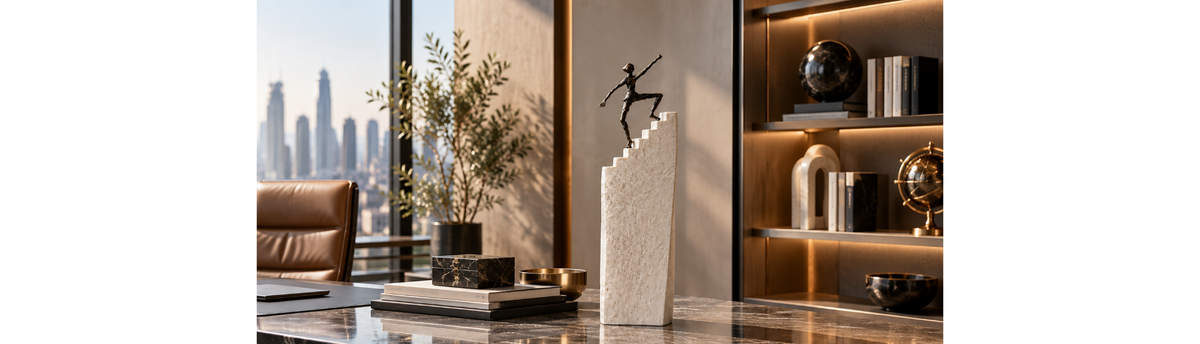

Business sculptures can do more than decorate an office. A thoughtfully chosen sculpture can introduce art, personality and visual meaning into a professional environment while creating a point of connection for leaders, teams, visitors and clients.
In executive offices, reception areas, boardrooms and meeting spaces, sculptural art can express ideas such as ambition, movement, achievement, resilience or collaboration. The interpretation depends on the form, context and personality of the space rather than on a fixed meaning assigned to every artwork.
For a broader understanding of how different objects are selected and styled in professional environments, see our complete guide to luxury office decor accessories in India.
ecture
Table of Contents
- What Are Business and Motivational Sculptures?
- Why Use Art and Sculptures in an Office?
- What Can a Business Art Express?
- Art for Leaders, Teams, Visitors and Clients
- Where Should You Place a Business Sculpture?
- How to Choose the Right Business Sculpture
- Scale, Proportion and Visual Weight
- Sculptures as Conversation Pieces
- Choosing Art for Different Business Personalities
- Common Mistakes When Using Sculptures in Offices
- How Sculptures Work with Other Office Decor
- Business & Motivational Sculptures Collection
- Business Sculptures for Offices in India
- Frequently Asked Questions
- Where to Experience Office Art in Mumbai and Kolkata
- Conclusion
What Are Business and Motivational Sculptures?
Business sculptures and motivational sculptures are sculptural art objects selected for professional environments because their form, subject or visual character can contribute something beyond decoration. As a category of office decor accessories, they can be used in executive offices, reception areas, boardrooms, meeting rooms and other professional spaces. They may be figurative, abstract, dynamic, geometric or symbolic, depending on the style of the office and the ideas the space is intended to communicate.
In a professional interior, the sculpture becomes part of the visual language of the room. Its scale, material, finish, colour and position all affect how it is experienced.
This is why choosing a business sculpture should not be reduced to asking whether a piece looks attractive. The more useful questions are: Where will it be placed? Who will see it? What is the character of the business? What other objects surround it? And what kind of feeling or association should the artwork create?
A business sculpture is best understood as both art and an office styling element. Its value comes from the relationship between the artwork, the room, the people using the space and the ideas the business wants the environment to communicate.
Why Use Art and Sculptures in an Office?
Offices contain many functional elements: desks, chairs, screens, storage, meeting tables and lighting. Without carefully selected decorative objects, a professional workspace can become visually predictable. Art introduces another layer. It gives the eye something to notice beyond the functional structure of the room and can make the environment feel more personal and considered.
Sculpture has a particular advantage because it is three-dimensional. Unlike a framed artwork that is generally experienced from one primary viewing plane, a sculpture can change as people move around it. Its shadows, contours and proportions can also interact with the surrounding space.
This makes sculptural art particularly useful in reception areas, executive offices, boardrooms and other spaces where people pause, meet or move through the room.
The strongest office art is rarely the object that demands the most attention. It is often the piece that gives the room another layer of meaning while still allowing the furniture, people and purpose of the space to remain important.
What Can a Business Art Express?
A sculpture does not have to carry a literal message. Its form can simply create an association or prompt an interpretation. This is especially useful in business environments, where the visual language of the office often reflects the personality of the organisation.
Leadership
A strong sculptural form can create a sense of presence in an executive office. A carefully positioned piece may become associated with confidence, direction and leadership without relying on written statements or motivational quotations.
Ambition
Upward movement, reaching forms and dynamic compositions can naturally suggest aspiration and progress. Such pieces can work particularly well in spaces associated with founders, entrepreneurs and senior leaders.
Movement and Progress
Dynamic sculptures can introduce a sense of movement into a room dominated by straight desks, shelves and other structured forms. They can make the visual composition feel more active without requiring additional decorative objects.
Achievement
Sculptural art can also be associated with milestones and accomplishment. This makes business sculptures relevant not only to office styling but also to occasions such as a new office, promotion, business milestone or company anniversary. When gifting is the purpose, the sculpture should still be considered for its form, scale, material and suitability to the recipient's professional environment.
Ideas and Innovation
Abstract sculptures can create visual curiosity. An unusual form can become a point of discussion in a meeting room or reception area and can introduce an artistic element into businesses where ideas and creativity are central to the work.
Balance and Collaboration
Some sculptural compositions use multiple forms or balanced relationships between figures. These can be visually relevant in spaces where collaboration, teams and relationships are important themes.
Do not decide what a sculpture “means” before looking at the entire composition. Consider its form, material, scale, placement and the context of the office before assigning a symbolic interpretation.
Art for Leaders, Teams, Visitors and Clients
Office art is experienced by different people in different ways. A sculpture positioned in an executive office may have a personal relationship with the person who works there, while the same type of artwork in reception may become part of the experience of visitors and clients.
For Leaders
In a founder's or executive office, a sculpture can become a personal statement within the workspace. The selection may reflect the leader's taste, interests or associations with ideas such as ambition, progress or achievement.
For Teams
In a meeting room or shared professional environment, art can help make the workspace feel more human. A carefully chosen sculpture can provide a visual point of interest without turning the office into a gallery.
For Visitors
Reception areas are experienced differently from private offices because visitors may encounter them before they understand anything about the organisation. A sculpture can therefore contribute to the visual character of the first impression without relying on overt branding.
For Clients and Business Partners
Client-facing environments benefit from objects that create a sense of individuality and thoughtfulness. A sculpture can provide a natural conversation point while allowing the room to feel considered rather than heavily decorated.
When selecting art for a professional space, consider everyone who will experience it: the leader, employees, visitors, clients and business partners. The best choice should belong naturally to the environment rather than speaking only to one person.
Where Should You Place a Business Sculpture?
The right sculpture can work in many parts of an office, but the scale and visual weight should change according to the space.
Executive Office
An executive office can accommodate a more personal sculpture on a credenza, console, side table, bookshelf or other carefully selected surface. In this setting, a business sculpture can become part of the visual identity of the room, particularly when its form or composition relates naturally to ideas such as leadership, ambition, progress or achievement. A larger statement piece may also work when the room provides enough visual space around it.
Reception Area
Reception is one of the most natural locations for statement office art. Visitors usually have a clear viewing point, and the sculpture can become part of the overall composition alongside the reception desk, wall treatment, lighting and seating.
Boardroom
A boardroom often benefits from restraint. A sculpture positioned on a console or credenza can introduce artistic character without competing with the table, seating or people around it.
Meeting Room
Smaller sculptures can work particularly well in meeting rooms. They can introduce personality into the space while remaining secondary to the purpose of the room.
Private Office or Home Office
A home office gives the owner more freedom to select art that reflects personal interests and taste. The sculpture can also connect the professional workspace with the wider residential interior.
How to Choose the Right Business Sculpture
Choosing a business sculpture should begin with the room rather than the product. Look at the available surface, the furniture, the wall behind it, the lighting and the distance from which the sculpture will normally be seen.
Then consider the artwork itself.
Form
Is the sculpture soft and flowing, geometric, figurative, dynamic or strongly abstract? The form should have a relationship with the visual language of the room.
Material
Material changes the way a sculpture is perceived. A metallic finish may create a sharper visual presence, while a more muted surface can feel quieter within the room.
Colour
A sculpture can either sit within the existing colour palette or create controlled contrast. Neither approach is automatically better. The choice depends on the visual balance of the room.
Finish
Glossy, matte, textured and reflective finishes interact differently with office lighting. Consider how the surface will look during the day and under artificial lighting before making a selection.
Viewing Distance
A sculpture viewed from across a reception area needs a different visual presence from one placed beside an executive desk. Details that work beautifully at close range may disappear when the piece is viewed from further away.
Scale, Proportion and Visual Weight
Scale is one of the most important considerations when styling an office with sculpture. A beautiful piece can look wrong if it is too small for its surroundings or too large for the surface on which it is placed. Consider the relationship between the sculpture and the furniture beneath it. A small sculpture on a large credenza may appear lost, while several large pieces placed together can make the surface feel crowded.
Visual weight matters as well. Dark colours, dense forms and complex compositions can appear heavier than open, light or visually delicate forms of the same physical size. Negative space is therefore part of the styling. The empty area around a sculpture allows its form to be understood.
Before selecting a sculpture for an office surface, look at the entire surface rather than the object alone. Measure the available area and consider the visual weight of everything that will remain around it.
Sculptures as Conversation Pieces
A well-selected sculpture can become a natural conversation piece. This does not mean that it has to be unusual, oversized or visually dramatic. Sometimes the conversation begins simply because someone wants to know what the artwork represents, where it came from or why it was selected for the room.
This quality can be especially useful in reception areas, client lounges, boardrooms and executive offices. Art gives visitors something to notice and can create a more memorable environment without turning the office into a display of objects.
Choosing Art for Different Business Personalities
The right business sculpture should feel appropriate to the organisation and the space in which it will be placed. A sculpture chosen for a traditional professional practice may have a very different visual language from one selected for a creative studio or entrepreneurial business.
| Business Environment | Art Direction to Consider |
|---|---|
| Executive or leadership office | Strong, refined forms with a clear visual presence |
| Corporate reception | Statement sculpture that can be appreciated from a distance |
| Boardroom | Controlled, balanced pieces that do not dominate the room |
| Creative studio | More expressive or unexpected sculptural forms |
| Professional services office | Refined pieces with restraint and strong material presence |
| Founder or entrepreneur's office | Art connected to personal taste, ambition or achievement |
| Home office | Pieces that connect professional identity with the residential setting |
This does not mean that every business needs a sculpture that literally represents its industry. In many cases, a more subtle connection works better. The objective is to select art that belongs to the personality of the environment.
Common Mistakes When Using Sculptures in Offices
Choosing Only by Price
Price alone does not determine whether a sculpture belongs in an office. Material, craftsmanship, proportion, finish and context all contribute to how the piece is experienced.
Using Too Many Statement Pieces
If every surface contains a statement object, no single piece has enough visual space around it. Luxury office styling depends on curation and restraint.
Ignoring Scale
A sculpture should be considered in relation to the furniture, wall and room around it. A small object can disappear on a large console, while a large sculpture can overwhelm a compact office.
Forcing Symbolism
Not every sculpture needs to represent a business value. If the symbolic connection feels forced, the artwork may appear more like a corporate prop than a genuine piece of art.
Filling Every Surface
Empty space is part of good office styling. Leaving some shelves, consoles and tables clear gives selected artworks greater visual importance.
How Sculptures Work with Other Office Decor
A business sculpture rarely exists completely on its own. It may sit within a larger composition of office decor accessories, furniture, lighting and wall art. For example, an executive office may combine a sculpture with a carefully selected desk accessory, an office clock or a piece of wall art. A reception area may combine a statement sculpture with decorative lighting and a considered wall treatment.
The objective is not to make every object match. It is to create relationships between them. Contrast can be useful. A sculptural object with a strong form may sit against a quieter background. A metallic finish may relate to the details of the furniture or lighting. A darker sculpture may provide visual weight against a lighter interior.
The most successful arrangements usually have one clear focal point supported by quieter surrounding elements.
If you are also considering sculptures as part of office wall styling, our guide to styling office walls with art, world maps, globes and statement pieces explores how wall-based and three-dimensional objects can work together.
Do not ask how many decorative objects an office needs. Ask which objects deserve to be seen, where they should be seen and how much visual space each one needs.
Business & Motivational Sculptures Collection
Spacio's Business & Motivational Sculptures collection brings together sculptural pieces suited to professional interiors, executive spaces and statement office styling. When selecting a piece, consider its form, scale, material, finish, visual weight and relationship with the surrounding furniture and interiors.
Business Sculptures for Offices in India
Business sculptures are particularly relevant to the growing interest in more individual and design-led professional interiors in India. Offices are not only functional environments. Executive cabins, reception areas, boardrooms, meeting rooms and private offices can also express the identity of the people and businesses that use them.
For Indian offices, the selection should also consider the scale and character of the existing interior. A sculpture chosen for a large corporate reception may need a different visual presence from one selected for a private executive office or home workspace.
Frequently Asked Questions
What is a business sculpture?
A business sculpture is a sculptural art object selected for a professional environment. It may be used as office decor, a statement piece, a conversation object or a symbolic artwork associated with ideas such as leadership, ambition, movement or achievement.
What are motivational sculptures used for in offices?
Motivational sculptures can introduce visual interest and symbolic associations into an office. They can be used in executive offices, reception areas, boardrooms, meeting rooms and other professional spaces where art can contribute to the character of the environment.
Where should I place a business sculpture in an office?
Common locations include an executive desk or credenza, reception console, boardroom sideboard, meeting-room console, bookshelf or other suitable surface. The right position depends on the sculpture's scale, viewing distance and relationship with surrounding furniture.
How do I choose a sculpture for a CEO or business leader?
Consider the person's office, preferred design style, available space and the occasion. Scale, material, finish and visual character are often more useful selection criteria than simply choosing a piece based on its price or size.
Can sculptures be used in reception areas?
Yes. Reception areas can be particularly suitable for sculptural art because visitors usually have a clear view of the space. The sculpture can become part of the overall reception composition without relying on overt branding.
How can office art be used for a team?
Art can make shared professional spaces feel more individual and considered. In meeting rooms and team areas, a sculpture can provide a visual point of interest while allowing the room to remain focused on collaboration and work.
Should every business sculpture have a motivational meaning?
No. A sculpture can be selected simply because its form, material and visual character suit the space. If a symbolic interpretation exists, it should feel natural rather than being imposed on the artwork.
Where can I buy business and motivational sculptures in Mumbai?
You can visit the Spacio Mumbai store at 3BK, Laxmi Industrial Estate, New Link Road, Andheri (West), Mumbai 400 053, where you can explore relevant collections in person and discuss your requirements with the Spacio Interior Styling Team. You can also find the Spacio showroom in Laxmi Industrial Estate, Mumbai on Google Maps before planning your visit.
Where can I find business and motivational sculptures in Kolkata?
You can visit the Spacio Kolkata store at 86B, Topsia Road South, Kolkata 700 046, where you can experience relevant office decor collections and discuss your workspace requirements with the Spacio Interior Styling Team. You can also use Google Maps when planning your visit.
Conclusion
Business sculptures can give an office something that purely functional objects cannot: a sense of visual personality and meaning. For leaders, a sculpture can become a personal statement. For teams, it can make a shared environment feel more considered. For visitors and clients, it can create a memorable visual point of interest. In reception areas, boardrooms and executive offices, the right piece can become part of the visual identity of the space without overwhelming its purpose.
The most successful business sculpture is not necessarily the largest or most dramatic piece. It is the one whose form, scale, material, visual weight and perceived meaning belong naturally to the space. Art in an office does not have to explain itself. Sometimes a carefully chosen sculpture simply gives the room another layer of thought, personality and identity.
Choose office art as you would choose any important design element: with attention to the room, the people, the occasion and the story you want the space to quietly tell.
Spacio's business and motivational sculptures collection brings together sculptural pieces suited to professional interiors, executive spaces and statement office styling.
When exploring the collection, consider the sculpture in relation to its intended setting. Think about scale, viewing distance, material, finish, visual weight and the personality of the recipient or workspace.


