
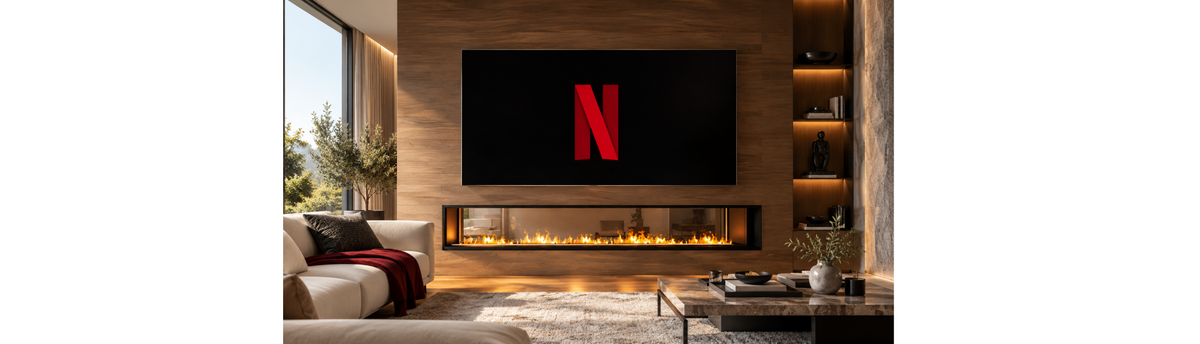

A fireplace can be visually beautiful and still feel wrong for the room. The reason is often not the finish, flame or technology. It is scale. A fireplace that is too small can disappear against a wide wall, particularly in a large living room or a double-height space. A fireplace that is too large can overwhelm the furniture, compete with a television or make a carefully planned wall feel heavy. The right size is therefore not determined by the fireplace alone. It is determined by the relationship between the fireplace, wall, room, furniture and viewing distance.
This becomes especially important when planning a statement wall or a fireplace below a TV. A long linear fireplace may work beautifully beneath a wide screen in a large living room, while the same visual proportion may feel excessive in a compact apartment. In a double-height interior, a fireplace that appears large at first glance may actually be necessary to hold its place within the room.
Table of Contents
- Why Fireplace Scale Matters
- Fireplace Width and Wall Width
- How Room Volume Changes Perceived Scale
- Fireplace Size and Furniture Proportion
- How Wide Should a Fireplace Be Below a TV?
- A Practical Fireplace Size Guide
- Why Long Linear Fireplaces Work on Wide Walls
- Fireplaces in Double-Height Rooms
- Viewing Distance and Flame Scale
- Does Fireplace Format Affect Scale?
- How Technology Influences Size and Placement
- Choosing Fireplace Scale Room by Room
- Fireplace Scale Across Indian Cities
- What About Vastu and Fireplace Placement?
- Common Fireplace Scale Mistakes
- A Practical Fireplace Proportion Framework
- Frequently Asked Questions
- The Right Amount of Fire Is About Proportion
Why Fireplace Scale Matters
Interior scale is about how objects relate to one another. A coffee table is judged against the sofa. A dining light is judged against the table. A sculpture is judged against the console, wall and surrounding objects. A fireplace follows the same principle.
The important question is therefore not simply, "How wide is the fireplace?" It is, "How much visual presence should the fire have within this room?"
That distinction becomes important because two rooms can have the same fireplace but produce completely different results. Place a relatively wide linear fireplace in a compact room and it may become the dominant feature. Place it on a very wide wall in a large living room and it may suddenly look restrained. Scale also affects the way the rest of the room is designed. A substantial fireplace may need a generous wall treatment around it. A smaller fireplace may need more surrounding material, cabinetry or artwork to establish its presence. Neither approach is automatically right. The room determines the answer.
This is why the broader complete guide to luxury fireplaces in India should be read as the category foundation, while this article focuses specifically on one question: how much visual fire does the room need?
Fireplace Width and Wall Width
Wall width is one of the first things to study when choosing a fireplace. A narrow fireplace on a very broad wall can look lost, while a very wide fireplace on a narrow wall can leave little room for the wall to breathe. There is no single percentage that works for every interior. The correct relationship changes with the room's height, furniture, television, surrounding materials and the type of fireplace being used.
Instead of applying a rigid formula, look at the wall in three layers:
- The fireplace: the main source of movement, light and visual focus.
- The surrounding wall: the stone, marble, timber, plaster, panelling, cabinetry or other finish that gives the fireplace its context.
- The supporting elements: television, shelving, niches, artwork, furniture and decorative objects.
When these three layers are considered together, the fireplace can occupy the right amount of visual space without making the wall feel either empty or overloaded.
Measure the complete wall before deciding on fireplace width. A fireplace should be judged as part of the wall composition, not as an isolated product.
What happens when the fireplace is too narrow?
A narrow fireplace can look disconnected from a wide statement wall. This is particularly noticeable when the wall also contains a large television, long cabinetry or substantial furniture.
The solution is not always to choose a larger fireplace. The wall may instead need a more concentrated composition, stronger material framing or a different placement. Scale is about relationships, not simply increasing dimensions.
What happens when the fireplace is too wide?
A fireplace that extends too far across the composition can reduce the visual importance of everything around it. On a TV wall, for example, a very wide fire can pull attention away from the screen. In a living room, it can make the seating arrangement feel secondary.
The fire should have presence, but the rest of the room still needs somewhere to belong.
Do Not Judge Fireplace Size by Width Alone
Width is often the first measurement people notice, but fireplace scale is three-dimensional. Height and depth can change the visual weight of the installation just as much as width. A low, long linear fireplace can feel very different from a taller fireplace with a smaller opening, even when both occupy a similar amount of wall space.
This becomes particularly important when a fireplace is integrated into cabinetry, a TV wall or a substantial material frame. The complete installation should be considered rather than measuring only the visible fire opening.
How Room Volume Changes Perceived Scale
Wall width alone does not tell the complete story. Ceiling height and overall room volume can change how large or small a fireplace feels. A fireplace installed in a room with a standard ceiling may become an important horizontal feature. The same fireplace placed on a tall wall can appear much smaller because there is more vertical space around it.
This is why a fireplace that looks substantial in a showroom may appear modest when installed in a large Indian villa with a high ceiling, wide glazing and generous furniture.
Room volume also affects the surrounding composition. In a larger room, the fireplace may need a stronger horizontal presence, a taller material frame or more carefully considered supporting elements. In a compact apartment, the same strategy could make the room feel crowded.
Fireplace Size and Furniture Proportion
Furniture is one of the best ways to judge whether a fireplace feels appropriately scaled. A fireplace does not exist in an empty room. It sits opposite a sofa, beside chairs, below a television or within a larger seating arrangement.
Consider a wide living room with a large sectional sofa. A small fireplace placed on the opposite wall may struggle to hold the same visual weight. Conversely, a very large fire feature may make a smaller sofa arrangement feel undersized. The relationship becomes even more important with freestanding fireplaces. Because the fireplace occupies part of the room rather than only the wall, its physical size affects circulation, seating and the amount of open floor remaining.
For built-in fireplaces, the surrounding wall and furniture usually provide more of the visual framework. For wall-mounted fireplaces, the open floor can make the installation feel lighter. These differences are why format and scale should be considered together rather than separately.
My earlier article on built-in, wall-mounted and freestanding fireplace formats examines this relationship in greater detail.
How Wide Should a Fireplace Be Below a TV?
The fireplace below a TV is one of the most important applications to consider when thinking about scale. The television and fire often become the two strongest visual elements on the same wall, so their proportions need to be considered together.
A fireplace integrated into a TV feature wall should not be selected by television size alone. The complete composition includes the screen, fireplace, cabinetry, wall finish, ceiling height and seating position.
A long linear fireplace can work particularly well beneath a wide television because the two horizontal elements can create a deliberate visual relationship. But the fireplace does not necessarily need to match the exact width of the screen. What matters is whether the two elements feel balanced within the complete wall.
Fireplace below TV in a living room
In a living room, the fireplace and TV are viewed from the main seating arrangement. The screen needs to remain comfortable to watch, while the fireplace should contribute to the room without competing excessively with it.
The wall surrounding both elements is important. A wide fireplace may need restrained cabinetry around it, while a narrower installation may benefit from stronger material framing or carefully positioned niches.
Fireplace below TV in a bedroom
A bedroom usually benefits from a more restrained scale. The bed, bedside tables, artwork and television already establish a strong composition. A fireplace should support that composition rather than dominate it.
Fireplace in a media room or home theatre
In a media room, the screen remains central to the viewing experience. The fireplace therefore needs to be considered carefully in relation to the screen, room lighting and seating distance. A fireplace below a projector screen presents a different proportional problem again because the screen may occupy a very large portion of the wall. The fire needs enough presence to belong to the room without interfering with the primary viewing experience.
For a more detailed discussion of this application, see Spacio's guide to choosing a fireplace below a TV in modern Indian homes.
A Practical Fireplace Size Guide
There is no single fireplace size that works for every room. The right scale depends on the width of the wall, ceiling height, room volume, furniture, TV or media wall, viewing distance and the type of fireplace being considered.
The table below is an initial visual guide to fireplace scale, not a technical sizing formula or installation specification. The ranges are intended to help compare proportions across different room types. The final fireplace size must be checked against the specific model, technology, installation requirements, wall construction, heat output and the overall design of the room. A fireplace expert should be consulted before making the final decision, particularly for real-flame or heating fireplaces.
| Interior situation | Approximate fireplace width to consider | What to consider |
|---|---|---|
| Small living room or compact apartment | 60–90 cm | A more compact fireplace can create a focal point without overpowering the furniture or wall. |
| Medium-sized living room | 90–150 cm | This range can provide enough visual presence while remaining proportionate to a typical seating arrangement. |
| Large living room | 120–200 cm | A wider fireplace can relate better to a large sofa, media unit or substantial feature wall. |
| Large open-plan living space | 150–250 cm+ | A longer linear format may work well when the wall and surrounding furniture have enough visual width to support it. |
| Fireplace below a TV | 90–180 cm | Consider the TV, fireplace, media furniture and surrounding wall as one composition rather than choosing the fireplace independently. |
| Wide TV or media wall | 150–250 cm+ | A longer fireplace can help balance the visual weight of a large screen and surrounding cabinetry. |
| Double-height living room | 150–300 cm+ | A fireplace with greater visual presence may be needed to relate to the height and volume of the room. |
| Bedroom | 60–120 cm | A restrained format often works well because the fireplace shares visual attention with the bed and other bedroom furniture. |
| Bar and den or entertainment room | 90–180 cm | Consider the fireplace in relation to the seating arrangement and the wall carrying it. |
| Large villa feature wall | 150–300 cm+ | A long linear fireplace can become part of the composition of the entire wall rather than appearing as a small object within it. |
The dimensions above help explain visual scale. They should not be treated as a universal formula for selecting a fireplace.
Why the Final Fireplace Size Needs Expert Input
A fireplace is not sized only by looking at the wall. The final decision should consider the relationship between the fireplace, the room, the furniture and the technology used to create the flame.
For electric, LED, water-vapour and other no-heat flame-effect fireplaces, the design conversation can be different from that of a fireplace that produces real flames and heat. With wood-burning, gas, bioethanol and other real-flame fireplaces, technical considerations become particularly important.
Fuel type, heat output, ventilation, installation conditions, surrounding materials, room use and the manufacturer's requirements can all influence the appropriate size, location and installation method.
I would always look at the fireplace as part of the complete room rather than as an isolated product. A measurement can tell you the physical size, but proportion tells you whether that size actually belongs in the room.
Five Proportions to Check Before Choosing the Size
| Relationship | Question to ask |
|---|---|
| Fireplace and wall | Does the fireplace have enough visual width and height to relate to the wall without making the composition feel either lost or crowded? |
| Fireplace and TV | Does the fireplace have enough presence to balance the screen and media furniture? |
| Fireplace and sofa | Does its scale feel appropriate to the main seating area? |
| Fireplace and ceiling height | Does the fireplace have enough visual weight for a tall or double-height room? |
| Fireplace and viewing distance | Can the flame effect be appreciated comfortably from the normal seating position? |
For a decorative flame-effect fireplace, the visual proportion of the installation may be the primary design consideration. For a real-flame fireplace, proportion is only one part of a much larger decision involving the technology, installation and safe operation of the fireplace.
Why Long Linear Fireplaces Work on Wide Walls
Long linear fireplaces are particularly useful when the interior calls for a strong horizontal element. Instead of concentrating the fire into a compact opening, the flame stretches across a greater portion of the wall. This can help visually connect a wide room. A linear fireplace can sit below a television, within a long feature wall or beneath a large expanse of stone or another finish. Its length becomes part of the composition.
But long does not automatically mean better. A very long fireplace can become excessive when the wall, furniture and room volume cannot support it.
The useful question is: Does the length help the room feel more balanced?
If the answer is yes, the linear format may be doing more than creating a larger flame. It is helping establish the proportion of the entire wall.
Fireplaces in Double-Height Rooms
Double-height interiors create one of the most challenging scale questions for fireplace design. A standard-sized fireplace can appear surprisingly small when placed against a very tall wall. This does not necessarily mean that the fireplace itself must become extremely tall. In many cases, a strong horizontal fireplace can provide the visual anchor that the room needs, while the wall above it is handled through artwork, panelling, shelving, lighting or carefully controlled negative space.
The important point is to judge the fire from the position where people actually experience the room. A fireplace that looks substantial in a close-up photograph may feel much smaller when viewed from the seating area across a large double-height living room.
How to balance a tall wall
There are several ways to make a fireplace belong within a tall interior:
- Use sufficient horizontal width to establish a clear focal point.
- Use the surrounding wall finish to connect the fireplace to the height of the room.
- Allow artwork, lighting or other elements to carry visual interest upwards where appropriate.
- Keep furniture substantial enough to relate to the room's overall volume.
- Avoid filling every part of the wall simply because the wall is large.
The last point matters. A large room does not require a large amount of decoration. Scale can also be created through restraint and proportion.
Viewing Distance and Flame Scale
The distance between the viewer and the fireplace changes how the fire is perceived. This is particularly important for modern fireplaces where the visual flame is a major part of the experience. In a compact room, the flame is experienced at relatively close range. Detail, movement and the relationship between the flame and surrounding media can therefore be more noticeable.
In a large living room, the same flame may be viewed from much farther away. A smaller fire feature can lose some of its visual presence simply because it occupies less of the viewer's field of attention.
This is one reason why showroom viewing can sometimes be misleading. A fireplace may look substantial when standing close to it but appear more restrained once it is installed across a large room.
Imagine the fireplace from the main seating position, not only from directly in front of it. The viewing distance can change how much visual presence the fire needs.
Does Fireplace Format Affect Scale?
Yes. The same width can feel very different depending on whether the fireplace is built-in, wall-mounted or freestanding.
| Format | How scale is perceived | What to consider |
|---|---|---|
| Built-in | The fireplace becomes part of the wall composition. | Wall width, cabinetry, material framing, TV and overall room height. |
| Wall-mounted | The fireplace can feel visually lighter because the floor remains open. | Wall position, television, surrounding finish, furniture and mounting requirements. |
| Freestanding | The fireplace has physical presence within the room rather than only on the wall. | Furniture, circulation, floor area, viewing angles and the unit's installation requirements. |
This is why it is useful to decide the intended role of the fireplace before deciding its final dimensions. A fire intended to anchor a wide media wall has a different proportional job from one intended to sit independently between two seating areas.
How Technology Influences Size and Placement
Scale should also be considered alongside fireplace technology. Different systems can have different installation requirements, and the chosen technology may influence where and how the fire can be incorporated into the room. For example, water vapour fireplaces can be considered where the visual experience of fire is important without the same role being assigned to room heating. LED and electric systems can provide different visual and functional possibilities, depending on the particular model. Holographic and digital systems create another type of visual fire experience.
Real-flame systems introduce further considerations around fuel, combustion and installation. The final dimensions should therefore never be selected purely from an image or a wall measurement without understanding the requirements of the chosen system. Explore the complete fireplace collection that covers different fireplace technologies and applications. The technology should be understood first, then the physical format and scale can be developed around the room.
Choosing Fireplace Scale Room by Room
Living room
The living room usually offers the greatest range of possibilities. A wide wall may support a long linear fireplace, particularly when the fire is being integrated with a television, cabinetry or a large material surface. In a compact apartment, a more restrained installation may create a better relationship with the sofa and available floor area.
Bedroom
Bedrooms generally benefit from proportion that feels quieter. The fireplace should relate to the bed, bedside furniture, television and wall rather than becoming the dominant object. A smaller wall-mounted or built-in installation can often maintain this sense of restraint, depending on the room.
Bar and den
A bar or den can support a stronger fire presence because seating is often arranged around conversation and atmosphere rather than one primary screen. A fireplace can become a visual centre, particularly in a larger entertaining space.
Dining room
In a dining room, the fireplace should relate to the dining table and the length of the wall behind it. A long fire feature can reinforce the horizontal character of a dining setting, while a smaller installation may work better when the wall already contains artwork, storage or decorative lighting.
Double-height living room
Here, room volume becomes especially important. A fireplace may need greater horizontal presence to remain visually connected to substantial furniture and the height of the room. The surrounding wall should then be designed to connect the fire to the architecture of the space without overwhelming it.
Fireplace Scale Across Indian Cities
The principles of proportion remain the same across India, but the type of home, room size, climate and way the space is used can change the design response. A fireplace in Hyderabad may be planned for a large living room or villa, while a fireplace in Shillong or Shimla may be considered in interiors where seasonal warmth can have greater relevance. In Kochi or Guwahati, ambience and the visual role of fire may be more important in some applications.
Fireplace in Hyderabad
For a fireplace in Hyderabad, room scale can vary considerably between apartments, large residences and villas. A wide living-room wall may support a substantial linear fireplace integrated with a television or feature wall. In a larger open-plan residence, the fireplace can also become a focal point within an entertaining area. The important consideration is whether the fireplace has enough visual presence to relate to the room and its furniture.
Fireplace in Shillong
A fireplace in Shillong may have a stronger relationship with seasonal comfort as well as interior atmosphere. In a substantial living room, the fireplace should be judged against the room's furniture and wall proportions rather than selected purely for its heating role. A built-in installation can become part of a larger wall composition, while a freestanding format may suit a room where the fire is intended to have a more independent presence.
Fireplace in Guwahati
For a fireplace in Guwahati, the format and scale should respond to the type of residence and the way the room is used. A wide living room can accommodate a stronger horizontal fireplace, while a more compact apartment may benefit from a format that preserves floor space. Where the fire is integrated into a TV wall, the television, seating and fireplace should be considered together.
Fireplace in Kochi
A fireplace in Kochi often needs to be considered in relation to warm-climate living, open spaces and the role of ambience within the interior. A water vapour or LED installation can provide a visual fire feature without making the room's design dependent on heating. In larger residences, scale should still respond to the width of the wall, furniture and viewing distance rather than simply selecting a smaller fireplace because the climate is warm.
Fireplace in Kanpur
When planning a fireplace in Kanpur, the room's proportions should lead the design. A substantial living room may accommodate a wider fireplace within a feature wall, while an apartment may call for a more restrained installation. Where the fireplace is paired with a television, the width of the wall and the scale of the seating arrangement become particularly important.
Fireplace in Shimla
A fireplace in Shimla can have both a practical and visual role. In a larger living space, the fire should be scaled to the room rather than treated as a small heating appliance placed wherever space is available. The surrounding materials, furniture and wall height should work together so that the fireplace feels integrated into the room.
Across these cities, the same principle remains useful: choose the amount of visual fire the room can support, not simply the largest or smallest fireplace that will fit on the wall.
What About Vastu and Fireplace Placement?
For homeowners who include Vastu in the design process, fireplace placement may also be considered in relation to traditional ideas about the fire element. These are traditional beliefs rather than scientifically established principles, so they should be considered alongside practical requirements, room planning and the chosen fireplace system.
Vastu can also become relevant to scale indirectly. If a preferred location influences the wall where the fireplace is placed, the available wall width, furniture arrangement and television position may all change. This is another reason to consider these decisions before a fixed feature wall or media wall is finalised.
For readers who want to consider this aspect in greater detail, Spacio's guide to Vastu considerations for fireplaces in India discusses the subject separately.
Common Fireplace Scale Mistakes
Choosing the fireplace before measuring the complete composition
A wall measurement alone is not enough. The television, cabinetry, sofa, ceiling height and viewing distance can all change the way the fireplace will appear.
Copying the proportions of a showroom
A showroom provides useful visual reference, but the room around the fireplace may be very different from the final installation. Always judge the fireplace against the actual proportions of the project.
Assuming a wider fireplace is always more impressive
Width creates presence, but too much visual weight can make the rest of the room feel secondary. A successful fireplace should strengthen the composition rather than overpower it.
Ignoring viewing distance
The fireplace may be seen from several metres away in a large living room. A design that looks detailed and substantial close up may need greater visual presence when experienced from the main seating position.
Designing the TV wall around the screen alone
A television and fireplace below it should be considered as one complete composition. The wall finish, cabinetry and furniture also contribute to the final scale.
Filling a large wall simply because there is space
A large wall can benefit from negative space. Not every part of a statement wall needs to be occupied by cabinetry, artwork or decorative objects. The fireplace can become stronger when it has room around it.
A Practical Fireplace Proportion Framework
Before finalising fireplace size, work through the room in this order:
- Measure the complete wall. Look at width, height and the surrounding openings rather than measuring only the available recess.
- Understand the room volume. Consider ceiling height and the overall size of the living space.
- Map the furniture. Identify the sofa, chairs, dining table or other major pieces that will establish the visual scale of the room.
- Identify the main viewing position. Consider how the fireplace will look from where people will actually sit or spend time.
- Decide the role of the fire. Is it anchoring a TV wall, defining a seating zone, becoming a major focal point or supporting the atmosphere of the room?
- Consider the television. If the fireplace is below or beside a TV, judge both elements as part of one composition.
- Choose the technology. Water vapour, LED, electric, holographic, bioethanol, gas and wood-burning systems can have different requirements.
- Choose the physical format. Built-in, wall-mounted and freestanding formats create different relationships with the wall and floor.
- Then establish the fireplace width. The final dimension should emerge from all these relationships rather than from the wall measurement alone.
When I look at a fireplace within an interior, I do not begin with its dimensions in isolation. I look at the wall, the furniture, the television if there is one, the height of the room and the distance from which the fire will be experienced. A fireplace should have enough presence to belong to the room, but not so much that it takes the room away from everything around it. Proportion is what makes a fire feature feel as though it was designed for the space rather than simply fitted into it.
Frequently Asked Questions
How do I choose the right fireplace width for my wall?
The right width depends on the complete wall composition rather than one fixed formula. Consider the wall width, room height, furniture, television, surrounding finishes and viewing distance before deciding how much visual presence the fireplace needs.
Should a fireplace be the same width as the TV?
Not necessarily. A fireplace below a TV should relate to the screen, but both should also be judged against the complete wall, cabinetry and room proportions. The fireplace can be narrower or wider than the television depending on the intended composition.
Is a long linear fireplace suitable for a small room?
It can be, depending on the wall and the rest of the room. A long fireplace can become visually dominant in a compact space, so the furniture, television, wall finish and available negative space should be considered before choosing the length.
Why do fireplaces sometimes look smaller in a large living room?
Room volume and viewing distance affect perceived scale. A fireplace that looks substantial when viewed close up may appear more restrained when seen from several metres away in a large room with a high ceiling and substantial furniture.
Does a double-height room need a larger fireplace?
Not necessarily a larger fireplace in every dimension. A double-height room often needs sufficient visual presence to relate to the height and volume of the space. A wider linear fireplace, a considered wall finish or carefully planned surrounding elements can help establish that relationship.
How does furniture affect fireplace size?
Furniture establishes the scale of the room. A large sofa arrangement may make a small fireplace feel insignificant, while an oversized fireplace can make a compact seating arrangement feel visually weak. The two should be considered together.
Does viewing distance matter when choosing a fireplace?
Yes. A fireplace viewed from close range can have a different visual impact from one experienced across a large living room. The main seating position should therefore be considered when assessing the size and visual presence of the fire.
Is a wider fireplace always better for a statement wall?
No. Width can create stronger presence, but the fireplace still needs to relate to the wall, furniture, television and room volume. A fireplace that is too dominant can weaken the balance of the complete interior.
Does the type of fireplace technology affect its size?
Technology can affect installation requirements and therefore the way a fireplace is incorporated into a room. Water vapour, LED, electric, holographic, bioethanol, gas and wood-burning systems should be assessed according to the requirements of the specific model.
Can a fireplace be too large for a TV wall?
Yes. A very large fireplace can compete with the television and make the lower part of the wall visually heavier. The screen, fire, cabinetry and surrounding wall finish should be considered as one composition.
Where can I compare fireplace options in Mumbai?
To discuss fireplace scale, wall proportions and different installation possibilities in person, you can visit Spacio's Mumbai store at 3BK, Laxmi Industrial Estate, New Link Road, Andheri (West), Mumbai – 400 053. You can discuss how fireplace size may work with a TV wall, furniture and the proportions of your room. You can also find the Spacio showroom in Laxmi Industrial Estate, Mumbai on Google Maps before planning your visit.
Where can I see fireplace options in Kolkata?
If you want to discuss fireplace scale and how a fire feature could relate to a larger wall or living-room composition, visit Spacio's Kolkata store at 86B, Topsia Road South, Kolkata – 700 046. You can discuss the relationship between fireplace width, furniture, television and wall proportions. You can also use Google Maps to find the Spacio Kolkata store when planning your visit.
Does Vastu influence fireplace size and placement?
For homeowners who follow Vastu, traditional placement preferences may influence which wall is selected for the fireplace. This can then affect the available wall width, television position and furniture arrangement. Vastu should be considered alongside the practical requirements of the chosen fireplace.
Should I decide the fireplace size before designing the feature wall?
Yes. If the fireplace is going into a feature wall or media wall, its dimensions and installation requirements should be understood before the surrounding cabinetry and finishes are finalised. This allows the fireplace to be designed as part of the complete wall rather than fitted into the remaining space.
The Right Amount of Fire Is About Proportion
The question is not really how much fire a room can physically accommodate. It is how much visual presence the fire needs to have within the complete interior.
A wide statement wall may call for a long linear fireplace. A compact living room may need a more restrained installation. A double-height room may require greater horizontal presence to relate to its volume. A TV wall needs the fireplace and screen to work as one composition. And every room needs the fire to relate to the furniture and the distance from which it will actually be experienced.
That is why fireplace size should be decided after understanding the room, not before. Study the wall, room volume, furniture, television, viewing distance, technology and installation requirements. Then determine how much fire the interior genuinely needs.
For real-flame fireplaces, the final decision should always be made with a qualified fireplace professional who can assess the selected technology, installation conditions and manufacturer requirements for the specific project.
Explore Fireplace Possibilities for Your Interior. See Spacio's complete fireplace collection to understand the range of fireplace formats and technologies available for different interior applications. Visit Spacio's Mumbai or Kolkata store to speak to one of the fireplace experts and discuss your requirement. Or drop a whatsapp message to +91 90515 83311 to connect right away.


