
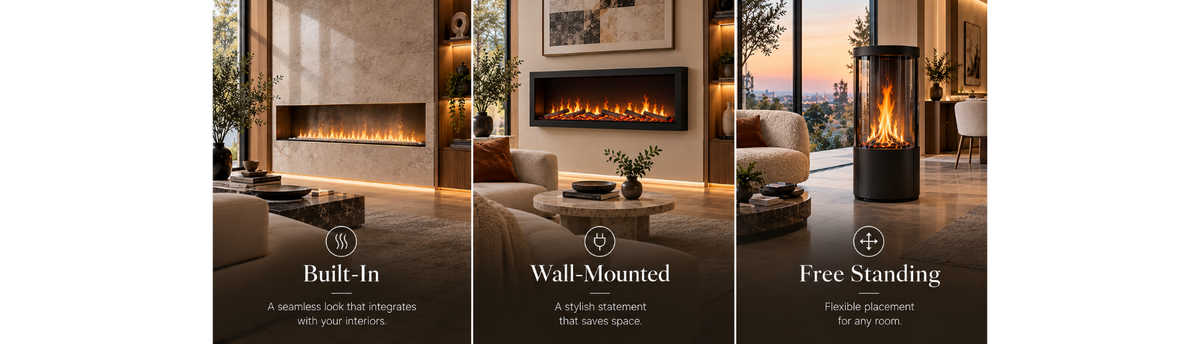

When choosing a fireplace, most people first think about the flame, finish or technology. Yet one of the earliest decisions should actually be how the fireplace will occupy the room. A built-in fireplace becomes part of a fixed wall composition, a wall-mounted fireplace sits within the wall plane while leaving the floor open, and a freestanding fireplace becomes an independent object within the room.
That difference affects much more than appearance. It changes how you plan cabinetry, how furniture is arranged, how much floor space remains available, where a television can sit, how a feature wall is designed and whether the fireplace can be moved or replaced later. In an open-plan home, it can even change how one part of the room relates to another.
For Indian interiors, this decision is particularly relevant because the same fireplace may be required to work in a compact apartment, a large living room, a TV wall, a bedroom, a bar and den, a terrace or a double-height space. The right format is therefore not simply the one that looks good on its own. It is the one that makes sense with the room around it.
The three formats solve different interior-design problems. Built-in fireplaces prioritise integration, wall-mounted fireplaces prioritise an open floor plane, and freestanding fireplaces prioritise independence and flexibility. The right choice depends on the room, the desired focal point, available space, furniture layout, technology and installation requirements.
- Why Fireplace Format Matters
- Built-In Fireplaces: Making Fire Part of the Wall
- Wall-Mounted Fireplaces: Keeping the Floor Open
- Freestanding Fireplaces: Treating Fire as an Object
- Built-In vs Wall-Mounted vs Freestanding
- Cabinetry, Shelving and Feature Walls
- Furniture Layout and Movement Around the Fireplace
- Which Format Works for a TV or Media Wall?
- Fireplaces in Open-Plan Interiors
- How Fireplace Technology Affects the Format
- Choosing the Format Room by Room
- How the Decision Changes Across Indian Cities
- What About Vastu?
- Common Mistakes When Choosing Fireplace Format
- A Practical Format Decision Framework
- Frequently Asked Questions
Why Fireplace Format Matters
A fireplace is rarely an isolated object in a well-planned interior. Its position influences the wall behind it, the furniture facing it and the objects placed around it. Once this is understood, the choice between built-in, wall-mounted and freestanding becomes a design decision rather than a question of personal taste alone.
Imagine a living room with a wide television wall. If the fireplace is built into that wall, the entire composition can be planned around one continuous horizontal line. Cabinetry, niches, stone, timber and the television can all be considered together. If the fireplace is wall-mounted, the same wall may feel lighter because the floor remains clear. If it is freestanding, the fireplace can move away from the wall and become a separate focal point.
The format also affects future flexibility. A built-in fireplace is usually part of a more permanent installation, while a freestanding fireplace may allow the room to be rearranged more easily, depending on the model and its installation requirements.
Before deciding on a format, it is useful to understand the wider category. Spacio's complete guide to luxury fireplaces in India explains the broader considerations around fireplace technology, application and selection. Here, the focus is narrower: how the physical format changes the interior itself.
Built-In Fireplaces: Making Fire Part of the Wall
A built-in fireplace is designed to sit within a planned wall or surrounding structure. It can be recessed into a feature wall, integrated below a television, placed between shelves or cabinetry, or surrounded by materials such as marble, stone, timber or metal.
The main advantage is integration. The fireplace becomes part of the composition rather than looking like an object that was placed against an already finished wall. This can create a stronger sense of continuity, particularly in large living rooms where a fireplace needs enough surrounding structure to hold its visual weight.
Built-in and the feature wall
A built-in fireplace works especially well when the wall itself is intended to be a major design element. The fireplace can establish the centre of the composition while shelving, cabinetry or niches provide supporting layers around it.
But the surrounding elements should not be added simply to fill empty space. A fireplace already creates visual interest through flame movement, light and material contrast. Too many shelves, objects or strong finishes around it can make the wall feel busy.
Built-in and long-term planning
The commitment involved in a built-in installation is important. If the fireplace is surrounded by fixed cabinetry or stone, moving it later can mean changing several parts of the room. For a new home or major renovation, this is often manageable because the wall can be designed from the beginning. For a finished apartment, a less permanent format may sometimes make more sense.
A built-in fireplace should be considered at the same time as the wall around it. The fireplace width, television, cabinetry, niches and material finishes should be planned as one composition. When these decisions are made separately, the wall can lose its sense of balance.
Wall-Mounted Fireplaces: Keeping the Floor Open
A wall-mounted fireplace is attached to the wall rather than sitting as a separate object on the floor. This gives the room a different visual quality because the floor continues beneath the fireplace instead of being occupied by a hearth-like structure.
This can be useful in apartments and smaller living rooms where every part of the floor plan matters. The open floor can make it easier to position a sofa, coffee table or occasional chair without having to work around the footprint of a freestanding fireplace.
Why wall-mounted can work well in contemporary interiors
A wall-mounted fireplace can sit comfortably within a clean media wall or a more restrained feature wall. It can also work when the homeowner wants the fireplace to be visible but does not want it to become a large piece of furniture within the room.
However, mounting the fireplace on the wall does not remove the need for planning. The height, wall finish, electrical points, television position and furniture arrangement still need to be considered together. The wall may look simple, but the decisions behind it are not.
When a wall-mounted format can be useful
- Compact apartments where floor space is valuable.
- Living rooms where the floor should remain visually open.
- TV walls where a clean horizontal composition is required.
- Bedrooms where a large floor-standing object may feel too heavy.
- Interiors where the fireplace needs to be present without becoming a dominant piece of furniture.
Freestanding Fireplaces: Treating Fire as an Object
A freestanding fireplace has a very different relationship with the interior. It does not need to disappear into the wall. Instead, it can be treated almost like a piece of furniture or a sculptural object, with the rest of the room arranged around it.
This quality makes freestanding fireplaces useful in open-plan interiors, larger living rooms, bars and dens and selected outdoor applications. The fireplace can establish a centre without requiring an entire wall to be redesigned.
It can also be useful when the homeowner wants greater flexibility. Depending on the fireplace, the unit may be easier to reposition than a built-in installation. That does not mean every freestanding fireplace is portable, however. Fuel type, electrical connection, ventilation and manufacturer requirements must always be considered before assuming that a fireplace can be moved.
Freestanding as a room divider
One of the more interesting uses of a freestanding or suitably designed two-sided fireplace is to help separate two areas without building a solid wall. In a large living and dining space, for example, the fire can help establish a boundary between the two zones while allowing the overall room to remain connected.
This approach changes the fireplace from a wall feature into a spatial element. The seating, dining furniture, lighting and decorative objects then need to respond to the fireplace from more than one direction.
Built-In vs Wall-Mounted vs Freestanding
| Format | How it relates to the room | Best suited to | What needs the most planning |
|---|---|---|---|
| Built-in | Becomes part of the fixed wall composition | Feature walls, media walls, large living rooms and planned renovations | Wall construction, cabinetry, finishes and long-term commitment |
| Wall-mounted | Sits on the wall while keeping the floor open | Apartments, compact rooms and clean TV-wall compositions | Mounting position, wall finish, wiring and relationship with the television |
| Freestanding | Acts as an independent object within the room | Open-plan rooms, larger living areas, bars and dens and flexible layouts | Furniture clearance, circulation and the requirements of the specific fireplace |
The important point is that these formats solve different spatial problems. A built-in fireplace helps complete a wall. A wall-mounted fireplace helps preserve the floor. A freestanding fireplace helps create a focal point within the room itself.
Cabinetry, Shelving and Feature Walls
Cabinetry is one of the clearest reasons to decide the fireplace format early. If the intention is to create a full media wall with storage, display niches and a television, a built-in fireplace can be planned as one part of that complete structure.
The mistake is to treat the fireplace as the starting point and then simply fill the remaining wall with shelves. Good composition works in the opposite way: first understand the wall's overall proportions, then decide how much visual weight the fireplace should carry and where the supporting elements should sit.
For example, a large linear fireplace may need generous negative space around the flame. A smaller fireplace may benefit from stronger surrounding materials or cabinetry that gives it greater visual presence. The same fireplace can therefore look completely different depending on the wall built around it.
Decorative objects should also remain secondary. A sculpture, vase, books or other accessories can help provide scale and texture, but they should not compete with the fire for attention. A wider decor and accessories collection can support this layer of the room when the composition calls for it.
Furniture Layout and Movement Around the Fireplace
Furniture should respond to the fireplace rather than being placed first and forced to fit around it later. This is particularly important with freestanding fireplaces because they occupy part of the usable room rather than only the wall.
Start by identifying the main seating position. From there, consider whether the fireplace can be seen comfortably, whether the television becomes a competing focal point and whether people can move naturally between the seating, dining area, entrance and other parts of the room.
A built-in fireplace generally gives the furniture more freedom because the floor remains available. A freestanding fireplace requires more deliberate spacing because it becomes another object around which people move. A wall-mounted fireplace sits somewhere between the two: it remains visually connected to the wall while keeping the floor relatively free.
Furniture scale matters as well. A very large sofa arrangement can make a small wall-mounted fireplace feel insignificant, while an oversized freestanding fireplace can dominate a compact seating area. Proportion should therefore be judged across the complete room rather than against the fireplace alone.
Which Format Works for a TV or Media Wall?
The fireplace below a TV is one of the strongest applications where format matters. The fireplace, television, wall finish, cabinetry and seating all have to work together because they share the same visual field.
A built-in fireplace is often considered when the TV wall is being designed as a complete unit. The fireplace can sit below the screen, with cabinetry or niches extending across the wall. This can create a strong horizontal composition when the proportions are carefully resolved.
A wall-mounted fireplace can produce a lighter treatment. Because the fireplace does not occupy the floor, the lower part of the room can remain visually open, which can be helpful in apartments and smaller living rooms.
A freestanding fireplace is usually a different proposition. Instead of becoming part of the TV wall, it establishes itself separately and may therefore compete with the television for attention. This can still work in a large room, but the design intention needs to be clear.
Spacio's guide to choosing a fireplace below a TV looks more closely at this particular relationship.
Fireplaces in Open-Plan Interiors
Open-plan rooms create an opportunity that fixed wall fireplaces do not always provide. Instead of using the fireplace only as a feature on one wall, the fire can help establish a relationship between different parts of the room.
A freestanding fireplace can sit between a seating area and another zone, creating a visual centre without completely closing the space. A two-sided or three-sided arrangement can make the fire visible from more than one part of the room, depending on the product and installation.
A built-in fireplace can also work in an open plan when one wall needs to anchor the room. The difference is that the fireplace becomes part of the room's edge rather than part of the circulation between zones.
The choice should therefore follow the role of the fireplace. If the fire needs to anchor one wall, built-in may make sense. If it needs to participate in the centre of the room, freestanding may offer more possibilities.
How Fireplace Technology Affects the Format
Format and technology should be considered together. The visual appearance of a fireplace does not tell you everything about how it needs to be installed, and different technologies have different requirements.
A fireplace can therefore be described by more than one category at the same time. For example, a water vapour fireplace may be built-in or freestanding, while an electric fireplace may be wall-mounted or incorporated into a media wall. Format describes how the fireplace occupies the room; technology describes how the fire experience is created.
Water vapour fireplaces
Water vapour fireplaces are often considered for interiors where the visual experience of fire is more important than heating. Their cool flame effect can be incorporated into feature walls, media walls and selected freestanding designs, depending on the particular model.
For interiors where this type of fire experience is appropriate, the indoor artificial water vapour fireplace collection gives a useful view of the category and the different formats available.
LED and electric fireplaces
LED and electric fireplaces can work across a range of interior formats. Some are intended primarily for visual ambience, while particular electric models may also provide heating. That distinction should always be checked for the specific fireplace rather than assumed from the word "electric".
When considering this route, the indoor artificial LED fireplace collection can be considered alongside the room's intended use and the required installation format.
Holographic and digital fireplaces
Holographic and digital fire effects place particular importance on how the flame image is seen from within the room. They can be useful when the fire is being treated as part of a contemporary feature wall or visual installation.
The holographic fireplace collection is relevant when the design brief calls for this type of visual fire experience.
Bioethanol, gas and wood-burning fireplaces
Real-flame fireplaces introduce a different set of planning considerations because combustion, fuel and installation requirements become part of the design decision. A built-in bioethanol fireplace, for example, needs to be considered as part of the structure around it, while a freestanding bioethanol model may be conceived as a separate object. Gas and wood-burning systems have their own installation requirements that must be assessed for the particular model.
Spacio's indoor bioethanol fireplace collection, indoor gas fireplace collection and indoor wood-burning fireplace collection represent different branches of the category. The format should be decided only after the requirements of the chosen system have been understood.
Choosing the Format Room by Room
Living room
The living room offers the broadest choice. A built-in fireplace can anchor a TV or feature wall, a wall-mounted model can preserve floor space in an apartment and a freestanding fireplace can create a more independent centre in a larger room.
Bedroom
Bedrooms usually benefit from a quieter composition. A built-in fireplace can become part of a refined wall treatment, while a wall-mounted format can keep the floor clear around the bed and seating. A freestanding model can work where the room is large enough for the fireplace to have its own visual space.
Bar and den
A bar or den can accommodate a more object-like fireplace because these spaces often benefit from a strong centre. A freestanding fireplace can work particularly well where seating is arranged around the fire rather than directly facing a television.
Dining room
In a dining room, the fireplace can become part of the evening experience without becoming the only focus. A built-in fireplace can work within a feature wall or side wall, while a compact wall-mounted model can introduce the visual effect of fire without taking valuable floor space.
Home theatre or media room
Here the screen remains the primary viewing element. A fireplace needs to support the room rather than distract from it. Built-in and wall-mounted formats can help maintain a controlled composition, but the technology, heat output and installation requirements of the specific fireplace must be assessed carefully.
Terrace or outdoor lounge
Outdoor spaces often favour freestanding formats because they can be arranged around seating and do not require the same type of fixed wall construction. Spacio also has dedicated outdoor bioethanol fireplaces and outdoor gas fireplaces for outdoor applications.
How the Decision Changes Across Indian Cities
The basic format principles remain the same across India, but the type of home, available space and climate can change the way the fireplace is used. A compact apartment in Mumbai presents a different planning problem from a villa in Hyderabad, a coastal home in Kochi or a larger independent home in Jaipur.
Fireplace in Pune
A fireplace in Pune may need to work across apartments, larger residences and homes with more generous living areas. In a new or renovated living room, a built-in fireplace can be integrated into a complete feature wall. In a room where the layout may change, a freestanding format can provide more flexibility.
Fireplace in Kochi
In Kochi, where the climate is generally warm and humid, the visual role of a fireplace can be more important than creating heat for much of the year. A wall-mounted or built-in water vapour or LED fireplace can introduce the visual presence of fire without requiring a large floor-standing object.
For a fireplace in Kochi, the format should also respond to the home's relationship with balconies, terraces and open living areas. A freestanding outdoor fireplace may serve a very different purpose from an indoor installation integrated into a TV wall.
Fireplace in Hyderabad
Hyderabad's mix of apartments, large residences and villas creates room for several approaches. A built-in fireplace can become part of a substantial stone or marble feature wall in a large living room, while a wall-mounted installation can be more appropriate where the room needs to retain a lighter floor plan.
For a fireplace in Hyderabad, larger homes may also allow the fireplace to become a central element in a bar, den or open entertaining space where a freestanding format can have a stronger role.
Fireplace in Jaipur
A fireplace in Jaipur may be considered for apartments, villas, larger homes, terraces and outdoor entertaining areas. A built-in fireplace can work naturally with substantial stone or other strong materials, while a freestanding fireplace can suit a courtyard or terrace where the fire becomes part of the seating arrangement.
Fireplace in Lucknow
For a fireplace in Lucknow, the property itself should guide the format. A larger independent home may provide enough space for a built-in feature wall or freestanding focal point, while an apartment may benefit from a wall-mounted solution that preserves the usable floor area.
There is no need to force the same fireplace format across every city. The useful question remains the same: how should the fire relate to the room, the wall, the furniture and the way the space is used?
What About Vastu?
For homeowners who include Vastu in the design process, fireplace placement may also be discussed in relation to traditional ideas around the fire element. These are traditional beliefs rather than scientifically established principles, so they should be considered alongside the practical requirements of the room and the chosen fireplace.
Vastu is best considered before the final position is fixed. Once a built-in fireplace has been incorporated into cabinetry or a feature wall, changing its location can affect the entire composition. The same applies to a wall-mounted fireplace where the television, electrical points and furniture have already been positioned.
Spacio's article on Vastu considerations for fireplaces in India provides further context for readers who want to include this traditional design consideration in the planning process.
Common Mistakes When Choosing Fireplace Format
Choosing the fireplace before understanding the room
The fireplace should not be selected in isolation. First understand the room's furniture, television, storage, circulation and main focal points. Then decide which format supports those conditions.
Building a feature wall around the fireplace without considering proportion
More cabinetry does not automatically make a fireplace wall better. The surrounding wall needs enough breathing space for the fire to remain visually clear.
Forgetting the floor plan
A freestanding fireplace may look excellent in an empty room but create problems once sofas, chairs, coffee tables and walking routes are introduced. Always judge the fireplace in relation to the furnished room.
Assuming wall-mounted means maintenance-free or effortless
Wall mounting changes the visual relationship with the room, but the specific fireplace still has installation and maintenance requirements. These need to be understood before the wall is finished.
Ignoring how the room may change later
A built-in fireplace can look highly integrated, but that integration is also a commitment. If the room may become a different type of space later, flexibility should form part of the decision.
A Practical Format Decision Framework
Instead of starting with the question, "Which fireplace do I like?", start with the room and work towards the format.
- Look at the room. Understand its size, proportions, entrances, windows and main furniture arrangement.
- Decide what the fireplace should do. Should it anchor a wall, become part of a TV composition, define a seating zone or act as an independent focal point?
- Look at the available wall. Is it already planned for cabinetry, shelving, artwork or a television?
- Check the floor. If floor space is limited, a built-in or wall-mounted solution may be more appropriate than a freestanding unit.
- Consider movement. People should be able to move naturally around the fireplace without the installation becoming an obstruction.
- Consider future changes. If the room may be rearranged, a highly fixed installation requires more thought.
- Choose the fireplace technology. Water vapour, LED, electric, holographic, bioethanol, gas and wood-burning systems have different requirements.
- Check the actual installation requirements. Do this for the chosen fireplace model before finalising the wall or surrounding construction.
- Then choose the format. The format should solve the room's design problem rather than create a new one.
The format of a fireplace should be decided by the role it needs to play in the room. When the fire needs to become part of a complete wall, a built-in solution can create that continuity. When floor space is important, a wall-mounted fireplace can keep the room more open. When the fire needs to stand independently or help define an open space, a freestanding format can be more appropriate. The important decision is not which format looks best in isolation, but which one belongs naturally to the room.
Frequently Asked Questions
What is the main difference between a built-in and a freestanding fireplace?
A built-in fireplace becomes part of a fixed wall or surrounding structure, while a freestanding fireplace remains an independent object within the room. The choice affects furniture planning, floor space, cabinetry and how permanent the installation will be.
Is a wall-mounted fireplace suitable for a small living room?
It can be. Because the fireplace does not occupy the floor in the same way as a freestanding model, it can help preserve usable space. The wall, mounting position, furniture arrangement and fireplace requirements still need to be assessed.
Is a built-in fireplace better for a TV wall?
A built-in fireplace can work particularly well when the television, fireplace, cabinetry and wall finishes are being designed as one composition. A wall-mounted fireplace can also work where a lighter treatment is preferred. The specific fireplace's installation and heat requirements must be checked before placing it below a television.
Can a freestanding fireplace be used as a room divider?
Yes, depending on the fireplace. A suitable freestanding or multi-sided fireplace can help separate a living area from another zone without creating a full solid wall. The room needs enough space for circulation and for the fireplace's specific installation requirements.
Which fireplace format is easiest to change later?
Freestanding fireplaces can offer more flexibility than fixed built-in installations, depending on the model. However, portability should never be assumed. Fuel, electrical connections, ventilation and manufacturer requirements need to be considered before moving any fireplace.
Where can I see built-in, wall-mounted and freestanding fireplaces in Mumbai?
To compare different fireplace formats in person, you can visit Spacio's Mumbai store at 3BK, Laxmi Industrial Estate, New Link Road, Andheri (West), Mumbai – 400 053. You can discuss how a built-in, wall-mounted or freestanding fireplace may work with your TV wall, cabinetry, floor plan and room layout. You can also find the Spacio showroom in Laxmi Industrial Estate, Mumbai on Google Maps before planning your visit.
Where can I explore fireplace formats for a home in Kolkata?
If you are comparing built-in, wall-mounted and freestanding fireplaces for a Kolkata interior, visit Spacio's Kolkata store at 86B, Topsia Road South, Kolkata – 700 046. The team can help you consider the relationship between the fireplace, TV wall, cabinetry, furniture and available floor space. You can also use Google Maps to find the Spacio Kolkata store when planning your visit.
Does Vastu affect the choice between built-in and freestanding fireplaces?
For homeowners who follow Vastu, the preferred location of the fireplace may influence the format. A built-in fireplace becomes more fixed once incorporated into a wall, while a freestanding model may offer greater flexibility in positioning. Vastu should be considered alongside the practical requirements of the fireplace and the room.
Should I choose the fireplace format before designing the cabinetry?
Yes. If the fireplace is intended to sit within a media wall or feature wall, its dimensions and installation requirements should be understood before the cabinetry is finalised. This allows the fireplace, television, shelves, storage and surrounding finishes to be designed as one composition.
Can the same fireplace format work in every room?
Not necessarily. A format that works well below a television in a living room may not be suitable for a bedroom, dining room, terrace or open-plan space. The room's purpose, available space, furniture and desired role of the fire should guide the decision.
Does the type of fireplace technology affect whether it should be built-in or freestanding?
Yes. Technology and format need to be considered together because different systems have different installation requirements. Water vapour, LED, electric, holographic, bioethanol, gas and wood-burning fireplaces should each be assessed according to the requirements of the specific model.
The Right Format Is the One That Belongs to the Room
A fireplace can be a wall feature, a media-wall element, a room divider or an independent design object. The format determines which of these roles it can play most naturally.
Built-in works when the fire needs to become part of a permanent wall composition. Wall-mounted can help keep the floor open and suit compact or media-focused interiors. Freestanding gives the fireplace a more independent presence and can provide greater flexibility in larger or open-plan spaces.
The best starting point is therefore not the fireplace catalogue. Start with the room, understand what the fire needs to contribute, study the furniture and wall around it, consider the technology and installation requirements, and then select the format that brings those decisions together.
Browse Spacio's complete fireplace collection to understand the wider range of fireplace possibilities, then consider the format, technology and room planning requirements before finalising your installation.


