
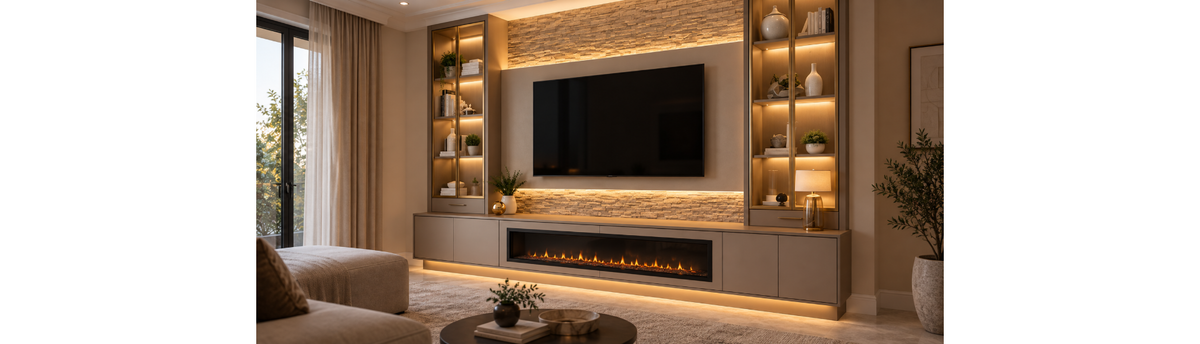

The right fireplace for an Indian home depends on more than how the flame looks. Climate changes the role a fire feature needs to play. In a warm city such as Mumbai, Kolkata or Chennai, the homeowner may want the visual presence of fire without making additional room heating the purpose of the installation. In colder destinations such as Shimla, Ooty or Kodaikanal, heat may become a much more important part of the brief.
That distinction changes how a fireplace should be selected. The decision needs to consider the climate, the room, the architecture, the desired fire experience, the amount of heat required, installation conditions, maintenance and whether the fireplace needs to remain useful throughout the year. A water vapour fireplace, an LED electric fireplace, a holographic system and a real-flame bioethanol, gas or wood-burning fireplace do not create the same experience or require the same planning.
The most useful starting point is therefore simple: decide what the fire needs to do for the room before deciding which technology should deliver it.
Warm Indian climates often make ambience, visual realism and year-round usability important considerations, while colder interiors may place greater emphasis on heat. Climate should guide the decision, but the final specification must also respond to room use, architecture, installation requirements and the characteristics of the selected fireplace technology.
Table of Contents
- Why Climate Matters When Choosing a Fireplace
- Fireplaces for Warm and Tropical Indian Climates
- Fireplaces for Colder Indian Climates
- Which Fireplace Technologies Suit Different Climates?
- Water Vapour Fireplaces
- LED and Electric Fireplaces
- Holographic and Digital Fireplaces
- Bioethanol Fireplaces
- Gas Fireplaces
- Wood-Burning Fireplaces
- Outdoor Fireplaces for Indian Climates
- Climate, Room Use and Architecture
- Climate and the Fireplace + TV Relationship
- Choosing a Fireplace in Different Indian Cities
- Where Does Vastu Fit Into Fireplace Planning?
- Climate-Based Fireplace Selection Checklist
- Navin Kanodia's Expert Perspective
- Frequently Asked Questions
Why Climate Matters When Choosing a Fireplace
A fireplace traditionally combines two experiences: the sight of fire and the warmth produced by fire. Modern fireplace technology has separated those functions. Some systems are designed primarily to create the visual experience of flames, while others create genuine combustion and heat. Some electric fireplaces can also incorporate heating, depending on the model.
This distinction matters particularly in India because climate varies significantly from one part of the country to another. A coastal apartment that already relies on air conditioning has a different fireplace brief from a winter residence in the hills. Treating both homes as though they require the same type of fireplace can lead to an unnecessary focus on heat, or the opposite problem of overlooking heating when it is genuinely important.
Climate should therefore be treated as an early filter rather than a final answer. Once you understand the environmental conditions, ask what the room is expected to do, how the fireplace will be used and whether the homeowner wants genuine flame, visual ambience, heat or a combination.
Spacio's guide to luxury fireplaces in India provides the broader framework for comparing fireplace types, applications and selection considerations.
Fireplaces for Warm and Tropical Indian Climates
In a warm climate, the first question should often be whether the room needs additional heat at all. In many contemporary residences, the fireplace is wanted because of what fire contributes visually: movement, glow, depth, atmosphere and architectural focus.
This is especially relevant to apartments, penthouses, villas and hospitality-inspired homes where a fireplace may form part of a living-room feature wall, sit below a television or become an architectural element between spaces. The homeowner may want to use the fire feature in the evening throughout the year rather than only during a short cold season.
That makes technologies designed primarily around visual ambience particularly relevant to the discussion. Water vapour fireplaces use mist and illumination to create a flame effect without combustion in the flame effect. LED electric fireplaces create a light-based fire effect, while some electric models can also provide heating. Digital and holographic systems use digital or optical representations, with the exact technology varying by model.
The important distinction is that these technologies should not simply be grouped together as "artificial fireplaces". They produce different visual experiences and have different characteristics. The homeowner should compare the technology against the room rather than choosing based on the word artificial alone.
Spacio's article on creating warmth without heat in Indian homes explores why ambience can become the primary fireplace requirement in warmer environments.
Year-round usability becomes important
A fireplace in a warm city should not necessarily become an object that only makes sense during cooler evenings. When the installation is primarily architectural, it can remain part of the room even when no heat is required.
This is one reason the fireplace's relationship with the surrounding architecture matters. A well-integrated fire feature can sit below a TV, within a feature wall or as part of a larger composition without making the room feel as though it contains a seasonal heating appliance.
For artificial fire, visual quality becomes particularly important. Spacio's article on what makes an artificial fireplace look realistic examines the relationship between flame movement, depth, light and the viewing environment.
Fireplaces for Colder Indian Climates
In colder locations, the balance can move in the other direction. If the homeowner genuinely wants the fireplace to contribute to winter comfort, heat becomes part of the specification rather than simply a secondary characteristic.
Real-flame technologies such as bioethanol, gas and wood-burning fireplaces involve combustion and produce heat. Their installation requirements are therefore different from those of non-combustion visual fire systems. Fuel, ventilation, exhaust arrangements, clearances, maintenance and manufacturer requirements may all become relevant depending on the technology and model.
Electric fireplaces can also be relevant where heating is required, but it is important not to assume that every electric fireplace provides heat. Heating capability needs to be confirmed for the specific model.
A cold climate therefore does not automatically mean "choose a real flame". It means that heat needs to be considered seriously. The appropriate technology still depends on the property, architecture, intended use and installation conditions.
Which Fireplace Technologies Suit Different Climates?
Spacio's fireplace collection covers several distinct approaches to creating the experience of fire. Understanding the difference between them makes climate-led selection much clearer.
| Fireplace Type | Fire Experience | Heat | Climate Relevance |
|---|---|---|---|
| Water vapour | Mist and illumination create a visual flame effect | Primarily an ambience-led experience rather than conventional combustion heat | Particularly relevant where additional heat is not the priority |
| LED / electric | Light-based flame effect | Some models incorporate electric heating | Flexible for warm homes and, where specified, colder interiors requiring heat |
| Holographic / digital | Digital or optical visual representation | Depends on the system; the visual technology itself should not be assumed to provide heat | Useful where visual fire and architectural integration are central |
| Bioethanol | Real flame through combustion | Produces heat | Relevant where genuine flame and heat are part of the brief |
| Gas | Real flame through controlled gas combustion | Produces heat | Relevant where genuine flame and heating are required |
| Wood-burning | Real combustion and traditional fire | Produces heat | More naturally aligned with cold-weather applications, subject to architecture and exhaust requirements |
This comparison is a starting framework, not a universal ranking. The same technology can serve different design briefs, and the characteristics of an individual model must always be confirmed before specification.
Water Vapour Fireplaces
Water vapour fireplaces are particularly relevant to the climate question because they separate the visual experience of fire from conventional combustion. The technology uses mist and illumination to create the appearance of flames, without combustion in the flame effect.
That makes the category especially interesting for warm Indian homes where the homeowner wants the atmosphere of a fire feature but does not need the fireplace to act as a conventional heat source. It can also be considered for contemporary architectural applications where the fireplace is integrated into a TV wall, feature wall or room divider.
Spacio's indoor water vapour fireplace collection is therefore a useful category to explore when the brief is centred on visual fire and year-round interior use.
As with any fireplace, however, the individual system's installation and operating requirements should be checked rather than inferred from the category name.
LED and Electric Fireplaces
Electric fireplaces use a light-based flame effect, making them another important category for climate-led planning. Some models can incorporate electric heating, which gives the category flexibility across different environments.
That flexibility needs to be understood correctly. An electric fireplace should not automatically be described as a heater. The homeowner should establish whether the selected model provides heat and, if it does, how that heating function relates to the requirements of the room.
For warm cities, an electric fireplace can therefore be considered where the visual effect is the main requirement. For cooler homes, models with an appropriate heating function may offer a different balance between ambience and comfort.
Explore Spacio's indoor LED and electric fireplace collection when comparing this category with other artificial fire technologies.
Holographic and Digital Fireplaces
Digital and holographic fireplaces approach fire from another direction. Rather than creating combustion, they use digital or optical visual representation. The exact technology varies by model, so "holographic" should not be treated as a generic description for every digital flame effect.
This makes the category particularly relevant when the visual presence of fire is the priority. In a warm apartment or contemporary media room, the ability to introduce a strong fire element without making conventional heating the central purpose can be valuable.
Flame appearance should still be judged in context. Viewing distance, surrounding lighting, the scale of the wall and other visual elements can influence how convincing a digital fire effect feels.
Spacio's holographic fireplace collection can be explored alongside the broader discussion of water, light and holographic fireplace technologies.
Bioethanol Fireplaces
Bioethanol fireplaces belong to the real-flame side of the category. They use real combustion and produce heat, which makes them fundamentally different from water vapour and light-based artificial fireplaces.
Climate is therefore only one part of the decision. The homeowner must also consider the installation environment, fuel, ventilation requirements, clearances, maintenance and safety requirements for the specific system.
In a colder residence, the genuine flame and heat may be important to the intended experience. In a warmer home, a bioethanol fireplace may still be chosen because the homeowner specifically wants real flame, but the additional heat and installation requirements should then be considered honestly.
Spacio's indoor bioethanol fireplace collection covers this real-flame category for interior applications.
Gas Fireplaces
Gas fireplaces use controlled gas combustion to create a real flame and produce heat. They can therefore be relevant to colder environments where both genuine fire and heating form part of the design brief.
They also require a more technical approach than a purely visual fire feature. Fuel arrangements, ventilation, installation, clearances and the specific manufacturer's requirements need to be established before the surrounding architecture is finalised.
For a large living room, villa or architectural feature wall, the visual scale of the fire can be important, but it should never be considered independently of the technical requirements of the system.
Explore Spacio's indoor gas fireplace collection when a real-flame, heat-producing installation is being considered.
Wood-Burning Fireplaces
Wood-burning fireplaces create real combustion and heat and have a distinctly different relationship with architecture. Unlike visual fire systems, they can require more substantial planning for exhaust, ventilation, fuel and maintenance.
This can make them particularly relevant to colder homes where the traditional experience of a genuine fire is part of the brief. A hill residence, retreat or winter-oriented interior may benefit from that relationship when the building and installation can accommodate it.
But climate should not be used as an excuse to overlook practical requirements. The architecture has to support the fireplace, and manufacturer and installation requirements need to take precedence over assumptions about what a traditional fireplace should require.
Spacio's indoor wood-burning fireplace collection represents this traditional real-fire category.
For a deeper understanding of the category, read Wood Burning Fireplaces: A Complete Guide for Indian Homes.
Outdoor Fireplaces for Indian Climates
Climate does not only affect indoor fireplaces. India's varied weather also creates different opportunities for fire features in terraces, balconies, gardens, rooftops, poolside environments and hospitality spaces.
Spacio offers outdoor bioethanol fireplaces and outdoor gas fireplaces. Both are real-flame categories, so the decision involves more than visual appearance.
Outdoor bioethanol fireplaces can be relevant where portability and genuine fire are part of the experience. Outdoor gas fireplaces can combine real flame and heat in outdoor entertaining environments. In both cases, the specific product's suitability for the location, weather exposure, installation and safety requirements should be established before use.
This is particularly useful for villas and hospitality-inspired residences where indoor and outdoor living are closely connected. The climate may determine when the outdoor space is most comfortable, while the fireplace can help shape the atmosphere during the appropriate season or evening conditions.
Climate, Room Use and Architecture
Climate provides the environmental context, but the room determines how that context becomes a design decision. A fireplace for a living room should not be evaluated in exactly the same way as one for a bedroom, home theatre or bar and den.
Living rooms
The living room is often where the relationship between climate and fireplace becomes most visible. In a warm city, the fireplace may primarily create evening atmosphere and act as an architectural focal point. In a colder home, it may also contribute to comfort.
The furniture arrangement, viewing position, wall width and relationship with the TV should therefore be resolved alongside the fireplace. The fire should belong to the room rather than being added after the architecture has already been decided.
Bedrooms
A bedroom usually benefits from a more restrained fire experience. In a warm climate, a visually focused installation can create atmosphere without making heat central to the room. In a colder residence, heating may be more relevant, but the fireplace still needs to suit the scale and intimate character of the space.
Home theatres and media rooms
Here the climate decision intersects with technology and viewing. A fireplace may sit below a TV or projector screen, but the selected system must work with the electronics, viewing distance, screen position, wiring, cabinetry and manufacturer requirements.
In a warm climate, the fire may be primarily visual. In a cold climate, heat may also be desirable. Neither decision removes the need to plan the media wall as a complete composition.
Bar and den
In a bar or den, fire becomes part of an entertaining environment. Climate can influence whether the fireplace is primarily atmospheric or whether heat is useful, while the architecture needs to accommodate seating, circulation, shelving, bar accessories and lighting around it.
Climate and the Fireplace + TV Relationship
For many contemporary Indian homes, the fireplace and television are designed together. This relationship is especially important because the TV is already a strong visual and technological element within the room.
A fireplace below a TV can create a strong horizontal composition. A fireplace beside a TV can create an asymmetric arrangement, while a fireplace integrated into a TV feature wall can become part of a larger composition of cabinetry, niches, stone, timber and lighting.
Climate changes the purpose of the fire within that composition. In Mumbai or Chennai, the fireplace may be wanted primarily for its visual contribution. In a colder location, heat may be part of the brief as well.
The important technical point is that no universal clearance should be assumed between a fireplace and television. Heat, flame type, screen position, fireplace width, wiring, ventilation, cabinetry and manufacturer clearances all need to be considered for the specific system.
Spacio's dedicated guide to choosing a fireplace below a TV explores this relationship in greater detail.
Choosing a Fireplace in Different Indian Cities
Climate-led selection becomes clearer when considered at city level. These examples do not mean that every home in a city needs the same fireplace. They show how the local environment can change the starting question.
Fireplace in Mumbai
For a fireplace in Mumbai, ambience can often be more important than conventional heating. In an air-conditioned apartment, penthouse or contemporary residence, the homeowner may want the glow and movement of fire without making additional heat the purpose of the installation.
This makes suitable water vapour, LED/electric and digital fire technologies worth considering when the brief is centred on visual atmosphere and year-round use. A fireplace below a TV or within a feature wall can remain relevant even when the room does not need heating.
Spacio's Mumbai store is located at 3BK, Laxmi Industrial Estate, New Link Road, Andheri (West), Mumbai – 400 053. For someone comparing the visual character of different fireplace technologies, experiencing the category in person can be useful before the final specification is made.
Fireplace in Kolkata
For a fireplace in Kolkata, the balance between seasonal comfort and ambience can vary according to the property. A contemporary apartment, independent residence and larger hospitality-style home can create very different fireplace requirements.
Where heat is not the central requirement, an artificial fire feature can remain part of the room's architecture throughout the year. Where genuine warmth and flame are important, the decision needs to move towards the relevant real-flame technologies and their installation requirements.
Spacio's Kolkata store is located at 86B, Topsia Road South, Kolkata – 700 046. This provides a physical point for discussing the differences between fireplace technologies and considering how climate and room use affect the choice.
Fireplace in Chennai
For a fireplace in Chennai, the climate makes the heat-versus-ambience question particularly relevant. In many contemporary homes, the fireplace may be selected primarily as an architectural feature rather than as a heating source.
That can make suitable artificial technologies worth exploring, particularly for living rooms, TV walls and entertainment spaces. The installation still needs to be evaluated according to the selected model rather than simply assuming that every artificial fireplace has identical requirements.
Fireplace in Delhi
For a fireplace in Delhi, seasonal changes make both ambience and heating relevant to the specification. A contemporary apartment, large living room or luxury residence may require a different balance between visual fire and warmth depending on how the space is used during the cooler months.
Electric fireplaces with heating functions, as well as suitable real-flame technologies, can therefore be considered where heat forms part of the brief. The final choice should still be based on the property's architecture, installation requirements, room use and the desired fire experience rather than climate alone.
Fireplace in Bangalore
For a fireplace in Bangalore, the decision may sit between year-round visual ambience and the need for occasional heating during cooler periods. In a contemporary apartment, villa or entertainment space, a fireplace can become an architectural feature even when heat is not its primary purpose.
Water vapour, LED/electric and digital fire technologies may therefore be relevant where visual atmosphere is the priority, while models with heating or real-flame systems can be considered when warmth is part of the intended experience. As with every climate, the specific technology and installation requirements should be assessed before specification.
Fireplace in Shimla
For a fireplace in Shimla, winter conditions make heating a much more meaningful consideration. A homeowner may want genuine flame and heat rather than a fire feature that exists purely for visual ambience.
Wood-burning, gas and bioethanol systems may therefore enter the conversation, subject to the specific property's architecture, installation conditions and safety requirements. Electric fireplaces with heating functions may also be relevant where the selected model provides the required performance.
Fireplace in Ooty
A fireplace in Ooty can occupy an interesting middle ground between retreat-style atmosphere and genuine seasonal comfort. Cooler evenings can make heat valuable, particularly in a residence used during the colder months.
The architecture and lifestyle of the property still matter. A fireplace in a private retreat, living room or hospitality-style residence should be selected for the way the space is occupied, not simply because the location is cool.
Fireplace in Kodaikanal
For a fireplace in Kodaikanal, the cooler climate can make warmth an important part of the desired experience. A genuine fire can also reinforce the character of a retreat or holiday residence.
Yet the same principle applies: start with the experience, then evaluate technology, architecture, installation and maintenance. Climate tells you that heat deserves attention; it does not by itself determine which fireplace should be installed.
Where Does Vastu Fit Into Fireplace Planning?
For many Indian homeowners, Vastu forms part of the planning conversation. Traditional Vastu principles commonly associate fire with the Agni element and identify the south-east as the Agni zone.
Vastu should be considered alongside architecture and technical requirements rather than used as a substitute for them. The fireplace still needs to work with the room layout, seating, TV or artwork, installation method, electrical or fuel requirements, ventilation where applicable, clearances and manufacturer instructions.
It is therefore better to consider Vastu during the planning stage, before the fireplace position and surrounding architecture have been fixed. Spacio's guide to Vastu corrections with fireplaces in India explores the subject in greater detail.
Climate-Based Fireplace Selection Checklist
Before specifying a fireplace, consider the following questions in sequence:
- What is the climate? Is the home predominantly warm, seasonally cool or genuinely cold during its main period of use?
- Does the room actually need heat? Do not assume that heat is automatically an advantage.
- What fire experience is wanted? Decide between ambience, genuine flame, heat or a combination.
- How will the room be used? Consider living, entertaining, sleeping, television viewing or hospitality.
- Which fireplace technology fits? Compare water vapour, LED/electric, digital/holographic, bioethanol, gas and wood-burning options according to the brief.
- Is the fireplace intended for indoors or outdoors? Spacio's outdoor bioethanol and outdoor gas categories serve different open-air applications.
- How will it integrate with the architecture? Consider feature walls, TV walls, cabinetry, partitions and furniture before installation is fixed.
- What does the specific installation require? Confirm electrical, fuel, ventilation, exhaust and clearance requirements where applicable.
- How will it be maintained? Maintenance varies considerably between technologies.
- Will it remain useful throughout the year? This is particularly important in warm Indian cities.
- Has Vastu been considered early? If Vastu forms part of the brief, resolve it alongside the architectural planning.
A fireplace should be selected according to the experience the homeowner wants from the room. I look first at the climate and ask whether heat is genuinely required. From there, I consider the room, architecture, scale, TV relationship, installation requirements and how the fire will be experienced throughout the year. The technology then becomes a much easier decision because it is responding to a clear design and functional brief rather than being chosen in isolation.
Why Climate Should Be Considered Before the Fireplace Model
The temptation when choosing a fireplace is to begin with appearance. A particular flame may look convincing, a certain linear format may suit a feature wall, or a real flame may immediately create the atmosphere the homeowner has imagined. But the appearance of the fireplace is only one part of the decision.
Climate establishes whether heat is desirable. Room use establishes when the fireplace will operate. Architecture establishes what can be installed. The TV or media wall may impose additional considerations. The desired visual experience determines whether artificial or real flame is appropriate. Maintenance and installation then help establish whether the chosen technology is practical for the property.
This is why two visually similar fireplaces can be very different choices for two Indian homes. A water vapour installation can make sense in a warm apartment where atmosphere is the priority, while a wood-burning or gas fireplace may make more sense in a winter-oriented residence where genuine heat is part of the experience.
The best fireplace is therefore not necessarily the one with the most heat, the most realistic flame or the largest visual presence. It is the one whose characteristics match the way the room needs to function.
Frequently Asked Questions
What is the best fireplace for a warm Indian climate?
A warm climate often makes visual ambience and year-round usability more important than conventional heating. Suitable water vapour, LED/electric or digital fireplace technologies may therefore be relevant, depending on the specific room and system. The right choice still depends on the desired fire experience and installation requirements.
Which fireplace is better for a cold Indian climate?
In a cold climate, heat becomes a more important selection criterion. Real-flame technologies such as wood-burning, gas and bioethanol produce heat, while some electric fireplaces also incorporate heating. The appropriate option depends on the property's architecture, installation conditions, intended use and the characteristics of the specific model.
Can I have a fireplace without heating my room?
Yes. Some fireplace technologies are primarily designed to create a visual fire experience rather than conventional combustion heat. Water vapour, LED/electric and suitable digital or holographic systems can therefore be relevant where ambience is the primary objective.
Are electric fireplaces suitable for warm Indian cities?
They can be. Electric fireplaces create a light-based flame effect, and some models also incorporate heating. For a warm city, the homeowner can prioritise a model according to its visual fire experience and whether additional heating is actually required.
Are water vapour fireplaces suitable for Mumbai and Chennai?
They can be particularly relevant when the homeowner wants the visual experience of fire without conventional combustion or additional heating. Their suitability still needs to be assessed according to the specific system, room and installation requirements.
Should a fireplace below a TV be different in a warm climate?
The climate can change the reason for choosing the fireplace, but the TV installation still needs to be planned around the specific fireplace. Heat, flame type, screen position, fireplace width, cabinetry, wiring, ventilation and manufacturer clearances should all be considered. No universal clearance should be assumed.
Where can I experience different fireplace technologies in Mumbai?
Spacio's Mumbai fireplace store is at 3BK, Laxmi Industrial Estate, New Link Road, Andheri (West), Mumbai – 400 053. If you are comparing fireplace technologies for a warm-climate home, you can visit the Spacio Mumbai store to discuss how climate, room use and fireplace technology affect a project. You can also find the Spacio showroom in Laxmi Industrial Estate, Mumbai on Google Maps before planning your visit.
Where can I explore fireplace options in Kolkata?
Spacio's Kolkata store is at 86B, Topsia Road South, Kolkata – 700 046. If you are comparing fireplace technologies for a home where seasonal comfort and ambience both matter, visit the Spacio Kolkata store to discuss different fire experiences and how they may suit a particular interior. You can also use Google Maps when planning your visit.
Does Vastu affect where a fireplace should be installed?
For homeowners who follow Vastu, traditional principles commonly associate fire with the south-east or Agni zone. Vastu should be considered during planning alongside the architecture and technical requirements of the selected fireplace. It should not override manufacturer requirements or practical installation considerations.
Which fireplace types produce real flame?
Bioethanol, gas and wood-burning fireplaces produce real flames through combustion. Water vapour, LED/electric and digital or holographic systems create visual representations of fire through different technologies. Automatic burners can control a real flame, but automation does not make that flame artificial.
Can outdoor fireplaces be used in Indian homes?
Spacio offers outdoor bioethanol and outdoor gas fireplace categories for open-air environments such as terraces, balconies, gardens and entertaining spaces. The specific fireplace should be selected according to its intended environment, installation requirements and manufacturer instructions.
Conclusion
India does not have one fireplace climate. The requirements of a warm coastal apartment can be fundamentally different from those of a winter residence in the hills, even when both homeowners want the same visual sense of fire.
In warmer cities, the priority may be a convincing fire experience that can remain part of the interior without making heat the focus. In colder locations, heat and genuine flame may become more important. Between those two extremes are many different combinations of climate, room use, architecture and lifestyle.
The most reliable approach is therefore to begin with the climate, define the experience the room needs, and then evaluate the available technologies. Water vapour, LED/electric, holographic or digital, bioethanol, gas and wood-burning fireplaces each have a different relationship with fire, heat and installation.
A fireplace should ultimately fit the home rather than forcing the home to fit the fireplace. Climate tells you what questions to ask. The room, architecture and intended fire experience determine the answer.
Explore Spacio's complete fireplace collection to compare different fire experiences, or continue with the related Expert Advice articles to understand fireplace technology, flame realism, TV-wall planning and Vastu in greater detail.


