
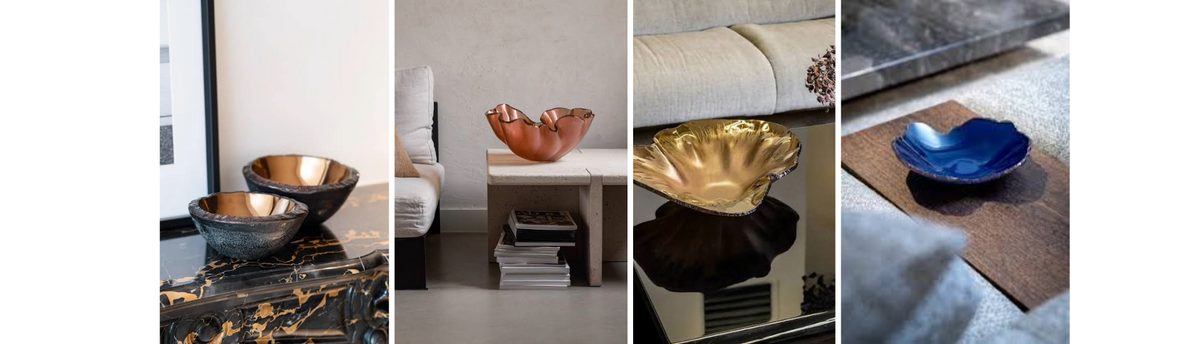

Choosing decorative bowls for a luxury home is about more than finding a beautiful shape. The right bowl needs to work with the surface on which it will sit, the scale of the room, the materials around it and the role it is expected to play.
A decorative bowl can be quiet or expressive. It can provide a low visual layer on a coffee table, become a centrepiece on a dining table, bring structure to a console or add a sculptural form to a side table. Some bowls are primarily decorative, while others can also be used for serving, flowers, floating candles or potpourri.
For a luxury interior, a well-chosen decorative bowl can become one of the most versatile premium home decor accessories, particularly when its material, scale and form complement the furniture and surrounding objects. This makes decorative bowls an important part of the wider luxury home decor accessories landscape. They sit between decoration and function, and when chosen well, they can become some of the most versatile objects in a luxury interior.
Spacio's decorative bowls collection includes sculptural and functional pieces in materials such as glass, ceramic, porcelain, wood and crystal. The important question, however, is not simply which material or shape looks attractive. It is which bowl belongs in your particular interior.
Table of Contents
- What Makes a Decorative Bowl Suitable for a Luxury Home?
- What Makes a Decorative Bowl Feel Luxurious?
- How Does Material Change the Character of a Decorative Bowl?
- Glass and Crystal Decorative Bowls
- Ceramic and Porcelain Decorative Bowls
- Wooden Decorative Bowls
- How to Choose the Right Size Decorative Bowl
- How to Choose a Decorative Bowl for Different Surfaces
- Decorative Bowls for Dining Tables
- Decorative Bowls for Consoles and Sideboards
- Decorative Bowls for Coffee and Centre Tables
- Should a Decorative Bowl Be Functional or Purely Decorative?
- How to Use a Decorative Bowl as a Statement Home Decor Accessory
- Can a Decorative Bowl Become an Exclusive Centrepiece?
- How to Style a Decorative Bowl with Other Accessories
- Decorative Bowls Around Major Focal Points
- Common Mistakes When Choosing Decorative Bowls
- What to Consider Before Buying a Decorative Bowl Online
- Why Decorative Bowls Belong in a Curated Luxury Interior
- Frequently Asked Questions
- Conclusion
What Makes a Decorative Bowl Suitable for a Luxury Home?
A decorative bowl works well in a luxury home when its design, material, scale and placement feel appropriate to the interior around it. It does not need to be large, ornate or expensive to have visual importance.
The first consideration should be the room rather than the bowl. Look at the furniture, finishes, lighting and existing decorative objects. Is the space already visually expressive, or does it need a stronger object to create interest?
A large marble centre table may need a bowl with enough visual presence to relate to the surface. A compact side table may need something smaller and quieter. A long console may benefit from a low bowl positioned alongside a taller vase or sculpture.
This room-first approach is important because the same bowl can look completely different in different interiors. An object that feels substantial in a showroom can appear surprisingly small on a large dining table. Conversely, a bowl that looks impressive online can overwhelm a narrow console once it is placed in the actual room.
For broader guidance on choosing decorative objects according to scale, proportion, material and placement, see How to Choose Decorative Objects for Your Home: Scale, Proportion, Material & Placement.
The best decorative bowl for a luxury home is one that has the right relationship with the room, surface, furniture and surrounding objects. Look at scale, material, craftsmanship, function and placement before choosing the shape or colour.
What Makes a Decorative Bowl Feel Luxurious?
A decorative bowl does not feel luxurious simply because it carries a high price. Luxury is more closely connected to the quality of the design, material, craftsmanship and the way the object relates to the interior.
A beautifully made bowl with a strong silhouette can become an important object even when its design is restrained. Another piece may attract attention through colour, surface detail or an unusual form.
There are several qualities worth considering.
Design
The shape of the bowl is usually the first thing the eye notices. Consider whether the form is soft and organic, geometric, sculptural, symmetrical or deliberately irregular.
The design should also relate to the furniture around it. A rounded bowl can soften an interior dominated by straight lines, while a structured bowl can provide definition in a softer composition.
Material
Material changes both the visual character and the perceived weight of a decorative bowl. Glass and crystal can introduce transparency and reflected light. Ceramic and porcelain can provide texture and a more tactile presence. Wood can bring warmth and natural character.
The best material is not necessarily the most elaborate one. It is the material that creates the right relationship with the existing interior.
Craftsmanship
Craftsmanship becomes particularly important when a bowl is intended to function as an artful object rather than simply as a container.
Look closely at the finish, edges, surface treatment, proportions and details of construction. A well-made object tends to reveal more of its character as it is viewed closely.
Context
Even an exceptional bowl needs the right setting. A sculptural piece placed on a crowded surface can lose much of its impact. The same piece surrounded by considered negative space can become a focal point.
This is one reason premium home decor accessories should be selected as part of the interior rather than as isolated purchases.
For a broader explanation of what makes a home decor object luxurious, including design, materials, craftsmanship and collectability, explore the earlier guide What Makes a Home Decor Object Luxury?.
How Does Material Change the Character of a Decorative Bowl?
Material is one of the most important decisions when choosing a decorative bowl because it changes how the object interacts with light, colour, texture and the surrounding furniture.
It is useful to think of the material not only as a finish but as part of the visual language of the room.
Glass and Crystal Decorative Bowls
Glass and crystal can create a lighter visual presence because light can interact with the surface and, depending on the design, pass through or reflect from the material.
This makes these bowls particularly effective where you want the object to add interest without introducing a heavy visual block. They can work beautifully on stone, glass or darker surfaces where reflections become part of the composition.
Crystal can also create a more luminous character. A carefully positioned crystal bowl may catch daylight or decorative lighting and become a subtle point of movement within the room.
Ceramic and Porcelain Decorative Bowls
Ceramic and porcelain bring a different quality. Their surfaces can feel more tactile and grounded, making them useful when an interior already contains glass, polished metal or other reflective materials.
Porcelain can work particularly well when the design is delicate or refined, while ceramic can offer greater visual texture depending on the finish and form.
When choosing between the two, consider the rest of the material palette. A softly finished ceramic bowl may introduce warmth into a very polished interior, while a cleaner porcelain form can maintain a more restrained composition.
Wooden Decorative Bowls
Wood introduces warmth and a natural quality that can soften contemporary interiors. A wooden bowl can be particularly effective where the room already contains timber furniture, natural fabrics or other organic materials.
It can also create useful contrast in a more formal setting. A natural wooden bowl on a stone or lacquered surface can prevent the arrangement from feeling overly hard or polished.
As with all materials, the aim is not to match the bowl exactly to the furniture. A relationship is usually more interesting than a perfect match.
How to Choose the Right Size Decorative Bowl
Scale is one of the most important considerations when choosing a decorative bowl. A bowl should have enough presence to relate to the surface beneath it, while still leaving enough space for the furniture and other objects to breathe.
Start by measuring the surface where the bowl will be placed. Consider both the overall dimensions and the amount of usable space that needs to remain clear.
A large dining table can accommodate a substantial bowl or a composition built around one. A compact side table may need a smaller piece. A long console may allow a larger bowl to sit towards one side while another object balances the opposite end.
Height is also important. A very deep or tall bowl may obstruct sightlines, particularly on a dining table. A shallow bowl may be more appropriate where people need to see across the surface.
When buying online, always compare the stated dimensions with the actual furniture. Product photography can make a bowl appear larger or smaller than it really is.
When choosing a decorative object, I prefer to judge it against the furniture and volume of the room rather than looking at the object by itself. A bowl that feels substantial in a photograph may disappear on a large dining table, while the same piece can feel perfectly balanced on a smaller surface.
How to Choose a Decorative Bowl for Different Surfaces
A decorative bowl should respond to the surface on which it is placed. The same object can have a completely different role on a dining table, console, coffee table or side table.
The surface determines not only scale but also how the bowl will be viewed and used.
Decorative Bowls for Dining Tables
Dining tables are among the most natural places for decorative bowls because they offer a generous central surface and often need a visual centre when the table is not being used.
A decorative bowl can function as a low centrepiece, particularly when the table is long and the arrangement needs enough visual weight to relate to the furniture. Consider the height carefully. People seated around the table should still be able to see one another comfortably. A shallow bowl can therefore be more practical than a tall decorative object.
A bowl can also be used functionally for serving, fruit or other items, provided the material and construction are suitable for that purpose. This gives the piece a practical role rather than making it purely decorative.
If the dining table already has a strong chandelier or decorative lighting above it, the bowl should complement that focal point rather than compete with it. The relationship between the objects above and below the table can make the entire dining composition feel more considered.
Decorative Bowls for Consoles and Sideboards
Consoles and sideboards offer a different styling opportunity because they are generally viewed as part of a larger wall or furniture elevation.
A decorative bowl can act as the lower, horizontal element in a composition. It can be paired with a taller vase, sculpture, books or another decorative object to create variation in height.
On a console near an entrance, the bowl can also have a practical function. It can provide a defined place for small everyday objects while still contributing to the overall styling.
Do not fill the entire console simply because there is space available. A bowl often has greater impact when it is given room around it.
For more guidance on combining vases, sculptures, books and decorative objects on a console, see How to Style a Console Table: Vases, Sculptures, Books & Decorative Objects.
Decorative Bowls for Coffee and Centre Tables
Coffee and centre tables are viewed from several directions and are usually used frequently, so their styling needs to balance visual interest with practicality.
A low decorative bowl can create a strong horizontal layer without taking up too much visual height. It can sit beside coffee table books, a tray or a smaller sculptural object. This combination can create contrast between horizontal and curved forms. Books provide a stable base, while the bowl introduces a softer or more sculptural shape.
A bowl can also help organise smaller objects. Rather than spreading several small decorative pieces across the entire table, placing them within or around a defined composition can create greater visual order.
For more on combining different decorative objects on surfaces, see How to Style Luxury Home Decor Without Making Your Home Look Overdecorated.
Should a Decorative Bowl Be Functional or Purely Decorative?
There is no requirement for a decorative bowl to be functional. Some pieces are selected primarily for their form and are best treated as sculptural objects. Others can perform a practical role. Depending on the design and material, a bowl may be used to serve food, hold flowers, display floating candles or contain potpourri.
This flexibility is one of the reasons decorative bowls can be such useful luxury home decor accessories. A piece can look beautiful when displayed empty but also adapt when the occasion changes. However, function should never be assumed simply because an object is bowl-shaped. Before using a decorative bowl for food, candles, flowers or other purposes, check the manufacturer's guidance and the suitability of the material and finish.
The decision should therefore begin with how you expect to use the object. If the bowl is primarily an art object, choose it for its form and presence. If it needs to serve a practical role, consider usability alongside appearance.
How to Use a Decorative Bowl as a Statement Home Decor Accessory
A statement home decor accessory does not necessarily need to be oversized. It needs enough visual authority to become an intentional focal point within the composition. A decorative bowl can achieve this through an unusual silhouette, strong material character, distinctive colour, craftsmanship or scale.
The key is to give it enough visual space. If a statement bowl is surrounded by several equally expressive accessories, its impact is reduced because the eye has too many competing points of attention. Instead, allow the bowl to lead the composition and let the surrounding objects support it.
This is especially effective on a large dining table or centre table. One substantial bowl can sometimes create more visual impact than several smaller objects placed together simply because the surface feels empty.
The same principle applies to high-end home decor accessories more broadly. High-end pieces should not be displayed merely to demonstrate their value. They should contribute something meaningful to the room.
Can a Decorative Bowl Become an Exclusive Centrepiece?
Yes. A decorative bowl can become an exclusive centrepiece when its form, scale and material give it enough presence to anchor the composition.
The strongest centrepieces are not necessarily the most elaborate. A beautifully proportioned bowl with a distinctive form can become the visual focus of a dining or centre table while leaving the rest of the surface relatively quiet. Think about what the bowl needs around it. It may work completely on its own, or it may be supported by a small number of complementary elements such as candles, books or a secondary decorative object.
The important thing is to avoid building a centrepiece that becomes so dense that the individual pieces lose their identity. Spacio's decorative bowls are therefore not simply another accessory category. The collection includes pieces that can function as sculptural objects as well as practical bowls, making them suitable for different levels of styling and different types of interiors.
How to Style a Decorative Bowl with Other Accessories
The easiest way to style a decorative bowl is to think about relationships rather than isolated objects. A bowl is generally a low form. This means it can work well beside something taller, such as a vase or sculpture. It can also sit on or beside books, creating a change in height and texture.
Material is another way to create contrast. A glass bowl can sit comfortably within a composition containing books and ceramic objects because each contributes a different visual quality. A wooden bowl can soften a polished stone surface. A porcelain bowl can introduce a quieter, refined element alongside stronger sculptural forms.
Colour should be treated similarly. The bowl can blend into the existing palette, connect with a colour already present or deliberately contrast with the room. Do not try to make every object match. A luxury interior generally feels more collected when different pieces have relationships without looking as though they were purchased as one set.
For a broader understanding of how vases, sculptures, books and decorative objects can work together, the earlier guide The Art of Mixing Vases, Sculptures, Books and Decorative Objects in One Room provides useful context.
Decorative Bowls Around Major Focal Points
Some rooms already contain a dominant focal point such as a fireplace, a large artwork, a dramatic view or a statement piece of furniture. Decorative accessories should respond to that focal point rather than compete with it.
A bowl can work particularly well in this situation because its visual height is usually lower. It can add detail to a nearby console, side table or centre table without becoming another tall focal point. For example, a fireplace may establish the strongest vertical and architectural presence in a living room. A decorative bowl on a nearby coffee table can support the composition through shape and material while allowing the fireplace to remain visually dominant.
The same principle applies around feature walls and other strong architectural elements. The accessory should complete the composition rather than compete with the architecture. This is particularly useful when combining premium home decor accessories with other major interior elements. Good styling is often about understanding what should lead and what should support it.
Common Mistakes When Choosing Decorative Bowls
Choosing the Bowl Before Considering the Surface
A beautiful bowl can still be the wrong choice if it does not suit the furniture beneath it. Measure the surface first and understand how much space needs to remain functional.
Choosing by Photograph Alone
Online photography can make objects difficult to judge accurately. Always check the dimensions and compare them with the intended location.
Using Too Many Statement Objects
If the bowl is already expressive, it may not need several equally dramatic accessories around it. Give it space to be appreciated.
Ignoring Function
If you intend to use the bowl for serving, flowers, candles or another practical purpose, make sure the design and material are appropriate for that use.
Matching Everything Too Closely
A bowl does not need to match the vase, furniture or other accessories exactly. Relationships through colour, material or form are often more sophisticated than perfect matching.
Filling Every Surface
An empty area around a bowl is not necessarily wasted space. Negative space can make the bowl feel more important and allow the surrounding furniture to remain visible.
What to Consider Before Buying a Decorative Bowl Online
Buying decorative bowls online gives access to a much wider range of designs, but it also makes careful evaluation more important.
Before choosing a piece, consider these questions:
- Where will the bowl be placed?
- What are the dimensions of the available surface?
- How will the bowl relate to the furniture around it?
- Does the material complement the existing interior?
- Is the bowl primarily decorative or will it also be used functionally?
- Will its height affect sightlines?
- Does it need to become a focal point or simply support another object?
- Is there enough negative space around it?
- Will the piece still feel relevant if the room changes over time?
These questions help shift the decision from “Do I like this bowl?” to “Will this bowl work in my home?”
That distinction is particularly important when selecting premium home decor accessories. Quality matters, but so does the quality of the decision behind the purchase.
Why Decorative Bowls Belong in a Curated Luxury Interior
Decorative bowls occupy an interesting position within luxury home decor. They are small enough to move easily around a home, yet substantial enough to influence the character of a surface.
They can be sculptural without being imposing. They can be functional without looking utilitarian. They can introduce colour, texture, reflection or warmth without requiring a major change to the room.
This versatility makes them particularly useful when building a curated collection of luxury home decor accessories.
Spacio's decorative bowls collection brings together pieces in glass, ceramic, porcelain, wood and crystal, with designs intended for settings including consoles, dining tables, centre tables and side tables.
The wider decor accessories collection allows these bowls to be considered alongside vases, sculptures, art objects and other decorative pieces rather than as isolated purchases.
That wider perspective is important. A luxury home is rarely defined by one object. It is the relationship between furniture, lighting, materials, artwork and accessories that creates the finished interior.
A bowl may be a small part of that composition, but the right one can provide exactly the form, scale, texture or function that the room needs.
Explore Decorative Bowls at Spacio
Explore Spacio's curated collection of decorative bowls in glass, ceramic, porcelain, wood and crystal, selected for consoles, dining tables, centre tables and side tables.
Frequently Asked Questions
What are decorative bowls used for in a luxury home?
Decorative bowls can be used purely as sculptural objects or for practical purposes such as serving, holding flowers, floating candles or potpourri, depending on the material and design. They can be placed on dining tables, consoles, centre tables and side tables.
How do I choose the right size decorative bowl?
Choose the size according to the furniture and surface where the bowl will be placed. A large dining table or centre table may need a bowl with greater visual presence, while a compact side table or console may require a smaller piece. Always check the actual dimensions before buying online.
Which material is best for a decorative bowl?
There is no single best material. Glass and crystal can introduce transparency and reflected light, ceramic and porcelain can provide a refined or tactile quality, while wood adds warmth and natural character. The right choice depends on the interior and the role the bowl needs to play.
Can a decorative bowl be used as a centrepiece?
Yes. A well-proportioned decorative bowl can become an exclusive centrepiece on a dining or centre table. Its impact usually increases when it has sufficient space around it rather than being surrounded by too many competing objects.
Can decorative bowls be used with other home decor accessories?
Yes. Bowls work particularly well with vases, sculptures, books, trays and candles because their low horizontal form creates useful contrast with taller or more vertical objects. The aim is to create relationships through height, material, colour and form rather than matching everything.
How do I style a decorative bowl on a console?
Use the bowl as a lower element within the console composition. It can be balanced with a taller vase or sculpture on one side and supported by books or a smaller decorative object. Leave enough of the console surface visible so the arrangement does not feel crowded.
Can a decorative bowl work in a small apartment?
Yes. A carefully selected bowl can provide visual interest without taking up much space. In a compact home, one well-proportioned statement accessory is often more effective than several small pieces competing for attention.
Should a decorative bowl match the furniture?
Not necessarily. It can blend with the existing palette, connect with a material or colour already present or introduce deliberate contrast. A relationship with the furniture is more important than an exact match.
Where can I buy and see luxury decorative bowls in Mumbai?
If you are looking to buy luxury decorative bowls in Mumbai, you can see and experience Spacio's collection in person at the Spacio Mumbai store at 3BK Laxmi Industrial Estate, New Link Road, Andheri (West), Mumbai 400 053. The showroom brings together decorative bowls in different materials, forms and scales, making it easier to assess how a piece would work on a dining table, coffee table, console, sideboard or other surface before buying. Visiting the Spacio showroom in Laxmi Industrial Estate, Mumbai allows you to experience the bowls in person and compare their scale, proportion, material and finish as part of a luxury interior.
Where can I buy luxury decorative bowls and experience them in person in Kolkata?
For customers looking to buy luxury decorative bowls in Kolkata, Spacio's showroom at 86B Topsia Road South, Kolkata 700 046 offers an opportunity to see decorative bowls alongside furniture, lighting and other luxury home decor accessories. You can visit the Spacio Kolkata store to experience different bowl forms, materials and proportions in person and consider how they could work as a centrepiece, console accessory or decorative element on a coffee or side table. The Spacio showroom on Topsia Road South, Kolkata is particularly useful when you want to see the actual scale and finish of a decorative bowl before making a purchase.
Through Spacio, he works with luxury home decor, decorative lighting, furniture and curated international design objects, with a particular focus on how individual pieces contribute to the character and balance of a complete interior.
Conclusion
The best decorative bowl for a luxury home is not necessarily the largest, most elaborate or most expensive piece. It is the one that feels right for the room. Consider the material, craftsmanship, scale, proportion and intended function. Then look at the surface where the bowl will live and the objects around it. A bowl may need to become a focal point, provide a quieter horizontal layer or simply introduce a practical element to an otherwise finished composition.
Glass, crystal, ceramic, porcelain and wood can each bring a different quality to an interior. The choice should respond to the existing furniture, finishes, lighting and overall visual language of the room. Most importantly, do not treat a decorative bowl as an isolated purchase. Think of it as part of the wider collection of luxury home decor accessories that gives a home its personality and visual balance.
When the right object is chosen for the right surface, and given enough space to be appreciated, even a relatively small accessory can have a significant effect on the way a luxury interior feels.


