
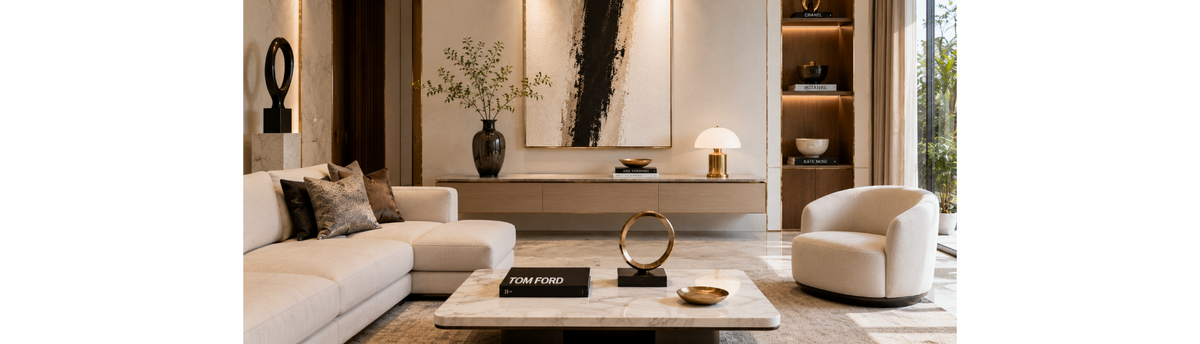

A luxury living room should feel composed, comfortable and personal. The right decorative objects help achieve this by adding texture, height, colour, craftsmanship and visual interest without making the room feel crowded.
The key is not to fill the living room with beautiful things. It is to select and arrange luxury home decor accessories so that they work with the furniture, lighting, materials and architecture already present in the room.
A vase can introduce height beside a low sofa. A sculpture can create a focal point on a console. Coffee table books can establish a horizontal layer, while a decorative bowl or tray can bring a quieter shape to the composition. The best arrangements feel natural because every object has a role.
This approach becomes especially important when choosing premium home decor accessories. Quality matters, but quality alone does not create a luxurious interior. Scale, proportion, placement and the relationship between objects determine how successfully an accessory becomes part of the room. In Indian homes, these decisions also need to respond to the scale of the room, its architecture, natural light, material palette and the way the living space connects to adjoining areas.
This guide explains how to style a luxury living room with decorative objects, including how to create focal points, work with scale, combine materials, introduce statement pieces and use negative space to keep the overall composition refined.
Table of Contents
- Start with the Room, Not the Objects
- Create Visual Hierarchy
- Pay Attention to Scale and Proportion
- Create Layers with Different Heights
- Use Materials to Add Depth
- Connect the Room Through Colour
- Style the Coffee Table Without Overloading It
- Use Consoles to Anchor the Room
- Use Statement Home Decor Accessories Carefully
- Use Negative Space to Let Objects Breathe
- Adapt the Styling to the Indian Home
- Mix Different Object Types with a Clear Purpose
- Common Luxury Living Room Styling Mistakes
- How Premium Home Decor Accessories Work in a Luxury Living Room
- A Simple Method for Styling a Luxury Living Room
- Frequently Asked Questions
- The Final Principle: Curate, Don't Fill
Start with the Room, Not the Accessories
The first step in styling a luxury living room is to understand what the room is already saying.
Look at the architecture, furniture, lighting, flooring, wall finishes and natural light before introducing decorative objects. A marble wall, sculptural sofa, large artwork, fireplace, statement chandelier or full-height window may already be providing a strong focal point.
Decorative objects should respond to these existing elements rather than compete with them.
For example, a living room with richly veined marble and expressive lighting may need quieter accessories. A room with simple neutral furniture may benefit from stronger sculptural forms that introduce character and visual movement.
This is why the same vase or sculpture can look completely different in two homes. The object has not changed. Its visual relationship with the surrounding space has changed.
Before buying anything, ask three questions:
- What is already attracting attention?
- Where does the room feel visually quiet?
- What does the composition need—height, texture, colour, contrast or simply restraint?
The broader principles of choosing decorative objects are covered in Spacio's complete guide to luxury home decor accessories for modern Indian homes. Here, the focus is specifically on how those objects should work within a living room.
Create a Clear Visual Hierarchy
A well-styled living room has a visual hierarchy. The eye should naturally understand what to notice first, what to explore next and what can remain quieter in the background.
The focal point may already be architectural. A fireplace, artwork, dramatic window or chandelier can naturally command attention. Decorative objects should then reinforce that hierarchy rather than create competing focal points.
If the living room does not have one obvious focal point, a carefully selected sculptural object can help create one. A large vase, artistic sculpture or distinctive art object can anchor a console or sideboard while smaller accessories provide support.
The important word is support.
Not every accessory should be a statement. When every object is trying to attract attention, the room becomes visually tiring even when the individual pieces are exceptional.
When I style a living room, I first decide what I want the eye to notice. Only after that do I select the decorative objects. A beautiful accessory is not automatically the right accessory if it competes with something more important in the room.
This principle is particularly useful when introducing sculptures and art objects. Their visual presence can be considerable, so they should be positioned where their form can be appreciated without creating unnecessary competition.
Use Scale and Proportion Carefully
Scale is one of the simplest ways to distinguish a professionally styled living room from one where accessories have been added without enough consideration.
A small object can disappear on a large sideboard. A very large sculpture can overwhelm a narrow console. A collection of tiny objects can look insignificant against a large wall or oversized piece of furniture.
The right scale is therefore determined by the room and the furniture around it, not by the object in isolation.
Consider a large living room with a generous sectional sofa and a substantial coffee table. Small accessories may not provide enough visual weight. A larger sculptural object or generously proportioned vase can establish a stronger relationship with the furniture.
In a compact apartment living room, the opposite may be true. One carefully chosen statement object can have more impact than several medium-sized pieces competing for limited visual space.
Proportion also applies between objects. A tall vase beside a tiny sculpture may create an interesting contrast, but if the difference is too extreme, the smaller piece may appear accidental rather than deliberately placed.
Good styling creates variation without losing coherence.
Create Layers with Different Heights
Once scale has been considered, introduce variation in height. Objects that finish at exactly the same level tend to create a flat arrangement. Different heights allow the eye to move naturally through the composition and create a sense of depth.
A tall decorative vase can provide vertical emphasis. A sculpture can occupy a middle level, while books, a tray or a bowl can create a lower layer.
This does not mean every arrangement needs three or four different levels. Even two carefully contrasted heights can be enough to create movement.
Height can also be created indirectly. A sculpture placed on a stack of coffee table books becomes taller without requiring a larger sculpture. A decorative object placed on a tray can gain visual importance because the tray creates a defined base. The objective is to create a composition that feels layered rather than arranged in a straight line.
Use Materials to Add Depth
Materials are one of the quietest ways to introduce luxury into a living room.
Glass can provide transparency and lightness. Stone introduces weight and permanence. Metal creates reflection and structure. Ceramic and porcelain offer tactile softness, while timber brings warmth through its natural grain. Instead of using many different materials, select a few that relate naturally to the existing interior.
A marble coffee table can be softened by timber or ceramic accessories. A room dominated by timber can benefit from glass or polished metal. Leather furniture can gain visual lightness from transparent crystal or glass objects. This material contrast is one reason high-quality decorative objects can transform a room without requiring large quantities of decoration.
For a deeper explanation of how craftsmanship, materials, design and collectability contribute to the perception of luxury, read What Makes a Home Decor Object Luxury? Design, Materials, Craftsmanship & Collectability Explained.
Connect the Room Through Colour
Decorative objects can quietly connect colours that already exist within a living room.
Exact matching is rarely necessary. Instead, look for relationships. A bronze accessory can echo the finish of a lighting fixture. A muted blue object can pick up a colour from artwork or upholstery. A neutral ceramic can relate to the tones of stone, timber or linen already present in the room.
Colour repetition creates continuity, but it should remain restrained.
If a colour appears only once, it may feel disconnected. If it appears on every surface, it can become predictable. Repeating an accent colour in two or three carefully selected places is often enough to make the room feel cohesive.
The colour of a decorative object is rarely important on its own. What matters is what that colour connects to within the room. A small repeated detail can often create more cohesion than a large amount of matching decoration.
Style the Coffee Table as a Composition
The coffee table is one of the most visible decorative surfaces in a living room, but it is also one of the most frequently over-styled. Because it sits at the centre of the seating area, every object placed on it becomes part of the room's visual conversation.
Begin with the shape and size of the table. A long rectangular coffee table can accommodate two or three related groupings, while a round table often benefits from one central composition. A square table may work well with a compact arrangement that is balanced from several viewing angles.
The table's material matters too. A glass table already feels visually light, so a large number of accessories can quickly make the surface appear crowded. A substantial stone or timber table can support objects with greater visual weight without feeling overwhelmed.
Build the arrangement around one principal element. This might be a sculptural object, a vase or a carefully selected stack of coffee table books. Supporting pieces should then introduce different heights, shapes and textures.
A stack of luxury coffee table books creates a horizontal foundation. A Murano sculpture introduces vertical or organic form. A decorative bowl creates a lower, broader shape. A tray can bring smaller objects together so that they read as one group rather than several unrelated pieces. The objective is not to place one of everything on the table. Each object should have a visual role.
Leave enough open surface for the coffee table to remain practical. People should still be able to place a cup, move a book or use the table while entertaining. A luxury living room should look considered without becoming difficult to live in.
I always look at a coffee table from the seating positions around it, not just from where I am standing. An arrangement that looks balanced from one angle can feel completely different from a sofa or lounge chair. Styling has to work in real life, not only in a photograph.
For a deeper exploration of how different object types work together, see The Art of Mixing Vases, Sculptures, Books and Decorative Objects in One Room.
Style Consoles and Sideboards with Restraint
Consoles and sideboards offer an opportunity to create a stronger vertical composition because they usually sit against a wall. The wall itself becomes part of the styling, whether it contains artwork, a mirror, wall panelling or another architectural feature.
Begin by considering what is already happening above the furniture.
If a large artwork is the focal point, decorative objects should support it rather than compete with it. A tall vase can create a transition between the furniture and the artwork, while smaller accessories can provide detail closer to the surface.
A decorative mirror creates a different relationship because the accessories are reflected. This increases their visual presence and makes spacing particularly important. A smaller number of well-positioned objects can therefore be more effective than a crowded arrangement.
Long sideboards can accommodate more than one grouping, but these groups should still relate to one another. Repeating a material, colour or form across the surface can create continuity without making the arrangement symmetrical.
A console in an entrance area is also experienced differently from one behind a sofa. The entrance console creates an immediate first impression, while a console behind a sofa is viewed as part of the larger living room from several directions. These differences should influence the scale and density of the accessories.
For more detailed guidance on styling different surfaces, see How to Style Consoles, Coffee Tables and Shelves with Luxury Home Decor Accessories.
Use Statement Home Decor Accessories Carefully
A statement home decor accessory can give a living room its personality, but it becomes a statement only when the room allows it to be seen.
A large sculpture surrounded by several other dramatic accessories loses some of its impact because the eye has too many competing points of interest. The same sculpture placed against a quieter wall or on a relatively restrained console can immediately become the focal point.
This is why statement home decor accessories should be treated as anchors within a composition rather than simply as additional decoration.
A statement piece does not have to be enormous. A distinctive silhouette, unusual material, exceptional craftsmanship or strong colour can give an object visual authority even when its physical dimensions are modest.
Consider the rest of the room before introducing one. If the living room already has a dramatic chandelier, large artwork and an expressive fireplace, adding several equally strong decorative objects may create unnecessary competition. In a quieter room, however, one sculptural accessory can provide exactly the character the space needs.
A statement object needs visual silence around it. The more expressive the object, the more important it becomes to edit the accessories immediately around it. Giving a beautiful piece room to breathe is often what makes it feel luxurious.
Let Negative Space Do Some of the Work
One of the most important elements in luxury living room styling is something you do not buy: negative space. Empty space allows decorative objects to breathe. It gives the eye somewhere to pause and makes carefully selected pieces more noticeable.
This does not mean a luxury living room has to be minimalist. A room can contain rich materials, layered textures and a considered collection of accessories while still feeling calm. The difference is that the objects are given enough space to remain visually distinct.
Negative space is particularly useful around sculptural objects. The silhouette of a sculpture is easier to appreciate when it is not surrounded by several objects with similar visual weight. The same principle applies to shelves and consoles. A deliberately empty section can give the neighbouring composition greater impact. An untouched area is not necessarily a missed decorating opportunity; it can be an intentional part of the design.
This is closely connected to the principle of restraint explored in How to Style Luxury Home Decor Without Making Your Home Look Overdecorated. Knowing when to stop is one of the most important skills in luxury interior styling.
Adapt the Styling to the Indian Home
Luxury living rooms in India vary enormously in scale, architecture and material palette. A compact Mumbai apartment may need a very different approach from a large Bengaluru villa, a Delhi residence or a spacious home in Hyderabad. The styling principles remain the same, but their application should respond to the room.
In a compact living room, fewer accessories with stronger visual presence can create more impact than many small objects. Keeping surfaces relatively clear also helps preserve a sense of openness.
Larger living rooms can accommodate objects with greater scale. A generous console may require a substantial sculptural piece rather than several small accessories that disappear against the furniture. Large walls may also need objects or artwork with enough visual weight to relate to the architecture.
Open-plan homes require another layer of consideration. The living room is often visible from dining areas, entrances and circulation spaces, so decorative objects should contribute to visual continuity without making every area look identical.
Material relationships are particularly useful here. The same bronze, timber, glass, stone or ceramic finish can appear in different forms across adjoining spaces, creating a subtle connection between them. The objective is not to decorate every room in exactly the same way. It is to create a home where the rooms feel related while retaining their individual character.
Mix Different Object Types with a Clear Purpose
A sophisticated living room rarely relies on only one category of decorative accessory. The interest comes from the relationship between different types of objects.
A vase can introduce height and a softer silhouette. A sculpture can provide a stronger focal point. A decorative bowl can add a lower, rounded form. Coffee table books can create horizontal layers, while a tray can visually organise several smaller pieces.
These objects work best when they do not all perform the same job.
| Object | Visual Role |
|---|---|
| Vase | Introduces height, softness and vertical movement. |
| Sculpture | Creates a focal point through form, silhouette or material. |
| Decorative Bowl | Adds lower, broader visual weight and softer curves. |
| Coffee Table Books | Creates horizontal layers and visual structure. |
| Decorative Tray | Groups smaller objects and gives the arrangement a defined boundary. |
| Decorative Box | Adds texture, detail and discreet functionality. |
The table is not a formula that every living room must follow. It is a way of understanding the different roles accessories can play. A successful composition may use only two or three of these categories if those pieces provide enough variation.
For example, a large sculptural vase and a low decorative bowl may be all that a small console requires. A generous coffee table may need books, a sculpture and a tray. The right combination depends on the surface and the room.
Common Luxury Living Room Styling Mistakes
Even exceptional decorative objects can weaken a living room when they are used without enough attention to composition. The problem is rarely the quality of the individual pieces. It is usually the relationship between them.
Using too many statement pieces
A room becomes visually tiring when several objects compete to become the focal point. If the living room already has a dramatic artwork, chandelier or fireplace, the decorative accessories should generally provide support rather than introduce several additional centres of attention.
Ignoring scale
A collection of small accessories can disappear on a large sideboard, while an oversized sculpture can dominate a compact living room. Always consider the size of the object in relation to the furniture, wall and surrounding accessories.
Matching everything too perfectly
Decorative objects do not need to come from the same collection or share exactly the same finish. In fact, a combination of glass, stone, ceramic, metal and timber can create greater depth when the materials relate naturally to the rest of the room.
Filling every available surface
Empty space is not wasted space. When every console, shelf, side table and coffee table is covered with accessories, the individual pieces lose their visual importance and the room can begin to feel crowded.
Buying objects before understanding the room
This is one of the most common mistakes. A beautiful object may not be the right object for a particular room. The furniture, architecture, lighting, materials and existing focal points should all influence what is eventually placed within the space.
Styling only for photographs
A living room is meant to be lived in. Coffee tables should remain usable, circulation areas should remain clear and decorative objects should not make everyday activities uncomfortable. The best styling survives beyond the photograph.
When I finish styling a living room, I do not ask whether I can add another beautiful object. I ask whether anything can be removed without weakening the composition. That final act of editing is often what gives a room its sense of calm and refinement.
How Premium Home Decor Accessories Work in a Luxury Living Room
The word premium should describe more than price. Premium home decor accessories bring together quality materials, thoughtful design, craftsmanship and a visual presence that can hold its own within a well-designed interior.
But even a beautifully made accessory will not automatically improve a room. Its success depends on placement, proportion and context. A premium object should contribute something to the composition rather than simply occupy an available surface.
A handcrafted glass object may be extraordinary when placed where natural or decorative light can reveal its transparency and colour. A sculptural stone object may be more effective against a quieter background where its form can be appreciated. A finely finished metal object may create a subtle connection with the lighting and hardware already present in the room.
This is also why choosing high-end home decor accessories should not be reduced to choosing the most expensive pieces available. High-end design is ultimately about the quality of the object and the quality of the decision behind its placement. A beautifully made piece can feel ordinary when it is poorly scaled or surrounded by competing objects.
The distinction becomes particularly useful when choosing between several accessories that may appear similar at first glance. Look at the material, finish, craftsmanship, proportions, originality and how the object will relate to the room. A premium accessory earns its place through what it contributes to the overall composition.
Spacio's curated collections bring together decorative objects from international design brands across materials, forms and categories, allowing accessories to be considered as part of a larger interior rather than as isolated purchases.
A Simple Method for Styling a Luxury Living Room
If you are beginning with a room that feels unfinished, it can help to approach the styling in stages rather than trying to decorate everything at once.
Step 1: Identify the existing focal point.
Decide what naturally attracts attention. It may be the fireplace, artwork, view, lighting or a strong architectural element.
Step 2: Identify what the room is missing.
Does the room need height, texture, colour, warmth or sculptural form? This gives you a reason for selecting the next object.
Step 3: Introduce one strong object.
Start with a statement vase, sculpture or other decorative object that establishes the visual direction of the composition.
Step 4: Add supporting objects.
Choose pieces with different visual roles. If the first object is tall, consider something lower. If it has a strong geometric form, introduce a softer or more organic shape.
Step 5: Connect materials and colours.
Look for subtle relationships with the furniture, flooring, lighting, artwork and textiles already present.
Step 6: Step back and edit.
Look at the room from different seating positions and from the entrance. Remove anything that feels unnecessary or creates an unwanted focal point.
This process is more reliable than buying a collection of accessories and trying to find somewhere to put each one.
Frequently Asked Questions
How do I style a luxury living room with decorative objects?
Begin with the room's existing architecture, furniture and focal points. Then introduce decorative objects according to scale, proportion, height, material and visual hierarchy. Use a few strong pieces and leave enough negative space around them.
What are the best home decor accessories for a luxury living room?
Vases, sculptures, decorative bowls, coffee table books, trays, decorative boxes and other art objects can all work well. The right combination depends on the room's scale, materials and existing visual elements.
How do I use premium home decor accessories without making the room look cluttered?
Choose fewer pieces and give each one a clear role. Avoid using several objects with the same visual weight and leave intentional negative space between important accessories.
How many statement home decor accessories should I use?
There is no fixed number, but most living rooms benefit from a clear visual hierarchy rather than several competing statement pieces. One strong object can often have more impact than many dramatic accessories.
Should luxury living room accessories match the furniture?
They do not need to match exactly. Instead, look for relationships in colour, material, texture, form and proportion. Complementary finishes generally create a more sophisticated and collected result than perfect matching.
How can I make a small living room feel luxurious with decorative objects?
Use fewer objects with stronger visual purpose. Choose accessories that are appropriately scaled, keep surfaces relatively open and use material contrast to create interest without adding visual clutter.
What is the difference between premium and high-end home decor accessories?
The terms can overlap, but neither should be understood simply as a price category. Quality materials, craftsmanship, design, provenance and the ability of an object to contribute meaningfully to an interior are more useful measures of luxury.
Why is negative space important in luxury interiors?
Negative space gives decorative objects room to be appreciated and allows the eye to move comfortably through the room. It also prevents several beautiful objects from competing with one another.
The Final Principle: Curate, Don't Fill
The most successful luxury living rooms are not necessarily the ones with the largest number of decorative objects. They are the rooms where every object appears to have a reason for being there.
A vase can introduce height. A sculpture can establish a focal point. Books can create horizontal layers. A bowl can soften a composition. A tray can organise smaller accessories. Materials can connect the objects to the furniture, lighting and architecture around them.
When these elements work together, decorative objects become more than decoration. They become part of the visual language of the room.
This is why choosing luxury home decor accessories for a living room should begin with understanding the room rather than starting with a shopping list. Whether an accessory is premium, statement-making or high-end, its impact ultimately depends on scale, placement, composition and restraint.
If you are building a collection of objects for your home, begin with the broader principles in Spacio's complete guide to luxury home decor accessories. Then consider how each object can contribute to the particular room you are styling.
Luxury styling ultimately comes down to knowing what the room needs, selecting carefully and knowing when to stop. The result should feel considered rather than decorated, personal rather than formulaic and refined without losing the comfort of a home.
Explore Luxury Home Decor Accessories at Spacio
Discover curated vases, sculptures, decorative objects, coffee table books and other accessories selected for refined luxury interiors.
Explore Luxury Home Decor Accessories


