
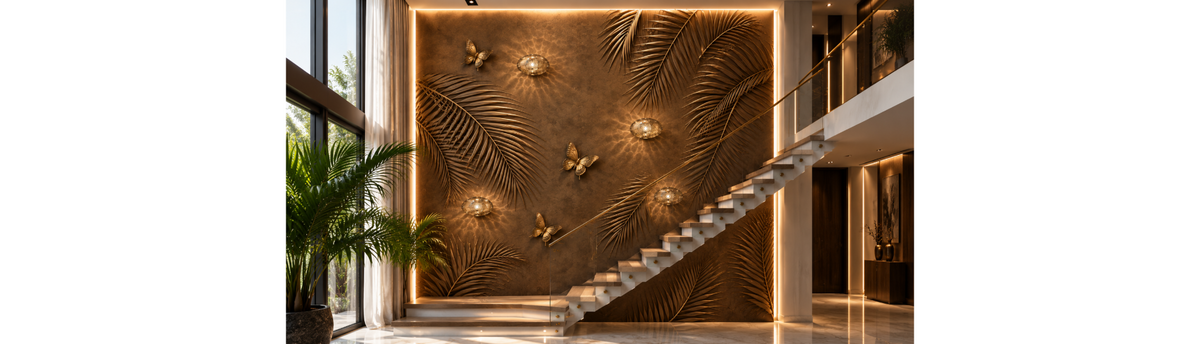

A wall can be one of the largest uninterrupted surfaces in an interior, yet it is often treated as a background rather than as part of the design itself. Luxury wall styling begins with a different idea: the wall is an active architectural and visual element that can carry art, texture, colour, light, reflection, sculpture, pattern and atmosphere.
For that reason, creating a sophisticated statement wall is not simply a matter of finding something attractive to hang on an empty surface. It involves deciding what the wall should contribute to the room, understanding its architectural proportions, selecting the appropriate surface or object, and then composing the different elements so that scale, hierarchy, material, lighting and negative space work together.
In an Indian home, the wall may be a compact apartment elevation, a broad living-room wall, a dining-room backdrop, a double-height surface, a foyer, a passage, a staircase wall, a partition, a curved architectural element or a wall that has to coexist with doors, windows, furniture or a television. Each condition changes what the wall can successfully carry.
The appropriate solution may therefore be wall art and paintings, a sculptural composition, an artistic wall covering, a mural, Italian fresco, metal fabric, an illuminated or crystal-enhanced surface, a decorative mirror, wall lighting, candelabras or a carefully controlled combination of several elements.
The important point is that these are not interchangeable decorative products. Each has a different visual role. Some primarily change the surface of the wall. Some create imagery. Some introduce three-dimensional form. Some reflect light. Some create atmosphere. Some establish the focal point. The skill lies in understanding these relationships and deciding which role matters most for a particular interior.
Table of Contents
- What Is Wall Styling?
- Why a Wall Should Be Treated as More Than a Background
- What Is a Statement Wall?
- What Makes a Luxury Statement Wall Different?
- The Main Types of Luxury Wall Styling Solutions
- Wall Coverings and Artistic Surface Treatments
- Murals and Artistic Wall Compositions
- Italian Fresco as a Wall Treatment
- Metal Fabric and Specialist Textural Surfaces
- LED and Crystal-Enhanced Wall Surfaces
- Wall Art as a Focal Element
- Wall Sculptures and Three-Dimensional Art
- Mirrors, Decorative Lighting and Candelabras
- How Different Wall Styling Elements Work Together
- How to Create Visual Hierarchy on a Wall
- Scale and Proportion: The Foundation of Wall Styling
- Why Negative Space Matters
- Colour and Material Dialogue
- How Lighting Changes a Wall
- Wall Styling Across Different Rooms
- Wall Styling According to Architecture
- How to Choose the Right Wall Styling Solution
- Common Wall Styling Mistakes
- Wall Styling in Indian Interiors
- Wall Art and Decorative Objects as Luxury Gifts
- Exploring Wall Styling at Spacio
- Frequently Asked Questions
What Is Wall Styling?
Wall styling is the deliberate design of a wall and its relationship with the surrounding interior. It considers the wall's architectural role, surface, artwork, sculpture, mirrors, lighting, furniture relationship and negative space to determine how that wall should be experienced within the room.
This is broader than wall decor. Wall decor describes the objects or treatments used on a wall; wall styling determines how those elements, the wall itself and the surrounding architecture work together as one composition. The objective is not simply to fill an empty surface, but to give the wall a clear visual role that belongs to the interior.
A styled wall can therefore be almost entirely surface-led, such as an expressive mural or artistic wall covering. It can be object-led, such as a large painting, sculptural artwork or decorative mirror. It can be lighting-led, where illumination becomes an important part of the visual experience. Or it can be a layered installation in which the wall surface, artwork, sculpture and lighting have deliberately been designed to work together.
This distinction matters because a wall does not always need more objects. Sometimes the most effective wall treatment is a strong surface with very little placed over it. In another room, the wall may be visually quiet and therefore provide the ideal setting for a substantial artwork or sculptural composition. The right answer depends on the role the wall needs to play.
Wall styling can also include architectural decisions. A recessed niche may frame an object differently from a flat wall. A curved wall changes the way imagery and objects are perceived. A double-height wall demands a different understanding of scale from a standard-height room. A partition wall may need to be considered from both sides. A passage wall may be experienced while moving through space rather than while sitting opposite it.
In other words, wall styling sits at the intersection of surface design, art, interior styling, lighting and architecture. Its purpose is not merely to make a wall attractive. Its purpose is to make the wall belong to the interior.
Why a Wall Should Be Treated as More Than a Background
When a wall is considered only as an empty vertical surface, the natural response is often to ask, “What can I put here?” That question can lead to unnecessary decoration because the wall is being treated as a gap that needs filling.
A better question is: “What does this wall need to contribute to the room?”
It may need to establish a focal point behind a sofa. It may need to add warmth to a dining room. It may need to introduce texture into an otherwise restrained interior. It may need to give a long passage a sense of rhythm. It may need to balance a large piece of furniture. It may need to visually connect two parts of a room. It may need to bring reflected light into a darker area. Or it may need to become the defining architectural experience of the space.
Once the wall is given a role, the selection process becomes more intelligent. Instead of beginning with an object and trying to find a place for it, the design begins with the architecture and the desired visual outcome.
This is particularly important in luxury interiors because a sophisticated room rarely depends on the quantity of decoration. It depends on the relationship between elements. A large artwork can look underwhelming if it is too small for the wall. A beautiful mural can compete with an equally strong sculpture if both are treated as focal points. A mirror can become visually distracting if its reflections are not considered. Decorative lighting can either reveal a surface beautifully or create unwanted visual competition.
The wall is therefore not a passive backdrop. It is one of the planes through which the interior establishes scale, rhythm, materiality, identity and visual hierarchy.
When I look at a wall, I do not begin by asking what object can be placed on it. I first look at the room, the architecture, the furniture and the way the wall is experienced. The wall may need art, texture, sculpture, reflection, light or sometimes simply more space around one strong element. The selection becomes much easier once the role of the wall is understood.
What Is a Statement Wall?
A statement wall is a wall that has been intentionally given a stronger visual identity than the surrounding surfaces. It becomes an identifiable part of the room's composition rather than remaining visually neutral.
A statement wall does not have to be the most colourful wall in the room. It does not necessarily require an accent colour, a dramatic pattern or a large amount of decoration. A quiet wall finished with a sophisticated material and one precisely scaled artwork can be a stronger statement than a heavily decorated wall. The word “statement” refers to visual intention. The wall says something about the room through its material, artwork, scale, composition, craftsmanship or atmosphere.
For example, a large artwork can establish personality and cultural character. A sculptural installation can introduce dimensionality. An artistic mural can create an immersive visual field. A reflective composition can alter the perception of space. A richly textured surface can add depth without requiring additional objects. An illuminated wall covering can make the wall an atmospheric element that changes after dark.
There can also be more than one statement wall within a home, but that does not mean every wall should compete for attention. The strength of a statement depends partly on the quieter surfaces around it. This is why the concept of a statement wall should always be connected to the wider room. A wall becomes successful when its visual identity strengthens the interior rather than competing with everything else in it.
Wall Styling, Wall Decor, Feature Walls and Statement Walls
These terms are related, but they describe different parts of the design process.
| Term | What it describes | Its role in wall design |
|---|---|---|
| Wall styling | The overall design approach | Determines how the wall, surface, objects, lighting and surrounding interior work together |
| Wall decor | Objects or decorative treatments used on a wall | Includes artwork, mirrors, sculptures, clocks and other appropriate decorative elements |
| Feature wall | A wall given deliberate visual or architectural emphasis | Uses surface, colour, material, artwork or another treatment to distinguish one wall from others |
| Statement wall | A wall that becomes a significant visual element within the interior | Creates a focal point or strong visual identity through a considered composition |
A feature wall does not necessarily need to be elaborate, and a statement wall does not necessarily need to contain many decorative elements. Both depend on the role the wall plays within the wider interior. Wall styling is the broader discipline that determines how that role is created.
A fireplace can also become one of the strongest focal elements within a wall composition. When a fireplace is integrated into a living-room wall, media wall or other architectural feature, the artwork, sculpture, lighting and surrounding surfaces need to respond to it rather than compete with it. For a broader understanding of fireplace technologies, formats, applications and selection considerations in Indian interiors, see Spacio's complete guide to luxury fireplaces in India.
What Makes a Luxury Statement Wall Different?
A luxury statement wall is not simply an expensive wall. Price alone cannot create proportion, hierarchy or visual coherence. A costly artwork can look insignificant on the wrong wall, while a carefully selected surface treatment can create considerable impact because it has been chosen and composed correctly. A luxury wall is not defined by the price or quantity of what is placed on it. It is defined by the quality of the design decisions behind the composition.
Scale determines whether the wall and its principal elements feel proportionate.
Proportion determines how the wall relates to the furniture, architecture and surrounding space.
Craftsmanship gives individual materials and objects their visual and tactile credibility.
Material quality determines how surfaces, objects and finishes contribute to the interior's overall language.
Lighting controls how the wall is experienced across different times and viewing conditions.
Integration ensures that the wall belongs to the architecture rather than appearing to have been added afterward.
Restraint prevents the composition from becoming visually crowded simply because more decorative elements are available.
Luxury is more accurately understood through a combination of intentionality, scale, proportion, material quality, craftsmanship, hierarchy, lighting and restraint.
Intentionality
Every major element should have a reason for being there. The artwork should not simply fill a blank area. The lighting should not simply illuminate because the wall has artwork on it. The texture should not be introduced because the room “needs something.” The decision should relate to the architecture, furniture, atmosphere or visual hierarchy of the space. Intentionality is often what separates a collected-looking interior from a room that feels decorated.
Scale
Scale describes how large an element feels in relation to the wall and the surrounding interior. A wall may be physically large, but the furniture in front of it may be compact. A double-height wall may require a different visual response from a conventional wall even when the artwork itself is beautiful. One of the most common wall-styling mistakes is choosing an object according to how attractive it looks individually rather than how it will read at the scale of the room.
Proportion
Proportion concerns the relationship between dimensions. The width of an artwork relates to the furniture below it. The height of a composition relates to the ceiling. The visual mass of sculpture relates to the wall around it. A mirror may need to relate to the console beneath it or to the architectural opening beside it. Good proportion allows a wall composition to feel integrated rather than arbitrarily placed.
Hierarchy
Hierarchy determines what the eye notices first, what it notices second and what remains supporting information. A wall can contain several beautiful elements and still feel unsuccessful if all of them demand equal attention. A strong composition normally has an anchor, supporting elements and quieter areas that allow the eye to rest.
Material quality and craftsmanship
Material contributes more than colour. It can introduce texture, reflection, transparency, warmth, depth or visual weight. A metallic surface interacts with light differently from a textile-like surface. Glass and crystal create a different visual experience from wood or ceramic. A painted or printed artwork behaves differently from a three-dimensional sculptural piece.
Craftsmanship becomes particularly visible when the wall is experienced at close range. Finishes, detailing, framing, joins, texture and the quality of the object all contribute to the perception of the completed composition.
Lighting
Lighting can reveal texture, emphasise artwork, create shadows, introduce sparkle, change the perceived depth of a surface or establish atmosphere after dark. It can therefore be considered part of the wall design rather than something added after the wall has already been completed.
Restraint
Restraint is not the absence of decoration. It is the discipline to stop when the composition has achieved what it needs to achieve. A wall with one exceptional focal element and sufficient negative space can often feel more luxurious than a wall containing multiple unrelated objects. Restraint allows materials, artwork and craftsmanship to remain visible.
The Wall Styling System: Surface, Treatment, Object, Light and Space
To understand wall styling clearly, it helps to separate the wall into layers. This does not mean that every wall requires every layer. It means that each possible layer has a different function.
A useful way to read a wall is:
Architecture establishes the physical condition of the wall: its height, width, curves, recesses, openings, adjacent surfaces and relationship to the rest of the room.
Surface is the visual base of the composition. It may remain quiet or become a significant part of the statement through wallpaper, mural, fresco, artistic covering, metal fabric or another specialist treatment.
Treatment describes what is done to the surface to change its visual character. This may involve imagery, pattern, texture, material, reflection or illumination.
Focal object is the element that carries the strongest visual attention. It may be a painting, sculpture, decorative mirror, sculptural artwork, wall clock or another major wall element.
Supporting elements reinforce the focal object without competing with it. These may include smaller artwork, secondary sculpture, lighting or carefully selected decorative components.
Lighting determines how the surface and objects are perceived. It can be decorative, functional, atmospheric or used specifically to reveal material and form.
Furniture relationship connects the wall to the room. A wall behind a sofa is not designed in isolation from the sofa. A dining-room wall has a relationship with the table and chairs. A foyer wall is experienced alongside the console, entrance and circulation path.
Negative space is the unoccupied area that allows the composition to breathe. It is not leftover space. It is part of the visual design.
Installation is the final transition from an idea or collection of objects to a completed wall. Positioning, alignment, scale and coordination determine whether the intended composition survives in the finished interior.
This layered model is important because it prevents a common mistake: treating every wall solution as the same type of thing. Wallpaper is not simply a larger version of wall art. A sculpture is not simply wall decor with more depth. A decorative wall light is not merely another object. Each changes the wall in a different way.
The Main Families of Luxury Wall Styling Solutions
The wall-styling landscape can be organised into several major families. These families will be examined in much greater depth later in this guide, but establishing the taxonomy here gives the reader a framework for understanding how the individual solutions relate to one another.
| Wall styling family | Primary role | What it can contribute |
|---|---|---|
| Wallpaper and wall coverings | Surface transformation | Pattern, imagery, colour, texture and continuity |
| Murals | Large-scale visual composition | Narrative, imagery, depth and architectural impact |
| Italian fresco | Artistic surface treatment | Artistry, texture, visual depth and a distinctive surface language |
| Metal fabric | Specialist textural surface | Texture, reflection, material presence and interaction with light |
| LED and crystal-enhanced surfaces | Illuminated surface | Glow, sparkle, reflection, atmosphere and visual depth |
| Wall art | Focal imagery | Personality, colour, narrative and visual focus |
| Wall sculptures | Three-dimensional focal element | Depth, shadow, form, texture and physical presence |
| Decorative mirrors | Reflection and visual expansion | Light, reflection, rhythm and spatial perception |
| Decorative wall lighting | Illumination and atmosphere | Glow, shadow, emphasis, rhythm and evening character |
| Candelabras | Decorative rhythm and atmosphere | Verticality, warmth, repetition and candlelit ambience |
These categories should not be understood as isolated silos. A mural can be the surface behind artwork. A sculptural piece can sit against a quiet wall covering. Metal fabric can function as a wall covering or as part of a larger wall installation. Decorative lighting can reveal a textured surface or establish the hierarchy of an artwork. A mirror can become the central object within a composition that also includes sculpture and lighting.
This relationship between categories is one of the most important ideas in luxury wall styling. The design opportunity often lies not in choosing one category but in understanding which category should lead and which categories should support it.
Surface-Led and Object-Led Wall Styling
One of the simplest and most useful decisions in wall styling is determining whether the wall should be surface-led or object-led.
Surface-led walls
A surface-led wall derives much of its identity from what happens across the wall itself. Wallpaper, mural, fresco, metal fabric, artistic wall coverings and illuminated surfaces can all create this type of composition.
The advantage is continuity. Instead of the eye reading one isolated object, it experiences a larger visual field. This can be particularly effective on broad walls or architectural surfaces where a small object would struggle to establish sufficient presence.
Surface-led does not mean object-free. A strong surface can become the background for a carefully selected artwork or sculpture. The question is whether the surface remains the dominant visual voice.
Object-led walls
An object-led wall uses one or more physical elements as the primary focus. These may include paintings, framed artwork, sculptures, mirrors or other substantial wall objects.
This approach can be especially effective when the architecture is already visually strong or when the homeowner wants the wall to communicate through art and collected objects rather than through an elaborate surface.
Layered walls
A layered wall combines surface and object. The challenge is that both layers must have a clear hierarchy. An expressive mural behind a highly detailed artwork can easily become competitive. Conversely, a quiet artistic surface can give a substantial sculpture or painting the setting it needs.
The goal is therefore not simply to layer more. It is to layer with hierarchy.
The First Question: What Should the Wall Do?
Before choosing wallpaper, artwork, sculpture or a mirror, identify the job the wall needs to perform.
| If the wall needs to... | The design may need to emphasise... |
|---|---|
| Create a focal point | Large-scale art, sculpture, mural or another dominant element |
| Add texture | Specialist surface, fresco, metal fabric or dimensional art |
| Introduce imagery | Wall art, mural or artistic wallpaper |
| Create reflection | Decorative mirror or reflective material |
| Add atmosphere | Decorative lighting, candelabras or illuminated surfaces |
| Strengthen architecture | Scale, continuity, vertical composition or a carefully integrated surface |
| Balance a large furniture element | Proportionate artwork, sculpture, mirror or layered composition |
| Make a long wall feel intentional | Rhythm, repetition, artwork groupings or a continuous surface |
This approach immediately removes many unsuitable choices. If the wall needs texture, a purely graphic artwork may not solve the underlying problem. If the room already contains strong pattern, another highly expressive patterned surface may create unnecessary competition. If the wall needs to balance a long sofa, an object that is visually tiny may fail regardless of its intrinsic beauty.
The wall should therefore be diagnosed before it is decorated.
Why Scale and Proportion Matter Before Selection
Scale and proportion are among the most important principles in wall styling because the eye never experiences an artwork or wall treatment independently. It compares the element with the wall, ceiling, furniture, doorways, windows and surrounding objects.
A small artwork may look substantial in a product photograph and still disappear on a broad living-room wall. A sculpture that feels dramatic in a showroom may become visually insignificant against a double-height surface. Conversely, an oversized piece can overwhelm a compact room or compete with architecture that already carries strong visual weight.
The same principle applies to surface treatments. A pattern that feels delicate across a small area can become visually dominant when extended across a large elevation. A richly textured material may need more surrounding space than a quiet surface because its visual weight is greater.
Furniture provides another essential reference. When a wall sits behind a sofa, console, bed, sideboard or dining table, the composition should acknowledge the furniture beneath it. The wall is not floating independently above the room. This is why dimensions should be considered before purchase or specification. The actual width, height and visual mass of the proposed element need to be considered against the wall and the room from the normal viewing positions.
For large walls in particular, “beautiful” is not enough. The element has to have enough presence to belong to the architecture.
Scale Should Be Tested From More Than One Viewing Distance
A wall is rarely experienced from one fixed distance. In a living room it may be seen from the sofa, the entrance and adjoining spaces; in a corridor it is experienced while moving; in a double-height space it may be viewed from both close range and across the full architectural volume.
The living room often provides the largest opportunity for wall styling because the wall works in direct relationship with sofas, seating arrangements, artwork, lighting and other major visual elements. The wall behind the sofa is particularly important because its scale and composition can influence the character of the entire seating area. For a room-specific exploration of this relationship, see Spacio's guide to styling living room wall decor behind a sofa.
Before finalising scale, consider three levels of viewing: close view for craftsmanship and detail, room view for the relationship between wall and interior, and arrival view for the first visual impression. A composition that works beautifully at close range may disappear at room scale, while one that works only from a distance may lack the material depth expected of a sophisticated interior.
Hierarchy: Deciding What the Eye Should See First
Hierarchy is what prevents a wall containing several attractive components from becoming visually confused. A useful composition usually contains a dominant element, supporting elements and areas of relative quiet. The dominant element does not have to be the largest object physically. It is the element that carries the greatest visual authority.
For example, an artwork may be the anchor while the wall surface remains quiet and the lighting supports the artwork. In another composition, the mural may be the anchor while the sculpture becomes a secondary layer. In a third, a highly textured or illuminated wall surface may carry the strongest identity, with a relatively restrained artwork placed over it.
Problems arise when several elements are all designed as anchors. A dramatic mural, oversized painting, large sculpture and elaborate lighting fixture can each be beautiful individually, but if all four demand equal attention, the wall loses clarity.
The question should therefore be:
This principle will become particularly important when combining wallpaper with art, metal fabric with lighting, mirrors with sculpture, or fresco with three-dimensional artwork.
Material Dialogue and Visual Weight
Luxury wall styling becomes richer when materials are considered in relation to one another rather than selected independently. Material dialogue means that the wall surface and objects have some meaningful relationship. They may share a material family, repeat a finish, contrast deliberately or create a balance between different qualities.
Metal can introduce reflection and visual precision. Glass can introduce transparency and lightness. Crystal can create sparkle and interaction with illumination. Wood can introduce warmth and organic visual weight. Ceramic and porcelain can introduce crafted form and tactile character. Textural surfaces can add depth without relying on imagery. Mirrors introduce reflection and can also multiply the visual information already present in the room.
The point is not to use as many materials as possible. Too many unrelated finishes can make a wall feel fragmented. Instead, the designer should decide which material quality needs to be strengthened and which should remain quiet. Visual weight is equally important. Darker, denser, more reflective or strongly textured elements can carry considerable visual presence even when they are physically small. A delicate transparent sculpture may occupy a similar physical area but read very differently from a solid dark object.
This is why material selection cannot be separated from scale and lighting. The same object can appear lighter or heavier depending on its finish, surroundings and illumination.
Negative Space Is Part of the Design
Negative space is the unoccupied area around and between visual elements. In wall styling, it is one of the most important tools for creating clarity and luxury.
When every part of a wall is filled, the eye has nowhere to rest. Individual pieces lose importance because there is no visual separation between them. A sculptural object may become less noticeable when surrounded by too many competing forms. Artwork can lose its authority when additional decoration crowds its edges. Negative space creates distinction.
It can also help a wall feel larger. A composition does not need to occupy every available square metre to feel substantial. In many cases, leaving carefully judged areas quiet makes the focal element feel more important.
This is particularly relevant to luxury interiors because restraint is part of the visual language. The objective is not maximum occupancy. It is maximum relevance.
A wall does not become more luxurious because more of it is covered. I look at the empty space around the main element as carefully as I look at the element itself. The space that remains quiet is often what allows the statement to become visible.
Lighting Is Part of the Wall, Not an Afterthought
Lighting changes the way a wall is read. It can reveal texture, emphasise artwork, create shadows, introduce sparkle, strengthen reflection and establish an entirely different atmosphere after sunset.
This is particularly important when the wall contains materials that respond strongly to illumination. A textured surface may become more dimensional when light reveals its relief. A reflective surface may change according to the direction and intensity of illumination. Crystal-enhanced elements may become more expressive when light interacts with them. Sculpture can cast shadows that become part of the composition.
Decorative wall lights can also function as visual objects in their own right. In that case, the lighting element must be considered alongside the artwork or surface rather than simply positioned wherever an electrical point happens to be available. The wall should ideally be considered in at least two visual states: how it reads during the day and how it reads after dark.
A composition that looks perfectly balanced in daylight may become visually uneven at night if one element receives much more attention than intended. Similarly, a wall that appears relatively quiet during the day can become an atmospheric focal point once its lighting is activated.
This does not mean every statement wall needs dramatic lighting. Sometimes controlled illumination is more sophisticated than obvious illumination. The correct level depends on the surface, artwork, architecture and atmosphere the room requires.
The Spacio Approach to Wall Styling
The central distinction in Spacio's approach to wall styling is that the wall is not approached merely as a place where products can be displayed. It is approached as a composition in which surface, art, sculpture, lighting, material, architecture and space have to understand one another.
That perspective changes the way products are selected. A piece of wall art is not evaluated only for its appearance. Its scale, framing, colour, material, visual weight and relationship to the wall matter. A sculpture is not selected only because it is attractive. Its dimensionality, shadow, scale and relationship with the surface behind it matter. A wall covering is not simply a pattern to apply. Its visual field, architecture and interaction with anything placed over it matter.
This is also why Spacio's wall-styling universe extends beyond one category. The relevant collections include wall art, sculptures and murals, wallpaper, art and murals, art surface coverings, LED and crystal wallpaper, Affreschi and fresco surfaces, sculptures and art objects and wall lighting.
These categories become meaningful when they are connected through a design decision. The question is not simply which collection contains the most attractive object. The question is which surface, object or combination gives the particular wall the visual role it needs.
That is the foundation of luxury wall styling: design the relationship, not merely the individual element.
With this foundation established, the next question is what the wall can actually become. The following section maps the major families of luxury wall treatments and wall objects in greater depth—from wallpaper, murals and Italian fresco to metal fabric, LED and crystal surfaces, wall art, sculpture, mirrors, decorative lighting and candelabras.
The next step is to understand the main families of wall-styling solutions and the different roles they can play. Wallpaper, murals, Italian fresco, metal fabric, illuminated surfaces, wall art, sculpture, mirrors, decorative lighting and candelabras do not solve the same design problem. Understanding what each contributes makes it easier to decide whether a wall should be surface-led, object-led, lighting-led or deliberately layered.
Wall Coverings: When the Surface Becomes Part of the Design
A wall covering changes the visual character of the wall itself. Instead of treating the wall as a neutral background and adding an object over it, the surface becomes an active part of the interior composition.
This is one of the most important distinctions within luxury wall styling because a surface-led wall can create impact across a much larger area than an individual decorative object. It can establish colour, pattern, texture, imagery or visual continuity across an architectural elevation.
Within this broad family are artistic surface coverings, wallpaper, murals, specialist textural treatments and other decorative surface approaches. They should not all be treated as interchangeable because they create different visual experiences.
Artistic wall coverings
An artistic wall covering can be thought of as a surface treatment in which the wall itself becomes part of the artwork or visual language of the room. The treatment may introduce pattern, imagery, texture, colour or a combination of these qualities.
This can be particularly effective on a large uninterrupted wall where a single framed artwork may not have enough visual presence. Rather than creating one isolated focal point, the surface establishes a broader field that can influence the atmosphere of the entire room. Spacio's Art Surface Coverings represent this category within the wider wall-styling vocabulary.
The important styling question is not simply whether the surface is attractive. It is whether its visual density is appropriate to the room and whether the furniture, artwork and accessories around it allow the surface to remain legible.
Wallpaper as a wall-styling medium
Wallpaper can introduce pattern, colour and visual continuity without requiring multiple objects. It can be subtle enough to act as a background or expressive enough to become the primary statement.
In luxury interiors, the design decision should therefore go beyond choosing a wallpaper design that looks appealing in isolation. Consider the size of the wall, the viewing distance, the furniture in front of it, the ceiling height, the room's existing material palette and the visual strength of other elements. A highly expressive wallpaper may already provide the visual complexity a wall requires. Adding several equally expressive artworks on top may weaken rather than strengthen the result.
Conversely, a restrained wallpaper can provide enough texture or tonal variation to give artwork a more considered setting without competing with it.
When a wall covering should dominate
A wall covering is more likely to work as the dominant element when the architecture benefits from continuity, when the wall is large enough to support a substantial visual field, or when the desired atmosphere comes primarily from colour, imagery or texture.
When this happens, the supporting elements should usually become more disciplined. Furniture, artwork, lighting and accessories can still contribute, but they should reinforce the surface rather than fragment it.
Wallpaper, Murals and Bespoke Visual Compositions
Wallpaper and murals occupy related but distinct positions within wall styling. Wallpaper can be used as a repeating or continuous decorative surface, while a mural can be approached as a larger visual composition designed to occupy the architectural field. Spacio's Wallpaper Art Murals collection sits within this broader category.
The distinction becomes particularly important when the wall is large. A mural can be considered in relation to the complete wall rather than as a pattern that happens to cover it. Its imagery, scale, visual movement and colour distribution become part of the architecture.
What makes a mural different from framed wall art?
Framed artwork is normally read as an individual object within the room. A mural can influence the entire visual field around it. This means the mural has to be evaluated from a different perspective. Instead of asking only whether the image is beautiful, consider how the composition behaves across the available wall area and whether important visual elements remain appropriately positioned once the mural occupies the architecture.
A mural with strong movement may create sufficient visual energy that the furniture needs to become quieter. A more restrained mural may allow sculptural objects or decorative lighting to participate more strongly. The important distinction is between selecting art as a personal object and selecting art as an interior element. Both are legitimate, but a wall-styling decision has to consider how the artwork behaves within the room.
Choosing the right wall art therefore involves more than deciding which image or artwork you prefer. Size, composition, material, relationship with furniture and placement all influence how the artwork works within the interior. For a deeper guide to making these decisions, see Spacio's guide to choosing wall art for luxury homes, offices and commercial spaces.
Printed and framed wall art
Bespoke and no-repeat mural thinking
One of the opportunities within bespoke wall styling is to think about a mural as a composition created for the specific dimensions and character of the wall rather than treating the wall as a generic rectangular area. This becomes particularly valuable when a wall has unusual proportions, a strong architectural feature or a large uninterrupted elevation. The objective is not simply to make the artwork bigger. It is to make the visual composition belong to the architecture.
Bespoke mural thinking will become more important later in this wall-styling cycle when we examine why made-to-order mural walls can differ from repeat wallpaper applications.
Italian Fresco: Treating the Wall as an Artistic Surface
Italian fresco introduces another category in which the wall itself becomes an important artistic component of the interior. Within the wall-styling vocabulary, fresco can be approached through different visual languages, including modern, three-dimensional and classical directions. These are not merely variations in decoration. They can create very different relationships with furniture, architecture and artwork.
Affreschi collection provides a relevant entry point into this category.
Modern fresco
A modern fresco direction can work when the objective is to introduce an artistic surface without making the interior feel historically themed. Its value can lie in the relationship between artistic expression and contemporary architecture.
Furniture can remain relatively clean-lined while the wall introduces visual depth and character. The balance depends on the specific surface, its scale and the rest of the room.
Three-dimensional fresco
A three-dimensional art's visual treatment can make the wall feel more physically expressive. When used successfully, the relationship between surface and light becomes particularly important because changes in illumination can reveal variations in depth and texture.
Classical fresco
Classical fresco can introduce a more traditional artistic vocabulary into a luxury interior. It can work especially well when the architecture, furniture or decorative language already has some relationship with classical or heritage-inspired elements.
However, classical does not automatically mean that every other element in the room should become ornate. A controlled contemporary setting can sometimes allow a classical wall treatment to become the central statement.
Fresco as a surface, not a backdrop
The important principle is that fresco should be considered as part of the architecture. If it becomes the strongest visual element, artwork and accessories should support it. If it is being used as a quieter artistic field, a sculptural or decorative focal point can be layered over it.
Metal Fabric Wall Coverings and Specialist Textural Surfaces
Metal fabric occupies a more specialist position within wall styling because it can function simultaneously as a wall covering, a textural layer and part of a larger installation. Unlike a conventional printed surface, a metallic treatment can introduce physical and visual qualities associated with reflection, texture, material density and interaction with light.
The result can be particularly effective when the interior already contains a considered relationship between materials such as metal, stone, wood, glass, upholstery and lighting finishes.
Metal fabric as a wall covering
When metal fabric covers a substantial portion of a wall, it can establish the material identity of that elevation. The surface itself becomes the statement rather than simply supporting a separate decorative object.
This can be useful where the design requires texture without relying heavily on imagery or where the interaction between the wall and lighting is intended to be visible.
Metal fabric as a texture layer
Metal does not always need to occupy the entire wall. It can form part of a layered composition in which another surface or artwork remains the dominant element.
For example, a metallic texture can support an artwork by introducing a controlled contrast between the flat image and the more tactile surface behind it. Alternatively, metal fabric can sit alongside another material so that the wall becomes a dialogue between different textures rather than one continuous finish.
Metal fabric and light
Light can significantly influence the way a metallic surface is perceived. Depending on the surface and illumination, the material can appear more reflective, more textured or more visually prominent.
This is why metal fabric should not be selected independently from the lighting strategy. The wall may look one way under daylight and another way once decorative or architectural illumination becomes active.
The relationship with the rest of the room also matters. Metallic surfaces can be visually connected to hardware, furniture details, lighting finishes or other reflective elements, but repetition should be deliberate rather than automatic.
LED and Crystal-Enhanced Wall Surfaces
Some walls are designed to be experienced through illumination as much as through colour, texture or artwork. This creates a specialised category in which the wall surface and light become closely connected.
Spacio's LED & Crystal Wallpaper collection represents this type of wall-styling opportunity.
The important design difference is that the illuminated surface can become an active visual layer. The wall is no longer being judged only by how it looks under ambient daylight. Its appearance after illumination becomes part of the intended experience.
Illumination as part of the surface
An illuminated wall can create a focal layer without requiring a large separate artwork. It can also be combined with artwork where the decorative lighting is treated as a controlled background rather than as a competing focal point.
This creates an important hierarchy question. If the illuminated wall surface is already visually strong, adding multiple decorative wall lights may produce too many competing points of attention. If the illuminated surface is relatively restrained, another object may be able to become the primary focal point.
Crystal and light
Crystal-enhanced surfaces can introduce sparkle and visual variation, particularly when light interacts with the surface. The effect is not simply “more shine”. The relationship between light, surface and surrounding darkness can alter the perceived atmosphere of the room.
Specification matters
Because illuminated wall treatments involve product-specific and project-specific considerations, the visual concept should be separated from assumptions about technical performance. Dimensions, electrical provision, installation conditions, substrate requirements and other specifications should be confirmed for the actual product and project.
Wall Art: From Decorative Image to Primary Focal Element
Wall art remains one of the most versatile ways to establish a statement wall because it can introduce imagery, colour, personality, movement and cultural or artistic reference without requiring the entire wall surface to change. Spacio's Wall Art Prints & Paintings collection represents one part of this category.
The important distinction is between selecting art as a personal object and selecting art as an interior element. Both are legitimate, but a wall-styling decision has to consider how the artwork behaves within the room.
Printed and framed wall art
Printed or framed artwork can create a focal point while retaining a relatively defined visual boundary. This can make it adaptable to living rooms, dining rooms, bedrooms, offices and passageways.
The composition, orientation and framing all affect the result. A horizontal artwork may reinforce the width of a room or furniture arrangement, while a vertical composition may work better with a tall architectural volume.
Art as the anchor
When artwork is the principal anchor, the surrounding wall can become deliberately quieter. This allows the artwork to carry the visual narrative without unnecessary competition. Supporting elements can still be introduced, but they should generally be evaluated according to what they add to the artwork rather than simply because the wall has additional space available.
Artwork against an expressive surface
Artwork can also be layered over wallpaper, mural, fresco or another decorative surface. This creates a more complex composition because the artwork and background both contain visual information. A restrained surface can make this relationship easier. A highly expressive surface requires more careful control of the artwork's size, colour, subject and surrounding space.
Aluminium art panels
Aluminium art panels provide another material direction within wall art. The material itself can change how the artwork interacts with light and the surrounding interior. Spacio's Aluminium Art Panels represent this specialist wall-art category.
Masterpieces and more collectible visual directions
More significant or collectible artwork can occupy a different position in the hierarchy of a room. When the artwork has substantial artistic importance or visual authority, it should normally be treated as the principal element rather than as another decorative accessory.
The broader principle remains the same: the wall should provide the right setting for the artwork rather than competing with it.
Wall Sculptures: Bringing Three-Dimensional Art to the Wall
Wall sculptures change the relationship between artwork and architecture because they introduce physical depth. Unlike a flat image, a sculptural work can be experienced through form, shadow, texture, projection and changing viewpoints.
Spacio's Sculptures & Art Objects collection provides a broader context for this category.
Wall sculpture can therefore be particularly useful when the room needs dimensionality rather than another two-dimensional image.
Glass wall sculptures
Glass sculptures can introduce transparency, lightness and changing reflections. Its relationship with the background becomes particularly important because the surface behind it may remain visually visible through or around the work.
Crystal wall sculptures
Crystal sculptures can introduce sparkle and interaction with illumination. In a carefully controlled composition, this can create a more atmospheric relationship between sculpture and lighting.
Metal wall sculptures
Metal can provide stronger visual weight, graphic form and material continuity with other metallic details in an interior. The finish and scale determine whether it reads as a quiet sculptural accent or a major architectural statement.
Mixed-media wall sculptures
Mixed-media pieces can combine different visual and tactile qualities. Their complexity makes surrounding restraint particularly important because the sculpture may already contain multiple materials, forms or textures.
Murano glass, ceramic, porcelain and wood
Different sculptural materials create different relationships with the wall. Murano glass can bring a distinctive glass-art character. Ceramic and porcelain can introduce crafted form and a different tactile language. Wood can bring warmth and an organic material presence.
These materials should not be reduced to stylistic labels. Their value within a wall composition comes from what they contribute in terms of colour, texture, transparency, reflection, warmth, form and visual weight.
Wall sculpture and shadow
One of the defining characteristics of three-dimensional wall art is shadow. The sculpture can change as the lighting changes, which means the wall around the sculpture becomes part of the viewing experience.
This is one reason sculptural wall art should be assessed from multiple viewing positions rather than only from the straight-on perspective of a product image.
Decorative Mirrors: Reflection as a Wall-Styling Tool
A decorative mirror can perform several functions within a wall composition. It can introduce reflection, alter the perception of space, interact with natural or artificial light and provide a strong decorative form.
But a mirror should not automatically be treated as a solution for making a room appear larger. In luxury wall styling, the more useful question is what the mirror is reflecting and how that reflection contributes to the composition.
Mirror as a focal object
A large decorative mirror can become the principal wall element, particularly in foyers, dining areas, bedrooms or spaces where reflection can create visual interest. Its frame, shape, scale and relationship with furniture can determine whether it feels architectural, decorative, sculptural or quietly functional.
Mirror as part of a layered wall
A mirror can also sit within a larger composition involving sculpture, wall lighting or another decorative surface. In such cases, reflections become an additional layer of information. This makes placement particularly important. A mirror does not only display itself; it displays whatever lies opposite it.
Mirror and lighting
Lighting can multiply the effect of a mirror, but it can also create unwanted visual competition or glare if it is not considered as part of the composition. A mirror should therefore be evaluated not only from the front but also in terms of what it reflects from the room, windows, artwork, lighting and circulation areas.
Decorative Wall Lighting: When Light Becomes a Design Element
Decorative wall lighting occupies a particularly interesting position because it can be both an object and a source of illumination. Spacio's Wall Lights and Decorative Lighting collections sit within this broader vocabulary.
A decorative wall light can establish rhythm on a long wall, frame an artwork, create symmetry, highlight a surface or become a sculptural object in its own right.
Wall lighting as the focal element
Some decorative wall lights are visually substantial enough to function as the main wall object. In that situation, the surrounding surface and accessories should provide enough visual quiet for the light to retain its presence.
Wall lighting as support
In other compositions, lighting is primarily there to reveal something else. It may illuminate a painting, accentuate a sculpture, reveal the texture of a wall covering or create a controlled glow around a mirror.
This distinction is critical. A light that is intended to support artwork should not accidentally become a stronger focal point than the artwork itself.
Decorative lighting and rhythm
Repeated wall lights can create rhythm along corridors, dining walls, staircases or other elongated architectural surfaces. Repetition can establish order, but it should respond to the architecture rather than being applied mechanically.
Wall Candelabras: Rhythm, Verticality and Atmosphere
Wall candelabras introduce another decorative layer through repetition, verticality and candlelight. They can connect a wall with classical, traditional, contemporary or eclectic decorative languages depending on their form and surroundings.
Within a dining room, foyer, bar or entertaining space, candelabras can help create a warmer visual experience. They can also be used alongside artwork, fresco or textured surfaces where the wall benefits from an additional vertical rhythm.
Candelabras with artwork
Pairs or groups of candelabras can frame artwork, but their scale and spacing need to respect the artwork's authority. If the candelabras become more visually dominant than the artwork, the composition changes from framed art with atmospheric lighting to a lighting-led wall.
Candelabras with fresco and textured surfaces
A richly artistic surface can provide an appropriate backdrop for decorative candlelight because the two layers operate differently: the wall supplies the visual field while the candelabras introduce rhythm and atmosphere. Again, the key is hierarchy rather than quantity.
Specialist Wall Surfaces: When the Material Is the Statement
The category of luxury wall styling is broader than conventional wallpaper and framed art. Specialist surfaces can become important when the design objective is to create a wall through material rather than imagery.
These surfaces may emphasise texture, reflectivity, dimensionality, craftsmanship or visual continuity. The correct treatment depends on the architecture and the material language already present in the room. The central design question remains: what quality does the wall need?
If it needs visual warmth, a material with warmth and tactile character may be more appropriate than a highly reflective surface. If it needs drama, a stronger textural or illuminated treatment may be appropriate. If the room already contains considerable material complexity, a quieter wall surface may provide the necessary balance.
How These Wall-Styling Categories Relate to One Another
The categories above become more useful when they are understood as a connected system rather than as separate product departments.
| Category | Primary visual contribution | Can act as the anchor? | Important relationship |
|---|---|---|---|
| Wallpaper | Pattern, colour, continuity | Yes | Furniture, artwork, architecture |
| Mural | Large-scale imagery | Yes | Architecture, colour, furniture |
| Italian fresco | Artistic surface and depth | Yes | Architecture, lighting, sculpture |
| Metal fabric | Texture and material presence | Yes | Lighting, metal finishes, furniture |
| LED/crystal surface | Illumination and sparkle | Yes | Electrical planning, lighting hierarchy |
| Wall art | Imagery and personality | Yes | Scale, furniture, surface, lighting |
| Wall sculpture | Depth, form and shadow | Yes | Lighting, viewing angle, negative space |
| Mirror | Reflection and visual expansion | Yes | What it reflects, furniture, lighting |
| Wall light | Illumination and decorative rhythm | Sometimes | Artwork, surface, electrical planning |
| Candelabra | Atmosphere and vertical rhythm | Sometimes | Art, fresco, dining and entertaining spaces |
The table demonstrates why “wall decor” is too broad a term to describe the actual design decision. Each category solves a different problem. Some primarily change the surface. Some introduce imagery. Some create depth. Some create reflection. Some activate the wall through light.
The designer's task is therefore not to decide which category is universally best. It is to determine which category, or combination of categories, is appropriate for the particular wall.
Wall Art and Wall Sculpture Are Related but Not Identical
Wall art is a broad visual-art category that can include paintings, prints, framed works, aluminium art panels and other artwork intended to contribute imagery or artistic expression to a wall. Wall sculpture introduces physical form and depth, whether through glass, crystal, metal, mixed media, ceramic, porcelain, wood or another sculptural material.
The distinction matters because a two-dimensional artwork and a three-dimensional sculpture behave differently within a composition. Artwork is often read primarily through imagery, colour and scale, while sculpture also introduces shadow, projection, viewing angle and physical presence. They can therefore work together, but they should not automatically be treated as interchangeable forms of wall decor.
The Three Primary Layers: Surface, Object and Light
The taxonomy becomes easier to use when the categories are grouped into three broad functional layers.
Surface layer
The surface layer includes wallpaper, artistic wall coverings, murals, fresco, metal fabric and other treatments that change the wall itself. Its main role is to establish the visual field.
Object layer
The object layer includes framed artwork, paintings, sculptures, mirrors, candelabras and other decorative wall elements. Its main role is to introduce focal objects, imagery, form, reflection and physical presence.
Light layer
The light layer includes decorative wall lights, illumination directed toward artwork or surfaces and illuminated wall treatments. Its role is to determine how the other layers are experienced, while sometimes becoming a visual element in its own right.
These layers can exist independently, but luxury wall styling becomes particularly interesting when they are composed intentionally. A quiet surface with a major artwork is primarily an object-led composition. An expressive mural with minimal objects is surface-led. A metal fabric wall activated by decorative lighting becomes a surface-and-light composition. LED crystal wallpaper with restrained artwork becomes an illuminated surface supporting an object. A mirror with sculpture and lighting becomes a layered reflective composition.
Choose the Dominant Layer Before Adding the Supporting Layers
Most successful statement walls have a clear dominant layer. The wall may be surface-led, where wallpaper, mural, fresco or another treatment establishes the visual identity; object-led, where artwork or sculpture carries the focus; or light-led, where illumination becomes a significant part of the experience. A layered wall can combine all three, but one should usually establish the hierarchy.
This principle prevents a common problem in luxury interiors: allowing several strong elements to compete simply because each one looks impressive individually. The question is not how many categories can be combined, but which element deserves to lead and which elements should support it.
Choosing the Category According to the Wall's Requirement
The category should follow the requirement of the wall rather than the other way around.
| The wall needs... | Potential direction |
|---|---|
| A broad visual field | Wallpaper, mural, fresco or artistic wall covering |
| A strong focal point | Wall art, sculpture, mirror or statement object |
| Texture | Fresco, metal fabric, specialist surface or sculpture |
| Reflection | Decorative mirror or reflective surface |
| Three-dimensionality | Wall sculpture or layered sculptural installation |
| Atmosphere after dark | Decorative lighting, candelabras or illuminated surface |
| A layered statement | A controlled combination of surface, object and lighting |
This is also why a designer should resist beginning with a product category. Saying “I need wallpaper” or “I need wall art” before understanding the wall can prematurely narrow the design solution.
The better sequence is to identify the wall's role first and then choose the category capable of fulfilling that role.
What the Different Categories Add to a Luxury Interior
There is another way to understand the taxonomy: by asking what kind of experience each category adds to the interior.
Wallpaper and artistic surfaces add continuity
They can make the wall feel like one connected visual field rather than a collection of separate objects.
Murals add narrative
They can give the wall a sense of imagery, movement and visual storytelling at architectural scale.
Fresco adds an artistic surface language
It can bring visual depth and an artistic identity directly into the wall treatment.
Metal fabric adds material presence
It can make the material of the wall itself an important part of the interior language.
LED and crystal surfaces add illumination
They can make the wall participate actively in the lighting experience of the room.
Wall art adds personality
Art can communicate taste, subject, colour, movement and individual character.
Sculpture adds physical depth
Three-dimensional art allows the wall to be experienced through changing shadows, forms and viewpoints.
Mirrors add reflection
They can visually connect the wall with the rest of the room by reflecting architecture, furniture, artwork and light.
Decorative lighting adds atmosphere
It can reveal, frame or transform the wall, while sometimes functioning as a sculptural object itself.
Candelabras add rhythm and warmth
They can introduce vertical repetition and a more intimate decorative atmosphere. Once these contributions are understood, the wall-styling decision becomes more precise. The question is no longer simply “What looks luxurious?” It becomes “What visual, material or atmospheric quality does this wall need, and which category can provide it most effectively?”
A wall can be beautiful in many different ways. It can be beautiful because of its surface, because of the art on it, because of the sculpture, because of the light, or because several of those elements have been composed carefully. The starting point is not the category. The starting point is understanding what the wall needs to contribute to the interior.
The next stage is where these individual categories become a genuine wall-styling system. A luxury wall is rarely successful simply because its individual components are beautiful. The more important question is how those components behave together: when wallpaper should sit behind art, when sculpture should be paired with a quiet surface, how metal fabric responds to lighting, how a mirror changes the objects it reflects, and how several materials can be combined without allowing every element to become a focal point.
That is the subject of the next part: how surface, art, sculpture, mirrors, lighting and materials are composed into one statement wall.
From Individual Elements to a Designed Wall Composition
Knowing the different types of wall styling solutions is only the beginning. A luxury wall does not become successful simply because it contains a beautiful wallpaper, an impressive sculpture, an expensive mirror or a decorative wall light. The design quality comes from understanding how these elements relate to one another.
This is the difference between selecting products for a wall and styling a wall.
A wallpaper can be beautiful on its own and still be the wrong choice for a particular artwork. A large sculpture can be exceptional and still appear visually insignificant if the wall behind it has too much competing detail. A decorative mirror can add light and depth, but if it reflects a visually chaotic part of the room, it can make the entire composition feel busier rather than more sophisticated.
Luxury wall styling therefore requires a relationship between the different layers. The surface establishes the environment. The principal object establishes focus. Supporting objects create rhythm or secondary interest. Lighting reveals the composition. Furniture below or beside the wall establishes scale and physical context. Negative space gives every component enough room to remain visually legible.
The wall should ultimately read as one composition rather than a collection of unrelated purchases.
The Wall Styling Layer Model
A useful way to understand wall styling is to think in layers. These layers are not necessarily physical construction layers. They are design layers that describe what each element contributes to the finished wall.
Layer 1: The Surface
The surface is the visual field on which the rest of the composition exists. It may be quiet or expressive. It may be a painted wall, wallpaper, an artistic surface covering, a mural, Italian fresco, metal fabric, an illuminated surface or another specialist wall treatment.
The surface determines how much visual information is already present before anything else is installed.
A highly detailed mural has a different role from a restrained textured surface. A luminous LED and crystal surface has a different visual weight from a plain architectural wall. A classical fresco creates a different design language from a contemporary geometric artwork printed onto a wall panel. Because of this, the first question should not be “What should I put on this wall?” It should be “What role should the wall surface play in the composition?”
If the surface is intended to be the dominant element, the objects placed over it may need to become quieter. If the surface is deliberately restrained, artwork or sculpture can take a stronger role.
Layer 2: The Anchor
The anchor is the element that gives the wall its primary visual identity. It can be a large artwork, sculpture, mirror, mural, fresco, illuminated surface or a carefully designed combination of several elements.
Not every wall requires an individual object as its anchor. In some compositions, the wall treatment itself is the anchor. In others, a single sculpture or artwork becomes the principal focus against an intentionally quiet background. The anchor should be identifiable quickly when the room is viewed as a whole.
This does not mean that it has to be the most expensive object in the room. It means that it carries the greatest visual responsibility.
Layer 3: Supporting Elements
Supporting elements reinforce the anchor without competing with it. These may include smaller artworks, sculptural objects, mirrors, secondary lighting, architectural details or carefully selected decorative pieces.
Support does not mean repetition for the sake of filling space. A supporting element should have a reason to exist. It might repeat a material, introduce contrast, create symmetry, extend a visual line, balance visual weight or connect the wall to another part of the room.
Layer 4: Light
Lighting is not merely an accessory added after the wall has been designed. In sophisticated wall styling, light can determine how the surface, artwork and sculpture are perceived. Decorative wall lights can become visible objects within the composition, while concealed or integrated illumination can reveal texture, depth and material.
The same wall can therefore have a different visual identity during daylight and after dark.
Layer 5: Negative Space
The final layer is the space that has deliberately been left empty.
Negative space is often misunderstood as unused space. In wall styling it is an active design decision. It separates visual elements, establishes hierarchy and prevents the composition from becoming a continuous field of competing information. A wall does not become more luxurious because every available area has been decorated. In many sophisticated interiors, restraint is what makes the principal element feel important.
Surface, Object and Light: The Three-Part Relationship
One of the most useful ways to evaluate a statement wall is to separate the composition into three questions:
- What is happening on the surface?
- What is happening in front of the surface?
- What happens when light interacts with both?
The first question concerns wallpaper, murals, frescoes, metal fabric, artistic coverings and other treatments. The second concerns art, sculpture, mirrors and other three-dimensional elements. The third concerns decorative lighting, directional illumination, reflection, shadow and the way materials respond to light.
When all three are considered independently and then brought together, the wall has a much greater chance of feeling intentional.
| Surface | Object | Light | Typical Design Effect |
|---|---|---|---|
| Quiet or restrained wall | Large artwork | Focused illumination | Artwork-led focal wall |
| Decorative wallpaper or mural | Minimal sculpture or art | Subtle lighting | Surface-led statement |
| Metallic or textural surface | Limited sculptural elements | Decorative wall lighting | Material-rich atmosphere |
| Illuminated or crystal-enhanced surface | Restrained artwork | Integrated glow | Luminous layered wall |
| Fresco | Three-dimensional sculpture | Soft or directional lighting | Architectural and artistic composition |
| Reflective or mirror-based surface | Sculptural object | Wall lights or ambient illumination | Depth, reflection and rhythm |
The table is not a formula. It is a way of recognising that the visual weight of one layer affects the appropriate intensity of the others.
Choosing the Dominant Element
Every strong statement wall needs hierarchy. The easiest way to create hierarchy is to determine what should dominate before selecting everything else. There are several possibilities.
When the Wall Surface Is Dominant
A mural, highly expressive wallpaper, Italian fresco, metal fabric or specialist artistic surface can become the main visual event. When this happens, adding several large artworks or sculptures can weaken the composition because the wall is already communicating strongly.
The supporting elements should generally help the viewer understand the surface rather than interrupt it.
When Artwork Is Dominant
A large framed artwork, aluminium art panel or significant original or collectible artwork may deserve to be the principal focal point. In this situation, the wall behind it can be intentionally quieter. The objective is not necessarily to make the background invisible, but to give the artwork sufficient visual authority.
Lighting becomes particularly important because the artwork must remain legible without the lighting fixture itself becoming the competing focal point unless that is intentional.
When Sculpture Is Dominant
Three-dimensional art behaves differently from two-dimensional artwork. Sculpture occupies physical space, creates shadow and often changes appearance according to viewing angle. This makes the surrounding wall important.
A sculptural installation may require more breathing room than a framed artwork. Its shadows can become part of the composition, while the texture of the wall behind it can either support or compete with its form.
When a Mirror Is Dominant
A decorative mirror can become the principal element when reflection is part of the design objective.
The important question is not simply where the mirror looks attractive. It is what the mirror reflects. A mirror can visually extend a room, reflect light, duplicate architectural details or create depth. It can also accidentally reflect clutter, doors, service areas or an uninteresting view. Mirror placement therefore has a relationship with the entire room rather than only the wall on which the mirror is installed.
When Lighting Is Part of the Statement
Decorative wall lights and candelabras can become significant visual elements in their own right. In these compositions, the fixture should be considered alongside the wall treatment and artwork rather than added after the design has been completed.
The position, rhythm and visual weight of the fixtures can determine how the wall is read. Paired fixtures can create symmetry; repeated fixtures can establish rhythm; a single sculptural wall light can act as an accent.
How to Build Hierarchy on a Statement Wall
Hierarchy answers a simple question: What should the eye notice first, second and third?
Without hierarchy, every element attempts to become important at the same time. This is one of the most common reasons a decorative wall can feel visually expensive in terms of individual objects but unsuccessful as a finished composition.
A useful hierarchy might look like this:
Secondary: supporting art, texture, smaller objects or architectural details.
Atmospheric: lighting, reflection, shadow, material sheen and other subtle effects.
Hierarchy can also be created through scale. A large object naturally carries more visual weight than several tiny objects scattered across a wall. It can be created through contrast, where a darker object sits against a lighter surface. It can be created through material, where a reflective surface catches the eye. It can be created through illumination, where light directs attention to one area.
The important point is that hierarchy should be designed rather than left to chance.
Scale and Proportion: Making the Wall Feel Designed
Scale is one of the strongest determinants of whether a wall styling composition feels convincing. An object can be beautiful, valuable and perfectly made and still look wrong if it is too small for the wall.
This happens frequently on large walls. A homeowner may select an artwork based on the artwork itself rather than the scale of the architectural plane. The result is an isolated object surrounded by excessive empty space, making the wall appear unfinished rather than intentionally minimal.
The opposite problem also occurs. Too many large elements may leave insufficient negative space and cause the wall to feel crowded. Proportion is the relationship between these elements. The artwork needs to relate to the wall. The wall needs to relate to the furniture. The furniture needs to relate to the room. The decorative lighting needs to relate to both the object and the architectural scale.
This means wall styling cannot be judged accurately by looking only at the product. Large and empty walls require this principle to be considered even more carefully because the scale of the architectural plane can make otherwise well-chosen pieces feel insignificant. For a practical guide to resolving large or blank walls through scale, proportion, wall art, murals, sculpture, mirrors, lighting and layering, see Spacio's guide to styling a large or empty wall.
Scale Relative to Furniture
A wall behind a sofa, console, dining table, bed or other substantial piece of furniture should be evaluated together with the furniture beneath it.
The wall composition should feel connected to the object below rather than floating independently above it. This does not mean that every wall needs a perfectly symmetrical arrangement. Contemporary luxury interiors can use asymmetry very effectively. But asymmetry still requires balance.
Scale Relative to Architecture
A wall in a compact foyer and a wall extending through a double-height living space cannot be approached with the same visual scale. Large architectural planes can require larger artwork, stronger surface treatments, repeated rhythm or vertically extended compositions. Smaller walls may benefit from a single concentrated statement.
The correct scale is therefore architectural, not merely decorative.
Visual Weight: Why Some Walls Feel Heavier Than Others
Two walls can contain the same number of objects and still feel completely different. The reason is visual weight.
Dark colours tend to carry greater visual weight than pale ones. Dense patterns can carry more information than quiet textures. Large sculptural forms can feel heavier than thin framed artwork. Highly reflective surfaces can attract attention because they interact with light. Strong contrast can increase visual impact.
When several high-weight elements are placed together, the wall can quickly become dominant within the room. This may be desirable if the objective is a dramatic statement wall. It may be counterproductive if the room already contains strong furniture, flooring, lighting or architectural features. Luxury wall styling therefore requires the wall to be considered as part of the total visual weight of the room.
Material Dialogue: Making Different Wall Elements Belong Together
Combining materials does not mean using as many materials as possible. Material dialogue means allowing different materials to have a recognisable relationship.
Metal can repeat a metal finish already present in furniture or lighting. Glass can introduce transparency against a solid surface. Crystal can reinforce a luminous quality. Wood can soften a metallic composition. Ceramic or porcelain can introduce tactile contrast. A mirror can connect several visual elements by reflecting them. The strongest combinations often contain both repetition and contrast.
Repetition establishes continuity. Contrast creates interest. For example, a metallic detail in the wall surface may be repeated through the finish of a decorative light. A sculptural glass object may contrast against a matte wall. A dark artwork may create a focal point against a lighter surface. A reflective mirror may introduce depth into an otherwise textural composition. The objective is not to make everything match. The objective is to make the differences feel intentional.
Colour and Wall Styling
Colour is not limited to paint.
It enters a wall composition through wallpaper, murals, frescoes, art, metal finishes, sculptures, mirrors, lighting and the objects visible in reflection. This makes colour coordination more complex than choosing a wall colour and then adding accessories.
A useful approach is to identify a dominant colour family and then determine where secondary colours should appear. A statement wall may use a relatively restrained background with one strong colour introduced through artwork. Alternatively, the wall treatment itself may contain several colours, while the objects placed against it remain materially or chromatically quiet.
Colour should also be evaluated at different times of day. Natural daylight can reveal one relationship while artificial illumination can change the apparent intensity, warmth or contrast of surfaces and objects.
Lighting as Part of the Wall Composition
Lighting deserves a separate design decision because it affects almost every other wall-styling element. A wall can contain exceptional artwork and still fail visually if the lighting does not reveal it properly. A textured surface can lose its depth if illumination is too flat. A sculpture can lose its three-dimensional quality if the light eliminates the shadows that give it form.
There are broadly three ways lighting participates in wall styling.
Lighting the Surface
Here the objective is to reveal the texture, pattern, finish or depth of the wall treatment. This can be especially relevant for surfaces where materiality is central to the design.
Lighting the Object
The light directs attention toward artwork, sculpture, a mirror or another focal object. The fixture may remain visually discreet or may itself become part of the composition.
Using the Light Fixture as an Object
Decorative wall lights, sconces and candelabras can function as sculptural elements even when switched off. In this approach, the fixture has two roles: it is a lighting device and a visible design object. This dual role makes placement particularly important.
Why a Statement Wall Should Be Designed for Both Day and Night
A luxury wall does not exist only under daylight.
In a home where entertaining happens in the evening, the night-time reading of the wall can be as important as its daytime appearance. Metallic surfaces may become more expressive under controlled illumination. Crystal or reflective elements can interact with light. Sculptures can produce shadows. Mirrors can multiply points of illumination. Decorative wall lights can introduce warmth and rhythm.
This creates an important distinction between wall styling that is visible and wall styling that is activated. The second is often more atmospheric because the lighting relationship has been considered from the beginning.
“The best statement walls are not simply decorated walls. They are compositions that continue to reveal different relationships as the room, light and viewpoint change.”
— Navin Kanodia, Interior Stylist
How to Combine Wall Art, Wallpaper, Sculpture, Mirrors and Lighting
There is no universal formula for combining wall styling categories. The right combination depends on which element carries the greatest visual responsibility.
Wallpaper + Wall Art
Wallpaper and framed art can work together when the relationship between pattern and artwork is controlled. If the wallpaper contains a strong motif, the artwork may need to be visually simple or positioned so that the two elements do not compete for exactly the same visual attention.
Conversely, a quieter wallpaper can provide an effective field for a more expressive artwork. The objective is not to make the artwork disappear into the wallpaper or to make the wallpaper disappear behind the artwork. Both should have a defined role.
Mural + Sculpture
A mural creates a broad visual narrative while sculpture introduces physical depth.
This can produce a highly layered wall, but the sculpture should relate to the visual language of the mural rather than appear to have been placed randomly in front of it. Scale becomes especially important because both elements can occupy significant visual territory.
Fresco + Sculpture
The relationship between Italian fresco and sculpture can create an architectural quality in which the surface and object appear to have been conceived together.
A classical fresco may call for a different sculptural language from a contemporary three-dimensional fresco treatment. The key is the dialogue between surface, form and proportion.
Metal Fabric + Decorative Lighting
Metal fabric can become particularly expressive when light interacts with its texture and sheen.
Here the lighting is not simply illuminating an object placed on the wall. It is helping reveal the material character of the wall itself. This makes the combination useful when the desired effect is atmospheric rather than artwork-led.
Mirror + Sculpture
A mirror can create depth while sculpture provides physical presence.
The relationship becomes particularly interesting when the sculpture and its reflection create a deliberate visual rhythm. However, the reflected environment must be considered before installation.
Artwork + Decorative Wall Lights
Artwork and decorative wall lights can create a classic focal-wall relationship, especially where symmetry or paired lighting contributes to the architecture.
The fixtures should be considered as part of the composition rather than as unrelated accessories added to either side of the artwork.
Wall Sculpture + Quiet Surface
A sculptural object often benefits from a relatively controlled background. This gives the viewer enough visual space to read its form, texture and shadow.
Illuminated Surface + Restrained Art
An LED or crystal-enhanced wall surface can already carry significant visual activity. Adding one carefully selected artwork rather than multiple competing objects can preserve the luminous quality of the wall while still creating a focal point.
Signature Wall Styling Combinations
The following combinations are useful not as rigid recipes but as examples of how different wall-styling categories can be assigned different responsibilities.
| Combination | Primary Role | Supporting Role | Best Design Logic |
|---|---|---|---|
| Wallpaper + framed art | Surface or art | Secondary layer | Balance pattern and focal artwork |
| Mural + sculpture | Surface | Three-dimensional focal point | Combine narrative with depth |
| Fresco + sculpture | Architectural surface | Sculptural form | Create an integrated artistic wall |
| Metal fabric + wall lighting | Material surface | Illumination | Reveal texture and atmosphere |
| Mirror + sculpture | Reflection or sculpture | Depth | Multiply visual relationships |
| Wall art + decorative wall lights | Artwork | Light and symmetry | Create a focused art display |
| LED/crystal surface + restrained art | Illuminated surface | Art | Layer light without visual overload |
| Mixed materials + dominant anchor | Anchor object | Material variation | Create richness while preserving hierarchy |
The Three-Question Test for Any Wall Combination
Before approving a combination of wall-styling elements, ask three questions.
1. Does Each Element Have a Job?
If an element does not establish focus, support the focus, add useful texture, create reflection, provide light, connect materials or strengthen the architectural relationship, its inclusion should be reconsidered.
2. Can the Eye Identify the Hierarchy?
If everything is equally strong, nothing becomes truly important. The eye should be able to identify the principal visual event without needing to decode the wall.
3. Does the Wall Belong to the Room?
A wall should not be designed as an isolated Pinterest-style composition. It needs to relate to the furniture, flooring, ceiling, lighting, architecture, colour palette and overall character of the interior. The wall may be dramatic, but it should still belong to the room.
The Relationship Between the Wall and the Furniture Below It
One of the most important relationships in wall styling is between the vertical wall plane and the furniture occupying the lower part of the room. A statement wall behind a sofa, console, dining table, bed or desk should not be designed independently of that furniture.
The furniture establishes a horizontal visual base. The wall composition rises from that base and creates the vertical experience. This is why an artwork can look correctly scaled when viewed alone but suddenly appear too small when placed above a large sofa. Conversely, a large wall installation can overpower a relatively delicate piece of furniture beneath it.
The designer must therefore assess both elements together.
Above a Sofa
The wall composition should generally feel connected to the sofa's width and visual mass. A large empty wall may require a broad composition rather than a single undersized object.
Above a Console
The console can act as the physical base for a mirror, artwork, sculpture or layered wall composition. Objects on the console and elements above it should be considered as one vertical arrangement.
Behind a Dining Table
The wall should support the dining experience rather than compete with the table setting. Mirrors, artwork, lighting and textured surfaces can all work, but the scale should reflect the size of the dining zone.
Behind a Bed
The wall can become an extension of the bed's architectural presence. Surface treatments, artwork, lighting or a combination can establish a calm but substantial backdrop.
When the Wall Itself Becomes the Artwork
One of the most important developments in contemporary luxury wall styling is the movement away from thinking of art as something that is always hung on a finished wall.
Sometimes the wall itself becomes the artistic element.
A bespoke mural can create an entire visual environment. An Italian fresco can give an architectural plane artistic depth. Metal fabric can transform the texture and reflectivity of a surface. An illuminated or crystal-enhanced treatment can make the wall part of the lighting experience.
In these situations, asking what artwork should be added afterward may be the wrong starting point. The more useful question becomes: Does the wall already have enough artistic information, and if not, what object would strengthen rather than compete with it?
This is particularly important for luxury interiors because sophistication is not created by accumulation. It is created by knowing when the composition is complete.
When the Object Should Become the Statement
The reverse is equally important.
Sometimes the wall should deliberately become quiet so that the artwork or sculpture can carry the identity of the space. This is especially relevant when the principal object has strong scale, unusual materiality, significant craftsmanship or substantial three-dimensional presence.
In such cases, the surface becomes a stage rather than the main performance. This distinction helps prevent one of the most common mistakes in luxury interiors: placing a dramatic artwork against an equally dramatic background simply because both elements are individually attractive.
Symmetry, Asymmetry and Visual Balance
Symmetry is one way to create order on a wall, but it is not the only way.
Paired decorative wall lights around artwork, repeated sculptural forms or a central mirror above a console can create a formal symmetrical composition. Asymmetry can create a more contemporary and relaxed composition. A large artwork can be balanced by a smaller sculpture, a mirror can be offset by lighting, or a dominant object can be visually counterweighted by an area of quieter surface.
Asymmetry, however, should not be confused with randomness. The eye still looks for balance. The difference is that the balance comes through visual weight rather than identical objects on either side.
Rhythm and Repetition on Long Walls
Long walls present a different challenge from compact feature walls. A single central object may leave the wall visually disconnected from the rest of the room, while filling the entire length with unrelated decoration can create clutter.
Rhythm can provide the solution. Repetition of material, lighting, artwork format, sculptural language or spacing can connect different points along a long wall. For example, repeated decorative wall lights can create a visual cadence. A series of related artworks can establish continuity. Repeated material details can connect sections of a larger surface.
The important principle is controlled repetition rather than duplication without purpose.
Negative Space as a Luxury Design Tool
Negative space becomes especially important as the number of wall-styling elements increases. Without sufficient separation, artwork loses individual importance, sculpture loses silhouette, mirrors create competing reflections and lighting begins to look like another layer of decoration rather than an atmospheric element.
Negative space creates pauses. It gives the eye somewhere to rest and makes the next object more noticeable. This is why an intentionally empty section of wall can be as important to a statement-wall composition as the artwork occupying the opposite side.
A Practical Wall-Styling Decision Framework
Once the wall categories and composition principles are understood, the selection process becomes much clearer.
Rather than beginning with a product, begin with the wall.
- Identify the wall's role. Is it intended to create a focal point, add texture, introduce art, improve atmosphere, create reflection, define an architectural zone or transform an otherwise empty plane?
- Read the architecture. Consider the wall's width, height, openings, niches, curves, doors, windows, adjacent walls and relationship with furniture.
- Decide whether the surface or object should lead. This single decision eliminates many incompatible combinations.
- Choose the dominant visual element. Establish what the eye should notice first.
- Determine the required scale. Evaluate the wall together with the furniture and the proportions of the room.
- Select supporting elements. Add only those elements that strengthen the main composition.
- Design the lighting relationship. Decide how the wall and its objects should appear in daylight and after dark.
- Check material dialogue. Look for useful relationships between metal, glass, crystal, wood, ceramic, porcelain, textiles, reflective surfaces and other finishes.
- Protect negative space. Leave enough visual breathing room around important elements.
- Review the wall from the whole-room perspective. A successful wall must belong to the interior, not merely look attractive in isolation.
Wall Styling Is Not the Same as Buying Wall Decor
The distinction becomes clearer when the decision process is considered.
| Approach | Starting Point | Main Question | Typical Risk |
|---|---|---|---|
| Buying wall decor | Product | “Do I like this object?” | Objects may not relate to one another |
| Choosing wall art | Artwork | “Where should this artwork go?” | Artwork may be incorrectly scaled |
| Choosing a wall covering | Surface | “What should this wall look like?” | Surface may compete with the room |
| Designing a statement wall | Composition | “What should this wall do for the room?” | Requires more planning but creates greater coherence |
This is the conceptual difference at the centre of Spacio's approach to wall styling.
The objective is not simply to provide more objects that can be placed on a wall. It is to understand how a surface, artwork, sculpture, mirror, lighting element or specialist treatment can be composed into a complete wall installation.
The Spacio Approach: Thinking in Compositions, Not Products
For a luxury interior, the question is rarely just which individual product is attractive. The more meaningful question is how that product behaves when it becomes part of an interior.
A piece of wall art has a relationship with the surface behind it. A sculpture has a relationship with scale and shadow. A mirror has a relationship with what it reflects. A decorative wall light has a relationship with both the architecture and the object it illuminates. A mural has a relationship with every object placed in front of it.
This means wall styling sits at the intersection of art, surface design, lighting, architecture and interior styling. Spacio's role within this category is therefore not simply to present individual wall products. It is to help create an understanding of the relationships between these categories so that a wall can be considered as a complete designed environment.
This composition-led approach is particularly important when working with luxury interiors, where the difference between an impressive collection of individual elements and a genuinely sophisticated room is often the quality of the relationships between them.
“A beautiful object becomes part of luxury interior styling only when its relationship with the space has been considered. The wall is not a display board; it is one of the room's principal design planes.”
— Navin Kanodia, Interior Stylist
The Complete Composition Test
Before considering a statement wall finished, step back and assess it at three distances.
Close View
Look at craftsmanship, surface texture, material transitions, artwork detail, sculptural form and lighting fixtures.
Room View
Look at the wall together with the furniture, floor, ceiling, lighting and adjacent architectural elements.
Entrance View
Consider the first impression when entering the room. What is noticed immediately? Is the intended focal point clear? Does the wall establish the desired mood?
A wall that succeeds only at close range may be too detailed. A wall that succeeds only from a distance may lack material or artistic depth. A strong luxury wall works at multiple scales.
From Composition to Application
The principles above provide the framework for deciding how wall-styling elements should relate to one another. The next question is where those compositions should be used.
A living-room statement wall has different requirements from a dining-room wall. A foyer wall is experienced differently from a bedroom wall. A double-height wall requires different scale thinking from a compact wall. A curved wall changes the way patterns, artworks and sculptural elements are perceived.
Architecture also changes the composition. Doors, windows, niches, partitions, corridors and lift lobbies create different wall conditions, while the dimensions and proportions of the architecture determine how much visual information the wall can carry. The same wall-styling categories can therefore produce completely different results depending on the room and architectural condition in which they are used.
This is why the next stage of luxury wall styling is not simply choosing more products. It is understanding how the composition changes when the wall becomes part of a particular room, architectural form and Indian interior context.
Wall → Surface → Treatment → Anchor Object → Supporting Elements → Lighting → Material Dialogue → Furniture Relationship → Negative Space → Complete Room Composition.
Wall Styling Across Different Rooms
A wall does not have the same job in every room. The right wall-styling solution depends not only on the physical size of the wall but also on how the space is used, what furniture sits in front of it, how people move through it, how long they remain there and what atmosphere the room is expected to create.
This is why there is no single formula for luxury wall decor that can simply be repeated throughout a home. A living-room wall may need to establish a principal visual anchor. A dining-room wall may need to create atmosphere and support conversation. An entrance foyer may need to communicate the character of the home immediately. A bedroom wall may require greater visual calm. A passage wall may need rhythm rather than one isolated focal point.
The same categories—wallpaper, murals, Italian fresco, metal fabric, wall art, sculpture, mirrors and decorative lighting—can therefore produce very different results depending on the room in which they are used.
Wall styling also connects naturally with the broader world of luxury home decor accessories. Sculptures, mirrors, clocks, decorative objects and other accessories can support a wall composition when their scale, material, visual weight and relationship with the surrounding interior are considered as part of the design. For a broader guide to selecting and styling these elements throughout the home, see Spacio's complete guide to luxury home decor accessories for modern Indian homes.
Living Room Wall Styling
The living room is often where a statement wall carries the greatest visual responsibility. It is usually one of the largest rooms in the home, contains substantial furniture and may be visible immediately from the entrance or from adjoining spaces.
For this reason, living room wall decor should generally be considered together with the sofa, coffee table, side tables, flooring, ceiling treatment and lighting rather than as an isolated decorative exercise. A wall behind a sofa can use a large artwork as its principal anchor, a mural as the dominant surface, a sculptural installation as the focal point or a combination of a restrained wall treatment and carefully selected art.
For a relatively quiet living room, an expressive wall treatment can introduce the visual energy the space needs. Where the furniture is already highly detailed, the wall may be more successful with a controlled surface and one strong focal object.
Large living rooms also offer an opportunity to work with wall art, prints and paintings, sculptures and art objects, artistic surface treatments and decorative lighting as interconnected layers.
The important decision is whether the living-room wall should be primarily art-led, surface-led, sculptural or atmospheric.
Dining Room Wall Styling
A dining room creates a different design opportunity because the wall is experienced while people are seated, talking, dining and entertaining.
The wall can therefore contribute to atmosphere as much as visual identity. Artwork can establish a focal point. A decorative mirror can extend the sense of space and reflect light. Italian fresco can introduce an architectural or artistic character. Decorative wall lights can create warmth after dark, while candelabras can introduce a more formal vertical rhythm.
A dining wall can also support a layered composition where the wall treatment is deliberately quieter and the artwork or lighting provides the principal focus. Scale is particularly important here. A small decorative arrangement may disappear behind a substantial dining table and chairs, while an excessively dominant installation may overwhelm the experience of the dining area.
The strongest dining-room walls often feel connected to the table rather than simply positioned behind it. For a more detailed exploration of this room-specific approach, see Spacio's guide to dining room wall ideas using art, mirrors, lighting, wall murals and fresco.
Entrance Foyer Wall Styling
The entrance foyer is one of the most important places to consider wall styling because it is often the first designed environment experienced on entering a home.
The objective is not necessarily to create the largest or most elaborate wall. It is to create a clear statement that establishes the visual language of the interior. A foyer wall can use a sculptural object, statement artwork, decorative mirror, artistic wall surface or controlled combination of art and lighting. Where a console sits against the wall, the console and vertical composition should be treated as one visual arrangement. The mirror or artwork above the console should relate to its width, while objects placed on the console should not compete unnecessarily with the principal wall element.
In a compact foyer, concentration can be more effective than trying to decorate every available section of wall. In a larger entrance, the architecture may support a stronger installation. Spacio's Entrance Foyer collection can be explored alongside wall art and sculptural categories when developing this type of composition.
Bedroom Wall Styling
A bedroom wall has a different emotional requirement from a living or entertaining space. It is generally experienced for longer periods and from a relatively fixed position, particularly when the principal wall is behind the bed.
This makes visual calm particularly important. A bedroom can use wallpaper, a restrained mural, textured artistic surface, artwork, sculptural elements or decorative lighting, but the composition should support rest rather than compete aggressively for attention. A wall behind the bed can become the room's principal architectural backdrop. The scale of the wall treatment should relate to the width and height of the bed, while bedside lighting and other furniture should be considered before finalising the composition.
A highly expressive surface can work when the rest of the bedroom is deliberately restrained. Alternatively, a quieter wall can allow a single artwork or carefully selected pair of decorative lights to become the focal point.
Home Office and Study Wall Styling
A home office requires a balance between personality and concentration.
The wall can introduce artwork, sculpture, maps or other meaningful objects, but the composition should not create unnecessary visual distraction when the room is being used for focused work. For a formal study, a richer material palette may support the architecture. For a contemporary home office, a large artwork or sculptural installation can create personality without requiring a highly decorative wall treatment.
Where video calls are frequent, the wall behind the desk also becomes part of the visible background. This creates another reason to consider scale, visual hierarchy and lighting carefully. The wall should look considered from both the user's physical position and the wider room view.
Home office walls require a slightly different balance because the space needs to support concentration, authority and personality without becoming visually distracting. Artwork, sculpture, meaningful objects and controlled lighting can all contribute to the composition. For a broader guide to styling the complete workspace with these elements, see Spacio's complete guide to luxury office decor accessories in India.
Bar and Den Wall Styling
Bar and den spaces can support a more intimate and atmospheric wall language than many formal living areas.
Metallic surfaces, mirrors, artwork, decorative lighting and candelabras can work particularly well where the intention is to create depth, warmth and evening atmosphere. A reflective surface can interact with bottles, glassware and lighting, while a sculptural wall element can introduce a strong focal point without requiring extensive surface decoration.
In a den, a darker or materially richer wall treatment can sometimes reinforce the sense of enclosure, but the final choice should still be evaluated against the furniture, lighting and proportions of the room.
Corridor and Passage Wall Styling
Passages and corridors are often treated as secondary spaces because they are transitional. In reality, they can become some of the most memorable wall-styling opportunities in a home because the viewer experiences them while moving through the architecture.
A long passage may benefit from rhythm rather than one isolated focal point. Sequential artworks, repeated decorative lights, a continuous mural, a controlled wall treatment or a series of related sculptural elements can create a visual journey. The viewing experience also changes continuously. The wall is seen from different angles and distances rather than from one fixed position. This makes repetition, spacing and sightlines particularly important.
Staircase Walls
Staircase walls can be challenging because their geometry is linked to movement and changing eye level.
A composition that works from the bottom of the staircase may look different halfway up. Artwork, sculpture, murals and lighting therefore need to be considered according to the direction of movement and the available sightlines. Vertical compositions can work effectively where the wall rises with the staircase, while a continuous surface treatment can help unify an irregular or visually interrupted elevation.
Where lighting is part of the wall, its rhythm should respond to the architectural movement rather than being positioned only for decorative symmetry.
Wet Areas and Powder Rooms
Smaller wet-area spaces can provide an opportunity for a more concentrated wall statement. A powder room, for example, can accommodate an expressive surface or artistic treatment because the wall is experienced differently from a large everyday living space.
However, wet-area suitability should never be inferred simply from the appearance or category of a wall covering.
The selected product or system must be assessed for the actual environment and installation conditions. Spacio's Wet Area / Toilet collection provides a relevant category starting point, but product-specific suitability remains important.
Wall Styling According to Architecture
Room function is only one part of the decision. The physical architecture of the wall can determine which wall-styling approaches are possible, appropriate or visually convincing.
A flat wall, double-height wall, curved wall, partition, lift lobby or wall containing doors and openings presents a different design problem. This is why wall styling should begin with an architectural reading rather than a product search.
Flat Walls
Flat walls provide the greatest flexibility because the designer can choose whether the surface, artwork, sculpture, mirror or lighting should establish the principal visual direction. However, flexibility does not mean that every option should be used.
A flat wall can become a canvas for a mural or artistic surface, a backdrop for a large artwork, a field for a sculptural installation or a restrained architectural background. The main challenge is usually proportion rather than geometry. The designer must determine how much of the wall should be activated and where the visual centre should sit.
Double-Height Walls
Double-height walls change the scale of the problem completely. A decorative arrangement designed for a conventional ceiling height can appear insignificant when transferred to a much taller architectural plane.
Double-height walls may therefore call for oversized artwork, large-scale murals, vertically composed fresco treatments, substantial sculpture or lighting that establishes a vertical rhythm. The objective is not to fill the height merely because it exists. The objective is to create a composition that acknowledges the full architectural scale.
A single oversized element can sometimes create greater authority than many small objects distributed across the wall. The relationship with furniture below is also critical. The wall should not feel divided into a lower decorated section and a large unused upper section unless that separation is intentional.
Curved Walls
Curved walls introduce continuity, movement and changing sightlines. A surface treatment may need to respond to the curvature rather than behaving like a standard flat-wall application. Patterns, artwork and repeated elements can appear different as the viewer moves around the curve. A curved wall can therefore be particularly effective for continuous artistic treatments, carefully considered murals, fresco, specialist surfaces or sculptural compositions that respect the geometry.
Installation feasibility becomes especially important here. The visual suitability of a material does not automatically establish its suitability for a particular curved application. The final treatment and installation method should be confirmed for the actual site and selected product.
Recessed Walls and Niches
Niches create natural zones within the wall and can be used to establish a concentrated focal point. A sculpture can occupy a niche as a three-dimensional anchor. Artwork can sit within a recessed field. Lighting can emphasise the depth of the opening. A contrasting surface can make the architectural recess more prominent.
The important decision is whether to emphasise the niche as an architectural feature or visually integrate it into the larger wall.
Walls with Doors and Openings
A wall interrupted by doors, windows or other openings should not be treated as though it were a completely uninterrupted plane. The openings become part of the composition. Artwork can be positioned to create balance around an opening. A continuous surface treatment can visually unify separate sections. Repeated lighting can create rhythm across multiple architectural breaks.
In such situations, the wall should be read as a complete elevation rather than as a series of independent rectangles.
Partition Walls as Designed Elements
A partition wall has a different function because it separates spaces without necessarily creating a fully enclosed room. This makes transparency, permeability and visual continuity important. Glass, metal fabric, sculpture, mixed-media elements and carefully integrated lighting can transform a partition into a visual feature while preserving the relationship between the spaces on either side.
Here, the wall is both architecture and styling surface. The design should therefore be evaluated from both sides wherever both sides remain visible.
TV Walls: Integrating Technology into Wall Styling
A television creates a particular wall-styling challenge because it is visually dominant but is not usually intended to function as decorative art. The objective is to integrate the screen into the architecture rather than allowing it to become the only visual event. Texture, controlled wall treatments, carefully positioned artwork around the screen, restrained lighting and appropriate furniture can help create a more complete composition.
However, decorative elements should never compromise the functional requirements of the television or its associated equipment. A successful TV wall is therefore an exercise in integration: technology, architecture, furniture, surface and visual hierarchy must coexist.
Lift Lobby Walls
Lift lobbies are transitional architectural spaces, but they can carry a strong role in luxury residential, hospitality and commercial environments. The wall is often encountered repeatedly and from close range, making material quality, lighting and visual clarity particularly important. Art, sculpture, metal fabric, artistic wall coverings and controlled lighting can create a designed arrival experience.
Unlike a private residential wall, however, a lift lobby may have different building, access, maintenance and circulation considerations. These need to be addressed as part of the actual project rather than assumed from the appearance of the design.
Room and Architectural Application Matrix
| Wall Application | Core Design Problem | Potential Wall-Styling Directions |
|---|---|---|
| Living room | Create a strong focal point without competing with substantial furniture | Art, mural, sculpture, texture, restrained or decorative lighting |
| Dining room | Create atmosphere and visual interest during entertaining | Art, mirror, fresco, decorative lighting, candelabras |
| Entrance foyer | Create an immediate first impression | Statement art, sculpture, mirror, illuminated surface |
| Bedroom | Create visual character without excessive stimulation | Wallpaper, restrained mural, art, texture, controlled lighting |
| Home office | Balance authority, concentration and personality | Art, sculpture, meaningful objects, controlled lighting |
| Bar or den | Create intimacy and evening atmosphere | Metal, mirror, art, decorative lighting, candelabras |
| Passage or corridor | Create rhythm across a transitional space | Sequential art, mural, repeated lighting, controlled variation |
| Double-height wall | Resolve enormous vertical scale | Oversized art, mural, fresco, sculpture, vertical lighting |
| Curved wall | Preserve continuity around changing geometry | Suitable mural, covering, fresco or sculptural treatment with verified installation approach |
| Partition | Separate spaces without creating visual closure | Metal fabric, glass, sculpture, mixed media, light |
| TV wall | Integrate technology into the interior composition | Texture, art, controlled lighting, restrained decorative elements |
| Lift lobby | Create a luxury arrival experience | Art, sculpture, durable-appropriate surfaces, metal fabric, lighting |
| Wet area | Balance visual impact with environmental suitability | Only products or systems whose suitability is verified for the actual conditions |
Wall Styling in Indian Homes
India does not have one single residential architecture or one single definition of luxury. Wall styling therefore needs to respond to the diversity of Indian homes, from urban apartments and high-rise residences to villas, bungalows, duplexes, penthouses and larger private residences.
The architectural scale can vary dramatically. One home may have a compact entrance and a carefully proportioned living room, while another may contain a double-height family area, long circulation walls, formal dining spaces, stairwell elevations and large entertainment zones.
This diversity creates an unusually broad application field for wall art, wall coverings, murals, sculpture, mirrors, decorative lighting and specialist wall treatments.
In an urban apartment, the wall may need to work within tighter circulation, lower ceiling heights, more closely spaced furniture and a greater number of architectural interruptions. In a villa, duplex or larger private residence, the wall may have greater vertical and horizontal scale but can also require stronger compositions to hold its presence across a larger viewing distance.
This difference affects selection. A treatment that is visually effective across a large uninterrupted elevation may need to be edited substantially for a compact apartment wall. The Indian context therefore matters not because there is one Indian style of wall decor, but because residential formats, architecture, materials, lifestyle and project conditions change the design problem.
Contemporary Indian Apartments
Urban apartments often require careful management of scale because the overall floor area may be substantial while individual wall planes remain relatively controlled. A large artwork, sculptural object, decorative mirror or expressive wall treatment can create a strong statement without requiring the entire room to become visually busy.
In apartment interiors, the relationship between the wall and circulation is also important. A wall may be visible from the entrance, living room and dining area simultaneously. The chosen composition should therefore work from more than one viewpoint.
Villas, Bungalows and Larger Residences
Larger homes can support more substantial wall compositions, but additional architectural scale does not automatically justify additional decoration.
Double-height walls, long corridors, formal dining rooms and large foyers may require stronger visual gestures, but the same principles of hierarchy and editing still apply. A large residence can actually make poor wall styling more obvious because underscaled artwork and fragmented decorative arrangements become easier to see.
Duplexes and Penthouses
Multi-level residences create opportunities to develop a connected wall language throughout the home.
Rather than repeating the same wall treatment everywhere, different walls can share a material, colour, artistic language or lighting vocabulary while performing different roles. A sculptural composition may dominate a double-height living area, while artwork or a quieter surface treatment carries the language into a corridor or bedroom. This creates continuity without mechanical repetition.
Traditional and Transitional Indian Interiors
Wall styling can also work within interiors that contain traditional architectural references, crafted materials or more formal decorative language.
The answer is not necessarily to reproduce traditional decoration on every wall. Contemporary sculpture, refined artwork, mirrors, decorative lighting and carefully selected surfaces can create a dialogue between existing architectural character and newer design elements. The wall becomes a point where different visual languages can meet.
Contemporary Luxury Interiors
In highly contemporary interiors, the wall can become one of the principal opportunities to introduce texture, art and material contrast. A restrained architectural interior can accommodate an expressive mural, a sculptural installation, an illuminated wall treatment or a carefully selected artwork because the surrounding environment provides sufficient visual control.
The reverse can also be true. If the architecture and furniture already contain strong forms, the wall may benefit from restraint.
Material Dialogue in Indian Interior Styling
Indian interiors frequently bring together multiple material languages: natural stone, timber, metal, glass, textiles, crafted surfaces and contemporary finishes. Wall styling can act as a bridge between these materials.
For example, a sculptural metallic element can connect with metal details elsewhere in the room. Glass or crystal can introduce transparency and reflection into a materially heavy interior. Wood sculpture can add warmth to a more reflective palette. A mirror can connect separate sources of light and colour through reflection.
The objective is not to make every material identical. It is to create enough relationships for the wall to feel like part of the same interior language.
Climate, Site Conditions and Project Reality
Indian projects can involve significantly different environmental and site conditions depending on location, building type, room and installation context. That makes technical assumptions particularly dangerous when selecting specialist wall treatments. Questions concerning substrate, moisture exposure, electrical requirements, access, dimensions, installation conditions, maintenance and product suitability should be evaluated for the actual project and the actual product or system.
This is especially important for wall coverings in demanding environments and for installations involving integrated lighting, specialist materials or large-format applications. A visually appropriate wall solution is not automatically a technically appropriate one.
“Architecture tells you what the wall can become; styling determines what it should become.”
— Navin Kanodia, Interior Stylist
Designing for How Indian Homes Are Actually Experienced
One of the most useful ways to approach wall styling is to consider the different ways a wall will actually be seen. A wall in a living room may be viewed from the entrance, from a sofa, from the dining area and from a circulation path. A foyer wall may be seen from outside the room before the viewer has even entered it. A passage wall may be experienced almost entirely while walking past it. A staircase wall changes continuously with elevation.
This means that wall styling is not always a frontal composition. Viewing angle, distance and movement all influence the experience. Three-dimensional sculpture can become particularly powerful where the viewer moves around it. Reflective surfaces can change according to what enters their field of view. Lighting can alter the wall after sunset. Murals and continuous surface treatments can reveal themselves progressively along a corridor or curved wall.
These are not merely decorative effects. They are reasons to select one wall-styling category over another.
Creating a Connected Wall Language Throughout a Home
A luxury home does not need every wall to look the same. In fact, repeating the same treatment everywhere can make the interior feel predictable. A stronger approach is to establish relationships between different walls.
One room may use artwork as the dominant element, another may use a sculptural wall installation, and another may rely primarily on an artistic surface. They can still feel connected through related materials, colours, forms, finishes or lighting. This is particularly useful in larger Indian residences where several rooms and circulation spaces need to feel like parts of one home.
The wall-styling vocabulary can change from room to room while the underlying design intelligence remains consistent.
Choosing the Wall Approach by Application
Once room and architectural conditions are understood, the selection process becomes more precise.
| If the wall needs to... | Consider first | Then evaluate |
|---|---|---|
| Create one strong focal point | Large artwork, sculpture or statement surface | Lighting, scale and furniture relationship |
| Transform a broad architectural plane | Mural, fresco, artistic covering or large-scale art | Overall room hierarchy and viewing distance |
| Add texture | Artistic surface, metal fabric or textured treatment | Material dialogue and lighting |
| Create reflection and depth | Decorative mirror | What the mirror reflects and how light enters it |
| Add three-dimensional character | Wall sculpture | Projection, shadow, scale and surrounding negative space |
| Create evening atmosphere | Decorative wall lights or candelabras | Placement, rhythm, reflection and interaction with surfaces |
| Introduce visual movement | Mural, sequential art or repeated lighting | Viewing direction and circulation |
| Define a partition | Metal fabric, glass, sculpture or mixed media | Visibility from both sides and architectural function |
| Resolve a double-height wall | Oversized art, mural, fresco, sculpture or vertical lighting | Full architectural scale and installation access |
| Integrate a TV | Controlled surface treatment and restrained surrounding elements | Technology, furniture and visual hierarchy |
Why Indian Application Knowledge Matters to Luxury Wall Styling
Understanding wall styling in India is not simply a matter of adding the phrase “in India” to a general international design article. It requires understanding the range of architectural scales, residential formats, design languages and project conditions in which these decisions are made.
An Indian luxury interior may involve a compact urban apartment, a multi-level residence, a large villa, a hospitality environment, a corporate interior or a highly customised private home. Each can require a different approach to the wall. This is why a meaningful wall-styling authority needs to understand both the categories of products and the conditions in which those categories are applied.
For Spacio, this creates an important connection between wall art, wall coverings, sculpture, lighting and interior styling. The value is not only in discovering individual categories but in understanding how those categories can be selected and composed according to the actual room and architecture.
From Application to a Real Wall-Styling Decision
At this stage, the wall has been considered from three connected perspectives: the type of wall-styling element, the composition created by combining elements and the room or architecture in which that composition exists.
The next step is to turn that understanding into an actionable decision. That means moving from “I like this wall treatment” to “This is the right treatment for this wall, at this scale, for this room, with this furniture, under these lighting and installation conditions.”
That decision requires a structured process involving architecture, purpose, dominant element, scale, material, colour, lighting, installation and final editing. It also requires knowing when a wall should remain simple, when a surface should become the statement, when an artwork should lead, when sculpture should introduce depth and when several categories should be combined into a more complete installation.
This application-led way of thinking is what turns a broad collection of wall-decorating possibilities into a genuine wall-styling discipline. It also creates the bridge from inspiration to specification: understanding not only what could work, but why it belongs on that particular wall.
How to Choose the Right Wall Styling Solution
Once the wall, room and architectural condition have been understood, the next question is practical: which wall styling solution should actually be selected?
This is where a design-led approach becomes more useful than simply browsing categories. A wall may be suitable for wallpaper, mural, fresco, metal fabric, wall art, sculpture, mirror or decorative lighting, but suitability alone does not identify the best answer.
The correct choice depends on what the wall needs to achieve, how much visual information the room can carry, what already exists around it and how the finished installation needs to perform.
A useful decision sequence is:
Step 1: Define What the Wall Needs to Do
Begin with the purpose rather than the product.
Does the wall need to create a focal point? Introduce texture? Add colour? Bring art into the room? Create reflection? Establish evening atmosphere? Resolve a large architectural plane? Add depth to a corridor? Integrate a television? Give a foyer a stronger identity?
Different objectives naturally lead toward different categories.
| Primary Wall Objective | Potential Starting Categories | Key Question |
|---|---|---|
| Strong focal point | Large artwork, sculpture, statement surface | What should the eye notice first? |
| Transform the surface | Wallpaper, mural, fresco, artistic surface covering | Should the wall itself become the statement? |
| Add texture | Metal fabric, artistic surface, textured treatment | How should light interact with the surface? |
| Add depth | Sculpture, mirror, layered installation | How should the wall project into the room? |
| Create reflection | Decorative mirror, reflective surface | What will the wall reflect? |
| Create atmosphere | Decorative wall lights, candelabras, illuminated surfaces | How should the wall behave after dark? |
| Resolve a large wall | Large-format art, mural, fresco, sculpture, layered installation | What scale belongs to the architecture? |
Step 2: Decide Whether the Surface or the Object Should Lead
This is one of the most important decisions in wall styling. If the surface is the lead element, the artwork and sculpture should usually support it. If the artwork is the lead, the surface can become quieter. If sculpture is the lead, the wall behind it may need to provide visual space for its three-dimensional form.
There is no universal rule that one category is more luxurious than another. Luxury comes from the appropriateness and quality of the composition.
Step 3: Read the Wall's Proportions
Measure and understand the actual wall rather than relying on a photograph or a rough visual impression.
Record width, height, architectural openings, niches, doors, windows and relevant furniture dimensions. A large wall may need a broad composition. A narrow wall may benefit from a vertical statement. A tall wall may require a stronger vertical scale than a conventional artwork arrangement.
Scale should be established before final product selection.
Step 4: Assess the Existing Interior
Wall styling should respond to what is already in the room. Look at the furniture, flooring, ceiling, curtains, rugs, lighting, architectural finishes and existing artwork. Identify which materials and colours are already dominant.
The wall does not have to match everything. It should, however, have a meaningful relationship with the room.
Step 5: Select the Appropriate Category
Only after the previous decisions should the specific category be selected.
This might lead toward wallpaper, art and murals, Italian fresco treatments, LED and crystal wallpaper, aluminium art panels, wall art, sculptures and murals, sculptures and art objects, decorative wall lights or another appropriate wall treatment.
The category should emerge from the design requirement, not dictate the requirement.
Before Finalising the Wall
- Has the wall's architectural role been clearly identified?
- Is there one dominant visual element or a deliberate hierarchy?
- Does the scale relate to the wall and the furniture below it?
- Has the viewing experience been considered from close, room and arrival distances?
- Do the materials belong to the same overall interior language?
- Will the wall work in both daylight and artificial light?
- Have doors, windows, niches, electrical points, furniture and other architectural interruptions been considered?
- Has the installation method been confirmed for the actual product and site?
- Is there enough negative space for the important elements to remain visually distinct?
- Would removing one element make the composition stronger?
From Wall Styling Idea to Specification
A wall can look convincing in an inspiration image and still require significant thought before it becomes a real installation. Specification is the stage where the design idea is translated into the actual conditions of the project.
This is particularly important for specialist wall treatments, large-format surfaces, integrated lighting, bespoke murals, sculptural installations and materials whose performance depends on the substrate or installation environment.
What Should Be Understood Before Ordering?
The exact requirements vary by product and application, but the design process should consider dimensions, quantity, site conditions, substrate, installation requirements, access, lighting requirements, surrounding materials and the intended finished appearance.
Where a product has specific technical requirements, those requirements should be confirmed from the relevant product information and project conditions rather than inferred from photographs or general category descriptions.
This discipline matters because specialist wall styling is often customised to the architecture. A beautiful material is only useful if it can be appropriately specified for the wall on which it is intended to be installed.
Measure the Wall Before Designing Around It
Dimensions affect more than quantity. They influence composition, artwork scale, repeat or panel planning where relevant, spacing, lighting positions and the relationship with furniture.
Measurements should therefore become part of the design process from the beginning rather than being treated as an administrative step immediately before ordering.
Consider Installation as Part of the Design
Installation should not be an afterthought. A wall treatment may look excellent in a product image but produce a completely different result if seams, joins, panel relationships, edges, lighting integration or architectural interruptions have not been considered.
For a bespoke mural, the composition may need to be considered in relation to the exact wall dimensions and architectural openings. For a sculptural installation, the mounting and physical relationship with the wall need to be addressed. For lighting, the fixture location and electrical requirements need to be integrated into the overall design.
In other words, the finished wall is not simply the product. The finished wall is the product, the architecture, the installation and the surrounding interior working together.
Bespoke Wall Styling and Made-to-Order Thinking
Not every wall can be solved successfully with a standard decorative product. Some walls have unusual proportions, complex architectural conditions or a scale that makes conventional repeat patterns or small-format decorative objects ineffective.
This is where bespoke and made-to-order approaches can become relevant. A bespoke mural, for example, can be considered as a complete wall composition rather than as a repeated wallpaper pattern. A customised artistic surface can respond to a particular architectural plane. A large sculptural installation can be developed around the proportions of the wall rather than selected solely because it is available in a standard size.
Bespoke does not automatically mean better. The reason to consider bespoke is that the architecture or design objective may require a solution that standard sizing cannot achieve effectively.
When a Bespoke Mural May Make Sense
A bespoke mural can be particularly relevant when the wall needs a specific visual narrative, a particular composition or a treatment designed around the exact architecture.
The advantage is not simply uniqueness. It is the ability to consider the entire wall rather than forcing a repeating pattern to behave like a finished composition.
When a Bespoke Sculptural Installation May Make Sense
A large architectural wall can sometimes benefit from a sculptural arrangement designed around its scale, viewing distance and surrounding furniture.
The sculpture can then become part of the architecture rather than looking like an object that has simply been enlarged to fit the wall.
Common Luxury Wall Styling Mistakes
Understanding what not to do is as important as understanding what to select.
Making Everything a Focal Point
If the wallpaper, artwork, sculpture, mirror and lighting are all designed to attract maximum attention, the wall has no hierarchy. Choose what should lead and allow the other elements to support it.
Using Objects That Are Too Small
Small objects are one of the most common reasons large walls feel unfinished. The solution is not always to buy more objects. Often the better answer is to select one appropriately scaled anchor or create a composition whose overall footprint belongs to the wall.
Filling Every Empty Area
Empty space is not evidence that the wall is incomplete. Negative space is part of the design. Removing unnecessary elements can make the principal artwork, sculpture or surface treatment feel significantly stronger.
Ignoring the Furniture Below
A wall composition can appear disconnected when it is designed without reference to the sofa, console, dining table, bed, desk or other furniture occupying the lower part of the room. The wall and furniture should generally be evaluated as one visual zone.
Choosing the Wall Treatment Before Understanding the Room
It is tempting to fall in love with a wallpaper, mural or sculpture and then search for a wall on which to use it. For professional interior styling, the order should generally be reversed: understand the room and wall first, then identify the treatment that solves the design requirement.
Ignoring Day and Night
A wall that looks exceptional in daylight can become flat at night, while a wall that feels overly dramatic in daylight may become atmospheric after controlled illumination. Where the wall is an important evening feature, lighting should be considered from the beginning.
Following a Trend Too Literally
Luxury interiors are not strengthened by applying every currently popular wall treatment. A trend may provide inspiration, but the finished wall should belong to the architecture, the homeowner and the overall interior.
Adding Decoration Without a Reason
Every element does not need a complicated explanation, but it should contribute something to the composition. If an object does not strengthen scale, hierarchy, material dialogue, rhythm, reflection, lighting, atmosphere or meaning, it deserves another look.
How to Source Luxury Wall Styling Solutions
Sourcing wall styling is different from buying a conventional decorative accessory because the final result depends heavily on context.
A product photograph can communicate colour, form and general finish, but it cannot always communicate the actual scale of an object within a room, how a surface responds to natural light, how a sculpture projects from a wall or how a mirror changes the space through reflection.
Do Not Judge Only from a Product Photograph
Before selecting an important wall element, consider its dimensions, material, visual weight, finish, viewing distance and relationship with the intended wall. Where possible, physical viewing can be valuable because scale and materiality are easier to understand in person.
Look at the Wall Before Looking at the Product
This sounds simple, but it changes the sourcing process completely. Instead of asking, “Which artwork should I buy?”, ask, “What does this wall need?”
The answer may lead to art. It may lead to sculpture. It may lead to a mural. It may lead to a mirror. It may lead to lighting. Or it may reveal that the wall needs very little beyond a carefully chosen surface.
Consider the Entire Installation
For important statement walls, sourcing should account for the complete finished composition rather than only the headline object.
This includes the wall treatment, focal element, supporting elements, lighting and installation requirements where applicable.
Wall Styling and the Art of Collecting
Wall styling can become more meaningful when artwork and sculptural objects are collected rather than purchased solely to fill an empty wall. A collection allows the wall to express taste, personality, cultural interest, artistic appreciation or individual memory.
However, collecting does not mean displaying everything simultaneously. A collection can be edited. Some works may occupy principal walls while others may be placed in quieter areas. Different pieces can be rotated over time. The wall becomes part of the evolving interior rather than a one-time decorative project.
This is especially relevant to luxury interiors because a sophisticated home often develops over time.
Exploring Wall Styling with Spacio
Wall styling is ultimately easier to understand when materials, objects, artwork and scale can be considered together.
Spacio's collections bring together several of the categories relevant to this broader wall-styling approach, including wall art, prints and paintings, wall art, sculptures and murals, art surface coverings, wallpaper and murals, LED and crystal wallpaper, Affreschi & Affreschi, aluminium art panels, sculptures and art objects and wall lights.
The value of seeing these categories together is that wall styling decisions can be considered as relationships rather than isolated purchases.
The Interior Stylist's Perspective: Why Wall Styling Requires Curation
Wall styling sits between several disciplines. It involves the visual language of art, the materiality of surfaces, the physical presence of sculpture, the behaviour of light and the architectural proportions of the room. This is why simply knowing the names of wall-decor categories is not enough. An Interior Stylist approaches the wall by considering the relationships between those categories. The objective is to understand what belongs together, what needs visual distance, what should dominate, what should remain quiet and what can be removed.
For Navin Kanodia, Interior Stylist, this composition-led approach is central to creating statement walls that feel integrated into luxury interiors rather than applied to them.
“The wall should not look as though decoration was added to it at the end of the project. The strongest walls feel as though the surface, art, light and architecture were always meant to belong together.”
— Navin Kanodia, Interior Stylist
This perspective also explains why wall styling cannot be reduced to a list of products. The same sculpture can create completely different results on two different walls. The same wallpaper can feel restrained in one room and overwhelming in another. The same mirror can create depth in one location and simply reproduce visual clutter in another.
The design intelligence lies in the relationship.
Building a Complete Wall-Styling Knowledge System
Wall styling is too broad to be fully understood through one article alone.
This guide establishes the central vocabulary and decision framework: what wall styling is, how it differs from ordinary wall decor, which categories can be used, how surfaces and objects interact, how hierarchy and scale influence the result, how lighting changes the composition, and how the approach changes according to room and architecture.
Each of those areas can then be explored in greater depth.
A reader interested in large empty walls needs a different answer from someone researching LED and crystal wallpaper. Someone choosing wall art needs a different framework from someone comparing luxury wall coverings. A homeowner with a double-height wall has a different architectural problem from someone styling a dining-room wall. A designer specifying metal fabric needs more technical and application-focused information than someone looking for general wall-decoration inspiration.
This is why the wall-styling category should be understood as an interconnected body of knowledge rather than one isolated article.
Foundation: What wall styling is and how luxury statement walls are designed.
Surface: Wallpaper, murals, Italian fresco, metal fabric, artistic coverings and illuminated surfaces.
Art: Framed art, prints, aluminium panels and significant artworks.
Sculpture: Glass, crystal, metal, mixed media, Murano glass, ceramic, porcelain and wood.
Lighting: Decorative wall lights, sconces, candelabras and illumination as part of the wall.
Composition: Hierarchy, scale, proportion, material dialogue, contrast, repetition and negative space.
Rooms: Living, dining, foyer, bedroom, office, study, bar, den and transitional spaces.
Architecture: Double-height, curved, recessed, partition, TV, passage and lift-lobby walls.
Decision: Selection, specification, installation, sourcing and long-term styling.
The purpose of building this wider structure is not to create more content for its own sake. It is to make each question easier to answer with depth while allowing the central wall-styling guide to remain the place where the entire category is understood.
Frequently Asked Questions About Luxury Wall Styling
What is luxury wall styling?
Luxury wall styling is the deliberate design of a wall using surfaces, artwork, sculpture, mirrors, decorative lighting and other appropriate elements to create a cohesive relationship with the architecture and interior. It goes beyond hanging decorative objects because it considers scale, proportion, hierarchy, material dialogue, lighting, furniture and negative space together.
What is the difference between wall decor and wall styling?
Wall decor generally refers to individual decorative objects or treatments placed on a wall. Wall styling considers how those elements work together as a complete composition. A wall may contain beautiful decor without being successfully styled; wall styling begins with the role of the wall and the relationship between its surface, objects, lighting and architecture.
What can I put on a large empty wall in a luxury home?
Depending on the architecture and room, options include large-scale wall art, a mural, Italian fresco, a sculptural installation, decorative mirrors, an artistic surface covering, metal fabric, an illuminated wall treatment or a carefully layered combination. The correct solution depends on the wall's proportions and the visual weight already present in the room.
How do I make a large wall look less empty without cluttering it?
Start by evaluating scale rather than adding more objects. A single appropriately scaled artwork, sculpture or surface treatment can often resolve a large wall more effectively than several small decorative pieces. Negative space should remain part of the composition.
Can wallpaper and wall art be used together?
Yes. The success of the combination depends on the visual strength of each element. Expressive wallpaper may require quieter artwork, while a restrained surface can support a stronger focal artwork. The two should have clearly defined roles rather than competing equally for attention.
Can sculptures and paintings be displayed together on the same wall?
Yes, particularly when the relationship between two-dimensional and three-dimensional elements is intentionally designed. Scale, spacing, material, visual weight and lighting need to be considered so that the sculpture does not overwhelm the artwork or vice versa.
Are decorative mirrors suitable for luxury statement walls?
Yes. Decorative mirrors can introduce reflection, depth, light and visual rhythm. Their placement should be based not only on the wall but also on what the mirror will reflect. A successful mirror composition improves the visual experience of the room rather than simply filling an empty wall.
How should I style a double-height wall?
Begin with the full architectural scale. Oversized artwork, large murals, fresco treatments, substantial sculpture and vertically composed lighting can all be considered. The key is to create a composition that belongs to the height rather than filling the upper wall simply because space is available.
What wall styling works best for an Indian luxury home?
There is no single solution. Indian luxury homes vary significantly in architecture and design language. Depending on the residence, suitable approaches can include wall art, sculpture, murals, Italian fresco, wallpaper, metal fabric, decorative mirrors, illuminated surfaces and decorative wall lighting. The selection should respond to the room, architecture, materials and lifestyle of the home.
Can I See Luxury Wall Styling Solutions in Person in Mumbai?
Yes. Homeowners, architects and interior designers researching luxury wall styling in Mumbai can visit Spacio's Mumbai store at Laxmi Industrial Estate, Andheri (West), Mumbai, and explore wall art, sculptures, decorative mirrors, wall coverings, decorative lighting and other elements used to create statement walls. Seeing these materials and objects in person can make it easier to understand scale, finish, material relationships and how different elements work together as part of a complete wall-styling composition. View the Spacio Mumbai showroom on Google Maps or visit the Mumbai store page.
Where Can Kolkata Homeowners Explore Luxury Wall Styling Solutions?
Homeowners, architects and interior designers looking for luxury wall styling in Kolkata can visit Spacio's Kolkata store at Topsia Road South, Kolkata. The showroom provides an opportunity to explore wall art, sculptures, decorative surfaces, mirrors and lighting in person, while considering how these elements can work together within a larger statement wall or interior composition. View the Spacio Kolkata showroom on Google Maps or visit the Kolkata store page.
What should I consider before installing a specialist wall treatment?
Consider the exact wall dimensions, substrate and site conditions, the product's stated requirements, installation method, access, lighting and the relationship with surrounding architecture and furniture. Technical suitability should always be confirmed for the specific product and project rather than assumed from the category alone.
What is the difference between a feature wall and a statement wall?
A feature wall is a wall given deliberate visual or architectural emphasis, often through colour, material, wallpaper, art or another treatment. A statement wall is a wall that becomes a significant visual element within the overall interior. The terms can overlap, but statement-wall thinking places greater emphasis on the complete composition and the wall's relationship with the room.
Should a wall be styled around the artwork or should the artwork be chosen for the wall?
Either approach can work. If a significant artwork is already the intended focal point, the wall and surrounding elements should support it. If the wall has architectural or surface-led importance, the artwork should be selected after the wall's role and visual hierarchy have been established. The key is to decide which element should lead the composition.
How many elements should a luxury statement wall have?
There is no ideal number. A wall may be successful with one substantial artwork, while another may require a surface treatment, sculpture and lighting. The better measure is whether every element has a clear role and whether the composition retains hierarchy and negative space. Adding more objects does not automatically make a wall more complete.
Does every luxury wall need artwork?
No. A wall can be the statement through a mural, Italian fresco, metal fabric, illuminated surface, sculptural treatment or another specialist surface. In some interiors, adding artwork to an already expressive wall would reduce rather than improve the composition.
Does every empty wall need to become a statement wall?
No. Some walls should remain visually quiet. Luxury interior styling depends as much on editing and negative space as on creating focal points. A wall should become a statement when doing so improves the overall composition of the room.
The Art of Wall Styling: From Surface to Installation
The most successful statement walls are rarely the result of one extraordinary product. They are the result of a sequence of intelligent decisions.
The wall is understood as architecture. Its purpose within the room is identified. The dominant element is established. Scale and proportion are resolved. Surface and object are given different responsibilities. Materials are brought into dialogue. Lighting is integrated. Negative space is protected. Furniture is considered. Installation is planned. Finally, the entire composition is edited from the perspective of the room rather than the individual product.
This is what transforms a decorated wall into a designed wall. A luxury statement wall does not need to be loud. It does not need to contain every category. It does not need to follow the latest trend. It does not even need to contain artwork.
It needs to belong to the architecture, to the room, to the furniture, to the lighting, to the materials and ultimately to the people who live with it. That is why wall styling is more than wall decoration. It is a method of composing one of the largest and most visually influential planes in an interior.
For an India-based luxury interior specialist such as Spacio, this creates an opportunity to approach the wall not as a catalogue category but as a complete design discipline—bringing together wall coverings, murals, fresco, specialist surfaces, wall art, sculpture, mirrors and lighting into compositions that respond to the architecture.
“A statement wall is successful when you stop seeing the individual products and start experiencing the composition.”
— Navin Kanodia, Interior Stylist
The journey does not begin with choosing what to put on a wall. It begins with understanding what the wall needs to contribute to the interior.
From there, the decisions become connected: architecture determines the opportunity, the wall's role determines the direction, scale and proportion determine presence, the dominant element establishes hierarchy, materials create dialogue, lighting changes the experience, negative space protects clarity and installation turns the design into a finished wall.
That is the difference between decorating a wall and styling one. A luxury statement wall does not need to contain every available category. It needs to make the right elements feel as though they belong together.
For Spacio, this is the foundation of wall styling as a design discipline: bringing together surfaces, wall art, sculpture, mirrors, lighting and architectural treatments in ways that respond to the room, the architecture and the people who experience it.


