
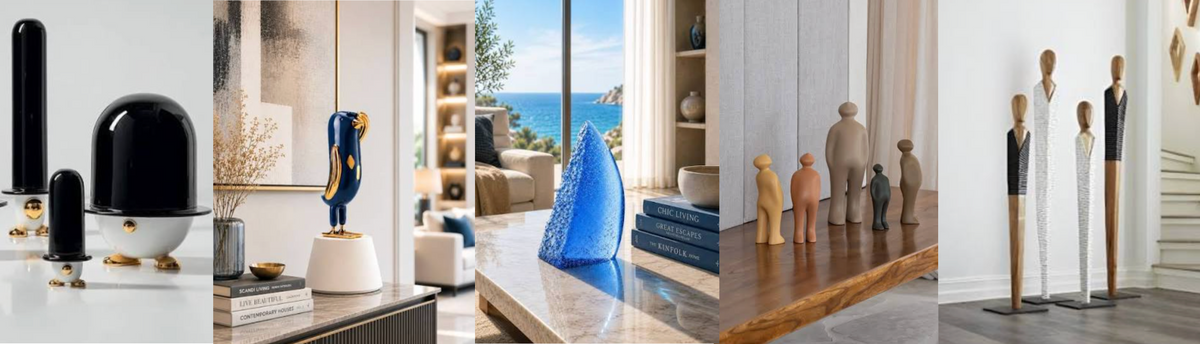

Choosing a luxury sculpture for a home is very different from choosing an ordinary decorative accessory. A sculpture has form, material, scale and presence, and the right piece can become one of the defining objects within a room. It may sit quietly on a console, catch the light on a centre table, occupy a niche, stand on a pedestal or become the visual anchor of a larger composition.
But not every expensive sculpture automatically becomes a successful choice for a luxury interior. The material, craftsmanship, provenance, proportions, colour, finish and relationship with the surrounding furniture all influence how the piece is experienced. A luminous crystal sculpture behaves very differently from a hand-worked Murano glass piece, just as a porcelain figurine creates a different atmosphere from a strong metal form or an expressive work of Pop Art.
For homeowners, collectors, architects and interior designers, understanding these differences makes it easier to choose a sculpture that feels genuinely connected to the interior rather than simply placed within it. This guide explores the major materials and forms of luxury sculptures available today, with particular attention to Murano glass, crystal, glass, porcelain and ceramic, as well as metal, mixed media, wood, Pop Art and other collectible art objects.
Luxury sculptures are not limited to one material, artistic tradition or visual style. For contemporary Indian interiors, the category spans handcrafted Murano glass, crystal, porcelain, ceramic, metal, wood, mixed media and collectible art objects, with each material creating a different relationship with light, texture, colour and space.
Luxury art objects sit alongside sculptures within this broader category. They may include collectible decorative forms, artistic objects, limited-edition pieces and unusual objects of curiosity valued for their design, craftsmanship, material or provenance. They do not always need to resemble traditional sculpture; what connects them is their ability to contribute artistic character and visual meaning to an interior.
At Spacio, sculptures sit within a broader world of luxury home decor accessories, but they occupy a particularly important position because they can introduce artistic expression, craftsmanship and personality into an interior. Our Sculptures & Art Objects collection brings together different materials, artistic languages and international design traditions so that a sculpture can be considered in relation to the home rather than as an isolated object.
Table of Contents
- What Makes a Sculpture a Luxury Home Decor Object?
- Why Material Matters When Choosing a Luxury Sculpture
- Murano Glass Sculptures: The Defining World of Venetian Glassmaking
- Why Murano Glass Has Such a Distinctive Heritage
- Understanding Murano Glassmaking Techniques
- What Makes a Murano Sculpture Collectible?
- How to Use Murano Sculptures in Luxury Indian Interiors
- Crystal Sculptures: Light, Brilliance and Collectability
- Glass Sculptures Beyond Murano
- Porcelain and Ceramic Sculptures
- Metal Sculptures and Stronger Visual Forms
- Mixed-Media Sculptures
- Wood Sculptures and Natural Character
- Pop Art Sculptures for Contemporary Homes
- Objects of Curiosity and Collectible Art Objects
- How to Choose the Right Sculpture Scale
- Where Should a Luxury Sculpture Be Placed?
- How Sculptures Work with Luxury Furniture
- Sculptures and Fireplaces: Creating a Relationship with a Focal Point
- How to Group Sculptures with Other Decor Accessories
- Choosing Sculptures as Collectible Objects
- How to Buy Luxury Sculptures Online in India
- Exploring Luxury Sculptures at Spacio
- Frequently Asked Questions
- Conclusion
What Makes a Sculpture a Luxury Home Decor Object?
A luxury sculpture is not defined simply by its price. In a well-considered interior, its value comes from the combination of design, material, craftsmanship, artistic expression and the way it contributes to the surrounding space.
This distinction matters because a sculpture can be visually striking without being particularly well suited to a luxury interior. A very large object may overwhelm a carefully proportioned living room. A highly colourful piece may compete with an already expressive artwork. A delicate sculpture may disappear when placed against a visually heavy background. The quality of the object and the quality of the placement therefore have to work together.
The same principles apply beyond private homes. Sculptures and art objects can give character to luxury offices, boutique hotels, restaurants, hospitality spaces, libraries, reception areas and premium commercial interiors. In these settings, scale, viewing distance and circulation become especially important because the object may be experienced by many people from different angles.
Craftsmanship is one of the first things worth examining. Look closely at how the material has been formed, joined, polished, carved, cast or finished. In a sophisticated sculpture, details that may not be obvious from across a room often become important when the piece is viewed at close range.
Material determines much of the sculpture's character. Glass and crystal interact strongly with light. Metal introduces weight and structure. Wood brings natural grain and warmth. Porcelain and ceramic can offer delicacy, tactility and surface detail. Mixed media can create contrast by bringing several materials together within one composition.
Form is equally important. Some sculptures are figurative, some abstract, some architectural and geometric, while others are inspired by animals, nature, movement or cultural symbols. The right choice depends partly on whether the interior requires calmness, movement, colour, humour, symbolism or a stronger visual statement.
Provenance can become important when the sculpture is being considered as a collectible object. Knowing the artist, studio, maker or design house can add context to a piece and help explain why it has particular significance beyond its decorative function.
Finally, there is relationship. A sculpture should relate to the room around it. Its scale should work with the furniture. Its material should respond to nearby finishes. Its colour should either connect with the palette or provide a deliberate contrast. Its position should give it enough space to be appreciated.
A useful way to think about luxury sculpture: choose the object for its artistic and material qualities, but judge the final decision by how naturally those qualities belong within the interior.
Why Material Matters When Choosing a Luxury Sculpture
Two sculptures can have almost identical shapes and still create completely different interiors because of the materials from which they are made. Material affects how light behaves, how heavy the object appears, how tactile it feels and how it relates to furniture and finishes.
This is why material should be considered before colour alone. Colour can be changed by lighting and surrounding finishes, but the inherent character of glass, crystal, porcelain, ceramic, metal or wood remains part of the sculpture's identity.
In a contemporary Indian home, this becomes particularly interesting because many interiors already combine marble, timber, metal, glass, stone, textured walls and decorative lighting. A sculpture can either repeat one of these materials or deliberately introduce contrast.
A polished crystal sculpture can amplify light within a room containing decorative lighting and reflective surfaces. A translucent glass sculpture can introduce colour without creating the visual heaviness of a solid object. A ceramic sculpture can soften a room dominated by stone and metal. A wooden sculpture can bring warmth into an interior with a cooler palette.
The material also influences the type of atmosphere the sculpture creates. Some pieces feel formal and precious. Others feel playful, organic, architectural or contemporary. This is why the best luxury sculpture collections are not simply collections of expensive objects; they offer different material and artistic languages for different interiors.
Murano Glass Sculptures: The Defining World of Venetian Glassmaking
Among the many forms of luxury glass sculpture, Murano glass occupies a particularly distinctive position. Murano is not simply a colour or a style of glass. It refers to a centuries-old Venetian glassmaking tradition associated with the island of Murano, where generations of glassmakers developed highly specialised techniques and a remarkable vocabulary of colour, transparency, pattern and form.
The historical importance of Murano is substantial. The Museo del Vetro in Murano traces the development of Venetian glass through centuries of experimentation, from Renaissance techniques to the revival of older processes and the close relationship between glassmaking, art and design. Murano's reputation was built not only on the beauty of its finished objects but on the technical skill required to produce them.
This is what makes an original Murano sculpture so interesting within a luxury interior. The glass can be simultaneously decorative and artistic. It can bring colour, transparency and movement into a room while also carrying the history of a specialised craft tradition.
At Spacio, Murano is represented through a dedicated Murano Glass Sculptures collection, as well as the broader Murano Studio collection. The latter is described within Spacio's directory as a collection of mouth-blown and hand-finished Murano works using techniques including murrine, filigree and sommerso, with each piece carrying the variations associated with skilled handwork.
Why Murano Glass Has Such a Distinctive Heritage
The story of Murano is inseparable from the development of Venetian glassmaking. Glass furnaces were established on Murano in the late thirteenth century, and over the following centuries the island became a major centre for glassmaking innovation. The Museo del Vetro records the development of techniques including filigree, clear glass, engraving, murrine and other specialised forms of decoration.
Murano's importance is therefore not simply historical. The tradition has continued to evolve. During the twentieth century, Murano glassmakers increasingly collaborated with artists and designers, creating a relationship between traditional craftsmanship and modern design that remains central to the character of Murano glass today.
This connection between craft and design is one of the reasons Murano sculptures work so well in contemporary homes. A piece does not have to look traditionally Venetian. Modern Murano sculpture can be abstract, figurative, colourful, minimalist or highly expressive while still drawing on techniques and skills associated with the island's glassmaking culture.
Understanding Murano Glassmaking Techniques
One of the most fascinating aspects of Murano is the sheer variety of techniques that can be used to manipulate glass. These techniques are not merely decorative details. They affect the depth, transparency, colour, pattern and visual movement of the finished sculpture.
Murrine is one of the most recognisable. It involves arranging coloured glass elements into patterns and then heating and consolidating them so that the pattern remains visible through the resulting glass. When cut into sections, the rods reveal repeated designs, which can then be incorporated into finished objects. The Museo del Vetro describes the technique as a form of polychrome mosaic and traces its revival in Murano during the nineteenth century.
Millefiori, literally associated with the idea of "a thousand flowers", is closely related to murrine. Coloured glass rods are created with complex internal patterns and then cut into sections, producing the distinctive flower-like or star-like motifs that can be incorporated into glass objects.
Filigree introduces another kind of visual complexity. Fine glass threads or rods can be incorporated into the body of the glass to create linear, spiral or net-like patterns. The technique was developed in Murano during the sixteenth century and remains one of the most recognisable examples of the island's technical virtuosity.
Sommerso creates depth by layering different colours of transparent glass. The result can appear almost three-dimensional because one layer sits visually inside another. This makes the technique particularly effective for sculptural forms where colour needs to have depth rather than simply sit on the surface.
Other techniques and finishes include lattimo or milk glass, engraving, aventurine, calcedonio and various forms of free-hand shaping. The important point for a buyer is not necessarily to memorise every technical term, but to recognise that Murano glass can contain a remarkable amount of craftsmanship beneath its apparently effortless surface. The Museo del Vetro's glossary documents many of these specialist terms and tools used in Murano glassmaking.
What Makes a Murano Sculpture Collectible?
A Murano sculpture can be appreciated purely as a beautiful object, but some pieces are also chosen because they carry qualities associated with collecting. The maker or studio, the craftsmanship, the technique, the form, the rarity and the provenance can all contribute to how a piece is perceived.
Authenticity is therefore important. When choosing Murano glass, it is worth understanding who made the piece and where it comes from rather than treating "Murano" simply as a descriptive style. A genuine connection with Murano's glassmaking tradition gives the object a different level of context.
Spacio's relationship with Zanetti provides one example. The source material records that Spacio has been retailing Zanetti in India since 2015, while Zanetti Murano is described as a family-run glassmaking business founded in 1956 and carried through four generations, with Oscar Zanetti continuing the family's glassmaking tradition.
indef
This kind of provenance matters because it helps the buyer understand what sits behind the sculpture. The object is no longer simply "a glass figurine". It becomes a work connected to a maker, a material tradition, a set of techniques and a place with a recognised history of glassmaking.
How to Use Murano Sculptures in Luxury Indian Interiors
Murano glass can be particularly effective in Indian luxury interiors because its relationship with light works naturally alongside marble, stone, timber, brass, metal and decorative lighting. A translucent or highly coloured sculpture can introduce a controlled note of colour into an otherwise restrained interior without requiring the entire room to become colourful.
A large Murano sculpture can become the focal point of a console in an entrance foyer or living room. A smaller piece can sit within a carefully styled bookshelf or niche. A pair can create symmetry on a long sideboard or console, while an expressive single sculpture can provide an intentional break in a more ordered composition.
Placement is particularly important with Murano because transparency and colour can change dramatically depending on the background. A pale glass sculpture may disappear against a very light wall but become luminous against a darker surface. A highly coloured piece may need more visual breathing room so that its colour remains the focal point rather than becoming part of general visual noise.
The same principle applies to lighting. Direct, harsh illumination can flatten some glass forms, while softer ambient lighting can reveal layers, reflections and transparency. This is one reason sculptural glass should be considered alongside the lighting scheme of the room rather than as an independent decorative purchase.
For homeowners looking specifically for this category, Spacio's Murano Glass Sculptures collection provides a focused starting point for exploring these pieces within the broader world of luxury sculptures and art objects.
Crystal Sculptures: Light, Brilliance and Collectability
Crystal is one of the most compelling materials for a luxury sculpture because it has a quality that few other materials can reproduce: it interacts with light from almost every direction. A well-designed crystal sculpture can appear luminous, reflective and almost weightless even when the physical object has considerable presence.
For Spacio, crystal sculptures are an especially important part of the category. They are also among the most popular sculptural objects within the collection. The appeal is easy to understand. Crystal can sit comfortably within both classic and contemporary interiors, and its transparency allows it to complement rather than compete with the materials already present in a room.
Spacio's Crystal Sculptures collection brings together one-of-a-kind, limited-edition and handcrafted pieces from international brands. The collection directory describes these as works intended to combine artistry and luxury, with crystal used to create objects that can become statements within an interior.
Why Crystal Works So Well in Luxury Interiors
Crystal is particularly effective when a room already has substantial architectural or furniture elements. A large sofa, marble centre table, dark timber console or sculptural fireplace can create considerable visual weight. A crystal sculpture can introduce detail and brilliance without adding the same sense of solidity.
Light is central to this effect. Natural daylight can reveal facets and internal reflections during the day, while carefully positioned decorative lighting can make the sculpture change character in the evening. This makes crystal particularly interesting in rooms where lighting is already an important part of the interior composition.
A crystal sculpture can therefore be more than an object sitting on a table. It can become part of the room's lighting experience.
Crystal Sculptures as Statement Objects
There is a tendency to associate crystal with delicate, small decorative pieces, but luxury crystal sculpture can be much more substantial. Large-scale forms, abstract compositions, figurative works and expressive designs can all use the brilliance of crystal to create a strong focal point.
When choosing a statement crystal sculpture, consider the amount of visual information already present around it. A highly detailed crystal piece may need a quieter background. Conversely, a simpler sculptural form can work beautifully against a more expressive wall, textured finish or richly coloured interior.
Crystal also works particularly well when the intention is to create an exclusive centrepiece. Its ability to catch light gives even a relatively compact sculpture a strong presence on a dining table, centre table, console or sideboard.
How to Style Crystal Sculptures
On a console, a crystal sculpture can become the principal object with smaller accessories placed around it rather than directly beside it. On a centre table, the sculpture can be combined with a restrained arrangement of books or a decorative tray, provided the composition leaves sufficient negative space.
Crystal can also work particularly well against dark finishes. Deep timber, charcoal, black, dark stone and richly coloured walls can make transparent and faceted forms appear more luminous.
In a lighter interior, the approach is different. Here, the sculpture may be appreciated more for its silhouette and changing reflections than for contrast. This is where placement becomes critical.
Crystal does not need to shout to become the focal point. Often, its strength is precisely in the way it catches the light, reveals detail and adds a sense of refinement without visually closing down the space.
Glass Sculptures Beyond Murano
Glass is probably the most versatile sculptural material in the category. It can be transparent, translucent, opaque, coloured, textured, layered, smooth, highly polished or deliberately irregular. It can appear delicate or substantial depending on the form and thickness of the glass.
That versatility makes glass sculptures particularly useful for contemporary interiors. Spacio's collection includes works from international artists and global brands, with different styles and techniques represented across the category. The collection directory specifically positions glass sculpture around creativity, skill, innovation and the different traditions of artists working with glass.
Murano glass is a specific Venetian glassmaking tradition, while glass sculpture is a broader category that includes works made using many different techniques, traditions and production methods. Not every glass sculpture is Murano, and identifying a piece as Murano should therefore involve provenance and authenticity rather than simply its appearance.
Glass and Light
The defining characteristic of glass is its relationship with light. Transparent glass allows the background to remain visible through the sculpture, which can make the object feel integrated into the room. Coloured glass behaves differently, becoming a stronger visual element and introducing a controlled accent of colour.
Textured or sculpted glass can create another effect. Instead of simply transmitting light, the surface can distort reflections and create movement within the object. This can be especially effective when the sculpture is placed where daylight or decorative lighting reaches it from the side.
Glass as a Contemporary Statement
Glass is not restricted to delicate or traditional forms. Contemporary artists and designers use it to create abstract shapes, organic forms, figures, animals, vessels and highly expressive compositions.
This makes glass particularly suitable when the objective is to introduce a statement home decor accessory without making the room feel heavy.
A large glass sculpture can occupy a prominent position while retaining a degree of visual openness. This is particularly useful in contemporary Indian homes where generous living spaces, large windows and open-plan layouts are common.
Porcelain and Ceramic Sculptures: Delicacy, Texture and Craft
Porcelain and ceramic occupy a very different place in the world of luxury sculpture. Unlike transparent crystal and glass, they tend to have a more tactile and grounded presence. Their appeal comes from form, surface, glaze, colour, modelling and craftsmanship.
Spacio's Porcelain & Ceramic Sculptures collection brings these qualities into the luxury home decor category. The material can be particularly effective when a room needs warmth, texture or a more intimate decorative presence.
What Makes Porcelain Different?
Porcelain is often associated with delicacy, refinement and a smoother, more refined surface. Its lighter visual character can make it suitable for sculptural forms where fine details, facial expressions, botanical forms or figurative modelling are important.
In a luxury interior, porcelain can introduce a sense of quiet sophistication. It does not necessarily demand attention in the same way as a brightly coloured Murano sculpture or a highly reflective crystal object.
This makes porcelain particularly useful when the objective is to create a room that feels collected rather than decorated.
Why Ceramic Has Such a Strong Design Presence
Ceramic offers enormous freedom in terms of form and finish. Depending on how it is made and finished, it can look earthy and organic, highly polished and refined, sculptural and contemporary, or deliberately raw.
This range allows ceramic sculpture to work across very different interior styles. A softly shaped ceramic form can sit comfortably within a warm Japandi-inspired interior, while a highly graphic or abstract piece can become an effective statement in a contemporary living room.
Ceramic also introduces surface interest that glass and crystal cannot provide in quite the same way. The eye can read the texture of the surface without the constant movement of reflections.
Porcelain and Ceramic for Indian Luxury Interiors
In Indian homes, porcelain and ceramic sculptures can provide a useful counterpoint to materials such as marble, brass, polished timber and glass. Where an interior contains several reflective surfaces, introducing a matte or softly glazed sculptural object can create balance.
They can also work particularly well with natural textures. Timber, linen, stone and textured walls provide a quiet background against which the craftsmanship of a porcelain or ceramic sculpture can be appreciated.
Crystal, Glass, Porcelain or Ceramic: Which Should You Choose?
There is no single material that is universally better. The right choice depends on what the interior needs from the sculpture.
- Choose crystal when you want brilliance, reflection, refinement and a strong relationship with light.
- Choose glass when you want transparency, colour, fluidity or a contemporary artistic expression.
- Choose Murano glass when craftsmanship, Venetian heritage, colour, technique and collectability are particularly important.
- Choose porcelain when you want delicacy, refined modelling and a quieter decorative presence.
- Choose ceramic when you want texture, warmth, individuality and a more tactile sculptural quality.
The decision becomes easier when you stop asking, "Which material is the most luxurious?" and instead ask, "What quality does this room need?"
A room that already has strong marble surfaces may benefit from the softness of ceramic. A darker interior may come alive with crystal. A neutral room may welcome coloured glass. A contemporary space with clean lines may benefit from the craftsmanship and visual movement of Murano.
Can You Mix Different Sculpture Materials in One Interior?
Absolutely. In fact, a considered combination of materials can make a sculpture collection feel more sophisticated.
The key is not to make every object different. Instead, look for relationships between them. A transparent crystal sculpture can sit near a solid ceramic form because their visual weights are different. A warm wooden sculpture can balance the coolness of glass. Metal can provide a sharper note between softer materials.
The same principle applies when creating a collection on a long console or sideboard. Rather than arranging objects according to material alone, consider height, silhouette, colour, texture and visual weight.
This is where sculpture becomes part of interior styling rather than simply product selection.
When Should a Sculpture Become the Statement?
Not every sculpture needs to be a statement piece. In a sophisticated interior, some objects should support the composition while one or two pieces are allowed to command attention.
A statement sculpture usually has one or more strong characteristics: unusual scale, distinctive colour, dramatic silhouette, exceptional craftsmanship, strong provenance or an immediately recognisable artistic language.
Murano glass and crystal are particularly capable of becoming statement pieces because they respond so strongly to light. Pop Art can create an entirely different kind of statement through colour, humour and cultural references.
The important thing is to give the statement object enough space. If every object is competing for attention, none of them becomes the hero.
Pop Art Sculptures: A More Playful Language for Contemporary Homes
Luxury sculpture does not have to be serious. Pop Art has become an increasingly relevant way to bring colour, personality, humour and contemporary culture into sophisticated interiors, particularly for younger homeowners and collectors.
Pop Art emerged from a fascination with popular culture, advertising, consumer products, celebrities and everyday visual imagery. In three-dimensional form, those ideas can become highly expressive sculptural objects that immediately change the mood of a room.
For a younger generation of homeowners, this can be particularly appealing. A Pop Art sculpture can make a luxury interior feel personal rather than formal. It can introduce a sense of playfulness without compromising the overall quality of the space.
Spacio's Pop Art collection provides an opportunity to explore this more contemporary side of art and decorative objects.
How to Use Pop Art Without Losing Sophistication
The secret is contrast. A colourful Pop Art sculpture can become much more powerful when surrounded by restraint.
Imagine a sculptural Pop Art object on a quiet marble console, against a relatively calm wall, with only one or two supporting accessories. The object immediately becomes the visual punctuation of the space.
It can also work against more traditional materials. A contemporary Pop Art sculpture placed near classic timber furniture or beside a refined fireplace can create an interesting tension between old and new.
For younger homeowners, this is often more expressive than choosing a room entirely around one design style. The sculpture becomes a reflection of personality.
I would never dismiss Pop Art from a luxury interior simply because it is playful. Luxury is not about making every object look serious. A well-chosen Pop Art sculpture can give a carefully designed room something that is often harder to create: personality.
Metal Sculptures: Strength, Structure and Contemporary Expression
Metal introduces a very different character to a sculpture. Where glass and crystal are defined by transparency and light, metal is often defined by structure, weight, surface and silhouette. It can feel architectural, industrial, refined, organic or highly contemporary depending on the finish and the way it has been formed.
Spacio's Metal Sculptures collection includes works that use metal to create strong decorative and artistic forms. For a luxury interior, metal can be particularly useful when the room needs a sculptural object with greater visual weight.
Metal sculptures can work beautifully with marble, timber, glass and leather. A polished metallic surface can connect with brass or other metal details already present in the room, while a darker or more textured finish can create contrast against lighter surroundings.
How Metal Changes the Character of a Room
A metallic sculpture can make a room feel more graphic and defined. Its silhouette often becomes as important as its surface because metal allows artists and designers to create angular, linear and highly structured forms.
For this reason, metal is particularly effective in contemporary interiors where the furniture already has clean lines. A sculptural metal form can reinforce that architectural language without simply repeating the furniture.
It can also provide contrast. A fluid metal sculpture placed against a soft upholstered sofa creates a meeting of hard and soft forms. A geometric metal sculpture on a rounded centre table can introduce a sharper visual note.
Choosing the Right Metal Finish
The finish matters considerably. Polished surfaces reflect their surroundings and can therefore become more visually active. Brushed or satin finishes are generally quieter. Dark finishes can make the sculpture appear heavier, while lighter metallic finishes can integrate more easily into a neutral interior.
Do not choose a metallic sculpture simply because its finish matches the room's existing hardware. A slight contrast is often more sophisticated than trying to match every metal element exactly.
Mixed-Media Sculptures: When Materials Become Part of the Artwork
Mixed-media sculpture allows several materials to exist within one composition. Glass can meet metal. Wood can meet resin. Stone can meet metal. Fabric, paint, found materials and other elements can also become part of the work.
Spacio's Mixed Media Sculptures collection represents this broader approach to sculptural art.
The attraction of mixed media is that the sculpture can contain several visual languages at once. One material may provide texture, another colour and another structure. The result can feel more layered than a sculpture made entirely from one material.
Why Mixed Media Works in Contemporary Luxury Homes
Modern luxury interiors increasingly combine different textures and materials rather than relying on one uniform finish. Stone, timber, metal, glass, fabrics and decorative lighting may all coexist in the same room.
A mixed-media sculpture can echo this approach at the level of the decorative object.
It can also become particularly interesting in a room where several materials already exist. Instead of choosing a sculpture that introduces yet another unrelated material, a mixed-media work can subtly connect two or three existing elements.
Wood Sculptures: Warmth, Grain and Organic Character
Wood brings something into a sculpture that glass, crystal and metal cannot: the visible memory of the material itself. Grain, knots, colour variations and the marks created during carving can all contribute to the identity of the finished object.
Spacio's Wood Sculptures collection offers another route into sculptural decoration, particularly for interiors where warmth and natural texture are important.
Wood sculpture can be particularly effective in contemporary Indian interiors because it can soften the harder surfaces often used in luxury residential design. Marble, stone and metal can feel visually cool and precise. Wood introduces warmth and tactility.
Wood Sculptures and Japandi-Inspired Interiors
The simplicity and natural character of wood make it particularly compatible with restrained interiors. A sculptural wooden object does not necessarily need colour or elaborate decoration to attract attention. Its form and grain can provide enough visual interest.
This makes wood especially suitable for interiors where the objective is quiet luxury rather than obvious opulence.
A carved wooden sculpture can sit comfortably on a console surrounded by fewer accessories. It can also provide a natural counterpoint to a polished stone surface or a contemporary metal sculpture.
Objects of Curiosity: When the Sculpture Is Also a Conversation Piece
Not every collectible object needs to be classified as a conventional sculpture. Some pieces are fascinating because of their unusual form, historical reference, construction, subject or sheer visual curiosity.
This is where Objects of Curiosity become particularly interesting within a luxury home.
These objects can give an interior a sense of discovery. Rather than looking as though every accessory was purchased from the same decorative vocabulary, the room begins to feel collected over time.
This is an important distinction in luxury interiors. A home that contains only perfectly coordinated objects can sometimes feel staged. A carefully selected object of curiosity introduces a little unpredictability and personality.
How to Use Objects of Curiosity Without Creating Clutter
The principle is the same as with sculpture: give the object room to breathe.
A curious object becomes more interesting when it is not surrounded by ten other objects competing for attention. Place it where someone can discover it naturally—a bookshelf, console, sideboard, niche or carefully considered tabletop composition.
Its unusual character should be the reason it is there. Do not dilute that quality by overcrowding the surrounding surface.
How to Choose the Right Sculpture Scale
Scale is one of the most important decisions when choosing a sculpture for a luxury home. A beautiful object can look completely wrong if its proportions are unsuitable for the surface or room in which it is placed.
The first question should always be: where will the sculpture live?
A sculpture intended for a large living room console can be considerably more substantial than one intended for a bedside table. A piece selected for a pedestal can have greater height because it is already being elevated. A sculpture placed on a centre table needs to be considered in relation to the people seated around it.
Large Sculptures
Large sculptures can become architectural elements within a room. They work particularly well in entrance halls, large living rooms, double-height spaces, generous niches and areas where there is enough visual breathing room.
However, large does not automatically mean luxurious. An oversized sculpture squeezed into a small space can make the room feel crowded rather than grand.
Medium-Sized Sculptures
Medium-sized sculptures are among the most versatile. They can work on consoles, sideboards, centre tables, shelves, pedestals and open display units.
This is often the easiest scale for homeowners because the sculpture has enough presence to be noticed without dominating the entire composition.
Small Sculptures
Small sculptures are particularly useful when building a collection. Several smaller objects can create a more intimate arrangement, provided they are connected through colour, material, form or artistic language.
They are also useful in areas where a large statement object would feel inappropriate, such as bookshelves, bedside tables or smaller consoles.
Why Pedestals and Plinths Can Transform a Sculpture
A sculpture does not always need to sit directly on furniture. A pedestal or plinth can give it a completely different level of presence.
Spacio's Pedestals & Plinths collection can be considered when a sculpture needs to be elevated and visually separated from the surrounding furniture.
This is particularly useful for a sculptural object with a strong silhouette. By raising it to a more appropriate viewing height, the pedestal can allow the form to be appreciated from different angles.
Pedestals are also useful when a sculpture needs to occupy an otherwise empty corner. Instead of adding several accessories to fill the space, one strong sculpture on a carefully chosen plinth can create a much cleaner composition.
Where Should a Luxury Sculpture Be Placed?
The best location is usually the one that allows the sculpture to be seen clearly without forcing it to compete with too many other objects.
There is no universal rule, but several locations consistently work well in luxury homes.
Living Room
The living room provides several opportunities: a centre table, console, side table, open shelving, niche or pedestal. A larger sculpture can become a focal point, while smaller pieces can support the overall styling.
If the room already has a strong artwork or dramatic chandelier, the sculpture should complement rather than compete with that focal point.
Entrance Foyer
The entrance is one of the best locations for a statement sculpture because it creates an immediate introduction to the home. A sculpture on a console, or a larger work on a pedestal, can establish the mood before someone enters the main living areas.
Dining Room
In a dining room, sculptures can be placed on a sideboard, console or nearby display surface. They can also be used to create visual interest when the dining table itself is kept relatively restrained.
The relationship with the dining furniture is important. A sculpture should not make it difficult to see across the table or interfere with conversation.
Bedroom
Bedrooms generally benefit from quieter sculpture choices. Porcelain, ceramic, wood and softly finished objects can work particularly well because they introduce personality without creating excessive visual activity.
Study or Home Office
A study provides an opportunity for more personal collecting. Smaller sculptures, objects of curiosity, Pop Art and pieces with an interesting story can make the space feel individual rather than purely functional.
Bookshelves and Display Units
Sculptures can provide essential breaks within a bookshelf. Instead of filling every shelf with books, introduce an object with a different scale, material or silhouette.
This creates rhythm and prevents the shelving from becoming visually repetitive.
How to Decide Which Object Should Be the Focal Point
A luxury interior does not need multiple focal points in every room. In many cases, the strongest compositions have one principal object supported by quieter elements. If the room has a major artwork, a sculptural fireplace or a dramatic chandelier, ask whether the sculpture should become the hero or the supporting character.
This decision should be made before styling the surrounding surface. Once the hero has been established, the remaining accessories can be selected to support it. For example, a highly coloured Murano sculpture may need only a few neutral supporting objects. A restrained ceramic sculpture may benefit from being paired with a stronger decorative tray, books or a contrasting vase.
The goal is not to make every object equally important. It is to create a hierarchy.
Scale Is More Than Height: Consider Visual Weight
Two sculptures with exactly the same height can have completely different visual weights. A transparent crystal sculpture may occupy considerable physical space but feel visually light. A compact black metal sculpture can occupy much less space while appearing heavier.
This is why measuring height alone is not enough. Consider the width, density, colour, transparency and silhouette of the object. A useful styling principle is to balance visual weight across a composition rather than simply matching dimensions.
For example, a visually heavy sculpture on one end of a console may need a lighter object or a taller, more open form on the other side. The objective is not perfect symmetry but visual balance.
How Sculptures Work with Luxury Furniture
A sculpture does not exist independently of the furniture around it. The table, console, sideboard, shelving or pedestal beneath it becomes part of the composition. This is why choosing a sculpture should always involve looking at the furniture and the surrounding interior as a whole.
In a luxury home, the strongest combinations usually come from contrast rather than exact matching. A highly sculptural piece of furniture does not necessarily need another sculptural object in the same language. Sometimes a quieter sculpture allows the furniture to remain the hero.
Spacio's luxury furniture collection includes sofas, centre tables, dining tables, dining chairs, sideboards, consoles, side tables, lounge chairs and other pieces that can provide the architectural foundation for decorative objects.
Sculptures on Consoles
A console is one of the most natural settings for a sculpture because its long horizontal surface creates an opportunity to build a deliberate composition around a vertical or organic form. A large sculpture can become the hero of the console, with smaller accessories providing balance. Alternatively, a group of two or three sculptural objects can create a more collected arrangement when their heights and visual weights are sufficiently different.
For a more detailed approach to combining vases, sculptures, books and other decorative objects on a console, read Spacio's How to Style a Console Table: Vases, Sculptures, Books & Decorative Objects.
The important thing is to avoid filling the entire length of the console. Negative space is part of the styling.
Sculptures on Centre Tables
Centre tables require a slightly different approach. The sculpture needs to be attractive from several viewing angles because people will see it from different positions around the seating area. This makes three-dimensional forms particularly effective. A sculpture that looks beautiful from only one direction may be better suited to a console or niche than a centre table.
Spacio's centre table collection provides different proportions and forms that can be considered when planning this relationship between furniture and sculpture.
Sculptures on Sideboards
A dining sideboard can provide an especially generous surface for sculptural styling. Here, the sculpture can be combined with decorative bowls, vases, trays or books, but one object should generally remain the visual anchor.
Spacio's dining sideboard collection can work as a natural foundation for this type of composition.
Sculptures and Fireplaces: Creating a Relationship Between Two Focal Points
A fireplace is already a strong architectural focal point, so adding a sculpture around it requires more thought than simply placing an object nearby. The objective should be to create a relationship between the fireplace and the sculpture rather than allowing the two elements to compete.
A sculptural object can sit on a nearby console, sideboard or pedestal and act as a secondary focal point. Alternatively, a smaller sculpture can be positioned on a mantel or adjacent surface where the fireplace remains visually dominant. This works particularly well with contemporary fireplaces because the clean geometry of the fire itself can provide a powerful background for a more organic or expressive sculptural form.
A sculpture can also work as a companion to a fireplace when the fireplace is already the dominant focal point. Rather than competing with the flame, the sculpture should support the composition through contrasting or complementary form, material and scale. A carefully placed glass, crystal, ceramic or metal sculpture can extend the visual language of a fireplace wall without making the overall composition feel crowded.
When the Fireplace Should Remain the Hero
If the fireplace has a dramatic flame presentation, substantial stone surround or distinctive architectural form, the sculpture should generally support it rather than compete with it. A transparent crystal sculpture, a restrained ceramic object or a sculptural piece in a neutral finish can provide the decorative layer without taking over the composition.
Spacio's fireplace collection includes contemporary fireplace designs that can become architectural focal points within luxury interiors.
When the Sculpture Can Become the Hero
If the fireplace is visually restrained, there may be an opportunity for the sculpture to take a stronger role. A large Murano glass sculpture, an expressive crystal work or a dramatic Pop Art object can introduce the personality that the architecture deliberately keeps quiet.
This is especially effective when the fireplace provides a calm, linear background. The contrast between the architectural simplicity of the fireplace and the artistic character of the sculpture can create a sophisticated composition.
Lighting Sculptures: Letting the Material Reveal Itself
Lighting should never be an afterthought when displaying sculpture. It can completely change how an object is perceived. Crystal and glass are particularly responsive to directional light. Transparent and faceted surfaces can catch highlights, create reflections and reveal details that may not be visible under flat ambient lighting.
Metal behaves differently. A directional light can emphasise texture, edges and contours, while softer illumination can make a metallic sculpture appear more restrained. Porcelain and ceramic often benefit from light that reveals their modelling and surface texture without creating harsh reflections.
Do Not Overlight the Sculpture
The objective is not to make the sculpture look as though it is in a museum spotlight unless that is deliberately the intended effect. In a residential interior, subtle lighting is often more effective. A nearby decorative light, concealed illumination or carefully positioned spotlight can reveal the object while allowing it to remain part of the wider room.
This is particularly important in luxury interiors where the overall atmosphere should feel calm and layered rather than theatrical.
How to Combine Sculptures with Other Luxury Home Decor Accessories
A sculpture rarely needs to stand completely alone. The right supporting objects can make it feel more integrated into the interior. However, supporting does not mean competing.
A sculpture can be paired with a vase, decorative bowl, tray, books, candle stands or a small object of curiosity. The selection should be based on relationships of scale, colour, material and form. Spacio's broader luxury home decor accessories collection provides many of these complementary categories.
Sculptures and Vases
Vases and sculptures can work exceptionally well together because their forms can be deliberately contrasted. A tall, narrow sculpture can be balanced by a wider vase. A solid sculptural form can be softened by a transparent or organically shaped vase.
Explore Spacio's Vases collection when creating this type of composition.
Sculptures and Decorative Bowls
A decorative bowl can provide a lower horizontal element beside a taller sculpture. This creates a useful difference in height and allows the eye to move through the composition.
Spacio's Decorative Bowls collection can be used to introduce another layer of form and material without taking attention away from the principal sculpture.
Sculptures and Decorative Trays
A decorative tray can act as the organising element for smaller accessories while the sculpture remains the hero. It can also provide a visual boundary between several objects and the larger furniture surface.
This is particularly useful on consoles and sideboards where a sculpture is accompanied by several smaller pieces.
Sculptures and Coffee Table Books
Books introduce a horizontal element and can therefore provide an effective base for a smaller sculpture. The combination works particularly well when the sculpture has a compact footprint and the books provide sufficient visual weight beneath it.
The styling should remain restrained. A sculpture placed on a large stack of books can be effective, but too many stacked objects can make the arrangement feel busy.
Sculptures and Wall Art: Three-Dimensional and Two-Dimensional Art Together
A luxury home can comfortably contain both wall art and sculpture, but the relationship between them should be considered. A large painting already creates a strong visual plane. A sculpture positioned directly below it can either reinforce that composition or compete with it.
One approach is to repeat a colour subtly. Another is to contrast the materials. A colourful painting may be paired with a restrained crystal or ceramic sculpture, while a neutral artwork may provide the perfect background for a more expressive sculptural object.
Spacio's Wall Art, Prints & Paintings collection can be considered alongside sculpture when creating a broader art-led interior.
Should a Sculpture Match the Colour Palette of the Room?
Not necessarily. In many luxury interiors, the sculpture is precisely where a controlled introduction of colour can make the room more interesting. A neutral room can accommodate a vivid Murano sculpture or a Pop Art piece. A colourful room may benefit from a quieter crystal, porcelain or ceramic object.
The important distinction is between contrast and disruption. Contrast adds interest. Disruption happens when an object appears to have no relationship with anything around it. Look for at least one connection: perhaps the colour appears elsewhere in the room, the material relates to a lighting fixture, the shape echoes the furniture or the scale balances another element.
Building a Sculpture Collection Rather Than Buying Individual Objects
For someone who genuinely enjoys sculpture, the most rewarding approach is often to think beyond individual purchases and begin building a collection. A collection does not mean buying objects that all look alike. In fact, the opposite can be more interesting.
You might begin with a crystal sculpture because of its brilliance, add a Murano piece for colour and Venetian craftsmanship, introduce a ceramic work for texture, and later add a metal or Pop Art sculpture because it speaks to a different part of your personality. Over time, the collection becomes a visual record of your interests.
Collect by Material
Some collectors naturally gravitate towards one material. Crystal may become a particular passion because of its relationship with light. Others may prefer Murano because of its history and extraordinary glassmaking tradition.
Others may find themselves drawn to the warmth of wood, the precision of metal or the tactile quality of ceramic.
Collect by Artistic Language
Another approach is to collect by visual language rather than material. Abstract sculpture, figurative work, Pop Art, organic forms and geometric pieces can each create very different collections.
The advantage of this approach is that the collection becomes recognisably yours, even when the materials differ.
Collect for the Story
The most personal collections often contain pieces that have a story. Perhaps the sculpture was discovered during a trip, chosen to mark an occasion, created by an artist whose work you admire or simply selected because it created an immediate emotional response.
That story may never be visible to a visitor, but it changes the meaning of the object for the person who owns it.
A luxury home should not look as though every object was bought at the same time to complete a checklist. The most interesting homes have layers. A sculpture collection is one of the easiest ways to introduce those layers because every piece can bring a different material, story, memory or point of view.
What to Look for When Buying a Luxury Sculpture
Once you move beyond styling and begin considering a sculpture as a collectible purchase, the criteria become broader than appearance alone.
Look at the material, craftsmanship, provenance, maker, edition, scale, finish and condition. Consider whether the object is handcrafted, limited edition or produced as part of a larger collection. Understand how it has been made and what makes the work distinctive. For materials such as Murano glass and crystal, craftsmanship can be particularly important. Variations created during handmade production can be part of the character of the work rather than imperfections.
Scale should also be considered before purchase. A sculpture that looks perfect in a showroom may feel very different when placed in a home with different ceiling heights, furniture proportions and lighting conditions. Finally, buy something that you genuinely want to live with. A sculpture is not merely a decorative accessory. The best pieces continue to interest you long after the initial purchase.
For a broader guide to selecting decorative objects according to scale, proportion, material and placement, see Spacio's How to Choose Decorative Objects for Your Home: Scale, Proportion, Material & Placement.
Are Luxury Sculptures Worth Buying?
A sculpture can be worth buying for many reasons, and financial investment is only one of them. For most homeowners, the more meaningful value is the way a well-chosen sculpture changes the character of a room and becomes part of the home's identity.
A beautifully made sculpture can remain relevant for years because it is not tied to a short-lived decorating trend. Its material, craftsmanship and artistic expression can continue to be appreciated even as the rest of the interior evolves. Some pieces may also have collectable value because of their maker, provenance, limited production or artistic significance. But it is important not to buy a sculpture solely because someone describes it as an investment.
Buy first for the quality of the work and your connection with it. Any future collectability should be considered an additional benefit rather than the sole reason for purchase.
For collectible sculptures, provenance can be as important as appearance. The maker, studio, designer, artistic tradition, production method and documented origin can all help establish why a piece has lasting value. This is particularly relevant when choosing Murano glass and other handcrafted works where authenticity is part of the appeal.
Choosing Luxury Sculptures for Indian Homes
Indian homes can offer particularly interesting settings for sculpture because contemporary residential interiors often combine international design with materials, colours and traditions that are distinctly Indian.
A sculpture does not have to look traditionally Indian to belong in an Indian home. Contemporary European glass, crystal, metal, porcelain or ceramic can sit comfortably alongside Indian materials such as marble, timber and stone. The key is to consider the architecture and interior language of the home rather than choosing objects based only on where they were made.
In a large Mumbai, Delhi, Bengaluru or Kolkata residence, for example, a substantial sculptural object may have enough space to become an architectural focal point. In a more compact apartment, a carefully selected crystal, glass or ceramic sculpture can create the same sense of personality on a smaller scale.
This is where scale becomes especially important. The right sculpture is not necessarily the largest one available. It is the one that feels proportionate to the room and gives the space a sense of completion.
Luxury Sculptures as Statement Home Decor Accessories
Luxury sculptures occupy a special position within the broader world of home decor accessories. Unlike a purely functional accessory, a sculpture exists primarily to be looked at, considered and appreciated. This is why sculptures can become some of the strongest statement home decor accessories in a luxury interior.
For a broader understanding of how different decorative objects work within a luxury Indian home, read Spacio's Luxury Home Decor Accessories: A Complete Guide for Modern Indian Homes.
A statement object does not necessarily have to be enormous or brightly coloured. A small crystal sculpture with exceptional craftsmanship can make a stronger impression than a large object with little character. The distinction lies in the quality of the object and the strength of its visual presence.
This also explains why sculptures work so naturally within the category of premium home decor accessories and high-end home decor accessories. Their value comes from the combination of design, material, craftsmanship, artistic expression and the ability to give a room individuality.
Explore Luxury Sculptures and Art Objects at Spacio Collections
At Spacio Collections, sculptures are treated as an important part of luxury interior styling rather than as secondary decorative fillers. The collection brings together different materials, artistic approaches and styles so that homeowners, interior designers and stylists can select objects according to the character of a space.
The main Sculptures & Art Objects collection provides a starting point for exploring the wider category.
For collectors drawn towards transparency, brilliance and the way light moves through a sculpture, explore the Crystal Sculptures collection.
For the extraordinary colour, form and craftsmanship associated with Venetian glassmaking, explore the Murano Glass Sculptures collection.
The Glass Sculptures collection offers another broad expression of glass as an artistic material, while the Metal Sculptures collection explores stronger forms, surfaces and contemporary silhouettes.
For pieces that combine different materials and techniques, explore Mixed Media Sculptures. For natural warmth and organic character, explore Wood Sculptures.
Collectors looking for the softer, tactile character of fired materials can explore Porcelain & Ceramic Sculptures.
For more expressive and contemporary art-led interiors, Pop Art offers a different visual language, particularly for younger homeowners and collectors looking to introduce colour, humour or cultural references into their interiors.
There are also Objects of Curiosity for collectors who enjoy unusual forms and conversation pieces, as well as Wall Art, Sculptures & Murals for spaces where three-dimensional and wall-based art need to work together.
Frequently Asked Questions About Luxury Sculptures for the Home
What type of sculpture is best for a luxury home?
There is no single best type. Crystal, Murano glass, glass, metal, mixed media, wood, porcelain and ceramic can all work beautifully. The right choice depends on the room, scale, material palette, lighting and the personality you want the sculpture to introduce.
Are Murano glass sculptures suitable for modern interiors?
Yes. Murano glass can work exceptionally well in contemporary and modern luxury interiors. Its colour, transparency and handcrafted character can provide contrast against clean-lined furniture, stone and neutral palettes.
Why are crystal sculptures popular in luxury homes?
Crystal has a distinctive relationship with light. Its clarity, facets and reflective qualities can make a sculpture appear different throughout the day as natural and artificial light changes. This makes crystal particularly effective as a statement decorative object.
Can glass sculptures be used in a minimalist home?
Absolutely. Glass can be particularly effective in minimalist interiors because its transparency creates visual interest without adding the same visual weight as a solid object. A carefully chosen glass sculpture can add personality while preserving a sense of openness.
Are porcelain and ceramic sculptures suitable for luxury interiors?
Yes. Porcelain and ceramic can introduce softness, texture and craftsmanship into a luxury interior. They are particularly useful when a room already contains harder materials such as stone, metal and glass and needs a more tactile element.
Where should I place a sculpture in my home?
Popular locations include consoles, centre tables, sideboards, bookshelves, niches, pedestals, entrance foyers, living rooms, studies and bedrooms. Choose a location where the sculpture has enough space around it to be appreciated.
How large should a sculpture be?
The scale should relate to the furniture, room and surrounding objects. Consider not only height but also width, density, colour and visual weight. A transparent sculpture can feel lighter than a compact dark sculpture of the same size.
Can a sculpture be placed near a fireplace?
Yes. A sculpture can complement a fireplace beautifully when the two are treated as related focal points. The sculpture should either support the fireplace or intentionally become the secondary focal point rather than competing with the fire.
Should luxury sculptures match the rest of the decor?
They do not need to match exactly. A controlled contrast in colour, material or form can make the interior more interesting. The important thing is that the sculpture has some relationship with the surrounding space.
Is Pop Art suitable for a luxury home?
Yes. Pop Art can add colour, personality and a contemporary cultural reference to a luxury interior. It can be particularly appealing to younger homeowners and collectors who want their homes to feel expressive rather than traditionally formal.
Where can I buy luxury sculptures, Murano glass and crystal decor in Mumbai?
If you are looking to buy luxury sculptures in Mumbai and would like to see the pieces in person before choosing one, visit the Spacio Mumbai store at 3BK Laxmi Industrial Estate, New Link Road, Andheri (West), Mumbai 400 053. The showroom brings together sculptures and art objects in materials and styles including Murano glass, crystal, glass, porcelain, ceramic, metal and mixed media, making it possible to consider a sculptural piece in relation to the scale, finishes and character of a luxury interior. Visiting the Spacio showroom in Laxmi Industrial Estate, Mumbai allows you to see the craftsmanship, proportions, colour, finish and visual presence of the sculptures in person before making a purchase.
Where can I see luxury sculptures and art objects in Kolkata?
If you are searching for luxury sculptures in Kolkata, you can see and experience a curated selection of sculptures and art objects at the Spacio Kolkata store at 86B Topsia Road South, Kolkata 700 046. The showroom brings together furniture, decor accessories and lighting for luxury residential and commercial interiors, providing an opportunity to view sculptural pieces alongside the materials, furniture and proportions of a complete interior. Visit the Spacio showroom on Topsia Road South, Kolkata to see luxury sculptures and art objects in person and assess their scale, material, craftsmanship, finish and suitability for your space.
Conclusion: The Right Sculpture Gives a Home Its Personality
The most successful luxury interiors are not defined simply by how expensive their furniture or finishes are. They are defined by the thought behind the choices. A sculpture can contribute enormously to that sense of thoughtfulness. It can introduce colour, texture, movement, craftsmanship, history or simply an unexpected point of view.
From the extraordinary craftsmanship of Murano glass to the brilliance of crystal, the versatility of glass, the strength of metal, the warmth of wood and the tactile character of porcelain and ceramic, each material offers a different way to express luxury. Pop Art adds another dimension altogether, proving that luxury does not have to mean traditional. For a new generation of homeowners and collectors, a statement artwork can be playful, contemporary and culturally relevant while still sitting comfortably within a sophisticated interior.
The objective, ultimately, is not to fill a room with sculptures. It is to choose the right ones. Choose pieces with character. Consider their material and craftsmanship. Understand their scale. Give them space. Let them interact with the furniture, lighting and architecture around them. And most importantly, choose objects that you will continue to enjoy living with.
That is when a sculpture stops being simply a decorative accessory and becomes part of the identity of the home.


