
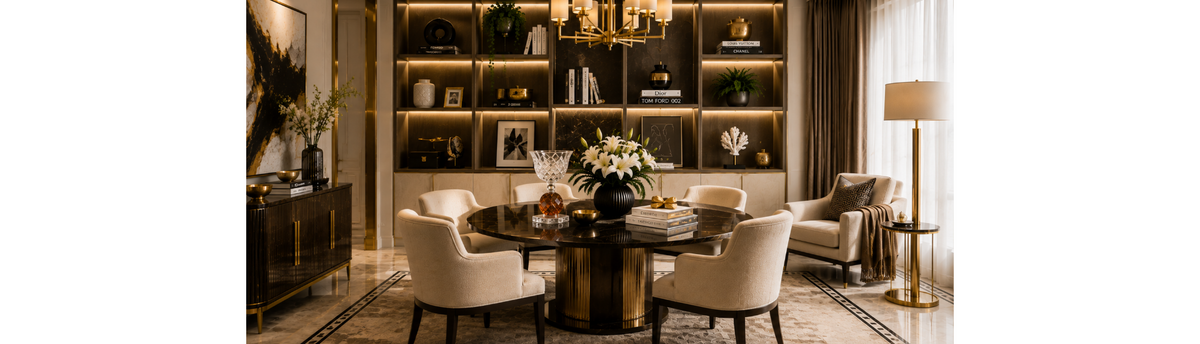

In India, luxury home decor accessories increasingly sit at the intersection of interior styling, design and collecting. A decorative object may be chosen for its material and craftsmanship, for the atmosphere it creates, for the story behind its design or simply because it completes a particular space. The most successful luxury interiors bring these different qualities together rather than treating accessories as objects added only at the end.
Luxury home decor accessories are the objects that complete an interior. Vases, sculptures, art objects, decorative bowls, clocks, mirrors, coffee table books, candles, diffusers and collectible pieces can introduce colour, form, texture, personality and meaning to a home.
But choosing them well is not simply a matter of finding beautiful objects. The object has to belong to the room. Its scale needs to work with the furniture. Its material should have a relationship with the surrounding finishes. Its colour may need to blend, connect or deliberately contrast. And perhaps most importantly, it needs enough space around it to be appreciated.
This is why an expensive accessory does not automatically create a luxurious interior. A single well-chosen sculpture can sometimes do more for a room than several decorative objects placed together simply because there was an empty surface to fill.
The principle is especially relevant in modern Indian homes. A compact apartment, a large villa, a double-height living room and a formal entrance foyer require very different approaches to scale and styling. The same object can look perfectly proportioned in one setting and completely out of place in another.
This guide explains how to choose luxury home decor accessories with greater confidence: what makes an object feel luxurious, how scale and proportion affect selection, how different categories of decor contribute to a room, how to avoid clutter and how to build a home that feels collected rather than simply decorated.
It also explores an important idea that sits at the centre of interior styling: the best place to begin is often not with the object you want to buy, but with what the room actually needs.
Table of Contents
- What Are Luxury Home Decor Accessories?
- What Makes a Decorative Object Feel Luxurious?
- Luxury Decor vs Expensive Decor: What Is the Difference?
- Why Decorative Accessories Matter in a Finished Interior
- The Different Roles Accessories Play in a Home
- How to Choose Home Decor Accessories: Start With the Room, Not the Object
- How Scale and Proportion Affect Your Choice
- How to Choose Materials That Belong Together
- The Blend–Connect–Contrast Method for Choosing Decor Colours
- How Many Decorative Objects Does a Room Need?
- Why Negative Space Matters in Luxury Interior Styling
- How to Build a Home Decor Collection Over Time
- Choosing Different Types of Decorative Accessories
- How to Style Accessories in Different Rooms
- How to Mix Decorative Objects Without Creating Clutter
- Common Home Decor Styling Mistakes
- Luxury Home Accessories as Meaningful Gifts
- Decorative Objects That Become Collectibles
- What to Consider Before Buying Luxury Home Decor
- How to Choose Accessories That Will Still Feel Relevant Years Later
- Frequently Asked Questions About Luxury Home Decor Accessories
- How Should You Begin Choosing Accessories for Your Home?
What Are Luxury Home Decor Accessories?
Luxury home decor accessories are decorative or functional objects chosen to complete, personalise and visually balance an interior. They can include vases, sculptures, art objects, decorative bowls and trays, decorative boxes, designer clocks, mirrors, coffee table books, bookends, candles, fragrance diffusers, wall art, artistic glass and collectible design objects.
The word accessory can make these pieces sound secondary to the larger elements of a home. In practice, they often have a significant influence on how a finished interior feels.
Furniture establishes function and occupies most of the visual volume of a room. Lighting shapes atmosphere. Flooring, wall finishes and fabrics establish the larger material palette. Decorative objects work at a smaller scale, but they can connect all these elements.
A sculptural vase can introduce height where most of the furniture is low and horizontal. A decorative bowl can provide a quieter form on a large dining table. A designer clock can give purpose to an empty wall. Books can add colour and create different levels on a coffee table. An artistic glass object can introduce transparency, craftsmanship and reflected light.
Accessories can also make an interior personal.
Two homes may have similar neutral sofas, stone flooring and timber furniture, yet feel completely different once the objects are introduced. One homeowner may prefer contemporary sculpture and restrained monochrome pieces. Another may collect colourful glass, books, handmade objects and pieces acquired while travelling.
Neither approach is automatically more luxurious. What matters is the quality of the objects, the judgement behind their selection and the relationship they have with the home around them.
Luxury home decor accessories can include vases, sculptures, art objects, decorative bowls and trays, designer clocks, mirrors, decorative boxes, coffee table books, candles, fragrance diffusers, wall art, artistic glass and collectible design objects.
These principles also extend beyond residential interiors. For a more detailed guide to selecting and styling accessories in professional environments, see our complete guide to luxury office decor accessories in India, covering office desk accessories, sculptures, wall art, clocks, decorative lighting, globes, world maps and other pieces used to create considered executive and professional workspaces.
Luxury home decor accessories are carefully selected decorative and functional objects that add form, colour, texture, personality and visual balance to an interior. Luxury comes not from filling a home with more accessories, but from choosing objects with quality, purpose and the right relationship to the surrounding space.
What Makes a Decorative Object Feel Luxurious?
A decorative object does not become luxurious simply because it is expensive.
Its value may come from the material, craftsmanship, design, originality, maker or production technique. These qualities are also what distinguish premium home decor accessories from ordinary decorative pieces. But there is another quality that is just as important once the object enters a home: appropriateness. An exceptional object can still look wrong when its scale, colour or character does not suit the setting.
A small sculpture or crystal decor may disappear on a long console. An oversized vase may overwhelm a compact apartment. A highly decorative object may compete with an expressive marble surface, while a restrained piece may provide exactly the balance the same room needs.
Luxury therefore comes from two decisions working together: choosing an object worth owning and knowing how to place it.
Material
Glass, crystal, ceramic, metal, stone, timber and other carefully worked materials can all create luxury objects. The material does not necessarily need to be rare. What matters is its quality, how it has been handled and whether it contributes something meaningful to the design.
Transparent glass can introduce lightness. Stone brings visual weight. Metal can add definition or reflection. Ceramic may introduce texture and a more organic quality. Material becomes even more interesting when it creates a relationship with the surfaces already present in the room.
Craftsmanship
Craftsmanship becomes visible through details. Hand-finishing, glassmaking, carving, metalwork, ceramic techniques and other specialist processes can create variations and qualities that reveal how an object was made.
These details may not always be obvious from across the room. They often become more meaningful as the object is seen closely and lived with over time.
Design
Some objects have presence because of the strength of the design itself. A distinctive silhouette, an unusual proportion or a thoughtful relationship between form and material can make an object memorable without requiring excessive ornamentation.
Good design also allows an object to remain relevant beyond the interior trend that surrounded it when it was purchased.
Originality
Luxury interiors benefit from objects that do not feel interchangeable. This does not mean that every accessory needs to be rare, limited or collectible. It means the home should not feel as though every object was selected only because it happened to be fashionable at the same moment.
A mixture of contemporary design, craft, personal objects, books, gifts and collected pieces often creates far more character than an entire room assembled from matching accessories.
Context
Context is where a beautiful object becomes part of a beautiful interior. A sculpture needs enough room for its form to be understood. A vase needs the right scale for the table beneath it. Artistic glass may benefit from light passing through or around it. A decorative mirror needs to reflect something worth seeing.
The object and its surroundings should strengthen one another.
To understand these qualities in greater depth, including how design, materials, craftsmanship, originality, provenance and collectability influence the value of a decorative object, read What Makes a Home Decor Object Luxury? Design, Materials, Craftsmanship & Collectability Explained.
Luxury Decor vs Expensive Decor: What Is the Difference?
Luxury and expense can overlap, but they are not the same thing. An expensive decorative object may cost more because of its material, designer, brand, craftsmanship, rarity or production process. These can all be valid reasons for a higher price.
But price cannot determine whether the object belongs in a particular interior. Consider a large console table. Filling it with several expensive objects does not necessarily make the arrangement feel luxurious. One well-proportioned sculpture, a vase and enough open surface around them may create a far stronger composition.
How decorative accessories are arranged can be just as important as the objects themselves. For a closer look at creating a balanced console composition with vases, sculptures, books and other accessories, see How to Style a Console Table: Vases, Sculptures, Books & Decorative Objects.
The same applies throughout the home. A decorative mirror needs to relate to the wall and furniture around it. A clock needs enough visual space to be read clearly. A sculpture needs breathing room around its silhouette. A coffee table book should contribute to the composition rather than simply occupy an empty corner.
This distinction is important when choosing high-end home decor accessories. High-end should describe the quality of the design, materials, craftsmanship and overall character of an object, rather than simply its price.
In this sense, luxury is as much about editing as acquiring. Instead of asking only: “Is this a beautiful object?” also ask: “Does this object belong in this particular space?”
That second question is where interior styling begins.
Why Decorative Accessories Matter in a Finished Interior
A home can be technically complete before it feels complete.
The furniture has arrived. The lighting is installed. The curtains are in place. The walls and flooring are finished. Yet something can still feel missing.
Decorative accessories often provide that final layer because they work at the scale at which people experience a home closely. They introduce detail. They create small focal points. They connect materials. They allow colour to move through the room. They can soften a formal interior or give definition to a very neutral one.
They also create opportunities for the home to reflect the people living in it. A favourite book, a sculpture chosen because of its form, an object brought home from a journey or a gift connected to an important occasion carries information about the homeowner that furniture alone rarely can.
This personal layer is particularly important in luxury interiors. Without it, even beautifully designed rooms can begin to feel like show homes. With too much of it, the room can become visually crowded.
The role of interior styling is to find the balance between the two.
The Different Roles Accessories Play in a Home
One of the most useful ways to understand home decor is to stop thinking only in product categories.
Instead of beginning with: “Should I buy a vase, sculpture or bowl?” begin with: “What does this part of the room need?”
Decorative accessories can perform several different roles.
Focal Objects
A focal object can become the visual anchor of a room. This is where statement home decor accessories can be particularly effective: one distinctive sculpture, vase, clock or art object can establish a focal point while the surrounding accessories remain quieter.
These pieces generally benefit from more negative space because their impact depends partly on allowing the eye to recognise them as significant.
Functional Decorative Objects
Some accessories combine beauty with practical use. Clocks tell time. Trays and boxes organise smaller objects. Bowls may hold everyday items. Mirrors serve a practical purpose while also reflecting light and views.
Objects that combine function with strong design can be particularly useful in apartments and smaller homes, where every surface needs to work harder.
Layering Objects
Layering objects help build a composition rather than dominate it. Coffee table books are one of the clearest examples. They add colour and horizontal form while creating a raised level for a candle, small sculpture or decorative object.
Smaller bowls, candles and compact pieces can perform a similar supporting role.
Wall Objects
Decorative mirrors, designer clocks and wall art allow styling to move beyond tables and consoles. They can complete vertical areas of a room, establish focal points and create relationships with the furniture below them.
When these objects are being considered as part of a larger wall composition, the principles of scale, proportion, visual hierarchy and negative space become especially important. For a deeper guide to bringing wall art, sculpture, mirrors, wall coverings and lighting together as a complete composition, explore Spacio's complete guide to luxury wall styling and statement walls in Indian interiors.
This becomes especially valuable in homes where floor and tabletop space is limited.
Atmospheric Objects
Some accessories affect the experience of a room beyond its visual appearance. Candles introduce small points of warm light. Fragrance diffusers add a sensory layer. Both can influence how a room is experienced even when they are not the visual focal point.
Personal and Collected Objects
Not every object in a well-styled home needs to come from an interiors collection. Travel finds, inherited objects, wedding gifts, books, artwork and pieces connected to personal interests can give a home individuality that cannot be created simply by purchasing a complete set of coordinated decor.
The role of styling is not to remove these objects because they do not match perfectly. It is to find the right context for them.
Before deciding which accessory to buy, identify the role the room needs the object to perform. Does the space need a focal point, more height, a practical object, another layer, something for the wall, greater atmosphere or a personal element? Once the role is clear, choosing the object becomes much easier.
How to Choose Home Decor Accessories: Start With the Room, Not the Object
One of the easiest mistakes when choosing home decor is to fall in love with an object before considering where it will live. There is nothing wrong with buying something simply because you find it beautiful, but when accessories are being selected to complete an interior, the better starting point is usually the room itself.
Look at what is already there. Is the room visually quiet or already expressive? Are most of the furniture pieces low and horizontal? Is there an empty wall that needs presence, a long console that feels unfinished or a coffee table that needs a stronger composition?
These observations begin to tell you what kind of object the room needs. A neutral living room with low furniture may benefit from a sculptural piece that introduces height or a stronger form, while a room with expressive stone, patterned upholstery and statement lighting may need fewer and quieter accessories.
The same thinking applies to colour and material. If the room already contains several strong colours, another one may create unnecessary competition. If the interior is intentionally restrained, however, a piece of artistic glass, a sculptural vase, a bookend or an art object may provide exactly the visual energy that is missing.
This changes the buying question from “What decorative object do I like?” to “What does this room need?”
Once you know what the room needs, the next step is making sure the object you choose is right in terms of quality, materials, scale and proportion, particularly when buying online. For a practical guide to evaluating these factors before making a purchase, read How to Buy Luxury Home Decor Online in India: A Guide to Quality, Materials & Scale.
That distinction is one of the foundations of thoughtful luxury home decor interior styling, particularly when choosing accessories for a finished interior.
When styling a home, I recommend looking at the room before deciding which accessory to add. A space may need height, colour, a stronger form, a practical object or sometimes simply more empty space. Once the need is understood, choosing the right object becomes much easier.
How Scale and Proportion Affect Your Choice
Scale is one of the most important considerations when choosing decorative accessories. It is also one of the most common reasons an otherwise beautiful object can feel wrong once it enters a room. The aim is not simply to add home accessories, but to choose luxury home decor accessories that genuinely improve the room. An accessory is never seen in isolation. The eye automatically compares it with the furniture, wall, ceiling height, surrounding objects and the overall volume of the interior.
Scale and proportion become especially important in transitional spaces such as staircase landings. A sculpture or planter that looks well-proportioned beside a living-room wall may feel too small against a tall stairwell or may obstruct movement on a narrow landing. These areas also need to be viewed from several positions, including the lower floor and upper landing. For practical guidance on choosing and arranging wall art, staircase chandeliers, sculptures and planters in these spaces, read Spacio's guide to styling a staircase with art, decorative lighting, plants and pots.
A small vase placed alone in the centre of a large dining table may look insignificant. The same vase grouped with another object on a compact side table may feel perfectly proportioned. Similarly, a substantial sculpture that looks natural in a double-height living room may overwhelm a narrow apartment console.
This is why dimensions matter, particularly when buying home decor online. Product photographs can make it difficult to judge scale unless you compare the stated dimensions with the actual surface or area where the object will be placed.
Choosing the right decorative objects is an important part of creating a considered interior. For a practical guide to selecting individual pieces, read our guide to how to choose decorative objects for your home, covering scale, proportion, material, visual weight and placement.
One thing I have repeatedly noticed while styling homes is that homeowners often underestimate the scale an object needs. A vase or sculpture can look substantial when seen individually in a showroom or online, but once it is placed on a long console, large dining table or within a double-height living room, it can appear surprisingly small. I therefore prefer judging an accessory against the furniture and volume of the room rather than judging the object by itself.
A Simple Scale Test Before Buying
When buying an accessory online, use its stated dimensions to recreate its approximate size in the intended location before ordering. You can mark the height and width with masking tape, paper or another object of similar dimensions, then view it from the positions from which the accessory will normally be seen.
This is particularly useful for vases, sculptures and decorative objects because product photography can make their actual scale difficult to judge. A few minutes spent testing the dimensions against the furniture and room can prevent an otherwise beautiful object from arriving at the wrong scale.
Consider the Surface
The size of the table, console, sideboard or shelf provides the first indication of the scale required. Large surfaces generally need either an object with enough presence or a carefully composed group of smaller pieces.
A very small accessory positioned alone on a long console can make the surface feel even emptier because the difference in scale becomes more obvious. At the other extreme, oversized accessories can leave too little breathing room and make a compact surface difficult to use.
Consider the Wall Behind It
Objects placed on consoles and sideboards are also read against the wall behind them. A tall vase or sculpture can help connect the furniture visually with a mirror, clock or artwork above, while a collection of only low objects may leave the overall composition feeling disconnected.
Think of the surface and wall as one visual arrangement rather than two separate areas to decorate. This is particularly useful when styling entrance consoles, living room sideboards and dining room storage units.
Consider Ceiling Height
Rooms with high or double-height ceilings can usually absorb objects with greater vertical presence because the surrounding interior provides enough visual volume. Taller sculptures, large vases and substantial decorative pieces may therefore feel more natural in these spaces.
Lower-ceiling apartments usually require more careful proportion, but this does not mean every accessory needs to be small. One confident, well-scaled object can often create a stronger result than several miniature pieces distributed around the room.
Consider Viewing Distance
An object intended to be appreciated from across a large living room needs enough scale and visual clarity to register at that distance. Smaller objects with fine craftsmanship or intricate detail are often better placed on side tables, consoles or shelves where people naturally see them more closely.
Do not judge the size of an accessory by the object alone. Consider the surface beneath it, the wall behind it, the height and volume of the room and the distance from which it will usually be seen.
How to Choose Materials That Belong Together
Modern luxury interiors often contain several materials at once. Timber, stone, metal, glass, fabric, leather and ceramic may all exist within the same room, and decorative accessories add another layer to this material palette.
The objective is not to make every material match. Excessive matching can make an interior feel overly coordinated, while thoughtful repetition and contrast allow different materials to feel connected without becoming predictable.
Repeat a Material Quietly
One way to create continuity is to repeat a material already present in the room at a smaller scale. A metal detail in a sculpture may relate to the finish of a nearby decorative light, while a stone bowl may create a quiet relationship with a marble table.
The repetition does not need to be exact. In fact, subtle relationships are often more effective because the room feels coherent without appearing as though every element was deliberately matched.
Use Contrast to Create Interest
Contrast can be equally valuable. A smooth artistic glass object can stand out beautifully against textured timber, while handmade ceramic can introduce softness and irregularity into a room dominated by polished stone and clean-lined furniture.
Contrast works when the materials strengthen one another rather than compete. A transparent or reflective object, for example, can provide visual lightness on a heavy surface, while a matte sculptural piece may give definition to a room containing several glossy finishes.
Think About Finish as Well as Material
Two objects made from the same material can create completely different effects depending on how the material is finished. Polished metal reflects light and attracts attention, while brushed or aged metal can feel quieter and more tactile.
Clear glass has a different visual weight from coloured or opaque glass. Highly polished stone behaves differently from a textured surface, just as glazed ceramic creates a different effect from a matte or handmade finish.
In Indian homes with strong natural daylight, reflective materials deserve particular attention. Clear glass, crystal, polished metal and highly reflective finishes can behave very differently near large windows during the day than they do under evening lighting. Before choosing their position, observe how direct and indirect daylight moves through the room, particularly during the brighter hours.
When choosing accessories, therefore, consider not only what the object is made from but also how that material behaves within the room.
The Blend–Connect–Contrast Method for Choosing Decor Colours
Decorative accessories do not need to match the sofa, curtains or rug. When styling a room, a more useful way to think about colour is to decide whether an object should blend, connect or contrast with its surroundings. This simple method helps define the role colour should play before choosing the accessory itself.
Blend
Accessories can remain within the existing tonal palette when the objective is to create a calm and restrained room. In an interior built around warm neutrals, for example, objects in stone, amber glass, bronze, muted ceramic or natural timber can add depth without introducing an obvious new colour.
Blending does not mean making every object identical. Variation in texture, transparency and finish can provide enough interest even when the colour palette remains quiet.
Connect
An accessory can pick up a colour that already exists elsewhere in the room without matching it exactly. A blue glass vase might relate to a small amount of blue within an artwork, while a warm-toned sculpture may connect visually with timber furniture.
These relationships can be subtle. When done well, they allow colour to travel through the room and make different elements feel connected without making the styling obvious.
Contrast
Sometimes the room needs a deliberate interruption. A strongly coloured vase within a neutral interior can become a focal point, while a dark sculpture against a pale wall can create definition and visual depth.
The stronger the contrast, the more attention the object will attract. Its scale, quality and placement therefore become even more important because the eye will naturally move towards it.
Rather than asking whether an accessory matches the room, decide what relationship you want it to have with the room. It can blend quietly into the existing palette, connect colours already present or introduce deliberate contrast.
How Many Decorative Objects Does a Room Need?
There is no ideal number of accessories for a room. A large room does not automatically need many decorative objects, just as a small room does not necessarily need only one.
What matters is visual weight. One substantial sculpture may have more presence than five small accessories, while a large dining table may feel complete with a single well-proportioned vase or bowl. For dining spaces, styling a dining table and sideboard with luxury home decor accessories requires a balance between visual impact and practical use, with centrepieces, sculptures, decorative boxes, vases, bowls, trays and other objects working together as a considered composition.
It is also useful to distinguish between objects in a room and objects in a composition. A living room may contain a mirror, floor sculpture, coffee table books, vase, clock and several shelf objects, yet still feel restrained because those pieces are distributed across different visual areas.
Problems usually begin when every available surface is treated as an opportunity to display something. The coffee table becomes full, the console becomes full, every shelf becomes full and even individually beautiful objects begin competing for attention.
A useful editing question is: “If I remove this object, does the composition become weaker or clearer?”
If removing it makes the arrangement calmer without losing anything important, the object may not be necessary in that particular location.
Why Negative Space Matters in Luxury Interior Styling
Negative space is the empty area around and between objects. It is one of the simplest and most effective tools available when styling luxury home decor.
When every part of a console, coffee table or shelf is occupied, the eye has difficulty deciding what deserves attention. Leaving deliberate space around an object allows its silhouette, material and craftsmanship to become easier to appreciate.
This is particularly important for sculptures, artistic glass and collectible objects. A piece with an unusual form can lose much of its impact when it is surrounded by several other objects of similar visual strength.
Negative space also allows the furniture itself to remain part of the composition. If you have chosen a beautiful stone console, handcrafted timber table or distinctive surface, there is little reason to hide most of it beneath decorative accessories.
Empty space should therefore not automatically be treated as unfinished space.
Sometimes it is exactly what makes the objects around it feel more luxurious. For a deeper look at editing decorative objects, creating visual hierarchy and using negative space throughout a room, explore How to Style Luxury Home Decor Without Making Your Home Look Overdecorated
How to Build a Home Decor Collection Over Time
A newly completed home does not need to be fully accessorised in one shopping trip. Interiors often become more interesting when decorative objects are acquired gradually and are allowed to reflect different periods, experiences and interests.
Some pieces may be selected specifically for the home, while others may arrive through travel, gifting or collecting. A wedding gift may eventually sit beside an object purchased years later, and a piece originally chosen for one room may move elsewhere as the interior evolves. For a deeper guide to choosing decorative objects as gifts, read our guide to Luxury Home Decor Gifts in India.
Begin With a Few Strong Objects
Start with the areas that most clearly need visual completion. This may be the entrance console, living room coffee table, dining table or one important wall rather than every surface in the home.
Choose a few objects with enough presence to establish the direction of the styling, then live with them before deciding what is still missing. This makes it easier to distinguish between a genuine need and the temptation to fill empty space.
Allow Different Origins
A collected home should not necessarily look as though every object came from the same collection. Contemporary European design can sit beside handmade objects, books, artistic glass, travel finds and personal pieces when there is some relationship of scale, colour, material or character between them.
The result is often richer because the objects do not all tell the same story. The skill lies in creating enough visual connection for them to coexist naturally.
Choose Objects You Would Want to Keep
Trends can be useful for discovering new colours, forms and materials, but they should not be the only reason to buy a significant decorative object. Before making an important purchase, consider whether you would still enjoy the piece if the furniture or colour palette around it changed.
Objects with strong design, craftsmanship or personal meaning often survive changes in interior styling better than accessories chosen simply because they fit a current trend.
Let Objects Move Through the Home
Decorative objects do not need permanent addresses. A vase that begins on the dining table may later work better on a console, while books, sculptures and smaller objects can be rearranged as furniture and daily use change.
Moving existing objects can refresh a room without continually adding new decor. It can also reveal combinations and relationships that were not obvious when the pieces were first purchased.
Begin with the room rather than a shopping list. Choose a few strong objects, pay attention to scale, material and colour, leave enough negative space and allow the collection to develop over time. A home becomes more personal when every accessory does not arrive at once.
Choosing Different Types of Decorative Accessories
Once you understand what a room needs, choosing the category of accessory becomes much easier. A vase can introduce height and colour, a sculpture can add form, books can create layers, a mirror can bring depth and reflection, while a clock can turn an otherwise empty wall into a functional focal point.
The important question is therefore not which categories a luxury home is expected to contain. It is what each type of object can contribute, where it works best and whether it has the right scale and character for the interior.
How to Choose Decorative Vases
Decorative vases are among the most versatile home accessories because they can introduce height, colour, material and form without requiring a large amount of space. They can work on consoles, dining tables, coffee tables, sideboards and shelves, while larger pieces may also function as floor-standing objects.
The first consideration is whether the vase will regularly hold flowers or primarily function as a decorative object. A vase intended for floral arrangements needs an opening, height and stability suited to the flowers or foliage you prefer, while a sculptural vase may be selected for its silhouette and material and can look complete even when empty.
Scale becomes especially important on large surfaces. A small vase can disappear in the centre of a substantial dining table or long console, while an oversized piece can obstruct sightlines or overwhelm a compact apartment.
Material changes the character as well. Artistic glass can introduce transparency, colour and reflected light; ceramic can add texture and an organic quality; metal can create stronger definition; and stone can bring visual weight.
When using more than one vase, they do not need to be identical. Related forms in different heights or complementary materials can create a more natural composition than a perfectly matching set.
Consider whether it will be displayed empty or with flowers, its proportion to the surface, its height in relation to nearby objects and whether its material and colour should blend, connect or contrast with the room.
How to Choose Sculptures and Art Objects
Sculptures and art objects can bring a stronger sense of individuality to an interior because they are usually appreciated for their form rather than for a practical function. Depending on their scale and character, they can sit quietly within a composition or become one of the most important visual elements in the room.
When choosing a sculpture, begin with its silhouette and consider how it will be seen. A sculptural object displayed on a console, pedestal, central table or open shelf may be visible from several directions, so the form needs to work from more than one viewpoint.
Choosing the right sculpture also involves looking beyond appearance. Material, scale, craftsmanship, provenance, placement and collectability can all influence whether a piece is right for a particular interior. For a more detailed guide to selecting sculptures and art objects for luxury Indian interiors, read How to Choose Sculptures and Art Objects for Luxury Indian Interiors.
The surrounding space is equally important. A strong sculpture generally benefits from enough negative space for its outline to be understood, while several expressive objects positioned too close together can weaken one another.
Sculpture can also introduce a form that is missing elsewhere in the room. An interior dominated by straight furniture lines may benefit from something curved or organic, while a soft and rounded room can gain definition from a more geometric piece.
In larger homes, floor sculptures can give purpose to areas that would otherwise feel visually empty without introducing another piece of furniture. In apartments and smaller rooms, a well-chosen tabletop sculpture can create the same artistic presence at a scale better suited to the interior.
Sculptures and art objects can introduce form, movement and personality to an interior. A carefully chosen piece can become a focal point, create visual interest on a console or shelf, or add character to a quieter part of the room. For practical guidance on placement, scale, negative space and composition, see Spacio's guide on how to style sculptures and art objects in modern luxury interiors.
The strongest choice is not necessarily the sculpture that attracts the most attention when seen on its own. It is the one whose form, scale and character continue to make sense once it becomes part of the home.
If you are choosing a sculpture for its material, craftsmanship or collectability, our guide to choosing luxury sculptures explores Murano glass, glass, crystal, porcelain, ceramic and other materials, along with provenance, scale and the qualities that can make a sculpture a lasting statement piece.
Decorative Bowls, Boxes & and Trays
Decorative bowls and trays occupy a useful position between decoration and function. A bowl can introduce a low horizontal form on a coffee or dining table, while a tray can organise several smaller items so that they read as one deliberate composition.
Among the more versatile categories of luxury home decor accessories are decorative boxes, which combine practical function with materiality, craftsmanship and visual character. They can add structure and refinement to consoles, coffee tables, sideboards, desks and other styled surfaces without competing unnecessarily with larger focal points. For a deeper look at how to select them, explore our guide to how to choose decorative boxes for luxury interiors.
This makes trays particularly useful on surfaces that also need to support everyday life. A candle, small decorative object and frequently used items can be brought together visually rather than appearing as unrelated pieces scattered across a table.
Decorative trays can also bring structure and visual balance to a carefully styled interior, particularly when used to group smaller objects on coffee tables, consoles or sideboards. For a more detailed guide, see our article on how to choose decorative trays for luxury home interiors.
Bowls can also help balance taller accessories. If a console already contains a tall vase or vertical artwork, a lower decorative bowl introduces another level without adding a second competing vertical form.
Because these objects are often handled, practical considerations matter alongside appearance. Consider stability, weight, edges and whether the material could scratch or otherwise affect the furniture surface beneath it.
Coffee Table Books as Decorative Objects
Coffee table books are unusual decorative accessories because their content can be as important as their appearance. Books about art, design, fashion, photography, travel, automobiles or other interests can reveal something about the people who live in the home while also contributing colour, scale and structure to the styling.
They are particularly useful for creating layers. One or two books stacked horizontally can form a raised platform for a smaller sculpture, candle or decorative object, preventing every accessory from sitting directly on the same visual plane.
Book size should relate to the furniture beneath it. Large-format books work particularly well on substantial coffee tables, while smaller books may be more comfortable on side tables, consoles or shelves.
The cover can certainly contribute to the colour composition of the room, but colour should not be the only reason for choosing a book. A home feels more personal when the books on display are subjects the homeowner would genuinely enjoy opening rather than objects selected only because their covers match the upholstery.
For a more detailed guide to styling coffee table books with scale, colour, texture, decorative objects and negative space, read How to Style Coffee Table Books in Luxury Interiors.
Designer Clocks
A designer clock is one of the clearest examples of an object that can be both functional and decorative. Contemporary clocks can use hands, markers, materials and negative space to create a wall composition rather than behaving simply as devices for telling time.
This makes them useful when a wall needs visual interest but another conventional artwork does not feel necessary. Some designs can become an important focal point in a living room, dining room, entrance or study while still performing an everyday function.
Scale is critical. A small clock can feel lost on a large wall, while an oversized design may dominate a compact room. Consider the dimensions of the wall, the furniture beneath it and the distance from which the clock will normally be viewed.
The clock also needs to relate to other wall elements. If artwork, mirrors and decorative lighting already create several strong focal points within the same visual field, another expressive wall object may make the room feel unnecessarily busy.
Used with restraint, a designer clock can behave almost like kinetic wall art. Its composition changes subtly as the hands move through the day, allowing function and visual interest to exist within the same object.
Decorative Mirrors
Decorative mirrors can perform several roles at once. They are functional objects and wall accessories, but they can also influence light, visual depth and the way another part of the room is experienced through reflection.
The first consideration should therefore be what the mirror will reflect. A beautifully designed mirror positioned opposite an unattractive or visually busy area may simply duplicate something you would rather not emphasise, while one that reflects a window, lighting feature, artwork or considered view can strengthen the interior.
Proportion matters as much as reflection. A mirror above a console or sideboard should relate to the width and visual weight of the furniture beneath it, while a small mirror placed on a very large wall can appear disconnected from its surroundings.
The design of the mirror itself also deserves attention. Artistic glass, sculptural forms, metal detailing and unusual silhouettes allow a decorative mirror to contribute to the room even when nobody is actively using it.
The best decorative mirror is therefore not simply the one with the most elaborate frame. It is the one that improves both the wall on which it sits and the view that appears within it.
Candles and Candle Holders
Candles introduce something most decorative accessories cannot: changing light. The flame creates a small point of warmth and movement that can soften the atmosphere of a dining table, coffee table, console or bedroom.
Candle holders can contribute to the composition even when the candles are not lit. Glass, metal and sculptural holders can function as decorative objects in their own right, particularly when their material connects with other finishes in the room.
Height needs careful consideration on dining tables. Tall candles can create drama, but they should not unnecessarily obstruct conversation or sightlines across the table.
On coffee tables and consoles, candles often work better as part of a small composition than as several unrelated pieces spread across the surface. As with any real flame, placement should also consider stability, surrounding materials, children and pets.
Choosing the right candle holder or candle stand involves more than selecting a beautiful object. Material, craftsmanship, scale, proportion, format and the way candlelight interacts with the surrounding interior all influence the result. For a deeper guide to selecting these pieces for luxury interiors, read our guide to choosing luxury candle stands and candle holders for luxury interiors.
Home Fragrances and Diffusers
Interior styling is usually discussed visually, but a home is experienced through more than sight. Candles and fragrance diffusers can introduce a sensory layer that gradually becomes associated with a particular room or with the home itself.
The fragrance should suit both the space and the people using it. A strong scent can become overwhelming in a small enclosed room, while something very subtle may disappear in a large open-plan living area.
The vessel matters too because diffusers and scented candles often remain visible for long periods. Their bottles, containers and materials become part of the interior and should therefore be considered with the same attention to proportion and placement as other decorative objects.
Fragrance is usually most successful when it contributes to the atmosphere quietly. It should be something the room gradually reveals rather than the only thing somebody notices when entering it.
Wall Art
Wall art can influence the visual balance of a room more significantly than many tabletop accessories because it occupies the vertical field of view. Paintings, prints, photography and other wall pieces can introduce colour, narrative, scale and personal interest while connecting furniture to the interior composition around it.
The first consideration is usually proportion. Artwork positioned above a sofa, console or sideboard should relate to the furniture below rather than appearing as an isolated object floating on the wall.
The room also needs hierarchy. If decorative lighting, a fireplace, designer clock or other major feature is already visually strong, highly expressive artwork nearby may create too many competing focal points. In a quieter room, the artwork may be exactly what gives the composition its identity.
Art should also be chosen for more than colour coordination. Subject, technique, emotion and personal connection can remain important long after the surrounding fabrics or furniture have changed.
Collectible Glass and Artistic Objects
Artistic glass occupies an interesting territory between decorative object, craftsmanship and collectible design. It can be transparent, opaque, coloured, layered, blown or shaped using specialist techniques, while changing natural and artificial light can alter the way the object appears throughout the day.
This makes glass particularly effective where it can be viewed against natural light, considered lighting or a relatively quiet background. Placement should allow both the material and the silhouette to be appreciated without surrounding the piece with too many competing objects.
Some glass pieces are chosen primarily for colour and form, while others carry greater significance because of the maker, design house, technique or glassmaking tradition behind them. Murano glass, for example, is better understood through its glassmaking heritage and specialist techniques than simply as a category of colourful decorative glass.
When considering a collectible piece, look beyond whether its colour works with the current room. Consider the craftsmanship, origin, form and whether the object has enough personal appeal to remain meaningful even if the surrounding interior changes.
The category tells you what an object is; interior styling asks what it contributes. A vase can add height, a sculpture can introduce form, books can create layers, a mirror can add reflection and depth, a clock can activate a wall, while artistic glass can bring colour, light and craftsmanship. Choose the category according to the role the room needs the object to perform.
How to Style Accessories in Different Rooms
The principles of scale, proportion, colour and negative space remain the same throughout a home, but the way they are applied changes from room to room. A living room may offer several surfaces for display, while an entrance foyer needs to make an impression within a much smaller area. A bedroom usually benefits from restraint, while a large dining room may need objects with enough presence to relate to the table and decorative lighting.
While this guide explains how to choose the right accessories for different rooms, every surface deserves its own styling approach. A console table, coffee table and open shelving each present different proportions, functions and visual challenges. Learning to create balanced compositions, establish visual hierarchy and use negative space effectively can transform how these surfaces look and feel. For a more detailed guide, read How to Style Consoles, Coffee Tables and Shelves with Luxury Home Decor Accessories.
The purpose of the room should always come before the styling. Decorative accessories should improve the way a space looks and feels without making everyday use more difficult.
How to Style Accessories in a Living Room
The living room usually offers more opportunities for decorative styling than any other part of the home. Coffee tables, side tables, consoles, shelves and walls can all support objects, while larger rooms may also have areas suitable for floor-standing sculptures or vases.
The challenge is not finding places to put accessories. It is deciding which of those places actually need them.
Begin by identifying the major visual elements already present. A statement chandelier, expressive artwork, fireplace, distinctive stone surface or strongly patterned rug may already provide considerable visual interest. In such a room, accessories should support the composition rather than compete with it. A quieter living room may need more help from decorative objects. A sculptural vase can introduce height, books can create layers on the coffee table and a distinctive art object can provide a focal point on a console.
Bookshelves can become particularly effective styling environments when books are combined with sculptures, vases, clocks, art objects and other carefully selected decor accessories. The balance between books and decorative objects helps a shelf feel curated rather than simply filled. For a more detailed approach, see How to Style Bookshelves with Luxury Artefacts, Sculptures & Decor Accessories.
Think of the living room as a series of connected compositions rather than one large surface to decorate. The coffee table may form one composition, a console and the wall above it another, while a shelf or side table creates a smaller visual moment elsewhere in the room.
Create a Visual Hierarchy
Not every decorative object should demand equal attention. Decide which pieces are intended to lead and which are there to support the larger composition.
If an important sculpture already provides a strong focal point on a console, the coffee table may need to remain quieter. If the coffee table contains a substantial artistic object, nearby side tables may require very little decoration.
Consider the Room From Different Angles
Living rooms are rarely experienced from only one viewpoint. Look at the objects from the entrance, from the main seating positions and while moving through the room to understand how the different compositions relate to one another.
This becomes particularly important in open-plan Indian homes where the living room may also be visible from the dining area, entrance foyer or another adjoining space. An arrangement that works from the sofa should still feel balanced when seen from elsewhere.
Bar & Den: Styling Luxury Decor Accessories for Entertaining Spaces
Bars and dens are increasingly important styling environments within luxury homes, combining entertaining, relaxation and display in a more intimate setting. Unlike purely functional spaces, a well-designed bar or den can use decorative accessories to establish atmosphere and personality while still allowing the room to remain practical. The right combination of functional barware and decorative objects can make the space feel collected, refined and connected to the wider interior.
The functional layer can begin with Spacio's Bar Accessories collection, where drinkware, decanters and ice buckets can contribute to both the use and appearance of the bar. Beautifully designed drinkware can introduce glass, crystal and reflective surfaces, while a decanter can act almost like a sculptural object when displayed with restraint. An ice bucket can add another functional element with a strong visual presence. These pieces do not always need to be hidden away; when selected carefully, they can become part of the decorative composition.
The den surrounding the bar provides opportunities to introduce a broader range of luxury home decor accessories. Sculptures and art objects can establish focal points, coffee table books can add personality and visual depth, while vases and decorative bowls can introduce contrasting heights, forms and materials. A decorative tray can organise functional barware or create a defined composition on a nearby console, sideboard or coffee table.
The most successful arrangements are not created by placing an accessory on every available surface. Instead, consider the relationship between the bar, seating, cabinetry, artwork, lighting and decorative objects. A strong sculpture may need little more than a clear area around it, while a compact bar may benefit from a restrained combination of a tray, selected drinkware and one decorative object. Scale, proportion and negative space remain just as important here as they are elsewhere in luxury interior styling.
Materials can also connect the bar and den into one visual environment. Glass and crystal can echo the transparency of drinkware, metal can relate to bar fittings or architectural details, while wood, ceramic and stone can introduce warmth and tactile contrast. Rather than matching every object, repeat selected materials, forms or finishes so that the different elements feel related without becoming predictable.
A fireplace, where present, can become another important focal point within a den or entertaining space. In that situation, the fireplace should establish the visual hierarchy rather than being treated as another surface to decorate. Artwork, a mirror or one carefully chosen sculptural object can support the fireplace while allowing it to remain the dominant architectural feature. For a broader understanding of fireplace technologies, formats, installation considerations and how to choose the right solution for an Indian interior, see Spacio's complete guide to luxury fireplaces in India.
Fireplaces also need to be considered alongside the decorative elements that complete the surrounding interior. Sculptures, vases, decorative objects, books, trays, bowls and other luxury home decor accessories can support a fireplace as a focal point, but they should reinforce its architectural presence rather than compete with it. For a broader guide to selecting and styling these elements, see Spacio's complete guide to luxury home decor accessories for modern Indian homes, which explores scale, proportion, materials, colour, visual hierarchy and the role of decorative objects within a finished interior.
For a more detailed approach to combining these elements, read Spacio's guide to styling a bar and den with luxury home decor accessories. The guide explores how trays, sculptures, books, vases, bowls, centrepieces and decorative objects can be brought together with functional elements to create a sophisticated and usable entertaining environment.
In a bar or den, do not separate functional barware from decoration too rigidly. A beautifully designed decanter, distinctive drinkware or elegant ice bucket can contribute to the visual composition while remaining genuinely useful. The objective is to make function part of the styling.
For a room-specific guide, see How to Style a Luxury Living Room with Decorative Objects, which explores how decorative accessories can be arranged with proportion, visual hierarchy and restraint.
How to Style a Coffee Table
Coffee tables are easily over-styled because their large horizontal surfaces appear to invite decoration. Yet a coffee table is still functional furniture, and enough free surface should remain for the way it is actually used.
A useful composition often combines objects of different heights, shapes and visual weights. Coffee table books can create a horizontal base, while a small sculpture, bowl, candle or vase can introduce another form or level.
These elements do not all need to appear together. On a compact table, a book with one well-chosen object may be enough, while a substantial table can support two or three smaller compositions without becoming crowded.
Work With the Shape of the Table
The geometry of the coffee table can help guide the arrangement. A long rectangular table may support objects distributed along its length, while a round table often works naturally with a more central composition.
The accessories do not need to repeat the geometry of the furniture. A rounded bowl on a rectangular table, for example, can soften the arrangement by introducing a contrasting shape.
Vary Height Without Blocking the Room
If every object is approximately the same height, the composition can feel flat. Books, bowls, candles, vases and sculptures naturally allow different levels to be introduced, but the variation should not interfere with views across the seating area.
Leave Space for Everyday Life
A coffee table that needs to be cleared every time somebody wants to use it has been styled for appearance rather than living. The strongest arrangements allow decoration and everyday function to coexist.
Combine a few objects with different heights and forms, but leave enough open surface for everyday use. The arrangement should look considered without making the table inconvenient.
How to Style a Console Table
Console tables allow a more vertical composition because they are usually positioned against a wall. This means the console surface, the decorative objects and whatever appears on the wall behind them should be considered together.
A mirror, artwork or designer clock can establish the larger vertical element. Vases, sculptures, books or bowls can then help connect that wall feature visually with the furniture beneath it.
One approach is to place a taller object towards one side and balance it with a lower grouping elsewhere. This creates movement without requiring perfect symmetry. In a more formal interior, however, a symmetrical arrangement may relate better to the overall room.
Do Not Hide the Console
If the console has a beautiful stone top, distinctive timber finish or sculptural form, allow enough of it to remain visible. Decorative objects should complete the furniture rather than cover the qualities that made the piece worth choosing.
Consider the Entire Elevation
Tall vases, candlesticks and sculptures can help connect the console with the wall above, but their height should be considered in relation to mirrors, clocks and artwork. Styling the tabletop independently from the wall often creates awkward overlaps or unnecessary competition.
How to Style an Entrance Foyer
The entrance foyer creates one of the first impressions of a home, but it does not need to explain the entire interior at once. A few carefully chosen objects are usually enough to introduce its character.
If the foyer contains a console, it may support a vase, sculpture, decorative bowl or tray. A mirror can add both practical value and visual depth, while an artwork or designer clock may create a stronger focal point when reflection is not required.
Scale should respond to the entrance itself. A large villa foyer may comfortably support substantial sculptural pieces or a floor-standing object, while a narrow apartment entrance needs greater restraint so that decoration does not interfere with circulation.
Practical behaviour should influence the styling too. If keys or other everyday items are routinely placed near the entrance, a well-designed tray or bowl provides an organised place for them instead of pretending that daily life will never reach the console.
Fragrance can add another layer to the first experience of the home. Used with restraint, it can make an entrance memorable without becoming overpowering.
The foyer does not need many objects. It needs the right introduction.
How to Choose and Style Dining Room Accessories
Dining room accessories need to work when the table is being used as well as when it is not. Because a dining table occupies considerable visual space, even a relatively simple centrepiece can have significant impact.
A sculptural vase, artistic bowl, group of candle holders, exclusive centrepiece or one strong decorative object may be enough for everyday styling. The scale should relate to the size of the table, while the height should allow comfortable views across it when people are seated.
This becomes especially important when the dining table is used frequently. An arrangement that needs to be removed at every meal may look impressive when photographed but can become inconvenient in everyday life.
In Indian homes where the dining area is also used for larger family gatherings, festive dinners and entertaining, flexibility becomes particularly valuable. A centrepiece that works beautifully every day should also be easy to move, simplify or supplement when the table needs to accommodate more people, serving pieces or seasonal decoration.
When a dining room also includes a fireplace or a strong decorative lighting feature, the accessories need to work as part of the wider composition. Spacio's guide to luxury dining room styling with fire, lighting and decor accessories explores how dining tables, centrepieces, sideboards, decorative lighting and fire can be balanced through scale, proportion and visual hierarchy.
Consider the Decorative Lighting Above
A chandelier or pendant already creates a visual focal point above the dining table. The objects below should have a relationship with that lighting rather than competing with it for equal attention.
The table can also change character between day and evening. Candles can introduce warmer points of light during dinner, while a sculptural centrepiece may become more prominent when the table is not being used.
Use Sideboards and Consoles to Share the Visual Weight
If the dining room contains a sideboard or console, not every decorative idea needs to be placed on the dining table. Sculptures, artistic glass, books or decorative objects can create a separate composition nearby, allowing the table itself to remain more restrained and functional.
How to Choose Accessories for a Bedroom
Bedrooms usually benefit from a quieter approach to decorative styling because rest, comfort and personal use remain more important than creating several visual focal points. Accessories can add character, but they should not make the room feel visually demanding.
Bedside tables already need to accommodate practical items and lighting, so decoration should not consume all of the available surface. A small object, book or candle may be enough alongside the functional elements.
A dresser or console provides more freedom for styling. A mirror, vase, sculpture or group of personal objects can create a considered composition without interfering with the sleeping area.
Bedrooms are also particularly suitable for objects with emotional meaning. Photographs, gifts, travel pieces, books and smaller collectibles may feel more natural here than in the more public areas of the home.
Luxury in a bedroom often comes from restraint and intimacy rather than display. When a bedroom also includes a fireplace or a strong lighting feature, the accessory layer needs to be considered as part of the wider composition. Spacio's guide to luxury bedroom styling with a fireplace, decorative lighting and decor accessories explores how these elements can work together through scale, material, light and restraint.
How to Decorate Shelves and Display Units
Shelves are different from other surfaces because several individual compositions are visible at the same time. The temptation is to fill every compartment with books and decorative objects, but doing so can make even a beautifully designed display unit feel crowded.
Some areas can contain books, while others may hold a sculpture, vase or collectible object. Certain shelves can combine two or three pieces, while others may remain almost empty. This variation creates rhythm and gives stronger objects enough room to be appreciated.
Avoid Repeating the Same Formula
If every shelf contains one stack of books, one vase and one small sculpture, the arrangement quickly begins to feel formulaic. Change the visual weight from one section to another so that the eye discovers something different as it moves across the display.
Balance Without Mirroring
Objects do not need to be positioned symmetrically for the shelving to feel balanced. A visually heavy object on one side can be balanced by several lighter elements elsewhere, while colour or material can repeat across the unit without appearing in exactly the same position.
Consider the Background and Lighting
The finish behind an object affects how clearly it can be seen. Dark objects may disappear against dark shelving, while transparent glass may need contrast or light behind it for its form to become visible.
Integrated shelf lighting can be particularly effective for artistic glass, sculpture and collectible objects. The purpose of the light should be to reveal the material and form rather than create distracting glare.
Styling Accessories in Large Homes vs Small Homes
Room size changes the way decorative objects are perceived, but the idea that large homes need many accessories and small homes need tiny ones is too simplistic. In both cases, proportion and visual weight matter more than the number of objects.
In Large Rooms and Double-Height Spaces
The challenge is often scale. Small accessories can disappear when viewed across a large living room or within a double-height space, so substantial vases, floor sculptures and stronger wall objects may be necessary to relate to the volume of the interior.
For a broader approach to styling a double-height interior, see Spacio's guide to styling a double-height space with furniture, lighting, fireplace and decor. It looks at how accessories need to relate not only to the room's volume, but also to furniture, fire, decorative lighting and the overall visual axis of a tall interior.
This does not mean filling the room with more decor. Large interiors can often support fewer, more substantial objects because each piece has enough presence to hold its own visually.
In Apartments and Smaller Homes
The challenge is usually visual competition. When furniture, functional objects and accessories sit closer together, too many decorative pieces can quickly make the room feel crowded.
Choose objects with clear roles. A decorative mirror can provide both character and reflected depth, a beautiful bowl can be useful as well as decorative, and one sculptural vase may create more impact than several smaller accessories.
Vertical surfaces become particularly valuable when horizontal space is limited. Clocks, mirrors and designer wall art can introduce personality without occupying tables or circulation areas.
Small homes do not require less character. They require more editing.
Large interiors often need greater scale rather than a greater number of objects. Smaller homes benefit from accessories that earn their place through visual impact, function or personal meaning. In both cases, proportion matters more than quantity.
How to Mix Decorative Objects Without Creating Clutter
A home can become more interesting when everything does not match. Artistic glass can sit beside ceramic, contemporary sculpture can coexist with an inherited object, and books, travel pieces, candles and collectible design can all belong within the same interior.
The challenge is creating enough connection between these objects that the room feels collected rather than random. That connection can come from colour, material, shape, scale or simply the way the pieces are distributed throughout the room.
Find One Relationship
Objects do not need to match in every respect. They may share a colour, material, shape, level of craftsmanship or similar visual weight, and one such relationship is often enough to help very different pieces coexist.
Vary Shape and Height
A group of similarly sized objects can begin to look like merchandise on display. Combining vertical, horizontal, rounded and sculptural forms creates a more natural composition and allows individual pieces to retain their identity.
Repeat Selectively
A material or colour can appear more than once within the room to create continuity, but avoid repeating it so consistently that every accessory feels coordinated. The objective is connection, not uniformity.
Separate Strong Personalities
Two highly expressive objects may each be beautiful but compete when placed directly beside one another. Giving them separate locations often allows both to have greater impact and creates visual interest across more than one part of the room.
Edit at the End
Once the room has been styled, remove one or two objects and look again. This simple exercise often reveals whether the composition genuinely needed everything that was added.
Editing is not about making every interior minimal. It is about making sure each object has enough reason to remain.
For a deeper look at how vases, sculptures, coffee table books and decorative objects can be brought together through balance, rhythm, material contrast and visual composition, read The Art of Mixing Vases, Sculptures, Books and Decorative Objects in One Room.
Common Home Decor Styling Mistakes
Many styling problems have little to do with the quality or price of the accessories themselves. They come from choosing the wrong scale, adding too many objects or treating decoration as something separate from the way the home is actually used.
Choosing Everything at the Same Scale
When every vase, sculpture and decorative object is similar in size, the room lacks hierarchy. Introduce variation so that some pieces lead visually while others support them.
Using Too Many Small Objects
Several small accessories can create more visual clutter than one larger piece. This is especially noticeable on long consoles, large coffee tables and open shelving where the surface needs objects with enough presence to relate to its scale.
Matching Everything
Accessories do not need to reproduce the exact colours and finishes of the furniture. Too much matching can remove the individuality that decorative objects are meant to introduce and make a room feel assembled as a set.
Ignoring Proportion
A beautiful object in the wrong scale can feel awkward regardless of its quality. Always consider the furniture, wall and overall interior around it rather than evaluating the accessory in isolation.
Decorating Every Surface
Not every empty table, shelf or corner represents a styling problem. Leaving some surfaces relatively open can make the areas that are decorated feel more intentional and allow important pieces to have greater presence.
Buying Sets Instead of Building Relationships
Matching sets can make decorating easier, but an entire home assembled from coordinated accessories can quickly lose personality. Objects of different origins can coexist successfully when there is a thoughtful relationship between their scale, material, colour or form.
Following Trends Too Literally
A fashionable colour or material can refresh an interior, but replacing meaningful objects every time another look becomes popular can make a home feel temporary. Trends are more useful as sources of inspiration than as instructions for what every room should contain.
Forgetting How the Home Is Used
A dining table that cannot comfortably host dinner, a coffee table with no usable surface and a bedside table overwhelmed by decoration are signs that styling has been prioritised over living. Luxury and practicality should reinforce one another rather than compete.
Luxury Home Accessories as Meaningful Gifts
Luxury home accessories can make meaningful gifts because they remain part of the recipient's everyday environment long after the occasion has passed. A vase, sculpture, artistic glass object, designer clock, coffee table book or other decorative piece can become associated with the person who gave it, the occasion it marked and eventually the home in which it was placed.
This makes choosing decor as a gift different from buying it for your own home. When selecting for yourself, you know the dimensions of the room, the furniture, the colours and the objects already present. When choosing for somebody else, much of that information may be incomplete, so the recipient becomes a more useful starting point than the interior.
Consider what you know about the person's interests, lifestyle and taste. Someone interested in art, travel, automobiles, fashion or design may appreciate a book connected to that interest, while a person who enjoys collecting objects may value craftsmanship, provenance or the story behind a particular piece.
Flexibility of placement is also valuable. A tabletop sculpture, decorative bowl, artistic glass object or book can usually move between a living room, dining room, study, bedroom or entrance as the recipient's home changes, while a very large object selected for a particular wall or surface requires much more knowledge of the interior.
Choosing Decor as a Wedding Gift
A wedding gift may enter a home that is still developing. The couple may be moving into a new residence, combining objects from two homes or still deciding how their interiors will look, so an object with strong design and flexible placement can be particularly suitable.
Longevity matters too. Wedding gifts often remain connected in memory to both the occasion and the giver, which gives a well-chosen decorative object the potential to acquire emotional value beyond its original material value.
For a more detailed guide to choosing luxury wedding gifts for the home, including premium decor accessories, statement centrepieces, sculptures, vases and artistic objects, read Wedding Gifts for the Home: A Guide to Luxury Decor Gifts for Newly Married Couples
Choosing Decor as a Housewarming Gift
A housewarming gift enters a more established context. If you know the home, you may be able to choose something that responds directly to it, such as a decorative bowl for a dining table, an object for a console or a coffee table book connected to the homeowner's interests.
If you do not know the interior well, avoid making assumptions about highly specific colours, large dimensions or decorative styles. An object with enough character to feel special but enough flexibility to work in different settings is usually a more considered choice.
For a deeper guide to selecting a meaningful gift for a new home, read Luxury Housewarming Gifts in India: What Should You Give for a New Home?.
When choosing home decor as a gift, I prefer beginning with the person rather than trying to guess the room. Their interests, lifestyle and personal taste usually tell us more about what they may enjoy owning. I also prefer objects with flexible placement, because they can remain relevant even as the recipient's home and interiors evolve.
Decorative Objects That Become Collectibles
Most home accessories begin with a simple purpose: they are chosen because they make a room more beautiful, complete a composition or create an emotional response. Some objects gradually become something more because of their designer, maker, craftsmanship, material, production technique, provenance or personal significance.
This is where decorating and collecting begin to overlap. A piece of artistic glass purchased for a console may lead to an interest in glassmaking, while one sculptural object may introduce the homeowner to the work of a particular designer or design house.
Personal history can create another form of collectibility. An object bought during a memorable journey, received as a wedding gift or inherited from family may never have formal collectible status, yet become far more difficult to replace than something purchased simply to complete a room.
The strongest collections usually develop around genuine interest rather than the desire to fill display space. Over time, a homeowner may learn to recognise differences in makers, techniques, materials and periods, and begin choosing pieces because of what they represent rather than only where they can be placed.
At that point, the buying question changes from “Where can I put this object?” to “Why is this object worth owning?”
That is often where decorative buying begins to become collecting.
What to Consider Before Buying Luxury Home Decor
By the time you begin looking at individual accessories, it helps to have a simple decision framework. This prevents a beautiful showroom display, photograph or current trend from becoming the only reason for making a purchase.
The following questions apply the Spacio 10-Step Accessory Selection Framework to the practical decisions involved in choosing an object and can be used whether you are buying one important piece or gradually building a larger collection.
1. Room — Understand what is already present.
2. Role — Identify what the space needs the object to contribute.
3. Scale — Judge the object against the furniture and volume of the room.
4. Material — Decide how it should relate to surrounding finishes.
5. Colour — Choose whether it should blend, connect or contrast.
6. Relationship — Consider how the new object will work with the other objects already present.
7. Practicality — Make sure it works with the way the home is actually used.
8. Relevance — Ask whether you genuinely like the object beyond the current trend.
9. Story — Consider whether its design, maker, craftsmanship or origin adds meaning.
10. Future — Ask whether you would still want to own it if the room changed.
1. Where Will the Object Go?
Identify the likely surface, wall or area before buying whenever possible, and measure it. Knowing the dimensions of a console, coffee table, shelf or available wall can prevent one of the most common mistakes in home decor: discovering that an object is dramatically smaller or larger than expected once it reaches the room.
2. What Does the Space Need?
Look at the room before deciding on the product category. Does the space need height, colour, texture, a stronger form, something functional, an object for the wall or simply a quieter finishing layer? The answer may tell you whether you need a vase, sculpture, mirror, clock, bowl, book or nothing at all.
3. Is the Scale Correct?
Consider the object in relation to the furniture, wall, ceiling height and viewing distance. Do not judge scale only from a product photograph, particularly when there are few familiar objects in the image to provide a visual reference.
4. What Is It Made From?
Material affects appearance, visual weight, fragility, maintenance and the way an accessory interacts with nearby finishes. Look beyond the name of the material and consider its craftsmanship, surface treatment and whether it adds something useful to the existing material palette.
5. Should the Colour Blend, Connect or Contrast?
Decide what role the colour should perform rather than rejecting an object simply because it does not match the room. It can blend quietly into the existing palette, connect with a colour already present elsewhere or introduce deliberate contrast as a focal point.
6. How Will It Relate to the Other Objects?
If the surface already contains several accessories, consider the new object as part of that composition rather than independently. Adding one object may require moving or removing another so that the overall arrangement becomes stronger rather than simply fuller.
7. Is It Practical for the Way You Live?
Fragile glass at the edge of a frequently used table may not be sensible, while a very large centrepiece may make everyday dining inconvenient. Consider children, pets, circulation, maintenance and how frequently the furniture beneath the accessory is actually used.
Maintenance should also influence the choice. Intricately detailed objects, open shelving and highly reflective surfaces may require more frequent cleaning in dust-prone environments. For valuable collectibles, glass-fronted display units or protected niches can sometimes provide a better balance between visibility and everyday maintenance.
For interiors with architectural niches, these same principles of scale, proportion and visual balance become especially important. Sculptures, vases, art objects and statement accessories can turn a niche into a focused display environment, where negative space is as important as the object itself. For a deeper look at this approach, explore our guide to how to style niches with sculptures and luxury home decor accessories.
Luxury should work with everyday life rather than against it.
8. Do You Like the Object or Just the Trend?
Ask whether you would still want the piece if you saw less of that colour, shape or material next year. Trends can introduce interesting ideas, but the more significant the purchase, the more important it becomes to distinguish personal preference from temporary familiarity.
9. Does the Object Have a Story Worth Knowing?
For craft-led, designer and collectible pieces, understanding the maker, material, technique or origin can add another dimension to ownership. Not every decorative accessory requires an elaborate story, but genuine craftsmanship and provenance deserve to be understood when they are part of what makes the object significant.
10. Would You Still Want It if the Room Changed?
Furniture changes, colour palettes evolve and people move between homes. An object that you would still want to own even if the room around it changed is more likely to have lasting personal value.
- Where will it go?
- What does the room need?
- Is the scale right?
- Does the material belong in the interior?
- Should the colour blend, connect or contrast?
- How will it relate to the other objects?
- Is it practical for the way the home is used?
- Do I genuinely like it beyond the current trend?
- Is there craftsmanship, design or a story worth understanding?
- Would I still want to own it if the room changed?
How to Choose Accessories That Will Still Feel Relevant Years Later
No decorative object exists completely outside its time. Colours change, materials move in and out of fashion and certain shapes become associated with particular periods of interior design. Trying to find something that will never date is therefore less useful than asking whether it has enough quality and personal relevance to remain worth owning as tastes evolve.
Look for Strong Design
Objects with clear proportions, considered materials and a distinctive idea behind them often remain interesting even when the wider design language changes. Strong design does not necessarily mean visually dramatic design; a quiet object can be equally distinctive when its form is resolved well.
Value Craftsmanship
Well-made glass, ceramic, metalwork, sculpture and other craft-led objects can continue to be appreciated for the way they were created rather than only for the trend they represented. Craftsmanship gives the owner something to discover beyond the object's immediate appearance.
Allow Personal Meaning
An object connected to a journey, person, occasion or genuine interest does not need to remain fashionable to remain important. These pieces often become the objects that survive several changes to the interior because their value has become personal rather than purely decorative.
Choose Flexibility
Accessories that can move comfortably between rooms and compositions are easier to retain as a home evolves. A sculpture, vase, book or artistic object may begin in one room and find a completely different role years later.
Distinguish Expressive Design From Short-Lived Trends
Timelessness does not require every accessory to be neutral or understated. Expressive objects can remain relevant for decades when there is enough design quality or personal connection behind them, while even a restrained piece can date quickly if its only purpose was to reproduce a passing trend.
A home becomes more personal when some objects survive more than one version of the interior.
Frequently Asked Questions About Luxury Home Decor Accessories
What are considered luxury home decor accessories?
Luxury home decor accessories can include decorative vases, sculptures, art objects, bowls, trays, designer clocks, mirrors, coffee table books, candles, diffusers, artistic glass, wall art and collectible design objects. What makes them luxurious is not simply price, but the combination of design, material, craftsmanship and thoughtful placement within the interior.
How do I choose home decor accessories for my living room?
Begin with the room rather than the accessory. Look at the furniture, colours, materials, available surfaces and existing focal points, then identify what is missing. The room may need height, colour, texture, function, art, a stronger focal object or simply more negative space.
How many decorative accessories should be in a room?
There is no correct number because visual weight matters more than quantity. One large sculpture can have more impact than several small accessories, while objects distributed across different compositions can allow a room to contain several pieces without feeling crowded.
Should home accessories match the furniture?
No. Accessories can blend with the existing palette, connect colours or materials already present or deliberately introduce contrast. Excessive matching can make an interior feel overly coordinated, while considered variation usually creates greater depth and personality.
How do you make home decor look luxurious?
Focus on proportion, material, craftsmanship and editing rather than simply adding more objects. Use pieces with enough presence, vary heights and forms, leave negative space and choose accessories that have a clear relationship with the room around them.
What is the difference between a decorative object and a collectible?
A decorative object is generally chosen for what it contributes visually or functionally to an interior. A collectible usually carries additional significance through its designer, maker, technique, provenance, rarity, design history or personal importance, although a decorative object can become collectible to its owner over time.
Can different styles of home accessories be mixed?
Yes. Contemporary objects, handmade pieces, travel finds, inherited items, books and collectible design can coexist when there is some relationship between them. Colour, material, scale, form or the way the objects are distributed through the room can provide that connection without requiring everything to match.
Are large decorative objects suitable for apartments?
Yes, when the scale is appropriate to the room and furniture. A small apartment does not necessarily need many small accessories; one well-proportioned statement object may create greater impact with less visual clutter than several miniature pieces.
What home decor works best for small spaces?
Choose objects that provide clear visual or practical value. Decorative mirrors, clocks and wall art use vertical surfaces without consuming table space, while bowls, trays and other functional accessories can serve everyday needs. One strong vase or sculpture can also create personality without overcrowding the room.
How should I style a coffee table without making it cluttered?
Use a small number of objects with different heights and forms while retaining usable surface. Books can provide a horizontal base, while a bowl, candle, vase or sculpture can introduce another level. The table does not need every category at once.
What should I put on a console table?
Consider the console together with the wall behind it. A mirror, artwork or designer clock can provide the larger vertical element, while a vase, sculpture, bowl or books can complete the surface. Leave enough empty space for both the objects and the console itself to remain visible.
Do decorative vases always need flowers?
No. Sculptural and artistic vases can function as decorative objects even when empty. Whether a vase needs flowers depends on its design, opening, proportion and the role it is intended to play within the composition.
Are luxury home accessories suitable as wedding gifts?
Yes, particularly when the object combines strong design or craftsmanship with flexible placement. Because a couple's home may still be developing, objects that can move comfortably between different rooms can remain useful and meaningful as the interior evolves.
What home decor makes a good housewarming gift?
Decorative bowls, artistic objects, tabletop sculptures, coffee table books, vases and other flexible accessories can work well because they can be placed in different parts of a home. When you know the recipient's interests and interior, the choice can become more specific and personal.
How do I choose luxury decor as a gift if I do not know the recipient's interior?
Focus on the recipient rather than trying to guess the room. Consider their interests, lifestyle and personal taste, and favour an object with flexible placement. Avoid very large pieces or highly specific colours and styles unless you know they will suit the home.
Should all luxury home accessories come from the same brand or collection?
No. A home often becomes more interesting when objects of different origins are combined. Designer pieces, artistic glass, handmade objects, books, gifts and personal collections can coexist when they are styled with attention to scale, material, colour and negative space.
Is expensive home decor always better?
No. Price can reflect material, craftsmanship, designer, brand, rarity or production technique, but it does not determine whether an object is right for a particular home. An expensive accessory in the wrong scale or context can be less successful than a more thoughtfully chosen piece.
How can I make my home look collected rather than decorated?
Allow the interior to develop over time and combine objects from different sources. Include pieces with personal meaning, avoid filling every surface and resist buying everything as a coordinated set. A collected home usually contains relationships between objects without making those relationships look overly planned.
What should I buy first when accessorising a new home?
Begin with the areas that feel most visibly incomplete rather than trying to accessorise the entire home at once. An entrance console, living room coffee table, dining table or important wall can provide a useful starting point. Choose a few strong objects, live with them and then decide what the home still needs.
How Should You Begin Choosing Accessories for Your Home?
The best place to begin is not with a shopping list. Begin by looking carefully at the home and noticing where the interior feels unfinished, where it already has enough visual interest and where an object could genuinely improve the composition.
Look at the height of the furniture, the materials already present, the colours that repeat and the surfaces that actually need something added to them. A console may need one strong vertical form, a coffee table may benefit from a low sculptural object and a few books, while an empty wall may be better served by a mirror or designer clock than another piece of furniture.
Some spaces may need nothing at all.
When uncertain, return to the same sequence: understand the room, identify the role the object needs to perform, consider its scale and material, decide whether its colour should blend, connect or contrast, and make sure there will still be enough space around it. Finally, ask whether adding the object genuinely makes the room stronger.
As the interior develops, allow room for objects that were not part of the original design plan. Something discovered while travelling, a piece of craftsmanship you become interested in, a wedding gift, an artwork or an object that simply creates an emotional response can give the home a layer that cannot be planned entirely in advance.
These objects are often what prevent a beautifully designed interior from feeling impersonal. They connect interior styling with memory, interest and the lives of the people who occupy the home.
Luxury home decor is therefore not a checklist of vases, sculptures, mirrors, clocks and accessories that every home is expected to contain. It is a process of selection in which material, craftsmanship, scale, proportion, colour, function and personal meaning all influence whether an object truly belongs.
Choose fewer pieces when fewer are enough. Invest in objects worth looking at closely, give important pieces room around them and allow contemporary design to coexist with personal objects when the relationship feels natural.
Most importantly, give the collection time to develop.
A well-styled home should not look as though every decorative object was chosen on the same afternoon.
It should feel as though the interior was designed thoughtfully, then given the freedom to become personal over time.


