
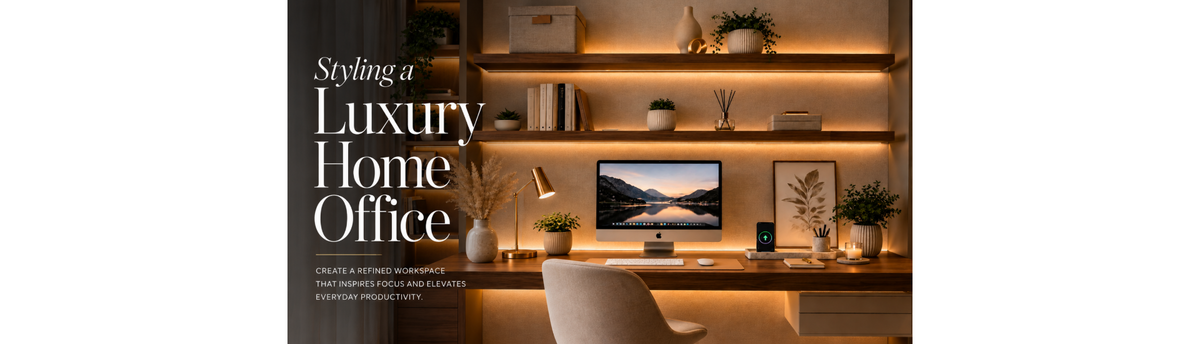

A luxury home office should feel designed for work without feeling as though every element was selected only for work. The desk, chair, storage and lighting establish the functional foundation, but sculptures, books, vases, clocks, trays, art objects and personal pieces can give the workspace its character. When these elements are selected with attention to scale, material, proportion and visual hierarchy, the office becomes a considered interior rather than simply a well-equipped workstation.
This approach is relevant not only to a dedicated home office, but also to private studies, libraries, executive cabins, directors' offices, boardrooms and other refined professional environments. The function may change, yet the styling challenge remains remarkably similar: create a workspace that feels personal and visually engaging while keeping the things needed for work accessible and the composition free from unnecessary clutter.
The most successful luxury office interiors usually combine useful objects with decorative ones rather than separating the two. A leather tray can organise everyday desk essentials. A sculptural clock can bring function to an otherwise quiet wall. Books can introduce knowledge, colour and visual depth. A sculpture can establish a focal point, while a vase can soften a strong architectural line. Personal objects can then give the space the sense that someone actually works, thinks and spends time there.
In this context, luxury office decor accessories are not limited to traditional desk accessories. The category can extend across the complete workspace environment, from desk organisers and clocks to sculptures, art objects, books, vases, trays, decorative lighting and carefully selected personal pieces.
For the broader principles behind choosing luxury home decor accessories, begin with Spacio's complete guide to luxury home decor accessories for modern Indian homes. This article takes those principles into the workspace, showing how premium, high-end and statement home decor accessories can be selected and arranged around the desk, shelves, walls and other parts of a refined office environment.
Table of Contents
- Why a Luxury Home Office Needs More Than a Desk
- Read the Workspace Before Styling It
- Start with Function, Then Build the Composition
- Build a Considered Desk Composition
- Use Sculptures to Give the Office a Point of View
- Bring Books into the Workspace
- Use Vases to Introduce Height and Softness
- Use Clocks as Functional Art
- Use Trays to Organise and Frame the Workspace
- Add Personal Objects Without Losing Refinement
- Style Office Shelves and Libraries with Purpose
- Use Wall Art and Sculptural Pieces to Create Visual Anchors
- Consider Lighting as Part of the Styling
- When a Fireplace Belongs in a Larger Study or Library
- Create Depth Through Materials and Texture
- Styling Home Offices, Studies and Executive Workspaces
- Layer Decorative Objects Without Creating Clutter
- Get Scale, Proportion and Negative Space Right
- Current Styling Directions for Luxury Home Offices
- Common Luxury Home Office Styling Mistakes
- A Stylist's Perspective
- Where to Experience Luxury Office Decor in India
- Frequently Asked Questions
- Final Thoughts
Why a Luxury Home Office Needs More Than a Desk
A desk is the functional centre of a home office, but it should not necessarily become the only visual centre. In a refined workspace, the desk, chair, storage, walls, shelves, lighting and decorative accessories all contribute to the character of the room. If the desk is surrounded only by functional equipment, the space can feel utilitarian even when the furniture itself is exceptional. The right decorative pieces introduce another layer of personality without compromising the purpose of the room.
This distinction is important because a workspace is experienced differently from a living room. It has to support concentration, meetings, reading, writing and often video calls, yet it is also part of the wider interior. In a home office, the room may need to transition between focused work and private use. In an executive office, it may need to communicate authority and hospitality. In a library or study, books and objects may already carry much of the visual identity. Styling therefore begins by understanding what the room already contributes.
The difference between premium home decor accessories, high-end home decor accessories and ordinary decorative pieces is not simply price. In a workspace, quality becomes meaningful when an object has a clear purpose within the composition. A sculptural piece should have enough room to be appreciated. A clock should be visible rather than hidden behind other objects. A vase should relate to the desk or shelving around it. A tray should make the workspace more organised rather than simply occupy another part of the surface.
Spacio's Office Accessories collection provides the broader foundation for this approach, bringing together products designed to combine function, personality and visual character within a workspace. Within that wider category, Office Desk Accessories can help organise and refine the working surface, while Office Decor Accessories can add the decorative layer across desks, credenzas, shelves and other surfaces.
The office environment can also be developed through more specific visual elements. Business & Motivational Sculptures can introduce a sculptural or inspirational focal point, while Office Wall Arts can give the walls a stronger visual identity. The important distinction is that these categories should be selected according to what the workspace needs rather than treated as a checklist of products.
Read the Workspace Before Styling It
Before choosing any decorative object, look at the workspace as a whole. Consider the size of the room, the position of the desk, the direction of natural light, the storage requirements, the wall surfaces and the sightlines from the doorway or adjoining rooms. A large home office with built-in cabinetry can accommodate a different level of visual weight from a compact study carved out of a bedroom or living area.
The desk itself is also an important clue. A substantial timber desk may already provide warmth and material presence, while a polished stone or glass desk may require accessories with more tactile qualities. A dark executive desk may benefit from glass, crystal or lighter-toned objects that introduce contrast. Conversely, a pale and minimal workspace may need a sculptural object or darker material to establish visual depth.
Look above and beside the desk as well. Is there artwork? Open shelving? A bookcase? A window? Architectural panelling? A niche? Does the room already contain a strong chandelier or another decorative lighting element? These features determine whether the workspace needs a statement object or a quieter supporting layer.
For the working surface itself, Spacio's Office Desk Accessories provide a more focused starting point. These pieces can help organise everyday essentials while allowing the desk to retain a considered visual character. The objective is to make practical objects feel integrated into the workspace rather than allowing them to become visual clutter.
This principle connects with the broader Cycle 1 approach to curation. Spacio's guide to styling luxury home decor without making an interior look overdecorated explores why hierarchy and negative space are often more important than the number of objects in a room. A home office benefits from the same discipline, particularly because visual clutter can interfere with the sense of order the workspace needs.
Identify the Natural Focal Point
Ask what the eye notices first when entering the office. It may be the desk, a large artwork, a bookcase, a window, a sculptural object or an architectural feature. Once that hierarchy is understood, supporting accessories become much easier to select. If the desk is already visually dominant, the shelves or walls can remain quieter. If the desk is restrained, a substantial sculpture or artwork can give the room a stronger point of view.
This is also where the idea of statement home decor accessories needs to be used carefully. A statement object should have enough visual space around it to be noticed. Putting a large sculpture beside an equally dominant clock, vase, artwork and collection of smaller objects does not necessarily create a richer office. It may simply create competition.
Before adding anything to a home office, identify what the room is already doing well. The next accessory should solve a visual or functional need—height, texture, organisation, contrast, personality or atmosphere—not simply occupy an empty surface.
Start with Function, Then Build the Composition
A beautifully styled home office still has to function as a workspace. Pens, notebooks, documents, devices, chargers and other daily essentials need practical places to live. The solution is not to hide everything away or to allow the desk to become storage. Instead, use well-designed functional accessories as part of the composition and reserve the strongest decorative pieces for areas where they can remain visible without interfering with work.
This is where office accessories can become part of the design language. A refined tray can gather frequently used items. A desk organiser can bring order without looking purely utilitarian. A sculptural paperweight or distinctive desk object can introduce personality at a small scale. A clock can provide useful information while functioning as a visual accent. When the functional layer is thoughtfully selected, it becomes much easier to add decorative objects without making the desk feel overloaded.
The same principle applies to professional environments. An executive office, private cabin or boardroom often needs a more formal visual language, but function should still remain visible. The objective is not to disguise the fact that people work there. It is to make the practical elements feel considered enough to belong within the overall interior.
Spacio's luxury office accessories collection is particularly relevant here because it includes both functional desk elements and decorative categories designed for professional as well as home workspaces. This makes it possible to build the office around a consistent design language rather than combining unrelated functional products with decorative objects.
Build a Considered Desk Composition
The desk is usually the most important styling surface in a home office, but it is also the one most easily overloaded. Start by identifying what genuinely needs to remain on the desk. Then create a deliberate composition around those functional essentials rather than spreading objects evenly across the entire surface.
A useful arrangement often contains different visual levels. A low tray or organiser can establish the base. A small sculptural object or desk accessory can provide a middle layer, while a clock, lamp or carefully chosen vertical piece can introduce height. The exact combination depends on the desk, but the principle is consistent: variation creates rhythm while negative space keeps the composition legible.
The desk should also remain visually connected to the room around it. If the office contains a substantial bookcase, for example, the desk does not need to carry another large collection of decorative objects. If the walls are quiet and the desk is relatively minimal, one exceptional sculpture or art object can give the workspace more personality.
Think about what the desk looks like from the chair as well as from the entrance. A composition that looks attractive from the doorway may become distracting when viewed continuously during work. The best desk styling is therefore visually interesting without demanding attention every minute.
For a workspace where sculpture needs to communicate achievement, ambition or professional identity, Spacio's Business & Motivational Sculptures offer a particularly relevant direction. These pieces can work on a credenza, bookshelf, side table or other display surface where the sculpture can be appreciated without interfering with the working area.
Keep the Working Zone Clear
A common mistake is treating the entire desk as a display surface. The primary working zone should remain clear enough for writing, reading, a laptop or documents. Decorative objects can be concentrated towards the edges or placed on an adjacent credenza, side table or shelf where they can be appreciated without interfering with the work itself.
This creates a useful distinction between the working composition and the decorative composition. They can belong to the same visual language without occupying the same physical space.
Use Sculptures to Give the Office a Point of View
Sculptures can give a home office a stronger sense of identity because they introduce form and dimension in a way that purely functional office accessories cannot. A well-chosen sculpture can sit on a credenza, bookshelf, console, pedestal or open shelf and become a visual anchor without making the workspace feel overly decorated.
The scale should respond to the furniture and architecture around it. A substantial executive desk or long credenza can support a larger sculptural piece, while a compact study may need a smaller object with a stronger silhouette. The objective is not to choose the largest sculpture available, but to select one with enough visual weight to belong to the environment.
Material can change the character of the workspace considerably. Metal can introduce architectural definition, glass and crystal can bring light and transparency, wood can add warmth, while porcelain and ceramic can create a more tactile presence. Mixed-media pieces can be useful when the office already contains several different materials and needs an object that visually connects them.
Spacio's Sculptures & Art Objects collection brings together sculptural pieces that can be considered for desks, consoles, shelves, libraries, studies and other interior environments. For a deeper look at selecting sculptures by material and visual character, see Spacio's guide to luxury sculptures in Murano glass, glass, crystal, porcelain and ceramic.
Let the Sculpture Have Enough Space
A sculpture becomes less effective when it is surrounded by several other objects with equal visual importance. Give the silhouette room to be understood. This is particularly important with abstract or highly dimensional pieces, where the negative space around the object is part of how its form is perceived.
If the sculpture is placed on a credenza behind the desk, for example, it may be enough to pair it with one low object or a small group of books. If it sits on open shelving, the surrounding books can provide structure while the sculpture interrupts the repetition. In either case, the object should remain recognisable as a focal element rather than disappearing into the display.
This principle also connects with the broader Cycle 1 approach to styling sculptures and art objects. The aim is not simply to own exceptional pieces, but to understand how scale, material, placement and negative space allow them to contribute to the interior.
Bring Books into the Workspace
Books can make a home office feel more personal while also providing one of the most useful visual layers in the room. Art books, architecture books, photography books, design books, business titles and other subjects connected with the person using the workspace can introduce colour, texture and personality without requiring additional decorative objects.
A few books can sit on the desk, while larger collections can occupy shelving or a nearby bookcase. Horizontal stacks can create platforms for smaller objects, while vertical groups provide a strong architectural rhythm. The objective is not to arrange every book identically but to create variation while retaining a sense of order.
For a home office, books can also communicate something about the person who works there. A carefully chosen architecture book, art monograph or design volume may become part of the visual identity of the room in a way that a generic decorative accessory cannot.
Spacio's Coffee Table Books collection provides another layer for styling studies, libraries, desks, consoles and shelves. These books can work particularly well when paired with sculptural accessories because the rectangular forms of the books provide a visual counterpoint to more organic or abstract objects.
The relationship between books and decorative objects is explored further in Spacio's guide to styling bookshelves with luxury artefacts, sculptures and decor accessories. Although that article focuses on shelving, its principles of rhythm, variation, scale and negative space are equally useful when building a home office library or study.
Use Books as Visual Platforms
A small sculpture, decorative object or desk accessory can gain greater presence when placed on a horizontal stack of books. The books create a visual base while the object introduces height. This simple relationship can be particularly effective on a credenza or open shelf where several different visual levels are needed.
Keep the number of books proportionate to the surface. A home office does not need to turn every available surface into a library. A few meaningful books can often communicate more than a collection arranged purely for display.
Use Vases to Introduce Height and Softness
Vases can bring a different quality to an office because their forms often contrast with the straight lines of desks, shelving and cabinetry. A tall vase can introduce verticality beside a low credenza, while a rounded or organic form can soften an interior dominated by rectilinear furniture.
A vase does not necessarily need flowers or foliage. In a refined office, the vessel itself may provide enough visual interest through its silhouette, colour, glaze, texture or material. This can be especially useful when the room needs a decorative element but should retain a professional character.
Consider the relationship between the vase and the furniture beneath it. A substantial credenza can support a larger sculptural vase, while a compact desk or side table may need a smaller form. Height should also be considered in relation to sightlines. An object that obstructs the view across a desk or blocks an artwork behind it may be visually impressive but poorly placed.
Spacio's Vases collection provides different forms and materials that can be used to introduce height, softness and material contrast into a workspace.
For a broader understanding of how vases can work alongside sculptures, books and other accessories, the earlier Cycle 1 guide to mixing vases, sculptures, books and decorative objects in luxury interiors provides a useful wider framework.
Use Clocks as Functional Art
Clocks have an especially natural place in a workspace because they combine function with visual presence. Unlike a purely decorative object, a well-designed clock has a practical reason to remain visible, yet its form, material and scale can make it an important part of the interior.
A wall clock can become a focal point above a console or credenza, while a desk clock can provide a smaller architectural accent on the working surface. The choice should depend on the scale of the room and the amount of visual information already present.
A large designer clock can reinforce the geometry of a contemporary office, while a more sculptural or unusual form can soften a formal executive environment. The important consideration is that the clock should be treated as part of the composition rather than simply as a device that happens to be on the wall.
For office environments specifically, Spacio's Office Clocks collection provides another way to combine function with visual character. A well-positioned office clock can become a focal point on a wall, credenza or desk while remaining genuinely useful within the workspace.
Spacio's Timepieces & Clocks collection includes clocks that can contribute both function and visual character to offices, studies, libraries and other refined interiors.
Position a Clock According to the Whole Wall
Before placing a clock, look at the wall as a complete composition. If artwork already occupies the main focal position, the clock may work better on an adjacent wall or as part of a secondary arrangement. If the wall is relatively quiet, a substantial clock can provide the visual anchor.
This is particularly useful in a home office because the clock can introduce a strong circular or geometric form without requiring another purely decorative object. It can also connect visually with other circular forms in the room, such as lighting, furniture details or sculptural objects.
Use Trays to Organise and Frame the Workspace
A decorative tray can be one of the most useful accessories in a home office because it creates order without making the workspace feel excessively formal. Pens, notebooks, small devices, a clock, books or a decorative object can be grouped within a defined area rather than scattered across the desk or credenza.
The tray itself should contribute to the composition. Material, finish and proportion should relate to the desk and surrounding furniture. A metal tray can reinforce hardware or lighting details, while wood, stone or another tactile material can soften a more technical workspace.
Scale is particularly important on a desk. A tray should organise the working surface without taking over the area needed for actual work. On a larger credenza or sideboard, a more substantial tray can create a stronger visual anchor and hold several related objects.
Spacio's Decorative Trays collection offers pieces that can function as both organisational tools and styling elements. For the deeper principles of material, craftsmanship, scale, proportion and placement, see How to Choose Decorative Trays for Luxury Home Interiors.
Use a Tray to Create a Controlled Desk Composition
One advantage of a tray is that it creates a visual boundary. Instead of several small objects appearing independently across the desk, they become one considered group. This can be particularly useful when the office needs to look presentable during meetings or video calls while still retaining the practical objects required during the working day.
Do not fill the tray simply because there is space available. Leave part of its surface visible. The tray should provide structure and organisation, not become another crowded display.
Add Personal Objects Without Losing Refinement
A home office should ultimately feel like someone's workspace. Personal objects can make the room more convincing because they introduce meaning that purely decorative products cannot replicate. A collected object from a journey, a framed photograph, a meaningful book, an inherited piece or an object connected with a personal interest can make the office feel individual.
The challenge is to edit personal objects with the same care given to decorative accessories. Not every meaningful object needs to be displayed at once. A small number of pieces, positioned where they can be appreciated, can create a stronger sense of personality than a desk crowded with souvenirs and photographs.
Personal objects can also be balanced against more formal pieces. A sculptural accessory can sit beside a meaningful book. A personal photograph can be placed near a refined clock. A collectible can occupy one section of a bookshelf while the surrounding shelves remain quieter.
This is where the idea of curation becomes particularly important. Luxury does not require an impersonal office. It requires a sense that the objects have been chosen deliberately and that the room reflects the person who uses it.
For the decorative layer specifically, Spacio's Office Decor Accessories provide a focused starting point for styling desks, credenzas, shelves and other surfaces. The broader Decor Accessories collection can then be explored when the office composition calls for additional forms, materials or decorative categories.
For a more specifically professional treatment, Spacio's Office Wall Arts collection can be considered for executive offices, studies, libraries, reception areas and other workspaces where the walls need a stronger visual identity. The artwork should still be selected according to scale, sightline and the architecture around it rather than simply because the wall is empty.
Style Office Shelves and Libraries with Purpose
Open shelving and built-in libraries can become some of the most expressive parts of a home office, particularly when the room has enough wall space to accommodate a substantial bookcase. But shelves should not be treated simply as storage that happens to be visible. They are part of the architecture and need to be styled as a complete elevation.
Begin with the books and the structure of the shelving. Then introduce larger sculptures, vases, clocks and art objects at selected points. Smaller objects can provide detail, while deliberately quieter sections create negative space and allow the larger pieces to remain visible.
Different shelf compartments do not need identical compositions. One can contain a group of books and a sculpture, another a horizontal stack and a vase, while another remains almost empty. What creates cohesion is the relationship between the objects, materials, scale and overall visual rhythm.
This approach is particularly effective in a home library or study where the books already provide substantial visual structure. Decorative accessories should break that rhythm selectively rather than compete with it.
For a detailed treatment of this environment, see Spacio's guide to styling bookshelves with luxury artefacts, sculptures and decor accessories.
When Shelving Surrounds a Fireplace
In a larger study or library, shelving may be positioned around a fireplace. When this happens, the fireplace becomes an important architectural focal point and the shelving should respond to it rather than compete with it. Objects placed closest to the fireplace may need to be quieter, while stronger sculptural pieces can be positioned where they reinforce the overall balance of the wall.
The fireplace does not need to become the subject of the office. It is simply another architectural element that can influence the styling hierarchy when it genuinely exists within the space.
Use Wall Art and Sculptural Pieces to Create Visual Anchors
The walls of a home office provide an opportunity to introduce larger-scale art and decorative elements that would not be practical on the desk. A substantial artwork can establish the visual identity of the room, while a sculptural wall piece, mirror or designer clock can provide a different type of focal point.
Consider the wall in relation to the desk and chair. Artwork positioned behind the desk may become part of the background during meetings or video calls, while a side wall may provide a quieter opportunity for a more personal collection. The viewing distance and sightlines should determine the scale.
A wall should not necessarily contain several major statements. If the office already has a substantial bookcase or sculptural piece, a quieter artwork may provide better balance. Conversely, a restrained office can benefit from one strong piece that gives the room a clear visual identity.
Spacio's guide to styling walls with art, sculptures and luxury home decor accessories explores the relationship between artwork, sculptures, mirrors, decorative objects, feature walls, scale, lighting and negative space in greater detail.
Consider Lighting as Part of the Styling
Lighting can change the way every other element in a home office is perceived. A sculpture that appears quiet in daylight may become much more expressive under directional illumination, while glass, crystal and polished metal can catch and reflect light in ways that add movement to an otherwise restrained room. Lighting should therefore be considered alongside the decorative accessories rather than added only after the styling is complete.
Natural light is the first consideration. Observe how sunlight moves across the desk, shelves and walls during the day. A home office with strong daylight may need fewer decorative elements because the changing light already creates visual interest, while a darker study may benefit from reflective materials, carefully positioned lighting and stronger sculptural forms.
Task lighting should remain focused on the work surface, but the rest of the room can benefit from a layered approach. A decorative table lamp can create a softer pool of light on a credenza or side table. A floor lamp can establish a reading area. Accent lighting can draw attention to artwork, shelves or a sculpture without illuminating every object with equal intensity.
This is where decorative lighting becomes part of the interior language. Spacio's Decorative Lighting collection can be considered alongside sculptures, books, clocks and other accessories when the objective is to create a workspace with layers of light rather than a single overhead source.
Where the workspace requires a more decorative lighting layer, Spacio's Office Decorative Lights can complement the functional lighting already required for work. A decorative light can contribute to the atmosphere of a study, executive office or library while helping to establish another visual layer within the room.
Think About Video Calls and Multiple Viewpoints
A contemporary home office often needs to work on camera as well as in person. The wall behind the desk may appear in video calls, while the desk itself may be viewed continuously by the person working there. Artwork, books, a sculpture or a clock can create a sophisticated background, but highly reflective surfaces should be positioned carefully to avoid glare.
The same consideration applies to mirrors and glass objects. Their ability to reflect light can be an advantage, but only when the reflection contributes to the composition. Before finalising the placement, look at the room from the desk, doorway and principal seating position and consider how the lighting changes from morning to evening.
Style the office for the full day, not only for the moment when you arrange it. Check the composition in natural daylight, under evening illumination and from the working position. Reflective and sculptural pieces can look very different as the light changes.
When a Fireplace Belongs in a Larger Study or Library
A fireplace is not essential to a home office, and it should never be introduced simply to make the room appear more luxurious. But when a larger study, library or executive workspace already includes a fireplace, it can become an important architectural element within the styling composition.
The fireplace should generally be treated as a focal point before decorative accessories are added around it. Its surround, mantel, material and proportions already create considerable visual weight. A large artwork above it can reinforce the vertical axis, while a mirror can introduce reflection and visual lightness. A single sculptural object on the mantel may be enough when the fireplace itself is already expressive.
In a library with shelving on either side, the fireplace can also establish the centre of the elevation while books and decorative objects create supporting rhythm around it. The shelves should not become a collection of competing focal points. Stronger sculptures or art objects can be positioned selectively, with quieter sections providing the negative space needed to keep the whole wall legible.
For interiors where a fireplace genuinely forms part of the design brief, Spacio's Fireplace collection provides options that can be considered in relation to the architecture, furniture and surrounding decorative elements. The fireplace should ultimately support the character of the study or library rather than turn the workspace into a living-room-style display.
Create Depth Through Materials and Texture
Material is one of the easiest ways to make a home office feel layered without adding unnecessary objects. A workspace may already contain timber, leather, stone, glass, metal or fabric through its furniture and architecture. Decorative accessories can reinforce these materials, introduce contrast or provide a bridge between elements that might otherwise feel disconnected.
A metal sculpture can echo hardware, lighting or desk details. A glass object can introduce transparency against dark cabinetry. A wooden accessory can soften a workspace dominated by stone and metal, while ceramic or porcelain can bring a quieter tactile quality. The objective is not to match every finish exactly but to create relationships between them.
Texture becomes particularly valuable when the colour palette is restrained. A smooth stone desk can be balanced by a tactile ceramic object. A glossy cabinet can benefit from a matte sculpture. A leather chair can sit comfortably within a composition that includes polished metal, glass and natural wood because the materials create controlled contrast rather than visual sameness.
This is also where the idea of a luxury object needs to go beyond appearance. Craftsmanship, material quality, finish, provenance and design all contribute to how a piece is experienced. Spacio's broader luxury home decor accessories guide provides the wider framework for understanding these relationships.
Layer Decorative Objects Without Creating Clutter
Once the functional elements, books, artwork, sculpture, lighting and major furniture have been considered, smaller decorative objects can provide the finishing layer. These might include bowls, boxes, paperweights, bookends, candle holders or other art objects that bring texture and detail to the office.
The most effective approach is to give each object a role. A decorative bowl can provide a low horizontal form. A box can conceal smaller items while contributing to the composition. A pair of bookends can give structure to a group of books. A candle holder can introduce height and a more intimate decorative element to a credenza or side surface.
Spacio's Decor Accessories collection brings together categories that can be used selectively across these layers. The important word is selectively. A home office does not need an example from every category. The strongest interiors usually identify what the room is missing and choose one or two pieces that solve that particular need.
Use Contrast Instead of Matching Everything
A refined office does not need every accessory to share the same finish, shape or colour. Repeating one material can create cohesion, but controlled contrast is what gives the composition depth. A dark sculpture beside pale books, a rounded vase against a rectilinear cabinet or a polished object on a matte surface can create visual tension without making the room feel inconsistent.
The same principle applies to decorative accessories from different collections. They do not have to look as though they were purchased as a set. They simply need to relate through scale, material, colour, shape or the visual language of the wider interior.
Get Scale, Proportion and Negative Space Right
Scale and proportion determine whether an accessory feels as though it belongs in the office. A small sculpture can disappear on a long executive credenza, while an oversized object can overwhelm a compact desk. The right size is therefore determined by the architecture, furniture and viewing distance rather than by the object itself.
Look at the relationship between the decorative piece and the surface supporting it. A vase should have enough footprint to feel stable visually. A sculpture should have enough surrounding space for its silhouette to remain clear. A clock should be large enough to read from the relevant distance. Books should be proportionate to the shelf or table rather than appearing like an afterthought.
Negative space is equally important. Empty areas around an object are not wasted space; they allow the object to be seen. This is especially important in offices because there are already many small functional elements competing for attention. Leaving some surfaces quiet gives the decorative pieces greater authority.
This is why a sophisticated workspace may contain fewer accessories than expected. The sense of luxury comes from the quality of the relationships between the objects rather than the number of objects displayed.
Do Not Forget the Arrival Area
The styling of an office does not begin only at the desk. In a private or executive workspace, the entrance and arrival area are part of the first impression. A well-designed coat hanger can provide a practical place for jackets and coats while contributing to the visual character of the space. Spacio's Office Coat Hangers offer a functional detail that can be considered as part of the wider office environment rather than treated as an afterthought.
Styling Home Offices, Studies and Executive Workspaces
The principles of luxury workspace styling can be adapted to different environments without making every office look identical. A private home office may prioritise personality and comfort, a library may revolve around books and architecture, while an executive office may require a stronger sense of authority and restraint. The underlying principles of scale, hierarchy, materiality and negative space remain consistent.
Luxury Home Offices
A home office can be more personal than a conventional professional workspace. Books can reflect interests, artwork can be chosen for emotional as well as aesthetic reasons, and collected objects can reveal something about the person who uses the room. This is an opportunity to create a workspace that feels connected to the rest of the home rather than isolated from it.
At the same time, a home office should not become another living-room display. The desk needs to remain usable, storage needs to be accessible and decorative pieces should be positioned where they support the room without interfering with concentration.
Private Studies and Home Libraries
Studies and libraries naturally allow a greater role for books, clocks, sculptures and art objects because the architecture often provides more shelving and display surfaces. Here, the styling should begin with the books and cabinetry before decorative pieces are introduced.
A sculpture can interrupt a long run of books. A vase can create height in an otherwise horizontal composition. A clock can provide a strong circular form. A few art objects can create points of interest across the shelves while quieter compartments preserve visual rhythm.
Spacio's Book Shelves & Niches collection can be considered when shelving itself forms part of the design environment. The decorative accessories should then be selected in response to the shelving's scale, material and configuration.
Use Globes and World Maps to Add Character
Studies, libraries and executive offices can also benefit from objects that suggest travel, knowledge and a wider view of the world. A globe can become a sculptural focal point on a desk, side table or bookshelf, while a world map can provide a larger-scale visual statement on an otherwise quiet wall. These elements can be especially effective in offices where the decorative language is intended to feel intellectual, collected and personal.
Spacio's Globes collection offers one route to this more distinctive layer, while World Maps can provide a stronger wall-scale element for studies, libraries and executive environments. As with any statement piece, scale and placement should respond to the surrounding furniture and architecture.
Executive Offices and Professional Workspaces
Executive offices often benefit from stronger materiality and more restrained styling. A substantial sculpture, an exceptional clock, a carefully curated collection of books or a single artwork can create authority without making the space feel overly decorated.
Reception areas, private cabins and boardrooms require similar discipline. Objects need to work from a greater viewing distance, and the composition may be experienced by people who are not familiar with the space. Strong silhouettes and clear focal points therefore tend to work better than numerous small accessories.
Commercial and Hospitality Workspaces
Luxury offices can also exist within hotels, members' clubs, hospitality environments, design studios and other commercial settings. Here, decorative pieces can help communicate the identity of the organisation while making the workspace feel more welcoming.
In these environments, practical considerations such as durability, maintenance, traffic and accessibility become more important. The styling should therefore be visually distinctive but appropriate to the way the space is used. A sculptural piece on a secure credenza may work beautifully, while delicate objects placed directly within a busy circulation path may not.
Current Styling Directions for Luxury Home Offices
Current luxury workspace styling is moving away from the idea that a sophisticated office has to look formal or corporate. More considered workspaces are combining rich materials, personal collections, sculptural objects and softer lighting with the practical requirements of modern work. The result is an environment that can feel professional while still having the character of an interior designed for living.
One direction is the use of fewer but more distinctive decorative pieces. Rather than filling shelves and desks, a strong sculpture, exceptional clock or carefully selected art object can provide a clearer focal point. Another is the use of tactile materials—wood, stone, ceramic, glass, metal and leather—to create depth without relying on strong colour.
Books are also becoming more important as personal and visual elements. Instead of treating them as background styling, a curated library can communicate interests, expertise and personality. This is particularly relevant in studies and executive offices where books can contribute to the character of the room without compromising professionalism.
Finally, flexible lighting and layered decorative elements are becoming increasingly important as workspaces serve more than one purpose. A room that functions as a daytime office can transition into a reading room, study or private lounge in the evening through changes in lighting and the way its surfaces are used.
Common Luxury Home Office Styling Mistakes
One of the most common mistakes is treating the desk as the entire office. The desk is important, but the walls, shelves, lighting, seating, storage and surrounding furniture all contribute to the experience. When only the desktop is styled, the room can feel unfinished.
Another mistake is placing too many decorative objects within the working zone. A desk needs enough clear space for actual work. If sculptures, books, trays, clocks and small accessories occupy every available area, the styling begins to interfere with the function of the room.
Choosing accessories without considering scale is another frequent error. A small sculpture can disappear against a large bookcase, while an oversized object can dominate a compact study. Always judge the object against the architecture and furniture around it.
Ignoring the background is also problematic. A beautiful sculpture can lose its impact against a visually busy shelf, while a strong artwork may compete with an equally dominant bookcase. Look at the silhouette and negative space around each important object before finalising its position.
Finally, avoid making every object look coordinated. Matching finishes too literally can make a workspace feel staged. A more sophisticated approach is to repeat selected materials or forms while allowing enough variation for the room to feel collected and personal.
A Stylist's Perspective
When styling a workspace, I think about what the room needs to support first and what it needs to communicate second. The desk and chair have to work, but the room should also tell you something about the person using it. That is where books, sculptures, clocks, artwork and personal objects become important.
For me, a luxury home office should never feel like a showroom of expensive objects. I look for a balance between function and personality. A great sculpture, a well-chosen clock, a stack of books or a meaningful personal object can completely change the character of a workspace when it is given the right scale and enough space around it.
— Navin Kanodia, Interior Stylist & Curator, Spacio
The best offices are therefore not necessarily the ones with the most accessories. They are the ones where every visible piece contributes to the environment. Functional objects are useful, decorative objects create character, and the space between them allows the composition to breathe.
Where to Experience Luxury Office Decor in India
If you are selecting luxury office decor accessories for a home office, private study, library, executive office or professional workspace, seeing the products in person can be especially valuable. Scale, material, finish, proportion and visual impact are much easier to assess when sculptures, books, vases, clocks, trays, decorative objects and lighting can be viewed as part of a complete interior composition. Spacio's Mumbai and Kolkata showrooms bring together office accessories, sculptures, decor accessories, lighting, books, clocks and other collections for customers who want to see and experience these pieces before choosing them for a refined workspace.
Where can I buy and see luxury office decor accessories in Mumbai?
If you are looking to buy luxury office decor accessories in Mumbai and want to see the pieces in person before choosing them for a home office, study, executive cabin or professional workspace, visit the Spacio Mumbai store at 3BK, Laxmi Industrial Estate, New Link Road, Andheri (West), Mumbai 400 053. The showroom brings together office accessories, sculptures, decor accessories, decorative lighting, clocks and other pieces that can be considered in relation to the scale and materiality of a complete workspace. You can see the Spacio showroom location in Laxmi Industrial Estate, Mumbai on Google Maps before planning your visit.
Where can I see and experience luxury office decor in Kolkata?
If you want to see and experience luxury office decor in Kolkata before buying pieces for a home office, private study, library, executive office or commercial workspace, visit the Spacio Kolkata store at 86B, Topsia Road South, Kolkata 700 046. The showroom brings together office accessories, sculptures, decor accessories, lighting, books, clocks and other pieces suited to refined residential and professional interiors, allowing you to consider their scale, proportion, material and finish in person. You can see the Spacio showroom location on Topsia Road South, Kolkata on Google Maps before visiting.
Frequently Asked Questions
How do I style a luxury home office?
Begin with the desk, chair, storage and lighting, then build the decorative layer around them. Use sculptures, books, vases, clocks, trays, artwork and personal objects selectively, paying attention to scale, proportion, material and negative space. Keep the main working zone functional while using surrounding surfaces, shelves and walls for stronger decorative statements.
What are the best accessories for a luxury home office?
Sculptures, art objects, coffee table books, vases, clocks, decorative trays, bowls, desk accessories, decorative boxes and carefully selected personal objects can all work well. The best combination depends on the architecture, furniture and function of the workspace rather than on using a fixed list of accessories.
How can I make my home office look luxurious without making it cluttered?
Choose fewer, more distinctive pieces and give them sufficient negative space. Keep functional essentials organised through trays and desk accessories, move larger decorative pieces to shelves or credenzas where appropriate, and establish one or two clear focal points rather than decorating every available surface.
How should I style bookshelves in a home office?
Start with the books, then introduce sculptures, vases, clocks and art objects selectively. Vary horizontal and vertical arrangements, change the scale of objects across the shelves and leave some compartments relatively quiet. This creates rhythm while preventing the shelving from becoming visually overcrowded.
Should I put a sculpture on my office desk?
Yes, provided it does not interfere with the working area. A small or medium sculpture can give a desk personality, while a larger sculptural piece may be more effective on a credenza, shelf or side table. Consider the silhouette, viewing angle and amount of negative space around it before deciding where it belongs.
How can I use books as decor in a home office?
Use books that have genuine relevance to your interests, work or design preferences. Vertical groups can create structure, while horizontal stacks can act as platforms for sculptures or smaller decorative objects. Books can also add colour, texture and personality to shelves, desks and credenzas without requiring additional decorative pieces.
Are clocks useful as decorative accessories in an office?
Yes. A well-designed clock can combine practical function with visual impact. A substantial wall clock can establish a focal point, while a desk clock can provide a smaller decorative accent. Choose its scale and position according to the room's architecture and existing visual hierarchy.
Can luxury office styling work in an executive or commercial workspace?
Absolutely. The same principles of scale, proportion, material, hierarchy and restraint apply to executive offices, private cabins, boardrooms, hospitality workspaces and other commercial environments. The selection should simply respond to the purpose, traffic, viewing distance and professional character of the space.
Does a home office need a fireplace?
No. A fireplace is not necessary for a sophisticated workspace. Where a larger study, library or executive room already includes one, it can become an architectural focal point that the artwork, shelving and decorative accessories respond to. It should be treated as part of the architecture rather than added solely as a decorative statement.
Where can I buy luxury office decor accessories in India?
Spacio offers luxury office accessories, sculptures, books, clocks, vases, trays and other decor collections for home offices as well as professional interiors. For an in-person experience, Spacio has showrooms in Mumbai at Laxmi Industrial Estate, Andheri West, and in Kolkata at Topsia Road South.
Final Thoughts
A luxury home office is not created simply by placing expensive objects around a desk. It is created by understanding how the workspace functions and then building a decorative layer that makes that function feel considered. The desk provides the working foundation, while sculptures, books, vases, clocks, trays, artwork and personal objects give the room its identity.
The strongest compositions balance function with visual interest. A tray can organise everyday essentials. A clock can become functional art. Books can bring knowledge, colour and personality. A sculpture can establish a focal point, while a vase can introduce height and soften the geometry of the furniture. Personal objects can make the room feel individual without turning it into a collection of unrelated displays.
The same principles extend beyond the home. Private studies, libraries, executive offices, boardrooms and hospitality workspaces can all benefit from carefully selected luxury decor accessories when the pieces are scaled appropriately and given enough room to be appreciated.
For the wider framework, return to Spacio's complete guide to luxury home decor accessories. From there, the individual decisions around sculptures, books, vases, clocks, trays, decorative objects, artwork and lighting can be understood as part of a broader approach to luxury interior styling.
The result should not feel overdecorated or overly formal. It should feel purposeful, personal and refined—a workspace in which the objects around you contribute to the atmosphere without getting in the way of the work itself.
Discover curated office accessories, desk accessories, sculptures, wall art, clocks, decorative lighting and other objects for refined home offices, studies and professional interiors.
Explore Office Accessories


