
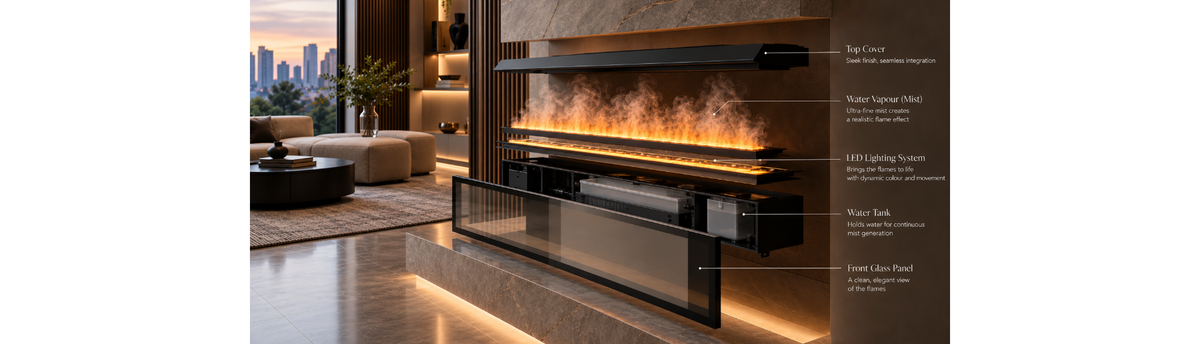

A modern fire feature can look deceptively simple. You see movement, light, colour and depth that resemble a natural flame, but behind that visual experience may be a carefully engineered combination of mist, LEDs, optics, digital imagery, heating elements, burners, sensors and control systems.
This is why two fireplaces can create very different experiences even when they occupy a similar position within an interior. One may create a cool, atmospheric flame effect through water vapour. Another may use LED illumination to recreate the appearance of burning logs. A digital or holographic system may create fire as an optical image, while a bioethanol, gas or wood-burning fireplace produces an actual flame through combustion.
Understanding what happens behind the visible flame helps homeowners, architects and interior designers make better decisions. The question is not simply whether a fireplace looks attractive. It is how that appearance is produced, whether heat is required, how the system is controlled, what installation involves and how the technology will behave within the architecture around it.
Contents
- How Modern Fire Features Work
- Water Vapour: Creating Flame from Mist and Light
- LED and Electric Fireplaces: Creating Flame Through Light
- Digital and Holographic Fire: Fire as an Optical Experience
- How Electric Heating Changes the Experience
- Automatic Burners and Real-Flame Technology
- Controls, Sensors and Safety Systems
- How the Technologies Compare
- Why Technology Matters on a TV Feature Wall
- Installation and Maintenance
- Fireplace Technology and Vastu
- An Expert View from Navin Kanodia
- Fireplace Technology Across Indian Cities
- How to Choose the Right Technology
- Frequently Asked Questions
- The Final Test: Choose the Experience, Not Just the Technology
How Modern Fire Features Work
Traditional fire is straightforward: fuel burns, producing heat, light and a moving flame. Modern fire features can separate those experiences. A fireplace may reproduce the visual qualities of fire without combustion, add heat independently, or use a real flame while automating parts of the burning process.
This separation is particularly important in Indian interiors. A homeowner may want the visual character of fire throughout the year but have little need for additional heat. An architect may want a long linear fire feature below a television without introducing unnecessary heat into the media wall. A hospitality project may require a genuine flame because the sensory experience is part of the design concept.
The technology therefore determines more than the flame. It influences installation, maintenance, temperature, controls, safety requirements, flexibility and the way the fire interacts with the rest of the room. For a broader comparison of these approaches, read Water, Light or Flame? The New Technologies Changing Interior Fire Design.
What makes a flame effect convincing is therefore not only the appearance of the flame itself, but the technology used to create movement, depth, illumination and interaction with the surrounding space. Different systems achieve that visual experience in different ways.
Water Vapour: Creating Flame from Mist and Light
Water-vapour fireplaces create their flame effect without combustion. A fine mist of water is generated and illuminated so that the vapour takes on the visual character of rising flame.
The important distinction is that the visible flame is an optical effect rather than a burning fuel. There is no combustion taking place inside the flame effect, which means the system can provide the atmosphere and movement associated with fire without producing the heat of a conventional real flame.
This technology is particularly interesting where the visual experience matters more than heating. It can work in warm Indian homes, bedrooms, living rooms, hospitality interiors and entertainment spaces where maintaining a comfortable room temperature is important.
Water-vapour technology also offers an interesting advantage for a fireplace integrated into a TV feature wall. Because the flame effect itself is not generated by combustion, the design conversation can focus more closely on proportions, viewing distance, media-wall construction and the relationship between the fireplace and television.
However, water-vapour technology is not maintenance-free. The water system, reservoir and internal components still need appropriate care. Water quality can also matter, particularly where mineral deposits may affect long-term operation.
Explore indoor artificial water-vapour fireplaces to understand how this technology is applied to contemporary interiors.
LED and Electric Fireplaces: Creating Flame Through Light
LED and electric fireplaces take a different approach. Instead of generating a flame-like appearance through mist, they use illumination and carefully designed visual effects to recreate the appearance of fire.
LED illumination can be combined with reflective surfaces, artificial logs, ember beds and other visual elements to create depth. The result can range from a simple glowing effect to a highly detailed representation of burning fire.
Electric fireplaces can also separate the visual flame from the heating function. This distinction is important. A model may provide flame ambience without heat, while another may incorporate an electric heating element that can be activated when warmth is wanted.
That makes electric technology particularly versatile for spaces where the fireplace has to perform different roles at different times of year. A homeowner may want warmth during a cool evening but only the visual effect of fire during warmer months.
LED systems can also be useful where a fireplace is placed below a TV or integrated into a media wall. The designer can consider the flame brightness, screen position, cabinetry and surrounding lighting as one composition rather than treating the fireplace as an isolated appliance.
Explore indoor artificial LED fireplaces for examples of how light-based fire technology is used in contemporary interiors.
Digital and Holographic Fire: Fire as an Optical Experience
Digital and holographic fireplaces move the idea of artificial fire further by treating flame as an optical image. Instead of relying primarily on mist or conventional LED flame effects, these systems use digital visual techniques to create the appearance of fire.
This changes the design possibilities because the technology is concerned with how the eye perceives flame rather than with reproducing combustion itself.
Holographic fire can be especially compelling in contemporary interiors where the fireplace needs to sit comfortably alongside large-format screens, minimalist architecture and integrated technology. The fire becomes part of the room's visual media rather than simply a traditional hearth translated into a modern product.
For a fireplace around a TV, this distinction can be significant. The designer is effectively balancing two visual technologies: the screen and the fire. The fireplace should create enough presence to anchor the wall without turning the entire composition into competing sources of imagery.
Explore holographic fireplaces to see how digital fire is being introduced into contemporary interior design.
How Electric Heating Changes the Experience
Electric fireplaces deserve a separate discussion because heating and flame effects do not necessarily have to perform the same job.
A non-heating electric fireplace can be selected purely for atmosphere. A heating model adds an electric heating element so the fireplace can contribute warmth when required. This distinction allows the visual flame to remain part of the interior even when the heating function is switched off.
For Indian homes, this flexibility can be useful because heating requirements vary considerably between cities and seasons. The same fireplace may be expected to function as a source of warmth in winter and as a decorative architectural feature during the rest of the year.
Heating also becomes important when a fireplace is installed near electronics. A fireplace below a TV requires the fireplace, television, cabinetry, wiring and ventilation considerations to be treated as one installation. Manufacturer requirements should always take precedence over generic spacing assumptions.
Automatic Burners and Real-Flame Technology
Not every technologically advanced fireplace is artificial. Real-flame fireplaces can also incorporate sophisticated engineering, particularly through automatic burners and electronic controls.
Bioethanol fireplaces burn fuel to produce an actual flame. Gas fireplaces use a controlled gas supply to generate real fire, while wood-burning fireplaces rely on the combustion of wood. Each creates a different sensory experience because the flame itself is physically present.
Automatic burners can introduce controlled ignition, flame adjustment, monitoring and shut-off functions depending on the system. Sensors and electronic controls can therefore become as important to the user experience as the burner itself.
The distinction between artificial and real flame should nevertheless remain clear. Automation does not turn a real-flame fireplace into an artificial one. It changes how the real flame is controlled and managed.
For projects where genuine fire is central to the design brief, real-flame technologies can provide qualities that artificial systems intentionally reproduce rather than physically generate: actual combustion, natural flame behaviour and heat.
Controls, Sensors and Safety Systems
The technology behind a fireplace is not limited to the mechanism that creates the visible flame. Modern systems may also include controls, sensors and safety functions that determine how the fireplace operates in everyday use.
Depending on the system, controls may include remote operation, flame adjustment, heat adjustment, timers or other operating functions. Automated real-flame systems can incorporate additional monitoring and shut-off functions appropriate to their design.
Safety technology should always be considered together with the underlying fireplace technology. A water-vapour fireplace has a fundamentally different risk profile from a real-flame burner. An electric fireplace with heating has different considerations from a non-heating model. Gas and wood-burning systems introduce their own installation and ventilation requirements.
This is why the technical documentation supplied with the specific model matters. Installation clearances, electrical requirements, fuel requirements, ventilation, surrounding materials and operating procedures should be confirmed for the actual fireplace being specified.
How the Technologies Compare
The easiest way to understand modern fire technology is to compare what each system is actually trying to create.
| Technology | How the fire effect is created | Heat | Combustion | Best suited to |
|---|---|---|---|---|
| Water vapour | Mist combined with illumination | Generally no heat from the flame effect | No | Ambience-led interiors, warm climates, TV walls |
| LED / electric | LED illumination and visual flame effects | Heating or non-heating depending on model | No | Living rooms, media walls, apartments and contemporary interiors |
| Digital / holographic | Digital or optical flame imagery | Depends on system | No | Technology-led interiors, media walls and contemporary architecture |
| Bioethanol | Real flame from bioethanol combustion | Yes | Yes | Interiors and applications where real flame is desired |
| Gas | Real flame from controlled gas combustion | Yes | Yes | Residential, outdoor and hospitality applications |
| Wood-burning | Real flame from burning wood | Yes | Yes | Architectural applications designed around traditional fire |
This table is a starting point rather than a substitute for technical specification. Different models within the same technology can behave differently, so the final decision should always be based on the actual product, room and installation.
Why Technology Matters on a TV Feature Wall
One of the most important applications for modern fireplaces is the relationship between fire and television. A fireplace below a TV, a linear fireplace integrated into a TV feature wall or a fireplace beside a screen is no longer unusual in contemporary Indian interiors.
But technology matters because the fireplace and screen occupy the same visual field.
A non-heating water-vapour or LED fireplace may be selected where ambience is the primary objective. An electric model with controlled heating may be more appropriate where seasonal warmth is also required. A digital or holographic system may suit an interior where the relationship between fire and screen is deliberately technology-led.
Viewing distance matters as well. A flame that looks convincing from across a large living room may be less convincing when examined from close range. The width of the fireplace, the scale of the television, the height of the installation and the amount of surrounding visual detail all influence the final effect.
The same principle applies to a fireplace in a media room or home theatre. The technology should complement the screen rather than create unnecessary glare, visual competition or heat where it is not required.
Installation and Maintenance
Technology determines the installation conversation.
Water-vapour systems require consideration of water supply or filling, electrical connection and access for maintenance. LED and electric systems require appropriate electrical provision and careful integration into cabinetry or walls. Digital and holographic systems require their optical and display components to be considered as part of the architectural installation.
Real-flame fireplaces introduce additional requirements around fuel, combustion, ventilation and safety. Gas systems require appropriate fuel connections and installation by qualified professionals. Wood-burning fireplaces have substantially different architectural requirements because combustion, exhaust and chimney design become part of the project.
Maintenance also varies. Artificial systems generally avoid the ash and soot associated with wood-burning fire, but they still require cleaning and care. Water-vapour systems require attention to water quality and internal components. Electric systems require their electrical and visual components to remain in good condition. Real-flame systems require fuel, burner and safety components to be maintained according to manufacturer instructions.
Fireplace Technology and Vastu
Technology may change how a fireplace creates fire, but it does not remove the design conversation around its placement.
In Vastu-based interior planning, fire is traditionally associated with the Agni element and the south-east zone, or Agni Kon. For homeowners who want to incorporate Vastu principles into a contemporary interior, the fireplace location should therefore be considered alongside the room layout, architecture and intended use.
Artificial fireplaces can also form part of this conversation where the homeowner wants the visual and symbolic presence of fire without introducing combustion or additional heat. The appropriate technology still needs to be selected according to the actual spatial and functional requirements.
For a deeper discussion of fireplace placement and Vastu considerations, read Vastu Fire: Simple Corrections with Designer Fireplaces.
An Expert View from Navin Kanodia
As a fireplace expert and interior stylist, Navin Kanodia approaches fireplace selection from both the technical and design perspective. For him, the technology should serve the room rather than become the starting point of the decision.
Navin Kanodia, Fireplace Expert & Interior Stylist:
“The right fireplace technology should be selected by looking at the experience you want to create, not simply by asking which technology is newest. I look at the flame itself, the amount of heat required, how the fireplace will sit within the architecture, how it will interact with a television or other focal point, and how the system will be used throughout the year. In many Indian interiors, the most successful fireplace is the one that delivers the right atmosphere without compromising the way the room needs to function.”
This approach is particularly relevant when specifying a fireplace for an Indian home because climate, architecture and lifestyle can change the priorities from one project to another.
Fireplace Technology Across Indian Cities
Fireplace in Delhi
A fireplace in Delhi can serve both an atmospheric and functional role. Technology that provides heat can become more relevant during colder periods, while artificial systems allow the visual character of fire to remain part of the interior when heating is unnecessary.
For large living rooms, villas and media walls, the choice may also depend on scale. A long linear fireplace can establish a strong architectural line below a television, while a more compact system may suit an apartment or bedroom.
Fireplace in Aurangabad
A fireplace in Aurangabad can be approached according to the scale and use of the room. Artificial technologies can provide a controlled visual focal point for living rooms and entertainment spaces, while real-flame systems can be considered where genuine fire and heat form part of the design brief.
How to Choose the Right Technology
The best technology is not necessarily the most sophisticated one. It is the one that answers the requirements of the room.
Start with the experience. Do you want an actual flame or the visual impression of flame? Do you need heat, or would additional heat be unnecessary? Is the fireplace going into a living room, bedroom, media room, home theatre, bar and den, hospitality space or outdoor setting?
Then consider architecture. Is it being built into a wall, placed below a television, positioned beside a screen or used as a freestanding design element? How much depth is available? What materials surround it? How will the fireplace interact with decorative lighting, artwork, sculpture or other focal points?
Finally, consider everyday operation. How often will the fireplace be used? Who will operate it? What maintenance is acceptable? What installation work is required? What safety measures apply to the chosen technology?
These questions usually narrow the field much more effectively than beginning with a product photograph.
1. Decide whether you want visual fire, real fire, heat or a combination.
2. Consider the room, architecture and intended frequency of use.
3. Evaluate the relationship with the TV, feature wall and surrounding materials.
4. Compare installation, controls, maintenance and safety requirements.
5. Select the specific technology and model only after the above questions are clear.
Frequently Asked Questions
How does a water-vapour fireplace create a flame?
Water-vapour fireplaces generate a fine mist and combine it with illumination to create a flame-like visual effect. The visible effect is not produced by burning fuel.
How does an LED electric fireplace create flames?
LED electric fireplaces use illumination and visual components to reproduce the appearance of fire. Depending on the model, the flame effect may operate independently of an electric heating function.
What is the difference between a digital and holographic fireplace?
Digital and holographic fireplaces use optical or digitally generated imagery to create the visual impression of fire. The exact technology varies by model, so the manufacturer's technical description should be consulted when comparing systems.
Do electric fireplaces always produce heat?
No. Some electric fireplaces are designed primarily for flame ambience, while others incorporate heating elements. Check the specifications of the particular model rather than assuming that every electric fireplace heats the room.
Which fireplace technology is suitable below a TV?
Water-vapour, LED/electric and digital systems can all be considered for a fireplace below a TV, depending on the model and installation. The fireplace, television, cabinetry, wiring, heat output and manufacturer clearances should be planned together.
Can a fireplace be integrated into a TV feature wall?
Yes, but the appropriate technology depends on the specific design and installation. A fireplace integrated into a TV feature wall needs coordinated planning for dimensions, heat, electrical connections, materials, clearances and access for maintenance.
Does a real-flame fireplace use technology too?
Yes. Modern bioethanol and gas fireplaces can incorporate engineered burners, electronic controls, sensors and automatic operating functions. These technologies control the real flame rather than digitally reproducing it.
Where can I see fireplace technology in Mumbai?
You can visit Spacio's Mumbai store at 3BK, Laxmi Industrial Estate, New Link Road, Andheri West, Mumbai – 400053, to explore fireplace options and discuss the appropriate technology for your project. Visit the Spacio Mumbai store page for details.
Where can I experience different fireplace technologies in Kolkata?
Spacio's Kolkata store at 86B, Topsia Road South, Kolkata – 700046 provides an opportunity to explore fireplace options and discuss technology, installation and design requirements. Visit the Spacio Kolkata store page for details.
The Final Test: Choose the Experience, Not Just the Technology
Modern fireplace technology has changed the meaning of fire inside an interior. Fire no longer has to mean only burning wood, visible smoke, chimney construction and substantial heat. It can be created through mist and light, reproduced through LEDs, presented as a digital image or generated as a genuine controlled flame.
That range is useful because Indian interiors do not have one universal requirement. A Mumbai apartment, Delhi villa, Kolkata residence, Bengaluru media room or hospitality project may each need a different relationship between fire, heat, architecture and technology.
The most convincing fireplace is therefore not automatically the one with the most advanced specification. It is the one whose technology supports the way the space is meant to look, feel and function.
For a broader understanding of fireplace types, applications and selection criteria, read Luxury Fireplaces in India: A Complete Guide to Choosing the Right Fireplace for Your Space.
And if the question is specifically about why one artificial flame looks more convincing than another, explore what makes an artificial fireplace look real, including flame movement, depth, light and visual realism.


