
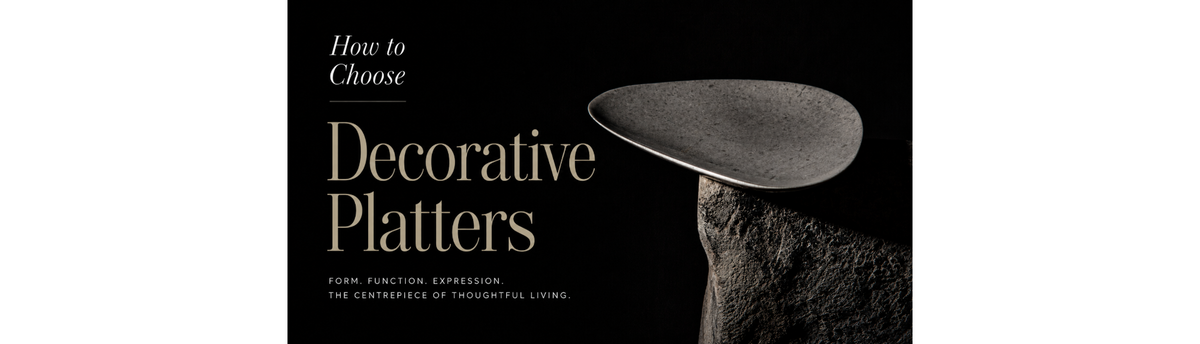

Decorative platters occupy a distinctive position within the world of luxury home decor accessories. They can function as display objects, sculptural forms, centrepieces, serving pieces or visual foundations for smaller accessories, depending on their material, scale, design and intended use.
That versatility is precisely why decorative platters should not be treated as simply larger plates. In a luxury interior, a well-chosen platter can introduce material, shape, colour, craftsmanship and visual weight to a room while helping organise the composition of a console, dining table, coffee table, sideboard, centre table, TV ledge or other architectural surface.
The category itself is broad. Decorative platters may be made from glass, crystal, ceramic, porcelain, wood, metal, stone and combinations of materials. Some are restrained and minimal. Others are sculptural, colourful, highly decorative or deliberately artistic. Some are designed to remain empty because their form is the primary attraction, while others can hold flowers, fruit, candles, potpourri or smaller decorative objects.
For this reason, choosing a luxury decorative platter requires more judgement than simply selecting a shape or colour that looks attractive online. The right piece needs to have a meaningful relationship with the room, the furniture, the available surface, the surrounding accessories and the way the space is actually used.
This is especially relevant when selecting premium home decor accessories, high-end home decor accessories and statement home decor accessories for Indian homes. A platter that works beautifully on a compact apartment console may require a completely different scale from one intended for a large villa dining table or an expansive living room.
Spacio's luxury decorative platters collection brings together designer, modern, sculptural and decorative platters in materials including glass, ceramic, porcelain, wood, crystal and other refined finishes. The collection demonstrates the breadth of the category and the different roles a platter can play within a luxury interior.
A decorative platter should be chosen as an interior object, not simply as a surface to fill. Material, craftsmanship, scale, proportion, function and placement determine whether it becomes a meaningful part of the room or just another accessory.
Table of Contents
- What Is a Decorative Platter?
- What Makes a Decorative Platter a Luxury Home Decor Accessory?
- Decorative Platter vs Serving Platter: What Is the Difference?
- Which Materials Work Best for Luxury Decorative Platters?
- Glass Decorative Platters
- Crystal Decorative Platters
- Ceramic and Porcelain Decorative Platters
- Wooden Decorative Platters
- Metal Decorative Platters
- Stone and Other Natural Materials
- Why Craftsmanship Matters in Luxury Platters
- How Shape and Design Change the Character of a Platter
- How to Choose the Right Scale and Proportion
- When Can a Decorative Platter Become a Statement Piece?
- Should a Luxury Decorative Platter Be Functional?
- Where Should You Display Decorative Platters?
- Decorative Platters on Consoles
- Decorative Platters on Coffee and Centre Tables
- Decorative Platters on Dining Tables
- Decorative Platters on Sideboards
- Decorative Platters on TV Ledges and Media Walls
- Decorative Platters on Shelves and Open Storage
- Can Decorative Platters Be Displayed on Walls?
- How to Use a Decorative Platter as a Centrepiece
- How to Style Decorative Platters with Other Luxury Accessories
- How to Match a Platter with the Material Palette of a Room
- Choosing Decorative Platters for Indian Homes
- How to Buy Luxury Decorative Platters Online in India
- The Spacio Decorative Platter Selection Framework
- Decorative Platter Trends: What Is Changing?
- Why Choose Decorative Platters from Spacio?
- How Decorative Platters Connect with the Wider Luxury Decor Collection
- Frequently Asked Questions About Decorative Platters
- Final Thoughts
What Is a Decorative Platter?
A decorative platter is a broad, usually shallow interior accessory whose primary purpose may be display, decoration, presentation or a combination of decorative and functional use. Unlike an ordinary plate intended primarily for everyday dining, a decorative platter is often selected for its material, silhouette, surface treatment, craftsmanship and ability to contribute to an interior.
Its proportions give it an important advantage over many smaller accessories. A platter has enough surface area to create a visual field within a room. It can therefore hold several objects, become the foundation of a centrepiece or remain almost completely empty so that its own design can be appreciated.
This makes decorative platters particularly useful within luxury interiors where surfaces need to be composed rather than simply occupied. A platter can define an area on a large coffee table, create a centre on a console, introduce an artistic object to a sideboard or provide a controlled foundation for candles and smaller accessories.
The term also covers a considerable range of design approaches. A decorative platter can be minimal and architectural, organic and sculptural, richly patterned, highly reflective, colourful, handmade, geometric or inspired by traditional craft.
There is therefore no single visual definition of a luxury platter. The category is defined more usefully by the relationship between design, material, craftsmanship, scale and purpose.
What Makes a Decorative Platter a Luxury Home Decor Accessory?
A decorative platter becomes a luxury home decor accessory when its design and execution offer more than basic utility or decoration. Material quality, craftsmanship, design originality, proportion, finish and visual presence all contribute to the perception of quality.
However, luxury is not synonymous with visual excess. A quiet platter made from exceptional glass, crystal, ceramic, porcelain or wood can feel considerably more sophisticated than an elaborate piece with excessive ornamentation but little design discipline.
The same principle applies across Spacio's broader luxury home decor accessories collection. Vases, sculptures, bowls, trays, boxes, platters and art objects may have different functions, but they become meaningful within an interior when their material, form and placement are deliberately considered.
A luxury decorative platter should therefore be assessed at two levels. First, ask whether the object itself is worth owning because of its design, material and craftsmanship. Second, ask whether it has a convincing reason to exist within the particular room where it will be placed.
An exceptional platter that is too small for a large console may have less impact than a simpler platter with the correct scale. Similarly, a highly decorative piece may become visually excessive in a room that already contains strong artwork, patterned surfaces and statement furniture.
The strongest decorative platter is not necessarily the most elaborate one. It is the piece whose material, scale, design and visual weight are right for the interior around it.
Decorative Platter vs Serving Platter: What Is the Difference?
The terms decorative platter and serving platter can overlap, but their primary purposes are different. A serving platter is designed primarily for presenting and carrying food. Its dimensions, weight, stability, surface and ease of handling are determined largely by that function.
A decorative platter, by contrast, is selected primarily for its contribution to an interior. It may never be used for food. Its value may come from its sculptural silhouette, unusual material, surface treatment, craftsmanship or ability to create a strong visual composition.
Some luxury platters can perform both roles successfully. This versatility can be useful in a home where the same object needs to move between everyday display and entertaining. But the distinction remains important when buying because a piece intended purely for display can be designed much more freely than one that needs to withstand repeated serving and cleaning.
Before purchasing, decide which role matters most. If the platter will primarily remain on a console or coffee table, prioritise design, material and visual presence. If it will regularly be used for entertaining, also consider durability, stability, maintenance and whether the finish is appropriate for that use.
Which Materials Work Best for Luxury Decorative Platters?
Material is one of the most important ways to distinguish one decorative platter from another. The same shape can communicate completely different qualities when produced in crystal, glass, ceramic, porcelain, wood or metal.
Material also determines how a platter interacts with light. Transparent glass and crystal can transmit and reflect light. Polished metal can create highlights. Ceramic and porcelain can offer depth through glazing and surface treatment. Wood introduces warmth and grain. Stone brings weight and natural variation.
There is no universally best material. The better question is: what material gives the room something it currently needs?
Glass Decorative Platters
Glass is one of the most versatile materials for decorative platters because it can introduce colour, transparency, reflection and light without necessarily adding visual heaviness.
Clear glass can work as a quieter layer within a material-rich interior. Coloured glass can become much more expressive, particularly when natural or artificial light passes through the surface. Textured or sculptural glass can create additional visual interest through distortion, transparency and changing reflections. Glass platters are particularly effective on darker furniture, marble surfaces and contemporary consoles because their transparency can prevent the arrangement from becoming visually dense.
They can also work beautifully with other glass accessories. However, when several transparent or reflective objects are used together, editing becomes important. Too many reflective surfaces can create visual noise rather than sophistication. A glass platter is often strongest when part of its surface remains visible. Covering a beautifully worked glass surface completely with candles, books or decorative objects defeats one of the primary reasons for choosing the material in the first place.
Crystal Decorative Platters
Crystal occupies a particularly important position within luxury decorative accessories because of its luminosity, weight, clarity and ability to interact with light. A well-made crystal platter can function almost like a piece of decorative art. Its appeal may come from the purity of the material, precision of cutting, faceting, thickness, silhouette or the way light travels through the piece.
This makes crystal especially effective in formal living rooms, dining areas, entrance consoles and other spaces where the accessory is expected to communicate refinement.
Crystal also has strong potential as a statement accessory. Because the material itself can command attention, a crystal platter does not necessarily require a complicated arrangement around it. In many cases, leaving it partially or entirely visible produces a stronger result. When selecting crystal, look beyond the label. Consider clarity, weight, detailing, cut, finish, edges and the overall quality of the object. These details become increasingly noticeable when the platter is placed in a prominent location.
Ceramic and Porcelain Decorative Platters
Ceramic and porcelain offer some of the greatest freedom in terms of colour, texture, surface treatment and form. They can be restrained and monochromatic or expressive and artistic. Porcelain can create a refined, lighter visual quality, while ceramic can range from highly polished surfaces to tactile, artisanal finishes. Glazing can introduce depth, subtle variation and colour movement across the surface.
These materials are particularly useful when an interior needs more surface texture rather than more reflection. A ceramic platter can soften an arrangement dominated by glass, polished stone and metal.
Shape becomes especially important with ceramic and porcelain because the material allows designers and makers to explore organic forms, irregular edges, relief work, sculptural profiles and other distinctive silhouettes. A beautifully made ceramic or porcelain platter can therefore function as an artistic object rather than simply a decorative container.
Wooden Decorative Platters
Wood introduces warmth and natural texture into a category that can otherwise become dominated by reflective and polished materials. The character of a wooden platter depends heavily on the type of wood, grain, tone, carving, finish and silhouette. A quiet natural finish can provide a neutral foundation, while highly figured grain or sculptural carving can make the platter itself a focal object.
Wooden platters are particularly useful in contemporary Indian interiors where stone, timber, upholstery and metal may already be present in the architecture and furniture. The right wooden piece can connect these materials without requiring exact colour matching.
They can also bring a softer quality to formal interiors. When paired with crystal, glass or metal accessories, wood creates contrast and prevents the composition from feeling excessively hard or reflective.
Metal Decorative Platters
Metal gives decorative platters a more defined architectural presence. Depending on the material and finish, a metal platter can feel warm, contemporary, sculptural, industrial or highly refined.
Brass and bronze tones can introduce warmth and work particularly well with timber, neutral upholstery, marble and darker finishes. Silver-toned and polished surfaces can introduce sharper reflection and a more contemporary character. Metal platters can also be particularly effective when the interior already contains metal detailing in lighting, furniture, handles or architectural elements. Repeating a finish in controlled quantities can create cohesion without making the room appear overly coordinated.
Because metal can have considerable visual weight, scale should be assessed carefully. A large dark or highly reflective metal platter may dominate a composition much more strongly than a similarly sized piece in pale ceramic or transparent glass.
Stone and Other Natural Materials
Natural stone introduces weight, texture and variation. Marble and other stone surfaces can create a strong connection with architectural materials already present in luxury homes. Natural variation is part of the appeal. Veining, tonal changes and surface character can make each piece visually distinct.
Stone platters can work particularly well on timber, lacquered furniture and upholstered surfaces because the contrast between natural mineral material and softer surrounding materials creates depth.
At the same time, stone can be visually dominant. If the platter has strong veining or substantial thickness, it may already contain enough visual information to function as the centre of the arrangement. Additional objects should therefore be selected with restraint.
Why Craftsmanship Matters in Luxury Platters
Craftsmanship is one of the clearest distinctions between an ordinary decorative accessory and a genuinely considered luxury object. On a platter, craftsmanship can be visible in the precision of the edge, consistency of the surface, quality of the finish, symmetry or intentional asymmetry, detailing, glazing, cutting, carving, joining and overall execution.
Because platters are often viewed from above as well as from the sides, the surface deserves particular attention. A design that looks convincing from one angle should continue to feel resolved when the platter is viewed from different positions in the room.
This is especially important when a platter is displayed on a centre table or dining table where people naturally view it from several directions. Craftsmanship also contributes to longevity. A well-resolved object is less dependent on a particular interior trend because its appeal comes from its construction and design rather than from novelty alone.
A luxury decorative platter should reward closer inspection. Its quality should remain evident in the material, surface, edges, proportions and details even after the first visual impression has passed.
How Shape and Design Change the Character of a Platter
Shape is one of the fastest ways to change the role of a decorative platter within an interior. Round platters tend to create softer visual movement and can work particularly well on rectangular furniture where their curves provide contrast. Rectangular and square forms can reinforce the geometry of architectural spaces and furniture. Organic shapes can introduce a more relaxed or sculptural quality.
Irregular forms can be particularly effective when the room already contains strong architectural lines. They interrupt repetition and introduce visual movement without requiring additional colour. Depth also matters. A very shallow platter may read almost like a surface or artwork. A deeper form may have greater functional capability while creating a stronger three-dimensional presence.
The edge profile is another important detail. A raised edge, sculpted rim, irregular contour or sharply defined boundary can change how the object catches light and how it interacts with objects placed within it.
How to Choose the Right Scale and Proportion
Scale is one of the most important considerations when buying decorative platters for a luxury home. A platter may look substantial in a product photograph and then appear surprisingly small once placed on a large console or dining table. Start with the furniture. Measure the surface where the platter is intended to go and consider how much of that surface should remain visible.
A large dining table can usually accommodate a more substantial centrepiece. A narrow console requires more restraint. A compact centre table may need a platter with enough presence to relate to the table without preventing people from using it.
Scale should also be judged against the surrounding objects. If a console already has a tall sculpture, a large platter may create too much visual competition. If the console is otherwise quiet, a larger sculptural platter may become the anchor that the composition needs. Do not judge size only by diameter or width. Visual weight matters as well. A thick crystal platter, dark stone platter or substantial metal platter may appear much heavier than a transparent glass or pale ceramic piece of similar dimensions.
I would never choose a platter by looking at the platter alone. I look at the furniture first, then the surface, then the objects that will sit around it. The platter should have enough presence to belong to the composition without taking over a space that already has a stronger focal point.
When Can a Decorative Platter Become a Statement Piece?
A decorative platter can become a statement home decor accessory when its design, material, scale or craftsmanship gives it enough visual presence to play a leading role in the composition. Statement does not necessarily mean oversized. A smaller platter with exceptional crystal work, a distinctive sculptural shape, unusual ceramic treatment or striking colour can command more attention than a much larger but generic object.
The strongest statement platters are often displayed with restraint. If the platter itself is visually complex, placing several other highly decorative objects on top can obscure the very qualities that made it worth choosing. In some cases, the platter should remain almost empty. Its surface becomes the artwork. In others, one carefully selected object can establish a relationship between the platter and the rest of the room.
This is particularly relevant to the concept of exclusive centrepieces. A platter can itself become the centrepiece, or it can provide the foundation for a composed arrangement of objects.
Should a Luxury Decorative Platter Be Functional?
Function is useful, but it should not be allowed to define the entire category.
Some luxury decorative platters are best understood as display objects. Their value lies in their design, craftsmanship and visual presence. Others can hold fruit, flowers, candles, potpourri or smaller accessories. Some may also be suitable for food presentation. The correct choice depends on the intended environment.
For a dining table that is regularly used for entertaining, versatility may be important. For a console in a formal entrance, visual impact may matter more. For a coffee table, the platter may need to combine display with practical organisation. When buying online, always establish what the piece is designed for rather than assuming that every decorative platter should be used as a serving piece.
Where Should You Display Decorative Platters?
Decorative platters can be used across many areas of a luxury home because their horizontal format works naturally with furniture and architectural surfaces. The most appropriate placement depends on the size, shape, material and role of the platter.
Decorative Platters on Consoles
A console is one of the strongest environments for a decorative platter. The long horizontal surface creates an opportunity to establish a controlled composition using one platter alongside a vase, sculpture, lamp, books or other decorative objects. A platter can also help visually connect smaller objects by creating a defined area within the larger surface.
For a broader approach to console styling, see Spacio's guide to styling consoles, coffee tables and shelves with luxury home decor accessories.
When the console is positioned beneath artwork or a decorative mirror, the platter should support the visual hierarchy rather than compete with the wall feature.
Decorative Platters on Coffee and Centre Tables
A coffee or centre table is an especially useful location because the platter can act as a compositional anchor. A low platter can hold candles, a small sculpture, books or another decorative object without creating excessive height. A more sculptural platter can become the principal object on the table.
Spacio's centre table collection demonstrates why scale needs to be considered together with furniture. The same platter can have a completely different visual effect depending on whether it is placed on a compact occasional table or a large architectural centre table.
Keep everyday use in mind. The composition should leave sufficient room for drinks, books and normal movement around the table.
Decorative Platters on Dining Tables
Dining tables provide some of the strongest opportunities for decorative platters because the platter can become the foundation of a centrepiece. A large platter can gather candles, flowers, a low bowl, decorative objects or other centrepiece elements into one defined arrangement. It can also provide visual continuity when the dining table is long and requires a composition with enough horizontal presence.
However, a dining table must remain functional. The centrepiece should not obstruct conversation or make serving and place-setting difficult. The best dining compositions therefore balance visual impact with practical use. A platter can establish the centre without consuming the entire table.
For the wider furniture context, explore Spacio's dining table collection.
Decorative Platters on Sideboards
Dining sideboards provide more visual width and are therefore particularly suitable for larger decorative platters. A platter can become the low horizontal element within a composition that also includes a taller vase, sculpture or artwork. This creates variation in height while allowing the sideboard to remain visually balanced.
In a dining room, the platter can also establish continuity between the dining table and the sideboard. The two surfaces do not need identical arrangements, but they can share a material, colour or design relationship.
Decorative Platters on TV Ledges and Media Walls
TV ledges and media walls often contain long horizontal surfaces that can become visually repetitive without carefully selected accessories. A decorative platter can break this horizontal line by introducing a distinctive form, texture or reflective surface. The choice should remain restrained because the television is already a strong visual element.
A platter with a quiet material and low profile may work better than an extremely colourful or highly sculptural piece when the screen itself is the dominant focal point.
Decorative Platters on Shelves and Open Storage
Platters can also work on larger shelves, open cabinetry and built-in storage when the dimensions allow them to be displayed without appearing squeezed into the space. They can introduce a horizontal form among books, sculptures, vases and vertical objects. This is particularly useful when a shelving composition contains too many upright forms.
The platter may be displayed vertically against the rear of a shelf or horizontally as a low platform, depending on its construction and intended use.
For a broader approach to combining decorative objects with books, see How to Style Bookshelves with Luxury Artefacts, Sculptures & Decor Accessories.
Can Decorative Platters Be Displayed on Walls?
Some decorative platters can be displayed vertically as wall objects, provided their construction and mounting method are appropriate for wall installation. This can transform a platter from a horizontal accessory into a form of decorative wall art. A collection of related platters can also create a larger composition, although this approach requires considerably more planning than simply arranging objects on a table.
Consider the wall dimensions, spacing, repetition, scale and relationship with nearby artwork or architectural features. A single large platter may be more effective than several smaller pieces when the wall already has strong visual elements.
How to Use a Decorative Platter as a Centrepiece
A platter can provide one of the most useful foundations for a centrepiece because it creates a defined boundary around the composition. Begin by deciding whether the platter itself is the hero or whether it is supporting another object. If the platter has a strong sculptural character, keep the objects placed on it minimal. If the platter is visually quieter, it can support a stronger vase, sculpture or floral arrangement.
Height variation is important. Combine a dominant object with lower elements rather than placing several objects of identical height together. Material relationships matter as well. A crystal platter with glass objects can create luminosity and continuity, while a wooden platter with ceramic and stone accessories can produce a warmer, more tactile composition.
The centrepiece should also be considered from all normal viewing directions, particularly on a dining table.
How to Style Decorative Platters with Other Luxury Accessories
A decorative platter becomes more useful when it is understood as part of a larger accessory system rather than an isolated object. It can work with decorative vases, decorative bowls, sculptures, books, scented candles, decorative boxes and other objects.
Decorative platters can also become useful in entertaining environments such as a home bar or den, where they can organise smaller objects or contribute to a broader composition alongside barware and decorative accessories. For a more detailed approach to combining these elements, read Spacio's guide to styling a bar and den with luxury home decor accessories. The guide explores how trays, sculptures, books, vases, bowls, centrepieces and decorative objects can be brought together with functional elements to create a sophisticated and usable entertaining environment.
The key is to give each object a role.
A vase can provide height. A bowl can create a low curved form. A sculpture can become the focal object. Books can provide horizontal layers. Candles can introduce atmosphere. A decorative box can add function. The platter can organise these elements into one composition.
This relationship is central to the broader principle established in Spacio's complete guide to luxury home decor accessories for modern Indian homes. Accessories should not be selected simply because they are individually attractive. Their relationship with the room and with one another determines how successfully they contribute to the interior.
Decorative Platters with Sculptures
A platter can provide a stable visual foundation for a small sculpture or art object, particularly on a large console or centre table. However, the sculpture should remain visually distinct. If the platter has a strong pattern or colour, the sculpture may need a quieter finish. Conversely, a neutral platter can provide the background for a more expressive sculptural object.
Decorative Platters with Vases
A low platter and a tall vase create an effective contrast in height. This combination works particularly well on consoles and sideboards. The vase does not need to sit directly inside the platter. It can sit beside it, allowing the platter to remain visible and create a wider relationship between the two objects.
Decorative Platters with Bowls
Combining two shallow forms can work when their materials, proportions and visual weight are sufficiently different. A large platter can provide the base while a smaller bowl creates the focal point. For example, a reflective platter can be paired with a matte ceramic bowl, or a warm wooden platter can provide contrast against a polished glass bowl.
Decorative Platters with Candles
A platter can gather candleholders, candle stands and candles into a controlled arrangement. This can be particularly effective on dining tables, consoles and sideboards. When the platter is placed near a fireplace, candlelight can contribute to the broader atmospheric layer of the room. The fireplace should remain the principal focal point rather than allowing the accessory arrangement to compete with it.
Decorative Platters with Coffee Table Books
Books can create a strong horizontal relationship with a platter. A small stack of luxury coffee table books can sit beside a low platter or, where the dimensions allow, beneath a decorative object placed within the platter. The combination creates multiple visual levels while maintaining a relatively low profile.
How to Match a Platter with the Material Palette of a Room
Matching does not mean choosing identical materials. In fact, exact matching can sometimes make an interior feel overly coordinated. A better approach is to decide whether the platter should blend, connect or contrast.
Blend
A platter can blend when it remains within the existing material and colour language. This is useful when the room already contains strong focal elements and the platter needs to support rather than compete.
Connect
A platter can connect when it repeats a material, finish or colour that appears elsewhere in the room. A bronze platter can echo bronze lighting details. A wooden platter can connect with timber furniture. A crystal platter can relate to glass or reflective architectural elements.
Contrast
Contrast is useful when the room needs visual differentiation. A warm wooden platter can interrupt a cool stone surface. A reflective metal platter can introduce light against dark furniture. A colourful ceramic platter can bring energy into a restrained neutral interior.
The strongest interiors usually contain a combination of these relationships rather than relying entirely on matching.
Choosing Decorative Platters for Indian Homes
Indian homes vary enormously in scale, architecture and interior language. A luxury apartment in Mumbai may require a very different approach from a large villa, farmhouse, penthouse or traditional residence.
Scale is therefore particularly important. Large Indian living rooms and dining areas can often accommodate substantial decorative platters, while compact urban homes may benefit from smaller pieces with stronger design presence. Natural light is another consideration. Glass and crystal can respond dramatically to strong daylight, while polished metal may create reflections that change throughout the day. Matte ceramic, porcelain and wood can provide a quieter visual response.
Indian interiors also frequently combine several material traditions. Marble, timber, brass, stone, textiles, lacquered finishes and handcrafted objects can coexist within the same room. A decorative platter can therefore become a useful bridge between different materials rather than being selected as a completely isolated object.
For homeowners and designers buying luxury decorative platters in India, the important question is not whether the piece looks luxurious in isolation. It is whether the material, scale and design make sense in the architecture and lifestyle of the home.
How to Buy Luxury Decorative Platters Online in India
Buying a decorative platter online requires more attention to dimensions and material than buying a small accessory where scale is less critical. Begin by measuring the surface where the platter is intended to go. Compare the product dimensions with the furniture rather than relying on the product photograph.
Next, understand the material. Look for clear information about whether the piece is glass, crystal, ceramic, porcelain, wood, metal, stone or a combination. Material names alone are not enough; the finish and craftsmanship also affect the character of the piece.
Look at the platter from multiple photographs where possible. A side profile can reveal thickness and depth that are not obvious from a top-down photograph. Consider whether the piece is intended for display, functional use or both. If it will be handled regularly, durability and maintenance become more important.
Finally, consider whether the platter can move with your interior. A strong object that can work on a console today, a dining table tomorrow and a sideboard later offers greater long-term value than an accessory that works in only one highly specific arrangement.
For broader guidance on evaluating quality, material and scale when purchasing luxury decor online in India, see How to Buy Luxury Home Decor Online in India: A Guide to Quality, Materials & Scale.
The Spacio Decorative Platter Selection Framework
When selecting a decorative platter, the following framework helps move the decision beyond simply asking whether the object looks attractive.
- Room: Where will the platter live?
- Surface: What are the actual dimensions of the furniture?
- Role: Is the platter decorative, functional, a centrepiece or a combination?
- Scale: Does it have enough visual presence for the furniture?
- Proportion: Does its shape relate naturally to the architecture and furniture?
- Material: Does it introduce warmth, reflection, texture or contrast?
- Craftsmanship: Does the quality remain convincing when examined closely?
- Composition: What objects will surround or sit within it?
- Longevity: Will it remain useful if the room changes?
- Reason to Own: Is there something distinctive about the object that makes it worth keeping?
This framework is particularly useful when buying online because it forces the selection process to begin with the interior rather than the product photograph.
Decorative Platter Trends: What Is Changing?
Decorative platters are increasingly being treated as design objects rather than purely functional serving pieces. This is reflected in the growing emphasis on sculptural silhouettes, unusual materials, artistic surfaces and pieces that can be displayed independently.
Another visible direction is greater material diversity. Glass, crystal, ceramic, porcelain, wood and metal can all occupy the same category, allowing homeowners and designers to choose according to the character of the room rather than following a single definition of what a decorative platter should look like.
Another important shift is the movement towards multifunctional accessories. A platter can be a centrepiece when empty, a foundation for decorative objects when styled and a practical serving piece when entertaining. For younger homeowners in particular, sculptural and design-led accessories can provide a way to introduce personality without committing to large-scale artwork or permanent architectural changes.
However, trend awareness should not replace judgement. The most valuable decorative platters are likely to remain relevant because of their material, craftsmanship and design rather than simply because they belong to a particular seasonal trend.
Why Choose Decorative Platters from Spacio?
Spacio positions decorative platters within the broader category of luxury home decor accessories, rather than treating them as a narrow serving category.
The Spacio decorative platters collection brings together designer, modern, sculptural and decorative pieces intended for different interior applications and material preferences.
The breadth of the collection matters because there is no single correct platter for a luxury home. A designer may need a large sculptural piece for a substantial console, a homeowner may want a refined crystal platter for a dining room, while another interior may require a warm wooden or ceramic form to balance a stone-heavy palette.
Spacio's approach allows decorative platters to be considered alongside the wider range of accessories required to build a complete interior composition.
This broader category relationship is important: Spacio → luxury home decor accessories → decorative platters → premium and high-end decorative platters in India.
For customers looking beyond one category, platters can be considered alongside sculptures and art objects, crystal sculptures, glass sculptures, mixed-media sculptures and other statement objects.
How Decorative Platters Connect with the Wider Luxury Decor Collection
Decorative platters become more useful when they are understood as one part of a larger accessory ecosystem.
A platter may provide the foundation. A sculpture can provide the focal point. A vase can introduce height. A bowl can provide a softer low form. A decorative box can provide discreet function. Candles can add atmosphere. Books can create horizontal layers.
This is why Spacio's wider collection includes categories such as decorative trays, decorative bowls, decorative boxes, vases and candle stands.
The categories are not interchangeable. Each performs a different role. But they can be combined within the same interior to create a more complete and considered composition.
Luxury home decor accessories are not a collection of unrelated products. Vases, sculptures, bowls, trays, boxes, platters, candle holders and other decorative objects work together through scale, material, proportion, function and visual hierarchy. Decorative platters are one important part of that larger luxury accessory vocabulary.
Frequently Asked Questions About Decorative Platters
What is a decorative platter?
A decorative platter is a usually shallow interior accessory selected primarily for display, decoration, presentation or a combination of decorative and functional purposes. Unlike an ordinary dining plate, its design, material, craftsmanship, scale and visual presence are often important reasons for choosing it.
What makes a decorative platter luxurious?
A luxury decorative platter is typically distinguished by the quality of its material, design, craftsmanship, finish, proportions and overall execution. Its relationship with the interior is equally important. A well-made platter with the right scale and placement can contribute more to a luxury composition than a more expensive object that is poorly proportioned for the space.
What are the best materials for luxury decorative platters?
Glass, crystal, ceramic, porcelain, wood, metal and stone can all work exceptionally well. The right material depends on the interior and the visual role the platter needs to perform. Glass and crystal can introduce light and reflection, ceramic and porcelain can provide texture and colour, wood can add warmth, while metal and stone can create stronger visual weight.
Are decorative platters only for dining tables?
No. Decorative platters can be displayed on consoles, coffee and centre tables, sideboards, TV ledges, shelves and other suitable surfaces. They can also be used as centrepieces or, where the construction allows, displayed vertically as wall objects.
Can a decorative platter be used as a centrepiece?
Yes. A platter can provide the foundation for a dining table or coffee table centrepiece. It can hold candles, flowers, a smaller bowl or carefully selected decorative objects. In some cases, the platter itself can be the centrepiece and should be displayed largely uncovered so its design remains visible.
How do I choose the right size decorative platter?
Begin with the furniture surface rather than the platter. Measure the available space and consider the surrounding objects. The platter should have enough visual weight to relate to the furniture without occupying so much of the surface that the composition becomes crowded or impractical.
Can a decorative platter be a statement home decor accessory?
Yes. A platter can become a statement piece through exceptional material, unusual form, strong colour, sculptural design, craftsmanship or substantial scale. A statement platter often works best with fewer surrounding objects so that its design remains visible.
What is the difference between a decorative platter and a decorative tray?
A decorative tray is generally more strongly associated with organising or containing objects and may have handles or a more defined raised edge. A decorative platter is often flatter and may place greater emphasis on display, sculptural form and visual presentation. There is overlap between the two categories, and some pieces can perform both roles.
Can decorative platters be used with sculptures and vases?
Yes. A platter can provide a horizontal foundation for a sculpture, vase or smaller accessory composition. The important consideration is to maintain hierarchy so that the objects do not compete equally for attention.
Are crystal decorative platters suitable for modern Indian homes?
Yes. Crystal can work particularly well in modern Indian homes because it can introduce luminosity, reflection and visual refinement without necessarily adding strong colour. Its scale and placement should be considered carefully, particularly in rooms with strong natural light or other reflective surfaces.
Where can I buy luxury decorative platters in India?
Spacio offers a dedicated luxury decorative platters collection in India, with designer, modern, sculptural and decorative pieces across a range of materials and styles.
Can decorative platters be used in luxury interior styling?
Yes. Decorative platters are particularly useful in luxury interior styling because they can establish a visual foundation for other objects, introduce material contrast and create a defined composition on large furniture surfaces. Their effectiveness depends on scale, proportion, material, placement and editing.
Where can I see luxury decorative platters in Mumbai?
If you would like to experience luxury decorative platters in person, visit the Spacio Mumbai showroom at 3BK, Laxmi Industrial Estate, New Link Road, Andheri (W), Mumbai - 400 053, opposite Audio Lab. The showroom brings together decor accessories, decorative lighting and fireplace products, making it possible to explore decorative platters and other statement home decor accessories in a physical setting. View the Spacio Mumbai showroom on Google Maps or visit the Mumbai store page.
Where can I explore luxury decorative platters in Kolkata?
For those looking to experience luxury decorative platters in person, the Spacio Kolkata showroom at 86B, Topsia Road South, Kolkata - 700 046 brings together furniture, decor accessories and lighting for luxury residential and commercial interiors. Visiting the showroom allows you to consider decorative platters alongside other interior elements and assess their scale, material, finish and styling potential in person. View the Spacio Kolkata showroom on Google Maps or visit the Kolkata store page.
Final Thoughts
Decorative platters deserve to be considered as a distinct category of luxury home decor accessories rather than as oversized plates or secondary serving pieces.
The category encompasses an unusually wide range of materials, forms and design approaches. Crystal can create luminosity and refinement. Glass can introduce transparency and colour. Ceramic and porcelain can bring artistic surface treatment and texture. Wood can provide warmth. Metal can add architectural definition. Stone can contribute natural variation and visual weight.
But material alone does not make a platter successful.
The real decision comes from understanding the relationship between the platter and the interior. Its scale should relate to the furniture. Its proportions should work with the architecture. Its material should either blend, connect or deliberately contrast with the room. Its craftsmanship should justify its presence. Its function should match the way the home is actually used.
And when the platter is exceptional enough to become a statement object, the styling around it should become more restrained, not more elaborate. This is the distinction between simply buying a decorative accessory and building a collection of luxury home decor accessories with intention.
For homeowners, collectors, interior designers and stylists in India, the decorative platter can therefore serve many roles: an exclusive centrepiece, a sculptural object, a foundation for accessories, a practical entertaining piece or simply a beautifully made object that deserves to be seen.
Explore Spacio's luxury decorative platters collection and consider it alongside the wider luxury home decor accessories collection to build compositions based on material, scale, craftsmanship, function and the character of your interior.


